AMA With Ron Gentile: Most Common Founder Mistakes To Avoid
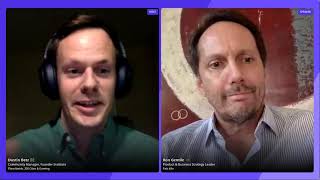
Ron Gentile, a venture partner and product strategy expert, outlines the most common founder mistakes: building before customer discovery, undervaluing non-technical functions, and misaligning with investors whose risk tolerance doesn't match your vision. He covers raising seed capital without revenue, how leadership changes as you scale from $10M to $100M, and why not all capital is equal.
Chapters
Welcome everybody to our first Founder Institute VIP networking summit for November. Yeah, we're now running these private networking events regularly twice per month. These are closed to the public, they're just for meeting others from across the FI Global network, whether you are an alumni, a currently enrolled founder, or one of our mentors or directors who might be joining us tonight. If you joined early, you might have already been networking in the Airmeet lounge, which is what we'll be doing for most of today. So let's just get right to to our kickoff event. My name is Dustin Betts. I'm an FI community manager calling in today from Pennsylvania, USA on the East Coast. And FI is a very global network though, and so we're expecting founders to join today from all across the world. So yeah, please introduce yourself in the chat. Let us know your name, your company name, what you're working on, where you're joining from, city or country. And yeah, we're excited to have you joining us. So this is the agenda for tonight. As I mentioned, each VIP networking summit kicks off with a brief talk and AMA with one of our featured global mentors. And today we're pleased to be joined by product strategy expert, Ron Gentile. He's gonna give a brief talk on common founder mistakes and how to avoid them and then answer your questions. So then for part 2, we will move to our open networking portion. We have an optional worksheet on virtual networking best practices that you can download bit.ly/vip-networking. We'll drop that link in the chat. But there's a randomly one-to-one speed networking option you can choose, or you can join one of the group video chat tables organized around different topics to connect with somebody that way. Yeah, so really brief housekeeping note at the top just about using Airmeet. It's a great networking platform, but it works best if you're joining from a desktop or laptop on either Chrome or Firefox, so not Safari. And if you're joining on a mobile device like an iPhone or an iPad, yeah, it's best to use the Airmeet mobile application, because even if you're watching on a mobile-based browser and can hear me speaking to you right now, some of those networking features won't work on mobile unless you're using their application. So again, I want to remind just really quickly, like, our guest is here to answer your questions, so please do not be shy. I have a producer in the background, Elijah, who is helping me, you know, curate your questions and bubble them up. So whatever's on your mind, yeah, don't be shy. Please put them in the chat. Ask. Okay, so I'm thrilled to introduce Ron Gentile, an entrepreneur. He's a startup operator and a product strategy expert. As I mentioned, he's held leadership positions across a variety of sectors, currently the CEO of MoodFit. Ron has created from concept to commercialization multiple top-ranked products, and he's been a high-impact member of management teams as well in successfully raising venture capital. He has expertise leading product organizations, began his career at Adobe helping build some of their flagship products, and then continued into consumer-facing digital health as well as wellness products and content applications. Ron's also a longtime player in the startup ecosystem. He's participated in thousands of deal screenings as well as sourcing diligence, formal advising, and startup mentoring. So without further ado, welcome, Ron.
Thanks, Dustin. Happy to be here.
Yeah, so I'm going to turn my camera off and kind of turn it over to you, and we'll be kind of watching the questions that come up. And then, yeah, as soon as you're done with your talk portion, I'll turn my camera back on and we'll bring some of those questions to your attention to ask.
Okay, sounds great. Hi everybody, um, great to be with you today. Um, I thought what I'd do is just talk a little bit about some of the most common founder mistakes I see, um, at various times I've been involved in VC and currently I'm a venture partner at a, a large fund out of Europe. And having sat in lots of screenings, having helped lots of founders along the way, there are definitely some patterns I see time and time again. And they're the kind of things where not only are they so common, but they're also very, I think, frustrating to, of course, founders because they waste a lot of time and money and they reduce their chances for success. So these are the kind of things I think that it's very helpful for everybody to know about and keep in mind at the onset of a venture. So in no particular order, let me give you a handful of these and then we can interact and take questions and talking about it. One of the first is building things too soon. That is actually building things before one has done sufficient customer discovery and really understands what is the pain point of the customer, what are the features that really matter most to the customer, and really understand that well, as well as understanding related things like, all right, how are we going to reach the customer? So there's not sufficient planning and evaluation of that plan prior to building. And it makes sense because often founders, first-time founders come from engineering product background, etc. So the comfort spot there is to just build. The problem, of course, is you may and often are building the wrong thing or building the wrong functionality, etc. So it's more thinking, more planning, more critiquing prior to building. So message one. Another would be undervaluing other functional areas. So a startup is just like, you know, any company. It has everything from the tech and product and design and marketing and and content and business development. And all these things are really integral to a company. So often what happens is founders, especially if they come from engineering, they think of these other things as sort of, yeah, well, that's nice, great, maybe we'll do that. Maybe we'll get somebody, a junior person to work on that. All those things are going to ultimately be just as important. As having good engineering. Another one would, and I throw this in the category of mindset, which is it's very hard at the start of a venture, especially if you're, you know, if you're, say you're, you know, in your 20s, your 30s, you know, you have some amount of work experience, although not a ton. Maybe you haven't run a company, maybe you haven't run an organization, etc., you've seen some snapshot of how a company works at a certain level. And then, so you don't know sort of what you don't know. And similarly, if someone has had a long career in corporate, but now they're doing a startup, there's a lot of things you learned in corporate, but that you don't know about startup. So the sort of mindset idea here is that, you know, it's hard to understand going into startups that it's an entirely different land. It's an entirely different process than whatever you're used to. And you have to come in with a very open mind to say, hey, Look, I don't know 99% of what I'm gonna need to know to do this and what I'm gonna need to know to succeed. And I'm coming in with an open mindset that I can learn those things and will be able to execute and do those, but that I don't know everything coming in. This is very important because, one, it can help avoid execution mistakes because you're more likely to adapt and change more quickly. And secondly, it's also a big turn-off for investors when they're trying to invest in or work with a founder where they feel like, oh my God, the founder thinks they know everything about this and we're very early stage, and the truth is they only know this much. So it's, you know, it's very hard then for the investors to work with them. So it's important to come in very committed to your ideas, but also very open-minded that you may not know everything, because none of us do when we're starting early on. And even later, we know a lot more, but there's still always more things to learn. So an open mindset is very important. Next one would, I would say it's sort of the listening/not listening to investors. You're going to talk to, if you're trying to raise external capital, you're going to be talking to a lot of investors over time. They may be angels, they may be VCs, different check sizes, all kinds of things. And it's going to be very hard to figure out who to listen to, who to believe. And you've got to realize everybody comes in with their own experiences, their own biases, their own motivations, etc. And you're going to hear different theories, different ideas about certain things. So somebody is going to tell you, oh yeah, you should just try to raise a few hundred thousand to get to this milestone first. Somebody else is going to say, "Don't do that. Try to go raise $2 million to get started." You're going to hear very different opinions. So, it's important to listen. It's important to take in and be appreciative of all that information that's provided to you. It doesn't mean you have to follow every piece of information. But when you start to hear patterns of people telling you the same thing, then you realize that's something that, oh, I don't get that, but I need to. If you try to follow every piece of information, you'll ping pong all around and you won't make progress. Another one would be that all money isn't the same. We often think early on when we're trying to raise, trying to start a company, trying to raise a first round of funding or even a second round, We think, oh my God, I just need the money. I don't really care. It could be in a brown paper bag behind the house and I could just stumble on it one day. I just need the money. And the truth is money comes in a lot of different forms from a lot of different people. And what you need to do is to find money/investors who are on the same page with you about the kind of company you want to build, about how long it will take for you to achieve certain milestones, all those kinds of things. Don't sort of go with a don't ask, don't tell policy of, oh yeah, they're saying a bunch of things, I don't totally get it, but I just want the money, so I'm just shaking my head. No, talk about the things, talk about your expectations, Talk about their expectations. Be transparent and open about that because, you know, a month after getting the money, if you're not aware of all these differences in expectations, all of a sudden you very quickly will be when someone's starting to really get on you a lot because their expectations were so different. Have those conversations early on. It's very important. And remember, you know, angels, VCs, very different expectations. VCs are going for, you know, huge, big, multi-billion-dollar exits. Angels a lot of times are looking, you know, that take 10 years for VCs. Angels may be looking for things that take 3 years and just give, you know, a smaller or more moderate exit to the business. So understanding what you're after, which best fits your business, which best fits the outcome you want, have those conversations, be willing to do that. Another big thing is, and we're talking about investors, is founders don't understand the process through the lens of the investors. So the investor, of course, is going to be very critical because they're going to provide the capital to help you grow your business, to hire people, to market your business, your product, etc. Um, and the problem is a lot of times founders don't understand, for example, the lens through which an investor looks at and evaluates possible opportunities. Possible startups to get involved in and invest in. So, you know, a lot of times as a founder, we think, oh my God, I'm going to come in and I'm going to tell them I've created the next amazing Facebook replacement or whatever. And I'm going on about how my like button is 3 times bigger or whatever. And the truth is, these things, while interesting, may not be the key things that the investor cares about. And what an investor cares about is going to be different in different sectors. For example, a healthcare investor versus a consumer-facing products investor versus a variety of things. So it's important to try to understand what matters to investors. In general, what they're going to be looking for is to de-risk. They're going to say, okay, where you are today, for you to get to the next interesting milestone where you can now raise perhaps more money from the next bigger round of investors, to get from here to there, what are the key risks? And a lot of times the biggest risk is going to be that the— whether or not the market wants this product. This is why The majority of startups fail, and the numbers are that 6 of 10 startups will just completely fail to zero. And the majority reason is because the market didn't want the product. So investors are always looking for, okay, what validation do you have that the market wants this product? So why a lot of times people will talk about, I'd love to see some traction. I'd love to see what your, you know, revenue rate is, your MRR, monthly recurring revenue. I'd love to see something that tells me that, you know, the old phrase that will the dogs eat the dog food. I want some validation the market will want that. So it's sort of step back and try to look at your business, try to look at the story of what you're pitching, what you're doing operationally through the lens of investor. And then the last thing, and then we can do some Q&A and and just talk here is to also realize that as a startup founder, wherever you are today in terms of your leadership skills, ability, experience, that there's a certain place you're going to need to be to be the leader of, you know, a company that just raised the next round of $10 million or the company that raised $100 million. Each of these is a big step up in what you're going to have to do as a leader. And so now if you've run an organization before or been a CEO, great, you understand a bunch of these things. But if you haven't and you were a staff engineer somewhere, you have to understand that you're going to have to find a way for you to go from where you are operationally and leadership to the kind of things necessary to be able to go and take this company bigger and bigger steps. And this is where there often gets to be tension because investors are like, okay, great, we want to put in $10 million more for the next round, but we want to see a different CEO because we want someone who has more experience doing this kind of thing. So, and it doesn't mean you always have to be the CEO of your company. A lot of it's all about doing what you do best and doing what you enjoy most. But having an awareness that, okay, my experience of leadership, etc., is here. And to get to the next place, I'm going to need to be at this level. And to have that awareness as you're going along, that great, I'm going to have to build up these skills. And having that candid conversation with investors, which is, hey, what is it I need to be learning to do to, to, in the, the company, the skills I need to build to be able to go from where I am to that next level. Investors are eager for you to do it. Having that candid conversation is important. So those are my sort of prepared shortlist about common mistakes I see. Back to you, Dustin.
Yeah, that was, that was fantastic. Thank you, Ron. That was a lot of really good advice that you just ran through. And the first question that I want to pose to you, it's about building a strong professional network, right? Because it's a prerequisite for so many aspects, I feel like, of founder success and growing their companies, you know, whether that's fundraising or the last point that you were talking about, kind of having the cognizance, the awareness of like realizing how they're gonna have to grow as a leader. I think like a strong professional network is a really core aspect to achieving that as well. So do you have advice maybe for first-time founders or for somebody who's not yet that well networked, particularly like in the startup ecosystem or in their niche, or just general approaches to like getting their feet wet into the startup ecosystem, so to speak, or beginning to build that network?
Yeah, absolutely. I mean, there's a ton of events always going on. I mean, there are, you know, and there are great accelerators like FI where you're going to meet a cohort of people. There are lots of events always going on around different topics. They may be topics about tech or go-to-market or, you know, life sciences or all these kinds of things. These are great, great things to get involved in. And, you know, and take the opportunity during those events when you see someone where you say, oh my gosh, that's someone I would like to connect with. It's perfectly fine to, you know, just tell them, hey, I'd like to connect with you. Can, you know, 'We chat for a few minutes,' whatever. It's always best if you have something concrete or specific you want to talk to them about. People respond to that better than just a general, 'Hey, can we chat?' because that feels open-ended and like someone's just going to, you know, you don't know where it's going to go. But having something concrete you can ask for or to connect with or to simply reach out on LinkedIn to be able to say, hey, I saw you were at the such-and-such event last night. I thought it was really great, blah, blah, blah. I would love to connect here. So the other thing I would say about this is have that lens for the kind of people you want to connect with. There's tons of events. And if you feel like, my gosh, I have tons of technical connections, but I need to start being better connected in, you know, regarding go-to-market or things like that, then have some awareness of that and start to seek out events and people in those areas.
Yeah, that definitely makes a lot of sense. And particularly, I think what you said about approaching somebody, you know, as we get back to the in-person events, yeah, kind of having a specific ask when you're doing the business card exchange thing, which is fine. I think people are actually finally excited to, you know, get back to some of that in-person stuff. There's a question here in the chat from Yasir asking about best approaches to validate startup ideas, and I think this kind of goes back to your very first point about building too soon is a mistake that you see. So if you have general advice out there, I guess, say, high-level or strategically, obviously it's different in every case, but for how to validate, I guess, before you build too soon, so to speak.
Yeah, yeah, it's always a great question. It's very dependent on, am I— what am I building? Is this a fintech product or am I curing cancer over here? Validating these are going to be wildly different. Um, a way to look at it that I think is very valuable is to say, look, we're gonna, we're gonna build this thing, and of course a lot of what's in here has been The pieces have been validated by other people before. Okay, I'm making a fintech product. Of course, it's going to have a settings screen. I know that. That's not where the key— one of the key risks. So it's what are the key risks, the key assumptions about this thing that we don't know will people want? And then what's the smallest experiment you can do with people to understand if they would want that key assumption. Sometimes this is a conversation over coffee and a scribbling on a napkin. And then usually what happens is you do a bunch of those, you get more input, you refine your idea, and go to maybe a little bit higher fidelity embodiment of your idea. And show more people again to see if you are on the right track. But the whole time, really focus on what are the things that are most risky or least validated? What are the linchpins that if that piece doesn't work in terms of people wanting it, all this other stuff doesn't matter, then this is the thing to really drill into.
I think this question, the last one that's just dropped here in the chat, for Reem, is interesting. It's asking to, I guess, an example of like the different leadership qualities that you would need as you're scaling up your company? You know, what are the different skills needed, they're asking, between, you know, a $10 million startup versus a $100 million company? And maybe those aren't the right, you know, metrics exactly, but can you give some like examples of how that leadership develops over time?
Yeah, well, I'd say the big difference between a $10 million CEO and a $100 million CEO is about $90 million. Right? But in truth, you know, are we talking about the value of the company? Are we talking about the money, amount of money raised, etc.? As you— in the early stages, it's going to be a lot about the product. Do you have a vision for the product? Are you able to lead a team around figuring out what are the right features? Are you able to start to get the product out in the market? Are you able to start to get initial sales? That might be direct-to-consumer sales, that might be sales coming from B2B2C relationships. It's that very early stage of things. Then the next step is, okay, great, we did that, we got to some initial interesting revenue, you know, small amount, etc., but interesting and starting to be a little bit predictable. Now we raise some more money or some money. And now all of a sudden, it's can I sort of manage against a plan? Can I make a good plan? And can I execute to that plan? Can I communicate well with my investors? Can I communicate well with the team? Can I resist getting, you know, as the company gets bigger, resist getting lost in more and more details and realize what you have to be is a facilitator. And you also have to learn to trust people and hire good people and be willing to turn over responsibility for things to them. This is a hard thing to do when someone's like, I've got an amazing idea. I was central to building the first version. And now all of a sudden we're getting to the next step. We're going from, you know, our— we raised $500K to now we raised a few million dollars or $5 million. All of a sudden you can't be in this low level. And so now you've got to learn to evaluate people, to trust the good people. Sometimes you're gonna have to learn to fire people. And you become more of a facilitator in that way. And then as you get to, you know, you ask the $100 million, etc., which of course is a good problem to have. Now you're getting to the point where what you're doing is it's about being very repeatable about the revenue. Okay, so you're not impulsive, you're being very predictable. You really have a very strong process and you're managing very clearly against next financial milestones. So the more revenue you start to build, the more scrutiny there is going to be about financial milestone after financial milestone. In the early innings, yeah, we know you told us that this year you would make $500,000 and you only made $100K, I'm not actually that worried about it. I'm more interested in, hey, why didn't the customers want it the way we thought, and what changes are we going to make so that they can find it? So it becomes more financial scrutiny later on.
Yeah, yeah, I think, I think that makes a lot of sense. And, uh, yeah, so there's another question. I don't know how much— if you have a hard stop here or not. You can let me know.
I'm okay.
Okay. Well, there's at least one more question, maybe two more that I want to ask. Lulu asked, the way it was phrased is, what makes a tech company a tech company? And it says this might be a silly question, but where's the line drawn? I think another way to think about what they might really be asking here is like, what makes an investable company? Can you talk about that? Yeah, just from your experience of, you know, an investable company versus one that's really just not a fit for outside investment?
Yeah, you know, every company is a tech company, right? Now, some companies may use deeper technology than others, if you know, but every company is using tech in some way. In terms of what Dustin is talking about is, is a company fundable through traditional tech kind of investors, angel investors, venture capitalists, etc. That's a function of, is this a market that is big enough to support a very large exit so that investors can make a big multiple back on their investment? Remember, I said 6 of 10 of your investments will totally fail, and that's if you're a good investor. Right. And so for the ones that succeed, investors are looking for, you know, let's just kind of crudely tell you 50x, okay, of their investment. That's why VCs are looking for, you know, somebody to go public in their portfolio to cover all the losses of the 46 other companies that went out of business. So It's can this thing scale up to be a big, you know, a crude number to use is billion-dollar-plus opportunity for you as a company. And that's why people will talk about what is the size of the market. There are other factors in there like how can you, you know, efficiently distribute to them. You know, if you're making a business where you only make 2% on every sale, well, the margins are very low. There's all this work involved, etc. Tech investors tend to like highly leveraged businesses where, you know, you build this thing and then the margins on it being sold, it can be sold fast, it can be sold perhaps self-service, a variety of things. It— they like more of those leveraged kinds of businesses because they're the ones that without huge costs can result in big outcomes.
Yeah, that makes a lot of sense. And yeah, the simplest part is really about scalability and demonstrating before those other requirements that it has the potential to grow, that it has that total market potential. There's one more question, I think, before I'll turn it over here. This one's from Jeff, and he's asking if it's possible to raise seed capital, $500,000, without any revenue? Is that happening today? And yeah, I kind of had a canned question about this. I mean, there's so much hype, particularly right now, about investors just throwing money at startups. I think it can be very frustrating for founders when they actually go to try to start to raise, realizing, well, it's not actually the case, 99% of the time, that investors are just throwing money kind of willy-nilly around. But yeah, thoughts for Jeff on raising $500,000 pre-revenue? Is that, you know, what kind of traction would you need to see for something like that to be realistic?
So, you know, Matt, I was asked this yesterday at lunchtime. It's very doable, but it's about having a story that accounts for the important risks. Okay. So, you know, there are times where people raise many millions of dollars and haven't even built a line of code or anything. But based— it may be based on their prior experience and knowledge in this space. It may be based on some amazing intellectual property they've come up with, you know, in this space. The more risks there are, the more traction, evidence, etc., investor will want to see before getting involved in and making the investment. So all of this is possible, you know, but yes, it's not the norm where people just shout at someone across the street, hey, I've got an idea for making guitars Do you have $500K? Oh, great. You shoot the check over. That's generally not the norm. And so, you know, again, put on the sort of glasses of the investor and think about for this business, what are the big risks and how can you de-risk them short of having to build everything out, etc.? Sometimes that's research. Sometimes that's based on bringing in certain skills on your team where someone has great domain knowledge in a certain area. So it is, it is certainly possible to raise $500K on a— with, without revenue, um, but think about the risks.
Perfect. All right, one final question. I promise this will be the last one. Uh, Reem's asking, uh, what's the biggest challenge or challenges, uh, that new founders will face when they're She said when they obtain their first VC fund, so I guess, hey, this is more with them. You're now accountable, say, to these investors because you've closed that fund. Are there goals that they should set? I'd say one is definitely send updates to your investors. That's really important. But yeah, it sounds like it's more like— the way the question is phrased, at least, it's when they obtain their first VC funds. Yeah, challenges at that stage.
Yeah, I mean, so all of a sudden now you're going through an entirely different level of accountability. Okay, now there are, you know, there are micro VCs that are doing smaller checks and, and putting them all over the place, and their involvement with the company is going to be less than traditional institutional VC where it starts to become a larger check. There's more accountability, there's more conversation going on with the investors. You know, a big challenge for founders at that point is to sort of shift from doing things in an ad hoc way to doing things now in a more thoughtful, predictable way. And a willingness to be transparent. Okay, I know we think, oh my God, I can't tell the investors this, or I can't tell them that, or I have to gloss this over and tell them all the best of things. But the frank truth is every investor knows there are dead bodies in your company. So investors feel better seeing them up front and knowing you have the willingness to say, oh, you know what, this thing is not working. I'm going to figure out how to fix it. I would love your input about it. And it didn't go according to plan. And I'm going to tell you early in the process. I'm not going to surprise you later at the board meeting. That's a big shift. And it's partially thinking of, I'm shifting from, the investor sort of being, you know, someone I'm courting to now someone who really should be part of my team. And you should use them as part of your team. And that includes being transparent, being honest, soliciting their input, telling them when there's bad news. And the same is true with advisors. You can utilize them, but it's a big shift when you've gone from operating in an ad hoc way previously.
Yeah, and another thing I know I've heard, you know, from others more senior than me in the startup ecosystem is, yeah, that can pay dividends like more long-term. So in terms of like having investors who decide to follow on because they've seen that you have that level of transparency, that you have that openness, that you want to like learn and you utilize them as smart money, so to speak. And yeah, just so— yeah, I think that transparency is some really good advice. Thank you so much for your time, Ron. I super appreciate all the insights that you've dropped on us here this evening. And yeah, I'm going to bring back on screen my presentation here. Oops, the wrong thing. Before we switch to the networking portion. Alrighty. So, yes, thank you so much again, Ron, for your time and the presentation. And yeah, now we're going to switch over to Airmeet. So, I'm just going to really briefly go over these Airmeet housekeeping reminders. Again, if you're on a machine like a desktop or laptop, Chrome or Firefox is the recommended browser. And then, if you're on mobile, we recommend you use the Airmeet mobile app to actually utilize the networking. Yeah, please be respectful of everybody's time in the group networking, be brief with your introductions and take turns speaking and asking questions. Another pro tip is if you meet somebody who you want to connect with further during the networking, make sure you find their name under the attendees tab or send them a direct message, exchange social links, exchange contact information. I've seen this happen before. It's very unfortunate if you feel like you made a good connection and then you lose that connection at the event. So yeah, be sure to exchange social or contact information. And yeah, last slide, just to have fun during the networking portion. Yeah, we're really excited about these events that we're hosting, you know, just for the FI worldwide network, and we hope you'll enjoy this time here to connect with others who are here today. So I will see you out in the lounge in a few minutes, and thanks everybody for being here.










