Charting Your Course from Employee to Founder
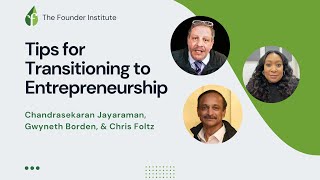
In a live Founder Institute panel hosted by Global Entrepreneur in Residence Chris Folts, two founders—Chandra, an engineer‑turned‑social‑impact entrepreneur from India, and Gwyneth, a former policy professional turned fintech founder—share their journeys from corporate or public‑sector employment to building startups. Chandra describes how personal experiences with water scarcity and heritage temple preservation led him to create WATSAN, a low‑cost, electricity‑free clay‑based water filtration system, and how he leveraged NGOs, grants, and the Founder Institute’s mentorship to iterate the product, add arsenic and fluoride removal modules, and expand into sustainable sanitation. Gwyneth explains her motivation to reform the debt‑collection industry after personal hardship, detailing her decision to buy debt portfolios, build a consumer‑focused fintech platform (Remit) that offers flexible payment plans, and avoid traditional collection tactics. Both discuss the importance of customer discovery, market validation, continuous innovation, and choosing the right funding path—grants, debt buying, or venture capital. The conversation also highlights the role of the Founder Institute in shaping founder mindset, the challenges of scaling technical solutions, and practical advice on perseverance, language barriers, and aligning product design with the target low‑income market.
Chapters
Well, I think we're ready and I think we're live. My name is Chris Folts and I'm coming to you from Founder Institute. We're based in Palo Alto, right in the heart of beautiful, sunny Silicon Valley. Tonight we have an interesting topic. You know, it's Labor Day here in America. It's the holiday where we're celebrating our labor force in America, and I think it's— there's some interesting opportunities to talk about what it's like going from Employee to Entrepreneur. Uh, my name is Chris Foltz and I am one of the Global Entrepreneurs in Residence for Founder Institute. It's a distinct honor to always get these opportunities to have these conversations with, I would say, prolific minds, right? People that have not always done things the traditional way, but have lived to tell the story and have done things to change the world. Um, so tonight we're gonna be talking about people that transition from the employee base doing traditional work into becoming entrepreneurs, starting startups, and making impact from a different perspective. So the first person that we have here with us tonight is coming to us at 5:30 AM in India. Chandra, let's bring him up on stage. Now let me tell you, this guy is fascinating. So here's an engineer that is— and I brought him on stage just because I want to elate, uh, this individual, and hopefully he turns his camera on, because there's not that many people that successfully bridge the gap from engineering to actually doing stuff that requires the innovation necessary for a startup. I gotta tell you, sometimes we call it the scientist problem when it comes down to pitch decks and everything. There's so many ideas, but what this, what, what Chandra has done at Watson is amazing. Uh, when it comes down to filtration, I watched his TEDx, I told him, and I didn't realize how simple some of the problems are, but the complexities to solve them that we don't think about. So he's created a startup that's actually been addressing this for years and making measurable impacts across India. But it's not just the startup. He's got a nonprofit, Rural Education and Conservation for Heritage. Come to find out, along the way, he's helping teach people and educate around some of the dilapidated temples in India. I'm a fan all the way from America. I'm a fan. Chandra, if you take a moment, tell us a little bit about what your startup is. I know you're a graduate of F5. Which program are you in? Um, give us just a little bit of background. I'm sure I'll bring more out during our Q&A tonight. Chandra, you're muted. There you go.
Yeah, hi, happy to meet you, Chris, and the other interested folks from Founder Institute. Uh, in fact, uh, necessity is mother of invention, right? I come from a poor background, and my mother used to say, only education is the only fulcrum which can lift you up. So that was the only mantra. So I was the last child among 5, 3 elder sisters and 1 brother, and money was really a problem, but happiness was always there. So I studied hard. Even though I got engineering, medicine, and many other seats, I could not afford the fee to be paid. So I had to settle down with the nearest college where chemistry was taught. I was— in fact, I scored 100% in chemistry because I love material science. I love the way things work. So I had to cycle down 6-7 kilometers down to reach my college, and I am a thin and frail guy, like 5 feet 3 inches, and my weight is always 50 kilos. And I studied in college and even today, so I had to cycle down And there was a huge lake en route to my college where heavy winds used to blow. I used to paddle in the same place. So I used to put it down in the nearby tea shop and then walk back or even do marathon and reach my college down there. So that was the way I started. But I was always fascinated with materials, the way things work and how it is able to get created into a product. Maybe this was the seed in my mind. And another thing was the poverty which I see around. Wherever I see there was poverty, there was a lack of essential things. There was, there was something which is still wanted by people even to meet their basic communities. Down the line, I had to go to Bombay, uh, to cut short, I had to go to Bombay to, uh, do my first job after I did my post-graduation in plastics. And again, language is a barrier. There were almost more than 100 different languages spoken in India. Predominantly, all the states, they speak Hindi. But in my state, there was this anti-Hindi movement where I could not learn Hindi because of the political issues. When I went there in the first job, I was not able to even converse with my neighbor, so I was ashamed by them. So this made me learn the language, and within 2 to 3 months, by talking to the nearby grocery shops or the vegetable vendor and learn the language. So I'm a fighter to the core. Basically, if there is something lacking, I wanted to learn. Like I used to run marathon if I cannot cycle in the wind. Same way it applies here also. If I am not able to handle my worker because language is a barrier, I learn the language. Again, to cut short, and I worked almost 2 to 3 decades in the plastic industry. And in the company, I used to go and ask my owner to give me something new. It could be an import substitution, it could be a new product development, it could be a new material to be tried out. So they will be very happy because this is a headache. Somebody is coming and inviting headache. Okay, so they used to give me the job. I used to happily do it because there were no internet, there was no AutoCAD or drawing, uh, 3D stuff. We used to hand draw. Again, go around and search out for the material, search out for the process, search out for various things. And this is how I learned the trick of seeking the unlearned thing and bridging the gap of the unlearned to learn it, or to find out a pain point, or find out a problem, and then troubleshooting. This is how I learned the whole trick. And when I— actually, it was— I was an accidental entrepreneur. So there are a lot of—
I don't think there's any accident here, right? As I'm over here trying to I grabbed my plastic bottle. I don't want to be judged. I'm not sure if this is good plastic or not. But the one thing I got to say as I'm listening to this, right? Again, I've watched your TEDx and everything. You have this humility, right? You haven't even drawn attention to the fact that you're a fellow from the Royal Academy of Engineering, right? You've done real things to help real people. And you come from humble beginnings by your own. But along the way, you know, you draw attention to these challenges you faced that You know, we both speak English, we're both speaking English right now, but even then, to many of our global listeners— I mean, there's hundreds of people right now that, that are tuning in, you know, there's a different— my English is different than yours. Mine is certainly less proper, let me tell you. But some people don't realize that even inside of languages where you speak the same, there's still these barriers. And I'm, I'm fascinated by the fact that you take the time to learn Right? So many people as entrepreneurs, Chandra, they don't— they feel, I've learned everything, right? You know, I'm at the top. You know, I'm a fellow at the Royal Academy. I don't need to learn anything else. And here you're teaching your stuff every day. I'm really excited. I got tons of questions for you. You know, some of the topics tonight, and we'll get into it. I want to introduce Gwyneth. But, you know, really, there had to have been a lot of considerations for you when it came to becoming an entrepreneur. You could probably go get a job in academics. You could probably go get a job at an engineering firm. After we talk to Gwyneth, I'm going to come back to you because I have some questions about that. What mechanism would allow you to take this engineering life that you have and apply it towards something that's not status quo? I'm going to come back to you. Let me introduce Gwyneth. I was telling Gwyneth in the back, I'm a super fan. I don't like to fan, fan, but not that I'm not a fan of you, Chandra. All right, we already know, we already established I'm a fan. Gwyneth comes from an interesting background. You know, I spent— if we're going to bring Gwyneth up on stage— I brought, uh, I spent most of my life in politics, right? So when I, when I come into the world of the startups, right, I'm like, oh, to have a political background, a policy background, it, it— people are saying this is a rare thing. And then I realized it actually is, until I meet Gwyneth, right? And then, and then what Gwyneth's life history is, right? Not only, of course, been a part of cool things, um, I think recently you were in Berkeley Skydeck, wasn't that recently, that you were part of their program. Gwyneth, I think that, um, you, you spent time at Barbara Boxer's office, Senator of California, uh, Gavin Newsom, I think when he was supervisor, uh, probably before mayor, um, and then, uh, and then you ran policy for like the Diamond Foundry. You were like the executive director of a restaurant association. You have this polymathic background that I'm just such a fan of because oftentimes government which you've played roles in plenty of different times. Government moves at one pace, right? And then the startup world moves at a different pace. But when we were talking in the background, we discovered that there's probably something that they have in common when it comes down to people that are coming out of government. Take a moment, tell us a little bit of what you have going on. I know you have an awesome startup. You're a graduate of FI amongst other things. Um, I, I'm a fan. Tell us a little bit why you're here tonight and, and story of how you decided to leave what you were doing and get into being an entrepreneur.
Thanks, Chris. I really appreciate that. I mean, I, I've definitely had a varied career, and I don't meet many people who started their career in Capitol Hill, have worked in the public, private, nonprofit sectors. There's a real advantage in working in all three sectors. The other thing that I've done that's very unique is I've worked in a lot of different industries. I worked in restaurants, I worked in tech, you know, I worked for a trade association like that was like the Chamber of Commerce. I was a lobbyist. And so What's really exciting is that by seeing— like, my whole career has been mostly in business, right? And being on the side of advocating for policy that creates economic development and opportunities so companies can thrive and people can have jobs and people can have good livelihoods. And so I've always said my career has been at the intersection where public interest meets social interest. And I think that more people don't think of the world that way. It's not a zero-sum game. You need good people who can see the bigger picture that can actually create solutions, because I think part of the challenge that happens when you've only had one worldview is that you can't understand how that intersects with everything else. And it's like even something as simple as— I mean, one of the great advantages when I worked for the Chamber of Commerce, for example, as their lobbyist, you know, the board of directors are all big large corporations, the Wells Fargos, the Charles Schwabs, all the headquarters companies here in San Francisco. But then we had all these small businesses, and sometimes the policies are really advantageous for a large corporation were terrible for small businesses. And so it's one of those things to see the world that way. You're like, oh, like getting a different perspective and understanding how what you think might be great for one group of people isn't great for another group of people. And I think that's really important when you're building products, no matter who you're building products for, trying to see the whole worldview and not just this sort of narrow, like, okay, I want to sell this product or I want to solve this problem. The people that you're trying to help have it, it's, it's, multifaceted. Each person has a slightly different version of that problem based on their own experience or the things that they need. So for me, it's actually been an interesting journey because my first thought about creating a company, I was working on Capitol Hill, and one of my friends who worked for the Department of Justice was walking her dog. Her dog was attacked by another dog. She ended up having to have her ACL— was like torn into— and surgery. And so many moons ago, I thought, pet insurance, maybe I should create a pet insurance company. And I started like a little survey and started going down that path. But then I was like, I've never actually even had a pet. It was kind of a far field. And let's just say it was a little bit ago, so it wasn't as easy today to create a startup. But from an early time, I had an idea and I thought about taking that, that, you know, that leap. And I think one of the things that was really challenging in my career is I often like did things I found very rewarding and I very much enjoyed, but I didn't feel like I was doing what I was meant to be doing. And it was that constant journey of like, this is not my life's work. I want to find that thing's my life's work. And when this idea and this came together for me, I realized this was my vocation. This is what I've been meant to do in life. And I'm absolutely committed 100%. It's funny because when I had my idea and I started telling people, I'm like, I'm going to apply for Founders Institute. And I remember taking the test because there's like a personality test, and then there's the logic test that's timed.
The test is tough.
And I remember thinking, I remember thinking, oh my God, they might think I'm a moron. So anyway, but I remember thinking, okay, if I get into this program, it's a sign that I absolutely must pursue this idea. And as a person who has jumped industries, you know, what I love to do is go deep. Like, I can know nothing about an industry and I like dive super deep into something. And that's what was appealing to me about Founder Institute because I like the fact that there was a curriculum and structure, and I wanted to build a company from— for the right way, the right way. I saw so many people who had to clean up messes and fix things or didn't do things the right way. And it's interesting because after I've done some other kinds of programs like, you know, accelerator incubators, and I'm always shocked by how little basic information people got about how to build a company, whether you're doing fundraising or even like customer testing or whatever. Like, we really take it for granted if you've gone through FI that people know and have that information. And quite frankly, lots of people go out there with a great idea or great technical skill but don't have any clue about how you build a company.
Huge point. That's, that's a wonderful point. And it's interesting because you spent, I think, a decade with IBM, right, in this kind of corporate environment, right? Big brother, whatever we want to call it. So you have this kind of cross-section, but you brought up an interesting point. And I'm going to jump back to my buddy Chandra on this. That a lot of people have these technical skills, right? You know, a lot of those people are engineers. A lot of these people come from science backgrounds. And, you know, in the corporate world, that could be a good thing, that could be a hard thing. In the entrepreneurial world, it could be what is your unfair advantage, or it could be the biggest challenge that you have. Chandra, coming from a technical background, right, you know, you spent your life working in plastics. I've never heard somebody more excited about plastics in conversation at 5:30 AM than you. So we know this is a passion. Why did you decide to do your own thing, right? Why didn't you just go into the corporate environment? And before you answer, everyone, please do me a favor. Tell us where you're from, if you don't mind, and you haven't done that. And if you have any questions for Gwyneth or Chandra, please put them in the question. But Chandra, why did you decide to just not go the status quo path and decide to do things on your own?
Yeah, actually, the question of the need and what is happening around always eats my head, and I'm always concerned about the bottom of the pyramid. See, we have everything— internet is here, light is there, electricity on the right time, right food and drinking water. But as I told you, I was an accidental entrepreneur in the sense during my end of weekends, I used to go around my state, Tamil Nadu, A lot of dilapidated temples were lying around. Those temples are all heritage structures, beautifully carved temples which are lying some 2,000 years to 1,500 years old. So I was fascinated on the material sense of the whole thing. A lot of vegetation grown on top of the temple, but the basement were never cracked or the temple never fell off. Just wondering how could without cement or steel reinforcement or anything, these temples are standing tall in spite of all the vegetation. Suppose you cut away all the vegetation, you may get the temple back in position. And there were more than 100,000 temples lying like that in and around my own state. So every weekend, as a heritage enthusiast, I used to go and clean the material, make some place worth for worshiping, and then come back. But this was a daunting task, and I've got a small group of motley people understanding the heritage, but I was trying to understand the science behind it. So in this journey, one thing really struck me hard was the non-availability of drinking water and poor sanitation. Women used to go behind the bushes there in the villages to relieve themselves, or the water contained the sticker of Bisleri or something, but the water inside was something wrong. When you drink it, people fall sick. It was duplicate stuff. So this really hit me hard. I thought, if basic amenity like water and sanitation is not there, What is the point in saying that we send rockets to air and whatnot, but the basic thing is not taken care of? So by the time I took— I was working in the MNC with the top-notch position as a global sourcing manager, because I've seen from the bottom how to create the product, how to roll all the machines, how to make the materials, and how to get the product done in a global level. I threw my job immediately. I started WATSAN, meaning water and sanitation. And this is how the spark was. There is a big need. So when I went into the statistics, it was an astounding 73% of the Indian population living in rural areas, but they are lacking good amenities like basic water and sanitation. This is the trigger. So again, electricity was a pain, wastage of water was a pain. The membranes which are used in the RO machine were thrown out as solid waste. So I wanted to knock off all these problems in one go because I am a troubleshooter from the beginning. I made a water purifier without electricity, without wasting water, using clay as the nanomaterial which does the filtration. And again, the product could be fitted by any Tom, Dick, and Harry. Do-it-yourself product. Just two containers, one above the other, the clay medium in between, just fitted with nut and washer, and lo, you have your product. So any people can pour the dirty water on the top, they get drinking water below. So this was the basic thing. And I used to do it myself in a small 10x10 room, rented room, and go and give it in the market, sell it slowly, and build up what Watson was all about. By the time Founder Institute came, I was a product man. I was a clear technocrat. I never knew the nitty-gritties of how to run the business, what to do, a pitching, how to talk to people about my product, how to do marketing. All this whole cycle of things were fine-tuned by Founder Institute, thanks to my first batch in my Chennai place. This was the first pioneering batch of Foundry School. So we had a real grueling ground. All the mentors were really people in the industry who used to grind me like anything, like military. It was like military training. If I don't know to tell what Watson is all about in one sentence, I'm out. They'll say, 'Get out, you just go.' And try to reframe your— So this is how I was trained to tell what is what. And this is how, uh, Foundry Institute helped me in fine-tuning me as an organization, me as a director of a company, and not as just a technocrat. So this is how the whole process started.
That's amazing. And, you know, I, I guess I never looked at it from that perspective, right? You know, the, the, the kind of required structure and everything that you learn to get to find solutions in the real world, right? You're talking about water filtration You know, everyone's focused on, do I have the best filter? And you're like, wait a second, even if I have the best filter, any filter, can I make it work without electricity? There's these other constraints. And so you live the problem yourself. You've experienced it in your community. And, you know, there's a lot of statistics out here that say, hey, listen, if, if you are personally affected by the problem, right, if it's something, it's not just a fad to you, you're not jumping on the money train. That the outcome, the likelihood of success is much higher. I think you're an embodiment of that, right? And when it boils down to it, by never giving up, I took a look at your technology, right? It's simple but large enough to matter, but simple enough to actually be implemented, right? So I got to give you kudos for that. Now, when you say you come from engineering, what is the one skill that you learned from being a product developer? Right? So we're coming from a technical side. If you had to say one skill that made your life easier when it came down to Founder Institute, or being an accelerator, launching this brand, what would that skill be, Chandra?
First, you have a need to be solved, a big pain point to be solved. And then you create a product or your company around that. It's not that I create something and then I want to become another Bill Gates. People will come and put money on me. That's a falsehood. So there is a real need, or just a real market need, or the pain point, bigger pain point that nobody else has solved, but you are trying to do that. I think you are already succeeded. In fact, that's what's amazing. I have no marketing team, I have no advertisement done at all. I've reached 500,000 rural households just by connecting with the NGOs and small self-help group women, by taking the product to the grassroots level or to the bottom of the private. So far I don't have a marketing team myself, but I am producing enough and I'm selling enough. I am a bootstrap company yet profitable because I'm solving the larger need of the country, a bigger problem which people could not solve. Any founder who wants to become a founder should see whether my product is really needed in the market, and then you go for it. Money is not at all a concern. In fact, I got grants after grants after grants, which is keeping my kitty good to create the new product. I have diverse many products in water purifier like arsenic removal, fluoride removal, larger sizes for 200 liters, 500 liters, 2,500 liters for school, primary health centers, for the border security force where the conventional RO machine cannot reach such people. We have been able to reach. And a woman used to carry water on their head, so I built a roller in which you can fill water and you can keep pulling it down. Now going one step ahead, we are trying to treat textile effluent. We are trying to make air from water. So I am as an innovator, I keep continuously doing. And again, if a founder thinks what I've done is the best, he is done. His company will be surely closing down quickly. He has to create, he has to innovate every day. He has to think, I have to step one step ahead, one step ahead, one step ahead. So one is the pain point, should be a larger problem or a troubleshooting which he has is been trying to solve. Other one is the continuous innovation. If these two are not done continuously, if company cannot survive.
I think that is amazing. I asked for one word, I'm so glad you expanded it to that because you, you, there's, there's so much that I could unpack in, in that. And I think we'll do— I've got a couple questions on what you said. I want to jump back over to Gwyneth. You know, Gwyneth, it's, it's interesting because I looked at your startup agreement, right? So one of the first things you drew attention to is this notion of shame that comes in the world of debt collection right now. And, and I sit back here, and anybody that's known me knows I have an interesting background. I went from politics to then becoming a drug addict to then becoming homeless after going to jail. And, you know, the amount of debt that you create through all this process is crazy. I defaulted on my student loans. I've faced every circumstance throughout this process. And, you know, there's a lot of behavioral psychology that goes into actually— you know, there are people out here that want to pay their debt, right? There are people out here that are somewhat even discouraged because of their debt to actually do something to create the ability to pay their debt. It's an interesting thing. Tell us about Remit. Why did you do this, right? I mean, you have this interesting background. You've seen problems, you've seen policies, you've seen things from all over. You could do anything, but here you are solving this problem. Why?
Yeah, I mean, it was personal. I mean, I personally, having worked in government and all these kind of great jobs, they're not very highly compensated. And I lived in expensive areas and I found myself falling behind before and experiencing all of the horribleness that's related to debt collection, the fear, the shame, the harassing phone calls. It's just an industry that is very extractive and has little regard to the consumer being collected from. In fact, I was talking to the Consumer Financial Protection Bureau, and they said it best. They're like, it's the only part of the financial services sector that doesn't have an incentive to be nice to the consumer that's being served, because debt collection is primarily agencies collecting on behalf of a creditor. So their customer in their mind is the creditor. The consumer who actually pays is not their customer, so they don't treat that person well. And for whatever reason, conventional wisdom for many years is sort of like the You think about the loan shark that comes and breaks your knuckles. For whatever reason, historically, people believe that you have to be mean and horrible to people to make them feel compelled to pay. Right. And like, but the general challenge when you talk to people, and one of the things I really will say when someone was asking about, do you build a product and then you go from there? And the truth is, one of the things that Founder Institute made me do very early on is interview potential customers. Find the people. And I was like, how do you find people with this kind of debt that's gonna— you can't like put something on Facebook and say, hey, do you have awful debt? Will you let me know? No one's going to do that, right? But you find a way to find that group of people, surveys, um, and then you ask them to opt in to give them your information so you can do then individual one-on-one conversations. But you find out like what happened to those people in those situations. Did they pay their debt? Did they not pay their debt? Why didn't they pay their debt? The number one point of friction was the payment plans and options being offered or what they could not afford. So if you tell me I need $2,000 a day, I'm going to avoid you because I don't have $2,000. In fact, if I had $2,000, I wouldn't have had to be— you wouldn't be calling me. But the whole entire system is set up because it's mostly commissioned-based salespeople is to try to get the most amount of money from people in the shortest amount of time. And that's at odds with actually collecting the most amount of money, quite frankly. Right. But also at odds with people's personal financial situations, which is why 15% of Americans get sued for debt. In other countries, there's even debtor's prison still. I think in the UK they can— in Ireland they can still come to your house.
There's some variations of it in the US. It's just called something different. I'm noticing now. Right.
But I think the thing to me was I saw an opportunity to take an industry that still still primarily leverages call centers and letters in the mail to collect debt, where people increasingly are not answering the phone, they're screening their calls, and certainly not answering the mail. I saw a system where people are taking payments with a collector over the phone, all kinds of challenges, and post-dated checks. You just thought, what is an industry ripe for like disruption? It is debt collection, right? Because people want to resolve debt on their own terms and they don't want it to be complicated. In our early returns are showing that's very true. If you give people the agency, say, hey, I'm gonna give you a discount but pay for as much time as you want, most people will do that, right? If you give them that. But if you're on a commission-based structure where you have to pay, you know, collectors and all these other people in the value chain, you can't make— you're not going to be able to do that. So you can actually create— get a lot more money, right, by treating people well and giving them the opportunity to play the pay at the pace that works for them, which to me seemed like a logical thing, but for other people it's not. And I think what's really interesting is there's this tension in the industry today that we're seeing that other people are like, wow, you know, I could get rid of my collectors. I mean, they're being very, you know, they're being very cautious about it and actually make a lot more money using digital channels rather than this other approach where, you know, there's tons of lawsuits, there's tons of litigation. I mean, it is for the Consumer Financial Protection Bureau, which regulates this industry in the United States, other than credit reporting issues, which a lot of debt collection agencies get into, debt collection is the number 2 biggest financial services product concern. Right. And these companies get fines. I mean, insurance for this industry is super expensive because of the litigation around the Fair Debt Collection Practices Act and the public community.
So it behooves them to actually go an alternate route. And they just don't know it yet.
Yeah, so exactly right. I think part of it is that when you've been in an industry, it's interesting. There's always this question about, and especially because I'm centering financial services, and they're like, well, you don't have a background in financial services. Like, how are you going to be successful? I'm like, I actually couldn't build this if I was. I mean, in the financial services sector, debt collection is the backwater of the industry, right? People think those people over there who work in debt collection are trolls, practically. And then they think of the people who are being collected from. The name is actually deadbeats. That's what they refer to these people as.
Like, one thinks he's a hero, the other thinks the other's a deadbeat. Nobody's happy with anybody in the equation.
And it's obviously high turnover and all those sort of things. But the bottom line is that as a consequence of that sort of mentality that lives in the industry, it's hard to be innovative because you found that your negative tactics have worked enough. And only now because are people looking at other solutions? But I'm always surprised when I talk to someone and they're double-downing on not using technology and not innovating, right, in that way. And so, I mean, I think for me, it was really exciting to take an industry that's basically been around since the beginning of time. So the beginning of time, people have owed people or organizations money. I mean, it's probably the third profession behind prostitution and politics, probably comes debt collection. You know, I mean, slavery in early days came from people having debt. So it is an industry that's been around industry that it's bigger and it's actually growing. It's— was the fascinating thing globally is that I saw for the first time that places like Thailand and Singapore were creating their first debt collection rules because—
well, there's some countries are just now issuing credit for the first time, right? But you know, there's a question that just came in the chat. I don't know, we're probably behind on it. Yeah, I want to ask you on this, right? So we know there's a market, you've established it, right? We know that there is kind of inferior systems in there, so there's probably some painful pain points. But how did you know that your idea was good, right? That the question that came in the chat, like, if I'm going to commit my life to this, right, how do I know it's something that's not just good to me? You know, Chandra brought up the idea of doing tons of customer discovery, but even with that, it's your own opinion. How did you know this was good?
Well, I think, A, like the point that was made, the customer discovery interviews, and then actually we even ran ads and were able to generate a waitlist in very short periods of time. And then I found myself on the circuit doing pitch competitions and the like. And people, like, it was always interesting 'cause most people don't talk about debt. It's very much a shameful thing in their life. And I had people from everywhere that would come up to me and tell me their debt collection story, right? When they were getting their PhD or whatever it was. And so it was one of those things where there was this interesting, even before we got into the market, this interesting resonance among people who ever had this circumstance and feeling like this is so needed. So like the waitlist, the customer discovery, you know, the early kind of wins with pitch competitions and all the rest. But we knew we were building something strong because there was so much, so many headwinds, so to speak, in that way. And also, I just really feel like, I mean, it's really interesting 'cause even in the last 2 years where delinquencies in the US are the highest they've been in 12 years, and, you know, Gen Z is leading in credit card debt, and globally people are taking on taking out credit cards and buy now, pay later. We're just kind of hitting that time where it's like, because I do think one thing that's interesting about tech is there is a bit of timing, right? You can have a fabulous idea and the timing can be wrong. You know, you look at a Webvan versus Instacart, right? The timing was just wrong for Webvan. It's essentially, I mean, and their model's a little different, but my point is that there is a big, um, timing does help. And I think the fact that debt has come to the forefront as well in people's minds has definitely made a lot of young people who actually use digital tools and actually care about getting financial literacy information online makes us super attractive.
I think that that's, you know, there's a key point to making things attractive, right? There's, there are some industries that are more attractive than the other, and most people are just like in all aspects of debt, Perhaps not the business owners, but everyone I know that's ever worked for debt collection companies, they just hate their jobs and all this. The people that obviously receive the calls are like, oh my goodness, this is horrible, and all of this. But then there are things that are perhaps like when you're dealing with what Chandra is working with, you know, we're talking about water and we're talking about rural India, right? So it's something that everyone faces, but it seems like a problem that is so large that if it hasn't been solved, how has it not been solved? Sandra, I got to ask, when it, when it comes down to this, you know, how do you know whether— you mentioned as a reply in the chat that, you know, you want to see if this problem is, is large. Is it, is it, is it something that affects the whole world? You want to, you want to look at these aspects. How do you know whether a problem is large enough to matter but small enough to win? How can you tell the difference between those things? Chandra?
Yeah, can you repeat the question?
Yes. So you drew attention, you know, how can you determine if the problem that you're solving, you know, you drew attention in the chat that there's a lot of, you know, you want to test the audience, you want to ask your customers, you want to make sure that there's a problem-solution fit, there's a pain point. How do you know whether that's large enough of a problem to actually go after? But small enough for you actually to get market share? How could you determine that? Water is a big problem. Yeah, everyone's solving it. Why did you go down the path?
It's a simple— like, when you look around, you see there are gadgets which are being used for water purification, but a lot of cost involved in maintaining it, running it. So you first, when you make your product, Go around within your own circle. Like suppose you are a college student coming with an idea, go around, ask your own friends, is this good? Are you wanting to try it? I am not going to charge you. For the testers, you can give it free also. If they say no, no, I have something better, why should I use this? I mean, I think there is some homework you need to do. Same way around your family. In fact, in my family, when I put this water purifier, my children were all just toddlers. Okay, they were excited to see something new, and my wife and my children explicitly started drinking water from the filter because their father had done that, or my husband has done that. For the excitement, they were using it. But my mother, she's 80+ years, she didn't touch it for 2 full years. She was buying the conventional canned water and she was drinking. So I didn't disturb her, I didn't force her. Okay. After 2 years seeing my attraction and like poor people coming down all the way, buying it from me and going out taking it to their homes, able to assemble. One day she transformed herself, stopping buying that bottled can water and she started drinking this. So I asked her, "Mother, what happened? Suddenly you are drinking water from this." She said, "You are not dead, but children are all toddlerless, they are still alive." That is the answer she gave me. So the question is whether your own people are accepting it, your own community is accepting it. Then you drew a bigger circle, you draw a bigger circle, maybe your own city, your own state. You don't have a larger target. They talk about Tom's home and all those stuff, okay? You first see whether the community nearby— I used to go to the nearby anganwadis, the childcare centers where poor families come and drop their children there. The children are taken care of. They give them food, and the evening when the daily wages workers come back, they pick up their children and go home. These are called anganwadis here. So I went and gave a test filter there. The children were very happy because they are drinking tap water directly, so they have something called filter there. So you start trying it within your own limits, within your own circle. I think the answer is already there. If they are accepting, I think your product can go anywhere. So that is how I started.
Was there ever a time along the way where you're just like, God, there's, there's a barrier, I can't get around it, I'm gonna quit? Or you were working down one design for your water filter and you just like, it's not working. When do you know to pivot? When do you know to quit on something and move on to the next? That's a challenge for a lot of entrepreneurs. It's got to be even harder in a technical product sense. How did you know when to do that, Chandra?
Yeah, uh, actually, uh, I'm fine-tuning my product regularly. Okay, when I give my product, I was not able to see the water through. I was not knowing whether it is full, the top bucket is full, or the bottom bucket is full. Then I made a transparent, almost see-through body, so then people are able to appreciate that, okay, there is some dirty water on the top, it looks likely brownish or yellow. What water comes down is transparent. So that upgradation or constant innovation is important. Then my taps, those were all imported from China because it were all cheap, but they were breaking very often. Then I built my own tap, I fixed it. Then there is this next version of arsenic removal. I collaborated with the local Indian Institute of Technology who developed a new nanomaterial for removal of arsenic. This is almost killing millions of people in 7 or 8 states in the country. I developed the arsenic filter. Then there is fluoride. Excess fluoride eats away your bone and teeth. Then I built up the fluoride removal filter, which is an add-on along with my filter. So continuous innovation is the key thing if you wanted to do something good and keep afloat. And this is what I did. I think I got your question right.
No, you did. Continuous innovation. And I think that that's important. You know, there's so many things that I can just write tons and tons of social posts from captions of both what you guys have said today. You know, I'm going to jump back to Gwyneth. You know, there's a lot of problems that you've identified in the existing space of debt collection, both on the debtor, the debt collector, everyone. Tons of problems, cluster systemic problems, and I don't even want to go down that path. How did you narrow down and decide which problems in that vast list that you were going to solve?
Yeah, I mean, I think I first focused on the consumer, which is obviously— I mean, it was challenging. I mean, I went into Founder Institute. I did the Silicon Valley one, started in June of 2022. You know, I mean, it's consumer fintech. Not a great time to be in that space. But for me, the real key for the success of the product and then being able to, you know, we're buying debts and we're actually offering a different value proposition for those consumers by offering them an opportunity to rebuild their credit. And what's unique about what we're doing is that pretty much if you look at the ecosystem of people in debt collection, they're like 6,300 companies in the United States that do debt collection. All of these tech companies out there, they do debt collection, but they don't do debt buying. And I looked at the numbers. I'm right now buying debt for 1.5 cents on the dollar. Anything I collect is profit. If you work on contingency, I collect this debt, but I get 10 to 15% of what I collect. To me, it was a no-brainer, um, because you also get to control the entirety of the customer experience. But for me, I decided buying debt. Now, that was controversial. People have like, oh my God, that's buying.
Yeah, could you buy my debt, Gwyneth, and then we can work something out in the back? I'm happy to give you 5, 10 cents on the dollar.
No, you buy portfolios, of course.
All right, fair enough.
Um, and so, you know, there is a startup doing something in that space, but it is labor-intensive because you have to call and negotiate. For me, we wanted to get rid of all the labor intensity, number one. Um, number two, maximize the fact that basically whether I serve 1 customer or 100,000 customers, other than a little bit of like, you know, space on AWS, it doesn't cost me significantly more to serve that many people. And I can serve them while I'm sleeping and while I'm awake. So that was the other thing to me. But number 3 was really looking at where is the real opportunity here? And it's in debt buying. All these people are focused on collecting on behalf of other people. But here's the problem. If you're getting 10 to 15% of what you're collecting and most people are not paying 100%, they're paying around on average around 50% of what they owe. You have to collect billions of dollars to become a billion-dollar company. And like I set out to be, I'm a venture-backed company. I knew that I wanted 20x+ returns. This industry has really strong returns, different times, different quarters, different years. They have about 38, their multiples are 38 times, you know, other people's multiples. So they, it often fluctuates. I mean, debt collectors, there are publicly a couple of publicly traded companies, but the only publicly traded companies are debt buyers and collectors. So the key insight of buying debt was the thing that kind of put me in a different category. And that's where I really wanted to focus. And while lots of people were like, oh, you don't, you know, do you really want to do that? You're taking on risk. I'm like, I don't take on any risk because at the end of the day, I don't— I can resell that asset sadly and probably sell it.
People think you're a collector. Do they miscategorize you in this?
In this case, we are a collector, but we're collecting debt that we buy. Right. We also—
so you're collecting your own debt, and people are more likely to pay it because of the unique way you're solving the problem for them to pay it.
Correct.
That's right.
But the reason— but the other part of the play was, once you can show that you do well with consumers, then you can do contingency where you don't buy the debt, and then creditors come running to you because now you show higher returns than everyone else. And you're not out there having to do the hardcore sell that everybody else has to do because everyone sees that that's a different approach. So it was sort of like, if I can capture the consumer and do it well on my own, then I can capture an entire other marketplace of a white label SaaS model where then I can do debt collection area. So for me, it was like thinking about what are the product lines and the way that I want this company to grow and the opportunities for real scale. Because again, for me, I got into this because I want to I want to disrupt the debt collection industry. I had a terrible experience. I feel like it needs to be better, and I feel like it would be better for everyone, you know, all people involved, if you could do that. So for me, it was very strategically thinking about, okay, where is the biggest economic return? And then how is that economic return, if it's successful, then parlay me into other product opportunities that are basically in the same space?
See, but I look at this you know, from a perspective, it's like I'm rooting for you here, right? It's the first time I'm like, man, I'm rooting for somebody that's buying debt. Because if your model is— when your model's successful, it's already proven to be— the more of it existing means that you're solving that shame problem you drew attention to at the very beginning. Because I don't care if, you know, what a lot of people realize is even if that's forgiven, there's tax implications for it here, there, and the other. There's so many different things. And, you know, it's just kind of this vicious circle, cycle, whichever way we want to— it's just vicious. And your, your success ultimately could mean success for people in an industry where the successes generally came at the detriment to the customer, because it's not the— it's not the customers, they're customers' customers. Brilliant. I'm such a fan of this. Let me jump back over to Chandra. You know, I see you're active in the chat. I don't want to take you away from the chat, but you know, if, if you If you were looking back, you know, you've got 35 years in this space, you've got 10 years in social impact-focused things, probably more, you're humble, but if you could do something different along the way, what would that be? I mean, I hear you talk about your unique approach to GTM, you know, doing it yourself, but there had to be something that you would do different along the way. What would that be?
Yeah. Actually, uh, data collection is the most basic thing for any problem solving. That is lacking in the world. Actually, many countries, they try to smudge their data on water or real-time, uh, the contamination in water because they wanted to prove themselves better than the other countries. But the real fact is water has terrible contaminations in many forms, like PFAS in water. By using a lot of modern materials and stuff like that. So data, uh, connection, data mining, and accumulation through artificial intelligence is something which would allow to do in a bigger way so that we can have exact problems of what type of water or what type of contamination is there, and then we could work behind it so that we give the customized water purifier to the particular region in, in any geography. Because this is a bigger problem. You go to America, the pipelines are all lead pipelines which were laid some 100, 150 years ago. Today the lead contamination is very high. But big country, the state, like cities like Vancouver, New York, and other places are really struggling for fighting out this contamination. They don't know where it comes from. Or maybe an algal bloom in a big river or a lake. Algae is killing up all the water. It is contaminating like anything. Hell. The growth is substantial. People don't know how to solve it, and they have used a lot of modern gadgets which are really carbon emitting, sucking a lot of energy, and not really treating the water the way it should be. So if I had the bigger power or a position in World Health Organization or UNIDO or something like that, I would first go for basic data mining— how they, uh, what type of contamination is really troubling which part of the world, and then try to solve it. Not just one simple gadget can solve every problem. This is the wrong science. So this is how I am working in my country. I could replicate in any other country. So data mining, understanding the data properly, and then applying artificial intelligence or the technology to solve it in a customized way is what I wanted to do in a larger space in the world.
You know, a lot of people go through accelerators, Founder Institute, one of the largest in the world. As you know, you were in our program and they're just like, listen, I've really got my problem solution figured out. I feel my market's validated, all of it. I got my pitch deck. Now I've graduated. I'm out here in the world. I'm already better set up than most people could imagine. But when do you know? Are you going after investors and VCs? Are you going after customers. How did you determine which path to take? Was it, was it obvious to go after grant funding? How do you know how to fund this, Chandra?
Yeah, actually, yeah, this is a very good question. First, you should know the domain which you are working. See, when I developed my water purifier, I decided to go for the low-income group, the poor people of the rural urban who cannot afford to go for a water purifier. So my product is not aesthetically great. Looking at the ultra-modern Unilever product or something like that, which is flashy with all the digital things there, with all the lights on. No, it is not the flashy product. The simple product, two buckets, one above the other with the filter media in between, which the low income group can buy. So it's very important to know who are your customers. You cannot go and say I'm solving the whole world's problem. There are automated water plants in bigger companies and other institutions where water monitoring is on, and you monitor the water constantly and keep remediating the water. And then that's a high-end product. I'm not at all focusing on that. So when somebody starts a company, creates a product, they should first decide who is their domain, who is their customers, who can really buy your product or service. If you don't define that, you are in trouble.
That's amazing. You know, I think you gave such great great advice on the subject matter. I think, I think it's very easy to overthink these things. You know, I could generally tell— my business partner Russell's an MIT engineer, Cal Berkeley computer scientist, and, and he's, he's taught me so much about the importance of customer discovery. And I think it's one of those things that we can, we can pretty much tell within 5 minutes whether a company is going to be successful based on how well they know their customer, right? So By constantly understanding, you know, the demographics you're serving, the industry you're in. What I heard you say is, you know, it changes the direction you're going in, but you have to keep your finger on the pulse. I think that you give amazing advice. And what you proved to me is that, you know, something I never thought about, I would have thought to get as far as you've gone, you know, you had some marketing campaign, you were doing press releases, all these things, you hired some firm. And you did it yourself, right? So when it comes down to that, and then I want to go back to Gwyneth because we have to wrap it up. Why did you decide to not hire a marketing firm or bring on a marketing firm? Why did you do your go-to-market on your own? Chandra, that's for you.
Yeah. See, in my case, it was reaching out to people who cannot afford to buy. Remember that, okay? This is something amazing. This is not in tune with the need, okay? If somebody is able to pay, I'll get the product sold, but it's the other way around. So what I did, I started connecting the big NGOs like WaterAid, water.org, World Vision India. So these are all big organizations who get funding from abroad, or maybe funding from philanthropists, funding from major investors in a big way that they wanted to solve a larger problem. So they see what is the larger societal problem. So drinking water is one of the biggest problems and sanitation the other way around. So in toilets also, I wanted to make it green. I built toilets from the waste glass fiber, solid waste dump by the windmill blade manufacturers, converted that waste into building the superstructure of a toilet. So that is the complete picture of WATSAN. So I had two big products. Where it is solving a larger problem, making it in a greener way, not emitting any carbon. Either my water purifier doesn't use electricity, or people don't need to boil the water using firewood or charcoal. So both ways I am carbon neutral. Again, in the toilet, I don't use cement, which is a carbon-emitting product. There is no water, there is no sand. Already we are ripping off the natural resources like water and sand, river sand, for building construction. So I— these are all the key things. When you create a product, make sure it is sustainable, make sure it is environmentally friendly, make sure it can survive in the backlash of, let us say, 10 years down the line, 20 years down the line. What is it? And then customize the product. As I said, I built arsenic removal filters, I built fluoride removal filters. So innovation is the key. You see, keep searching, because today internet is a great boon. Keep on searching what is the new problem. In fact, I have an alert in my Google page telling about contamination, water contamination, telling about fluoride removal, telling about arsenic. I keep that alert in my mail, so daily I get a Google alert of the problem across the globe which is on water contamination or sanitation or something like that. Then I go and try to read it. Then in my LinkedIn page, I keep writing about that. How am I knowing?
I'll check.
This is very important for an entrepreneur to know what is there in the world out and what is there in the competition. Tomorrow some new material could be developed by a scientist, but the biggest gap from the academia to the industry is the scalability part. Am I making it affordable? Am I making with the material which is easily available? Am I making it consistently doable and consistently scalable? See, in a lab I can create 100 grams of product or some new innovation which could solve a big problem, but unable to scale it up, the whole geology or the whole science behind it completely changes. I will not be able to mass produce 2 tons or 3 tons or 4 tons of that nanomaterial. That is where the scientist has to think, talk to the industry. Can you build a machine, or can you build a big equipment which can multiply the mass production or the service? I'm able to service, let us say, some 10 units in in and around my facility. The same service, it could be a service, it could be in it. Is it able to solve the problem of the whole city, or the whole state, or the whole country? There should not be bugs in between. All these are to think now, if I want to do it for tomorrow. That is the key thing.
That is fantastic advice. And I really appreciate it. For those of you that are going to stick around after for our networking room, Join this table if you have anything technical, right? Because the advice I heard from Chandra tonight not only applies to all startups, but there's some key insights in there to actually solve this scientist's dilemma, is what I call it, where everything's about the technical that you forget that this needs to be adopted, this needs to be usable, this needs to be something that the barriers of your product's use aren't what's preventing it from being adopted by your customers. So I got to hand it to you, Shadra. Thank you so much. Let me go back to you, Gwyneth. I got one final question for you. Again, I'm such a fan. I hope we get to work together on something. I'm so thankful that you came through the FI programs, and I really think you're doing something unique in your space. Now, you've been— you've had a lot of career experiences, very, very diverse. If you could give advice to the Gwyneth that started her entrepreneurial journey, whenever you identified that point in your career, from the Gwyneth that's sitting here today, what would that advice be about the journey that you have in front of you?
I mean, you're going to have to have patience. I think we all think everything comes quickly and fast and it doesn't. I think you also need to really think about, are you going to build something that requires funding and are you going to pursue venture capital, or are you going to build something that could be an amazing company but you get grants or you, you know, don't have to do venture capital because Those are actually two fundamental different paths. And I think on the upfront, you really need to think about if you're going to say take money from venture capital, are you planning to create 10 or 20x returns? Do you want all the expectations and the pain in the ass, quite frankly, it takes to go through the process of fundraising? Because it's very hard. I decided to do financial services. We're actually partnering with a bank for the credit offering that made things much more complicated. And I will tell you that at times I'm like, oh, why did I have to do that? But At the end of the day, you have to go with eyes wide open, especially if you're going into anything like in healthcare, financial services. Most of those things are highly regulated spaces. They don't happen. Things don't happen overnight. And so if you don't like having things beyond your control and not being in a position where you can't move and run as fast as you want to run, don't choose those two industries specifically. Obviously, climate tech, you could say the same thing. I mean, there are lots of industries that that's true for. But I also think, again, the fundamental thing is you do think upfront about how much money am I going to need? And is this something I want to pursue venture or another path for? You can have an amazing company that does very well without choosing the venture capital route. And, you know, if you're not trying to be a billionaire, it's probably a better route.
A lot of people don't even understand, you know, what, like how venture capital works. You know, there, They're out here thinking that it's— that's the profits they want to see here in my business or that they're looking at growth, specifically the growth of the day that they got your company and what value it was to the day that they sell your shares, you know, so their motivations behind growth are different. And I think that, you know, it's—
it's—
I loved how you broke down the different pathways because, you know, I think oftentimes people come into accelerators, you know, and, and they may find out that, like, listen, that You know, my idea is maybe better served as a nonprofit, or maybe it's a better brick and mortar. There's, there's a different type of company that gets venture capital funding. Just because you may not align with that doesn't mean you don't have the greatest idea that's going to solve the biggest problem in the world, right? But knowing that you don't align with it appropriately is going to save you a lot of time, right? And we don't need— we're trying to solve the shame that comes with that right now. We don't need more shame come from people that are starting businesses the wrong way. I got to thank you both. I mean, I've learned so much from this. You know, I come into these events and, you know, I spend as much time as I can to do some research on the guest. And, you know, your backgrounds are amazing, but in the real world, you're also amazing as well. Nothing sounded like a stump speech from either of you, right? You know, everything was authentic. You know, the answers were real. And I think that's what the founders deserve, not just the Founders and Founder Institute. Thank you for all of you that are joining tonight, but for, for people that are out there that decide that they're going to commit their life to solving a problem that they've taken time to figure out is a problem that other people have as well, and they've got a solution for it. I want to thank both of you for joining us tonight at Founder Institute. I'm so thankful that you decided to be entrepreneurs, right? It's making impact in unique ways. Uh, for those of you, please Join us right after this. We're going to be in the networking lounge and we all have tables there if you want to ask some questions or go into details. Thank you both of our guests here for staying up with the chats during this. It was amazing. I'm over here learning somehow some of you are answering questions while you're literally talking to me. That was amazing. You know, so I appreciate that. Again, this is Chris Boltz from Founder Institute, and I want to thank you all for joining us tonight in our event. Going from employee to entrepreneur and the transition to becoming a startup founder. At Founder Institute, fi.co, we have amazing programs all over the world that help give you these fundamental frameworks and understanding about what it actually takes to have success as a founder. They say Founder Institute is tough. There's two people here that drew attention to some of the challenges, but it's that way for a reason. If you want to learn more about that, feel free to join a table with me or to ask our guests after this. Again, thank you everyone for joining us. Uh, this is Founders' Stoop. Have a great rest of your day. Take care.










