In this pitch, Beatriz, founder of DADAA, presents the platform as the world’s only visual conversation network where artists and non‑artists collaboratively create drawings panel‑by‑panel across borders. She explains how each panel is contributed by a different person, turning individual artwork into a shared, evolving piece that fosters economic independence for creators. The platform currently has over 150,000 registered users and 80,000 drawings, with 80% of traffic coming from viewers rather than creators. Beatriz outlines the need to shift from a desktop‑only experience to a mobile app, leveraging a partnership with Apple and the Apple Pencil for better creation tools and marketing support. Revenue strategies include API integrations with merchandising and royalty‑free image marketplaces (e.g., TeePublic, Pond5), and a pilot with SAP to use the platform for employee engagement and cross‑cultural communication. The company is raising $500,000 to reach a milestone of 3 million creators and 10 million viewers, after which a Series A round is planned. The Q&A segment addresses questions about current desktop limitations, why the platform isn’t yet a direct marketplace, the consumer‑to‑creator ratio, and plans to redesign the discovery experience for viewers.
Chapters
Alright, so I'm Beatriz, I'm the founder of DADAA, and DADAA is basically the only visual conversation network in the world. And what that means is that it's a place where artists and regular people can speak to each other through drawings. What you see here, every panel is made by a different person. And it's not only— you're not only engaging in a real dialogue, but— are you listening to me?
Yes.
Yes.
Okay.
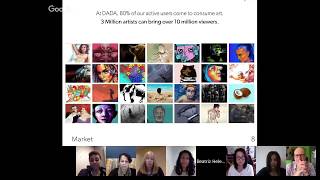
But you're also— what you're creating, it's your work, it's becoming part of somebody else's creation, and that's very, very powerful. So envision a global community that can take control of their work and through software and creative collaboration achieve economic independence. Meaning that what we want is for artists and anyone to do what they love and create art together, and we as a platform will take care of the distribution, marketing, and sales of everything that is being created. So this is how it works. Somebody— this is an example— somebody in the US made a simple flyer probably not an artist, and an artist in Chile responded with this indigenous person. And from there, other people started replying, and 6, 7 months later, we have somebody in Italy still replying to and adding to this conversation. What's beautiful is that all of this has been created by different people in different countries who have never met each other at different times. And it's a completely spontaneous process. So basically, in essence, that is also a new way of making art that wasn't possible before. And we have over 150,000 registered users, 80,000 drawings being created by this community, and it's very, very— our users are very, very engaged. So I'm an artist. I've done illustrations for the New York Times. I worked at MTV and Disney, and I'm also an entrepreneur. I founded an animation studio in New York and I managed its offices and the offices in South America for over 10 years. We have a CTO, tech co-founder, who's been with us from day one. And a CMO co-founder who's been for 20 years in advertising, who takes care of all the communications and the community management. So we, at this point, we know that 80% of our users come to view art. So we're thinking that if we can get to 3 million content creators, they can attract 10 million viewers who can potentially become— could be able to buy this content. So our goal is to get to 3 million by spring of 2017. And we know that we're missing out 80% of the market by being on desktop only. So the main component here is to make a killing mobile app. And for that, we partnered with Apple as they're pushing Pencil, which is specifically to draw. They're helping us in every step of the process of development. They're also going to help us with business and especially for us, the marketing once we go to market.
Cool.
So You know, we're experimenting and exploring different revenue models. One of the things is the content and people are creating original content. Just remember that nobody's uploading anything, everything's being created there. So we're partnering with different platforms so that we can integrate the APIs and just monetize this content. Whether it's for merchandising or digital art or Pond5, you know, it's a marketplace for royalty-free images. We're exploring those avenues with them. Where the big opportunity is, is the talent. Since we're creating a very engaged community, we know that we have an addressable market of 16 billion just in the US. And a very interesting opportunity came out where SAP came to us and they want to do a pilot program with 7,000 of their global employees because they see that as a platform, as the perfect space for employee engagement, fostering creativity and innovation. And also because it's a universal language and they have a lot of problems with language and cultural barriers, they think that this could be a great place for them to solve all of that. So that is very unique. There's nothing like it online, offline. We're not an online gallery. We're not a drawing tool. We are an engaged network of people who are creating art with each other. And we're fundraising $500,000 that will get us to that next milestone and then raise Series A. And thank you very much.
Wow, guys, I gotta say, well done, Beatriz. I really— I've been typing in the chat, if you gotta see it to believe it, because I mean, I scroll through some of them and I laugh. I scroll through them and I cry. I mean, it's like Amazing. Nothing I've ever seen. It's really— and for the judges, I would recommend it's just dada.nyc. If you want to pull it up and scroll as you ask, you'll be— hopefully, hopefully you don't crash your connection.
I was just peeking, peeking on my phone. It's unbelievably beautiful. So thank you so much.
Yeah, so again, I mean This is a kind of business that you just don't normally see, but it's beautiful. So questions, anyone in the chat as well?
I see, uh, I don't know.
Yeah, actually you have someone who wants to invest in this.
Yeah, perfect.
So sorry, I just had to throw that out there.
Yeah, that's awesome. I just want to continue with what, um, Adeo said. This is, you know, all the pitches have been so unique. None of them are like, oh, the Airbnb for X or Uber for Y, right? They're all super unique ideas and they're all authentic founders. They're all, each of them solving their own problems. So just like I pulled up Dala as she was talking about it, I love that when I tried to scroll down, it scrolled right. And the design is just very impressive. Very impressive.
Thank you so much.
Yeah, no, I love it too. I was just saying just the communities that are being created, you know, by each of you, but certainly this last one as well. I just love that, that impact that you're all having on bringing people together in your own unique ways. I think it's amazing.
Well, I gotta say, so actually there's a bunch of people in the chat saying, how do I invest in these companies? So, um, I didn't necessarily expect that, but I hoped it. By the way, I'm kind of tearful because it went so well. And you're right, these businesses are just so awesome and unique. And, and Dada in particular, I just— not that I didn't love the other businesses— to me it just speaks Again, it just makes me happy. So for people who are interested in investing, in the chat, um, you can email grads@fi.co, and, and we have a gentleman named Mike, and he can put you in touch with the founders, uh, to, to comment. And then we'll paste in the chat a list of the companies and their URL so you have their names. But let's go back to additional feedback about data. I mean, Jill, Chandani, anyone?
Yeah, I mean, I just love— I mean, you're getting great traction, which is fantastic, going back to that. And you've identified— you identified what you need to do, I think, around the mobile app, around, you know, the partnerships you're establishing are fantastic. I don't know if I have any specific questions that you didn't answer. Your revenue model, you're working on different aspects of that. I think it's all, yeah, it's all wonderful.
Thank you.
I have one very basic question.
So how—
how you said it's only on desktop, so And you said the images are not uploaded. So somebody just draws on their desktop using the mouse right now? Okay.
Yeah, yeah, mouse or tablet. Yeah.
Okay. So the question I had was, you know, why not open these up for sales right now? Like the, you know, you were talking about that being one of your revenue models for just any consumer who comes to your site to just be able to buy one of these. Right. What prevented you from opening that up?
Well, this is one of the things that we're doing. Actually, we're testing that exactly this week. We already created it, but we believe that we now— we don't want to— one of the things that we're very cautious is that we don't want to be a marketplace necessarily. We want to use marketplaces that already exist. So we are going to do it, and we're going to put it out there. For us, the.5 partnership would make more sense. So whatever way we can do it together, like with TeePublic, for instance, they do merchandising, right? Any drawing can become a t-shirt or a mug. If you go to the other, you will be able to do that, and only the transaction will happen at TeePublic.
But as you'll be able to turn it Because I'll tell you, there are ones that I've seen that are so beautiful, profoundly beautiful, I would buy. And they're really— Chandani, back to your question, like, they're really long, right? They can scroll for like—
Right, right, right.
—forever. But I mean, I don't know how you would even print them. That would be an it. But I would have one on my wall, no question. Yeah, that's for sure.
Yeah, absolutely.
There is a platform of Curious, it's called, that in New York that is It's basically tackling that problem. So anything that you do, they can make it in beautiful prints already framed and they send it to you. So those are the kind of things that we can do.
I mean, I would buy one that's 10-foot long and that one with the flower that became the aboriginals that became the eagle. I think it's one of the most beautiful things I've ever seen humanity create. I mean, that's not— I mean, to be honest, so I would have it printed on my wall in a heartbeat. Yep, I agree with that. Sorry, I keep— Gorgeous. Any other questions, guys? Maybe some final thoughts if you don't have other questions or feedback.
I just have a quick comment on that. I think you might be underestimating the consumer-to-creator ratio because for something like Yelp, I know it's not a good comparison, but just something like Yelp, 90% of them are consumers, 9% of them— this is sort of like, you know, a rule of thumb kind of thing— 9% of them give the thumbs up, thumbs down, or the stars, and there's only 1% creating the actual reviews. So similarly with your, you know, with your visual communication, visual storytelling thing, if you only have 1% of creators, you can have 99% consumers. So what I was trying to say is if you focus on that, if you are trying to monetize advise the consumers and not the creators, that would be easy to do by opening it up, by getting the consumers would be an easier thing to do as well.
Right, exactly. Yes, that's the one thing that we learned, that actually we created the platform for content creators, not thinking necessarily of viewers. So the actual experience when you view, it's terrible. So what we are doing is making it into a discovery app and redesigning the whole platform so that it's very easy for people to just see it and see the whole content. So that's exactly— so that would work. We would like to get— we think that if we do that, we would probably get about 60% of active users because they're mostly consumers.
Yeah, it's— and the thing is, you've done the harder part. For most people, getting the creators is harder. Yeah, and getting the consumers is easy. So because you were so focused on creators, you've done the harder part already. Yeah, so it's easier for you to grow from here. This has been beautiful.
By the way, Sue, your co-conspirator Judy is answering questions. Oh great, I would ask that questions, but speedily responding to everyone. Well done, Beatriz. Well done. Thank you so much.