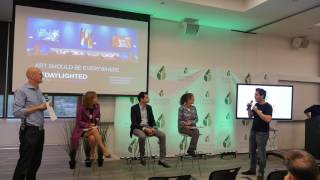
In this FounderX pitch, Alex Cammarano, co‑founder and CEO of Daylighted, introduces the "Smart Gallery" – a software‑only digital canvas that turns any existing TV into a curated art display. The solution consists of a small dongle plus a mobile app that streams rotating works from local artists, galleries, and museums, allowing viewers to learn about, interact with, and purchase the art. Daylighted monetises via a subscription model: $9.99 / month for consumers and up to $490 / month for businesses, with no hardware sales and a zero‑commission policy on art sales. The go‑to‑market strategy is B2B‑first, leveraging high‑traffic public spaces (hotels, co‑working spaces, offices, hospitals) to showcase the product and drive B2C adoption. The company reports over 1,000 screens in the pipeline, a recent 100‑hotel chain deal, 15,000 artworks, and strong engagement metrics (e.g., 2,000 interactions from a single WeWork screen in one month). The team of four founders and advisors from Marriott and Art.com has raised $1 M, with half already committed. During the Q&A, investors probe unit economics, revenue‑share with artists, customer‑acquisition cost, barriers to entry, and installation timelines. Cammarano emphasizes the advantage of being hardware‑light, the large, royalty‑free content portfolio, and the ability to acquire customers quickly through B2B placements.
Chapters
So hi everyone. So yeah, we're lucky we have the product on live demo today, so feel free to come after the pitch if you want to talk about it and see how it works. But basically it's Daylighted and we created a smart gallery. The smart gallery is a digital canvas that connects people with the local art communities. So we think that in a couple of years people will enjoy art digitally through a subscription, just like any other form of art, like music or movie, simply because the new generation, we want, we value experiences over possessions. We want constant discovery, we expect unlimited curated content, and so to get there, the art industry has to embrace its digital revolution. Because on the other end, artists already jumped into digital. I mean, look at that. This is a Van Gogh painting being animated by an Italian artist. And there are so many more new forms of art like this one, like morpho-art, chrono-art, data generative art, and all of them are stuck on YouTube. The only way for all of us to enjoy that new form of art is the digital canvas. And so that's what we created, a smart gallery. A smart gallery is a digital canvas connected to the local art communities. It's any screen that we transform into a canvas by simply plugging a dongle on the back of the screen. It then rotates artworks from your favorite local artists, from a gallery in New York or in LA, or from a museum we no longer have the time to visit. It is also connected to an app where you can learn about the piece, curate your exhibition, but also interact with the communities. You can talk to the artist, and you can even purchase paintings or photography or sculpture from them that you see on the screen. So just like Spotify or Pandora, we charge a subscription, a monthly subscription. Start at $9.99 for consumer and can go up to $490 per month for businesses that need more customized service. We don't manufacture any hardware. We don't sell any hardware. There are TVs everywhere. You've seen TV in your lobby, in waiting rooms, and the only option for content is CNN silent or any other news channel on the silent mode? And so it was a no-brainer for Marriott, Hyatt, Accor, InterContinental, WeWork, Silicon Valley Bank to choose our service. We have more than 1,000 screens in the pipeline and just signed a deal with a hotel chain that is going to install about 100 hotels. We have 15,000 artworks on the platform and receiving dozens of inbounds every day without doing any marketing and won 2 awards as the best new product in the hospitality industry. We're also named as one of the 50 thought leaders and innovators in that industry. The market is obviously huge. The B2C market in the US only is a $30 billion market. And it's followed by a corporate market, a B2B market of another $20 billion market. We use the B2B market as a go-to-market strategy because each installation in a public place is in a hotel, in a restaurant, in your offices, is a place where the consumer can discover the Smart Gallery and experience the Smart Gallery. And it's a cultural product. So when people see, they get what it does, and they really appreciate it. To give you an example, at WeWork, in only 1 month, we had 1 screen and 1 tablet available. We had more than 2,000 interactions. So it's 45 artists contacted by the people at WeWork and 93 requests about the product. So installing that network of screens is not only generating revenue in the B2B, but it's also doing marketing for a B2C product. There's 4 people in the team. Elizabeth and I created the company, Betty and Nicole joined us last year, and we have amazing advisors like Ali Mehrali, who is a director at Marriott and Starwood, and Geoffroy Martin, the former CEO of Art.com. Raising $1 million to install that network of screens in the B2B and launch our B2C product. Almost half of it is already committed or in bank. And so that was Daylighted, trying to make art more accessible. So if you want to join us, we'll make sure that anyone can enjoy art as naturally as we all listen to music every day. Thank you.
And I just want to say, I mean, okay, just be blunt here. How fucking awesome is that? I mean, raise your hand if you think it's awesome. And you know, He was in my class, and I'm like, this is gonna be fucking awesome. And then— excuse my language, everyone— but then you see the screen now, and I'm like, that is really amazing. And earlier today, some of the images are static and some of the images are not, and you're sitting there and you see them start moving. It's really just a tremendously beautiful experience again. And this is an example of like, you can where words come out someone's mouth and you're like, "Yeah, yeah, yeah." But then you see the product and you're like, "That's pretty awesome." Hats off to you. Sorry to steal the show here.
Thank you.
My question is—
I can go ahead and start. Yeah, the product is amazing and you have to see it for yourself. The reason I— I guess we looked at, I think, Mural a year, year and a half ago, for instance. The thing that I liked about what you guys are doing is that it's hardware light. Because you're not supplying the hardware. You can plug it into any TV. And you guys have a B2B strategy versus pure B2C, which I think has been challenging for other folks in the space. I'd love to hear more about that. I think some of it, maybe because of time, you didn't focus on it. And then secondly, it sounds like you have some pilots going with WeWork and InterContinental and other hotel chains. I'd love to just hear more about where those are going and what it what it looks like in terms of the pipeline. Otherwise, good job.
Thank you. So, yeah, the idea of not starting with the hardware is simply because we think that the hardware component will be handled by the screen manufacturer. It's nothing less than a screen, so if a company tells you that their screen is better than the others, simply not true. And so we think that the key in that market will be to succeed in the content and in the service you're able to provide, so understanding what people really want to have at home. Not necessarily beautiful image, but contextualized image, something that has a meaning. And so this is exactly what we're working on. The other question was about the pipeline. And so yes, we worked it at the property level at the beginning to get trial with the hotel chain, because there's so much traffic in those places. But also in offices, in doctors' waiting room, we're working with a few hospitals to have art program in the hospitals to entertain the patients. So it's not only a hotel. But yeah, from the property level, they love the experience. And so they pull us to the corporate to discuss some branch accord where we can deploy in all of some of the chains, not the entire group, but some of the chains.
Madeline or Zhao, who wants it? You look ready.
Yeah, sure. I thought the product is really beautiful. And the fact that you were focusing on presenting it, I think that attracted my eyes and certainly elevated the pitch. I really like that. I think because you're selling the screens and then subscription, I would like to get into unit economics a little bit more, just to understand how you actually can capture that addressable market you have on the board.
So like I say, we don't sell the screens. It's very rare that we have to install new screens. Most of the time, especially in the public environment, screens are already there. And like I say during the pitch, they put screen in the public spaces, like a waiting room or a lobby, to entertain people, to make the space more interactive. But so far out there, there's no content options. Either you put the cable on silent and everybody hates it, or you purchase very expensive videos, or you do your marketing. But the millennials are very interested in having localized, contextualized, cultural experience. And so it makes a lot of sense for those companies to entertain people with local art. So we're using existing screen most of the time. When it's not the case, we suggest them what screen to buy. So yeah, and like I said, any screen can be used.
I'm interested actually setting up one of our screens in the new office when we're in renovation right now, but I love it. Me too.
So 3 people, because we had one in our office. I'm like, I don't want it to go, man.
And what we guarantee is every week you'll discover a new local artist in your office.
So the unit economics, you didn't answer though. And I know, forget the hardware point, you disavowed that, but is there unit economics that you can reveal?
So in terms of pricing?
Is there revenue share with the artist, for instance?
Cost of customer acquisition.
Yeah, yeah, yeah. So that's part of the beauty of our model. We offer something amazing to the artist. That's why we have so many inbounds with the artist. Right now, artists pay to be on Facebook, to be on AdWords, to bring people to their website. Traction is very difficult to get visibility. What we tell them is we're gonna take your website, bring it where people go at no cost. So there's a huge opportunity for the artist. And what we just launched recently is when we sell artworks that we don't print, because we offer some print services too, but when we don't print or when we represent a gallery, we no longer take commissions. So we based only on the subscription that we charge the venue for, but we don't take commission on the sale of the art, which allow us to have this amazing portfolio of artworks and provide the services to all those venues.
Wow, so zero commission gets better artists. That's probably unheard of. And then that allows you to charge the subscription and brings down your CAC, cost of customer acquisition. Madeline, do you have a question or comment?
Yeah, I do have some comments. I really like it. I mean, I, you know, looking at Electric Objects or Mural, the issue I had with them is that It was hardware. I mean, I do hardware, but hardware is very, very hard. And I'm always looking at those things going, why are they doing the screen? Because there's nothing new there. And it's too expensive. And why doesn't somebody just do this as an app? So I think that's super important. And I applaud you for that. And I think that's a really good way to go, because I've never understood that, especially if they're not doing some unique form of— if it's a smaller device. I mean, I have seen some things for personal photos that look quite interesting, like Loop, where it's this tiny thing, going to be in-home. It might be a sharing thing or a family thing. So I think this is super interesting. I think that it was the unit cost, like understanding kind of the financials and the metrics of it, I think are super important and would be good for you to explain. And also, like, what's What's the barrier to entry for other people, and really what's your secret sauce? Because when you are only software, I mean, it's a double-edged sword, right, of how you—
Yeah, so really the bottleneck in the industry will be to evangelize the consumer market, which is where is the real opportunity. And it's very difficult right now for all those companies because the marketing costs are extremely huge. And people are, until they see it, they're not really interested in having images on the screen. And so I think our difference is to go B2B and show the product, and that allows us to have our B2C penetration a lot easier than the other company. Then the other barrier to entry as of right now is the quality of the content. Those other companies sell a way to consume the art, so they have to acquire the content to be able to remunerate the artists and then charge you the subscriptions. What we do is completely different. We offer a way to distribute the art, so we don't have to pay for the content. And so we acquired that huge portfolio. And I think the key in that industry will be in the content and in the service. And that will be the barrier to have the largest portfolio and the most attractive one. Right.
So if you have the best portfolio of content and the screens look like that, then everyone's gonna be— 'cause you're gonna just pick based on the content, I imagine. It's sort of like you wouldn't subscribe to a song service that has 50 songs. You want 50 million songs, right?
Yeah.
But I do— I am curious about, like, How long does it take to get somebody to do it? Like here you've got 3 people that are saying they'd put it in their offices. I don't have an office, but I might want it in my home. Really understanding kind of what is the first meet to installation and how that works, I think is going to be really important because B2B, that's always kind of the struggle of what's the cost of the acquisition and how much time does it take, how many feet on the street do you need, etc.
It goes faster and faster. The first people were very skeptical, as everybody is when it's a new industry and a new product. And again, it takes to see it. So the more installation we have, the faster it goes. The more partners like Marriott and IATA.
So if I bought it right now and I said, OK, I'm in.
Yeah.
You'll receive it in less than a week.
And then I— great. All right. So then I can put it up myself because you just plug it in the back.
If you already have the TV, there is an installation guide.
Do you recommend like a stand like that, or can you say, hey—
Of course, yeah, we offer a few diversity of stand that you're welcome to look on the website and purchase too, if you don't have the TV on the wall. And since we can do any sizes, if your house is smaller, you can have a smaller screen that will suggest with a smaller stand.
And I saw you do portrait and landscape.
And of course it's portrait or landscape, yeah.
But for example, like on WeWork, you said You've had 97 inquiries about the product. You've had, you know, 47 artists that have been contacted. What, in that one month, have you seen additional revenue versus just the WeWork revenue? That's kind of the question.
Yeah, so a lot of those people were B2C people that were—
Sure.
That wanted to have it at home. We haven't launched the B2C yet.
Okay.
And so they're on the waiting list that has hundreds of people that are waiting for the product. All those people come from the tablet interactions. And so we're waiting to launch that B2C offer to provide those people and to see the economics, the effect of those interactions on the economics.