Employee to Entrepreneur: How Ines Da Silva Costa & Renata Bonaldi Made the Leap
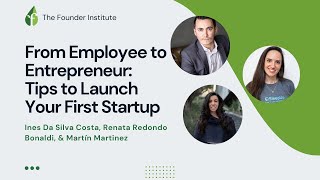
In this Founder Institute‑hosted webinar, host Martin Martinez interviews two recent alumni – Inés Da Silva Costa (Omnia) and Renata Bonaldi (SleepUp) – about their transition from corporate roles to founding tech‑enabled health startups. The conversation covers the personal moment of “taking the leap,” the structure and impact of the Founder Institute (both in‑person and virtual formats), early product development (AI‑driven human‑capital platform and EEG‑based digital therapeutic), fundraising approaches (bootstrapping, government sponsorship, grants, equity), team building (co‑founder dynamics, hiring senior talent, culture), international expansion challenges (data‑privacy regulations in Switzerland, Dubai, MENA, and Brazil), the importance of networking and conferences, and the ongoing support of the global Founder Institute community. The panel also fielded audience questions about financial safety nets, mentorship, and how to stay connected after the event. The dialogue is candid, highlighting resilience, uncertainty, and the practical realities of early‑stage entrepreneurship.
Chapters
One thing that I realized that extremely important is networking, um, and that opened a lot of doors. And, uh, going to the right conferences in the right countries, because I noticed that different countries do business differently and some are more fast-paced than others. So this was something really interesting to tap in. Regarding the, as you mentioned, like people, Ines, what are you doing? Um, I mean, a lot of people knew that I like to create things and I like to drive, uh, change or innovation. For me, it was more the family. So, Ines, what are you doing? But at a certain point, they, they understand. Okay, we see what you're doing. You are going somewhere, and things build. So I think it's about resilience, really.
Happy Monday, everybody. Happy Monday. Thank you all for sticking around a little bit after the top of the hour, wherever you're coming from. My name is Martin Martinez. I am the founding and executive director of the Texas chapters here at Founder Institute. Coming to you live, as you can imagine, from Austin, Texas, the capital city here in the Lone Star state. We're kind of coming off a big high, you know, just a month ago, literally 30 days ago, we brought 41 countries representing the Founder Institute community to my home state where I live in Austin for Founder X. Maybe some of you heard about it, saw it through our feeds, but I won't dive too much into it. I want to get to know all of you. I want to get to know all of you. And right now, my, you know, my producer backstage will let me know how many folks we got It's a little bit different for me on Airmeet these days, but let me know where you're coming from. Use that chat tool. Looks like we got a big group of folks already in the house, and we like to wait a little bit, you know, past the top of the hour so you can file in. I know you're— if you're here for the Employee Entrepreneur Event, because that's what we're doing, you're probably on break right now. You might be off work, or you might be somewhere squirreled away in the office trying to get this in before the boss catches you. You. So you're in the right place. And I love this event. I love this event. Just because for many of you, the journey is, is terrifying. It's lonely. You don't even know where to start right now. That's why you're here. You're trying to hear from others who have taken that leap. But let's find out where you all come from. We have a few folks on the East Coast, what, like Georgia, Nashville, Boulder, Vegas, Ontario, Zurich, Kansas, NYC, Germany, Right on. So we got people all over the— all over Europe and the US right now. We typically have people from all around the world. Morocco. All right, I'm seeing some more. Keep doing that, y'all. Drop your LinkedIn, connect. We're a global organization, 200 cities, 100 countries all around the world. And just in Texas alone, we have 4 chapters: Austin, Houston, Dallas, and San Antonio. So I haven't seen any Texas folks in there. Come on, give me a howdy. We got at least 4 people from Luxembourg. It looks like Dimitri's happy about that. Norfolk, Nigeria. All right, we got Dallas. Right on, Nick. I'm going to keep looking at that from time to time, but as you can see, there's a lot of you. So let's keep piling it in, connect. Tell us about what you're working on or what you're dreaming of working on. Okay, that's what the Founder Institute's here for. But so as I mentioned, we're on Airmeet. It's an event that— it's a platform that we've been using since the pandemic, so literally 5 years. You know, we've been— we transitioned over and we love to host events. It's also got a networking tool. Obviously, if you were here before we started the broadcast, you saw those networking tables. So definitely take advantage of that after. Connect with each other. There's different topics and they're more intimate. You can camera on and pitch people and just connect, right? So all those folks that are out of Luxembourg, definitely connect and maybe y'all can meet up in person after this. Um, so here's a couple things, and then we're going to bring up, um, Inés and Renata, uh, to have a great conversation about their journey becoming entrepreneurs, becoming founders, and using the Founder Institute community as that vehicle to launch their businesses. Um, you know, we have the chat. The chat is great. Many of you will have questions. Hopefully all of you have questions. That's why you're here. Uh, but use the QA function if you're using the chat. You're on a desktop, typically Chrome or Firefox are the most optimum. You might be on your phone right now, it's fine, but you're not going to get all the bells and whistles. You won't be able to interact as much. Just make sure that using the QA function to surface all questions, and you can upvote questions. Maybe you have a question that somebody has already asked, upvote it. I'll see that and I'm going to be using that QA tool towards the end. Definitely get those questions in now. But because as you can notice, chat's just blowing up with all you amazing people from all around the world, it'll be harder for me and the team backstage to really identify those questions. So use that QA tool. That's what I'll be prioritizing. And if you don't, I might make fun of you in the chat or just online. So don't avoid that. You don't want that. You don't want that. But y'all are doing everything right, dropping in the links. And a couple of y'all are using that emoji tool down at the bottom over here. Use that emoji thing. Give me thumbs up, laughs, sunglasses, whatever. All right, y'all figured it out. Sweet. All right, we got 50 minutes. Let's get to it. I'm gonna bring up— Renato's gonna bring up Nez. Let's, let's get this going. How we doing, ladies?
All good.
Yeah, great.
Yeah, we were chatting backstage, y'all. But for everybody that y'all that isn't, you know, privy to what's the ongoings of the backstage conversation, let's get to know you both. Right now, I'm pushed away over on the left side of the screen. So I'm gonna work my way that way to the right this way, I guess. Inés, how you doing? Tell us where you're coming from. And just in a quick one sentence, because you know how to do it. Tell us what you're working on.
So my name is Inés, I'm from Portugal. I live and worked in Switzerland for a couple of times and because of Omnia. So the startup that was born because of Founder Institute, or during the Founder Institute, I moved to Dubai. Um, so, and actually, it's a pleasure being here. Um, I don't know if you want me to introduce a little bit on Omnia.
Just give me that one sentence.
One sentence. So Omnia is a dual platform for, uh, that has an embedded algorithm that is supporting employees and employers to improve human capital performance. Okay, that's a little bit longer than one sentence.
Oh no, hey, it's been, it's been a minute since y'all got out the program. It's something we do like on day one, we got to try to get you to distill it down to a sentence, but you're right on it and it definitely involves. Renata, how about you?
Hi, so great to meet you all. Thank you for being here. It's going to be a pleasure to share my experience. Um, so I am Renata, CEO and co-founder of SleepUp. SleepUp is a digital therapeutic platform for treatment and diagnostics of sleep disorder that was born in the Founder Institute in Brazil in 2019.
Awesome. Awesome. Okay, so 2019. Again, you're one of the last ones to come before we shifted to strictly online. And as you— you're more recent, right?
Yeah, 2024. So last year. So quite recent.
Yeah. So it's very fresh in your mind right now. Or not. It's just stories at this point. But it's beautiful to watch. Someone else who's been through it, has been building, you know, for over 5 years now, going on 6, um, and someone who just got out the program. So what I love about just this conversation that's about to come, y'all, in the honest, that you're going to see the growth, you're going to see what happens immediately after the Founder Institute and what, what, what the journey is like, but also what the journey's been like since, right? So definitely get those questions going. I know you're going to have a bunch. We already have a few popping in, so chat on over that QA tool. Upvote the ones you want to hear answered or ask one if you've yet to see it answered. And again, I will poke fun at you if I see you dropping questions in the chat because I won't be able to see them. So let's get to it. Renata, let's start with you first because this one probably going to take a little bit more just like, ooh, where really was I? Since it's been almost 6 years since you've gotten through F5. What were you doing beforehand and what led you to find Founder Institute because that just wasn't cutting it for you anymore?
Yes. Well, I have a textile engineering degree. So engineering degree, I used to work in big multinational companies in the disruptive innovation area. So I had, I was familiar with innovation and, but I always wanted to have my own company that I could really solve a problem to connect with my purpose, to be more rewarding and impact positively the society. So that was the beginning of SleepUp. I used to work in the corporate industry, but still in the innovation and intra-entrepreneurship area. In my company. Yes.
Nice. You already had— you're already kind of doing entrepreneurial work within.
Yes.
But entrepreneurship, yeah, for those of you that aren't familiar with that word, I mean, entrepreneur, I could barely spell it when I was starting my first company. Entrepreneur is going to be, again, you're looking for innovation, you're connecting dots in otherwise disparate places within departments in larger corporations. So that's really cool. You're already kind of training that brain. Before you did it yourself. How about you?
So before, I was working in pharma. So my background is biological engineer. I spent 7 years in pharma in different areas. So commercial and also then product development, drug development. And during that time, yes, there was also some initiatives that I was trying to drive internally. Uh, cross-function. So that also helped, but the, the area was different, even though now we're still very connected with mental health. So a little bit on the healthcare, but way more technical in terms of AI, machine learning, and technology. So that was quite a shift. I went back a little bit on my studies background because back then I did a bit of coding. And now it's a little bit back on that. Yeah.
Nice. Well, again, thank you both for sharing that. I'm gonna build from, from these two, you know, backgrounds. But obviously, both of you have higher degrees, both of you have some pretty extensive specific, you know, educational backgrounds, which I believe will probably, probably leads to what you're working on now. You already have it, and many of you in the audience Again, a lot of you are probably, you know, 10, 12, 15 years in your careers, our typical age for a founder that joins the program. It's not mutually exclusive, but typically, you're going to be about a decade in your career, you and you know what you're doing, you're doing pretty well at it too. But it's just, it's just not giving you the joy, it's not challenging in a way, or maybe you're seeing deficits, seeing holes in the work that you're doing, and no one No one's really answering the call to solve it, but you see an opportunity. Renata, where did you see an opportunity?
Mm-hmm. Yeah, so I used to work with wearables. That's my expertise, wearable technology, more in the healthcare sector. And during my MBA, I studied the use of wearable technology for chronic disease. And I was already, you know, kind of looking for a specific topic to start my company, to start my entrepreneurship journey. And I found out in this study that sleep disorder was the first chronic condition that people wanted help with technology. So that was the beginning of SleepPath. It was not because I suffer from insomnia or have any sleep problems. No, thanks God, I sleep very well. But because we identified that it was a big, big problem. In fact, it, I think 30%, around 30% of the population suffer from sleep disorder and they're still not able to solve it. So that was the beginning of SleepUp.
Interesting. Oh, I mean, you, I need to take some tips from you on sleep. I still have an entrepreneur's soul and that can always keep you up. Being the entrepreneur. How about you, Inés?
So it was two things. One was when I was doing global project management and changing the organization, so doing change management. It was really overseeing a lot of dynamics in teams, and team performance became a topic, and also individual performance within the organization. And on the other side, I was doing also some coaching coaching sessions with people during life transformation. And I saw that a lot of things that I had in private clients, it was also, was also brought into the corporate world. So I thought, okay, how can we scale this? So that's why the AI came into place. And naturally, I also wanted to have my own company at some point. I have the target on 30 years old, but then I was delayed because of COVID So I decided then to, yeah, you know, like take the leap and merge this AI with the human performance. Yeah. So that's how we came together for Omnia.
Awesome. I love that. You know, again, y'all use the emojis down there. I try to make this as interactive and live as possible. Use them emojis, give a round of applause. And I know there's a clap feature down there for our two panelists here today. Um, yeah, we're about 10 minutes in, so— or 10 minutes since I got 20 minutes to go. So we're gonna spend the next 30, 35 really drill into this now. Um, because again, the journey is unique to every entrepreneur, um, and especially for a lot of you in the audience and for these two right here that I'm, that I'm getting to know. Um, it's lonely, especially when you're surrounded by people that are just in that golden cage, that corporate world. Again, doing it, right? So it takes a lot of courage. It takes a lot of really, maybe sleepless nights, Renata. Maybe sleep wasn't always great for you those first few years building, but it's nice to hear that it's definitely settled in. So the first one is obviously taking the leap, right? And Founder Institute, for all you listening, watching, we got folks from Tel Aviv, we got folks here. Looks like we have over 200 people now in the audience. Welcome. Howdy. Again, use that QA tool, not the chat, to ask questions. If not, somebody else in the audience might make fun of you, and not me. Taking that leap again is the first step, right? And it may not be immediately. It may not be, oh, I'm joining Founder Institute, I'm gonna take the leap and just quit my job now. But it can be, it can be. So when was that point for you? I'm gonna go to you, you know, because again, it was very, it's very fresh for you.
Was it during, after So how was it? So I think, and probably a lot of people here feel the same, before that leap there is a huge transformation happening inside of you, I would say, um, to get to reach that point. Um, so I start feeling that, um, I start changing and the environment around me was not changing with me. So naturally I start looking for options I knew that at a certain point I would need to make that move because it was inside. I really wanted to do that. And at a certain point also, I promised myself that would be the last position I would take. So, and naturally, when you put that intention, somehow life brings you into that point. So there was a point that indeed there was opportunity to sign a mutual agreement, uh, and I, I took it. I, I had to take, you know, to be in truth with, with myself, I need to do it. Um, for me was a bit, uh, I knew what I didn't want, so I knew that the path was only forward. I saw that some people asked about the financial support and all of that. I, I could give even some options, uh, depends on the country where you are, depends on the situation. But if you want to go into that, I can give some hints on that. Um, but yeah, so for me was really the point I felt that the road was really ended, and it took me 3 years to, to reach this point. Um, so it comes really from inside. And then what happened is, uh, we start looking for different options. So I start looking for alternatives, what I wanted to do or not. And here I think, uh, just maybe an insight to people, depends how you are at work. So for example, sometimes people can manage to like migrate into the entrepreneurship while they are working. And I think here is really how you feel at work. And if that energy is positive still, you can also work in parallel, for example, or if in some cases people move because they cannot stay. So if that's the case, I would say really cut it if you can, because whatever you build, you build with a new energy. Um, for example, one of the companies I built, it was while I was still in, uh, in my corporate job. And I noticed at a certain point I needed to pivot because my energy was very different when I was an entrepreneur versus when I was an employee. So just keep that in mind. Uh, at certain points you really need to be full step in. Yeah. Okay, so for the financial part, maybe, Martin, I let you—
We'll hold on that one. We'll hold on that one. We start getting into that minutiae towards the end. And that's going to be a more specific question. But it's a good question. Yeah, let's not, let's not bite that one too soon. Because we want to get some grounding first. But good question where that's coming from. And I see all there. It's gonna vary. But what I'm gathering right here, environment is important. Right? You need to be really training your mind, your body, your soul for what you're about to embark on. And then if the work environment that you're currently in corporate-wise is not conducive to that, then you might need to leave early. If there's a balance that's allowing you to work on this while still maintaining, you know, that corporate lifestyle for the time being, then, you know, maybe hold on to it for a little bit, build that, that safety, that, that nest egg, maybe that you talked about. But if it's not, it's not going to help you move forward, you might need to move faster. What's your thoughts on that, Renata?
Well, I always knew that I wanted to be entrepreneur, so I kind of prepared myself and financially as well. I knew that that was going to happen. It was just a matter of time and opportunity. So I got pregnant. I was— I got pregnant and I left for maternity leave and that was the trigger of everything. So I spent my maternity leave organizing the the company and I was, you know, it was just the moment that gave me the energy and the courage enough to leave everything. So I left the maternity leave, I quit my job. The day after was the first day of the Founder Institute. So after that day, it was like for me was 100% sure that I was not going to go back. It was just from there onwards.
So life, life can make it happen, right? Again, through dramatic— I've, you know, I've seen that, you know, I've had founders coming out of our Texas programs, one of which started a company because of that fear of having a family. She just didn't want to leave the workforce and start a company to help, you know, moms. This evolved since transition back into the workforce after having families because their earning power decreases and y'all, you two will know that better than I ever will. Because that's the experience that, you know, that y'all can have and I can't, as a dude. But still, life can be powerful. I've had other founders who lose people that matter a lot in their life, and it changes. You think about priorities, what really matters to you? Do you want that safety net? Do you want to be doing everything the way it's always been done? Or you want to do something bigger, something better for those people that matter to you? And for all those people in this audience, you have people that matter to you. So what do you want to do that matters to them? And that's where it starts, where the journey can begin in a very simplistic sense. But you're taking these skills that you've built, this experience that you have, this knowledge of a market and an opportunity maybe no one's really pursuing. So let's dive into a little bit that, right? The Founder Institute helps you refine it, but it's just the beginning. It evolves after the journey. The journey continues to evolve, but it evolves certainly after you leave the program. So let's actually talk a little bit about your experience in it. For you, Renata, let's— I know it's going to be a little bit further down the memory banks. So I want to go with you first and see what we can dig up.
But I remember like if it was yesterday.
Yeah. So tell me that first day again. What were you expecting? You know, what was it like? The movies or the podcast or whatever? And what was the crashing reality that became so? And how, maybe how did the idea change throughout those 4 months of program?
Well, I think that's, first of all, I think when you, when you decide to be entrepreneur, you do need to have the support of an acceleration program, a community. That's fundamental. It's very important to learn the foundation, the basics, to make connections. And I chose Founder Institute at that time. I, of course, I talked to a lot of people, I did my surveys, and I realized that was a good choice, one of the only ones I would say for a very early stage, you know, just, just an idea. And I did these, the test, and the result was, was great. So I thought, I thought, well, that's, that's going to be what I actually needed. And when you start, because I was 100% focused on the Founder Institute, I was not doing like in parallel of other jobs. So I was really, you know, taking it very seriously. And that's very important because the program, and I did the face-to-face program, was very, very hard, you know, facing a lot of kind of bad comments and it was very, very difficult. And But that's when, after 4 years of finishing it, you just realize that that was actually very soft comparing to the actual day-to-day of running a startup. But yeah, it was, it was really, really helpful in terms of structuring everything, covering all the topics needed for validations and for actually also for reflection. Is this the right thing for me? Why am I doing this? What's the purpose of all of this? Did I tell my family about it? What do they think about it? So it encourages you to really make a good reflection if that's for you. So yeah, I would— that was, I think, one of the most— and the pitches, of course, the sessions of pitches and all the very hard feedbacks on it. Uh, it was at the beginning, it was, it was like difficult for me to understand why do I need to do so many pitches, pitches, but that's the essential thing of understanding what you're doing, being able to communicate and raising, you know, convincing people and raising money. So yeah, that's great.
Yeah, we'll get to that part a little bit later. Um, but yeah, Inés, your, your experience is a little different. Obviously you did yours online just recently. But again, the expectations are still there. The tools are different. Tools are different in terms of how we're doing it. But the experience is very much the same from your perspective. Again, to what Renata was saying, you got to have these kind of hard conversations with people around you, people that love you, because they're all going to call you crazy. They're gonna be like, why are you leaving your nice cushy job?
Oh, yeah, that happens.
You're crazy.
No, I know.
Yeah, that happens to me. Happens to all of us. Happens to every single one of us. As much as you want to deny it or or pretend that it doesn't. It does. They don't get it. And for you, it's very fresh. You know, what was that experience going in? And also assumptions, things that you thought you were going to be right that weren't through the process.
So, um, talking about the FI or after or both?
All of it. Start with the first day, day one, right?
Okay, day one. So, um, actually one was, um, this is funny because I remember I had a last-minute application. I had half an hour and I wrote the idea in half an hour and then I applied. So it was out of the womb, I was in FI, to be honest. Um, so, and I, because of this, I really felt it was meant to be. Um, so the first day, uh, I remember that we have access to the, the platform before the really first day. So I was really reading everything. It was a lot of knowledge that I was not aware of, especially in the venture capital part. I was very interested in that, especially because as an engineer, we don't touch much on that. So I definitely think the structure is a plus, especially in a, in a journey that is so unstructured because you are entering, creating something from scratch and trying ideas. So the structure really helped. The feedback helps a lot as well because, you know, you have, you feel also supported because there are people with previous experience. So that definitely is a plus. Um, but at the same point, so this is the, the hard skills, right? So this is, uh, the capabilities that you are building during the course. But then comes reality check. Um, and, um, one thing that I realized that extremely important is networking. Um, and that opened a lot of doors and, uh, going to the right conferences in the right countries, because I noticed that different countries do business differently and some are more fast-paced than others. So this was something really interesting to tap in. Regarding the, as you mentioned, like, people, what are you doing? Um, I mean, a lot of people knew that I like to create things and I like to drive, uh, change or innovation. For me, it was more the family. So, in this, what are you doing? But at a certain point, they, they understand. Okay, we see what you're doing. You are going somewhere. And things build. So I think it's about resilience, really.
Hello.
I hope I answered your question.
No, you did. You did. You did perfectly. Okay, perfectly. Um, but again, like, this is And I was telling our speakers before, when I have a very conversational style, so I'm pulling it out of y'all bit by bit. But that again, that's the truth of it. You know, the journey is really at the heart of this conversation, right? Because it's going to keep going. It doesn't stop, right? Doesn't stop until you quit. Or hopefully you're not quitting, you're exiting, right? You're ringing a bell on a stock exchange or very powerful brand is maybe picking you up and then your life changes a little bit more. More, right? But it certainly has changed so far, right? So, so let's talk a little bit about that. Let's talk about, again, that process, right? Again, y'all had assumptions coming in. Y'all had to talk to the people that love you, like, hey, I'm doing this, I need your support. You know, you're gonna hear, you're crazy, don't do it, right? But you can't let that discouragement, you know, take you back any steps because you won't, you won't follow through, right? So Founder Institute is a great grounding and support network, whether you realize you need it or not in the beginning, but you certainly understand that it's valuable when you're done to help you with that, to remind you that. So what, what was, what did you love? And what, you know, what, what was challenging? Because we had, you know, Renata, with you, you were in person, so you got to see these people more often. Inez, you have the opportunity to meet a lot more mentors, but you're stuck on a screen, right? So how did you, how did you navigate those waters of, you know, putting yourself out there? Connecting with our community and just getting that assurance that you aren't alone, you're not crazy, and keep going. And as I start with you, and then we'll bounce over another.
So, so yeah, so during the program was really intense. So I didn't network much. I was connecting with potential clients as part of the program. But after, so I need to decide on incorporation, also the country and all of that. And I reached out to to some people from FI in the US, multiple people from US and Singapore. So because I was, you know, evaluating different options. So that was, it was good to know that even first, these people have time, they allocate time to talk to you and they follow up. So if there is another meeting that you want to have, they're happy to do it. And on top of that, they really give you a lot of insights. And okay, you can send my pitch, your pitch, and I can see what I can do with it. Of course, some people do it, other people not. Depends on the person that you connect. Fair enough. Um, the other thing that you asked, Martin, around putting out there. So actually, so I was doing in Switzerland, and then somehow, because I'm quite intuitive, sometimes I like to also go observe a little bit how the environment is giving me information. Information and Dubai starts coming into the, the screen or into the options. Uh, and then I, I saw that they have a big AI framework on a, in terms of strategic framework for AI. So I decided to go there. Um, and then it's really has also in the, in the Founder Institute, they mentioned like screen all the networks, all the events, uh, pinpoint all the potential investors. And that was a game changer. For me at least, because here people really introduce you to people, uh, and people in very good positions and in very good institutions. So that for me was a very, uh, good experience. So, yeah, no, go ahead. Yeah, so if you have the time to, you know, also be an entrepreneur— I know that not everyone has the same, you know, capital in the beginning, But if you try, even if it's online, it can work. There I would advise more one-on-one. You can check the ecosystem in some places and try to connect with some people. But if you can really go face-to-face, it's a very different dynamic because you build on the personal level. And that I really advise for people to try it. And even if you are before you build your company, you know, you never know. Who you would know, who you would need, or who you would open doors for you in the future. So I would advise that, actually.
All right. Yeah. Again, leveraging the network. Again, you might be really focused on just getting this thing done and finishing the program and the candy, but the network's there for you. And that's kind of how you saw it. Renata, how was it for you?
It's interesting. It's interesting because it was very different. It was before pandemics. So it was like, it's even funny to remember now. We had like group presentational activities, you know, days of the week that we would just meet everyone face to face to do some group work. And we, everything was in person. Every week we had a presentational session where we would pitch in person. Everything was in person. And at that time we took it for granted, but now I really appreciate how amazing it was to make very strong connections. Of course, the downside is that it was like focused in São Paulo. So the network was focused in a specific region in Brazil, which of course has advantages and disadvantages. But I agree with Inês, the, the, the presencial, you know, the face-to-face connection, it's very important. It's very important. But at that time, I missed the, you know, being able to connect internationally. And that I did just afterwards, after the pandemics, I realized that I had to really, because of the type of my company also, I had to make connections and I had to decide actually to flip or not to, you know, to change country to look for opportunities and people that could help me, communities and events and, you know, research outside of Brazil. And that gave me different perspectives. And Founder Institute was really good at that. You know, it's a big, huge community all over the world. So you can connect with people, you can ask for mentorship. And so yeah, I think I could benefit from both, you know, the face-to-face groups in the beginning, and then after a few years, we still use the international community.
Nice. Again, thank you.
I did the Founder Lab as well.
Oh, you did the Founder Lab too? All right. And that in and of itself, you know, that was our first virtual program. So for those of you that aren't familiar in the audience, the Founder Lab FunnyLab is kind of our fundraising training program. We've always done it virtual because we're a global organization. It's kind of difficult to bring everybody from all around the world into the same room. But what I just heard, you know, I've seen it, you know, again, we're in Texas, we've been doing it, we've been in person for over 2 years. Again, we're like the only programs in the world that are strictly in person, just like the old days. And that's just my decision because I'm nuts. But for everybody else around the world, You know, it's still very much virtual. So it doesn't matter if you're specific to a region, wherever you're at right now, if you want to dial in and connect with a certain community, but you're not there, you can take a program regional, but I would encourage all of you in the audience, if you get a chance to talk to those leaders, people like myself, I would demand more in-person events, at least maybe they do more in-person events. So tell those people, if you're applying, you're talking to those leaders, tell them you want to see them. Because to Renata's point, there's just something magical about the in-person. To Inés as well, as she was getting out the program, she was really taking advantage after the fact. So there should be a melding of the two. You should be able to see that while you're in it doing the program so that you're just not stuck at a screen the whole time. And yeah, the blinders can be on. You forget because we're all just in this little box and we forget. But one thing I do want to highlight that I hadn't get to because of this opportunity that we have, because we've gotten so well hosting online events, we've been doing for this entire decade at this point. I get to sit with two people right now on two different continents. So there's three continents represented on this call right now, on this event, you know. So that's a magical thing that we haven't been able to do beforehand. But we can't rest on that. There's still something about being in person that you're gonna get, and traveling, obviously. And as we're talking about going to the right conferences, those kind of things. So let's talk about that as we're shifting in. We're about 18 minutes for the top of the hour. So let's talk about the future, and then we're going to see if I can pull some questions from the audience, um, because I know they have probably some that I've yet to address. Does that sound good? Um, so, so, Renata, yeah, let's tell us. So what's been up? What's changed? Where are you at? Have you— tell us about just the journey post, because you spend some time. Where are you at right now? What are you looking forward to with SleepUp?
Yes, well, being a founder in the healthcare highly regulated area is a long-term game. So in the first years, we, of course, we fundraise it, we develop all the technology, we clinically validate it, we apply for regulatory approval. So it's— we filed our IPs. So it's a long process. And we were also lucky to be able to, since the beginning, get customers and develop and iterate at the same time as we go. And now we finished last year, we finished the full development of our electroencephalogram headband because we also have hardware. So to make everything even worse, I mean, more difficult, more challenging. We also work with hardware and algorithms and everything. So it's a long journey. We are at the point now of launching the most important product that we developed, which is the electroencephalogram headband. And right now we are actually seeing a lot of international opportunities. And that's very important, as Ines said. We need to be able to kind of perceive and be open to where, where they want us to be, where we have customers, big customers, where we have big channels, big distributor opportunities and barrier to entry. So we are in that stage. And so we, we are now more international. We have customers in many countries, but every country is a challenge, different market dynamics, different regulatory process. And it's like getting absolutely crazy, but it's very exciting that we see that a huge potential of our solution to solve a big problem. So, so yes, that's our stage right now.
Amazing. How big is your team now?
We're 17 in the team.
Wow, amazing. That's awesome. Congrats. Looking forward to seeing that. Again, hardware is hard. It's something you know very, very well. How about you, Nan? Tell us what's been life, you know, because over a year now, maybe a year, less than that since you've gotten out of the program.
Yeah. So we started and there is a lot of questions on MVP. So this is what we have been working on that. So we We are developing it. So we started in Switzerland, the team is in Switzerland, but then moving to Dubai and wanted to expand to get some traction here in Dubai because also for my private life, I wanted to be here. It was quite a challenge because when it comes to data privacy and the data storage for algorithms and machine learning. It's quite different. So, uh, so in the end, I, I needed to learn about two different countries when it comes to data protection. Um, so that was a big learning, um, which is— I mean, Dubai is good because it's quite flexible for innovation, but at the same time, we want to scale, so we have to comply to different geographies. And I would like to to have that from the start. Being here and actually as an engineer and also with Omnia, I get attention from other type of clients in the pharma industry that want to optimize AI. So actually Omnia was also, because of Omnia, I also get other type of offers. So things are expanding, but it's also important to focus. So this is what we are doing at the moment. We are looking at the strategy. Of course, Omnia is a technical product that is being developed, but we see that there's options also to develop other type of things. And because of that, now the team has grown in a slightly different direction. But it's important to keep the overall vision of Omnia, how it started. So it was, I think, quite unexpected. At least for me, wasn't expected. So now, um, so now we are— I'm, I'm handling all of these different, uh, options and needs to filter out some. So it's, uh, I was not expecting this, uh, but it's good. It's a good, uh, experience that came. Um, but, uh, it's, it's a lot of work at the moment, to be honest. So the direction, in terms of the direction, now I really want to ground here, uh, start with MENA because the contacts are good here. Uh, Switzerland, we are leveraging because all my network in the end from pharma are in, uh, in Switzerland, and Omnia is, can be applicable to any employee, and we are targeting big companies. So yeah, so we are doing, um, we are doing that, talking with the, with clients for pilots. Because we are polishing the MVP. In terms of funding, fundraising, which is something that naturally comes, right, at a certain point, most of the times, depends. There is some points based on network, but there I'm delaying as much as we can. Yeah, so that's how it is at the moment. If you have a specific question, I can answer.
Definitely, definitely. We only have so much time. So we got about 12 minutes for the top of the hour. So definitely, thank you, Inés. Thank you, Renata. This has been an amazing conversation. It was going exactly in a way that I anticipated it'd be. So I appreciate y'all sharing your stories and kind of showing a little vulnerability and just showing the truth about the journey. Because again, it's not necessarily like how people like to, like to frame it. And certainly, if you're just trying to quit your job and start something, it ain't like those dreams that you might have in the beginning. It's going to change. But if you really care about what you're doing, it'll change for the better. And it'll push you and it'll turn you into somebody that you're always meant to be. I've seen it over and over again just with our programs in Texas, and I can feel it here with these two as well. So let's, let's dive into some questions. There's one right at the top. Seems Vegas is very popular. And we touched on it a little earlier. And as we began, I wanted to get to it now. Lauren out of Fort Lauderdale. She's asking about, again, how did you— I mean, you're taking the leap, right? That safety net, that financial support, you're putting a lot of risk on it and the clock is ticking. There's only so much you may have in the bank. Renata, you had mentioned it earlier, but as you're probably in the thick of it now. So let's start with Renata and work our way back on that from Lauren out of Fort Lauderdale. Let's see if we can get that question up on screen, but so everybody else can see. But yeah, but how did you handle savings? How did you budget? Because again, it's a very high risk you're taking, one of the biggest ones you possibly could take in your own.
Yeah. And I remember I just had my baby where every, every normal person would be like, okay, let's just raise my child. And then I will— no, I said no, I'm going to do everything at the same time. And then 6 months after the pandemic came and I was at the beginning of, you know, of the startup. With a baby at home and everything was just chaotic. And that's the way it is. It didn't change anything up to now. It's always a challenge. It's, um, at that time I had some financial stability, I would say. So I was the first full-time employee. And, and, um, yeah, at the beginning I was, I was the only one and I had 3 co-founders. That were still working on their companies. And after we raised, actually after we won a grant, we won a grant in the middle of the pandemic. And then one of them, my co-founder, came full time as well. So it's like, I would say it's like you need to, kind of balance between the co-founders, who can work full-time and who, who can wait a little bit. And then you kind of accommodate everything until, but you need, of course, the commitment of your, let's say, your co-founders. You need commitment of everyone when they are going to be full-time because sometimes it can take forever, right? But so, yeah, you need to agree on everything and So for us, it was the beginning, was pretty much like that. And as we started selling and we raised again and then we continued to have and then we, we, yeah, we hired more people.
Nice. Awesome. Ines, again, I know it's a little bit more visceral and real for you right now.
Yeah. So, so I was full-time employee as well. I'm going to focus on Omnia because Omnia, I, I started when I was full out. Um, so there was— I had, uh, support from the government. Um, so they, they were aware what I'm doing, so that kind of helped. Um, so I had that sponsorship there, um, and then I start investing my own money. Um, I didn't have a co-founder, so I wanted to keep things running from the start to test and so on. Um, and, um, yeah, so basically we are bootstrapping, uh, either— so basically you get the clients and you pay for that. Um, but it was really based on my, my own investment, so I allocate a specific money for that and, uh, and invested like that. So it was a conscious decision to, to do that apart from the sponsorship that I was getting.
Yeah, sure. All right, so yeah, so what I'm getting out of you both is, again, you're, you're having an open and, you know, transparent communication channel with those around you as well. I mean, you got, again, you, you and es, you're getting seen, but again, take it through your work as well as, again, you know, working, I guess, with the government, just having that visibility. You're not the same thing. It sounds like you also had some people with you, whereas, and as your solo co-founder going into this, you had maybe a team with you or not, or at least early co-founders, right? Um, that's the next question really that's popping in, so let's segue into that. Um, we're gonna— Danwin out of South Africa, right on. Um, so looking for co-founders, I'm going to kind of distill and reiterate kind of what Danwin's talking about— team. So again, you're doing that, you may be doing this alone, but you need to build a team. It takes a village, right? So maybe for you, Inés, like, what are you looking for right now? Maybe what's that team looking like now? You know, how did you also, you know, inspire and motivate? You're the founder CEOs of these companies. That's also a role that's new for a lot of folks. Maybe you manage small teams, but now you got to manage all these other expectations. So, you know, how was it like for you?
So the team, the first team that I hired was quite easy. They were actually partners from FI, so for the FTP, so it was easy. So they were also in town, it was easy to, to grab, and I kind of trust them. When I— for me it's very important, trust, this is key. I need to trust the team. So because I also, when I have professionals, I like them to do what they do best. Um, so in— but for example, now, uh, I I expanding, I'm looking for more seniors, senior people, experts, because things are getting so big that I need someone that can build strategies or specific points to cascade down to the team. So I start feeling, okay, I really need to focus on specific topics within the product development and I need to start having someone focusing on that. What am I looking? So this case is a more senior role and usually I look for experience. I look, I ask, for example, I do research what I need from them and I ask some typical interview questions like, okay, how would you tackle that? What do you think about that? To see how they, they navigate with the proposals that they have. Um, also because we are in the startup, we negotiate other kind of benefits, and this is also sometimes a little bit back and forth. Okay, so what's important for you? What feels fair for you? How we do this, uh, launching Sometimes there is different options and you will learn using EFI if you do it. Not necessarily everything needs to go to equity. It's why I realized, and not everything needs to be salaries. So there is other ways also to, to engage people in the long run. So, and you can also shift, like someone can start in a specific role and then, okay, let's see if we target this and we manage that. That client, then let's renegotiate and then we can, uh, have something more, you know, more desirable because we make it happen. So I think this is also a way to motivate, to be very transparent with people. And, uh, okay, and sometimes I'm very clear. So some people ask me for things that has a startup, I mean, makes no sense to give like high salaries or stuff like that. I would love to, but we are not there yet. So I'm really clear, I need a team that is willing to dress the t-shirt and go with me for growth. And then people shift. It's funny, they say, okay, I really like the mission, so let's make this work. Um, so this is something that I think is also important, like, be proud of what you're building and don't sell it for less. And be, you know, set your expectations for the people you want in your team. Um, so, so this is something important. Um, for co-founders, um, I think maybe Renata is better to, to speak about because I don't know if you have a co-founder, um, or more than one. Um, for me, this is something that I know exactly what I want because of the algorithm that we're building, but it's not there yet. So I'm screening still people and I'm open to, to talk with people on that. Um, but I'm putting that a little bit on the later stage. Uh, I want to make sure that the team is operating well and then open for that. So, so yeah, I hope I gave some insights for you guys.
So yeah, for now, well, I think that's the very— that's one of the most important topics of setting up a startup. I think that there is a statistic that I think the first, the major reason of startups to break is team problems, right? It's, and that's really true because everything can go wrong. And, you know, when you start choosing and you start writing contracts and vesting and that this and that, you have to consider everything, everything that could go wrong and how you can get, you know, get that person out of your business before things get worse. But anyway, in my case, we are 4 co-founders, myself and my twin sister, we are the co-founders. So I was the one like with the idea, and then I invited my co-founder, and she did some sessions of the Founder Institute, and then we incorporated together. And then we had two kind of later minor founders, co-founders in the clinical area. In the healthcare sector, you need to have that blend of technical, business, clinical, you know, it's science, and it's hard, academics and researchers. And so we are together until now. It's going to be about almost 5 years. So we're still together. And that takes a lot of effort really to, and it's funny because it's all about purpose. It's the 4 of us, we Really, it's 5 actually, 5, the 3 minor and 2 major. We all connect in terms of the theme, of the purpose. And it doesn't matter what happened. Like I had this, some of the co-founders that they had problems, they had to stop and then they came back and many different things happened, but they're still like, they are still doing what they can to, you know, to work and make things happen. And that's what connects people at the beginning, the mission, the purpose. And, and yeah, well, I think that's the, and of course the culture. So we are digital first, we are digital. So we, you know, have people working all over the world and Brazil mostly. And that helped us to keep, because these co-founders, we used to live in the same kind of town. And now everyone is in one part of Brazil and that didn't change anything. So I think that's important, you know, keep changing together with the team at the same time, keeping the culture so that you can accommodate the pandemics, you can accommodate someone that wants to do like a post-graduation in another country and then come back. And so it's a lot of effort, but it's it's worth it. I think the team is the most important thing for, for the long term. Yeah.
Amazing. Amazing. Thank you both. No, we've run a little bit over, but I want to close out with this. Thank you all again. I wish I could hit all your questions, but we'd be here another hour. So, but in any case, thank you. Thank you too. Again, I hope I get to meet both of you in person at some point soon in the future. But I like to close out a couple things. First one is just You know, for as we wrap up backstage, maybe we can get some LinkedIn so that folks can follow your journey. If you're open to that, you always get that going. So let's, let's do that. And then for me, looks like the Luxembourg people in the audience are all going to have a party at some point looking at that. They all want to meet up. So that's great. Tag us. I want to be the blame for this Luxembourg party that's going on that I can't go to. But what can we do to follow y'all's journey more? What can we see? Is there anything you're sharing anything cool? Let's start with you, Inés, right now. What can we do to continue to follow the journey?
The journey from Omnia and what I'm doing?
Everything. Anything you're comfortable with.
So definitely LinkedIn is going to be the place. I'm also, I actually, Martin, I got inspired with these videos and probably I'm going to try to answer some other questions. I have one article. I'm starting doing a little bit more on that. Spanish. So I might open some slots, depends. Now I wanted to do that, but I'm quite busy. Let's see. So yeah, so mainly it's in LinkedIn, I would say, because then you can access this forum, you have access to the website, you have access to everything. So yeah, I would like that.
Awesome. Awesome. Yeah, it looks like our team backstage is also dropping some of these down there. So definitely follow there. How about you, Renat? Anything else that we could do to follow the journey outside of LinkedIn?
Well, I would, of course, let's connect. I think one of the most important things is to help each other, founders helping founders, because that's, you know, most of the time, that's the only, not most of the time, but very frequently, that's the only like genuine help you receive of people that was in the same situation that than you and people that have been through the same problems. It's very difficult. It's very, very difficult when you just— it's a very lonely journey. You will not be able sometimes to talk to your family because otherwise they will tell you, you are suffering, just quit. And that's not what you want to hear. You want to hear people that encourage you, to support you, to give, to present to you options. And so many times I just wanted someone to talk to me and to encourage me and to help me to make decisions. So that's the importance of having advisors in that. But when you don't have money and you don't have like equity, you just, you know, every founder that you approach, it will be willing to help because we have this give back feeling because we've been to so many, so many and so many problems and we are all willing to help. So Just, just ask, just ask for help and founders will help you.
Yeah, you're speaking the truth right there. And I thank you. Thank you both. And use some emojis down there, use them claps and all the hearts and stuff. I want to see it all bubble up. Good job, everybody. Thank y'all. Thank y'all for sticking over the top of the hour. I'll let y'all get back to y'all's day building companies and leading teams and changing the world. I can't wait to continue to follow your journey. Make sure y'all in the audience connect away. And as if you do publish some things, tag me. I want to share it. I'm sure you're answering more of those questions.
Yeah, I will.
Please do. I love it. Tag Founders too. Those Luxembourg people, take a photo and tag us on LinkedIn. I want to see that whenever y'all meet up for beverages. But in any case, thank you to 200+ people that joined us today. Right now, Founder Institute programs for summer and fall are open. Usually fall is our biggest season for y'all. So if you're looking to take the leap, you're trying to get out of that job and you want to do something bigger and greater for yourself and those around you, definitely take advantage of those programs. Texas programs are also around. I saw a few Texas people in the audience. We'll be coming in the fall, hosting a lot of events. For those of you that might already be joining a program, tell your local team you want some more in-person experience. Is definitely get in touch with people outside of the online world because a lot of things can change. And that network, that community that these two were talking about is there for you because you're not alone. You won't— you never will be in this journey. You just got to remind yourself, poke up a little bit and look around because there's people that want to help. People in this Founder Institute community, people like myself and the mentors that support our programs around the world. So in any case, I'll let y'all get back to your day. We do have networking. We're going to keep this room open. So once Once us three disappear into the ether, you're going to see those tables again. Feel free to drop in. Ladies, if you all want to, you're more than welcome to as well, but I know you all have companies to build, so no worries if not. But in any case, we wish you all a very great week ahead of productivity, inspiration, and community. We'll be back to you again, I think in a few weeks with another great event online. You might see me hosting, we'll see. We'll see. But in any case, keep building the future, y'all. Future is bright regardless of the uncertainty we may see in our face right now. And you have the ability to make that so. So keep building. We're here for you. And we'll see you next time.
Thank you all.
Cheers, everybody.
Thank you.










