In this Founder Institute Demo Day pitch, Tori Smith introduces Endiotix, a company developing ultra‑small, actively propelled medical robots for gastrointestinal (GI) diagnosis and therapy. The flagship device, PillBot, is a multivitamin‑sized capsule that swims through the GI tract using four differential thrust jets, streams real‑time video, and is remotely steered with an Xbox controller. The long‑term roadmap envisions a "pill surgeon" capable of cutting polyps, taking biopsies, and eventually performing micro‑interventions elsewhere in the body. Smith highlights her 13‑year medical‑device background and three prior successful ventures, and introduces co‑founders Dan Moyer (electrical/computer engineering) and James Urd (machinist). The pitch positions PillBot against passive capsule cameras (e.g., PillCam) and traditional endoscopes/colonoscopes, emphasizing active navigation, sedation‑free procedures, and a potential reduction of hospital stays from hours to minutes. The GI device market is framed as a $40 billion opportunity; the business model mirrors existing capsule camera pricing at $500 per single‑use disposable unit, leveraging current reimbursement codes. Regulatory strategy involves an FDA‑cleared 18‑month trial with ~100 patients, aiming for rapid market entry. Fundraising is active, seeking angel investment now and institutional capital following a first‑in‑human demonstration slated in the coming weeks. The Q&A covers motivation, timing, growth potential, team formation (met at Burning Man), mobility (6‑DOF swimming after patient prep), competitive landscape, and pre‑clinical status, concluding with a promise of an imminent live demo of the human‑sized robot.
Chapters
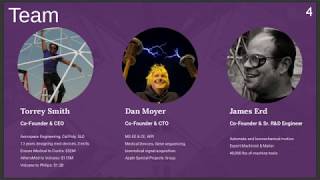
All right, guys, how's it going? My name is Tori Smith, and this is Endiotix. All right, so Endiotix is here to create tiny medical robots to diagnose and treat illness inside the human body. And so we're going to start this process in the GI tract. And the roadmap here basically starts with a thing called PillBot, which is a dignified colonoscopy in a pill. But we want to move that into a pill surgeon that can actually start treating issues like cutting polyps and doing biopsies, and even go into micro versions of that in the future that go elsewhere in the human body. So I've been designing medical devices for 13 years in the San Francisco Bay Area, and I have 3 successful companies behind me. And my best buddy Dan Moyer is a brilliant electrical engineer and computer engineer doing all of our circuit design. Finally, our third guy is James Urd, is a master machinist and maker. He's really a Renaissance man. I'd like to introduce you to PillBot. PillBot is a tiny robot the size of a multivitamin, and this thing is capable of swimming around inside your body. We have a real-time video feed going to the doctor, and they actually control it with Xbox control. We do this with differential thrust on the 4 pump jets that are inside. It gives us the ability to go forwards, backwards, spin around, all kinds of amazing motions remotely. So we're competing with passive pill cameras, which just passively move through your body. And we're also competing with traditional endoscopes and colonoscopes. And our goal with Endiotix is basically to put all of the therapeutic and even diagnostic power of an endoscope or a colonoscope into that pill camera form. This gives you a fast, sedation-free procedure. It's pretty revolutionary. This has been an amazing year for Endyotix. We started with a very large prototype and have been working our way down, and we're actually just weeks away from actually getting this inside a human for the first time. So this is, this is an amazing time for Endyotix. Initially, we're probably gonna start selling in the pill cam market, But if you notice, there's a huge $40 billion market for all the devices in the GI tract. And so our goal is to attack the endoscopes and colonoscopes and really make a big impact. The revenue model is borrowed from the world of pill cameras. So these are $500 single-use disposable devices. And our goal is to plug into the existing system and reimbursement code framework for that. In order to go to market, we need to go through FDA. But the amazing thing is we're looking at a very short trial of about 18 months beginning to hopeful market entry with as few as 100 patients. So this is a relatively lightweight path to market. We're very excited about that. And for our final slide, I'd just like to say we are fundraising actively. Our goal is to use this first-in-human demo to bring in our first institutional money. And in the meantime, we are starting to talk with some local angels who might want to come in a little bit sooner. So with that, I'd love to open this up for Q&A.
All right. Awesome, Tori. Nice work. So why are you doing this? Why did you start this company?
I'm doing this because I just feel like we've been doing minimally invasive surgery for, you know, 50 years now by sliding catheters inside people. And it just makes me think, you know, it's time for the next revolution in interventional medicine, right? I see a huge opportunity to have a, you know, a tiny little robot, if you can call this prototype tiny, be able to actually cut the cord of the catheter, right? We think we need the tip of the catheter minus the catheter. That's kind of the tagline we're going for right now.
Amazing. So why do you think the timing is now for a product like this?
You know, the timing's now because when I was a kid, these concepts were in science fiction movies and science fiction books. But now when you look at the scale of electronics and modern lithium batteries, this is a time of incredible innovation and that the pace of advancement on all the technical fronts has gotten to the point where this is possible. And so now the reason that I feel like it has to be done now is my team has the experience to make stuff like this, but we also have the experience getting devices to market and through FDA. And so if we can be the first group that actually gets a remote moving tiny robot in the human body, we'd love to kind of start that as the new standard of care in a lot of ways.
Everyone in the chat room, please ask questions. We want to make this as interactive as possible. Why do you believe that your company has a high growth potential?
Well, basically because, you know, our patients are potentially every human being on the planet. Our goal is to make cheap, tiny little robots that can do incredible work inside the human body without sedation, without having to knock people out and putting them on drugs, we think we can reduce a hospital stay from, say, 6 hours down to like 30 minutes for a given procedure. And so we just see huge potential in the US market, in the global market. We think we could put these in third world countries with doctors remotely controlling them, or even in the future using some machine learning and some AI to get some of the procedure done automatically. So we just see a huge opportunity here.
You know, Shawna asked, you know, you might have mentioned this in your slides, but how did you build your team, your advisors? How did you all meet?
You know, this is really funny. We actually met creating giant Tesla coils out at Burning Man. And we basically started working together professionally. A lot of us were connected to the medical device world. And so, Endiotics just seemed like the next logical step for us because we love doing crazy stuff as long as there's a big challenge and as long as it's emotionally fun. I mean, this has been an incredible adventure for us so far.
Christian asked, how much mobility do you feel that your device can accomplish?
That is such a good question. I mean, this thing is a swimmer, right? So, it's really good at swimming through clear liquid. Which means that our patients would have to fast for 24 hours. They have to drink about 2 liters or more of this horrible clear liquid. It's actually pretty uncomfortable, but in that very artificial condition, suddenly we have this amazing ability to move around in 6 degrees of freedom. And so we have to prep our patients, but once we do, we see some incredible opportunities to move around and get deep into the body where you just can't reach effectively or safely with scopes.
What other medical pills are currently in use? Like how are the companies in the space doing right now?
The biggest one would be called PillCam and it's been around since 1998, believe it or not. We've had 21 years of passive pill cameras. And so now there are several companies making passive pill cameras. They take about 24 hours to get through the body. So it's a very different kind of a procedure. And then recently you are starting to see companies do other types of pill-based interventions. So there are pills that deliver a drug at a certain time. There are pills that measure pH and other things as they go through the body. So far, no one is doing active real-time propulsion. And so that's really the foundation of our technology.
Can you, you know, can you speak to like the actual like competitive landscape a little bit and what the barriers are to entry?
Absolutely. Well, so we need to distinguish ourselves from the passive pill cameras. So we hope that our real-time video and our active propulsion really puts us aside, differentiates us there. And then the other thing is the world of endoscopes and colonoscopes is very well defined, and we have a task of proving to doctors that we can actually do the active diagnostic from this platform and that we can begin to do interventions with our pill surgeon prototypes where we actually cut polyps off. And I think if we can prove to doctors that we can do an equal procedure with this guy and not have to sedate patients and slide long tubes into them, I think we've got a winner here.
And, you know, the final question here is, You know, there's a question here in the chat room about like preclinical data. What kind of preclinical data do you currently have? And you know, where do you see the surgical tools attaching to the robot?
Well, you know, I've got a big grin on my face because what I'm holding here right now represents the first version of this robot that is actually small enough physically to go into the human body. And so if you stay tuned to Endeotix over the next days and weeks, you're gonna see the first live demo where this goes inside a person. It's a research and development demo. It's not going to be getting us to market immediately, but we're about to demonstrate this thing moving in a person for the first time ever under active control remotely. So this is an incredible time to ask that question.
Amazing. Thank you so much, Tori. That was terrific. Appreciate you taking the time to do this. For those of you that would like to learn more about, you know, Endyotics, feel free to email Tori at endiotics.com that you see here on your slide. All right, thanks Tori, appreciate your time.