Eren Bali Keynotes SF Fall 2018 Cohort Graduation
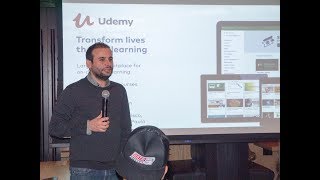
Eren Bali, founder of Udemy and Carbon Health, traces his path from a Turkish village to building the world's largest online learning platform with $170 million raised. He pivoted Udemy from live to on-demand learning through the Founder Institute, then moved into healthcare after his mother's medical case exposed workflow problems, creating Carbon Health as a tech platform for clinics and hospitals.
Chapters
I'd like to move on to our keynote speaker, who happens to be a Founder Institute graduate, and we're very excited to have him here, Aaron Bolly, founder of Udemy. Hey everyone, my name is Aaron Bolly. I was at the very first Founder Institute batch. Batch. So it was like a large batch, maybe 40 or 50 people. It was very different back then. It was— I think there was a mantra to leave no founders behind. So they were almost graduated everybody, which can change very drastically. So let's only try to graduate the best people who are very serious about this. But yeah, it was actually a kind of like interesting experience for me. I'll talk about it, but let me give you guys kind of quick background of myself and the companies I started. So I'm the— I was the founder and CEO of Udemy, which we started as a part Founders Institute. And I also more recently started a company called Carbon Health, where I'm the founder and CEO. So quick background first. So Udemy was essentially— the basic idea for Udemy has not changed since the first time we started the company in 2007. So kind of long story, but we started the company in Turkey first. And the mission has not changed almost at all. Versus my new company, we iterated a lot. So I want to kind of give both of them as background for both companies so that you guys get a kind of sense of the different considerations. So this is me and my two older sisters. I was born in a very small village in the southeast part of Turkey, kind of the rural side of the country. Not much as opportunities. But growing up, I was very interested in chess. I think chess was probably my first passion. So I started playing very competitively since the age, I guess, 4. And I got interested in mathematics. There isn't really a lot of room to grow into your capacity if you're born in a small village in the southern part of Turkey, right? So it's kind of— imagine the areas closer to Iran or Iraq. But for me, something happened that changed my life. So my older sister was eventually going to college, and my parents bought her a computer. So over the summer, I had access to the computer. I started playing chess on it, and I started finding mathematics resources, communities, and And long story short, I actually ended up self-training myself for more advanced mathematics using internet and nothing else. And I ended up winning the gold medal in Turkey's national math olympiads and silver medal internationally. So for me, I'm not saying this is just a brag about it, but I kind of realized internet was not going to create this completely leveling field, but it would actually give a chance for people to catch up. I'm kind of looking back right now. I got made into chess again after 25 years. And I realized back in the day, you could only be a grandmaster, you could only expect to be the world champion if you were born in Soviets and if you're in one of the major areas where chess was competitive. But now with internet, it's so much more democratized. If you look at the top 2, it's far more diverse. A lot of countries bring up winners. And Norway, which is a small country, has the world champion right now. So Magnus Carlsen, who's from Norway. So essentially, internet definitely democratized the concept of being competitive chest. And it's also making big impact with the rest of the world as well. So I don't know what's happening. Okay. All right. So before we even came to the Silicon Valley and I joined— before I joined Founders Institute, so we started the company like we did originally in Turkey. It was called from nowhere back in the day. 2007, this is us. We had one small room that we had rented in Ankara, the capital of Turkey. And we were just working together to build something with our plastic chairs. We came with those $5 chairs and our own $10 desk. So that's how we got started. But the kind of mission was very simple. So internet could create some level of deal. So we wanted to tell, if we made it possible for anybody to teach online, to share their expertise online, And a lot more people around the world could be taking, learning from those people, right? So we thought experts are not necessarily coming from top college or top education institutions. Experts could be coming everywhere. So if you actually just provide a platform for them, you could actually have a kind of outsized impact on the world. So we started in Turkey. The original product was a live education marketplace instead of an on-demand education marketplace like it is today. But the concept was very similar, like a marketplace where experts and students can connect to each other and learn from each other. But we very quickly realized in 2007 Turkey was— it was the wrong time, wrong place, and wrong product. It was the wrong time, there was zero education ecosystem in— there was no startup ecosystem in Turkey at all. No angel investors, no one who would understand what a share, like an option, means, right? A second is, even in the United States, looking back at 2007, 2007 was way too early. So a lot of the video streaming or the live communication tools were really early. They were not functioning properly. And we did not have devices with standard microphones and cameras. So it was actually not the right time, even if you were in the area. And lastly, live education was the wrong product for what we were trying to get. And Udemy's idea is connecting the experts, students, and instructors. But when you are very small, it's really hard to bring instructors and students who are interested in the same subject together. But if you also bring them together at the same time, that becomes an impossible problem to solve. And after Udemy, probably 100 more companies were started for Udemy for live education, including Google. Google started to help us. They all failed. So we very quickly realized after launch that it was not going to work. But because there were no investors in Turkey, I was actually funding the company by working at nights for Silicon Valley companies as a nighttime developer. So just at night I would work for companies here, and during the day we would actually work on Udemy together, Kenova together. So because of that, I had some connection to a couple companies here. So one of them brought me here full-time, so he had to kind of decide to shut down the company. So, and that's the part, like, we— I came in, we started working for the startup, which I learned a lot from the company as well, but I was really still very compassionate about Udemy. But because we had failed once, like, we didn't really think that we could actually recover it, right? So my co-founders, like, oh, like, everybody had left, all the team had left already, stopped working on it, um, And yes, we had pretty much given up on the idea. I actually initially applied to Founders Institute with a different idea. So we did a business-oriented social network for a local newspaper agency back in 2008 or '09. So we made some money. We said, OK, now let's just make a business-oriented social network and scale it. That was the idea. We kind of had the 10 first sessions. A lot of the mentors correctly identified that this was a terrible idea, right? So, and, but like one day I was like, I was talking to Adrien, so we were maybe like about to be kicked out, I guess, because we did not have any kind of viable idea there. So, and I said like, we had built this thing like a couple years ago, what do you think about it? I think still it was very innovative. And Adrien said, this is like, this is extremely innovative. This is exactly what you should be working on. So I was already wanting to take it again, but the kind of additional motivation was like, was huge for us. And one of my co-founders, Gagan, so he was working on another idea, which was also a terrible idea. But I eventually kind of convinced him to join us to kind of build Udemy together. So we kind of renamed it from Knowband to Udemy, launch to company. So unlike some of the other founders, we like, just to kind of be fair, like we I was an engineer as my other co-founder. We brought all of my— most of my former team from Turkey to Silicon Valley to work in other startups. But the plan was to eventually get them back to Udemy as soon as we get funding. So we'd already built some other application. And we threw everything we had built before and rebuilt Udemy as an on-demand education marketplace instead of a live education marketplace. So, and I'll skip the story a little fast probably, but so I guess one of the slides is kind of— okay, it's here. So, but if you just— if I'll fast forward and come back. So Udemy today has roughly 500 employees. We raised $170 million. It is like the largest online education platforms. So we are a lot larger than some of the companies you might have heard of, like Coursera and Udacity. So it was a very competitive business. So we ended up becoming very successful. We will probably take it public next year or so. But I think the kind of— if you, again, pull back from the day we were thinking about taking this idea again. So we decided to kind of do it again. We went through the program. And Founders Institute program was great for us because we were all Essentially, two of us were immigrant entrepreneurs, and Gaga was a fresh grad. None of us had any real job experience. And this program was actually a late-night, evening program, so we could actually continue to work full-time in a company and do it on the side. So that was very important because our visas all relied on, essentially, our full-time jobs. There was no other way we could actually get this started. But I, I learned a lot from the program, and reality is not everything we learned in the program became immediately useful. Like, because when you first start, you have to build the product, you have to be good at those kind of things, and those are not easy to learn in a like 5-10 week entrepreneurialship program. You might do it in a development bootcamp to kind of help with that. But so, but what happened is over the couple years, I would keep opening the old videos again. I would actually pull them back. I'll look at what people talked about branding, and research, and IP. And that became essentially almost like a curriculum we got that was very impactful to us over the next 4 or 5 years of the company, not just when we first started. But really, you had to push something yourself. But it actually gave us both confidence and some of the basic understanding to get started. We met with a lawyer named Joachim Taku, who was drafting the first original Founders Institute documents. And he's still my lawyer after 10 years, both companies. I've been working with him. Our first investor was one of the Founders Institute mentors named Russ Rabin. So he was interested in education. He liked what we were doing. And then he became the first angel investor. And then once we got Timur, honestly, the rest of the round was really fast, kind of quick to fill out. So fundraising was not easy at all, but still it was great to start with some network. So it's really hard if you're not a Silicon Valley native person who already has a huge network in the Bay Area. If you are not in that kind of minority of the population, it's really critical to get some initial network who will make some introductions, will introduce you to more people. For us, I don't think there's any way we could get this up and running without a founder's institute. So, but again, the rest of the story is sort of like, we raised the first round, we started growing fast, and then we started growing 20% month over month for 4 years in a row. And then, even if you had small amount of revenue in the beginning, after 4 years of 20% month over month growth, you become a huge company. So, um, so that was a kind of wild ride, but I think like, post-Founders Institute, we also got really in touch with all the other people in the Institute. For example, some of the people in my class are investors right now. They are VCs that we talk to. And some of my other friends have raised money from them. So actually, the original network has become more than just an initial support group. But it was definitely— I think that the team of people who are doing the program together is probably the most important thing long term. The mentors are good. They give some connections, maybe some advice. But they are usually full, like, busy, full of people who have critical full-time jobs. They're not going to be next to you all the time. But your classmates are actually the real value, like, in the long term, when it comes. So I'll actually kind of move forward to my personal background. So but kind of a quick thing. It's funny, when we first were ideating about Udemy as part of Founders Institute, We had this kind of session about what would be the perfect dream team to happen on your business. So we said we dream if, for example, I said Dorian was teaching a course on Udemy. That was my dream, right? And I think Gagan has kind of selected Negraz— sorry, I forgot his name. So Negraz Tyson. And so we kind of picked these. Last 3 names here were listed in our dream things to happen as a part of your company. And it did happen before 2005. Actually, in less than 5 years, all those 3 people were actually teaching courses on Udemy. So, and what happened is, for Udemy, I was the founder and CEO of Udemy for the first 5 years. I eventually stepped down. And I got very interested in healthcare. So I'm still chairman at Udemy. Still fairly involved, fairly active with the company. But I decided to start a new company, and I want to talk about the story of it because I think contrast is interesting. So once I was obviously an established entrepreneur at Udemy, everything changes, just to be very clear about it. So the first time you want to raise money is very easy if you have at least one success story. And the reality is, in your first company, you don't have any track record, you get really low valuations, which happened to us at Udemy. So, like, we got a lot of— we got very diluted and we lost control very fast. So things like that happen if you're not ideal. But the reality is we were high-risk entrepreneurs. It was a big risk to bet on us, right? So, and what happens if you have one successful company and you raise another company? That's where you get— now, now it's your turn, right? Now you get amazing terms, like you have super, uh, kind of super-voting power and All the investors will line up to kind of give money to you. So it changes very quickly. But if it's your first company and the company is not exploding in terms of growth, you will have to give up, right? So that is normal, but you still get very successful and very rich when it becomes successful. But it's still different when you are doing your second company, right? And maybe some of you guys will start one company and that will be your last company. So that's really going to be dream for most people. But for me, I got— interested in healthcare kind of almost on an accident, right? So what happened is, um, I, I was still a student, and my mom is still back in Turkey, and she, she had basic back pain, abdominal pain, and in one week she had a full body stroke. So literally her entire body had like independently kind of like got a stroke, and she wasn't able to move pretty much anything. And I had to take 4 months of work to go back to Turkey. My sister is a physician, so she lined up some of the best specialist professors to look at my mom and understand what was happening. And what we did first was we wanted to extract all of my mom's medical records from all the hospitals she had been to, all of her primary care records, her medical images, PET scans, lab results. You just kind of compiled everything. This is not the real folder, but it's a— It was a 1,500-page document that my sister had generated with all the DVDs, MRIs, everything attached to it. So she perfectly cataloged everything. And we were going from doctor to doctor. And each doctor was doing kind of the same thing. So if they look at— I don't know why some of the slides are not coming, but— OK. So each doctor was doing the same thing. They would actually look at every page. They would write 2 words into their notebook. And then they would look at their notebook to make a decision. So I asked my sister, so what are they writing on their notebook? And she said, they are making a chronology of the case so that they can understand what's happening. And I said, why aren't we giving the chronology to them so that they can, instead of spending 2 hours looking at everything, they can spent 2 minutes skimming through a kind of essentially a presentation of the problem that in a way that's presented in a way which makes more sense to a physician, right? So, and while I was waiting for a doctor, I made this very original sketch about what it would look like if you actually made a medical health record design that kind of resonates with physicians. So I made this initial mockup, so like sudden collapse of nervous system what's wrong. So from like essentially presenting my mom's case, I say, you know, like, it should be a chronological order. Just as my sister, all the doctors were generating on their notebook, right? And then all the medical records, all the lab results, all the images, everything should be there so that people can look at them, comment on them, and multiple doctors can work on them together. So I just made this one-page design, and eventually one of the professors diagnosed what was happening. So it was a rare disease called neurosarcoidosis. I just remember perfectly, my mom recovered. No sad story here, right? So everything was going well, but this kind of idea of like the observation that this entire team, the two sets of physicians, which is one of the most expensive resources in the world, right, is the time of the physicians, was being— the tools they were using were so inefficient, and really nothing about the technology stack they were using made sense to them. And I know that it did not make sense for patient needs either. So that kind of got stuck in my head for a long time. So I went back to Udemy, but after a year or so, I decided to actually take a stab at solving this even larger problem of healthcare being extremely inefficient and really the technology kind of making the patient's and doctor's life miserable instead of making it better. But what happened is, honestly, I had the vision or the idea, the almost like I wanted to do what we are doing today, but when we first started, we didn't think that it was going to be viable. So we didn't think— we designed the entire healthcare technology from the ground up. It was an idea that even I could kind of get on, like, start with. So we picked something small. We said, let's make a small community of physicians who can share medical records with each other, like these complex cases with each other. They can comment on it. Almost like a Stack Overflow made for physicians. But the idea was to kind of create a structured dataset so that it becomes a kind of large repository of very interesting complex cases and physicians can search through these things. So that became the kind of a smaller version of the idea. So we decided to— we actually built the first version. We raised some money with just the idea. And this is what happens, like if you have one successful company, you have the idea, you send an email to a couple people and you get you get around on, right? So that's what happened. So, and very quickly we realized this was a kind of bad idea, right? So it was— so it was a bad idea because, um, the medical records were actually really locked in the health record systems, right? And if you had no control on them, it was really tricky to extract them to an outside place. And for doctors, this was going to be too much work to do that from the beginning. So we started by getting more about how people discover what are the more key problems there. And we came up with— we realized essentially was the entire healthcare system, there's so much disconnect around the patient care. That was the core problem. And then the green decide, so And really, our success came from creating a destination, online learning destination, without having to produce all the courses ourselves. And similarly, Uber became the world's largest transportation company without owning any cars. And again, Airbnb is, in a way, the world's largest hotel network without owning any of their rooms or any of their buildings. So I started having this bigger idea of what would it look like If you want to be the world's largest healthcare provider, right? If you want to do what Uber did to transportation, become the actual provider without owning the assets, what would it look like? That became this question that kind of stuck in my mind as we were working on this other idea. And one kind of Christmas day, I made this 200-page sketch of what healthcare experience would look like if we're building this for ourselves. So at that point, I had not even told my team about it, right? But this was kind of the idea. If we build the entire healthcare experience from the patient's perspective and own that piece, and we also can proactively build the entire physician experience from the electronic health records, scheduling, messaging, billing, e-prescription. It's a very complex product problem, right? So usually, most— health systems use somewhere between 10 to 15 different software to connect to that. And they're really bad, really disconnected, coming from '90s designs. So we said, if you just build all this entire technology stack, you can actually build a healthcare experience which is significantly better than what's possible today. And we realized all the medical records logic we were designing for the other idea was really meant to become the primary driver of healthcare. So we can use the technology but let me kind of ditch the old idea. And I told our team, like, what do you guys think about it? Like, are you guys— this is crazy. It's not— it doesn't feel doable at all, but it would be really fun if you try to do it, right? So, and they kind of agreed to work on it and ditch the old idea. And I told investors, and I was expecting— I told them that they could get their money back if they don't like this idea, but most of the time they wanted to put more money than kind of put their money back. So, and And what we did next is— there's a video here. I don't know whether it will work. So we opened a small clinic in San Francisco. And in 9 months, we started from nothing, found some clinicians, nurses, built an application for the patients to essentially own the entire patient experience, and launch a clinic and started seeing patients. This is from zero, having no idea about how healthcare works, to having a clinic which is seeing real patients. Quick video that we had produced in the early days. I don't know whether the sound will go back. So this is very fun, right? Because the challenge here was like, even though we could raise some seed capital, healthcare is very complex, there are a lot of regulation issues. This was like, when we put up this idea, most investors thought like, there's no way we can get this, like, get something viable in the next 2 years, so we should just third-party software. But all the third-party software would make the experience terrible. So we kind of decided to get into like a big undertaking, very quickly build this kind of experience. And very, like, I mean, even after a month after we launched, it was very clear that patients loved the experience. Patients loved being able to schedule online and message with their doctors, get their lab results from their phone. So the Proving that the experience was great was very quick, to be honest. And then we started getting into the detailed platform. We started building a lot of other functionalities. And so this became kind of essentially, coming out, it became a concept where we want to provide care as you have a physician in your family. I mean, part of this was a digital experience. So from the software side, it can be a choose card, be a chatbot which collects most of the information, things like that. We have an array of different modalities for care. And these are mostly built in the first year, right? So we improved them significantly by then. And actually, there's also a good physical component too. So we built applications for the exam rooms. We have a kiosk for the front desk. So it became probably— I mean, honestly, I can't believe what we've been able to build. We only have 5 engineers by the way. It's not even very large. Most of the time, we have 2 engineers only. But this was like sometimes something that sounds just like crazy, so crazy that there's no way you can do it, is sometimes a much better idea than something that feels like a viable, doable thing, right? But you had to— but building that product is the product that you have to be good at, right? That's— there's no— unfortunately, there's no replacement to the kind of skill set that you don't have. You'll have to find it somewhere, ideally with a co-founder. So, uh, so you can build like everything from the branding, the packaging, of the physical space experience. So it could be a pretty interesting company. OK. So— [SPEAKING SPANISH] Let's not worry about it. So what happened later is we were looking for this more scalable model. And we realized that we started working with hospitals. So what happens is we decentralize all the user experience for physicians, for patients, all the technology, all the design, all the marketing. A provider brand, but we decentralize the ownership of the physical clinics. So we do have some clinics ourselves, but by and large, the clinics that operate Carbon Health are actually owned by hospitals. So they want to— they love this user experience, and they want to provide this in their geographic region. And we kind of do the end-to-end for them. So for the patient experience, it's mostly Carbon Health, but the physical clinics are owned by the hospital. And the physicians are all employed by the hospital. So we don't have to take a financial risk. So we can actually scale this to thousands of different clinics. So I honestly think it's a kind of great idea. The business has been doing very well. So we have 170,000 patients. So in 3 years, we made a small acquisition, 7 clinics in the area. And we'll probably open another 50 clinics in the next 18 months. Which again sounds like a really crazy thing to do. But I think that's like, sometimes you just, if you just put the goal and then reverse engineer what exactly you would need to do that, it does happen, right? And most of the very successful companies are started that way, right? So, so, so this is very successful, but what's happening is, so fundraising, we raised the first seed rounds easily, right? But once we were trying to raise Series B round, it still kind of became hard. I mean, we are doing it right now, we are closing it soon. So it's happening. But I want to mention that even if you're an established entrepreneur, what happens is to start a very successful company, two things have to happen at the same time. So first of all, your idea has to work. It has to be a real good idea. So that is, if you have a bad idea which is not going to work, then you cannot be successful. But in addition to that, it also has to be somewhat controversial. If everybody is thinking your idea is great, then the best you can get is a kind of small exit to an established company, right? So if, like, if mobile started growing really fast and you started a mobile advertising company, that's clear, straightforward. One of the large companies will buy you, right? So that's what you're looking into. If you build an AI company right now doing one of the thousand different ideas about AI, it just generally makes sense. There's really almost nobody disagrees with the importance of AI. So you're looking for an acquisition. It's really hard to stay as an independent company because the domain is so straightforward. So it just makes a lot of sense to all the large players, right? So what happens— it has to happen for you to be very successful is that people have to really dislike your idea, right? At least it has to be polarizing. And Udemy— nobody believed in Udemy's idea for a very long time because people believe that you can never start an online education business without having a certification or diploma attached to it. And this was the comment of 9 out of the 10 smartest people we know in this business, right? So even people who invested in Udemy, they kind of liked us. They liked that we were able to iterate fast and we were scrappy. But they didn't think the particular idea was going to work. They thought it was actually a puto idea. And what did happen is we actually turned out to be right about that. It turned out to be right that a lot of people want to improve their lives, and learning is one of the best ways to do it. And you don't really need certification. You don't even need a diploma for most of the learning that people need. So essentially, it turned out to be right. And that became the reason why we became very successful financially and why we will be a very large public company. But even with that under my belt, so we are doing Carbonell. So there are a lot of reasons for investors to be really scared of this idea. So we are doing primary care. So the assumption is that primary care has exact, absolutely zero margin. So we have 34% of the margin are coming. So we already saw, we figured like who did this actually correct. So people who are worried about anything with brick and mortar, which I think is the wrong way to look at it. They want to avoid insurance billing, which I understand the complex, but like I think that most people who are concerned about this, inherently are wrong, right? But even with that, in this field, it's not very easy because you think they are wrong, you think you are doing the right thing, all the data we have shows that what we are doing is right, but even with that, it's actually not, it's an uphill battle. You actually have to question yourself again and again. You will have to iterate on the idea until it becomes, or the business model, or the go-to-market strategy, until it becomes something that actually can become a viable company. How are we doing on time? Oh, we need to get on to the pitches? Sure. So what that says, I want to talk about the story of two companies as two different entrepreneurs starting it. But you can also see some of the similarities. Do you have any questions to me? We can take a couple of questions. We've got time for maybe two questions. You said that a company needs two things to be successful. The first one was a controversial idea. What's the second one? Your idea has to be a good idea. Oh, that's good. Seriously? So you have to be successful and also in a controversial idea. That's really the two things. That's why I think a novel approach— I mean, if you can do a non-controversial idea, But then your execution has to be really tight, very good. You just have to out-execute everybody. So if you're doing an AI company right now, you just have to do it a lot better than every other— the 10 million other people who have the same idea right now. So, and even with that, you're looking for a kind of mediocre, mid-level exit, right? With that. But if it's a controversial idea that nobody's going to think is a good idea, then you have actually an opportunity to kind of start one of the biggest companies in the world. One more. Aaron, does your app have any health monitoring built into it, or does it sort of integrate well with other third-party health monitoring apps? So we are planning to do that. So that was one of the things that I thought was so important, like, so we should do ASAP. And I'm glad we did not actually prioritize it before, because the reality is, once you open the clinic and start seeing real patients— actually, first, our Friends became patients. And they all asked for that feature. They said, can I connect my Apple Watch or other stuff into the car vent? And then when the real patients came in, we realized this was not even the top 10 priorities of the real patients. So we had to work on, can it reliably prescription alerts, lab results, and can I essentially get in and out faster. So we mentioned this important idea about, if you're a technical person like me, looking at healthcare from the outside, It sounds like it's one of the top 3 most important ideas. In reality, it's maybe idea number 30, right? So we are still doing it, but not as important. Real quick. Yeah? Your first startup is about education. Second is healthcare. And do you think the third one? So I think it's maybe robotics. So probably 10 years later, for like— actually, starting a success company takes 10 years. Thing where you start another company every 3, 4 years. So I have twin daughters right now which are 8 months old. So my dream is that when they grow up and when they're like 15 years old, we'll actually start building robots in my garage together. And then that will become my next business. All right. Thank you so much.










