Fantine is the 2019 impact startup Pitch For Purpose Champion!
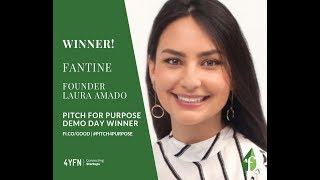
Laura pitched Fantine, a blockchain marketplace connecting coffee farmers directly to roasters. About 25 million farmers earn less than production costs because middlemen control pricing. Fantine's platform provides traceability and a machine-learning price index, charging roasters $119 monthly, and won the 2019 Pitch for Purpose competition.
Chapters
Hi everyone, my name is Laura and I'm here to talk to you about Fantine and how it is fueling the revolution of the coffee value chain. Have you ever felt that you work a lot but someone else gets all the recognition? That's exactly what happens to 25 million coffee farmers around the world. They work hard to produce our beloved beverage, but their earnings don't even cover the production cost. On the one hand, middlemen get a big chunk of the profit while adding almost no value. On the other hand, the coffee price is tied to the New York market that treats it as a commodity with no differentiation at all and without considering its quality nor its production costs. We are here to change this. Fantine is a centralized marketplace that connects farmers and roasters directly. Reducing the number of layers between them. Using blockchain technology, buyers can trace the entire journey of the coffee they are buying. They receive full transparency about coffee's quality and they benefit from a shorter supply chain, which in turn translates into better prices and fresher coffee. On the farmer side, they get access to new markets and customers, reducing the dependence on largest importers. They can set prices based on cost, therefore they get to double their income. Farmers and their crops receive digital identities that enable the full traceability of the coffee throughout the entire value chain. All the information related to these transactions is stored into our secure ledger. Then we use machine learning to aggregate this data and to produce a new price index, a price that is bottom-up. Transparent, fair, and auditable. Our ambition is that the industry uses this price instead of the commodity price. Our revenue model is a monthly fee of $119 paid by buyers. The opportunity is huge. Coffee industry is a $100 billion industry, and specialty coffee is growing at a double-digit rate and booming everywhere, especially in the US, China, and Japan. We start with a pilot with farmers in Colombia, and we plan to reach 1,000 roasters and 4,000 farmers in the first year, earning $1.4 million. These are some of our competitors. However, none of them provides full transparency combined with an open market that connects buyers and sellers. We are in pre-seed phase. We aim to build our MVP by October this year and to launch in April. This is our great team. We are Laura and Federico. We got into this because we really love good coffee. Now we strive to improve an obsolete value chain so that we can deliver the best coffee to the world while improving farmers' lives. Thank you.
Hi there. Great. Audience questions? Voting is coming soon. And thank you for a great job, Laura. So why don't we start, Christine? We were joking about coffee before we started the webinar. So why don't you go with the first question here?
Sure. So if you could sort of speak to the pricing model and how you got to that point, make that decision.
The $119? You mean the revenue model? Yeah.
Not just the actual price, but how you were going to structure, you know, the pricing.
Okay. We started thinking like the current roasters or the roaster, they travel to origin at least one time per year, trying to find new varieties of coffee. So one ticket for one person costs barely or at least $1,000. So we are going to charge $119 per month, which is $1,400 per year, which is almost the same as one ticket. So we think this is a good price for them and enough price, and they can find a lot of varieties of coffee, not from just from one place. But actually what they are looking now is to find different varieties because this is a huge trend, a huge topic in the coffee industry that everyone wants to see new coffees and change the coffee every week like Starbucks does. So that's what roasters and coffee shops also, they are trying to figuring out different varieties.
I don't want to sound like an idiot here, but, you know, I would imagine there's a nearly infinite variety, but I mean, is there some sort of taxonomy of varieties, like there's 50 main ones and 1,000 derivatives or—
Yeah, actually, there are two different types of beans, Robusta and Arabica. Arabica is the highest quality, so we are focusing only on Arabica because this is the variety that has more potential in terms of flavors and profiles. And yes, this kind of coffee is like wine. You can find different flavors, Chocolate, fruits, a lot of different things, and it depends on the place it was harvested, the altitude, the processes that are different processes. So that's actually why we decided to— we met with my co-founder in a coffee tourism experience, and then we learned all of this. So yeah, that's what we came with Fantine. Afterwards.
Okay, well, there you go. Noah, questions?
Yeah, I mean, I love this product concept. I'm a huge coffee enthusiast. I roast at home, and, you know, I think there's the potential to do in coffee, you know, what's been done in the wine world, you know, and really expose, yeah, all the, you know, unique varietals and experiences, you know, to the broader market. I also, we have one investment actually in a coffee roasting equipment business that puts mini roasters in cafes and allows for micro-roasting. So we have some experience as investors in the coffee market. And, you know, it's actually, you know, the world's largest commodity market. It's really, it's a huge market. But I guess my first question would be, do you see a way to expose the information that you're gathering beyond the wholesale markets, you know, to extend it out to the consumer to help, you know, the roasters create that extra value as well by virtue of using your product?
Yeah, actually, that's one of our goals. And is that on the one side that the roasters can use Fantino, our platform, to actually certify that their coffee is truly fair trade, because the consumer will know that this coffee they are drinking was paid like a fair price. And you could know it from like with some code. We are still figuring out how we are going to do this, but the idea and our goal is to do that, to have full transparency from farm to cup. Actually, yes.
Well, and I guess, have you done some market sizing on the roastery opportunity?
Yeah.
How large is that opportunity?
Well, there are more than— it depends on the region. Actually, roasters, this is an industry that is spreading all over the world, the roaster thing, and coffee shops as well. This is, it is important to say that this is an industry that currently is, the trading is managed by very few companies, less than 10 or 15 worldwide. So, this is like a new segment, a new market channel, which is all the thing about roasters and coffee shops. In the US, for example, there are more than 2,000 roasters, more than 2,500 roasters. And in the case of Europe, more or less the same. And in China and in Japan, there are also great opportunities because the industry actually is overcoming or surpassing the tea industry in China and Japan as well, in both regions. So yeah, there are many roasters and they are growing everywhere.
Noa, anything else? You roast at home, man. I'm like—
I know, I can't compete with my roast at home.
Actually, I'll just mention quickly, Paul Rice, who started Fair Trade USA, was in my business school class and is a friend, so I kind of saw, you know, from the early days of trying to get that organization going how hard it was, and I guarantee you he would be super interested in Fanteen, so glad to introduce introduce you to them.
Thank you. Great.
Whoa, that's amazing. And I know I met, uh, the one of the, the programmers at the company you're talking about, your investment company. Noah, let me get some questions from the chat and then I'll turn it over to judges. We got a lot. Clearly coffee is popular. Um, you know, you kind of answered this, but Pavel was asking, why did you choose coffee as a product? I mean, I guess you could apply the tech to tea and other—
Actually, because the problem is huge in the coffee industry. In general, in the agricultural sector, the value chain is so unbalanced, but we could say that in coffee is even worse. So the value that remains in producing countries is less than 5%. And we, as I told you, we met in a coffee tourism experience and then we got firsthand with we knew the problem firsthand. And we realized how much effort is put into the coffee growing and how bad and how difficult is life for farmers. They cannot rely on coffee. They cannot have a livelihood from coffee. And actually, they are migrating to main cities. They are switching coffee for other crops. In the case of Guatemala, they are migrating to the US because they don't have— they don't see a life in coffee. And newer generations, and the, yeah, newer generations either neither see a livelihood on coffee. So this is unacceptable and it is unsustainable as well. So I like coffee, I'm a coffee lover, and I decided to study coffee, and that's why I'm from Colombia as well, but I decided to explore more about the coffee industry and the coffee process. And then where was I? Understood the problem firsthand, and also my co-founder, and actually we met there. And—
Can I ask you just to keep the answers a little shorter because there's a bunch more questions I want to get to.
Yeah.
Out of curiosity, you brought Colombia up. This wasn't a question from the chat, but what percentage of coffee comes from Colombia worldwide today?
Actually, there are top 10 countries. Colombia is the third. The first one is Brazil. The second one is Vietnam, but Vietnam only produces Robusta, and Colombia Colombia is the third one with 8% of the coffee production in the world.
And then BM was asking, how do you address the falling coffee demand from buyers like Starbucks who are selling less and less coffee in their stores?
That's why we are creating a new channel for the ones who really need good coffee, who are the roasters and the coffee shops. Actually, Starbucks also are interested, is interested in good coffee, but they are more like beverages with coffee more than just coffee. And yeah, we are trying to focus first on these roasters and coffee shops that they are growing, but obviously they can be—
Yeah, like Phil's. Phil's is way better in the Bay Area than Starbucks, and they're dominating. Okay, John McDonald was asking, How do contracts for beans typically work? Are there futures or spot sales?
Sorry, can you repeat?
So, yeah, how do contracts for the beans typically work? Are there futures or spot sales?
Yeah, actually, yeah, currently the coffee trading is almost a financial business. So the coffee is a financial instrument, so they buy coffee in order to use a financial investment. And then they sell coffee when the price is going up. And that's what we are trying to change with this. We will be transparent with information about origin, when the coffee is ready to be sent, when are the harvest times, and all of this important information that can be— we are using blockchain for this, for record all of these transactions. And that's why we are not— yeah, that's what we are doing. Not a financial, not using the coffee as a financial instrument or financial business, but more like a normal product that you can trade. Imagine that Pantene is like the Alibaba of coffee. So you can find coffee, you can find several type of producers with different qualities and varieties, and there you have all the information about them.
I love that. And by the way, you being the Alibaba of coffee is great. So right, right now, are you developing your own blockchain or using something like Ethereum? Was the last question from Matthew. And then we're going to open up the voting.
Actually, we are using a permissioned blockchain and it's a hyperledger fabric.
Okay, great. What we're gonna do now is— judges, do you have any last quick questions?
No, I think we release her to the hounds of the chat.
Okay, so we're gonna do— we're gonna start opening up the ball. Thank you very much. Thank you very much, Laura. This is amazing. I just want to say, Christine, isn't this great that we have 3 female entrepreneurs.
Well, it's great if it was, uh, not intentional necessarily.
It wasn't intentional. This was all, uh, this was all organic.
That's fine. In that case, when you roll the dice and you're only picking 3, it should happen sometimes. So good for you.
Yeah, well, listen, you know, it's better than, it's better than, um, all men, which I think was what we would see for many times. Yeah, in fact, so have I, unfortunately. And so this was completely organic, chosen by votes. And it wound up, you know, it's great to see that because we really need to, you know, we're not going to make the world a better place if companies are started by men. And it needs to be started by both men and women working on things that matter. And so I appreciate now the poll is opening up, everybody. So I believe if you go to the— there's a poll link and you can— who should win the Pitch for Purpose competition? And it's also in the chat. So I'll ask my team to make sure it's posted there. They're experiencing a little lag and I see votes are coming in. I'm going to set a timer of just over a minute. I'll give a little over a minute and a half. So if you haven't voted, figure out how to vote. In the meantime, I made some comments on the women and working on things that are important. Christine or Noah, do you have comments that you want to throw out there about the company? Sorry, I'm starting my timer for you.
Yeah. So So I think it was interesting because they're all in different stages of development. So it's hard to do an apples to apples because it's not like everyone's, you know, obviously the SolverGen has a much longer time to get to market than other companies are going to have because of the regulatory issues. It's also in some ways a technically harder problem because you've got to find good data, you've got to clean that data, you've got to make sure you can manage it, you know, sort of teach the system about it so they can make decisions. I think Fantine's gonna have, you know, their challenge is totally different. They've got supply and demand. It's gonna be about creating that marketplace and making sure the pricing works. I have a feeling they're gonna go experiment with pricing quite a bit once they get into market more. And Praxilabs is already in market. So again, not apples to apples. I think the challenge for them is just, you know, making sure they've got a sustainable pricing model because I do believe they'll have great demand on both sides. I think they'll see students have better outcomes, but it's gonna take time. So it's—
Yeah. I mean, they had a quarter million dollars of revenue.
It should get traction as long as the product is there. Again, I think SolverGen sort of a little too early to tell, but generally, yeah.
Yeah. Quarter million dollars of revenue for PraxiLabs. Noah, do you— what are your thoughts on the 3 companies and do you have a favorite? Christine, do you have a favorite before we go to Noah?
I do have a favorite.
I didn't know if you want me to say. You can say it.
We're voting. So I think right now my favorite is Praxilabs. I think they're the ones that have, um, they have the most proven product market fit. Um, I think they're also, given that we are in a pitch for purpose pitch competition, um, I think they're having, uh, they will impact the most people. People potentially, just because it's evergreen. And I think there's a cap for, you know, how many farmers, for example, there's a cap for how many, you know, labs. There's not a cap for how many students. Every year we make more students.
So that is definitely true. Noah, any comments on the 3 companies and your favorite while we let people vote for another minute?
Yeah, I think SolverGen, this, the need to create more of an open source community around tying, you know, tumor types to actual treatment and getting outcomes data, you know, and making that, you know, widely available. I think it is a real, you know, it is a real need. There is a real social benefit there because what you've kind of seen in the industry is that the private companies And in many cases, actually, the university research health systems have been finding the data so valuable, they're really monetizing it and they're keeping it, you know, very proprietary. And to the extent that it can actually be, you know, exposed more broadly overall, the entire industry will move forward faster. So, you know, I think there's a lot of potential impact there. It's, probably a long-term impact because it's really going to take— it takes time to form, you know, any kind of an open, open source, open research community, you know. So it's, it's a years-long, you know, mission there. I think Prax Labs, I'd agree with Christine, it does have an ability to touch a lot of people, help a lot of people faster, and they have fantastic metrics in terms of student retention, which is really hard to show. Actually, it's really hard to show movement in that with a single product. That's really impressive. And Fantine is addressing a real problem, you know, being close to coffee in many ways.
You roast your own beans?
Yeah. You're really close to coffee. I am a coffee guy.
You're really close. Are you roasting beans right now?
Well, I drink coffee literally all day long. I always have coffee near me. But, uh, yeah, it's right now, it's actually a severe problem for farmers because coffee prices have been falling. There's an oversupply situation. And in many cases, they're actually the best farmers can only sell at commodity prices and those prices are below their costs. So there's a real disincentive today to create higher quality coffee, which is really absurd because there's much more demand for higher quality coffee. That's the real growth, you know, opportunity in the coffee market and the whole— all the beverage markets, right, are moving toward premium products. So, Fanteen's really addressing a real, you know, a real problem and, you know, that's awesome. But I think— I would have to I would come in alongside Christine saying PraxiLabs is touching the most people today and I think has a lot of, has very leveraged potential to help the most people in the nearest term. So that's the one that I'd probably say stands out the most among these.
All right guys, we're gonna do the vote then, okay? So 10 seconds for everyone who hasn't voted. 10, 9, 8, 7, 6, 5, 4, 3, 2, 1. So, all right, the, the results look like they're in. Wow, it's, uh, it's, yeah, it's a lot closer than you would think. So we're looking at—
yeah, well, you have 3 good companies. I mean, it wasn't like you had, you know, some chum in the water and then—
And really amazing founders. You know, I was impressed by them all and with backgrounds, passion. You know, this is the great thing about when you work on a business with purpose or impact. You don't get these founders that like are like reading from a book. They clearly cared, right? And so passion wasn't a problem. So, okay, the results are as follows. Coming in and in a close— they're all close here— that's like 30% with Solvargen. Number 2 is 33% with Proxylabs. And then the winner, Noah, you know, at 37%, in case you can't do math, is Fantine. So, you know, well done, Fantine. Now, I really, really appreciate— I was gonna— I kicked Laura off screen to make us a little bit bigger. Maybe if the admin team can pull Laura back on screen to say her final closing words. But I want to thank our partners at, at 4 Years from Now and the Mobile World Congress for really helping to pull this together. I want to thank everyone who watched today. I want to thank all the people that applied, all the people that voted. And I want to thank you, Noah, and thank you, Christine, for making some time. Guys, we just need more entrepreneurs working on things that matter, right? And, you know, let's improve the lives of the people who grow coffee and can't support their families. Let's teach women and children in Africa and the MENA regions about STEM. Let's help cure cancer by making data more available. And it's entrepreneurs like the women today and men all around the world that are working on these purpose and impact businesses that are going to make the world better. So thank you, everybody. Thank you, guys.
Thank you. Thanks for including us.
Any final words to close it out, Nora or Christine?
No, I just— congratulations to these great founders who are— again, they're all good companies. So I just want to congratulate them on the progress they've made so far and looking to Looking forward to seeing them get to the next level.
Yeah, kudos to everyone who participated, everyone who submitted an application. You know, you're all working on great things and keep at it. The mission is what counts and you'll find a way to break through. So keep going.
Well, I'd love to do it again with you guys. This was lovely. Thank you for coming out today. Beautiful. And don't forget, if you want to learn more about the For Good programs we have, fi.co/good. Thanks everyone, have a lovely day.
Thank you. Thank you.
Oh wait, we got Laura on. Laura, do you want to say some final words? There you go.
Yes, hi. Oh, well, uh, thank you everyone. Uh, we are excited, we are happy. We were happy for, uh, made it to the final. Now we are absolutely excited. And actually, well, this is a proof that we are on the right path. And that's it, we are starting, but that's, that's how it is. We are putting all of our efforts, we are focusing 100% on this, my co-founder and me, and we are looking for advisors and people. So if you know someone who are, who might be interested in this business, please reach out to our website, Fantine.io. And yeah, thank you so much, the Founder Institute, Adeo, and the, your viewers, and yeah. Thank you.
Well done.
Thank you everyone who watched.
So Noah, we'll be sure to hook you up with her so that you can make some introductions. And by the way, for just one last thing, we have Peter Diamandis on July 8th coming on to talk about purpose-based businesses as well. He's the founder of the XPRIZE organization. He's the founder of Singularity University. That should also be a wonderful webinar. So again, thank you very much, Laura. Thank you very much, judges.
Thank you.
Happy day.
Thank you.










