FI50 Founder Q&A: Meet Founder Institute Alumni of Fast-Growing Startups (June 2022)
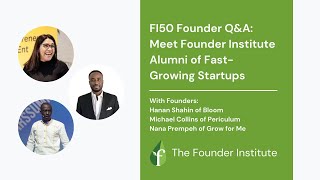
Three FI50 founders from Africa share how the Founder Institute pushed them to pivot weekly, test ideas fast, and raise pre-seed funding. Hanan Shaheen built Bloom (fashion e-commerce in Jordan), Michael Collins launched Paraculum (credit assessment in Nigeria and Kenya), and Nana Prempeh created Grow4Me (farmer crowdfunding across West Africa).
Chapters
All right, welcome everybody to this Founder Institute special FI50 alumni panel. Today we're going to be featuring 3 founders of fast-growing Founder Institute portfolio startups. My name is Dustin Betts, I'm going to be your host for today. I'm a community manager at the Founder Institute. I also sort of play a role as a grad team liaison between our HQ marketing team and our grad success team. So that's a little bit about me. For those who are not familiar with Founder Institute, we are the world's largest pre-seed startup accelerator. We've now helped launch over 6,000 portfolio companies across more than 200 cities all around the world. So if you're interested in learning more about Founder Institute, we are currently enrolling for pre-seed accelerator programs on all 6 continents, and you can see that full list of enrolling accelerator programs at fi.co/enrolling. So the agenda for today's event is basically I'm going to very briefly introduce the 3 featured FI alumni on the panel today, and then we're going to dive straight into the Q&A. So I have a couple of questions that I've prepared to ask them, but we really encourage you to ask questions. That's sort of the reason that we host these events is for you all in the audience to have a chance to ask our alumni your own questions. So don't be shy. At any point that questions pop into your head, whether it's for the whole panel or addressed to just one specific alumni here on the panel, yeah, please feel free to drop them in. And my trusty producer who's helping in the background, Felicia Terrell, will help surface the questions and bring them to our attention so that we can ask the panel. So yeah, that's pretty much, we're gonna just focus on Q&A and hopefully get to as many of your questions as we can. So without further ado, I'm just gonna kick it off here and introduce each of our three panelists in turn, and then we'll, We'll move to Q&A. So our first featured panelist is Hanan Shaheen. She is an FI Jordan alumni and the founder of Bloom. Bloom is a try-before-you-buy fashion e-commerce platform where customers can try on clothes before having to make their final purchasing decision and deciding to pay. And Bloom announced receiving pre-seed funding in October of 2021. Hanan, thanks so much for joining. Wanna tell us a little bit about yourself and your company by way of introduction?
Hello, Justin. Hello, everyone. Thank you for having me. I'm excited to talk again about Founder Institute because it did change my life. And I want to give back. I had a startup before my startup Bloom, and I suffered a lot. And I actually got to know about the program while I was volunteering with Founder Institute Jordan to recruit founders. And at some point, I was talking about the program, I closed the phone and I thought, you know what, this is exactly what I want. So I closed my first startup because it was not scalable and decided to start with the second one, which is Bloom. And yeah, so this is initially the story.
Awesome. Yeah, well, thank you so much for being here, Hanan. And yeah, so everybody who has questions about Bloom as we, as we go, definitely don't be shy. Yeah, put them in the chat for us to ask. Our second panelist I want to introduce next is Michael Collins. He is an FI Toronto alumni and the founder of Paraculum. Paraculum uses alternative data to provide credit assessments. So different from your big three credit agencies. And this is for borrowers largely in underserved markets. And so those alternative credit assessments allow allow lenders and financial institutions to lower their risk of lending and lend to these underserved markets. Terraculum announced a $620,000 pre-seed funding round in October of 2021. Welcome, Michael Collins. Please, yeah, tell us a little bit more about yourself or your company.
Thank you, Dustin. Hello everyone. Thank you for joining, and I'm very, very happy to be here. Yeah, Michael Collins, Nigerian born, raised I have a background in banking and, you know, that's where I actually started to discover the need of what we're solving and founded a company in 2019. And in 2020, late 2020, I joined the Founders Institute program, which accelerated our company, our business, and I'm sure I'll get the opportunity to talk more about that. But it's a pleasure to be here and thank you for having me.
Yeah, thanks so much for being here, Michael. Uh, yeah, excited. And yeah, people who have questions about Paraquillum, fintech, for Michael, yeah, drop them in the chat and we'll get to them next. Uh, our last but not least is our third panelist I want to introduce is Nana Prempeh. He is an FI Ghana alumni and the founder of Grow4Me. Grow4Me is a crowdfunding platform that helps small and shareholder farmers to scale up their growing operations. And in October of last year, Grow4Me was selected by Google Black Founders Fund to receive non-dilutive capital. Welcome, Nana. Please tell us a little bit more about yourself and about Grow4Me.
Hey, thanks so much for having me here. My name is Nana. I'm CEO and co-founder of Grow4Me, and we started our company about 2 years ago officially. Prior to that, we had experimented with farmer input financing and realized that there's a great opportunity in agriculture in Africa. And as we went deeper, we realized that there was a need to provide a ready market. So Our company currently spends a lot of time raising capital to provide a ready market for farmers. And just last week, we also incorporated in Kenya and Nigeria. So we are growing gradually, and I'm excited to be here. Farmer Institute made it possible for my co-founders to come to speed with what it took to build a tech company. This is my second company, and I was so happy that we went through it. It helped us in our fundraising process, and we are happy with where we are now.
Awesome. Yeah, interesting theme between you, Nana, and Hanan, who both— this is your second startup, and that's the one where you joined Founders Institute. Yeah, thanks so much, Nana, for being here. People who have questions about crowdfunding, about smaller-scale agriculture, yeah, for Nana, definitely drop those questions in the chat. Yeah, just can't emphasize that enough. The purpose of this event is really to get to as many of your questions as we can, so please don't be shy. Yeah, really quickly, I want to highlight too that we've done these alumni panels before, but this is a special one. It's our FI50 alumni panel. So if people haven't seen our FI50 report, you can go and check it out. It's at our website fi.co/50. And so yeah, that's where we're kind of pulling these 3 founders from here. It's a report on 50 of the fastest-growing companies from across Founder Institute's global portfolio. And yes, since we released that FI50 report in Q4 of last year, we've gone on to release a couple regional ones. So we have one that's highlighting just companies from LATAM, And then we have another one that's highlighting companies from all across Europe, Middle East, and Africa, our EMEA FI50 report. So we're kind of regionalizing them now, but yeah, these three founders were featured all on the original one at fi.co/50, the global report. And yeah, we're super excited to have all three of you here to kind of, yeah, answer questions for everybody. So yeah, just please drop questions in the chat. Felicia is gonna help bring them to the surface. I'm gonna kick it off right now with one question that I wanna ask each of the panelists in turn, which is, at what stage were you when you began the FI program and what was the biggest reason why you decided to join the Founder Institute accelerator at that time? So let's just kind of go in order that I introduced you. If, Hanan, you want to speak to that first?
Yes. So I was in, I think, less than even an idea. All I wanted is to do a successful business. That can actually grow, that is scalable. And I didn't really know how. Again, I had a business before. It was not scalable. I did not know it was not scalable. I just was, I was working hard. I did succeed, but I don't think the amount of success that I got was equivalent to the hard work I did invest in and even the money. So I decided to join Founder Institute with whatever idea I had, something I really like to do, which is clothes. And it was the pandemic, we started in 2021, and it was not easy to try on clothes in the shops in Jordan. So my idea started with simply just putting on outlets, outlets, a pattern online, And during the program, it changed a lot. I pivoted around 11 times. I'm the queen of pivots. Because it was not a clear idea, and that was fine. I mean, this is the core of the program, is that you and your idea grow together. Actually, I just pivoted lately again, because the more you understand the market, the better your idea becomes. So this is the level that I started with. Again, less than idea stage. Yeah. And what was the second question?
Oh, it was, yeah. And what was your biggest reason, I guess, for joining The Founders? You kind of alluded to, you know, having had one startup before, but yeah, did you want to speak to that part?
Yeah, I think I just saw that working hard is not good enough. I've always thought that if you just work hard, success will come to you. It just doesn't. You get burned out. This is what comes to you, but you might not succeed. So yeah, this is the reason why.
That's true. Thanks so much for sharing that, Hanan. Yeah, if we had to distill like the value proposition of Foundry Institute into one word, which is an exercise we did somewhat recently, we said it's direction. And so we try to provide founders with a direction to navigate that. That startup journey. And so it sounds like that was kind of something that you got out of the program, which is great. Same question to you next, Michael. At what stage were you when you began the Founder Institute Accelerator in Toronto, and what was your biggest reason for deciding to join?
Yeah, so I was a little bit further ahead in my life, in the company's life cycle. I founded a company in June of 2019 and joined FI, I joined the '21 cohort. So that was like, I think we started in November. And, but we had, you know, the business idea that I came into FI with evolved. And it reminds me of a Winston Churchill quote where he says, "To improve is to change and to perfect is to change often." And that's basically what Founder Institute helps you do is to help you to improve on what your idea is or what you think your product is to help you achieve that product-market fit, which is what every founder is trying to do. And it helped me even to refocus kind of like what we're trying to, like kind of like our target customer. And now we are now, we now have customers in Nigeria and Kenya where We have business and we have employees now. We have about 14, 15 employees now in the company, and we're growing and scaling rapidly. So, um, and the reason why I joined FI essentially was because I needed a direction. Like, I had, you know, I knew what we're trying to— the problem we're trying to solve, but I didn't know how to do it really. Like, um, you know, so, you know, joining FI, I was able to be around a network of mentors, the other cohort members, and the difficulty of being in FI, and kind of gives you a kind of almost a real-world view of what it's like to run a company. That definitely helped me later on, which later in the year we were able to generate revenue and then move on from there. But yeah, so that's kind of like our story.
Yeah, great. Definitely feel like there's a lot of overlap between kind of the pivoting around your value proposition between what you and Henan also just said. So that's great to hear. Same question to you as well, Nana. At what stage were you when you began the program in Ghana and what was your biggest reason for deciding to join the Founder Institute Accelerator?
Yeah, thanks once again for the question. So my co-founders and I had tested idea. We had literally cycled from Accra to Nigeria on bamboo bicycles for 5 days and seen that there was a great opportunity to finance farmers and to provide inputs. But we got to a point where we were about to start a company. It was incorporated in January 2020, and I had co-founders who had not built a tech company before. They had been in other businesses but not built a tech company apart from one. So I needed to have a program that puts structure to the things that we're going to experience, and this was going to be my second time, and I believed that Founder Institute was going to provide that kind of structure and make it very easy for us to have the same language. And that was my initial intention for going through the program because I'd gone through an accelerator before. Now we get into the program and I realized that it was beyond my expectation. Not only did it provide structure, but it helped us to really work our company in a way that could really scale and be attractive to investors. And primarily, the original idea was just to go there and provide structure for my partners and I, and we got more than that.
Awesome. Yeah, thank you so much, Nana. So I'm going to get right to the audience questions. I'm going to prioritize your questions over any that I sort of like to ask founders. So yeah, please don't Don't be shy. The first question here is from Gopalakrishnan. Sorry, I probably really butchered your name there, but asking, we're a B2C travel app on mobile and planning to launch in July. They've been selected to join an FI cohort that starts in September, so kind of a delta there between sometime July, September, 2, 3 months, and asking would it be good to join given that they plan to already have an MVP by the time they launch in July and traction during that timeframe? Yeah, it seems a couple of people sort of answered that you pivoted a lot or really reevaluated sort of your value proposition during the 3.5-month FI program. Would anybody like to kind of speak to this question first on feasibility of planning to launch in July and then starting a program that starts in September?
I can, I can, I can go. Because when, when we joined, we already had an MVP. We had something that we thought was market ready. So I think the beauty of FI is that it works if you just have an idea or if you have an existing product or an MVP. I think even the latter is probably, from my own personal experience, is FI works a lot better when you have something that you have your assumptions and you can test those assumptions and see if it'll hold up in the real world as opposed to just an idea. But like I said, FI works whether you come with an idea or you have a product that you think is ready for market. So yeah, I definitely think, I definitely recommend that you still attend the program even though you have an MVP.
Thanks, Michael. Hanan or Nana, either of you want to kind of speak to this, believing they're going to have MVP ready but then a couple months before their program would start?
Yeah, I think you are— you can join FII when you just have an idea, but when you have a thesis that you've tested to an extent, you have maybe even a set of co-founders, it's even better. It's even easier because as a CEO, you can really, you know, bring your team to speed, and the things that you have to figure out are already kind of structured for you in the exercises you do. So by doing the exercise, you're literally building your company. So yes, it's great when you have an idea, when you even have an MVP, better. When you have a team, excellent, because then you can all share the lessons and, and, and benefit together. Of course, it's just going to be the founder or the CEO who's going to be in the program, but I believe that the knowledge you acquire should be translated to your team. So I would, I think wherever you are, FI makes a point for you to join, but it's better when you've done some work before joining. It makes it more relevant and more insightful.
I can say, I think you could change the perspective a bit because we as founders think I've done this stage, for example, I have an idea. So it's great. Ideas change. You have an MVP, you'll do it maybe twice. You have a product, you'll keep doing it and iterating. So it's not about a certain milestone that— that FI is not about you having accomplished a certain milestone. It's about a mindset. Building a startup is a game. It's just like a video game. The problem is we as founders, first-time founders, we just don't know the rules of the game. So you keep working and working in an empty, dark space where no one knows what you do and you don't know what you do. So when you join the program, regardless, regardless if you have an idea, an MVP, or even a product, if you do not know the rules of the game, which starts with your mindset, you will never make it. So regardless of which stage you are, just join. The idea will change, the MVP will change, the product will change even after you graduate. and this is what we need to accept. We will fail multiple times and we will accept failure. And maybe this is what my biggest lesson is, the amount of 2s that I got in Founder Institute, because you keep getting each week, you'll get a rating on your pitch from 1 to 5, and most probably I got the 2s. Again, I'm also the queen of 2s. And previously I used to think of it as an offense, like, oh my God, they don't like me, they don't deserve this. But reality is this needs to change, this needs to grow, and this needs to improve because we are working in a changing world and it's never personal to you. So if you get this mindset, you will fail more, but you will get up. This is the intake out of it.
Yeah, I like that insight on founder mindset and definitely agree with what all three panelists said. I guess like the thing that I would sort of emphasize is kind of what Michael said, I think at the beginning, and Nana touched on this too. It's like, it really helps participating in the FI program if you do already have some level of MVP, because the program is not pedagogical in the sense like it's not a classroom lecture where you just sit and passively absorb information. The curriculum. And if anybody wants to kind of dive into detail, the website to— or the page on our website to check out is fi.co/program, where it shows you basically the different sprints that you work through across the core curriculum over that 3.5 months. But yeah, as Michael emphasized, having some level of MVP, it just makes the real-world kind of testing of all of those different sprints a lot more applicable than if you're still sort of in the idea stage and very theoretical. So yeah, that's kind of how I would recap what each of our panelists said. Have said in turn. We've got a ton of audience questions coming in. Thank you, everybody. Keep them coming. I have a few panelists-specific questions that I just want to get to really quick. And so the first one is from Oza, and it's for both Michael and Nana. Can you please share your experience starting a company in Nigeria, or at least, Michael, you said you're doing business in Nigeria, I believe, and how you were able to raise pre-seed funding? So Oza is asking specifically about starting a company in Africa. Either of you want to jump in, Michael or Nana, and speak to that?
Sure, I can, I can jump in. So, the uniqueness for us was I live in Canada. I'm literally physically in Canada. I founded the company here, and the core, the parent company is based out in Ontario. It's an Ontario-based company. We do have operations in Nigeria and Kenya right now. And essentially, there's a certain way you have to structure your company, and you have to get your company ready for funding. And there's certain milestones that you will need to hit before you're kind of like venture ready. So in terms of difficulty, I mean, it's not very difficult as long as you have a certain level of product-market fit. With what you— with the problem that you have or the problem you're trying to solve with the right product that you're building. And once you have that, I think, you know, the way the world— exactly, as someone just put in there, Delaware C-Corps. That's how a lot of Nigerian founders, you know, have basically set up their company. They have the Nigerian local company and they have the Delaware C-Corp as a parent company that now has the Nigerian company as a subsidiary. And then once you have that all set up and you have the product-market fit, getting in touch with investors becomes a lot easier. And the thing about FI is that they kind of will help you with that. And Hanan mentioned something about weekly pitching, pitching every week, that it really, really helps you to the point that even now I don't need a pitch deck. I can literally pitch my entire pitch without the deck because you do it so, so often. So you have to get venture ready, uh, you have to get— make sure your company is set up correctly. Uh, programs like Founder Institute will give you a certain level of exposure, and then when you do have that product-market fit, then you can now look at securing capital, and then it's a lot easier process.
Yeah, yeah, go ahead.
Yeah, so, um, I'll break that, um, answer the question in two parts. First is the incorporation, which is, uh, um, to incorporate in Nigeria, I would suggest you use a platform, it's called Nostrad, or I'll send a link that makes it easy for you to just, you know, put everything there, pay, and then take care of the entire registration. Um, similarly in Kenya, it makes it very easy. First, getting the legal entity set up is the most critical thing in my opinion. Depending on the type of business you're going to operate. So after you've gotten that done, it's a very easy thing because there are companies that are doing that for you. The next really thing is operations. The next thing is your technology being available, and depending on what, where, how your technology is going to operate in these, those markets. If it's web, easy, you can do that from your servers. If it's USSD-based, because a lot of African or, or Sub-Saharan African markets USSD is a very effective channel of reaching your clients for certain types of services. When I say USSD, you dial a star number and a hash before you go. So depending on what type of technology you are using, you also have to make that technology available in there. And technically, if you're going to have customers' data, you must make sure you are data compliant. Now with these boxes ticked, the legal and the technology available, then comes operational part. So this is my second company. My first company, we tried partnering with a larger company to take care of operations and we provided the technology. I can say it didn't work. It failed. So in this time, we are actually going to run operations with Nigerians. So we've seen companies that have done it and worked. And basically what that means is that you must have boots on the ground depending on the type of business you're operating. Typically I found that in most Sub-Saharan African markets when there's a face to put to the product for initial phase, it helps in traction and building customer confidence. And then subsequently you wouldn't need that because then the brand would have grown. So it's very key that you understand that those markets are— for example, Nigeria is the biggest market in Africa. It surpasses South Africa and it's a huge market. Lagos alone is literally the entire Ghana in one city. Nigeria is a monster and you need to really get Nigerians to run your business in Nigeria to succeed and it's as simple as that. I think that it's a market anyone who wants to build a Pan-African company should be in. It's a large market and there's great opportunity. I must also say that you would have to learn the ropes because it's a unique market. It doesn't come easy. I can speak about other markets, about Ghana, but since the market— the question was specifically to Nigeria, I would end there.
Awesome. Yeah, thank you both for those detailed thoughts. I think that the person will find that helpful. I have a question as well for Hanan, actually, too, since I asked both Michael and Nana a question in turn. So this first question is from Seham, and they're asking, how did you study feasibility, basically? What were your first steps? And a very similar question as well also for Hanan, who phrases it, what was your experience in FI? Because you were pre-product, I guess, when you started, what were the insights? So yeah, just want to speak to any or both of those questions, Hanan, about just, yeah, being kind of— it's different maybe from what we described being earlier stage when joining and how that affected your journey through.
I always say about like when you go into the program, just Trust it, trust the flow. It looks hard. Sometimes they have the weirdest questions ever. Like, why would they ask me this question? Why would they ask me about what I love? How I feel? It's weird. Just answer the questions. You will get to an assignment that asks you to do an MVP. Before that, you will be asked about feasibility. The beauty of the program is that it asks the right questions at the right time. So all you need to do is literally follow the assignments and do them willingly. Don't do them because someone is— it's not the school part. It's not because someone is looking over and wants to see what you do. Do it because you want to do it and you will get the answers. I remember for me, I was doing one of the assignments which asks you about your feasibility, and part of your feasibility in early stages is just assumptions that you throw in the air. And then I, I remember I had colleagues who were doing the same assignment and they just decided to throw any answer just to do the assignment because it's easier. But what I really did is that I went and asked people I got answers that I didn't like. I had to accept them, ask new questions, and keep asking questions till I got not to the answer that I wanted, because obviously it was not the right assumption, to the answer that people wanted at that point. And this is where I started getting some feasibility. At a later stage, I was a bit insecure about Okay, did I get the right answers or not? Because sometimes we ask the wrong questions as well, or in the way of we asking questions, we kind of let people know the answer. So we're feeding them the answer to hear it. So I also noticed that I'm doing that. So I stopped doing that as well. And for me, because it was e-commerce, I simply was brave enough. I'll call it brave because it was scary for me to just put everything on Instagram. It's cheap. Actually, it doesn't cost anything. And I started doing sponsored ads to different assumptions. So I did assume that people wanted to buy certain items with a certain— and they wouldn't mind a certain profit margin that is good for me. And this is where I started changing my ads. So this time, for example, I put a certain cost and then another one And I was not— because at first you would think, I don't want to do any mistakes. This is my name. No, just do all the mistakes. This is how you get feasibility by doing all these mistakes. And the beauty of the program again is that it literally tells you to do these mistakes. So this is literally how you get your feasibility. And actually, because I recently pivoted to B2B, model, I'm doing the same mistakes again. And now I'm doing it as a landing page because it's a different approach. But I'm doing it this way because I'm literally opening the assignments that I had and reviewing them back and following the assignment again. It's funny, it's just a loop. The loop keeps going on again and again and again. You get better and it gets harder. So kind of the same amount of pressure.
Yeah, that's super interesting that, yeah, you're having graduated, but pivoting again and using this as the, or the FI curriculum or program as like a framework to work through each of those iterations in turn. Super, super interesting. Question here from JS I want to ask next is, could you please speak to the initial capital? We've talked about raising capital, but the initial capital that you guys invested into your own startups and how long you were bootstrapped or how you bootstrapped along the way. Anybody want to take that question first?
Yeah, I can speak to that. So when we started a company, one of our— we're 4 co-founders— one of us financed with about $15,000 for us to start operations, and we're able to pay back that and also raise more capital to operate. One of the strategies we adapted very early on was to— by the way, we started our company during the COVID season, so our overheads was pretty very low. So a lot of the founders, we were not— we were the original employees and we were not taking salary. We just got money for our data and airtime and to build our first MVP and validate the idea. Our strategy was to grow traction and then raise quickly. Right after F5 went to Foundry Lab, we were able to raise some money from— some little money from investors to grow our platform and our customer base. And the last strategy we adopted was because we were in a space where there's also some grants available We took advantage of grants to develop the technology, the markets, and that allowed us to make some mistakes and correct ourselves with little cost to our equity. And that's one of the ways we were able to raise the traction from which we were able to raise the needed capital. I think other things that we did was to stick to really early on updating potential investors about our progress, what we're doing, and how we're performing, and it did help. I believe a template makes life easy. But finally, it was really to understand the markets within which you operate and understand where the capital will come from and put in structures internally to consistently pursue those markets or those channels where we could have capital to grow. So that's how we started and that's how we raised capital.
Thanks, Nana. Michael or Hernando, either of you want to speak to kind of bootstrapping, pre-funding?
I can go quickly. So yeah, I basically used up my entire life savings and credit and debt and everything, right? You have to remember when you start, you have such a short window, especially if you're bootstrapping, to be able to hit a certain level of traction where you either have enough traction where you can raise outside capital. One thing that you're not going to, unless you are a second-time founder, and even then, you know, if you're a second-time founder and you had a successful previous exit, you're still going to be difficult just to raise capital on just an idea. right? So you're not going to just say, oh, I have this great idea, you know, blah, blah, blah, it's going to be a billion-dollar idea, blah, blah, blah, whatever, right? I just raised money. It's not going to happen. You're going to have to start with something and hit a certain level of traction to be able to get to that point. So that's what I did. I leveraged every single resource I could, which was very difficult. But I had to do, you know, it makes, it hones your senses because you know that, okay, I'm going all in, um, and I have to make it work, right? And that gives you a certain level of razor-sharp focus because, you know, you gotta have to make, you have to make this work or else you run out of, of dry powder, you run out of capital, and then if you don't have anything to show for it, then that just sucks, right? So in terms of bootstrapping, that's what I did. I think I started off with about $15,000 of my own money and then credit cards and so on, maxed out everything. But luckily, by the time I got to the point where I basically ran empty, I had enough traction that I could now raise venture capital. So that's kind of like what you want to do. You have to be very precise about what you want to do, your milestones you want to achieve. Programs like FI will help you to kind of focus your attention on what is important and avoid all the noise and distractions. And once you achieve that certain level of traction, then, you know, the, the money is out there. You know, even, you know, they're saying the soft economy and, you know, the stock market and everything happening, I mean, there's still money out there. As there's looking— the money out there is looking for good founders, good businesses. Um, once you create that visibility that you are the right founder in the right space at the right time, you'll be able to raise money for sure.
Yeah, thanks so much for that answer, Michael. I wanna keep moving and get to some more questions here, 'cause I've got a ton. We're definitely not gonna get to all of them, but keep asking them 'cause I'm making judgment calls as I go and ask them. So the next one I wanna ask is from Natasha and she asks around mentors and advisors, sort of a two-part question. Can you share your experiences around the incorporation stage as well as specifically the advisor selection? So for any of you especially who brought on advisors in like a formal capacity after you had incorporated, anybody want to take that question first around advisors?
I can take it. Regarding mentors, I think this is the value proposition of Founder Institute, having the mentors local, national, international mentors. The quality of mentors matters, so because I think it became kind of a trend that someone says, I'm mentoring someone. For me in Jordan and in the MENA region, there are lots of free programs running with mentors who are not really mentors because first of all, how could someone mentor you about building your own startup while they've never done that before, it's not a business, it's different. If I am successful in a corporate level, that does not entitle me to give you any startup advice. So the type of mentors I used to see, because I, again, I had a business before, and I had mentors before, and I kind of lost hope of mentors because at some point it becomes a waste of time, someone telling you that they know more than you, and that's not how mentoring goes. I was shocked, actually, in Founder Institute, because I found very successful people with 4 exits, investments, and you would imagine that they would look down to you. They were actually very humble. They used to write notes about my pitch deck, I was like, oh, because I'm not used to that. I'm used to people talking like, I'm better than you, and they don't do that. They actually listen to you. They write notes about you. They write recommendations to you. And my main value proposition is a try-before-you-buy e-commerce website. And when I remember when I pitched a nice idea at the time, I did not know it's all about logistics anyway. And I knew it from a mentor who was an alumni of Founder Institute as well. So this is the type of information you get from these mentors. I still follow up with them, by the way, even when they give you feedback, they give you honest feedback. They don't tell you, go shut it down, nor they tell you, you are the best person in the world, because neither of these advices are advices anyway. They tell you exactly what is the problem, and where to move forward, how to think. It's not a mentor's job to give you the answer, it's your job to find it. The mentor's job is to guide you with more questions, to let you think. Again, the beauty of it is because at some point when you are raising funds, most likely you will raise funds from your region. These mentors also are from your region, so they know the market, So they would also give you advice that makes you fit in the market because you have to at some point. And you will get a collection of local mentors, national, because you want the bigger vision. What?
Oh, I think you're good. I think you just froze for one second, but you came right back. Actually, yeah, I love the way you framed the mentors. I mean, the mentorship through FI versus some other mentors are more corporate space who you connected with prior. I think that the way you explained it makes a lot of sense. And like a kind of truism is like mentors who are not that good of mentors tend to be people who tell you very specifically, you know, this is what you must do, this is the way you must do your next thing. Whereas the mentors who tend to be really good are much more like asking you questions and sort of having you like discover those sort of next steps for yourself. Or it's more of like a, an inter— a back and forth questioning process that brings those to light. But I wanted to ask you one other question as a follow-up very quickly, uh, and then just because it's relevant to what you saying. So this question is from Saif and asking, will FI help— this is sort of a two-part thing, but already having a registered company supposedly with revenue and customers already, but will FI help to access angel investors or VCs within the MENA region? And I wanted to, yeah, post that to you because you're definitely active in the region and talked about the mentor network. So Any thoughts on that?
I think because I recruit founders as well, people always ask you, will FI or a certain entity help you get funding? No one will, it's just you, and it's no one's job to get you investors, it's literally your job. However, the job of the network of Founder Institute is to give you the right information to know the right space with the right pitch deck to go and talk to people. So if you want an intro to someone, they will definitely introduce you, but you need to know where you want to go so that anyone can help you go there. But if you don't know where you want to go, and you just want to get an investment, I don't think anyone can help with that. I have asked for multiple intros from mentors from my cohort, and they did it it happily, but then it's up to you. So it's up to you to know where you want to go, and it's up to you to know how much money you want and why, and to present your startup. So the job of Founder Institute is to put you in the right place with the right people, and then it's up to you. I think it's everywhere, it's not only in MENA.
Yeah, I would definitely agree with that. Founder Institute has certain post programs, and if you go to fi.co/scale, You can see some of these programs that we run just for alumni, like these 3 of the Founder Institute core program, and one of those post programs is called Funding Lab. That's the one that we run most often. And so it's structured quite similarly to the Founder Institute core accelerator, but it's just for founders who are focused full-time on fundraising, already have some level of traction and team. And so there are sort of prerequisites for it. But the next question I want to ask to each panelist in turn is just what was the most challenging part for you during the actual FI program itself. Hanane, if you want to go first, go in the order. What was the most challenging part for you during the program?
It's just not quitting, I think. And I keep having these let's-quit thoughts every day because it's hard. But I guess the magic is When it's hard, just don't quit. I think this is the hardest part for me.
But, but sweet and definitely true. How about for you, Michael? Most challenging part of the program?
The most challenging part for me was the assignments. They're very thorough and you have one week to complete them and you also have to pitch.
Every week.
You have to record yourself pitching, and you have to submit that pitch every week. So that was very difficult because the assignments were not like, you know, something you just type up. You actually have to do something. You have to complete them, and then you write, you type about them, or you do a screenshot or whatever it is. And it's one of those things where it was difficult and it's by design. I'll be honest with everyone here. I've, you know, after FI, we raised our pre-seed funds and I got into Techstars, the Montreal program. FI, Founders Institute, is more difficult than Techstars. Way more difficult, and it is purely by design, because they're trying to simulate how difficult being a startup founder is, so they make it really difficult for you. People quit. I remember my cohort, we started at 80, a bunch of people quit, a bunch of people were told to, you know, come back next program because they just they just couldn't keep up. And we started as at 80-something, we ended up, I think, 21 or 24 at the end, right? So bunch of people quit, a bunch of people were told to come back. And what I've discovered is after Founder Institute is that being a founder is way more difficult than Founder Institute. So Founder Institute prepares you to become a founder by making things difficult for you. But then actually running a company, I wake up at 5 in the morning, I have 2 teams, 2 sets of teams in 3 different time zones, in Kenya, in Nigeria, in Canada. I have to, you know, we're talking sales, product, business development, marketing, all that stuff I got to deal with every day. Decisions, all the stuff I have to do every day is way more difficult than Founders Institute. And Founders Institute makes that program difficult so that you can kind of have a sliver of understanding of what it's like to actually run a company and you're mentally prepared and you can go through the program and go, you know what, this is, if this is only 10% of what it's like to run a company, this may not be for me, right? I may just go seek employment, you know, have a, you know, probably better, you know, steady salary, you know, 2 weeks vacation, et cetera. Like, I'll give you an example. I've been running curriculum for 3 years straight. I haven't had any vacation or time off. It's hard. So that, for me, is the most difficult part of the program. But like I said, it's difficult by design. It's difficult to make you see that this is not easy. This is hard. This is difficult. Like I said, 3 years of running curriculum straight and no vacation. No time off. I work every 7 days a week. It's hard. So, but yeah, so that's what I found difficult about the program for sure.
You explain that so well, Michael. Like, yeah, I love the way you framed it. Like when you say almost the exact same thing at FI, it's like, with the program is hard because it's because running a startup is even harder. And so, yeah, as a simulation for the real world of a founder, that is absolutely the intent of why the program is challenging, and yeah, couldn't have definitely said it better. So great, great insight. Don't want to skip you, Nana. What was for you the most challenging part of the FI Corps program?
Founding Lab. I mean, I know Founding Lab is after Founder Institute, but if Founder Institute is hard, Founding Lab is super hard because then you need to run your company, grow your traction, and raise funding. And I hope that for those who make it through the Foundry Institute and go into the Foundry Lab, they are able to step up their game because it's— Michael did a good job at describing the difficulty, but I also want to talk about how Foundry Institute helps you to raise. And Hanan has spoken about it. I think that Foundry Institute really helps you to raise, and more of that help comes at the Founding Lab where you learn how to raise funding, and it's a very critical program. If you manage to get in, you would be given the tools and the skills, but you will not be given the money. You would have to go find the investments, but you'll be given the right tools and skills. And trust me, when I'd gone through it, I, I, I was able to raise my, um, my first round, and I still use those principles. And funny enough, the tools I've built through that program. Currently my whole cap table is managed on Foundry Institute templates. My funnel I use was the funnel I designed whilst I was in Foundry Lab, and other entrepreneurs borrow it to try and raise. So I think that for me is the most difficult part, and yeah, that's how it helps you to fundraise.
Great, great insight. Yeah, we have like 10 more minutes left, so I want to get to like 2 more questions hopefully. So this This question here is from Gupreet asking, "Do you have co-founders?" So to each of you in turn, and if so, how or where did you find them? Asking, you know, is it true that you can't get funding as a solo founder? It's not 100% true, Gupreet, but it's mostly true. And that is like a prerequisite for the program that Nana was just talking about. In order to join a funding lab, you do have to have some level of team already in place. So yeah, does anybody want to kind of speak to where you found your co-founders and where you were in the process when you did Yeah, briefly.
Yeah, my founders have been friends for a long time, and we never thought about starting a business until we did a trip from Ghana to Nigeria on bicycles. We saw an opportunity, and we all had interest in solving it and had some skills that could, that could help each other. But because we only decided to find the— found the company together because we wanted to build a company that we were excited about each other before the product because you spend most of your time with people in your company, so you must as well enjoy their company if you're going to do this long term. And I think one of the best decisions I made— this is my second company— and when there's no work, I just enjoy to talk, talking to them as friends and as human beings. And I know that's not the case for everyone, but in my case, I was just lucky to have my friends being my co-founders, and it's been an exciting journey. That said, other founders of later stage co-founders who joined, we had no relationship, but they were good at what they did and they joined.
I can follow up on what Nana said. I actually started with my best friend, but it did not work out, which is completely fine. We're still friends. We just can't work together because it just didn't work. We had different visions. Different dreams, no clear goal. And that does not mean we don't like each other, it just means it's not working. So later on, I needed a co-founder, so I actually found him on LinkedIn. And he's great. So if you want something, you will find it on LinkedIn. And he lives in Tunisia, I'm in Jordan. I've never seen him face to face. We have been in long-distance relationship. However, it's working well.
So yeah, very interesting. Yeah, sorry, I love it. It's so different from, from Nana as well. Not maybe your first co-founder when it was your friend, but this, uh, you built a virtual-first company during the pandemic. Yeah, I've met a co-founder through LinkedIn who you still not met face-to-face. Yes, yet. So super interesting. Uh, how about, how about for you, Michael? I believe you have, uh, definitely a team. I know you have a team, but how about co-founders?
Where'd you find Yeah, so I'm going to go the other way where I am a solo founder. I founded Periculum myself. We have a founding team, but there is no— I have no co-founder. So I'm going to go back to when Nanus said he rode on a bicycle from Ghana to Nigeria. That's one heck of a bike ride. So I mean, you know, good job there. But in it just shows, like, you know, just from the panel, you just see the different, you know, diverse backgrounds of how we all founded our companies. Like, I have no co-founder. I founded— I was a solo founder. I did Founder Institute full-time and worked on the business full-time, and that was hard. I recommend a co-founder if you can find a good one, but if you can't and you feel like, you know, It just means that a lot of the responsibility falls on you. But yeah, I mean, I'm living testament that you can kind of do it all. So yeah.
Yeah. And building initial traction helps you, you know, should Michael, if you wanted to like go out and find a co-founder, I think like once you start to have product-market fit or get closer to it, yeah, at that point, if you're like a non-technical person, you're much more attractive to bring on a technical co-founder if you can demonstrate, okay, this idea has some legs to it, basically. And so that's the way I would answer that. I want to answer just like a few more questions quickly myself before I get to, I guess, our final question, just because there's a lot that we didn't get to. But Mohanad is asking, is language a problem in joining F5? So being not fluent in English. Mohanad, no, a lot of the programs are not run in English. And so, yeah, if you go to fi.co/enrolling and look at what city or regional cohort is closest to you, you might find a language or a native to match your program that matches your native language. I don't know if any of you took a program that was not run in English, but at any rate, we definitely do have programs around the world that are not run in English. And if you're not sure, you can like apply to one and ask kind of at that point. Phase to make sure that the language matches your requirements. Another question, just to knock another one out quickly, Adochi, Adochi asks, do some founders still work full-time basically before joining the program? And the answer is yes. So Founder Institute is kind of unique in this respect, as opposed to a Techstars seed stage accelerator. We position ourselves at the pre-seed stage and a lot of founders who do come in, are still full-time at their full-time job basically. And they have this idea that they've been toying around with, maybe they've built the landing page or something like that, but they want to use Founder Institute, the curriculum as a pretty hardcore sandbox to basically test their idea. But all of the programs, generally speaking, as long as you're taking a program that's like within your time zone, they're always run in the evening. And that's to facilitate being able to stick on with your full-time job while you're trying to decide if this startup is something that you want to focus on full-time in the future. So there, I got— answered at least 2 more questions, I guess. But I want to be respectful of everybody's time here and get to one final question and wrap up before we get to the top of the hour. So my final question in closing is just, what tips would you give to somebody, to a prospective founder, to be successful in the program? So everybody can answer this question in turn, but just your kind of top-level takeaways as an alumni, what tips would you give somebody who's maybe been accepted and is looking forward to coming in, in the coming weeks or months? Anand, do you want to answer that question first?
Um, I would say again, just don't quit. It's weird, it's strange, it's not comfortable, because if you want to grow, you will get out of your comfort zone. Building a startup means getting out of your comfort zone each time you get from idea to proceed, to see it. You just don't know what you're doing. You fake it till you make it. It's fine. This is how all of us feel in all stages. So just don't quit if you feel this way.
Perfect. How about you, Michael?
Yeah, so I would just say show up, work hard, and listen, because there's a lot of takeaways, there's a lot of experience in the cohort, in the mentors. A lot of the mentors My mentors are currently operators or former operators. They operate businesses. These are not business executive types that went to business schools. These are people that actually run businesses. So having that open-mindedness to actually show up, work your ass off, and you listen to good advice, I think you'll be successful.
Awesome. How about you, Nana?
Two things: less talk, more action, and enjoy the experience. That's what you should do. Do more work, work less, and enjoy the experience. It's very important. You go through this experience once.
Awesome. Well, yeah, we are very rapidly approaching the top of the hour here. I do want to be respectful respectful of everybody's time. I want to say thank you again to each of our three guests, Hanane, Michael, and Nana. Thank you so much for joining us and sharing your thoughts with the prospective founders who are here on the call with us. Really appreciate all of your insights and feedback and answering these questions. And yeah, just for everybody who registered via the FI site, you will get a copy of this webinar replay if you joined us later or want to rewatch parts of our guests' answers. Should land in your inbox within the next couple days. Yeah, and for everybody who joined us here live, please keep healthy, you know, stay in touch with us, and thank you everybody for joining us. Thanks, thanks everyone.










