Finding for a Remote Startup Co-Founder (Dec 2020 Event)
Jonathan Grecian shares how to find and evaluate a co-founder, especially remotely. He outlines the Founder Institute's selection criteria: fluid intelligence, agreeableness, conscientiousness, and empathy. He recommends stress-testing partnerships with small projects and using a 34-question compatibility checklist before discussing equity splits.
Chapters
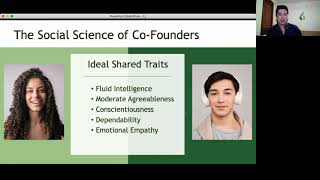
Everybody, welcome to this Founder Institute event, and we are all here to help you find a co-founder tonight. We had over 600 people register to this event, so thank you all for joining. I think I can see you all in the, in the chat here. Let us know where you're from. Let us know what kind of a person you're looking for. The whole point of this event tonight is to, is to help you start to, to network. With other people interested in startups. And as we all know, in this COVID age, this is becoming more and more difficult to do. All right, so with that being said, my name is Jonathan Grecian. I'm a co-founder of the Founder Institute. And here's how this event is going to work tonight. A lot of you have already been in some of these networking rooms. Basically, we're gonna go back to those networking rooms in a little bit. All right, I'm not gonna take up too much of your time, but you probably saw in those networking rooms, you can join in two different ways. Number one, top of the screen, you can click randomly match me with other people. That's sort of a chat roulette style, 3 minutes each style of networking where it's one-on-one. And then the other style of networking in there is where you can jump into different tables depending on the topic. And, you know, I would kind of look at that as a metaphor, as a, you know, it's a virtual conference room, right? And in this conference room, there's a lot of different roundtables based on topics, and you can join all of those to meet other people. So we're gonna get back to that in a couple couple of minutes, but please, you know, don't be shy. Join a lot of different rooms. I know it's a little bit weird, the dynamic in this virtual world to network, but, you know, we have to adjust. So, but before we get to that, I'm going to go through a quick presentation on finding formalizing co-founder relationships because it is one of the biggest reasons why startups do fail. When they are building their companies. All right. So with that being said, you know, my story is, to be honest with you, it's not that interesting. I met my co-founder Adeo at the Founder Institute. I met him on Craigslist. No, it wasn't in the one-to-one single section of Craigslist, but this was back in 2004. And, you know, I was just interested in getting into startups and online gaming at the time was something that I was super interested in. So, in order to get into online gaming, I went on to Craigslist and Craigslist's still a pretty big site, I think, but at least back then it was sort of like the only site. And, uh, and I, and I found an opportunity to, to join a startup and I ended up being the first marketer there. And, and that company ended up growing and raising a whole bunch of money and selling a couple of years later. So to be honest with you, I sort of got a little bit lucky. And all of this. But at the end of the day, I think the lesson there is that you just have to, you know, if you're interested in something, just go find where the other people are that are interested in that space. Now, that being said, the co-founder dynamic that I do have with my co-founder, Adeo Ressi, is an interesting one. And I do think there are lessons here versus how I found my co-founder. So if you, for anybody that knows us, myself and Adeo my co-founder, are pretty opposite. We're on different sides of the spectrum, but that's why it works. My co-founder Adeo is very extroverted. Myself, I'm very introverted. Adeo is very— he's somebody that always wants to do the risky thing, just kind of wants to go push, move, move, move. And I'm the one who's a little bit more contemplative, a little bit more risk-averse. And then in terms of skills, really, he is more of the sales, the technology, and the finance side. Whereas, I mean, I'm like allergic to spreadsheets, to be honest with you. So I am more of the marketing, the creative, some of the operations and the product side. So when you put all those things together, we're sort of a yin and a yang, right? It's not, as far as like skills go, we're completely separate. But it's the important things that we share, which I think is why we make a good co-founding team. And we have shared interests, both of us. Like, literally, I met him because I was on Craigslist. He was running a gaming startup, and I was interested in gaming, right? So we were both kind of, you know, video game nerds for a while, and we definitely bonded through a lot of video games back then. You know, we're both very structured thinkers, okay? We both think the same way. And you could see this in the dynamics of the Founder Institute, everything in the founding Founder Institute is extremely structured, and that's just the way that we think. And we also have a very similar work ethic. We're both sort of workaholics and, you know, not bragging, that's not necessarily a good thing, but, you know, even though our personalities are very different, we share things that are, that are super valuable and that have made us a pretty good co-founding team. So Now, when you look at kind of what the classic team composition is, this is the thing that a lot of people talk about. It's this classic hustler, hacker, hipster dynamic. All right. And I, I loved— I got very excited when I found this image of a unicorn dapping, and I just had to put it into the slide. So, you know, humor me on that one. But basically, the classic dynamic that a lot of people will think of with the technology startup is the hustler, the hustler, the hacker, and the hipster, right? The hustlers are going to be the ones that are going to sell. They're going to be the ones that are going to raise funding. They're going to be the ones that create all the connections. The hackers are going to be the ones that actually build the product. And the hipsters are going to be the ones that figure out how to design it, how to present it to the world, how to message it to the world, how to market it. All right. This is— I'm not like condoning this at all. It's sort of a little bit of a tired way of thinking. But I think at the end of the day, it's It's fairly valuable, and I'll get to that in a moment as to why it's a valuable way to look at things. Now, at the Founder Institute, we take a very social science approach in our applications process, and that's allowed us to find a lot of traits that we have found to be very conducive to forming good co-founding teams, right? So obviously, you look at the hacker, hipster, hustler dynamic, that's very much focused on the skills that the people have. But that obviously is just one part of a very, a much larger equation, right? Really, at the end of the day, going with the co-founder, it's, it's, you're, you're sort of, sorry about that, sort, it's sort of a, like you're getting into a marriage, right? So a lot of the traits that we have found, and we use social science here at the Founder Institute, is fluid intelligence is incredibly important. What fluid intelligence means is that you have the ability to learn quickly, right? If you have a hacker, a hipster, and a hustler on your team and none of them, like, care about legal or something like that, you're probably going to fail, all right? And it's not that if none of them care about legal, but if none of them are willing to learn legal and willing to learn new things and problem solve, then the team's probably going to fail. And that's what fluid intelligence— it's a Big Five personality trait in the social sciences. It essentially measures how quickly and how willing you are to learn new things. So that's something that we test for. So definitely, if you're looking at other team members, the ability and the kind of the want for both of you to learn new things is incredibly important. Agreeableness is another trait that we look for in the Founder Institute. Now, agreeableness is on a scale. If you're a 100 agreeable, that means you're a total pushover. If you're a 0 agreeable, you're an insufferable asshole. Pardon my French, right? So you want to both sort of be somewhere in the middle of that spectrum. And these are traits that we have found, you know, when team members share these traits, that, that makes really effective teams. Conscientiousness is the ability to be industrious, the ability to be kind of self-starting, right? Obviously, if a co-founding team has one person who's really passionate about the business, who's always self-starting, and they always have to kind of pick the other one up to like that's just not gonna work. Dependability is something that's incredibly important for obvious reasons. And then also emotional empathy, okay? And I think this is something that is definitely overlooked, all right? My co-founder and I, Dale and I, we fight a lot, okay? And we've had some pretty intense fights as well, but it's at the end of the day, you're trying to do something bigger than both of yourselves, right? So the ability to kind of be empathetic for each other, the ability to, to understand, okay, this person's going through some problems right now, this person has to kind of step up. Like, those are the dynamics of extremely strong co-founding teams, and those are the kinds of things that we look for in the Founder Institute. So if you want to get an analysis of some of the traits that you have, we do have an Entrepreneur DNA assessment. You can take it at fi.co/join. You can even learn more about our the social science that we use in our admissions process at fi.co/dna. I know it sounds a little bit out there, but we have been testing entrepreneurs since 2009, and I believe now we have over 40,000 tests. And we've taken the data from the teams and the individuals that have been successful in the real world, and we've gone back and correlated it. So we found a lot of matching on the social science front. So check out fi.co/dna if you're interested in any of that. Now, leaving aside the hacker, the hipster, the hustler, and the social science that I just gave you, you know, at the end of the day, there, in my opinion, I think there's two things, right? Number one, you have to fill the gaps. Okay. And this is especially if you're going to be raising funding, you just need to look at your business. All right. If your business is going to be selling a subscription product to very large companies, you should probably have someone on your team that has experience selling subscription products to very large companies, right? It's just sort of common sense. You have to take a step away from your business, look at the team as a puzzle and see, okay, is there a missing puzzle piece here? Is there a missing puzzle piece here? All right. So you have to identify those gaps. And then secondly, again, part of my French, second time I'm cursing here, but this is a term that I love. In startups, you need FSO people. Okay, figure shit out people. You don't need somebody who is like the best email marketer in the world. You don't need somebody who's the best like social media marketer in the world. When you're first starting a company, your team is really small. You need people that can figure shit out. All right. Because every single one of you, if your team's only 2 people, 3, 4, 5, 6, whatever it is, every single one of you is going to need to be problem solving all day long, learning new skill sets and things that you don't, you know, you didn't go to school for, things that you aren't traditionally, you know, kind of trained to do. That's just the nature of a startup is that you're going to have to be solving problems nonstop. So if you have a team of SFO people, people that love tackling new problems, figuring shit out, and then you have other people on the team that aren't those kinds of people, you're going to immediately hit some pretty, pretty strong friction points. So again, at the end of the day, yes, I'm not saying that you don't want great marketers and you don't want great salespeople and all that kind of stuff, but if they don't have that FSO personality where they want to learn new things and they're willing to get their hands dirty on legal or sales or whatever it is, even if it's not kind of, you know, part of their traditional skill set, then you're probably going to fail. So you got to find FSO people, people that not only can figure shit out, but that get energized and enjoy figuring shit out. So we're starting to transition here into the second part, which is, you know, formalizing this co-founder relationship. All right. The first thing I'm going to tell you is that friendship does not equal business partner. Uh, you know, luckily I haven't been through this, but I've seen a lot of really strong friendships, particularly like college friendships, that kind of stuff, just completely deteriorate and end with lawyers. Um, because people equated a friendship to a great business partnership. Okay. Like that, that just doesn't work. The friendship, you know, kind of checks off maybe a couple of boxes, but it, uh, it certainly does not check off all the boxes of somebody that you need to be a business partner or co-founder. A test drive is absolutely mandatory. Okay, you sort of have to stress test this relationship. And one of the most effective ways that I've seen, in a way that we always are telling people in the Founder Institute to do this, is to start a small project. All right, if I tell you, if you're my co-founder, there's a lot of, there's a lot of, you know, implied things there. It's maybe a little bit too much too soon. Like, hey, you and I are interested in maybe building a business together. Why don't we just start on a little project and see how it and that project, by the way, that I've seen to be super effective is just run an event together. Okay? I don't care if you're both engineers or whatever, you've never run an event. Just say, okay, we're building a business in the fintech space, or we're building a health and wellness business. Just launch an event together. And this is a lot easier, by the way, now in COVID, because you can do all this stuff online. Launch an event together, try to fill it and try to get like different partners of corporations and stuff to help you promote it. Now, even if that has nothing to do with the business that you're building, here are the benefits. Number 1, it's going to put you and your co-founders in a situation where you all sort of have to figure stuff out, you know, be FSO people, as I was saying before, right? And you all sort of have to say, okay, I'm going to do this, I'm going to do this, I'm going to do this. And believe me, there's going to be a lot of things that none of you want to do. But again, this is sort of simulating what your startup experience is going to be like. Number 2, You know, even if it fails, like you're going to see, okay, this person's good at this, this person's good at that. Somebody's not going to do better than the other person, right? You're going to see all these team dynamics that you will see in a startup in this event, right? You're going to have to decide, okay, who's going to host the event, who's going to run the event, who's going to be the person on screen. And then finally, at the end of the day, you should be able to sit down and say, okay, how did this go? What do we learn about our relationship with this event? All right. So not only are you learning the dynamics of how your group is going to function under stress and under uncertainty, which is the life of a startup team, but you're also, by the way, going to be building a list and building relationships that could be helpful for your business. So please stress test your relationships. All right. You probably wouldn't get married without going on a date. You probably wouldn't get married to somebody, you know, if you haven't at least had like one fight, right? Like those are the types of things that you need to, to, to try to figure out in your co-founding relationship. The other way to ensure compatibility, and I believe we sent this email in the link, or I'm sorry, I believe we sent this link in the email to all of you before this event. Is these 34 questions to ask potential co-founders. You really start— need to start getting into the nitty-gritty. All right. It's not enough that both of you want to solve this problem. It's not enough that this person has this skill set, you have this skill set. And so that kind of matches together. You have to make sure that your motivations and priorities match the other person's. All right. And the way that we kind of like to look at this is like, okay, are you, are you just trying to go to like, you know, be comfortable? Are you trying to go to the moon? Are you trying to go to Mars? Right? Like, the idea is like, how ambitious are we really trying to be in this business? Because, you know, to start discussing those things from the beginning will make a lot of discussions later on a lot more, a lot easier, and to make sure everybody's on the same page. Similarly, you know, your financial and life situation, right? So it's like, okay, how much time could I reasonably spend on this business without taking in any income? right? That's extremely important. And it just shocks me how many co-founders don't have that discussion. And then they're like, oh wow, my co-founder doesn't have any money left. I'm like, how the hell did you not know that? Right? And then finally, you have to finalize the roles and responsibilities. And I guess the best piece of advice I can give there is just to go deeper, like 3 levels deeper than you think you would ever get. Okay. Because I think a lot of people make very high-level assumptions going into co-founder relationships where it's like, oh yeah, I'm the marketer. So clearly I'm going to take care of that and they're going to take care of this. And then immediately it starts to clash. Okay. So be very, very clear going into it exactly. Okay. If we do this business, here are the things that I'm expecting to do. Here are the things that I'm expecting to do. Now, obviously that's going to be a fluid situation, but having those discussions in the beginning is incredibly important and check out Bitly. 34-questions or the, the email that you received before this event. And you'll get emails after this event as well. But, um, I— you really have to dive into some of those questions to make sure there's compatibility. Now the topic that, that a lot of people love to talk about is the equity split. And here's the funny thing, um, this is a test. Okay, this is a test not only for your co-founder relationship, like a stress test on how it's going to work. It's a test on how kind of, you know, realistic both of you, the co-founders, or multiple co-founders are being with each other. And also, it's a test that a lot of people on the outside looking in are going to look at your business to evaluate it. An investor, if they look and they see a 50/50 investor split, or 33/33/33, of the 3 with, or sorry, a founder's split, or, you know, 1/3 across the board for, for 3 founders, uh, that's going to be a red flag. Okay. And the reason for that is that we're not all equal. I'm sorry. All right. Um, I'll tell you right now, my co-founder owns a much larger portion of my business than I do. And there's very clear reasons for that. Number 1, he fronted a lot of the money to get us started. Right. Number 2, he created a lot of the initial relationships that we needed to get going. And these are relationships that can certainly be uncomfortable, but if you don't have those relationships in the beginning, you're setting yourself up for failure. You're basically pushing a catastrophe down the line and you're setting up massive red flags for investors or anybody else that really starts to look into the inner workings of your business. Okay. So there's only one wrong answer and that's 50/50 or an even split. And if you go to bit.ly/equity-split, there is a spreadsheet in there that should hope that should help make some of these difficult discussions at least a little bit easier, put a little bit more structure around that. It's like, okay, like, who's, who's going to be working the most? Who's going to bring this to the table? Who's going to bring that to the table? But you have to have those difficult discussions now. And if you don't, again, you're setting yourself up for failure and you're setting up a huge red flag for other people looking at your business. Alright, so the last part, and then I'll stop speaking, is how to find your co-founders. So Here's a quote from me, officially the first time I've ever quoted myself, but the lack of a co-founder is a terrible excuse to not get started. All right. Back in the pre-COVID days, we ran a lot of meetups and a lot of events. And the number of people that I would see at these events that were sort of, you know, I'd see them event after event saying, oh yeah, I'm here. I just, I can't get started until I find, you know, a technical co-founder. I can't get started until I find a marketing or sales co-founder. I'm just waiting to find that co-founder because I have this brilliant billion-dollar idea. Right. If you're one of those people, you are in a negative cycle that's going to ensure that you never get started and that you will fail. The lack of a co-founder is a terrible excuse to not get started, to quote myself again. And the reason for that is that it's sort of a chicken and egg thing, right? You're not going to meet the right people until you do get started, until you do start building out the business. That's when you're going to start to have these kind of lucky encounters and have these happenstance connections in when you actually start to build your business and when you start to reach out to people in your space and you start to interact with other people that are interested in the same thing that you're interested in, like, that's the only way to find those people, right? To sit there and just wait for them to magically appear before you get started. It's an excuse. And the earlier you can kind of acknowledge an excuse, then the better off you're gonna be. And it's especially an excuse now because the, The number one kind of situation where I see this come to fruition is with your solo business founder looking for a technical co-founder, right? And they're like, oh, well, how the hell am I supposed to start a business if I can't build it, right? There's a million things that you can do for your business before you actually start building the physical product. We've had FI companies come through and build waiting lists of tens of thousands of people. We've had them use tools like these here. It's a whole movement called the no-code movement. And, you know, build kind of MVPs and, you know, kind of hack together different technologies to put together a basic product to validate the product exists, start building out, you know, a user base for that product when it does exist. And again, by actually going and building the business as far as they possibly can with the skills that they have, they are interacting with other people in the space. And that's how you meet co-founders. Okay, it's to move as far as you possibly can with the skills that you have. And I'm not gonna— I'm not saying it's easy, okay, but it's certainly a lot easier now than it has been in a very long time because of this whole no-code movement. And the other thing, and this is especially relevant if you don't necessarily have a business idea, is just you have to participate. All right, use your LinkedIn and just start connecting with people. Maybe it's somebody from high school that you don't care about, you know, just start connecting with them because they might be able to connect you to start building out your network. Obviously, Founder Institute. So here's my little shameless plug. Founder Institute helps you plug into a lot of different startup networks in your, in your local city and also in Silicon Valley and all around the world. You could start blogging using Medium, talking about the problems that you want to solve, right? That then people are going to start coming to you. There are Slack communities now around different topics all around the world. Similarly, there's Facebook groups, there's Co-Founders Lab is a great service. You could just start going to events. And again, even if you're an introvert like me, you know, now that we're in a COVID world, joining these events is a lot of time just firing up your computer on a webcam. So go to Eventbrite, go to Startup Weekend, go to meetups, just start connecting with other people in your space. All right. If you're an observer and you're just waiting because you think you have this amazing idea, you're not participating in all of the other things that are going on, then you're probably never going to get started. And if you do, you're going to be doing yourself a disservice. Because you're not going to be connecting with all of these other people that can potentially help your business. All right. So with that being said, you're here at this event. So you've taken that step at least, right? And here's what we're going to do. So in order to leverage this event, we're on a platform called Airmeet, which you probably all know. It's a fairly new platform. We definitely do not recommend joining from a mobile device. Use Chrome or Firefox on a desktop. Or, sorry, that's supposed to say tablet, and you're gonna have the best experience. Number 2, you can join any random, or you can join the random matching kind of chat roulette style networking on the top, or number 3, you can jump through all of the different tables, and you can see here, we kind of put together a bunch of different tables based off topics, and we also put together some general networking tables, and I love dogs and I love cats table. You can probably find me in the I love dogs table in just a little bit. And when you jump into these tables and when you network, which is going to be the remainder of this event, okay, 3 pieces of advice. Number 1, be clear and concise, all right? Nobody wants to hear you go through a whole soliloquy about how your business is needed and blah, blah, blah. They just want to know what the hell it is that you do and what the hell it is that you need, okay? And, uh, we have a a format here at the Founder Institute called Startup Mad Libs, which you can see here. You could also see it at fi.co/madlibs. And I know members of my team are going to be pasting this into the chat, but basically it tries to distill, to make it as simple as possible to talk about what it is that you're trying to do. And the way that you do that is my company, insert name of your company or project or whatever. We're developing a defined offering. So that could be an app, SaaS product, a piece of hardware, whatever. Again, simplicity. Don't use jargon. And buzzwords, right? Just be simple. So you're naming your company, you're developing an app to help a defined audience. So maybe it's, you know, mothers in, in the United States that love yoga or something like that. You're helping that defined audience solve a problem, right? If your business isn't solving a problem, your business may not need to exist with all likelihood. So what problem are you solving? And then again, what's your secret sauce, right? So for any Anybody who took MBA courses here, you could also call that your unique value proposition. Keep it short and sweet, all right? The networking rooms are going to be open for a while now, for at least an hour, if not longer, so if you need to take a couple minutes to kind of work on this and just get it down tight, do that, and my recommendation is, especially if this is your first time doing it, when you have your first draft, cut it in half. All right. And then when you have your second draft, maybe cut it by another third and you'll start to realize how much extraneous words you're using and how much complexity you want. At the end of the day, you just want to be clear and concise. And then secondly, you know, after you can describe what it is that you're doing, you know, talk about kind of, you know, what you're looking for, right? You should always have an ask. So why are you building the company? Kind of what's your passion really quick? And again, what are you looking for in a co-founder? And the last thing I put in here is don't be a jerk, all right? So, you know, I think this should be a little bit self-evident, but I think the part that's not self-evident and that we see on a lot of these events is that people just like to talk about themselves and about their ideas, and they like to not respect other people's time. Don't be that guy or girl. Don't be that jerk, okay? We're all here to connect with other people. Don't ramble on about what you're doing. Keep it clear and concise. And if you do meet other people that you want to connect with, as you can see here, there is an attendee bar on the right-hand side. You can search people's names and you can private message and all that kind of stuff. So, you know, hopefully here, the whole point of this event is for you to create some connections. These things are hard to do. In this COVID era. We will be sending a copy of this presentation and also a lot of different links via email within the next 48 hours. But with that being said, I hope you have some fun. Try some one-to-one networking, try joining a lot of the different tables, and I hope you meet some, some great people. So with that being said, we're gonna, we're gonna transport you back into the virtual conference room where you can network with people, and I hope you have I hope you have fun, and again, be clear and concise. Don't be a jerk. All right. Have fun, everybody. Hey, everyone. Hopefully you're not sick of seeing my face yet, but I wanted to just come in here with a quick little halftime speech. Speech, so to speak. So we've been, we've been going around to some of the different tables and seeing how everybody's doing. Number one, I just want to reiterate to be clear and concise, all right? And Isaac Esoantse from Ghana— sorry, Isaac, if I'm pronouncing your name wrong— I just wanted to highlight Isaac because Isaac did a really good job of being clear and concise, all right? So guys, Isaac put his messages to the chat. I know Isaac's been in in the video networking rooms as well. But as you can see here, Isaac's super clear and simple about what he's doing. And if you did want to connect with Isaac or with any other person that you see on the event, all you have to do is click those three little dots to the next, right next to their chat or their profile, and then click direct message, and then you can directly chat with anybody that you meet on the event. But I just wanted to say, Give a little heads up to— and a cheers to Isaac. And if anybody's interested in building a— and working in a fintech company to help e-commerce trading in Ghana, reach out to Isaac. Okay, the last thing that I want to say is that we have been going around and look, participate, okay? Don't be the person sitting in a room waiting for people to come to you, even if maybe you don't have interested interest in marketing, or maybe you don't have interest in fintech or something like that, you might meet people there that have other skill sets that may be valuable to your business. All right, so please jump around. Don't just sit in, in one table the whole time. This is about, again, participating, getting out there, meeting all different kinds of people. All right, well, uh, we're gonna, we're gonna transport you back into the rooms that you were just in. Sorry for that little little halftime pep talk here, but the rooms are going to be open for a very long time, so please, I hope you all are having fun, and again, just be clear and concise, and you can connect with anybody you want by clicking the three dots to the right. All right, have fun, everybody.










