Founder Institute Online Info Session + Q&A (August 3, 2017)
In this 45‑minute live webinar, Jonathan Gretchen, co‑founder of the Founder Institute (FI), walks the audience through the organization’s purpose, history, and operating model before fielding a wide range of participant questions. FI is positioned as an idea‑stage accelerator that aims to “globalize Silicon Valley” by providing a structured, mentor‑rich, equity‑sharing program for early‑stage founders worldwide. The presentation explains how FI was born from a knowledge gap observed while running thefunded.com, the development of a predictive admissions test (the FI DNA), and the core pillars of people, teamwork, and process that drive success. The curriculum spans 3.5 months, includes weekly hot‑seat presentations, mentor‑driven assignments, and a shared liquidity pool where each participant contributes 4 % of company warrants to a 15‑year pool that is split 75 % to the local ecosystem (graduates, mentors, directors) and 25 % to FI headquarters. Mentorship is intensive (2:1 mentor‑to‑founder ratio) and mentors are compensated via the pool based on anonymous founder ratings. The session also covers graduation selectivity (≈35 % make it), post‑graduation resources (Founder Lab, Founder X conference, angel syndicate), fellowship programs (Female Founder, Veteran), fee structure (application fee, course fee ranging from a few hundred to ~US$2,000, refundable before the third session), and practical Q&A about language, idea requirements, full‑time job compatibility, equity buy‑back, and city‑specific program nuances. The tone is candid, instructional, and occasionally blunt, reflecting FI’s emphasis on honesty about the difficulty of entrepreneurship.
Chapters
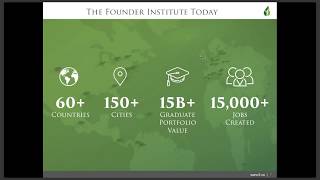
Hey everyone, how's it going? My name is Jonathan Gretchen. Welcome to this Founder Institute virtual and 100% live Q&A session. So I am a co-founder of the Founder Institute. We're based here at our office in Silicon Valley. And we'll basically— the way it's going to work today is I'm going to do a presentation on FI. It should be about 20 minutes or so. Try to get into detail on what FI is, where it came from, the structure of the program, all that kind of good stuff. And then after that, really what I want the meat of this event to be is to get your questions and to answer your questions. So as you can see here, I guess it's that way, it's this way. Okay, um, there's a little chat box right over here. On my side it's here, but to you guys, I guess it's over here. Put your questions in the chat. I'm not gonna be looking at it myself because that would give a pretty bad experience to you, the viewer, for me to be trying to read chat and talk at the same time. But we do have a member of our marketing team here, Catherine. Hello. Hi. Catherine will be looking at all of your questions and kind of feeding them in so that I can answer those questions from you. And if, you know, we are going to be sending a video of this as well afterwards, but if we don't get to any of your questions, you can always reply to any email from us, etc. So give me one second here. I am going to share my screen. I think my face is going to disappear and you're just going to see my slideshow. And there we go. Do you see that? Okay, cool. Awesome. So I got confirmation here. You guys should see my slideshow. So again, I'm gonna do about a 15-20 minute presentation. Any questions that you have, it could be any question at all, put it in the chat. We'll queue it up for after the slides. Any questions that come up during the slides, same deal. Once we get done with this, I'm gonna do about a good 20-30 minutes of Q&A and try to get to all of your questions. So we're here to talk about the Founder Institute. And already it's not working. One second. Okay, cool. So what is the Founder Institute? Well, in a nutshell, just right off the bat, the Founder Institute is an idea stage accelerator that helps founders launch enduring companies through structure, mentorship, and a global network. You've probably heard, you know, the term accelerator gets thrown out there a lot. We are an accelerator in the idea stage. So we take people generally before they are ready for, you know, a typical accelerator, which really, I think a more accurate term would be a seed accelerator. And, you know, those take teams with product and maybe even some revenue, and they kind of get them on a path, right? So those are the later stage companies. We work at an earlier stage than that. And our mission at the end of the day is to globalize Silicon Valley and empower entrepreneurs to build companies that will create a lot of jobs. We are based in Silicon Valley. We are now in over 160 cities around the world, but we try to take some of the lessons from Silicon Valley, the good lessons, that is, and, you know, really internationalize that to help people all around the world. Now, getting into the why of the business a little bit, and this is something that we really press when we work with entrepreneurs in our program, because if you don't have a good why to why you're doing something, you're probably not going to be able to see it through. If your why is just to make money, that's not the greatest motivation that we've seen for the challenges of entrepreneurship. You need to have a greater, a greater purpose. And for us, that purpose came from from this insight right here, right? Uh, myself and Adeo Ressi, my co-founder, we were running a website called thefunded.com. That website is still, um, in operation. Uh, it basically was and still is a review website with total anonymity for entrepreneurs to rate and review venture capitalists. And we were— every single person that joined that site, we wanted to make sure that there was somebody that was actually raising funding. Right, so that they could leave good reviews, reviews that weren't, you know, overly negative or overly positive, like, you know, valid reviews. And what we found was that we were literally rejecting about 80 to 90% of the people that were applying to that website. And the people that we were rejecting were entrepreneurs. There was nothing wrong with them, but they were entrepreneurs that thought the next step in their journey was to raise funding. But it really wasn't. It actually was about 20 steps down the line, right? So then we realized that there was this huge gap where a lot of people just think that, all right, I'm gonna start a company, I gotta get funding, then I gotta do this, then I gotta do that, then I gotta do this. But really it was totally inverse. There's a million things you can do before funding. And that was just a huge knowledge gap that we found. So, you know, most people really don't know the effort that's involved and they don't know the process that's involved. And that was really one of the big impetuses of starting the Founder Institute. And the second thing that is really explained on this slide is that, you know, there's a lot of hype around entrepreneurship. It's cool. It's quote unquote sexy. There's no shortage of organizations out there, events that you'll go to that are all like, you know, let's change the world. Let's do this, do something you're passionate about. At the end of the day, if you look at this, the picture on the screen, right, there's somebody who's looking at a ship that's capsizing. I think that's a really good metaphor because most people look at entrepreneurship as, you know, maybe it's like a yacht out in the Mediterranean and they're sailing and they're living the good life, drinking champagne. But that's really not what entrepreneurship is. Entrepreneurship is really, you know, to use the same analogy, it's really rocky waters. Your ship's going to sink. And if it doesn't sink, it's going to be near sinking almost every day. And I think a lot of that gets kind of lost in the mass media and what, you know, a lot of these organizations that push entrepreneurship, you know, really talk about. And, you know, for us, it was really, you know, let's be clear, let's be honest, let's be tough. And, you know, if somebody's not cut out for this or if somebody's idea is just not where it needs to be, let's be very clear to them because that will help them in the long run, right? So most people start out without knowing the process and the effort involved. And too many companies fail due to the early mistakes. You know, most companies fail right in the beginning of the process. You know, they might actually technically fail a couple of years in, but that's just dragging out mistakes that they made maybe in the first 12 months. So those are the things that we set out to fix with the Founder Institute. And basically the solution, and this is Adeo Rusty, my co-founder, it's, you know, him here with Elon Musk in 2003. I actually saw a news article today about this where when they went to Russia to look at rockets, you can Google it if you're interested. But basically the idea was, was to create a program that, you know, there's plenty of programs that'll help, that'll help, uh, later stage founders that have funding and that have product and that sort of stuff. But let's, let's create something that helps high potential early stage founders. And by early, really idea or comp, you know, just forming the company or just forming the team stage. And let's help them through a step-by-step program, strong mentor support, and a global network. And those were really kind of the initial ideas of the Founder Institute. And, you know, we started out humble. We started out this first class. We didn't know it was going to go global. It was at a— we basically created like kind of an ad hoc partnership with Stanford University. We ran a session at their, you know, just on some unused classroom. You know, it wasn't part of the curriculum or anything, just kind of a nighttime thing. And before we knew it, people were, you know, the companies that came out of that first program were really promising, one of which is Udemy.com, which is worth close to $1 billion, if not more now. And we had people all over the world, startup ecosystem leaders, you know, telling us, how do we bring this to our city? And, you know, kind of like how a lot of small companies are born, we just followed the demand. And now, you know, about 8.5, 9 years in, we're in 60 countries, 150 cities. You know, and a lot of jobs in the portfolio value created. So if you look also at our results, and this is just 2016 alone, 4 of our companies were acquired just last year. You could see some of the, you know, some of our bigger companies here that had a lot of success just in the past year. They've raised over $100 million last year in aggregate. A very, probably even more than very, an extremely conservative estimate of the amount of funding that our companies have raised would be about $550 million. And if you wanted to learn more about those companies, you can check out this link on the bottom right, fi.co/companies. So let me stop bragging about how awesome we are and let me start talking, getting into specifics. So why are we so effective? Well, as I explained before, you know, we come from this background of like, okay, a lot of people fail in the beginning and they don't have the process, right? So how do we fix that? And if you look at the success of companies, it mostly comes down to these three things: people, teamwork, and process. So let's start with people. Ideas mean nothing. Okay. We run thousands of events around the world. And probably the most common thing that I say, that I hear from early-stage founders, idea-stage founders is, well, you know, I don't, you know, I ask them like, well, what's your idea? Like, let me hear it. I'll give you some feedback. And they'll say, well, no, I don't know. I don't want to share that with you. You're going to steal it. Ideas mean nothing. Absolutely nothing. Great companies start with great people. Okay. Facebook was not an idea that was stolen by the Winklevoss twins by Mark Zuckerberg. Facebook was, you know, a larger theme that Mark Zuckerberg took. And over the course of many years through execution and through a million micro decisions and through, you know, so many sleepless nights, a whole process that was probably so villainized and romanticized in the movie, The Social Network, if you've seen it. Right? It took all that for him to make a great, a successful company. The idea meant absolutely nothing. At the end of the day, great companies start with great people. And, you know, that's an easy thing to say, but how do you act on that? Well, it's not easy. And it's one of the main tenets of the Founder Institute is, you know, we've basically, at a startup that Adeo and I worked at before the Founder Institute, We had a very hard-charging startup culture. This was in New York City. So we worked with a leading social scientist to create a test to find the right employees for that company. And the test was very effective. So when we were starting the Founder Institute, we went back to the same social scientist and we said, you know, all right, like, you did a really good job figuring out how we can find employees for a startup. Now, let's take that a couple levels higher. How do we find people that can build a startup, right? And that is this predictive admissions test that we've now been working on, um, for almost a decade, uh, with leading social scientists. It takes about an hour to complete. You know, you can give us your idea if you want in the beginning. At the end of the day, we're going to look at it, we'll consider it. But the biggest aspect of our acceptance process is really seeing if we think that you as a person have the raw materials of being an entrepreneur. And a lot has been written about this test. It's been on the COVID of Entrepreneur Magazine, as you can see here. It's over 30,000 people have taken it, translated it to 9 different languages, which is no small feat, I'd like to point out, because of all the cultural aspects of a personality test and how the words are used. But throughout the last 8.5, 9 years, every single time a founder's gone through our program and they've gone into the real world, we're collecting data points, right? So we're seeing how they did on the test in the beginning. We're seeing what personality traits correlate to creating strong entrepreneurs on the backend. And as a result, you know, we've gone through multiple versions of the test. The first one was 3 hours. Now it's down to about 45 to 90 minutes or so. And we have a really good accuracy on predicting if somebody can be a successful entrepreneur or not. If you want to learn more about it, you can check out fi.co/dna. But just to give you a really quick rundown, high fluid intelligence is somebody's ability to really think on their feet, so to speak, to quickly learn a rule set and apply it to new problems, right? That, that is I'm not going to go through the rest of these here because this one is really pretty important. You know, as an entrepreneur, you can read as many books as you want. You can be able to cite every— you could literally memorize every single business book out there. Once you start building a business, the playing field's changing constantly. The feedback that you're receiving, the data that you're receiving. Being a good entrepreneur is really You know, if it boiled down to one thing, it's your ability to take new information and apply it quickly. And that is, you know, one of the main things that we look for. You can read up on some of these others, which are all also major, but to be honest, will just take me a little bit longer to dive into. But again, you can, you can read all about this on fi.co/dna to learn more about the tests and our application process. Now, great people, right? If you have great people, you're finding great applicants through this test that I just mentioned. Now you need to combine those great people with other great people that have built successful businesses. And that's where our mentors come in. In any FI class, we'll identify somewhere between 20 to 40, sometimes, you know, a little bit lower, a little bit higher startup mentors. And we really try to find people that, you know, aren't too academic, aren't too consultancy, like people that have built companies before. And they're with you all throughout the process. And I'll get into the process in a second. But in any class, you know, the, the ratio is about a 2-to-1 mentor-to-founder ratio. And again, you know, these founders are there, kind of, the idea is you take a lot of smart people together in a room, and cool things can happen, right? Now, that's a good segue to this next part. So if the first tenet, the first pillar is people, the second one is teamwork. You have great people, smart people in a room. The magic happens when you make sure, you know, you combine all of their intelligence, all of their passion, but now let's create a shared incentive so that they work together. And that's where the shared liquidity pool of the Founder Institute comes in. And to be honest, I would say this might be quote unquote, our secret sauce. And that is where every single person that participates in the Founder Institute semester shares in the equity of the companies that are created. And that includes the graduates, you know, the companies, the founders themselves. Everybody puts 4% of warrants, which is essentially an option to purchase the shares in your company, into a 15-year pool. And FI manages that pool and it's shared out as you can see here in this pie chart. So 75% of that pool goes right back to the local ecosystem, and that's shared evenly across the graduates of the program, the mentors of the program, and your local directors. And then 25% of it comes back here to Silicon Valley headquarters, the Founder Institute, which obviously allows us, you know, to pay for our office space and grow and things like that. Some interesting things that I'll note that I'll mention here too. So on the graduate end, it's 25% to graduates. So let's say you had 10 graduates in a semester, that means each of you will get 2.5% split evenly. Now, the mentors, we don't do it that way. The mentors, their share of that 25% is totally based off the anonymous ratings that they receive from you, the founders. So let's say some mentors aren't that helpful, right? You know, we can't control these things. Nobody can. We bring in smart people. We put them in a room with you. Some people might be more helpful, more willing to help, more willing to give introductions. More willing to meet you for coffee or dinner or whatever it is, based off your anonymous ratings, their share will go up. So if somebody's super helpful, they're gonna get more equity in the ecosystem. So that is really the basis of this shared liquidity pool is to encourage greater mentor support. And there's no shortage of programs out there that bring in startup mentors. We actually compensate them, right? And their compensation is based off of the amount of help that they give you. And not only that, but you receive upside from the other founders in your class. So, you know, this is kind of a revolutionary thing that we do here at the Founder Institute where, you know, you pledge a little bit of equity in your company. You, in exchange, you get the involvement of a ton of other mentors and advisors in your local ecosystem. And to boot, you have financial upside if any of your companies, whether it's your company or any of the other companies in your cohort, you know, have a nice exit. And to date, we have distributed over a million dollars to founders, mentors, directors, etc. This screenshot It's such a good picture that it actually looks like it's a stock photo, but it's not. It actually is a photo that we took of checks that we were sending out. So finally, when you get smart people in the same room, you give them a shared incentive, you still gotta tell them, you gotta give them some structure, some process of how they work together. And that's where the Founder Institute curriculum comes in. So we've broken it down 3.5 months. You go through these basically 3 sections of building a company. Definitely some people come in that are a little bit earlier stage and some people that are come in that are a little bit later stage, but either way, it is helpful to look at every single one of these aspects. And as you can see here, bolded at the bottom are kind of the 3 special sessions. So with the Mentor Idea Review, You will actually be pitching to a massive panel of mentors and, and getting kind of graded and scored. Same with the mentor progress review, except that's less about the idea and more about the progress that you're making in the program. And then there's graduation for the lucky few. Every single weeknight session will start with something like a weekly update to talk about what you've accomplished in the last week. We then have what are called founder hot seats where you will present And depending on where you are in the program, it might be about your idea, it might be about your progress, but basically presenting on where you are. There'll be mentor talks on whatever the topic is. You know, if it's revenue, the mentors will talk about, you know, how they generated revenue, the models that they use, all these sorts of things. And then it'll finish up with some Q&A. And a lot of times people will go out to a café or something like that afterwards to just further build relationships. And a lot of this work, you know, we always get a lot of pushback when we're like, oh, we have a curriculum and we have assignments and things like that. Our stuff is real work, right? I hate it when somebody calls it homework. It's not homework. Homework is like fill in the blank and we'll score you. Our assignments are things like go out and sign LOIs, letters of intent, right? If you're a SaaS or a B2B company. If you're a B2C company, it'll be like, all right, in the next week, we want you to put up a landing page and perform an A/B test with at least 1,000 users to figure out what pricing structure is best for your business, right? These are real assignments to build your company. And we push you to do it in a really quick period of time. And then we also have mentors that are there to help you decipher all of that information. And, you know, we don't, we don't just throw you out there in the world and don't help you do it. We also have a lot of step-by-step guides, things like templates, right? Pitch deck templates, financial models, product development, legal templates for different types of agreements, whether it's with an advisor, an investor, an outsourcer. You know, we have all these types of templates to help you through the process. You know, basically trying to take a lot of the logistical work off of your plate and, you know, just let you get to the hustle of being a startup founder. And again, throughout this entire process, every single week you're presenting on the progress that you're making, um, and you're getting honest feedback from the— not only the program directors but the mentors. We actually have a rule they can rate you on a scale of 1 to 5. No 3s are allowed. Um, if you Google no 3s are allowed, you can get a full explanation to that theory that we use. I wouldn't even call it a theory, it's been proved for the last 8 and a half years. But basically, we want mentors to either be positive or negative for you, because a lot of people need to try to be nice and they want to be nice, but as a startup founder, you need to hear the truth. And we are all about giving you that truth because it will help you grow as quickly as possible. So along those same lines, this stuff is hard. Building a company is hard. It's extremely hard. Um, and as a result, the Founder Institute is hard. And less than 35% of people that start the Founder Institute make it to the graduation. And this is 100% by design. If you are not ready to put the time into being a startup founder, if you do not have the drive to be a startup founder, and/or if you don't have the current idea or business with the right team or the right market or whatever it is to build an enduring company, you will not make it through the Founder Institute. And again, this is by design. So about less than 35% people make it through. The good news is, is that for the people that, that do drop out, you're able to roll over your course fee into the next program. And, and obviously, you know, we have a lot of people that do that, and the people that come back, you know, kind of with the renewed focus and, and that have worked on their idea a little bit more, the, the graduation rate the second time around is obviously significantly better. But we're not going to sugarcoat things. Building an enduring company is extremely challenging. So if we allowed people to graduate that didn't have the right product, business, attitude, or team to do that, it would be a disservice. So it's hard, and, and that's why the Founder Institute is hard. So when you do graduate, you join the world's largest network of startup and mentors. We also don't kind of just leave you lurking. We have a whole set of resources and postgraduate programs to help people after they graduate the program. Once you graduate, you see here, and, you know, we call it the beta, you get access to the global lists. You have a dedicated support contact here in our Silicon Valley office, a ton of partner discounts, And obviously you have the economic upside and liquidity pool. For people that are really ready to raise funding in about the next 6 months, we have a virtual program called Founder Lab where you get a dedicated fundraising coach. We share database investors, actually work with you and edit your pitch decks and do virtual training sessions and all things like that, help you negotiate your term sheets. And then finally, Towards the end of where we can really help people is, you know, after they've raised the seed round or an angel round. And at that point, we can, you know, we host virtual demo days, we do office hours, events, things like that. And we have a kind of a syndicated network of angels that we call founder angels. Once you get past the seed round, you know, if you're looking at Series A, Series B, that sort of thing, we obviously try to help as much as we can. but the Founder Institute is really optimized towards this earlier stage of the process. Um, I had mentioned some partner discounts. We have a lot trying to help you across things like hosting, email, um, cloud services, you know, basically everything you can think of. Um, and just to give you a kind of a highlight of some of the, the graduates that have used FI and that have, you know, raise a lot of money thereafter. Companies like Udemy, Travelcar, and iCarsClub, just looking across the Americas, Europe, and Asia. But just as important, you know, the Founder Institute is not— there's plenty of FI companies that have been successful that don't raise funding. Our entire goal of FI is not to help you raise funding. Our entire goal of FI is to get you to the next step in your process and whatever that is. So we've had companies like Skimble, that has been a mobile fitness app where they were actually, I believe, in our first Founder Institute class and it was a girlfriend and boyfriend. They have since married, but they built this awesome app with millions of users, never took a cent in funding. And similar thing can be said about Auto Reduct and Grid Blaze here as well. Now, we keep the cost for the Founder Institute low. There is a $50 application fee. For the test that I'd mentioned, you know, this isn't an automated test. There is a human person that we employ. Her name is Megan. She's our head of admissions that reviews every single test that comes in. And as I had mentioned as well, you know, we have social scientists that are working on this. So there is a hard cost. The good news is, is that if you attend an FI event, you can apply for free and you'll get a link for that. If you're on this webinar right now, you'll get a link. But if you've been to an FI event in the past as well, any email that you receive would have that link. Secondly, the course fee is low. Now, I don't have a number here because there's people from a number of different cities, but the course fee can range, you know, on the low end to a couple hundred dollars, and then on the high end, you know, places like San Francisco, New York, etc., around $2,000 to a little more than $2,000. Now, keep in mind that this pays for a 14-week course. 14 different sessions. And it really is just a break-even thing from us. We're a small team here in Silicon Valley. We have a very modest office. You're welcome to come visit if you'd like. Really for us, as it should be, the value of FI is in the bonus pool, right? The value of the companies that we're creating. The course fee allows us basically to operate and hire here in Silicon Valley in order to help you and to help everybody create bigger companies. So you can learn more about the course fee in your city by going to fi.co/about. But you can also get a full refund on that course fee before the third session in your program to see if FI is right for you. So last two slides, and I'm going a little bit over here as usual, but who is FI for? The program started off as being just for the idea stage, this first section, right? We started off as almost kind of in this employee to entrepreneur space where it was for people, you know, before they made that jump, before they devoted all that time to validate their ideas, find co-founders, things like that. Now, over time, the amount of demand that we received from the people in the later stages of the process as well has somewhat forced us to bifurcate our program where people can come into FI in different stages and then they get put on separate tracks, so to speak. The program really adjusts itself for where you are in the process. So, you know, at the idea stage would be the earliest stage of the process, you know, back of the napkin sort of thing. And then at the later stage of the process, it would be somebody that, you know, as an early company, you might have some revenue, you might have some products, you might have a team, but you're not making the progress that you want, right? And we kind of deal with anything in between there. If you already have a lot of funding or not funding, if you already have some funding, if you already have, you know, a good amount of revenue and those sorts of things, we're probably too early for you. We're happy to talk. But really, we work with people, you know, at the earlier stage to get them on the path. And, you know, that path could be to just start bootstrapping and funding their company through the revenue that they're generating, or by raising a seed round or getting into a seed accelerator or something like that. And finally, you know, how do we compare to a lot of the other programs out there? So as I'd mentioned, we're certainly before something like a Y Combinator or Techstars or 500 Startups in the seed accelerator realm. We definitely don't compete with those organizations. We actually partner with them. And a lot of our graduates will go on to those organizations. So when I explained that, the next question that a lot of people asked me was like, oh, okay, so does that mean that you're a pre-accelerator? And I wholeheartedly am just against that term because we're not a pre-accelerator because a pre-accelerator means that you would go into the Founder Institute to get into a seed accelerator. And that's just not the point of FI. The point of FI is to get you to the next step. If a seed accelerator is that next step, that's great. If you can raise a seed or angel round without a seed accelerator, that's great too. And if you don't have to raise money at all, that might even be better, right? So this is where, you know, we would, we would go kind of, you know, just, just taking a small smattering of some of the larger startup organizations out there. This is where we live. So in summary, Founder Institute can provide you the structure, mentorship, and network to build an enduring company. Alright, so I am going to take off my screen, put my face back on here for you guys, and then I will be ready. Alright, cool. So let me bring up some of the notes that Catherine has been doing here. Alright, so A lot of questions, which is awesome. Thank you, guys. Sometimes I'm here trying to entertain you without questions, and that's certainly not my strong suit. So Aaron asked, "I am based in Zurich, and I am not fluent in German. Are all programs run in English?" All programs are not run in English. That's for sure. We have— programs that are translated all across the world. And we spend a lot of time translating those programs. Zurich, I don't know offhand exactly, but if you wanted the answer to that question, just reply to any email that you've received from us with that question and you'll get an answer back really quick. I believe offhand that Zurich is run in English, but again, I don't want you to— It is. Okay. So my coworker over here, Corey, who works with a lot of cities, is saying Yes, Zurich is in English. But if anyone else had a similar question, they're not all run in English, right? English obviously is a big language, you know, for business around the world. But if you truly want to globalize Silicon Valley, which is our mission, you know, you're going to have to cater to the local markets. And we have translated the program into a ton of different languages. Okay. So Mohammed asks, "Can I join the program even if I don't have an idea?" The answer to that, Muhammad, is yes. Now, I will put a qualifier on that, okay? The program moves very, very quickly. So, you know, what I have found is that a lot of people that come in and they say that they don't have an idea, what they really mean is that they have an idea, but they just like don't— they just don't feel too good about it, right? So my guess is, Muhammad, that you probably have an idea. And if you don't have an idea, at the very least you have something that you're passionate about or an industry that you've been working in that you think is, you know, not optimized and there's some problems that you see that you might be able to fix. Whatever it is, if you come into the Founders Institute, whether you have the idea for the company or not, if you're passionate about it, about the problem, the industry, whatever it is, then you might have a pretty good chance as the program starts to ramp up of finding somewhere to build a business within that industry. But if you just come in kind of totally, you know, no passion, no idea, not even any idea of any industry, um, you're probably not going to make it because it moves quick, right? And this is true not only for the Founder Institute, for, for anything in entrepreneurship. Like, everybody has ideas, right? You can go out with your friends, have a drink, have coffee, everyone, everyone's got ideas. Anybody can do that. That's easy. The hard part is actually, you know, hunkering down and working on that hours and hours, days, months, years. Right. And that's kind of where the talkers get separated from the doers. So, you know, I'm assuming that, you know, when you say that you don't have ideas, just an idea that you don't feel good about, and that's fine. That will get sorted out in the first few weeks of the program. But if you really have no idea where to go, then you might wanna join some, maybe some other things, go to some startup events, things like that before coming into FI. Or you could also always join and drop out by the third session if you think it's moving too quick for you. So I hope that answered your question. Joe, Jonah, is it possible to do well in this program while also having a full-time job? So that's, that's a good question. It's a nice segue from the last question. Um, you know, so as I showed before, you have the, the earlier stage, right, is the people idea, back of a napkin sort of thing. They might have a full-time job. Um, and the later stages is might even have a team, corporation, maybe even some revenue product. So the Founder Institute definitely works for people with the full-time job. It is a part-time program. It takes place at nights. You know, totally doable. That was the initial design of the program, and that has not changed. Now, for somebody that has a full-time job, it will be more challenging first than for some of the other people in your class that might not have a full-time job and that might be full-time working on their startup, right? That, that's just logic. Now, in any class, I'd say that the split is probably about 40% don't have or have a full-time job, um, and maybe 60% don't, um, you know. And I'd probably say maybe there's probably like a 20% in there too, or 30% that are like freelancers, right, sort of things, a part-time flexible job. So you certainly won't be alone joining FI, uh, with a full-time job. That's It's extremely common, but it's going to be hard because you're, you know, the amount of work that you put in, I guess, is probably the easiest way to explain it. The amount of work that FI is going to be for you is not going to be less because you have a full-time job, right? Because the market, building a company without FI, just in the marketplace, it's not going to be less either. So it's going to be a lot of work. There's going to be a lot of nights, a lot of weekends. But the design of the program is very much to facilitate that because, you know, there's just a lot of people are trained in general business and jumping into the entrepreneurship world is very, very different. So the design of the program is very much optimized for that. But I don't want to sugarcoat, it's going to be hard, just like anyone else that comes into the program. But you're just going to have a little bit less time maybe than some other people people will. Okay, so I try to be honest. I, I truly hope— and, and people will be mad at me here too if I'm scaring people away, uh, but you know, we're about honesty here. This is, this is hard, um, and if you have a full-time job, it will be harder. But that, that's the case whether you do FI or just build it on your own at night. All right, it's gonna be nights and weekends. So Let's see, lots of people asking about this. Brett, Raissa, John, Jocks. My company is past the ideation stage yet pre-funding. Shh, sorry. We have people in the office here that are being a little bit loud. My company is past the ideation stage, yes, pre-funding. What type of value could I get from the FI program. Okay, so if you saw that chart I put up before, the Founder Institute will take you and push you to whatever the next stage in your process is, right? So let's see, if you're past the ideation stage yet pre-funding, okay, so let's say that you, you know, I might not have the exact thing that you're describing, but let's say that you have, um, you know, you have an MVP already, some kind of product, maybe a co-founder or two, um, and now you are pushing to get it out in the marketplace. Maybe you already even have, um, but are just trying to accelerate that next process to get to that next step, right? Which might be funding, or it might be just significant revenue, or whatever. So in that case, the Founder Institute, which provides you with a couple of different things. Number one, it would provide you with a structured process to analyze what you are doing and plan the next step, right? Number two, you're going to be meeting with mentors every single week that can help you decipher all the data points and the information that you're getting, right? And there's never ever one, you know, strict way to look at this, right? I, I know some people come into FI, and, and I've gotten this feedback before, where they actually complain to me. They're like, every mentor told me something different. And I'm like, well, that's the world. Like nobody here has like the golden key, right? Like you're gonna get different feedback from everybody. So, you know, but obviously the feedback from mentors that, you know, people that can pattern match and some mentors' feedback may be more valuable to you because they've been in your industry and that sort of thing, right? You're gonna get expert feedback from a lot of different people. People to help you decipher the data that you're collecting. And then number 3, you know, if you're looking for advisors, if you really are, you know, looking for funding and those sorts of things, we're going to improve not only all of the materials that you have, but we're going to identify what are the things that might be holding you back from getting that, right? So a lot of people think that funding is just like, oh, I need to get my deck together and just go out and pitch, right? Um, yeah, your deck just has to be good, and you're probably gonna have to pitch hundreds of people if you want to close funding. Um, but at the same time, if you can say, okay, well, you know, if you have experts and say, I'm looking at your deck right now, number one, your churn rate sucks, so you got to improve that before you have any chance. Number two, you don't have any experts on your team, you need an advisory board on your team. Number three, right, whatever it is, um, those mentors will help you identify that. Um, also join your advisory board. Um, to help you find those people, and you can leverage the larger network of FI to find investors, strategic partners, clients if you're a B2B company, that sort of thing. So, um, again, I'm trying to, to group people in, so I'm assuming maybe post-MVP stage is, is that you— what, that's what you were referring to. Okay, so Valentin asks, how does FI support founders How do you get funded after graduation? A lot of funding questions, no surprise there. So in a couple of ways, Valentin. So number one, for any graduate, you're invited to come to a conference that we run called Founder X. You can look that up at founderx.com. This is kind of our global network event. We bring all people from all around the world, very networking-based, lots of parties, just lots of open networking, office hours with different mentors, matching people people together sort of thing. And then in addition to that, we do workshops and stuff like that. Uh, number 2, you are able to immediately see and search all the mentors in the FI Network worldwide. Now, just the qualifier there, not every mentor is an investor, right? But a lot of mentors are investors, so that helps as well. Now, what we also do is, is when graduates are at the point where, you know, and we communicate with you and you can send us pitch decks and all that stuff. When you're at the point where we think that in the next 6 months you can raise funding, we have this program called Founder Lab. And you can look that up at founderlab.com as well. We work with you, live office hours sessions, video chats, literally go in and edit your deck, share contacts with you, make introductions to investors where appropriate. And try to help you get funded that way, right? Um, so those are the big things that we do here at Founders2, uh, Global here in headquarters. And we also have a syndicated angel list— maybe I shouldn't call it angel list because that's a company— um, a syndicated list of angels, I'll say, uh, called Founder Angels, where that will be built all around the world, people that are interested in companies, and we break it down by the types of companies that are interested in things like that, and we'll syndicate around to those people. Um, but in addition, you know, a lot of the, the investors that you'll meet— everybody wants to raise money from Silicon Valley investors, you know, for, for whatever reason, right? Um, and we're in Silicon Valley, and yeah, Silicon Valley is great, all the stuff, but, uh, the investors that you're probably going to meet are going to be the ones that are local, right? And we can help train you, we can help put you through a process to identify them and close them and negotiate with them. Um, but really you know, the value that a lot of our local directors and the local mentors play in your network is going to get you connected locally to those people. So that, that should help you as well. Hopefully I answer that. Um, okay, so Jocks asks a follow-up question there: do I need to give more equity to get the support after graduation? No, simple answer. You guys probably wish my answers were that quick for everything. Okay, so John asks, how does the veterans fellowship differ from applying regularly? Okay, I will take a step back on this. John, um, you're a veteran. That's awesome. We love veterans. Uh, we have a— we have fellowships, uh, for a number of different, uh, people, organizations, you know, wherever you are around the world, right? So for example, globally, everywhere, uh, we have something called the Female Founder Fellowship, and that is, uh, a fellowship where any female can apply to the Founders Institute for free, and any female— or not any female, but the, the best female applicant in every city can enroll in the Founders Institute for free. Right? The number of females in technology is a big problem. If any of you have been reading the news for the last month, 2 months, or even before it started becoming into the news cycles, if anyone's been in the industry, this has been a problem for decades, right? We try to combat that. You know, we have this power so to speak, or this reach where we're helping train and groom and, you know, put out into the world all these early-stage entrepreneurs. So we have a great opportunity to change things like the number of females in entrepreneurship, which is why we offer things like the Female Founder Fellowship. You can learn more about that at femalefounderinitiative.com. But to get back to the veteran question, right, which is similar. The veteran fellowship, in the same way, you can apply for free, and the top veteran in any city gets to enroll in the program for free as well. Now, the female fellowship is global. The veteran fellowship is not because we're, you know, we operate in 60 countries around the world. So, John, I'm assuming that you're probably US-based. Um, but, uh, you know, you will be judged and accepted, you know, with the same criteria as everybody else. But, um, you would get into the program, or if you did get into the program and you were the top applicant, um, you know, we would basically roll you into the program without having to pay a course fee. And, you know, the veteran fellowship is something that we started about 2 or 3 years ago, and we've been seeing some good results. The Female Founder Fellowship we started about 7 years ago, 6 years ago, and that actually increased the number of female graduates in our program by about 30 to 35%. So, you know, just a little bit in the beginning really helps create that opportunity. And depending on what city you're in, if you want to learn about the fellowships that are available in your city, uh, you can go to fi.co/fellowships. Just make sure that you're in the right city because it's not a global thing. It really depends on where you are, except the female fellowship is global. Okay, um, can I apply to several different Founder Institute cities? There's a question from James. Um, do me a favor and don't, because it's going to cause a lot of havoc in our system, but Uh, I guess let me take a step back to the motive of that question. You know, if you don't get in on one city, you're probably not going to get in the other city. So, um, you know, I think the basis of that question shows me that you're probably not thinking about this the right way. Um, you know, where's the city that you think that you're gonna have the best chance to build your company? Right? That's the city where you should apply. If you're traveling around to go to a Founder Institute program somewhere else, like, you know, you don't have a network there, or it's not a city that's great for your industry or whatever it is, like, that's not the— that's not the way to look at it, you know. Um, you know, we don't— there was a reason why we syndicated FI to all these cities around the world, right? We didn't just have the Silicon Valley program and had people fly out here and live here for 4 months and then go back home. You can build a company anywhere. And I think what a lot of people discount is the fact that, you know, there probably are investors by you. Um, they might not have just been unlocked yet, or you don't know where to find them. Um, everybody kind of wants to move to Silicon Valley, but let me tell you, it's expensive here. I commute about 3 hours a day personally, pay a lot of income taxes. And you, you know, in your city, the, the bar will probably be lower than it is here in Silicon Valley and all of these types of things. So, you know, generally speaking, every city is going to have advantages for building a company. Rather than look to apply in all these different cities, okay, take a step back and say, all right, if I'm here and I want to build a successful, enduring startup company, what city, where would that be? Okay, and then figure out where to apply there. Um, if you apply to 10 different cities, you know, we— this, this isn't an algorithm that we created. I mean, like, someone on our team will see it and they'll probably be annoyed. So why don't you, um, apply in the place that you think you have the best chance of of creating a great company. All right, Valentin asks, "How does the bonus pool model work if company pay out dividends to shareholders?" So dividends typically does not apply to the bonus pool, right? The bonus pool is an option to buy future shares. These are all common shares. Believe me, the Founder Institute has absolutely no interest whatsoever in holding voting shares in any of the companies because, you know, we have over 2,500 companies now. We basically would just sit on boards all day and that's not what we're here to do. We're here to create companies. So those dividends don't apply to the bonus pool. The bonus pool comes into play, you know, in a formal liquidation event. Of a company. So let's see, um, last question. So I'll throw it up, um, if anyone else has any final last questions. This is the last question my team is telling me, but I'll just say it here on screen. Any final ones? We're going to sign off in a minute, so, so get them in there. What task assignment, um, has proven to be the most challenging for founders and Why? Are there any examples that we can look at? All right. So you can see an example of an assignment on a session and videos at fi.co sessions. If you scroll down, you'll, you'll see an assignment. But to answer the question on the ones that are the most challenging, you know, there are so many, to be honest with you. Like, I'll even give you a little insight into how we do it, right? So we've been operating now for close to 9 years. We, you know, you start to pattern match, right? This company needs to do this. This company needs to do this. Like, you know, their mentor scores are saying that this is really weak. Here's what they can do, right? And we've tested out all these different things. So we have a set of probably, I don't know, 15 to 20 or maybe even 25 or so templates. And then we adjust those based on the company. And we intentionally make them challenging. And these are what are called special assignments. And you can read about those as well at fi.co sessions. Um, when you get something like a special assignment, it is really meant to essentially cure the issue that the feedback, the bad feedback that you're receiving about your company in a really quick way. So, you know, it's hard for me to get an exact example, but Let's say that the mentors and the feedback that you're getting, they think that the, you know, the target market you have, the value proposition that you have is not going to resonate enough with enough people. Your special assignment then might be, for example, In the next week, we want you to survey this many people with this, you know, females 24 to 34 or something like that and see if they have this exact need. But, you know, going a step further, not just survey them, but also to, you know, have them fill in a form and give you their email and all these sorts of things. Right? So these types of assignments force you to do a lot of things that you need to do as a startup founder, right? Number one, you got to set up a site, you got to set up a landing page, you got to set up a drip campaign off the email to get the results afterwards, right? You might have to do a little bit of advertising, um, all these different things, right? So we make you do these things really, really quickly. So, you know, it's hard for me to say what's the hardest thing is. But, you know, all of it is very tailored to what you need as a business, and we make you do it really quickly. Okay. So I guess this is the last question. Jocks, thank you. I've seen your name pop up in here a lot. So thanks for helping me here and answer your questions. Is it possible to buy back the 4% of the share before the 15-year deadline. Yeah, no. And, you know, the way I explain it is this, all right, like, in any business, our business here at FI, you know, is at the early stage to help companies grow, right? And we have a lot of founders, and this is typical, right? Because as an entrepreneur, you're kind of always trying to find a deal, right? Like you have that creativeness in you. So Jox, I actually appreciate that you're asking that question because that probably means that you're like a negotiator, that you're always looking, you know, for some way to lower a cost or look at a different way at a situation, right? Like that skill will probably be extremely helpful for you in entrepreneurship if it hasn't been already. But at the same time, on our end, right, if we entertained things like that, right? And believe me, we've had people come to us and say, hey, like, rather than paying the course fee, can I just like give you a month of like consulting? Or, you know, all this kind of stuff, right? Like, if we entertained all these types of things, like, like, we just, we'd go out of business because we just don't have enough time, right? Like, as a business, you need to figure out what your business is, and then you need to optimize towards that, um, and put your resources towards that once you've figured out a good model and once you've figured out a way to provide value and have happy customers and stay alive keep the lights on, right? So, you know, that's why we wouldn't entertain something like that. You know, if we started negotiating contracts for individual people, now, you know, we're going to have to have a lawyer in-house. Lawyers here in Silicon Valley are not cheap. Nothing here is cheap, definitely not lawyers. So yeah, Jocks, while I appreciate the thinking behind it and the creativity, it's, it's not something that we can do, right? And I think, um, as you grow your business, you'll start to see that, you know, there are some places where literally if you started changing things and negotiating and trying to switch things up all the time, you know, it would just distract everything else and you wouldn't be able to, uh, to move forward. That was the decision that we made at FI, you know, probably 6, 7, 8 years ago even, right? So we're a little bit past that point. Okay, so hopefully I answered all of, uh, everybody's questions. If you have more questions, um, you're always welcome to reply from— to any of the emails that you've received from us. We also run conference calls twice a week where you can call in. I'm on the calls pretty often as well. It's a great opportunity for me to talk to people and give to do some customer development, and customer development never ends, right? So I love doing it. You can learn more about those weekly conference calls at fi.co/calls. And again, you can reply to any email that you receive from us or send us an email at fi.co/support. And we are a fairly small team here, so we're not gonna get back to you in 15 minutes, but we'll get back to you in a day or two. And with that, I'll say thank you, everybody. And, you know, whether you build a company with FI or not, I wish you best of luck. Take care.










