FounderX 2022: Esther Dyson Keynote Interview
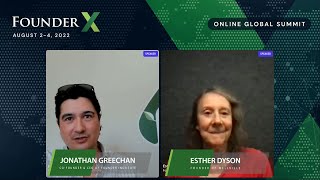
In this FounderX 2022 keynote, host Jonathan Greechan interviews technology pioneer and angel investor Esther Dyson. The conversation begins with Dyson’s early career—her work as a fact‑checker for Forbes, the creator of the influential newsletters Release 1.0 and Release 2.0, and her role as founding chair of ICANN—illustrating how she built expertise by constantly asking questions. Dyson explains how a conflict‑of‑interest‑free newsletter about Eastern European startups led her to start angel investing in the late 1980s, emphasizing the statistical nature of angel returns, the importance of learning from failures, and the freedom to take creative risks with one’s own money. She shares concrete investment anecdotes (23andMe, Evernote, WPP, etc.) and stresses that her value‑add is mentorship, proofreading, and connecting founders to networks rather than merely providing capital. The interview then shifts to Dyson’s nonprofit Wellville, a ten‑year, six‑person effort that coaches five small U.S. communities (e.g., North Hartford, CT and Muskegon, MI) to improve “human infrastructure”—education, maternal health, child‑care—by fostering collaboration among local organizations instead of competing for short‑term grants. Dyson discusses the challenges of building trust, the need for long‑term thinking, and the importance of being a catalyst rather than a manager. Finally, she offers a broad perspective on the democratization of technology, warning that democratizing finance can become gambling, that social media needs governance to prevent manipulation, and that DAOs and the metaverse risk reproducing existing power imbalances. Throughout, Dyson’s philosophy centers on transparency, problem‑solving motivation, and the belief that leadership should be driven by the desire to solve real problems, not personal ego.
Chapters
All right, well, let's get this show on the road, shall we? I'd like to invite on our first keynote speaker, Esther Dyson. So first, you know, I can provide an introduction for you, Esther, but I feel like I am going to butcher it. To be honest with you. But let me just quickly, if you don't mind, let me just give a little bit of context. So Esther, back in the— was it even the '80s or was it more the '90s— was running essentially the top newsletter surrounding technology and the internet. And in 1997, she wrote a best-selling book called Release 2.0: A Design for Living in the Digital Age. Since then, she was also, I mentioned before, the founding chairman of ICANN, all right? And that's the Internet Corporation for Assigned Names and Numbers. So maybe with that, do I have the second shortest email address in the world? @j@fi.co?
Yes, but I assume that there's a huge number of people tying you for that.
Okay, that's fine.
But yeah, I mean, somewhere there's a T dot something, and that dot something is probably a country code because those are 2 letters, like.us or.uk, and everything else was 3 letters until more recently.
Right. Like, I remember back in the day, it was— there was some entrepreneur that went to, I believe it was Cameroon, to get the.cm. And he made a whole lot of money with that.
And there's— basically, the country budget of Tuvalu is supported by.tv..tv. I mean, domain names are endlessly fascinating, and I won't bore you with them now. The other thing, just what you said before, in addition to the newsletter, which is called Release 1.0, I had a conference called PC Forum that stood for PC Forum back in 1982, and then when it finally closed because CNET bought it, uh, it was called Platforms for Communication Forum, PC Forum. So it just morphed from PCs to Platforms for Communication but didn't change its name. And yes, putting on conferences and events is really tough, so Everybody clap for Jonathan and his team.
Clap for my team. I'm just— I just work here, you know. Fair enough. But, um, but tell us, um, also, so you, you started at— as, uh, as a journalist, is that fair to say? I know you— I believe you wrote for The Crimson, and, um, and you, you kind of—
I was a fact-checker for Forbes, which, you know, it's like an altar boy for the religion of truth and transparency.
Well, I guess, I mean, maybe we'll get into later in this, but if— how do you feel about the religion of truth and transparency now?
Um, I still worship in that religion, not necessarily in the church of the media, and, and I love using words and stuff like that, but Fundamentally, the best training for almost anything in the world is asking questions. Because if you're a founder, you'll find out what's happening with your team and your customers. If you're working, you'll be listening to what could I be doing better? Am I really approaching this problem in the right way? The willingness to be both stupid and to be corrected, which is really hard, is probably the best training you can have for pretty much anything.
I couldn't agree more. Knowing what you don't know, that's something that we are always kind of preaching to our founders. And especially as an entrepreneur that's really just kind of doing that customer development, we tell them like, look, you're not an entrepreneur right now, you're a researcher. Right. You're just trying to understand a little bit more about the problem. And that same mindset brought you into angel investing as well. How did that— did that happen naturally, or was that just kind of you just digging deeper?
Well, so I had this newsletter and a conference, and of course investing would have been a huge conflict of interest. They worried about that stuff in those days.
And they don't really worry about that anymore, unfortunately.
Anyway, in 1989, I went to Russia for the first time. I'd learned Russian in high school. My father was involved with NASA and space, so we knew the Russians were good guys, even though the Soviet Union was not. And in '89, I went there for the first time and started a second newsletter, Release 1.0, and then REL East was about the startup world in Eastern Europe. And it, it made no money. It was free. It was basically a vehicle for my education, which is pretty much everything I've ever done. And maybe 5 years after I started that, and I also had another conference called East-West High-Tech Forum, this friend of mine said, you keep telling people they should invest in Eastern Europe, you know, Hewlett-Packard and Microsoft spend more effort there. And suppose I gave you a million dollars to invest? And I said, oh no, I can't do that, I'm a journalist, that would be a— how much money did you say? Because in the early '90s in Eastern Europe, a million dollars was a lot. And I, I closed down the newsletter because I realized, oh, people talk to me because I have the newsletter, but if I have money, they'll also talk to me. And so I started investing in Eastern Europe and discovered, wow, this is really fun. I like, I like finding startups. I like finding companies that are small enough to be helped, as opposed to— I'd worked on Wall Street for 5 years also, where you mostly just pick companies but you can't influence them as an individual investor. But with angel investing, you— it's more like raising children, whereas, you know, stock trading is, is more like sort of adopting them late in life or something, right?
Anyway, and we have the, the audience today is, is we have a ton of entrepreneurs, um, angel investors, a lot of people that are just getting into angel investing and just getting into investing in general. Um, so I'd like to dive a little bit deeper into that, which just, you know, into your journey into becoming an angel investor. And for everybody on the line, I mean, I've only been conversing with Esther for a couple of weeks now over email, but I believe, Esther, you're very modest. I also saw one of your quotes was that angel investors are great at being self-referential, I believe, and you definitely practice what you preach. But you have invested in some really amazing companies. But it probably also wasn't the quickest and most painless way to get there, right?
Well, I mean, angel investing, first of all, the most important thing to understand is it does not work if you invest in 1 or 2 companies, unless you get extraordinarily lucky. If you invest in 10 or 20, you know, statistically, you should get lucky enough to pay for the whole bunch because net-net angel investing over time creates more value than it uses. And so you need to have enough statistically to get lucky. If you avoid the really horrible ones, it pays off pretty well, but you need to be lucky enough to have enough assets, safety net to do that. Second thing is, don't look at the things that don't work out as failures. Look at them as educations. Yeah, this was an educational experience. I paid $25K for it. I paid $100K for it. Boy, am I smarter. And then it just, it feels better. The third thing is, as an angel investor, you don't need to apologize for your mistakes or even your educations. It's your own money. And so you can take more risk and be more creative. And I invest in things where I know I'll learn something. That's how I invested in 23andMe and got on their board. And I looked at the agenda. I invested. And, you know, jury's still out, but much, much grown from where it started. I invested in Evernote, where I see you're talking to Phil Libin tomorrow.
Yep.
And, you know, all kinds of— I was on the board of WPP where I was not an angel investor. I came along later, but, you know, this is a company that operates worldwide in probably most of the countries from which most of the people, the 100+ countries on here. I could pretty much go to any country and find some guy from WPP, which is a big ad company, who knew about what was happening in the local consumer marketplace and so forth. And, you know, you need to be prepared to help. I've proofread so many press releases and statements of little startup companies. You know, that's— it's not all that big strategy questions. It's making yourself useful, right?
And I know, and, and one of the quotes that you've had is the reason to not invest, the investor, but it's like, this is a good idea and I can help make it happen, right? So it seems like in addition to the, um, just the learning, you, you felt like you could bring something to the table. You weren't just looking at it like a Wall Street investor, you were looking at it as, yeah, you know, this is a vision I can help make happen, my money just being a small part of that.
Right. And it's also, I mean, I wouldn't pay somebody to play tennis for me. You know, it's the playing of the tennis. It's not the winning of the game. That's part of the fun.
Right.
And yeah, it's funding my nonprofit now.
Right. Let's talk about your nonprofit. And it's, you know, as I was mentioning before, there really is just a dearth of companies right now that are doing things that honestly are making the world a better place, right? I mean, I guess maybe saying there's a dearth is not fair, but at least it's not the ones that we're talking about enough. And what you're doing at Wellville, I think, is Super interesting. Now, this was a company you got involved in. It's just by— was it through investing or through—
I mean, I started it.
Okay.
I did not— for what it's worth, I did not start Adventure, which had the newsletter and the conference. I went to work for the founder and he had a conflict of interest. He was on the boards of both Compaq and Lotus back in the day. So I, you know, speaking of mentors and everything else, he was a good-looking former vice president of Morgan Stanley, and, you know, but I— he was running this little Rosen Research outfit of 5 people, and I looked at him and I thought, yeah, you know, I'm younger, I'm not a VP from Morgan Stanley, but I could do this. And You know, as a mentor to people, you don't need to look like them as much as you need to inspire them that they could do, you know, they can learn to be as good as you. And if you're a good mentor, you want them to be better than you, you know, and you want them to do all the work. I mean, it's easier to mentor people than to do the work. So the world is fair. Anyway, the— so I, I was on the, the judging board of what would have been the health— the X Prize for healthcare that didn't happen. And I thought, we really need an X Prize for health, not for healthcare, because health is— health is an asset. Healthcare is a repair job. And I thought somebody should do that. I was going to give a talk about how somebody should do that, and I realized that would be a terrible talk. Somebody else should do something that I had this idea. And in 2014, pulled the thing together, hired a CEO because I also realized, and this is really relevant, being a CEO is a tough job. And especially in a startup, you know, you need to deal with real estate, you need to hire people. It's— you need to be in charge of all the details. And the honest truth is I'm not very good at that. I'm a reporter, thinker, I ask questions, but— and I proofread, but there's a lot of stuff I don't do. So my CEO came from healthcare, from Cigna, but he'd worked in public health, and it's basically a a 10-year nonprofit project. And those are all important. It's not— and we don't give people money. We are in fact more like coaches or mentors to the people in the 5 small communities that are trying to make their communities healthier places for basically for kids to grow up. And these are 5 small communities around the U.S. You know, I love Africa and Russia and I could work anywhere, but It's kind of like, where do I have standing to criticize, uh, basically what the government is not funding, the problems? You know, where can I actually hope to influence without being an outside agitator to, to change our, to change our policies so that we invest in human infrastructure as well as in you know, physical infrastructure and stuff like that. So after 10 years—
human infrastructure. So you're— is it like education, things like that?
Education, maternal health, child care. Half the kids in this country, and in various other countries similar, but again, I, I want to focus where I can be most useful and be an example, not try to solve everybody's problem. They're born poor, eligible for Medicaid. They have parents who are poor who don't have time or education to help raise them, and, and they get damaged by the time they're in high school. And, you know, I don't want every kid to be an Einstein. I do want every kid to live up to its potential. And at the end of 10 years, which is in 2024, we start finding journalists and documentaries and sort of showing, you know, you don't need us to do this. These communities did it themselves. We just poked from the side and asked questions. And, you know, again, I, I want to be a catalyst. We have a team of 6 people. We can't run things, but we can definitely help the communities do that better. So that's the basic idea. And it's— we don't raise money from foundations because we're too weird. And we're— people don't think long-term enough now. And our fundamental pitch is think long-term and think across geographical, racial, financial boundaries and work with the whole community.
That's so— all right. I didn't realize that a team of 6 people. So let me just get your— and you got— so you're working with several communities of a couple hundred thousand, 5 communities of a couple hundred thousand residents, right?
In total, the smallest is North Hartford in Connecticut, which is 20,000, and the biggest is Muskegon in Michigan, which is the one that I work in most closely. And they And just one more thing, and then I'll— it was not a nice white ladies here to give you digital apps to make yourselves healthy. It was— there's this opportunity to get— basically, it started as a contest and it ended up more as a collaboration, but there's this opportunity that you and your community can apply for. And to our great surprise, in 2014, we got 42 communities that applied. Rick, our CEO, and I visited 10 of them and picked 5. And speaking of education, that was an amazing summer.
Yeah, I could, I could only imagine. So I guess, and, and I want to talk about some of the, the entrepreneurs you've invested in in a moment, but just that this is such an amazing, amazing project that you have. And again, you're working You're up against a lot of the challenges that a lot of people trying to create change are, right? These are things that are measured in years, if not decades, across multiple election cycles, across multiple funds, for example, right? If, uh, for anybody raising VC at the moment, um, you know, how— and, and I guess that, that kind of lends to why you say you're weird. How, like, that has to all be about the vision, right? I mean, how have you been able to find the people to really believe in that? And at that point, it's almost assured that it's not a bottom line thing, right? A lot of people say, yeah.
It's not. And I mean, that's the great luxury I got by getting lucky first in the stock market and with the angels. Um, the, the goal— I mean, in the communities, it took us 2 or 3 years for people to really trust us. You know, like, who are these people? Why are they here? You know, they, they don't seem to be taking anything away, but— and then they began to listen to us. And I mean, that's— but it's, it's slow. And our, our role is really the coach at the sidelines You own the ball, you're playing the game. We want to help you play your game. We're not telling you what game you should play. And each of the communities has enough problems that, you know, it's— you don't need to solve all the problems, you need to solve one or two. And when one or two effective organizations, suddenly they become more willing to share with others and to collaborate. Because just as people get addicted to drugs or food or whatever, Frankly, venture capitalists get addicted to exits. They don't get addicted to steady, sustainable businesses growing nicely. They get addicted to, wow, he got $50 million for whatever. Small community organizations get addicted to short-term grants. They chase after the grants. They spend a lot of money writing proposals. They compete with other community organizations. Which basically tears at the local fabric and don't build anything sustainable. So we try and, I mean, in Muskegon, one of the things I'm proudest of is Goodwill and YMCA working together on childcare and Boys and Girls Club cooperating with the police in summer recreation programs. And again, knitting that fabric together.
Yeah, we see this. It's unfortunate, right? I mean, we see this in a lot of the international markets we work in where when the government comes in—
Yeah, yeah.
They say we're going to have these amazing programs, right? All of a sudden, all of these players that used to be collaborative, now they're chasing money. Yeah, they got pitchforks against each other because they're chasing grants. And it is— It is unfortunate. So I have any questions in the chat, please don't be shy, throw questions into the chat, okay? We have a team of producers here who's feeding me questions. So please let me know any questions that you have, but, you know, just talking about a lot of— so you guys are doing some amazing stuff, okay? And there's a lot of other organizations, and I'm not going to name names or industries, right? But democratizing X is, is a very common rallying cry of many, many different businesses in technology right now. And I think at a high level, yeah, you know what, democratizing things can be good, right? Um, and I just love to— as somebody who's really seen a lot of these ebbs and flows and a lot of these you know, the hype and the downturns and this kind of stuff. Like, where are the markets right now that you think are actually being democratized, and where would you say maybe you're not so sure?
Well, I mean, let's start with, to me, the big elephant. Democratizing finance is in so many ways democratizing gambling. And, you know, Robinhood, et al., a lot of crypto. I mean, we're seeing that. And some people saw it at the height because it was inherently risky, and some people are seeing it way too late because they've lost their life savings. And it's, it's— I mean, to me, it is so evil to, to go after people who are poor and who can't spare the money and telling them you're democratizing bogus and making them spend money that they then lose. Democratizing one's voice, which is, you know, in the beginning what Facebook and all the social media did, is wonderful. Twitter, I love Twitter. But, you know, then you discover that when you democratize something, you still need governance, you still need quality control, you still need you know, enough friction so that the bad guys can't come in and without transparency get more power than you realize, whether it's privacy invasion or, you know, spreading lies. And I, I'm really interested in this stuff. It's half the people who do this are not really doing it for political reasons. They're doing it because it makes more money to make people unhappy, anxious, buy stuff, you know, come back. And so if you want to regulate this, partly just look at the metabolism. Don't even look at the DNA. Look for where the money's flowing. And if too much money is flowing, something's— somebody's probably doing something wrong under cover of darkness. So, you know, my goal is to help people have the tools to manipulate themselves rather than to be manipulated by people who take advantage of these supposedly democratizing facilities. And, uh, that the metaverse— do you want to pay rent every time you walk down the street? I mean, I want—
that's where it's going, right?
Yeah, I want the government to— I want us to pay collective rent whether it's virtual or physical, and then have us free to walk around and live without paying some overlord all the time. And yes, taxes which are income-dependent, I think, makes sense to pay for that infrastructure. But the notion, you know, whatever you think of the metaverse, you know that the people who are rich are somehow going to get a better deal than the ones who are poor.
And I know, and you've written about this too, where, you know, you were a part of ICON, and ICON back then, I mean, the whole goal of that organization was to essentially keep it, you know, away from government control, right? It's like, we have this amazing thing that can free information, so how do we keep it pure? And now, now here we are, right? I mean, do you, do you think that, I mean, who do you think should be in control or can even be in control of this? I know this is probably a really hard question, by the way, but I'm just, I'm just honestly curious of your opinion of some of these.
So the first challenge is, yeah, the public should be in control, but who's that? Again, there should be Transparency versus privacy. The more power you have, the more you are asking for something, the more transparent you should have a requirement to be. If you're an individual citizen, you know, walking along the street, you should have privacy. If you're somebody who wants a loan, it should be legitimate to ask you, well, where did you get the money from? Whether it's sanctioned nations or drug dealing. And if you have the power to control people, again, you need more transparency into your practices and what you do, how your algorithms work.
Right.
That's— and people need to understand that paying for that friction is part of the cost of setting up the operation, and it is the responsibility of whoever's making the profits to pay for that governance. In, in the case of ICANN in particular, you're right, we, we wanted to keep governments from controlling the internet. We also wanted to keep it as a fair and honest market, and I would say we more or less succeeded on the first. That doesn't mean there's not censorship in specific countries. We did not succeed in the second. It's a pretty sleazy business, but You know, the cost of it to society is relatively small. There are a bunch of people getting rich off basically duplicate domain names and selling m1crosft.com, you know, selling typos and, you know, basically, right, domain farms.
But it's just moved a lot away from the domain names as far as they don't matter as much.
And besides, it's not like selling tobacco or drugs. It doesn't physically harm any— I mean, you don't get addicted to domain names. You can get addicted to profits. But so that's where that is. But when you come to the DAOs, the distributed autonomous organizations, the notion that no, they're going to be totally decentrally controlled, It just doesn't make sense. The people near the honey control the honey, and for your average member of a DAO, they're— it's not a big enough part of their life. If you actually work for it, then you're closer to the honey. But the notion that by playing a game you— again, there's a lot of rubbish being sold right now. And there's, I think, you know, and there isn't— there are enough real problems in the world that I'd rather see people focus on those that can make you money solving them too. It's not— I'm not suggesting everybody be nonprofit, but, you know, things that in the US are redundant, in emerging markets can be extremely valuable. You know, just making commerce more efficient as opposed to making redundant stuff more competitive and, and basically pricing things so low that they're no longer profitable. Like, I mean, personally, I think Uber has been a huge gift from the venture capital community to the upper levels of American society.
It's a transformable It's never been sustainable. So we have a couple of minutes left here, and before we get going, um, I do want to just— a couple of things. So look, you've invested in some pretty legendary CEOs, all right? And, and one of the quotes that really stuck out to me was that you— and I'm paraphrasing, right— but you kind of reject the people that come to you that have the mindset of, I've always wanted to be a CEO. All right. And I, and I saw that as an interesting, um, a very interesting paradox, especially because even before you started investing, right, you were, you were a journalist. So you were observing, um, for a very long time. So tell, tell me, yeah, like, just the if we can dive into that a little bit. And maybe, I don't know if you have an example or two of somebody that is CEO but never really kind of sought to be that and why you saw that as really important.
So let me just answer somewhat differently. I'm trying to think of who that might be. But it's more the notion I want to be CEO. And frankly, my friends will get annoyed, but when Hillary Clinton said, I want to be president, I deserve it, or something along, it's like, this is not a privilege or an honor. It's a job. And if you take that job, you have duties. So the CEOs I like are ones who say, this is the problem I want to solve. If being CEO is the right thing for me to do, fine. But if, you know, I'm happy to be chief technical officer or chief customer, you know, I want the problem to be solved. I don't— I'm not looking for the title. I'm looking to help create the team that will solve this problem, because no one can do it without a team, and then ultimately a team with a much larger team underneath. And so it's just— it's the wrong motivation. And and you will focus on being CEO rather than, oh, I want to solve this problem, but actually the solution I thought was not right. Let's, let's try a different solution because my magic idea might not be the right one, but we still want to, you know, make drugs more accessible to sick people who need them, or make schooling more available to kids who need that, or, you know, we want to find something to make bridges strong. I mean, who knows what, but you know, it should not be about some individual's ego. It should be about somebody wanting to pull together a team because they think there's a real problem to be solved and they want to do something that's not redundant, right? Uh, so you know, when Anne Wojcicki started 23andMe, that was it wasn't exactly a problem, but it was— this is a place of knowledge that she wanted to make more available to individuals. What is their genetic makeup? What is their ancestry? What are their disease risks? And it was, it was wonderful. You know, we learned— we all of us learned so much, and our customers learned a lot about themselves, and some of them discovered unknown cousins or you know, or, gee, I should be really careful about taking this drug because it interacts badly with my genetic makeup or something. So that's, that's a good example.
Okay, so it's the one— yeah, it's, it's the ones that are focused on solving the problem, um, and they'll do whatever it takes to get there. Yeah, even if it means, you know, they won't lie.
But it's— and it's ones who want to build a team to do this, and, and they want to do something that's— yeah, it doesn't need to be amazingly unique, but it needs to be— I'm not just trying to compete with somebody else who's doing the same thing, because then why bother, right?
All right, well, Esther, thank you so much. Joining us. Everyone in the crowd, please give Esther a heart or a thumbs up or a clap, or I don't know what other emojis are available on this platform, but any of the ones— oh, there's a wow! There's a wow in there. Okay, maybe that's the top of the list.
Or a friendly whistle, or, you know, who knows. Anyway, thank you all.
Thank you so much, Esther. Yeah, it's honestly your inspiration and and hearing your insights on this stuff has been— I've learned a lot. This was all a learning process, right? And I've learned a ton, not just from our conversation, but even just preparing for this conversation. So thank you so much.
Thank you. Have a good 3 days.
All right. Thanks. Okay. So really quick, we are now going to transition into the other part of the event. We are about to now break out. Into an investor and advisor's track and a founder's track. I'm going to turn off this camera in a second, and you all should be transported back to the main room. Uh, we're going to be starting off the investor's and advisor's track, uh, with a talk by Mike Superovici, uh, who used to run the alumni team at Banner Institute, is an FI alum, and now is the head of acceleration at VC Lab. They have launched over 200 funds now in the last 2 years. All right, and, uh, on this first, uh, talk, he's going to share some of the experiences that they had and really provide a roadmap for anybody that's interested in raising a fund. Uh, what are some of the first steps that you need to do to accomplish that? Um, and then on the Founders Track, we are going to have Rami Assad. Rami has been a great partner with the Founder Institute. He is the co-founder and CEO of a company called Finmark, has done a ton of webinars with FI, always get great ratings, and his, his talk is going to be about really how to manage your startup through times of adversity. All right, I thank you all again for joining, and I hope to see you all in some of the sessions. Thanks everyone, this is going to be a fun couple of days. Please do me a favor if you can, turn your video on, Try to get on a desktop or a laptop using Chrome or Firefox. The event is much more useful if you're interactive and if people can see your face. All right, welcome to Founder X, and I hope I'll see you in a session soon. Thanks, everyone.










