FounderX 2022: How to Effectively Manage Dilution as You Fundraise, with Hanah Tran of FHH Ventures
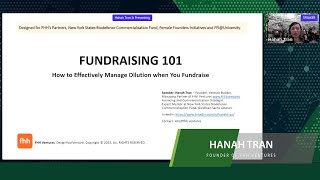
Hanah Tran of FHH Ventures breaks down five founder mistakes in fundraising: chasing growth without a dilution strategy, ignoring the cap table, and misunderstanding investor needs. She walks through a framework that starts with your exit goal and personal life goals, then maps financing to five business phases, and builds a clean cap table tracking equity, vesting, and investor terms.
Chapters
All right, welcome everybody to our second session in the Founders Track for today, which we're gonna talk about how to effectively manage dilution as you fundraise. We're already following a little bit behind schedule, and I wanna just give our speaker as much time as possible to speak and to answer your questions at the end. So I'm gonna keep this intro really brief, but our featured speaker for this session is Hannah Tran. She's the founder and venture builder and a Goldman Sachs veteran before that. Specifically here, she founded and manages FHH Ventures, which is a venture studio focused on fintech and Web3. And as she and I were just talking about before we clicked start here, agri, foodtech, and biotech, and health equity. And so with that kind of very, very brief introduction, I wanna turn the floor over to our guest, Ana. Take it away. And I'll pop back up here when we get towards the end so we have time for questions.
Alright, hi everyone. It's very nice to be here and talking to you and hopefully those might not— the knowledge that I'm sharing could be helpful for you down the road when you decide to fundraise. So it's very short, I just go start with the presentation and let me know if any question and in case you have any question that we not be able to answer during the session today because it's short, feel free to reach out to me later on on, right? Okay, so as you see, this is where we basically tailor— we are venture builder, so we invest our own in-house startup and we take them to exit at different kind of scale. So this is our expertise to share with outside startup, because I see that lots of founders struggling to navigate the different funding path and don't know how to fundraise or how to manage the dilution, and that's where we we would like to share our knowledge to help you. Next slide. So just go straight to the problem here. So what are the 5 common mistakes of founders when fundraising? So be very quick, we need to know what the problem so we can resolve it. The first one is the mindset. Most people just think the bigger, the better, right? And then they forget about the cap table or neglect about the business need, also even not fully understand your investor need. And last but not least is that you don't do enough the research on the financing option on your domain. So as you know, we work in fintech, in Web3, but we also, over the last 10 years, we have really invested and new venture in agri-food biotech for health equity. So that's where our domain, and depend on each sort of vertical, we need to resource and find a suitable financing option for that. So that's really important. So how to address those mistakes and how to manage the dilution effectively? So I want to ask you first and foremost, Visualize your end goal. This is our approach when we build venture and we take them to exit. What is our end goal with that venture? And should we fundraise, right? Because as for us, it's a little bit different because we have our sort of— we are business operator ourselves, so we kind of have a fund, like not really evergreen fund, but we facilitate the capital flow. But for founder, the lack of access to funding is very very common. So, but first and foremost, you have to really visualize your end goal. And here is not just the end goal of your business, what you want to achieve when you build that business, but also your goal of life, right? Because we— I see that lots of founders struggling with the wellness and mentality issue, especially during the pandemic, um, and the wellness also one of the key factor and what you want in your life as well. So first of all, ask yourself, should you fundraise? And to help you to visualize, basically, typically, if you intend to exit your business, usually there will be 5 phases, right? Launch, commercialization, growth, scale, and exit. That's where what we define in our scope Other funnel, other Venture Builder may have different scope, but this is basically our sort of secret sauce in a way. And for each phases, we align our business phase with financing phase, and that this alignment is very, very important because the moment you can visualize your end goal, then you can walk back, you know, like walk back and start from the beginning. You even have to visualize what you want at the end even before you start doing it, and that is very important. And try to be specific. Let's say if you want to exit this business at $10 million, then you work back and how much fund do you need and what would be the step you need to take in, how much the revenue, how much the profit you need to to bootstrap or to raise funds for, right? So based on that 5 mistakes, let's deconstruct the problem. So the first one, as I mentioned, is the mindset. Lots of founders often ignore training your mindset, you know, but actually that's important. You always think, you always keep in the trap that you have the million dollars, maybe that, you know, idea, right? But it's not really the case. Your mindset decides everything, and your mindset will decide the success of your business and how big the exit of your business. The idea you can change later, don't worry about it. So here's a mindset of most founders when they fundraise. They think the bigger the better. Even lots of news Outside, they sort of try to advocate for a big fundraising, or they try like, our startup fundraising round is oversubscribed. But you should take a step back and think, is it really necessary? So it's very important to remember 3 key things in any fundraising campaign. First is that you have to stick with your goal. And you really, really try to maintain your clean cap table with a very simple economics. I will go to that later. Try to customize your business need, and that is what go back to the visualization of your end goal. And always try to be in control if possible, because it's at the end of the day, it's your business, right? It's your company. The next problem would be you have to look at the math. Your cap table. You cannot ignore that. And lots of people, lots of founders often forget about your cap table, what's on your cap table. And this is very important to be able to build your own cap table using your Excel spreadsheet. I highly recommend that because that helps you to fully understand who owns what of your company. and try to keep it clean. The more simple, the better, and try to be accurate. So, a few key things I noted down here. We may not have enough time, so reach out to me if you need anything, you know, have any questions around that. But key thing to remember on your cap table, you have to be very clear: is it a pre-money valuation or post-money valuation? The equity allocation among your team, I mean, co-founding team, and also the vesting. Investing quite important. You might understand that, but actually it's quite important. Employee option, investor lead, convertible note, usually like nowadays, right, SAFE is using, it's very common, but it could hurt you. Try to Google it, I'm not trying to, you know, right here. And a few other things, you need to do your due diligence with your investor, like is there any warrant, liquidation preference, redemption right, et cetera. The third one would be how to customize your business need, and it has to be aligned with your life need. One founder I recently coached, she said she doesn't want to run that business for life, and she just needs to go to make it, to have it valued at $10 million, and she will exist. She doesn't need $100 million. So all of those goals you need to take into account in order to decide, should you fundraise, How long you want to keep running this business? When you want to exit it? You don't need to go to the whole 5 phases, but you can just exit it at commercialization phase. That's what we often do. We exit at small scale and it helps us to optimize our capital flow. That's why we never run our fund, actually. That's very good strategy for us, maybe not for everyone though. How much dilution are you willing to take? And last but not least, again, what are your life goals? Lots of Lots of people just want to become serial entrepreneur, and if you want to become serial entrepreneur, you have to exit and redo it, redo it, right? But if you want to build a unicorn, that's totally different matter. The next one is negotiation with empathy. This one is what you need to really keep in mind to understand your investor. Who are they? Knowing your investor is very important. Are they seed or seed Series A or growth? And is that they have the investment strategy that's suitable with your business strategy, because you don't want to run into conflict later on, right? You're like getting in bed with them at the end of the day if you receive their money. And, you know, and always ask them very clear, clarify very clear in terms of how much do they want to own your company. Usually, like, as a serial, you would have to give like 20% of your own equity. And so try to keep in mind all of those things, be clear, and clarify every detail that you're not sure. Also, you also want to understand how long that the fund, their fund has been set up and run, because usually the VC run has the length of 10 years or maximum 12. So and then outside protection, and also, you know, own other terms. Last but not least, and that's very important, do your homework on financing options because that would help you with your strategy, right? Like, doing the, you know, optimize your fund during the launch and commercialization phase would be the best way to manage your dilution effectively because it affects the whole business. I'm going to stop here. There are a few more slides, but you can always read that and connect me on LinkedIn. Feel free to reach out for any question. Yes.
Yes. Thank you so much, Hana. All the slides, you'll be able to access these in the recording afterwards that we send out in an email follow-up. You can flip through them and then they can read them more in detail after. But yeah, we want to switch over to the fluid networking session now to give everyone time to interact with Ana and ask questions. So thank you so much. Yeah, another super information-dense slide. And I know there was a couple of questions here in the chat about cap tables and such. So as Ana said, you can connect with her on LinkedIn or hopefully find her here in the fluid networking to ask your questions. But thank you so much.










