FounderX 2022: Keynote Interview with James Joaquin (Co-Founder of Obvious Ventures)
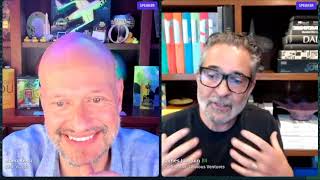
James Joaquin, co-founder of Obvious Ventures, explains the fund's approach to world-positive investing across climate, health, and inequality. He discusses portfolio wins like Beyond Meat and Proterra, and uses a time-machine metaphor for picking founders with breakthrough tech, favorable trends, and right timing.
Chapters
So we're going to bring on now James, who's on the investor side. Okay.
I just— my camera button just lit up here.
Greetings.
Can you see me in here? Okay. Yeah.
Your bookcase is cooler than mine.
It's, you know, designed by my better half, of course.
Well, you know, she is amazing.
She's way better. Yeah, I don't know. Thank you for inviting me, uh, onto your global stage. I'm excited.
Yeah, you know, I— well, we— I couldn't imagine a better pairing, and it kind of happened weirdly. You like, he RSVP'd, you RSVP'd, and then we were like, okay, let's do both, because we get to showcase really two sides of the equation that care. And, you know, I talked about in my opening that like it now is the time, right? We've had this pandemic that sort of broke, and you've heard some of the talk from Phil about it, broke down a lot of these boundaries that maybe we set for ourselves that now are gone.
Yes. Right?
And we can really have agency in changing the world, and that's happening. And we need, for the change that this world needs, It's entrepreneurs, supporters, and investors coming together and just, you know, making it happen. And I can't imagine a better guest to talk about the investor side than you.
Well, thank you for the kind words. I loved Phil's comments that like we should be building things that matter. We should be solving problems, building solutions. What are the two ingredients we need brilliant entrepreneurs and we need capital and maybe a little bit of advice and wisdom to go with that capital. That's the chocolate and peanut butter where we can really make a dent and build these solutions.
I know. And so you've been— what? So James, you know, why don't I can introduce you. I'm losing my voice.
So I can self-intro.
That would be super lovely. And then I have some poignant questions about that chocolate peanut butter stuff that you're working on at Obvious. So, okay.
Well, to everyone watching the live stream, hello, my name is James Joaquin. I'll bore you for 60 seconds with a quick intro. I am one of the co-founders of an early-stage venture capital firm called Obvious Ventures. I started Obvious with Evan Williams, who in Silicon Valley is very well known as the creator of Blogger, the co-founder and starting CEO of Twitter, and the co-founder and CEO of Medium. In fact, Ev, He actually just recruited a new CEO and stepped out of the CEO chair at Medium. And Ev and I co-founded Obvious with our third co-founder, Vishal Vasish. Vishal doesn't come from the tech world. He's an India-born immigrant that worked his way up to Chief Strategy Officer of Patagonia, the sustainable apparel company. I know most of you own at least one Patagonia item in the closet, probably a vest with some sort of logo embroidered on it. And my background is similar to Ev. I'm a repeat tech entrepreneur before becoming a VC. So I've worn the founder shoes many times. Those soles are worn down. 3-time venture-backed CEO. Started my first startup studying computer science in college. That company was acquired by Apple. And I spent 6 years at Apple during the personal computer era. And then this thing called the internet was invented. You may have heard of it, Adayo. I thought it was pretty interesting and left Apple to start building internet startups. And the first one, when.com, it was the first web-based calendar. It was acquired by AOL. The next one, ofoto.com, it was one of the first online photo services in the digital camera days. That was acquired by Kodak. I ran it as a subsidiary of Kodak for 3 years. And then I became— I love Ofoto. I love Ofoto. Thank you for being a customer.
Well, yeah, I use it all the time.
You know, after Ofoto Kodak, I actually became the CEO of a global payments service. So that was kind of part of my entrance to the global stage, running a company called Xoom with an X, X-O-O-M. And Xoom helps immigrants that have left their country to go find work, helps them send money back to their families. And those customers were getting ripped off by a monopolistic player called Western Union. We use the internet to bring low prices and fair and transparent foreign exchange fees. And that was our mission. That mission ended up being our key business driver. And we took a lot of market share from Western Union. Zoom had a successful IPO on the NASDAQ. And I've been on the venture side of the table ever since. And to tell you quickly why we started Obvious, I like to start with the why. That's the question I ask entrepreneurs. Why are you building what you're building? For Ev and for Vishal and for me, we came together with this crazy shared belief that we could use venture capital and entrepreneurship to actually build solutions to systemic challenges. We looked at challenges like the climate crisis, like chronic disease, like income inequality. And we looked up and down Sand Hill Road where all the big VC firms are, and we didn't see them investing in solutions. They were just doing enterprise software and ad tech and disappearing photo apps. So we said, let's actually start our own purpose-built fund. We coined the term world-positive venture capital to describe this idea. And we came up with a new term because our idea was different at the time. We believe for the right companies, these solutions can actually outperform. They can drive the best venture capital financial returns, and they can have huge social and environmental benefits. Every dollar of revenue that revenue can just naturally have that social or environmental benefit linked to it. And that's why we started Obvious. We try to authentically invest in those kinds of companies. We have 3 big pillars we call sustainable systems, healthy living, and people power. They map to those big challenges I mentioned. And we've got over 100 investments now, 6 public offerings and growing. We just raised our 4th core fund, crossed a billion over a billion of assets under management. So, we went from crazy idea to, I don't know, adolescent startup in the venture world and we're having a blast doing it. And that's my quick intro.
Man, where do I begin? Well, first of all, you're 1, 2, 3, 4, 5, 6, 7, 8, 9.
That was—
you add, not only do you do amazing things, you do it with—
We make math jokes with our fund sizes.
Do you want to just tell about, because I think that's just beautiful. Like, he's not only good at what he does—
Our first fund was 196, yeah. We— I mean, it happened kind of by accident because we were trying to raise a $100 million fund and we got oversubscribed. That, in venture terms, that means we have, you know, more people giving us money than the size of the fund. So when we got to around $120, I went to my co-founder Ev and I put a piece of paper in front of him and I said, sign this amendment. It's going to increase your subscription to the fund by this weird amount. And it was this weird number ending in, you know, 456789. And he signed it and he looked at me and he said, why am I signing this? And I said, well, because tomorrow we're going to file our Form D with the SEC and a whole bunch of journalists, including the Wall Street Journal and TechCrunch, they all watch that database. And most funds just put boring numbers in that database, $100 million, $200 million, whatever. Andreessen raised a billion. Why don't we give them a really interesting number? And why don't we celebrate the math and science and physics that is the basis of the technology we like to invest in? So, so we did a fun number. We did 1, 2, 3, 4, 5, 6, 7, 8, 9. Got a ton of press just based on that. And that became a tradition for us at Obvious. Our latest funds are both 9-digit palindromic prime numbers, and they add up to $461 million, which is also a prime number. Our 4th core fund, our 6th total fund, and over $1 billion in AUM. So we're trying to keep our nerd cred alive.
Well, you know, but, and you're funding amazing things. Like, I love Beyond Meat.
Yeah, that was our first IPO, Beyond Meat. People thought we were crazy investing in plant-based meat.
I mean, you know, I became a vegan about a year and a half ago, and it was one of the more affirming decisions I've made in my life. So you invest in things like Beyond Meat. You also have the creamery, Miyoko's Creamery, which makes a lot of the—
Cream cheese and butter.
How do you think about the world? Like, because you got these wins, right? Obviously you didn't know they were going to be wins.
Yeah, we had a thesis that they would be.
Fair enough, right? So that, that's what you're saying. So you came in the world and said, look, I think that this is going to be disrupted, I think this team is going to be the disruptor, and then you just went in.
To explain it, I mean, we do a lot of thematic work. We think of ourselves as a thematic venture capital fund, and that's different than funds that are just chasing the latest hot thing, you know. And there are very, very successful VCs, you know a lot of them personally, Adeo, that are really good at just, you know, chasing the flavor of the month. We're a little different because we're trying to do this world-positive work we're mapping out what we think are these big systemic challenges. Let's take climate change. And in our first fund, we said, well, we need to really accelerate renewable energy. And we invested in companies that were doing everything from software for solar installers to fintech companies doing loans for financing solar. We backed a company called NRV that does energy efficiency marketplaces. In our second fund, we refresh those themes within sustainability to say, well, we really think we need to electrify anything that uses internal combustion. We called it the electrification of everything. How do we put the internal combustion engine out of business? We looked at automobiles. We said, well, we think Elon's got that covered in terms of automobiles. But then we looked at other big markets using internal combustion. And when we looked at heavy-lift vehicles like buses and trucks, we found a company called Proterra. We backed Proterra. They're the only US company making electric buses, like city-scale buses. They're now a public company. They went public in 2021, but we invested years prior around that thesis. We invested in an electric vertical takeoff and landing air taxi company called Lilium, right? All of those pieces of the puzzle for us start with, a research point of view. And that tends to lead us to find companies that are building some more, some healthier or more sustainable product or service that could disrupt a big trillion-dollar industry. Right.
And you've said that the most successful founders are often ridiculed, derided, and overlooked early on. Is this like, is so, I mean, going after electrification probably seemed like a terrible idea when gas was like whatever, $2.50 in the pandemic, and like a really great idea right now when it's like $8 in the, uh, in the Bay Area, you know.
Um, I mean, one of the ways I describe that, Adeo, is that we build time machines. I love this metaphor because In early-stage venture capital, I believe you have to have a point of view about where the world is heading. And you have to pick the time horizon correctly. If the time horizon is too short, then you're too late. Then the value creation has already occurred. If your time horizon is too far, well, then your company might not have enough capital to actually make it, right? So there's this kind of near-future sweet spot, right? And, you know, our thesis is we want to find an amazing team of founders. They're the pilots of the time machine. They need to have some breakthrough technology that's 10 to 100 times better than what's here today. But the technology is necessary but not sufficient. We also need to believe that there's some sociological change, there's some change in the market, in society, with a customer. Maybe it's a generational trend. Our plant-based protein thesis was based on the idea that millennial and Gen Z generations were really going to shift to eating less animal meat and that they were going to need delicious, nutritious alternatives. So we look for that combination of technology, societal trend, getting the market timing right, And most importantly, finding the founders that can actually pilot the time machine. And if we get the knobs and dials right, you get a Beyond Meat, or you get a Recursion Pharma, or a Proterra, where when it actually lands, it's got the right product at the right time. It's disruptive. It's got a big moat. And it creates both a lot of financial value, but also a lot of value to society, to humanity, because what they're building is just better. It's got environmental or social benefits baked in.
Yeah, amen. And we need that. Like I opened with like, I see 2030, we reversed climate change, we've increased biodiversity, and we're powered by renewables, right?
From your lips to God's ears, yeah.
Exactly. And we just need to like everyone, that's where we're going. Right, like, you know, if you're not working on that, like, it might take a little longer.
It might take a little longer than 2030, but I'll take it as soon as we can get it.
Well, it might. Okay, well, let me ask you, because I, I know you, you have some time machine-y, uh, investments, right? But like, and, and some of them are helping in that. But, but, but before we go there, yeah, how do, how do we make it faster? Let's not think about how, how it will take longer. Why don't we think about how we can make it take less time?
Yeah. Yes, please.
Well, I love your ideas.
I mean, I'll tell you one idea is 2 years ago or 3 years ago, I would have said we need more capital into these things. But in the case of climate tech, if we just take climate, I don't want to disregard some of the other big challenges we have. But at least with climate, I have never seen such a sea change in the capital markets and with investors. There's so many new funds. There's so much money coming into climate tech. That's really promising. And I think that's helping solve the next shortage, which is founders, entrepreneurs to work on this. You and I grew up in a Silicon Valley where our best and brightest minds were working on ways to get humans to click on advertisements more frequently.
Many of them still are.
Many of them still are. They've got million-dollar bonuses to get more engagement and open rates of apps and all of these things that are— they're generating greenhouse gases. They're not solving a climate problem. They're not solving a mental health problem. They're maybe— they're contributing to it, right? But I'm personally meeting more and more engineers from, say, the social media industry saying, I'm done. I don't want to work on this stuff anymore. It's not good for humans. I want to go work on climate. I want to go work on a direct air capture startup and figure out a way to take carbon out of the atmosphere in a low-cost way.
Oh yeah, the mass resignation right now is great for startups.
So that's exciting. That's a real shift, right, of people wanting purpose, wanting meaning in their work. And you don't have to sacrifice money. You can make money and have meaning. You can have it both.
Thank God you said that. I was trying to get this out of, uh, Phil earlier because, like, sorry, you know, I'm losing my voice and sound like— but, uh, I think you can also, in more than even have make money, you can do that. So I'd say you can have 3 things: make money, yes, have fun, yes, you're working on something, and work on something meaningful. I actually don't think you need to compromise on anything. Right? You can have a great time, make money, and change the world. And we should manifest that.
100%. Right?
And then if you're working on Exxon and not having a great time, you'll be like, whoa.
Can I tell you a quick founder story about that?
Yeah, I'd love that.
So when we, you know, I work in service of founders, right? So I'm just always in awe of great founders. And when we started Obvious Ventures, we recruited a venture partner onto the team named Sami Inkinen. Sami is from Helsinki, Finland. He's an immigrant that came to the US. He was the co-founder and president of Trulia, the online real estate website, helped take Trulia public, had a successful IPO. And then after taking Trulia public, Sami competed in the World Ironman, you know, the like toughest triathlon in the world in Hawaii, and he won the World Ironman for his age range. So this guy is like the fittest man in the world, and after winning that Ironman, his doctor gave him a physical and diagnosed him as pre-diabetic. And his doctor said, look, mainstream medicine, if you're pre-diabetic, our recommendation is that you exercise more and lose weight.
Would you imagine?
You're like Captain America and someone tells you to exercise more and lose weight, right? So, so Sami, even though he was from the tech world, he said, I'm going to— I'm going to figure out this puzzle. Something is fundamentally wrong here. And he found a couple of M.D. doctors, medical doctors at two different universities that had a very radical contrarian theory about metabolic health because diabetes is a metabolic disease. Sami that, you know what, I have found with the help of these doctors, this idea that a ketogenic intervention that's medically supervised can actually heal a human's metabolism and actually repair their insulin system. And he wrote on a napkin, he said, I'm gonna start a company and reverse type 2 diabetes in 100 million people by the year 2025. He was not a healthcare entrepreneur. He came from the tech world, but he was an n-of-1 study, right, around this. And he went so deep on it and we got so excited, we wrote him his first check and said, go for it, go build that company. That company's now called Virta Health. It's valued over $2 billion in the private markets. It's caring for hundreds of thousands of patients and growing. Over 60% of their patients get completely off of insulin and completely reverse their, their type 2 diabetes. So they're actually doing it, and, and they were ridiculed by mainstream medicine when they started. Now it's a breakthrough for one of the biggest global chronic disease epidemics on the planet, which is T2D. And so to me, that's an example of like founder determination and passion to go solve a problem.
Yeah, I mean, a lot of it boils down to that. Tell us about some other, uh, time machines. That's a, that's a great one, and I love, I love him. He's so awesome. Uh, but what are some other time machines that you're like passionate about or love to share that you—
So let me, let me tell you, I, I don't want to, you know sit here promoting companies on the, you know, on the whole time, but I'll tell you about, you know, two other time machines that I'm personally really passionate about. One is called Diamond Foundry. It was one of the first—
by the way, this is good though. People need to see these success stories.
A lot of stuff is like a little too negative in my view.
Oh, it's hard, you're gonna die. Like, we should also celebrate and discuss the success, right?
I just don't— I just don't want to be that guy that's like just promoting companies, but I think these are the these are authentically world-changing companies. And hopefully we'll have lots of time to answer questions, right, from your audience as well.
And by the way, while we do this, let me remind them there's a Q&A button on the—
Use the Q&A button. I see the chat stream flying by my right side of my screen, but I'm not looking at it. So use the Q&A section. And Adeo, two quick time machine examples. One is called Diamond Foundry. It's one of the first investments that I made in the early days of Obvious Ventures. And it's a company that is a perfect example of a time machine because when they started, their technology wasn't even working yet. But they told me they had an idea to build plasma reactors. These are like Think about a box the size of 2 refrigerators that actually uses microwave energy to create a plasma ball hotter than the sun inside a vacuum chamber. And they were going to put 1 micron thin seeds of diamond and then move that plasma ball up slowly over about a 3-4 week period. And inside that chamber, gases like methane would release carbon atoms And those carbon atoms would just naturally attach to that diamond seed and build a perfect carbon lattice known as diamond. And in these reactors, they wanted to grow pure diamond. And so we backed that company early. It's a huge success story. Number one, they're up to like 10-carat diamond blocks that they're growing. Number 2, our social thesis of that time machine is that, you know, the next generation of couples wouldn't want a blood diamond engagement ring, that consumers would actually want an above-ground diamond. This idea of a carbon-neutral diamond, which by the way, Diamond Foundries created the first-ever carbon-neutral diamonds. They use 100% renewable energy to grow these diamonds. So in a way, they're really like a diamond sink, right? We're taking Imagine being able to turn methane, instead of releasing it in the atmosphere, we can turn it into pure diamond. That's the definition of alchemy. And they're, you know, they're very, very successful, large business now selling these diamonds. They've got multiple foundries that they've built on multiple continents around the world. And they're now growing diamond wafer large enough that they've created a diamond gallium arsenide sandwich for a new kind of semiconductor that can use a diamond backing to dissipate heat more effectively. Diamond is a miracle material. It has 22 times the heat transfer of copper. If we can make diamond semiconductors, we can solve a lot of the cooling challenges of data centers. The reason Google and Apple and Facebook are building so much solar to try to make their data centers carbon neutral, it's not for the electrons in the chips, it's for the air conditioning to cool the buildings. 'cause those chips get so hot. And so this idea of diamond semiconductors is the next big market for Diamond Foundry. That was all a time machine when we invested.
That's pretty awesome, right? And then like talk about, you know, exploitation of labor, doing things that, you know, like that.
I mean, talk about flipping negative externalities to positive, whether it's child slavery or even if you buy a, a responsibly mined diamond from Canada, you're still doing a ton of environmental damage. They're digging football field-sized—
Oh yeah, those, those, those are really not where humans should live. They're like these pipes that come up in northern Canada and like, it's like 110 below in the winter. It's like not—
So why not just imagine a better future and then invest in founders to build it?
Right, that's awesome. All right, what's the other one?
Okay, one more. Uh, this, this one is still, um, uh, we haven't talked about it much. It's still— this company is still quiet. I, I, I wouldn't say stealth, they have a website, but they're still in the early days. And the company is called MycoMedica, M-Y-C-O. And I don't know how much biology you studied, but that's a clue that this company is based on mycology, on the study of mushrooms and fungi. And it's founded by Paul Stamets, who I think is the greatest living mycologist on planet Earth. Paul Stamets is featured in the Michael Pollan book How to Change Your Mind. I think many of our viewers— I'm seeing some hearts pop up— they probably know and love Paul. He wrote a number of bestselling books, including Mycelium Running, about the mycelium network and how it's, you know, it's the largest living organism and it's part of a giant networked consciousness. Well, Paul, in addition to all of his mushroom work, he actually has one of the deepest knowledge sets, know-how, and specimen libraries around psilocybin, which is the, you know, psilocybin mushrooms, cubensis mushrooms that that are known as magic mushrooms. And so we've built a new company with Paul as the founder. We led the seed round. I serve on the board. And this is about bringing Paul's research, often called the Stamets stack, which is combining psilocybin, lion's mane mushroom, and niacin, where that combination in the, in the research lab— and there have been two papers accepted and published in the, in this, in the prestigious journal Nature about studies where this stack is creating neurogenesis. It's helping human physiology regrow neurons. And we've done tests where— with what's called a TAP test to measure your motor neuron response. And humans that are over 50 that were microdosing this stack showed dramatic improvement in that TAP test. And that's a proxy for neuro— for measuring neurodegenerative diseases like Parkinson's and Alzheimer's.
My mother is right next door.
All of us have someone in our family, right? And as we play whack-a-mole and we solve the other chronic diseases like heart disease, diabetes, as those go away, even cancer, as we're really dropping the numbers on cancer, what we're gonna be left with are neurodegenerative diseases, Alzheimer's, Parkinson's, we're just gonna see those go up, right, as a percentage. And we think the research this company's doing, it's preclinical, so it's very early days, but we think that there's early promise that we can unlock the wisdom in the mushrooms to actually help, you know, restore and repair our central nervous system and prevent or treat these kinds of neurodegenerative diseases. So that's a time machine I'm really excited about. It's super early. It's an area that a lot of VCs wouldn't touch, right? Because it's psychedelics for human health. But we think, we think that time machine is going to land in the right place and that in the near future we're going to see at the federal and state level, you know, the FDA embrace psychedelics like MDMA and psilocybin as breakthrough solutions for human health. And MycoMedica, we think, is an amazing team going after that.
Well, I'll say there's a lot of stuff that's legalized is far worse than the stuff that's made illegal in many cases. And the reality is, if you have a psychotic problem, in some cases it's also been studied. The effects for PTSD are like incredible.
Yeah, there's a nonprofit called MAPS founded by Rick Doblin. They're doing incredible work. They're in stage 3 human trials and the results are some of the best results the FDA has ever seen in terms of positive effect versus placebo treating treatment-resistant PTSD. This is the toughest, hardest, worst PTSD cases. They're getting great clinical results with basically no toxicity.
They're like, yeah, it's crazy.
The negative patient outcomes in their trials were in the control group, not in the experiment group.
Yeah, I mean, I, you know, and maybe you heard it or missed it, but like Phil and I were talking about, like, now is the time for change. Like Like, you know, leave aside the psychedelic effects of the mushrooms, the actual medicinal side of what they've proven is like irrefutable at this point. And like a lot of the stereotypes, a lot of things are just changing and it's about time.
And we have to show a lot of respect and honor the indigenous people and First Nations that taught us a lot of that knowledge. From psilocybin mushrooms. Well, and thousands of years of knowledge, you know, predate the Western world jumping on this bandwagon.
There's still a lot more knowledge to come. I think we're really— that is another whole area. You know, I'm sure we had some mutual friends who've spent time trying to learn and bring some of that knowledge back. It's— and organize events around that. I think that's definitely another trend that's going to be happening. There are questions from the audience. And before I go there, I'd love though, like, you know, not to steal your thunder, but like, what are some of the things that you're— what time machines are you looking for now, maybe is the way to ask it.
Yeah, I mean, you want me to give up my secret treasure map?
Well, you know, listen, This is mentors and founders, maybe some other investors, but it's going to be like, sure, the audience where your time machines may find a time machine leader, if you will.
Yeah. I mean, I'll mention two things, Adeo. One more of a general category and one specific. You know, the general category is what I would call learning and or what the industry calls learning and development. But I really think about, and you were talking to Phil about this, that we're entering into this era of hybrid and distributed teams. Because of that, we've rebuilt the whole productivity stack. So we're figuring out how to work together when we're not physically together. That there's a huge world positive unlock there, which is that we can allow people on other time zones and other continents to participate in the innovation economy. I think that's really powerful. And so I'm looking at companies that are enabling that. And I'm also looking at companies that are thinking about in this new messy hybrid world, how do people get mentorship? How do they get coaching? How do they get skill development in the workplace when you can't just like follow your boss around to meetings? How does that work? We need new tools for learning and development. And I think it's going to be critical for the next generation in the workplace, right? They have to get mentorship and osmosis and training. And I think we need new—
But not like sitting at home on whatever, you know, like TikTok.
I love it so much. Yeah, I mean, you know, old folks like us, we were fortunate to have bosses and mentors. And, you know, I was so fortunate to get trained at Apple. Apple had its own university and sent me to classes. And, you know, taking some job on Zoom, you don't necessarily get the same kind of training. So coming up with new infrastructure for learning and development and training and upskilling, that's an area, that's a time machine area I'm interested in. And then one specific area I'm interested in is an area called metabolic mental health. And I described to you what Sami and his team have done at Virta using a metabolic intervention, right? It's like a doctor-supervised nutrition to reverse type 2 diabetes. Well, I think this idea of food and nutrition being directly linked to chronic diseases can apply to mental health as well. And there are some early clinical trials, one out of Stanford, where they actually, they took really, really tough schizophrenia and bipolar patients, and they put them into full remission using a metabolic nutritional intervention.
Was it a diet or was it like supplements?
I mean, it was a lot of things because it was doctor-supervised, but it was really focused on this ketogenic intervention, on fixing an energy imbalance in the brain by switching— feeding those mitochondria in the brain with ketone bodies instead of with glucose. So, you know, time is— I think sugar keeps coming up as the villain in all of my— in all of my investing. But I think there's— I think there's a real possibility that it— that it could be a villain in mental health as well.
Well, I went on a diet. I did this younger. We talked about it and like, holy crow, it cuts off— it cuts off. And man, you very quickly, if you go on a zero sugar diet, you change like 100% and in many good ways, like you lose a lot of weight. So, James, we got lots of other speakers coming on. Yeah, I mean, I could go for hours because, you know, this is so beautiful. Is there any final thoughts and words you can leave to the entrepreneurs or the investors that are here today listening?
My final words would be: find profit and purpose, make it a flywheel. The more purpose-driven your company or your investing, the better they're going to perform. You'll attract better people, you'll retain them, everyone will find meaning in their work, and I think you'll make a lot of money doing it.
Have fun, have purpose, make money. Boom! Thank you. A big round of applause. Losing the voice.
I know your voice is going here.
I know. John, welcome back.
Yeah, that was, that was, that was awesome, guys. Thank you so much. Thank you, James. Thank you, Adeo. That was, that was honestly an incredible introduction to, to everything that we're trying to do here, right? We have entrepreneurs trying to make the world a better place. We have funds trying to make the world a better place. We have entrepreneurs and that have become fund managers trying to make the world a better place.
Thanks to VC Lab.
Yeah, this is awesome. Thank you guys so much. Everybody in the audience, give— I know there's some emojis in there. I'm dating myself a little bit here, but throw the emojis at Adeo and James. I think there's a few of them in there. There's some hearts and some muscles or whatever. I don't know. I'm a little bit old. Party.
We'll put all emojis. Yeah, and thanks for using what's left of your voice on me.
Yeah, thank you.
This was such a beautiful— like, I couldn't have planned it better, and it was of course planned, but like, just, it's so beautiful. All right guys, thanks everyone. I'm gonna go gargle and try and resume some voice power.
All right, thank you, thank you, Adeo. Thank you, James. Also thank you, Phil, who signed off before.










