From Idea to Global Success: Founders Institute's Alumni Reveal How
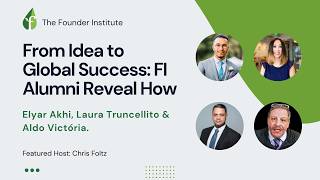
In this Founder Institute alumni webinar, host Chris Foltz interviews three alumni founders—Laura Trunks Salido (Employable), Aldo Victoria (Wordify, an AI‑powered electric car‑sharing platform), and Elyar (WaiterCall, a restaurant gamification and data platform). The discussion covers each founder’s origin story, problem identification, pivots, product‑market fit, customer discovery, go‑to‑market strategies, funding, team building, and key lessons learned. Laura explains how Employable uses AI to surface transferable skills beyond resumes, reducing hiring time and cost. Aldo describes Wordify’s evolution from printers to gasoline cars to electric‑vehicle sharing, highlighting the shift in target customers and the importance of location and infrastructure. Elyar details WaiterCall’s use of geofencing, games, and leaderboards to collect behavioral data, engage Gen‑Z diners, and provide actionable insights to restaurant owners, while also describing a bootstrapped, performance‑based compensation model. Across the panel, the founders stress the value of rapid iteration, continuous customer feedback, clear 30‑second pitches, and awareness of time constraints and market location for startup success.
Chapters
Well, hello everyone. My name is Chris Foltz, one of the Global Entrepreneurs in Residence at Founder Institute. Such an exciting event planned for today. For those of you that have not been part of any of our Meet the Alumni from Around the World programs like this, well, welcome for the first time. For any of you that have any questions, comments, or anything that you want to know from the founders, there's a couple ways to get that. You can ask questions in the chat, but then afterwards our great founders from this evening are gonna stay after a little bit and actually sit at the tables where you can ask some questions one-on-one. So part of the Founder Institute program, which is always exciting to me, is the graduates that we have, the alumni of our program. We've successfully graduated more than 8,000 companies in the Founder Institute network since its inception. But every single day we're bringing new sectors, new industries, and new parts of the world into our program. Tonight we get to meet 3 of those amazing founders. I keep saying tonight, so whether you're coming from the morning, afternoon, or evening, trust me, whatever time is the right time for you to be here. So the 3 founders that we have today come from different parts of society. One of them I've got to spend plenty of time working with over the last several years. So we have Laura Trunks Salido. Laura's company Employable, super exciting. This is the first time I've ever heard the concept transferable skills and the importance that plays in the workforce in modern society. So Laura's gonna share with us a bit about her journey this evening. And then of course we have Aldo Victoria. Now he's got the amazing Dominican accent. So I'm just gonna give you all the heads up now. You'll enjoy every word that he says. You know, Aldo comes from a completely different background and, and I'm gonna let him explain because when I first saw the brand name that he had, I'm like, this has to be something to do with employment. And then I was somewhat shocked about the interesting problem he's solving and how he's doing it. So Aldo will explain that this evening. And then Elyar, I gotta tell you, you know, whenever I go to restaurants and I think about all the information that's taken from me everywhere in life and all the consumer patterns that I use, and then I think about, was anyone doing this in restaurants? And what are ways that restaurant owners can actually use the information that they learn from the— we'll call them behaviors of the visitors of the restaurant— to better their business, better their throughput, and actually get real results for the restaurant in this modern, information-heavy universe that we live in. So happy to have all three of you here today for this wonderful event. You know, I'm gonna start with Laura. Ladies first in this situation. Plus, I know you, right? So at the end of the day, Laura, Employable's been on my radar for years now. And when you first came to me and said, listen, Chris, I've got this HR-related company. We're using AI to actually get the right fit of people in the workplace. I'm like, listen, I've heard this a million times over. And then I learned the difference between what everyone else is doing, what Laura's doing. And frankly, I think a lot of us in the HR world today, or anyone that's applying for a job, they know how hard it is with applications that are out there where you can literally with one click apply for 3,000 jobs with the absolute perfect AI resume with every buzzword and everything. This has actually posed quite a problem for the HR departments and companies. If everyone on the planet's applying for the same job, it's like no one's applying for the same job. So Laura, I know this is one of the problems you are solving. Tell us a little bit about you and Employable and what you have going on. Everyone would love to hear.
Yeah, thank you. Thank you, Chris. My name is Laura. I'm based in Washington, D.C. DC metro area. I was born in Taiwan before my family moved to the US. I went to University of Maryland in engineering and went on MIT for further studies, all in the AI machine learning, particularly in natural language processing field. When I started actually with Founder Institute, It— I came, didn't even have an idea, and Employable was born because of Founder Institute. It was during the pandemic in 2020 when I was helping my friends to look for jobs, and I realized what Chris was saying about the difficulty in getting through the funnel. And as an employer, this is my second company, I already previously had a successful company, and I had the opposite problem of finding great teammates. So Employable aims to go beyond resumes to find what not only you have done but also what you are capable of, meaning we connect people's ability with jobs, not resumes with job descriptions. And I have to say, Chris, you had a very good example there. Everybody knows that when everybody applies, nobody applies. So we help employers identify not only the qualified candidates, but we are also able to help them save costs up to 60% and shorten the recruiting time by more than 70%, uh, from anywhere 2 years to as short as 2 to 7 days. So that's what we bring to the table for employers.
That's remarkable. Sorry, sorry to interrupt. Go ahead, Laura.
Yeah, yeah, it's fine. Um, for candidates, um, we have great testimonials about how someone just told me, uh, a while ago about his job. We discovered him when he was still delivering pizza at that point in time, but today he is the sales director of a technology company. So this demonstrates what it means about and the importance of what we're doing. We are changing people's lives and we're changing people's lives for the better. Thank you.
That's remarkable. And you have such amazing statistics there. And I think a lot of— you said this time savings, and I think what a lot of people don't realize when it comes down to hiring and training individuals, time is one of the most costly things. Whether you don't have a person filling the role, the time that you take, time is definitely a problem in these. Laura will have tons of questions once we get through introductions with the rest of the people. Thank you so much. Aldo, Aldo Victoria, I'm jumping over to you, buddy. All right. You know, you've got an interesting problem to solve here, and I never really thought about it when I first looked up your brand and started doing some research on this, right? I'm like, what, what, based on the name, I had a bunch of wrong assumptions. Tell us about this and why you believe that this new method of car sharing and using it in the way that you're doing is going to change the world. It already is. You've got some impressive numbers, Aldo. But go ahead and tell us a little bit about what you have going on.
Yes, uh, millions of persons around the world have problems and struggle with debt, financial goals that haven't been met, or simply their salary, they couldn't keep up until end of month. So they have figured out that they can do translation service on platform like Uber and Drive on Didi. But there is a problem. They don't have a car, and renting one on the traditional market is too costly for just a couple of hours that they are going to do it on the free time for earning extra money. So basically what Wordify does is that connects, uh, as intermediary platform, the car owner with two drivers that want to do Uber part-time. And that's very important because our driver just want to do Uber part-time for any extra income. So they don't want to have a car and don't need a car full-time. So we have developed all this technology. We basically, what we're trying to do is AI car sharing where we can handle all this workflow of people coming by, picking up a car, returning back the car, and taking care of the car. That's a very important pain that we're trying to resolve for the car owners. So that also the people can have a saving, that they can save 50% on rent and 15% on gas because we are using basically electric cars.
You know, I think it's such a beautiful concept. Whenever I use Uber, you know, you have this selection. Yes, I'd like to use an electric vehicle. You know, a) generally they come in a Tesla and there's more room in there. I'm a bigger person. I love that. But then I was talking to one of the Uber drivers and they said that as an Uber driver, they actually get paid a little bit more. They were getting a bonus for using an electric vehicle, right? And then I'm just like, but the cost of this— he was describing how they have some sort of program there that, that basically it gives you somewhat affordable leases. And then I asked them how much the lease was and it was through the roof. So what you have solved in this situation is you split the day into two. So for that driver, whether you're from 8 AM to 4 PM or something of this nature, maybe 8 to 6, whatever the time is. And then the remaining part of the evening for those people that are driving day shift or night shift, they're sharing the same vehicle. I thought this was such a brilliant concept. So I went to the website, I'm like, okay, what's the process of onboarding? Seamless onboarding, seamless everything. Totally impressed. I see even got some cars in Yonkers, New York. I believe I saw something like that on the website, which is just fascinating to me. I've got tons of questions for you, Aldo. We'll get back to you once we get through the rest of the intros here.
All right.
Thank you. I see your camera keeps going on and off. Are you here to stay with us? I know you're in Georgia, but I know you have awesome internet there. I can already tell.
Well, yeah, we have awesome internet, but for some reason it keeps kicking me out.
Well, I don't know.
In the middle of my conversation, something happens.
Yeah. Don't worry. I'll bring you— when you come back in, I'll get you in there. All right. So I checked out Waitercall. Right. And I'm sitting here and I'm like, why did nobody think about this before? Right. You know, every decision that's— I, you know, I come from the world of politics. Then I kind of got in the world of public relations and marketing. But what I can tell you, the difference between sales and marketing is the use of data. Right. And most of the data that comes from the behavioral psychology of a human is generally the most valuable data out there. You brought this into restaurants and dining experiences. Why don't you tell our listeners how WaiterCall works and what goes on in a process here that makes it different than what already exists.
Sure thing. Thank you, Chris, for having me. And hi everyone, it's very nice to meet you. So basically, let's start from the fact that why no one ever thought about this, right? That was your first thing, the first question that came to your mind. That's because I've been working in this restaurant POS sales for for the past 7, 8 years when I was working as an employee. And from there we got to know how we can add this value to the restaurants. And that's why the expertise that we had and our co-founder had allowed us to basically bring it to the restaurant environment. And that's why nobody ever thought about it because I was working in the sales for a very, very long time for the restaurant POS. We used to literally just call every single person Hi, do you want this POS system? And then we made some good relationship, friendship with the restaurants all around the world. And that's how I got to know that WaiterCall is necessary for the restaurant. And that's how we made WaiterCall. Now, how it works is actually very interesting. So we provide this entertainment to the guests of the restaurant. And through geofencing, it connects their phones with geofencing. So there's no QR code, et cetera. Those are out of the way. As it connects, you just click on it, you enter the platform, and as you interact with your family, with your friends, because there are a variety of games, there are board games which you can play with your friends or your families, including Monopoly, some form of Monopoly there. And as you play those games, the AI is watching you. So what are your hobbies? Are you playing mostly the music-related games? What type of awards are you selecting in between them? So we have partners who provide us with these kind of free tickets in exchange to the marketing that we do for them on our platform. Let's say a gas station gives us a 50% discount and we place it as an award for the guests to play. And if they are at the top of the leaderboard at the end of the month, they get that award. But they can also select the cinema ticket for the next upcoming movie, Avatar, that we get from our cinema company, and then they can spend their time with their family there. And now there's also very valuable information here, which means if you are selecting the car petrol, that means you have a car potentially. But there are more data that needs to be added for it to be 100% sure. But that potentially means that you have a car, and the other one is potentially you have a family. That's why you're going like— So this gives the restaurant owner data such as Okay, they have car. Okay, if I wanna open my next branch, I can open in a place where there are no metro station. Yeah? And that's one type of data. Or if the hobbies are music related, they can easily understand that, okay, I need to push music events in my restaurant more often. Because to be honest, 2026, the food and just the service do not bring back Gen Z customers to the restaurant anymore. That's in 2020. We are in the new world of hospitality, and this is how we help the restaurant owners to basically tailor their strategies based on exactly what they need to stay competitive in the market.
I think it's absolutely brilliant. And I was doing some research and I saw that you have like over 250 like partner companies involved with this, probably on your award side of things. And did I, did I read this right? You have 5 million users who have used the platform. Is that accurate?
I read we have more than 5 years. We have more than 5 million users that are actually using our platform today.
Is unbelievable, my friend. I'm so happy to hear that. You know, you deserve a round of applause. I mean, nowadays getting 10 users on a platform is, is somewhat hard with the attention span of modern humans. And, um, to see this coming right out of Georgia, the country of Georgia, for those of you that are tuning in, not that he wouldn't fit in Georgia the state in the U.S., but he's coming all the way from the country of Georgia. And I know that I read somewhere this was a US-launched company. Where was the first country that you started actually getting your users from?
We started from the small country of Georgia, to be more specific, even Tbilisi, the capital of Georgia. And then from there, we expanded into Turkey, Azerbaijan, Uzbekistan. Then through some type of investor, we connected to Switzerland. Then Ethiopia, Poland. So you see, it's very random. But that was just because we were connecting with the restaurant owners online and they are like, oh, that's very cool, let us have it. And then we were just expanding immediately there. So yes, this is, this is where we started and this is where we are right now.
You know, I don't think you give yourself enough credit when you say random. I think your decisions were intentional and brilliant. So for all of you that you are listening out here that thinks you're maybe from smaller market, you're not from Silicon Valley, you're not from the US, Here is proof right here in front of you that you get into programs like Founder Institute, you get into various ecosystems around the world. And if you have something that's good vision, it actually solves a problem. It doesn't matter where you come from. It doesn't matter where you start. It matters where you're going. And Liar is a prime example of success in that. Let me jump back to you, Laura. You know, you said something interesting in your intro. You said that you came to the program, to our DC program, with literally not a complete idea yet. You hadn't figured out where you wanted to take your brilliant mind and apply it. So are you saying that when you came into Founder Institute, were, were you at stage zero? Were you at idea stage? Where were you at when you came into the program?
Well, uh, when I came into Founder Institute, I was already working. Well, I already had a company and, um, I received a scholarship to go through the program. From Women Tech Network. The idea at the beginning was for the first company, but in the middle of the process, it was the pandemic, I was helping my friends look for jobs. The mentors at Founder Institute think that what I was building for my friends had much more potential than my first company. So I pivoted completely in the middle of the program, and that was how Employable was born. Wow.
I think a lot of people are scared of the word pivot, right? They'll look at a pivot as some sort of they failed at something or whatever the situation is. I personally don't believe that. I mean, generally a pivot is a brand evolution, for that matter, or it's getting more focused, more specific. Did you have any fear pivoting in the middle of a program like that, that, that, that this could potentially not be the right fit, the direction you're going in with the pivot? Walk me through the, the psychology of that pivot.
Um, very stressful, and obviously a lot of the, um, doubts. Um, and I think ultimately being an entrepreneur, and you, you have to be somewhat unrealistic in a way, so that you have that confidence to push through a lot of the difficulties. And that's what helped me. Of course, mentors were very helpful during that process to help me look through the possibilities, and I'm very grateful for that. But you need confidence, you need good mentors, and You, you need to be optimistic.
I think that's very good. You know, when I come back to you for questions, I'm going to talk a bit about transferable skills because I think it's so important for people to understand what that actually means and where it actually matters in your resume. So my next questions are going to come back towards transferable skills. Let me go to you, Aldo. All right. So you're in the Dominican Republic, right? So beautiful place, awesome people. Were electric vehicles a big thing in the Dominican? When you started? Um, you know, I understand the beginning here.
Even right now, isn't, uh, we have about 5,000 electric vehicles here in Dominican Republic. We have 2 million cars, so you can see that it's less than 1% of electric vehicles. And also here, all the technology for charging the, charging the car has been very early stage, you know. Uh, when we started, we had a lot of problems with the charging station, but we partnership with the— with one of the biggest charging stations here on Latam. Uh, we have figured out how to resolve all these early market problems, you know, because we had a lot of problems with the charging station.
So what's interesting there is what you're telling me is that you had a country that had an undeveloped infrastructure for electric vehicles. You have a barely noticeable percentage of cars out of that 2 million, with only 5,000 the entire nation, but yet you you decided to start a company in this particular space. That had to be both exciting and terrifying at the same time. Walk me through what stage were you when you came into our FI Colombia program with this, with this idea?
Yes, the, the thing is the following, uh, we started with a non-electric vehicle car, I mean traditional car that use fuel, you know, um, but the problem is that when you have this car doing too cheap and the car doesn't resist all that work and all that operation, you know. So we moved to electric car like a secret recipe because you can do this only on electric cars. A fuel car doesn't allow you to do this, you know. So it's like an effect. The electric vehicle, no, was our first decision. It's an effect of what we needed, you know, for going more, for moving forward. And basically, uh, we think that that was a very good decision because this is a very early market. People have cars that they can't sell right now because, uh, the market is not very developed for reselling, you know. So we have opportunity to say to that person, okay, you can put the car on the platform and you can earn money with our technology, you know, on our platform. So we see all the benefits, you know, but what's It wasn't our, uh, our first try, and that's important because, as you mentioned, pivoting is very important for a startup. Because we started with a few cars and we pivoted to electric, and the success was on the pivot on the, on the electric cars.
That is amazing. When you came into the FI program, had— was the company already started? Were you still working with just gas via petrol-focused vehicles only? When did the transition and pivot over to electric vehicles only happen?
Okay, when we started, we started, um, basically with the idea of sharing things, uh, sharing a print. Even, uh, we started with sharing printers. The idea is that when we share app, you can print any document and that you have from the app, a printer that you have on your home or your office that you want to share it, you know. So we started in our mind like eBay for, for trading. So We were pivoting, you know, from printers to cars to electric cars and so on.
You know, that's— I was not expecting you to say that you started with printers. And it's always the times in my life where I don't have a printer at home is the only times in my life where I actually need to print something. So I could already imagine that. But that's quite a change going from printers. I can understand going from gas vehicles over to electric vehicles. What made the jump from printers to vehicles in general? What was the big thing that caused that decision to change?
Okay, so we were exploring because I mentioned the idea was that we're going to share, no, a different kind of asset. And after we saw that the printing service sector wasn't recovering after the COVID then we decide and we explore different options. And there comes the knowledge that we got from Founder Institute because we analyze, we study the market, you know, to see what seems to us to be the next step. So we did our research and we go forward with the car sharing, you know, that was the second phase of the startup.
Well, to the point of anyone again, that's out here scared of making pivots, evidence tonight tells you that pivots have worked in remarkable ways for everyone on here. Elio, let me go back to you, my friend. Now, I don't know if you— did you have any kind of pivots along the way, or did you start this company off knowing that this is what you wanted to do in the restaurant landscape with WaiterCall?
We didn't have much of a pivot, but we had a product enhancement, basically. Let's, let's call it like that. We did not really pivot much, but we already started with the same idea, same approach. And we continue to— that's simply because we've been doing this for a very, very long time. We've been planning for this for a very, very long time, either through my co-founder who's been in hospitality for 10+ years, either through me who's been in the sales aspect of the restaurants for over 7 years. So we already knew that, but as we got into FI, we got mentorship, we got feedback, and that's how we enhanced the product as the time passed.
That's amazing. Give me an example of an enhancement that you're so happy that you made along the way that wasn't really on the drawing board at the beginning.
I see. So I will give you a very direct one, very, very direct one, which is directly related to our product. So in terms of the awards that we were giving to the customers, we were giving the customers awards based on their work on each game that they were playing. So if they were playing this game, they were winning that game, and then we were giving them the awards. But here was the problem that that becomes, first of all, more gifts in human psychology equals no value. If they get awards multiple times, that equals low value. So we had this issue and we discussed it with one of the mentors in FI, and we came to the conclusion to create a leadership that gives the award at the end of the month, one or two awards, but big ones that are tangible enough for people to compete, compete for it. And we did this, we did this through leadership creation. So as you are playing, the more you win, the more you go on the leadership. And another thing is, if you are playing this game in this specific restaurant, you cannot play the same game in another restaurant. So it helped indirectly people to constantly return back to this restaurant because that's the only way they can get to big award rather than getting a 5% discount, which is at the bottom for the 10th, 10th person in the leadership. That's, that's one of the very direct and specific ones that we got to know in mentorship programs.
You know, I think that is absolutely remarkable. I think a lot of people like to throw around words like behavioral psychology in understanding humans, and they'll do it under initial concept, right? They'll, They'll say this is rooted in something real with the human mind. But you see, what I heard you say that it was quite interesting was the idea of, of further understanding what the numbers are saying. And it was very brilliant how you said that when, when people were winning that day, you know, and everything, everybody was winning, everything could lead to winning, it devalued the win. Um, and, and I think that was quite, quite amazing. Now I understand the importance of leaderboards there. Um, uh, Was it hard to transition from that process to now having this kind of leaderboard process for the deliverables? Was there any pushback at all from the places you already had this implemented?
No, we just needed to, because the way we got these gifts from our partners was through long-term meetings, right? We were sitting together with them and we were saying, this is the value that we will bring to you. These are the number of customers that we will convert. From the restaurant to you. So those meetings that we had, we had to do them again this time, but we had to convince them that instead of you giving us 5%, 10% discount, you got to give us 50% discount. And they are like, oh my God, what, 50% discount? But then we had to go through the explanation saying that 5%, 10%, people are numb to those numbers. Every restaurant has that number written. People don't even pay attention anymore. You get— if you want value to be added really for you. So we had to renegotiate from the beginning the exact same partners that we renegotiated previously. That was the hardest transition, basically. But in terms of tech, our CTO is a perfect guy. He just did his own magic as usual.
Well, I'm completely sold on it already, just the way you described that. I could imagine any of those partners that didn't want to take up your renegotiated offers. You know, boy, that would have been foolish. Like, it's such a brilliant approach. I'll come back to you shortly with a couple more questions. Kudos for all that. Laura, let's jump back to you. You know, I remember when I first met you and I'm sitting here and I'm like, what are transferable skills? Now, you know, of course I had this immediate understanding. Anybody that knows what the word transferable means can probably figure it out. But then my nerd business partner Russell, he's like, Chris, you ever work with people in the military? He knows I have. And go back and look at the resumes. They'll have interesting job titles, Bravo 26C, whatever. And, and, but nobody realizes by looking at their military role, their military job description, that in there they may be doing interoffice communication, they may be doing marketing, you know, to, for whatever their divisional stuff is. They're doing things that are actually things that may be done in a traditional office environment, but it's hidden within this weird code of military job description. And that's when I realized, wow, transferable skills are something that, that is beyond what I assumed they were. So tell us a little bit more about how do you at Employable define transferable skills and why do these skills matter so much when it comes down to getting a job nowadays?
Yeah, thank you, Chris. So transferable skills basically are skills that could extend beyond what you could see on resumes. And traditionally, and a big problem of what the job market currently has, is the applicant tracking systems and the job posting sites predominantly use keyword matching to learn about you. And as you can imagine, you're not just a few keywords, and your ability could be explained in so many different ways that there's no way it could be completely captured. It was not until recently, until the AI, the models are mature that we can capture much more info. And because of that, we're able to detect people's capabilities. In your example about military officers, right, you can imagine if someone's primary job is driving a tank, right? There's no such job in the civilian world. But that doesn't mean this person cannot have equivalent skills or capabilities that could be utilized in the practical world, in the civilian world, right? Example would be getting those officers to become, say, for example, data center project managers. This type of things cannot be accomplished through traditional matching algorithms and keyword search mechanisms. This is important in both ways. One, for employers, we could address the labor shortage issues, right? Traditionally, There are some industries, advanced manufacturing, construction, transportation, sometimes takes 2 years to find someone capable of that particular position. With this type of the transferable skills mechanism, we can expand the job candidates pool for employers. For job candidates, it's Even more important, we can help you discover the jobs you didn't think you could apply for. And with all the news that you've heard, this is very important for the next steps for job candidates.
That's amazing. You know, Laura, you know, it's one of those things where I'm sure a lot of people wonder when it comes down to applications like yours, you've got the human that's applying for the job. You've got the companies that are looking to find the right candidates. And I would often read in case studies of yours and testimonials about Employable, people say that they're the companies, they're not just looking for the hard technical skills, but they want to make sure people are the right cultural fit for their company. You know, some of these soft skills, durable skills, truly human skills. And I love that you address those things. But tell me, when it comes down to your customer discovery at the beginning, when you were validating your customer customers. I saw Weston in the chat had asked a question, you know, what was the kind of pushback? Like, how did you determine whether you're going to charge the candidate, whether you're going to charge the employer? How did you validate who the right customer was for your company?
Yeah, that's a great question. And first thing I would say is, um, this is actually an ongoing process. As a founder, you constantly ask for customer feedback. You constantly improve, you constantly refine and tune. It's not set in stone just in one shot. At the beginning, it's especially difficult. Numbers are important. You got to find the type of customers as broad as possible at the beginning, and then eventually you will hear different cohorts telling you certain things. So different industries may tell you different stories, and then you start to discover what types of the problems different industries have. You may be solving the problems with a particular industry, that's great, but for a business like ours, that at the beginning you got to decide where you want to hone in on, And that's— it's very important to go broad and do it as fast as possible to find people's pain points.
I think that's the key thing that you said is to actually find people's pain points. You know, Russ and I have the honor to review probably 1,200, 1,300 pitch decks each year. And what we always say is this, we can tell within 5 minutes whether a company is going to be successful. By how well they know their customer. It sounds like you really took the time to, in an ongoing process, constantly know your customer, Laura. Kudos for that. Let me jump over to you, Aldo. Similar question here from Weston. You know, you've got this, you've done some pivots. We went from printers to gas vehicles to whatever. You know, we know that humans are customers in all of those things, but tell us a little bit about your initial customer discovery and validation. and, and how you determine who's actually going to be paying the bill to you guys through this process. Give us some insight.
That's a really good question because you have to define who is your customer. As a platform, you have always this problem that you have to define who's the customer and who is, um, the user, you know. And in our case, you may think about that the driver is the is the user. For us, it's not. For us, the customer is the car owner because we are going to do many business with the car owner, and maybe we can do business one time or maybe two times with the driver. So that's a very important part of the startup that you can define who is the customer. And when you know who is your customer, and that's a very important part, then you can transform your business. You can ask the question, you can Validate the question with the customer. You can ask the customer question and understand their pains, work with the pain. So that makes you have traction, you know? That's what made you have traction.
Did you have any issue getting those first customers to the platform? I mean, obviously you switched. Once you switched over to vehicles, you knew there was something there. But did anything change about the customer moving from, let's say, the gas vehicles over to electric vehicles, which was kind of a pain for you to have to deal with.
Yes, and they are, they are two different customers for us because they all— I would say that 99% of the car rental, uh, more for Uber, are being gas, gas customers, you know. So they don't have really a pain because they are, they are having their business, you know, renting several cars But on the other side, you have this car owner that doesn't have a rental business, but they want to make extra money. So, but they want to also to make it, make it the true way, you know, a secure way where they mitigate their risk. So when you have, uh, when you have a private, uh, you can have, for example, this case that you have cars that you're sharing, but the customer could change because The customer for the gas car wasn't the same of the car owner of the electric vehicle. The car electric car owner vehicles are many executives, many directors or high-level employees from companies, you know. So when you pivot and you have to, to, to, that you are the different doing different thing, you have to, to really validate that if the customer is the same. Even if it appears to be the same, you know.
I think that's very brilliant. And I guess I would have not have thought that, that the customer would change so much just by switching the type of engine to an electric motor in the vehicle. Whole different ball game. Um, you know, I was in a meeting the other day and somebody asked me, they said, Chris, what's the difference between Coke and Pepsi drinkers, right? And I'm just like, oh, I didn't necessarily have an answer. And what they said was that Coke customers, people that drink Coca-Cola, they, they really don't change much in their life. They love what they love and they stick with it. But Pepsi drinkers, you can convince Pepsi drinkers to drink something else and try something new. I have a feeling that probably when it comes down to cars, when you're dealing with some people that are especially cutting edge, even your Dominican Republic, they, they have now incentives when you get electric cars. You know, the world's changing here. My guess is the electric car driver, maybe a different type of customer just in general demographic-wise. Did you find that to be true?
Yeah, that's, that's totally true. That's totally true. That's totally true.
Fascinating. Well, I mean, kudos for being aware of all this. I wouldn't even have parsed them. I figure people that drive in this capacity, they're not buying a new car per se. But, uh, brilliant that you stayed on top of this. Let me jump over to you, Elio. You know, it's one of those things where you clearly know sales, your business partner knows hospitality, you know, and I think a lot of people assume that everyone is their customer, right? Everybody eats food, everyone goes to restaurants. My guess is that not everybody uses your product and they get into the restaurant. Some tables, they just don't want to touch it. How did you know what the right customer is? And more importantly, who is your customer here? Is it the restaurant? Is it the consumer? Is it the partners? Help us understand that landscape. Sure thing.
So here, here are the type— okay, let's, let's first divide into who pays us and who uses. So we have two categories in there. We have the payer, which is the restaurant owner, or let's say the general manager, or the people who are basically the decision makers in the restaurant. So that's who pays us for the services that we provide for them. Now, the users, on the other hand, are also divided into two. The users could be staff. The users could be the guests who enter the restaurant environment. Now let's talk about the guests who are basically using our services the most. The biggest users are, first of all, in terms of age, they are the Gen Z category, yeah, or late millennials. Now when it comes to the type of people who uses it the most are usually 3 categories. One, group of 3 friends. It can be Gen Z age. That's the thing. The second one are actually the people who are on the date, because we all know on the date things can become very awkward very fast. So we have games that are for the couples that they can play to basically melt the ice between each other. That's the second category. And the third category are parents and children, because we all know that most of the time parents want to create this relationship with between them and their baby boy or baby girl. But usually what happens is they spend their time on the phone on different type of stuff. So the parents come and join the game together as they're spending time in the restaurant. And that's the third category that uses it the most in terms of usage. Now, how we— which type of restaurant do we exactly go for is also two categories. In general, number one is the one people can spend and do spend time inside. So it's not the type that people come and eat and immediately leave. It's usually the relaxed dining restaurants, the ones that people are lounging and having a little bit of chill time with their friends. Let's have some good time, though. That's the type of restaurant that uses it the most. The second category which we did not intend to sell to, but it came through, was the ones that are trying to make their restaurant look full all the time. And that's how they are using this service to keep the customers on the table during the times that they don't have much of a customer, not the rush hours, but the hours that are basically, they don't have much clients. Let's say the tourist, the tourist area restaurant where people are passing from in front of it. If they see that the customers, this restaurant is full of people, that restaurant is usually the one that you want to go to because you see they are full. So these are the two categories that we actually sell to today.
That is brilliant. I would have never thought about some of these things. You know, when it came down to evolving your understanding of the customer archetypes, Was there any challenges in that process like that, that kind of hit you in the face like this did not turn out the way we expected, so we had to make some changes at all?
Absolutely. So we are in the restaurant and hospitality business. Our customers are one of the most difficult type of customers to work with in any, in any terms. And in terms of customer understanding, trying to understand who who you should sell, how we can evolve, you need to be able to talk to them, correct? But they don't want to talk to you. They don't want to answer your questions. They will not answer your questions. 60 and more percent of the meetings that you're trying to hold with them are no-shows. So how do you exactly understand who are you gonna sell this product to? And that's one of the biggest challenges that comes back to your question previously, that why no one has ever done this. Yeah, that's one reason. The second reason is that restaurants are not tech savvy. The third reason is that restaurants do not know what they want in many cases. That's this question that— that's, that's a surprise, right? How can a customer not know what exactly are they— that's exactly how restaurants operate. They don't know what they eat. And now What am I going to do to try and understand it? Now, that's a question that needs an hour of explanation from my side on how we did it. But that's mostly coming back to my background in the sales that I had like hundreds of thousands of calls every day. And that's how we got to know. But for a person who's just starting the hospitality sector, I really wish good luck because that's a very difficult sector to work with.
I can imagine. You know, I think so many times as humans, people are uncomfortable with uncertainty. And what I just heard you say is like, listen, you're going to be uncertain along the way here. But one thing that is key for everyone to understand that's listening today, when it comes down to customer discovery, it's not about making a fancy survey, buying a list and sending out. You need to talk to real humans and you have to be okay not hearing what you want. That means you can't just ask grandma. Grandma's going to use your platform regardless because grandson made it, right? You have to ask real people, and you have to be okay with realizing that, again, not everyone is your customer. I think that's brilliant. Let me jump back to you, Laura. You know, you've got several people in the chat that have direct questions for you, Laura, so I'm going to try to sum a couple of them up here. I saw that Terry and also Gustavo, they both set direct questions. We'll start with Terry's. You know, one of I think it's a question I've asked you often as well. You know, do you do anything to understand? I believe Terry drew attention to EQ levels, right? Other things to kind of measure. But how do you garner information about the human that differentiates them from another person that's applying for a role for things that don't exist on LinkedIn? Like, and I believe that's what Gustavo said. Do you have any kind of assessments or something you're doing internal? To help discover some of the stuff that people may not have on their social media profile on LinkedIn? How do you find those nuggets of what makes these, these employees good at being in the roles that they want? Nope, you're muted, Laura.
So we have information on— well, all of us have information on the internet. And that's where we harvest and extract intelligence about people, about companies. And what we care about is not necessarily how good a person is, but about the fit with a certain job in a certain company. So from the company side, we have information about what people say about them, what they say about themselves, and press release, and on the candidate side, there's public information about that as well. But most importantly though, we ask candidates. So we have an AI agent, Evan, to work on both employer side and job candidate side to let us know and understand what they're looking for, because we truly believe that candidates need to love the job they want to do. And that's the secret for productivity. So we ask candidates about their preferences as well. And in the backend, when we train the data, took 2 years for us to establish our proprietary data and models. With that, we use a lot of the public datasets to train our models.
That's amazing. You know, I went through the onboarding process with Evan once on your platform. I can't remember which stage Evan was in development. And what I found fascinating is, is Evan asked questions that if I, if I asked these as a human, I would have a good understanding of the mindset of the employee I was asking the questions. You know, is this the type of employee that's going to be okay spending time on, on overtime tasks or work on the weekend? Some of the questions I thought were fascinating. Of how I like to work, right, as an individual, whether that means I want my boss to check in with me over everything, whether I would feel comfortable doing things without having a boss checking in on me every couple of minutes. And when I think about all the times in my career where I faced challenges kind of working inside organizations, it wasn't anything to do with the skill, whether I had it or didn't. It wasn't because I was, you know, culturally a fit. It was because of the interoperability for me and the way that I work, right? I would get the outcomes. But if it's a type of environment where at 5 o'clock every single day I've got to turn in, here's my tasks that are completed, I probably would not— I would get the task done, but I would not fill out that sheet. So I think it's fascinating that you ask those types of things as you go in. But then more importantly, that you're doing some real analysis on this, right? So those of you who haven't had the opportunity to reach out to Laura, she kind of walk you through the platform. But I was quite surprised when it presented jobs for me that I actually felt like it was a fit. And, you know, one of the things that I think is super interesting is I asked, I asked him, what do you do with the, the, the employers, right? Like, do you take their job description, put on the website? And you say, no, we don't want, we don't want their, their request description because oftentimes what they're looking for isn't actually what they want. Tell me what you meant about that, for instance. That's fascinating.
Yeah, yeah. So to echo the idea about what customers want, a lot of the times, believe it or not, they really don't know what they want. In the case of in the employer's world, our customers are primarily HR directors, HR managers, recruiters for the company. They have their internal customers, which means they have different departments, have requests about filling certain positions, and the HR managers need to have that capability and be fast enough to facilitate all the requirements. Now, in specific industries, those positions could be very difficult to understand, and hiring managers don't have time to really write up all the things they've done. In that case, HR managers don't have a good way to understand it either. What do you do, right? So this is where we come in. The Evan, our AI agent, will help the company understand the job content and provide the job description accordingly. And we reach out to find the best fit. And that saves a ton of time and misunderstanding between the departments.
Big time, especially on the understanding part of things. I think that's brilliant. Aldo, let me jump over to you, my friend. You know, I, I guess I don't know this. How many people are on the team at, at, at your company? Is it just you and a co-founder? I mean, where are we at team-wise?
Okay, we have right now 5 persons on the team. Me, the co-founder, and also we have an advisor involved.
Interesting, because I saw one of the questions from Michael in the chat. You know, how do you know after you have your founders, co-founders, you have your advisors, when do you know when it's time to start bringing on team members? Right. And I know this is very interesting at Founder Institute. If you go to fi.co/benchmarks, we put out this benchmark list, we update it regularly. And one of the things that I've noticed on there is we used to have a standard like, you know, you are at this stage when you have this many team members and so on. That team member number is dropping in the age of AI. You know, you see people vibe coding their way to success over the course of a weekend. So Aldo, when is— when do you know you need to start expanding your team beyond advisors?
Well, if you want to be exponential, you can have an operation where you have more operation and you are having to have more person. So what we do is basically that when we see that we have an operation struggle, for example, instead of hiring person, what we try is to automatize the process, the workflow. And lately, which AI is more efficient also. What we— when we do hiring, you know, is when we need a skill in sales, in advertising, for example, So we see the position not on operation needs. We saw it more on the skill that the business is needing, you know.
I think that's the best possible answer you can give. What you're basically saying is you don't just hire for hiring's sake. You don't need to just bolster team. You need to solve for the specific thing that you need to solve for with highly skilled individuals. I think that's absolutely phenomenal. How did you fund this? Like, do you have investor money? Was it bootstrapped, i.e., putting your customers' money back in? Were you self-funded? How did this all happen?
We have been doing everything. We have bootstrapped. I personally initially funding all this, you know, and after that we, we have received, uh, some small investment, and from that we have grown, you know, with all these investment, um, with the main focus not, you know, uh, not growing the expense and trying to use and allocate this funding the best way so we can use these funds the best way to grow and scale, you know.
That's great. And I think a lot of people misconstrue like self-funding and bootstrapping. They kind of use these words individually. But what I can tell you is just what I heard from Aldo, that that's a kind of a tracker. You see, with investors, it's not about trying to get them to say yes, right? It's trying to make it hard for them to say no. And how you make it hard for them to say no is by de-risking everything. So when an investor sees that, listen, we put some of our own money in, then we got some angel funding, then we did bootstrapping, meaning returning our customers, reinvesting the money in, that is a de-risking path. I think that played a huge role. Aldo, thanks for sharing that. Eliar, let me jump over to you with similar questions. How many team members do you guys have right now?
Currently we have 4 full-time and 4 or 5, uh, part-time.
How did you decide? I mean, full-time people, I mean, that to me it's always scary, right? Now you, now you're responsible for other people's, in that case, their livelihood. When did you know it was the right time to actually get full-time team members here?
Well, the team members that are full-time currently are actually the co-founders that we have, 2 co-founders that have full-time working. And the other one was the friend of my CTO who started as part-time and then decided to join us as a full-time because we managed to sell our company to him and the long-term vision that we had. Now, when we decided to add the part-time ones as well, it's also important. Then we saw the need to be able to expand into this market. So let's say I speak very— I speak English. Georgian is not my mother tongue. I cannot sell in Georgian language. I— my partner cannot do the sales. My CTO cannot do the other full-time we have cannot do. So now we are in a dead end. We cannot do it ourselves anymore. We are bootstrapped, by the way. You got to consider that because we had— we had to do everything ourselves as much as we could. So we are like, okay, we cannot— we cannot do that. Ever. There's no other way. If I want to do that, I got to start learning the language. And then I have to start learning the language to be able to sell it. Now, these are very difficult for me. It's going to take a long time. I don't have the time. We need to hire someone. Now, that's when we actually added someone to work with us, but with a very innovative way. I think that probably you want to end. That's going to be your second question.
Yeah, I was gonna be like, what is this innovative way, my friend?
It's actually very simple. They don't have any salary. The person who's selling our, this product for us, they don't have salary. They earn their salary as they work ahead. So they get the percentage, that percentage stays this month. For the next month, they get paid the same amount because they brought that customer in. And the next month, the same, they increase, increase it. So they start from zero, they can get to a certain amount anytime they want. That's how we managed to hire bootstrap because other way we didn't have the money to pay their monthly salary. So this is how we did it. The same goes for the customer support. They only get paid based on the number of people they respond. So—
And I think that's brilliant. I think that's also sustainable, right? And I think so many people don't think about the sustainability of it. That is another important thing to investors. All right, I'm gonna have one more question for all of you. For anybody that I didn't get your question in the chat, please join after at the tables where you'll be able to sit down with Laura, all three of them, right? And you can ask the questions directly. I see there's some questions for Eliar. There's some various questions in here. Laura, let me go back to you for the final question before we break here. You know, you've been in a lot of places here. I see you, you're involved in various technology councils. You were sitting down with Chuck Schumer's office in New York and various legislative leaders trying to solve problems, this, that, and the other. But I know just like me, it wasn't until I got involved into the startup ecosystem that I even started realizing how much I didn't know about the startup ecosystem. What was something that you had no idea that, that when you first started in Founder Institute that now you know that you wish you knew at the beginning? Like something that is, is a, the biggest instrumental thing that you wish you knew at the beginning of your startup journey.
One very important thing that everybody needs to know is time. You have nothing except your time, and you have a deadline, and you got to be fast, much faster than you think you could do. The reason is, especially if you're in a technology startup, you have certain credits you could apply for with all the large accelerators and all that, but everything has a timestamp on it. You got to deliver certain results within certain timeframe, and if you don't deliver that result, you're done. And then in certain cases, it's not like my first company. My first company is a consulting government contracting firm, time frame is not as nearly as fast. This one, if you don't deliver by the time you are 5 years old, you're considered a later-stage company, and at that point, the people are going to hold you at a different standard. You won't have those credits that large tech companies give you, and you have to have enough the revenue to sustain all the cloud cost and all of that. Time is very important. You gotta do it fast.
That's amazing.
I wouldn't have thought about those particular things, you know, where it's not necessarily the, the results or the staging in terms of how much money you're making that literally can transition you from an early stage startup to a later startup just because you weren't paying attention to time. Wonderful advice. For those of you who wanna meet Laura, please stay afterwards. She'll be there employable It's like the word employable, but with an N instead of employable. AI is Laura's website if you want to check it out. I believe that's accurate. Let me jump to you, Aldo. You know, you've already hit us with some amazing advice. What is some advice, something that you learned inside the FI Columbia program that you wish you knew at the beginning that you didn't? If you go back and give yourself some advice, what would that be?
Location matters for for everything, for job, for living, and for a startup also. And that might, might impact you, the location. So if you are doing something that is location-based, like we're doing for example, you— I, I would recommend that you go to a bigger market and start in a bigger market if possible, no? Because if you do it on a smaller emerging market, when you have the traction You will have the passion, but the investor won't want to invest you because you are on a location that they can invest, you know. So take in mind that about the locations when you're starting a startup.
That's wonderful advice. I know that you're based in the Dominican Republic, you're a part of our FI Colombia program, and now you've got footprints in, in various countries here. So I'm so very proud of the work that you're doing, my friend. Location is key. So we know time's important, We know location's important. Elio, going to you for the final question-answer session between you and I tonight. Um, what is that one bit of advice that you wish that you can go back in a time machine, which I'm sure you built in one of your careers already, and give to yourself that you did not know at the beginning of your Founder Institute journey?
That will be learn how to explain your startup in less than 30 seconds. If you cannot do that, you will lose sales. You will lose people potentially who could invest in you. You will lose so many potential team members that could be joining you. So learn how to explain your—
how—
what is your company even. Even though I was the one who understood everything, I could not explain my company to someone who I wanted to sell it to. I could give them the way that is gonna— it's gonna give them value, but I could not explain it easily, easily for them. So now during the FI, I learned that, and I'm very sad that I couldn't do this in the early stage because we could start with more clients if I could do that, especially with the fact that I had the connection But the fact that I could not explain my company, I lost a lot of sales.
Wow. I think that is some of the most important advice for anyone that's a founder in this space, just in life in general. But I think you nailed it there. You know, at Founder Institute, we have the 1-second or 1-sentence pitch. Then you kind of graduate to the 60-second pitch and then 3 minutes, then 5 minutes. And so many people are like, why? I've already got enough information. I could do 5 minutes on this. But then can you do 30 seconds on it? And it's so much harder. I could probably do 2 hours on a dozen subjects right now, but could I give you 30-second bangers on each of those things? Probably not. So it's much harder to do that than you can imagine. Luckily at FI, we have a very interesting tool to help people craft their one-sentence pitch, and then we have frameworks to help you get to that 60-second pitch. But you nailed it. And this isn't the old cliché where you're on an elevator, you have only the elevator ride to give some of the information. This is exactly how it actually is in the real world nowadays. Add the attention spans of modern humans, boy, it makes it even harder. I think that's phenomenal advice. So we've got time, we've got location, and we've got being able to articulate in a 30-second window. Phenomenal advice from all of you. I couldn't be more thankful. So I want to thank all three of you, Laura, Elyar, Aldo, for taking the time. I hope you can stay after a little bit and join the networking tables. With some of the listeners. For those of you that are listening, I really appreciate all of you that have joined us today. Jump into the tables afterwards if you've got direct questions. Trust me, these founders are awesome. They're going to share. They're going to give you the truth too. That's the one thing that we like about this. The truth is a commodity that we work with at Founder Institute. So you're going to hear it straight from them. For those of you that are new in your journey as a startup leader, if you haven't joined some of our other events at Founder Institute, or join a cohort or our startup ideation bootcamp, please check it out at fi.co. If you haven't seen the Entrepreneur DNA test that we do, man, over 200,000 people have taken this. It's been wildly successful in understanding yourself and your entrepreneurial journey. I implore all of you to go there. All right. So thanks everyone for attending today. Again, this is Chris Foltz, Global Entrepreneur in Residence at Founder Institute. I appreciate all of you. And please join us at the tables and have a great rest of the day.










