Funding & Scaling in Africa: Expert Advice from Tarek Chelaifa & Dali Lakhoua
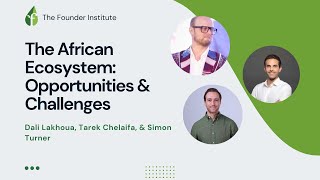
The webinar, hosted by Simon Turner of the Founder Institute, featured a panel with Tarek Chelaifa, a venture partner at Silicon Badger, and Dali Lakhoua, an investment officer at AfricInvest/CAIF. The discussion covered the current state and evolution of Africa’s startup ecosystem, highlighting a 2024 funding dip to $2.2 bn and the continued dominance of fintech as the foundational layer for digital services. Both speakers noted a maturing ecosystem with more experienced founders, increased VC presence, and expanding support structures (accelerators, grant programs, blended finance). They examined sector trends—fintech, climate‑tech, logistics, SaaS, and the emerging but often overstated AI wave—detailing what makes AI startups investable (niche data, defensible moats, clear revenue models). Gender and agritech funding gaps were identified, with female‑led agritech startups receiving disproportionately little capital. Practical advice was given on founder pitching (clarity, adaptable narratives, market‑specific knowledge), user‑need validation, and capital‑raising (raise only what is needed for the next milestone, beware of SAFE note terms, maintain credibility). Valuation methods were discussed, emphasizing growth narratives for early‑stage firms and multiples for later‑stage revenue‑generating companies. Exit strategies were framed as primarily strategic acquisitions rather than IPOs. Finally, both panelists urged founders to be adaptable, resourceful, and to leverage the growing network of programs, mentorship, and funding opportunities across Africa.
Chapters
I'll take that. I think there's a lot of different opportunities. If you're looking at Africa specifically, a lot of the funding is going very much so to fintech, which remains dominant in terms of, you know, of the importance of it because the infrastructure is missing. And like Dali explained, without a first layer of fintech, you cannot build any digital services or a digital economy before having that foundational layer. So Fintech is driving a lot of the investment.
Welcome everyone, we're so excited to have you here today for insightful sessions with our speakers Tarek Chalefa and Dalia Lakour. This is more than just a webinar, it's a chance to learn, connect, and take actionable steps towards building your startup dreams in the African ecosystem. And Founder Institute tonight is so grateful to have you here. As you can see, we've got a question and a opportunity, so all the way through this session we want you to be able to ask questions. So in the Q&A box, this is where you write your cute questions and answers, and we'll make sure we try and follow up during the questions. Um, some of the things we're going to be looking at tonight, the key trends and opportunities in Africa's startup ecosystem, how investors and accelerators approach startup growth, and get you some tips for building community connections in the African startup community. We're going to have approximately about an hour with a quick introduction of our guests and discussion with them, all the while trying to add your questions, uh, into the conversation. Then after that, make sure you stay on because we're going to have some open networking with some ecosystem players and our guests, and you can join us around the table and ask questions. So now I'm going to bring to the our two guest speakers. We've got Tarek Chalefa, the Venture Partner at Siliconbadia, and Dalia Lakhour, an Investment Officer at Africa Invest Group. And once they're up on stage, I will get them to introduce themselves. Good evening, Tarek. Can you hear me?
Yes, I can hear you well. Thanks a lot, Samir.
It's great to have you, Tarek. I just wanted you to give us a bit of an insight into who you are and a bit about your background.
Yeah, absolutely. Welcome everyone, pleasure to be with you all. And so my name is Tarek. I'm 10 years experience working in ecosystem development and venture capital throughout North Africa, Middle East. And so my previous roles were initially starting with Flat6 Labs launching in Tunisia, where we made investments in close to 70 companies, investing in the early stage, identifying companies that are ready for acceleration and investment, and then supporting them through business development and facilitating further rounds of investment. And we've launched a a few programs there. I've worked at GSMA in the telecommunications sector, supporting mobile operators deploy corporate innovation programs, deploying programs that are supporting financial inclusion and digital inclusion. And I'm currently a venture partner at Silicon Badger, which is a growth stage VC fund based out of the US and the Middle East, investing in North African companies at the Series A stage. And also advising a fund called Digital Africa, which is an early-stage Pan-African fund targeting markets outside of what we will call the Big Four. Hopefully, we'll explain those concepts and supporting them with very, very catalytic investments ranging from $50,000 to $100,000 for idea-stage companies. That's all for me. That's great.
Thanks, Tarek. I can already see so many people joining the conversation, and they're definitely people that are going to have interesting questions for you, I'm sure. Thanks, Tarek. And Dali, good evening.
How are you? Good evening. Thank you, Simon. Um, I'm glad to be here tonight. Uh, welcome everyone. Uh, so I'm, I'm Dali. I've joined— I'm part of AfricInvest since 3 years now. I'm part of— and AfricInvest is a global pan-African investor doing both PE Mainly PE, I would say, but we started doing VC 10 years ago. I'm part of a VC fund called CAIF, and CAIF stands for Cathay African Invest Innovation Fund. It's a JV between two fund managers, African Invest and Cathay Innovation. Cathay Innovation, they bring their expertise. It's a Franco-Chinese investor where they bring their— and they are present in Europe, in Asia, and in the US. And we are present in Africa, and so we created this fund together, and they bring their VC expertise, we bring our African expertise, and we are trying to help founders scale their startups. We are investing in startups that are raising their Series A and Bs, helping them go from a round to another, and we are in the final year of investment of the fund. So we are trying to build with this fund some synergies with our portfolios, both for the Cathay portfolio and the Africavest portfolio. We have about $2 billion of assets under management. We've been operating in Africa for 30 years now, so we are very well connected. We have 8 offices in Africa and we are trying to create these connections when, when a startup has proven their model in their core market and trying to expand either in their own market or in other markets. So this is who we are.
Awesome, awesome. Thanks, Ali. And just again, looking at some of the people that are joining, we have a lot of aspiring founders joining, so, um, they're going to be listening to you with bated breath, I'm sure. So let's dive in. First of all, I'm going to look at getting an understanding of the African startup ecosystem and your journey to where you are now. So let's start with you, Tarek. You've got a background in international development and partnerships. What led you to the world of venture capital and early-stage startups?
I would say serendipity. Most of my previous kind of interactions with founders came out living outside of my own country of Tunisia and meeting founders that were pitching to to accelerators and VC funds. I was at the time based in the US, in New York to be precise, and I would have friends come over and they would tell me about the startups at the time. That was around 2010, and that was my first introduction. And then coming in just after Tunisia, after finishing work and then my studies, I realized there was a kind of a very nascent ecosystem that was supporting young entrepreneurs, a lot of founders coming outside or coming back to the home country to build. And this is where I kind of met a lot of the people there. And I joined an early stage investor in one of the first kind of venture capital funds, so to speak, or accelerator. Called Platik Labs. And this is how I got into that role, um, in, in working in the tech ecosystem, which led me then to work with other actors and companies that were working either regionally or Pan-African-wise. And they can be in many flavors, right? They can be investors or VC funds, they can be educational hubs or universities, They can be big corporates, they could be think tanks, or they can— and from all of these interactions, you kind of learn about the opportunities of how we can work more closely together. And depending, obviously, since I was at that time working in North Africa, which is outside of Egypt, are very smaller ecosystems when looking at in terms of size, demography, And so it becomes very crucial to identify opportunities of collaborating and, uh, and finding opportunities where the companies or the initiatives we bring out are regional and have a larger scope of the domestic markets we operate in.
Yeah, yeah.
And just on your point of collaboration, it's certainly something we'll come back to because it's essential for any of our startups joining tonight to learn how to collaborate with partners and ecosystem. Thanks, Terry. And Dali, you've got a background in corporate finance and asset management. How did this influence your— how does this influence your approach to venture capital? And how did you find yourself here? Is it serendipity as well?
Yes, same, actually. I was— I did not even apply to Afit Invest, to be honest. It was— it came— I was only— I was in Paris and I just wanted to leave Paris, and I was applying for another family group in Tunis, and last minute I had the chance to join the Africanvest Group, and that's why I joined. But yeah, about my previous experience, when doing— so I was for 7 years, I was a part of an advisory firm called Accuracy in France that specializes in corporate finance. And we were doing a lot of due diligence, very advanced analysis, financial analysis that we still use when investing now. But to be honest, when looking at a startup, an early-stage startup, we are not doing like very advanced financial due diligence because it doesn't make sense. The company does not have historicals, it's very hard to see to try to explain things when the company just started. However, it gave me some background and some knowledge to be able to better understand the unit economics and to better model the forecast. So I'm gonna explain what I want to say. When a startup is sharing a business plan with us, most of the startups Most of the business plans look like this, and we need to understand what is feasible and what is not feasible, how much, what can be achieved. So on one side, we need to understand what's the market size, what's the market potential, and what the company can get out of that market. So that's the top line. On the other side, we can need to understand what resources the company needs to have to be able to reach those revenue levels. And so this is and this is the cost structure of the company. And so my background helped me understand when looking at mature companies what it needs to reach certain level of revenues, and so it helps me understand what startups that are early stage can achieve in the future.
I can see why that would help now. This is a question for both of you because I think it's quite broad and It's a really good place to start. Can you give us an overview of the African startup ecosystem and in your time, how it's— what you've seen it evolve? Tarek, you go first.
I think overall, just to answer shortly, I think it's greatly evolved. If you take numbers quantitatively-wise, this year, the year of 2024, was actually one of the worst years in the last 5 years, according to numbers from, you know, Partec or the big deal Africa. So we're 2024 closed at $2.2 billion down from $2.9 billion. So when you look at the numbers, it doesn't look so good. Just to give it in perspective, it's these numbers are similar to what Miami brings in terms of investment. In their ecosystem, the state of Miami, for a whole continent, right? So in that regard, I think funding has been slowing down, but in my opinion, I think the scene, the industry is maturing more and more comparing, you know, the number, if you're looking at the building blocks of what is an ecosystem, looking at startups for one end, a pipeline of startups, funding and investments, opportunities and people that can allocate capital, policies and frameworks that support and are conducive to investment and creating businesses, and also opportunities in terms of technology and education are all getting better in Africa if you look at it from a, from a continental perspective. And so you're seeing, although a lot of there are still challenges regarding the funding. You're seeing a mature and more mature startups and founders that understand what it takes and what is needed. You have, I think, a lot more VCs that are coming in either as emerging fund managers trying to raise a fund or actually deploying their first funds. And so this is also very conducive and supporting government. I mean, supporting the startups. And finally, in the last 10 years, you've also had some kind of enabled policies for startups starting in Tunisia and then moving on to South Africa, Nigeria, Kenya, Senegal, all had their own kind of startup policy frameworks that are conducive. So I think overall it is still a lot of challenges when you look when you think about Africa and what needs to happen in terms of ecosystem. But when you look back 10 years or even 5 years, I think there's been a lot of developments, improvements, and maturity from the industry as a whole. Although it still needs to prove itself as an asset. VC still needs to prove itself, I think, in my opinion, as an asset class, as an asset class that can generate revenue and great opportunities for investors. And having more exits from startups, more stories of acquisitions and exits are vital for the future of the African ecosystem.
Great answer, great answer. Dali, same to you.
Yeah, fully aligned with Tarek. I think the market is maturing and what we see now more and more are founders that are second-time or third-time founders who when we started investing 5 years ago, 5 to 6 years ago, most of them were first-time investors. So these people have the experience of their first or second startup that they created and that probably either they created, they exited, or probably that they have had to shut down. But still, it's a good experience to have, not to do the same mistakes again. So those, those founders are much more mature and it's much easier to have like a serious conversation about what they want to achieve and how they will achieve it because they have previous experience. On the ecosystem itself, 5 years ago in most of the countries, most of the fintechs that were trying to help with payments were maturing as well. But this, I can say that in most countries that we, most African countries, even if the adoption is not there, is not there, but most of the time there are solutions for digital payments. And when you have the solution for digital payment, you can build on top of it because the payment layer is essential, and if you don't have it, you cannot build on top of its digital services. And last point, comparing 5 years ago to now, there used to be a lot of free cash from coming from US investors that did not have any feet on the ground, did not know the market, and were applying the same valuations, same US valuation to Africa. This was not helpful because it set some valuation that had no sense and that couldn't, and that did not help founders fundraise, like, for the next round because the initial valuation was too high. So for them raising at a lower valuation or valuation that was only flat or 5 or 10% higher than the previous one was too complicated and it made conversation very hard. And I know founders that had to shut down their startups because they were refusing all valuations that were almost flat when compared to the previous one. So I think that now the market is much mature and, and ready for the next wave.
Okay, so would you say also that— I think you've already answered this question to some extent— but that with the maturing of the market, there's been, there's an improvement or maturing of startup founders in general, not just second-time ones but first-time ones? Are they better prepared by the time you see them?
Yes, because they are much more— there are so many structures now and institutions that are helping them. When I see, when I compare now how many either incubators, accelerators, or early-stage investors there are on the market compared to 5 years ago, it has nothing to do. And I let Tarak share more because he has been involved in this and he has been building this ecosystem.
Yeah, definitely. I think there's, uh, there's much more opportunities, uh, for entrepreneurs today in capitalizing. You know, programs like Founder Institute weren't necessarily around in all African cities, um, or, or other ecosystem players. You have also much more opportunities with regards to not only— before there was basically nobody being able to provide venture capital or risk capital for early-stage startups 5 years ago. Very few ecosystems had those, right? Now there are opportunities for grant funding, there's opportunities for blended finance, and there's a lot of support structures that are providing and helping them bridge that gap, understanding how much they need to raise in, you know, in insane valuations, understanding how to present their business in a professional way, understanding what are the financial instruments that can help them, not only looking for VC but looking other ways. There is a lot more international programs supporting entrepreneurs in different geographies, or, you know, that are gender-specific, which is also a problem sometimes for women founders to raise funding, or specific industries. You have corporates that are either looking for opportunities also there's a lot of work to do, but corporates offering opportunities for, for founders or startups. So all of this is, I think, something very new that wasn't around 5 years, and it still needs to improve, but is, is there's indications that there's more and more opportunities for founders to tap into.
Yeah, I totally agree. We've got a good question just on the topic of gender-specific. We've got a good question from Alexis Duma, and she says hello. She's interested in insights and experience with pre-seed funding female-led African agri-startups. Seems there's much less funding and super-rigorous processes, mainly the accountants, grant writers, lawyers, like that, for successful applications. What do either of you have to say to that?
I can take a stab at it. Yeah, his perspective. But I think, you know, agri-tech and, and female-led are actually, when you look at numbers, are actually less funded most of the times, and unfortunately so. Is it a question of a bias? Is there, you know, is there a difficulty? But regardless, in Africa in particular, there are less women that receive funding either at the leadership stage or, you know, teams that are men and women. And that is a problem that is shared, I think, internationally as well, not only in Africa, but there is that problem. And agritech, because of the fact, maybe if you're looking at it from a startup or VC perspective, sometimes a lot of agritech are capex-intensive or capital expenditure-intensive, meaning that you will need to acquire, you know, equipment or activities to fund these activities. And the revenues that you can generate from that are sometimes minimal, so which may lead sometimes maybe venture capitals to not look at that, um, and, and seek more digital type of businesses, you know, fintechs or SaaS. So maybe that might be one of the, the recommendations, that might be one of the, you know, the, the, the, the specifications. Also, the market sometimes is very aggregated or fragmented, which makes it difficult for a startup to service customer as a whole. I mean, there are always exceptions, but I mean, this is maybe my two takes on this. However, I, I love agritech, and I come from a family that very close to agriculture. And I think not necessarily agri-startups should look specifically to venture capital to fund their activities because there's other opportunities to fund them, you know, maybe through warehouse financing or blended financing or revenue financing, revenue-based financing, or other opportunities that exist in other markets, not in all of them, but can be more flexible when looking to fund your activities. But yeah, grants is quote-unquote free money, which is not dilutive, but then requires a lot of, you know, proposal, grant writing, and understanding what the grant— I mean, the donor wants to bridge that gap and increasing your chances of receiving that financing.
Thanks, very good, very comprehensive answer, Tarek. Thank you. Nali, anything you want to add on gender-specific? Tobias?
No, I think we are facing the same challenge here at Africanvest level. The startups that reach Series A and Series B are, most of them are male-led, and we can't do, unfortunately, we can't do anything about it. We are trying, but we give a chance to all startups the same way, whether it's female-led or male-led. And unfortunately, in our pipeline, more like 80 or 90% of the startups that we meet are either male-led or in the best case co-founded by two founders that were— one is male and one is female. But unfortunately, we cannot give advantage to a startup because it's female-led.
Brutal but true.
Yeah, but the process is the same. Actually, we have our LPs, our own investors, are incentivizing us to get to reach reach a certain minimum of female-led startups, but at the same time, so we have some incentive to promote and to support more female-led startups, but at the same time, we need to support the project that is the most promising and the most solid. So in any case, we will have the same rigor in our processes.
Okay, awesome. Slight deviation, but keeping within, uh, the topic of different sectors. I want to know what industries and sectors you're currently seeing that are exciting you, what are the most promising, um, where do you see the most innovation, where do you see the most growth potential. And just so you know, we've got a question here: where do you see the most of funding heading into besides AI-based startups in Africa? I'm not sure if that's necessarily true, but we can certainly look at it as you answer. Dari?
I'm happy to start. So I'm gonna do the same comparison 2-3 years ago to currently. 2-3 years ago, we saw different startups that were acting in different sectors, in different verticals, and all of them were adding a fintech layer on top of it. Adding financing on top of it to generate additional revenue and to grow the volumes of, like, of the goods that are being traded on the marketplaces. Today we have a shift, given that the fintech player is more or less mature, still maturing, but much more mature than it used to be 3 to 5 years ago. Now what we are seeing is the adoption of AI, sometimes abusive because everyone tends to put those two letters in their pitch deck while there is no AI, it's only one algorithm, it's the if-then, no. But the most exciting startups are the ones that are really trying to address a local problem, but by really using real data and training the models to solve this issues. For example, we have one startup in our pipeline that is solving problems for e-commerce. And one of the problems is to identify the right level of stock and to communicate with the merchant to tell him if he's okay to get delivered more stocks because the brand wants to deliver. Before, they needed to use software, and most of these merchants are not— do not have like an advanced use of their computer, while they can communicate by writing using generative AI. And this startup is building it and helping those merchants have access to more, have access to the brands and have access and to optimize their own stocks. And this is one of the use cases where I really think that AI is well integrated and brings a lot of value. It's not a word just to make it more fancy.
Tarek, before I come on to you, there's a similar question on AI which you may want to just like be able to take. This says AI startups are becoming a growing industry on a global scale. What are your thoughts on this in the African market? And since it's becoming such a saturated market, what criteria would you look at for deciding on a startup to invest in?
It's a, it's a, it's a good question. I think this depends on the type of investor and what they're looking for, you know, what's their, their ticket size, what is their expertise, and their capacity to see that opportunity and drive it through as an exit, right? When you're looking at AI, I think like Dali said, AI is becoming more and more of a trendy buzzword that is slapped on any company to make it, you know, look, look more innovative. But AI really depends on the capacity for this specific company to be very niche, very expert in one specific sector, and collecting data that is real data and that is trained on that model that nobody else has. I think that's the only way in which you can create an AI company that creates what we call a moat or defensibility, and that makes it very attractive for other potential acquirers or companies that would want to work with them. Right. I don't see the question again, but just in terms of AI startups, I think there are not lots of real AI startups and every investor will look at it from a different way, but investors are not necessarily duped when you just write AI. What they'll look at is more around the quality of the team, the founders, their experience, and the quality of the datasets and how they're working with these models to generate revenue and opportunities. So that's in terms of Africa. I think another thing that is important is differentiating, you know, AI that is used for improving your operations and helping you drive more revenue versus, you know, a company that is AI-led and using AI and selling AI, you know, algorithms, intelligence, and algorithms to fuel other companies, right? So the example, you know, examples of InstaDeep are quite famous, and the company that AfricInvest invested in was purely specialized in finding opportunities for big industries, and not necessarily in African markets but international markets, right? Markets in Europe and the USA. Um, and so this is where I think it's important, depending on the investor, depending on the DNA of the founder, Is it, you know, are you driving AI to solve local challenges, or are you looking for AI to develop big problems in bigger markets or in other, in other geographies?
I hope that answers that specific question about AI. Are there any other areas of growth that you're seeing, or anything else with exciting activity in different sectors?
I still think, I mean, I'll take that. I think there's a lot of different opportunities. If you're looking at Africa specifically, a lot of the funding is going very much so to fintech, which remains dominant in terms of, you know, of the importance of it because the infrastructure is missing. And like Dali explained, without a first layer of fintech, you cannot build any digital services or a digital economy before having that foundational layer. Fintech is driving a lot of the investments in Africa. Second, I think, is, is climate tech, which climate tech is kind of a slapstick kind of word, but basically any technology in climate tech can revolve around agriculture or climate or energy and can have a fintech component. But this is where a lot of opportunities are found, yet to be seen where the exits, the exit opportunities are. And most of the funding is driven by big companies in Africa. That have like SunKing, for example, that have raised big amounts of money. I think, and then logistics is the third kind of sector that is driving a lot of opportunities. So companies like Moov that are providing vehicle financing are, and actually now targeting other markets and going into Latin America, are some of the 3 biggest kind of sectors that are being invested in Africa. And then it really again depends. I think there's other, there's a lot of great opportunities depending on the market, depending on the founder. On, on SaaS is still, uh, still a big, big business and big opportunity and very attractive for investors. Um, and so these I think are kind of the sectors to look at when you're looking at Africa.
Been taking time. That's it. Awesome. Okay, thank you for— everyone's continuing to put some more great questions into the chat. Please keep them coming. I'm going to get to them as soon as I can, but don't forget, at the end of this session we have a networking session as well. We'll be able to ask our guests and other ecosystem players similar questions. So guys, I'm going to move on now from the startup ecosystem to more founder-based questions. Some of the challenges and realities of building in Africa. So let's start with you, Dali. What's some of the most common mistakes you see early-stage founders when it comes to pitching to investors?
I would say that the most common mistake is not being able to explain clearly the products and the business model. This is sometimes we struggle to, after 10 minutes of pitch, we struggle to understand the product and the key elements of the product. And keep in mind that the first buyer of your product will be your investor. So if you cannot be, if you cannot convince your investor that, the investor that your product is attractive and brings some value-add to your clients, then you will struggle to sell it to your own customers as well. So it's very, very important to train your pitch and to improve your pitch to be able to explain it clearly. And try to have different— try to improve your pitching skills to have the 1-minute pitch, the 5-minute pitch, pitch and the 30-minute pitch, because you need to, in these 3 different situations, to be able to give like snapshots of your product in only 1 minute or in 30 minutes. And in 30 minutes, you will give much more detail, but in 30 minutes, the attention of your investor is concentrated in the first 10 minutes. So try to be concise, explain the key elements, and then go into the details. Yeah, this is the most common mistake, I would say.
Yeah, and with those, having a 60 seconds, having your 15 minutes, having a 30-minute pitch, it's also important to have your, you know, differentiate your investor pitch from your marketing pitch. These are all common things, I guess, that we see. Same to you, Tarek.
I think it's a lot of the same. It's that first impression that counts, right? If you're meeting with with any kind of partner, made, or, or a customer, potential customer, or investor, it's important to be very clear on what year it is you're, you're selling, who you are, and why you're presenting them— so yourself in front of them, right? And having a clear ask of what you need and what you're expecting out of this conversation, right? And so having that flexibility of explaining a very short opportunity or explaining it in, in a larger context And also adapting the pitch, I think, and adapting your presentation depending on who you're presenting to and how, and not just being, you know, robotic in the way you're presenting things is very important. So that flexibility, I think, is some of the common pitfalls that we have. And second, I think, is market familiarity. And because Africa is such an interesting continent, Even when you look at the specific region, you look at North Africa, for example, seems like it's very culture— the culture is the same, the languages are very similar, the markets are driven by the same type of regulatory kind of traditions, yet they're radically different, right? And so some founders will come in and pitch the opportunity in one specific market and looking at in the next 2 years going into the neighboring country and seeming it easy, but it is actually quite complex and challenging. And not a lot of startups manage this kind of jump to other markets without first really being very strong in their core markets. And so you can sense when a founder actually understands what is necessary to becoming a multinational or at least a regional company. And so some companies, some startups tend to kind of look at it quite vaguely in pitching to investors sometimes.
Yeah, and just, you just touched on something about scaling to other markets, so I'm going to ask a question that I already had on that while we're there. What strategies have you seen successful African startups use to scale beyond their local markets? Uh, and into other regions globally, or it can be into other regions. If we were talking Maghreb, we're talking northwestern Africa.
I can start. Yeah, I think one of the, the key success factors of expansion when going to a new market is to find the person that will help you enter that market. As Tarak said it earlier, every country has their own culture differences, they have their own regulation, they have their own traditions, etc. So if you don't know the market, it's really hard, it's really hard to expand in a new market alone. So the best The best success stories are people that manage to recruit the right talent to help them expand into markets, into a new market. And the new talent, you have to be very careful about the new talent that you are recruiting. You need to assess what kind of profile do you need. Do you need to recruit a country manager? To start expanding in a new market, or do you need to need the sales? Do you need to start selling your products first, or do you need to start managing a team? And sometimes, and we've seen it in our portfolio, some startups start by recruiting country managers that will be very good in terms of processes, etc., but are not good into selling the product. And to test if there is product market fit of your product in a new country, you need the sales. So you need to test your product, you need to start selling it, and then when you see that there are good positive signs, then you start recruiting a team and a country manager. So this is one way to expand successfully in my markets by identifying the right profile to help you.
Yeah, that's right, that is very comprehensive.
Thank you.
Um, Tarek, I'm going to give you one from the audience because we've got quite a few questions now coming to them. So what are the best strategies for identifying user needs and validating a problem before developing an MVP in Africa? How can I ensure the solution aligns with real market demands?
Wow. Um, I think that's the, the core of kind of the, the first stage of your business. And it's always a challenging one, right? It depends really, first of all, if you're looking to find a solution for a business or for consumers, right? And depending on this, you'll need to have a very strong understanding of who these users are, what they do, what motivates them, and how big of a problem is it, how do they solve this problem currently versus what you think would be, you know, potential opportunities. I think this is, this is a whole class in and out of itself, you know, from design thinking to value proposition. I think some of the companies that I've had the chance to work with on an earlier stage, when it, when, when it regarded kind of B2C, the way they would do it is prototyping. So obviously prototyping even before building the, the business itself or building the product in itself. Um, leveraging platforms that are social groups like, for example, Facebook or, or WhatsApp are great ways to kind of test, talk to your users, talk to your customers, and getting close to them. Um, I think the more you're obsessed, um, is the higher chances of success. And so I've seen companies from marketplaces to to e-commerce using those kind of channels to test out and even solve the problem for them manually without using any kind of interfaces or UI/UX or anything, but just solving the problem manually, finding the— and through there identifying what are the major pain points and how that interface could come out to be. With regards to B2B, it's very different. It's more different. I think it comes from a very clear understanding from the industry in itself. Most of the time, the people that are selling SaaS solution, for example, for an enterprise, have had that experience in that industry before, have unique insights into how that industry is working or how that business unit is working within a specific region or a specific geography, and has found a solution around that and using that insight to build. Um, and so from strong understanding, you know, of their day-to-day or the day-to-day of their peers. They try to create a solution around that, and they then, they validate it with their peers, with industry. Finding corporate sponsors or people that are ready to pilot the solutions is already a great indication that you're getting closer to improving your solution, at least, and getting one step closer to what would be a product-market fit. So again, very different trajectories depending on the industry, depending on if you're servicing B2C or B2B, in identifying what would be the first customer and how to present an MDP.
Yeah, thanks Tarek. And thank you, Abruzzun, for that question. Great question, great answer. Thanks to John as well for highlighting the question to make sure I saw it. I'm going to go to Dali now. We've got another great question from Ted: given that African startup exits are still developing, what realistic exit options exist for investors and founders beyond acquisitions by global tech giants?
When we invest in companies, we always run this analysis to try to identify the different scenarios. Of exits. While when we started, 5 years ago, most of the startups were saying IPO, IPO for everyone. We don't, we see it less and less, and we don't think that, except for a few startups, IPO can be an exit scenario. But for most of the startups, we would say, I would say that the acquisition can be done by strategic. So, and I also think that, I also believe that a startup should be building their case to be, to building a product to be attractive to the target industry that they want them to be acquired. And how to do so is to adapt their product, to the needs of that industry. So if you are, if you are, if you are doing, if you are in the logistics or in telematics and you want, in telematics you can, you can think of being acquired of a big giant player coming from the US or South Africa, or you can also try to target automotive industry. But in automotive industry, you need to, to have a product that brings a lot of value to the automotive industry. So you You need to think of your solution to target, like to create value add that will be the most attractive to your potential acquirer.
Okay, great. I hope that answered the question, Mateo. Tarek, question from Priyanka: from an investment standpoint, what are things you look for not only from African founders but also from the infrastructure, ecosystem, Any policies to look out for as a foreigner looking to partner within the continent, e.g., Ghana, Morocco, Kenya?
Um, okay, so I think, I think here, I think there's any, any investor will look at it, you know, as a scorecard in a way, and, and, and look for checks and, and think about what is good, what is bad before making a go or no-go decision on any investment. So if we go to infrastructure, right, we will look at it, the target market in specific, and is this startup building an infrastructure that is non-existent? Can they build it? What's the opportunity? What's the upside? What are the existing options? All of these are important, right? If you're building a fintech and there's no, you know, opportunities for you to reach out to your customers, there's no mobile banking or there's no mobile payments, it becomes very difficult for you to service any kind of fintech, for example, right? If there is a specific regulation around agriculture and that can't allow for drones, for example, operating in your market and you're specialized in in drone imagery for agriculture and improving crops, then that becomes difficult, right? So regulation is a challenge, and so your startup would not make sense in that specific market. So all of these, you know, infrastructure, then the ecosystem, right? And if, let's say, I'm an AI startup and I am trying to build AI solutions out there servicing a specific market, but I'll need access to talent, but I am in a country where talent is less accessible, or there's not a lot of strong presence from industry or research centers or even universities, then that might be also something that I need to consider, an investor might look, consider potentially in the future of this company. So all in all, I think what would, if I'm an investor, I'm looking to look at what are the strengths and what are the opportunities that lie that this company, this opportunity can tap into to make it a successful business or a business that is worth investing and can, like Dali said, I think any investor is looking long-term in a window of let's say 5 to 10 years, sometimes longer, of what could be the potential exit path. It might be short, it might be early in the seed stage, early stage, but any investor is looking for that opportunity And so it's important to look at the whole ecosystem, the whole opportunities from regulation, infrastructure, talent, etc., before making that investment. And that's how an investor thinks about any opportunity.
Well said, Tarek. So unsurprisingly, so many, so many of our audience have questions about money and raising capital and funding. This is not unusual in any respects, but access to funding is certainly a major hurdle. How do founders overcome this and what should they know about raising capital in the region?
I mean, I can start, but I'll leave some to Daddy. There's a lot of them, but I think what you need to know about capital is raise what you need and understanding the, you know, a lot of early stage, or if they're looking for equity, they're looking for VC, they're doing safe notes and adding a lot of different safe notes from different angels, which is great because it allows for unlocking capital quickly. But then you need to be mindful of, you know, the clauses and the liquidation for each of these kind of safe notes, because when you come into maybe a price round it makes it very difficult for, you know, a VC that is more on the growth stage side of understanding, you know, the dilution and where they can make that investment. But sometimes investments can't be made because a lot of, you know, first tickets or first investments were done at either valuations that did not make too much sense, or because they took it from different people or institutions at different terms, making it difficult for So first recommendation would be to think about raising what you need to get you to that next milestone, and that milestone will then dictate the next investment that you need, the amount that you need, being mindful of your runway and how much money you have in the bank, how much you're burning to get you to the next milestone. I think those would be my— what I see a lot as pitfalls that a lot of founders find themselves in when raising capital.
So what about you, David?
Yeah, I fully align with you, Tarak. I think when fundraising, try to keep some credibility and if you are— and try to optimize what you are raising. So if your funding needs are €1 million, and those 1 million are enough to cover for the developments and to cover for expenses during 1 year to reach a certain milestone. Do not try to raise 5 million because it would be easily seen that you don't need those 5 million and you haven't reached the size, the revenue level, or the size of the size needed to be able to reach those 5 million. And this will impact heavily your credibility. And when discussing with investors, it's a question of trust. You, from the first day, from the first moment you start discussing with investors, you start building on that trust, on that. And if at some point the investor starts seeing, having some doubts about your capacity to analyze your funding needs or your capacity to deploy or to execute, then there is some doubt, and when there is doubt, it's very difficult to convince. So, fully aligned with Tarek on trying to define from the beginning the different milestones that you need to achieve. The milestone can be a revenue level, but it can also be a number of clients, a number of customers that are using your app, maybe a number of users that are not even paying but just testing and giving some feedback on your app. It can be a milestone if you are an early-stage startup. And only raise what you need to raise to go to the next step.
I think raise what you need is a key quote from both of what you just said. And we talked a little bit about valuations there, and I've got a question here from Tongu. It says, hello, at EasyCare, we're a health tech marketplace that are generating revenue already without external funding. Are there suggestions of where to get valuations that are generally acceptable in the African and Western ecosystems?
So there are different methodologies. There are different methodologies for evaluation, but at the end, it ends up as a negotiation. To be honest, there is no mathematical formula for valuation. Keep that in mind, and if anyone tells you that there is a mathematical formula, they are not interested in your startup. The valuation is based— so at a later stage, at startups that are raising, that have significant revenues generating about $1 million, $2 million of revenue, then we start— if people start aligning on the valuation methodology because we start using multiples, and multiples are using public listed companies to which we add a premium because the company is growing fast, etc. But if you are an early-stage company, the valuation at the end is based on how much growth and what is the scale that the company can achieve. So if today I see that you've developed the technology, but you are a— that you spent 5 years developing a top-notch technology, and that you just achieved your— you finalize your product that is out on the market, but you just started generating some revenue, very little revenue, you cannot base your valuation on the revenue level. But if you compare that technology If you, you can try to compare what it would take to develop again the same technology and try to set evaluation. If any another startup or a company needs to, how much time that company would need to spend to generate the same value based on the technology that you create. If you started generating revenues, then it gets easier because if you reach like a million dollars of revenue, this is where you use more classic approaches. But maybe on the earlier stage, I would let, uh, complete what I just said.
I think I'm not gonna— it's exactly the same thing, Dali. I think if you're an early-stage company and you're already generating revenue, it's more about the growth, the equity story, and where you can go with that funding, right? You're already generating revenue. Depending on these revenues, if they're predictable or not, if you know if they're— and then you can accumulate them over time, there is— and you can grow those numbers. Then an early-stage company can look at, you know, what can this company be in 5 years, for example, for example, depending on the technology you're building, the infrastructure you're building, this— the revenues that you can build. So that's in the early stage, this is what we're looking for. They look a lot at the team, obviously is always the most important one. And secondly, I think if you're looking to talk with investors, if you want to help them kind of think about evaluation, you can go straight into, you know, discounted cash flows and all these things. So what would— what mostly what an early stage investors will look at is comparables, for So are we seeing comparables in, in adjacent markets and seeing these opportunities either from an exit perspective or what the value of the company could be? Most of the time it's a lot because the market realities in the US are very different from realities in Europe and different from realities in Africa, but still gives, gives an indication of opportunities. Um, and also I think more, more generally, if you, you want to value a company it's the understanding of the founder of the overall opportunity. You know, if you're talking to a founder that understands where this company— what can this company can be, what are the potential exit pathways, what are the potential, you know, commercial partnerships that can happen— an investor will look at it and see it as a reduced risk, you know. And the more arguments you're putting on the table in terms of that maturity, in terms of different levels, the more an investor is willing to take that risk.
Okay, great. And guys, we're literally down to our final minute, so I'm going to ask you a really brief, quick question with 30-second answer. If you had to give one piece of advice to early-stage entrepreneurs navigating Africa's startup landscape, what would it be? Whoever wants to go first.
Uh, okay, I'm happy, I'm happy to start. Um, I think, I think I think my piece of advice would be: be adaptable and resourceful because you will be facing a lot of challenges and you need to be creative in how you will use resources and to address the different limitations and gaps that you will be facing. So try to adapt, don't hesitate to cut down costs if they're not necessary. And try to optimize the resources that you have because they are limited.
Okay, same to you, Tarek.
I think, you know, enjoy the journey and leverage all the opportunities that exist. You know, we talked about kind of retrospectively 5 years ago what exists and what exists now, what doesn't exist now. So you have the opportunity to be connected with founder institutes, There's many more opportunities, grants, VCs, funding programs, mentorship, fellowship. It's important to not go to all of these programs because they are varying kind of quality, intensity, and, you know, make that make sense for you. But leveraging these opportunities as much as possible, networking through those opportunities as much as possible so that you can increase the level of opportunities, you know, it may be from a funding standpoint, talent, or, you know, key networks that will help you grow your business. Try to make the most out of these opportunities and staying, you know, very flexible on what your needs are. Things change, can change quickly, so it's important to always adapt. So yeah, I think overall it's a great time for Africa to create a business. A lot of challenges, but but more and more opportunities for founders to build a business.
Great final words. Thanks, Tarek. Thanks, Dali. So to both of you, thank you so much for your contributions this evening. Thank you for answering my questions. Thank you for being so readily able to answer those from the audience. If we didn't get around to your questions in the audience, by all means stay for the networking session. There are some couple good ones there. I know from the contraceptive gel question about licensing and IP is very good. Building moats, AI-powered solutions. If you want to ask these questions, hang around for our networking. But Tarek Chefa, Venture Partners Siliconbadia, and Dali Lakhour, VC Investment Officer, Africa Invest Group, thank you so all so much for joining. We're really grateful for your time. We hope you'll be able to stick around for networking. Anyone looking to join FI in the local city, just go to fi.co/apply on the web and you'll go to the nearest city near you. That's all from me for now. Thank you. I'm Simon Turner. It's been great to have you this evening. Thank you all so much for joining and staying as well. We had some great numbers tonight And thank you so much, guys. Really a pleasure to have you.
Thank you, Simon.
Thank you, Simon.
Thank you, everyone.
So much.
Bye.
Bye-bye.
Bye.










