GeoMoby - precision geolocation without the battery drain
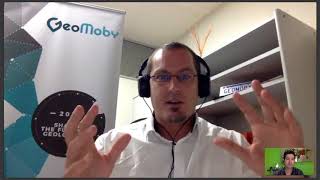
Christophe pitches GeoMoby, which tracks workers indoors and outdoors without draining batteries. The company pivoted to mining and construction, where it now does $200k in revenue and projects $1M by year-end. It manufactures its own hardware and stores no personal identifiers.
Chapters
Great, thanks a lot, John. So yes, I'm Chris. Sorry for the weird start. I'm the founder and CEO of Geomobi. Geomobi is a location services provider specializing in real-time geolocation, geofencing, and activity monitoring. So we're basically helping our clients to make sense of their real-time location data, leading to better business decisions and eventually increasing their bottom line. So, we're basically convinced that the battle of tomorrow's business performance will be won by using contextual, accurate, but also real-time location-based data. The problem is that the quality of location data is not reliable enough. Collecting the data is very power-consuming. Storing location data and tracking movements and behaviors can lead to serious privacy issues. And the current location-based services do not cover all use cases, both indoors and outdoors. Well, uh, until now. So we have developed a suite of software development kits which is integrated directly into your mobile application or your IoT device, extracting location intelligence that is accurate, battery-friendly, private, and covers all location-based use cases, whether you want to track assets, personal, indoor, outdoors, multi-story building, or even underground mine, with the ability to reach these end users from several kilometers away down to just a few inches. So because we've got a very horizontal technology that can potentially serve multiple verticals, we chose to focus on very large markets ready for digital disruption with a very enthusiastic growth momentum. And where our technology can address at least their top 3 challenges. So of course we've got mining, which is a $22 billion industry, but also the construction, which is a $10, globally $10.3 trillion industry. So we did pivot the entire business about 2 years ago to focus on the enterprise platform that showed much better revenue opportunities than our initial subscription model. So last financial year we turned about $200,000 from various customers listed in the ASX, and with the same growth we had in the past quarter, we are on track to reach $1 million by the end of this year. So business model, our business model is very easy, very simple. We use a combination of one-off setup fee along with a yearly license based on the volume of messages going through our cloud service. There's about 15 to 20 geofencing companies at the global level at the moment, but with our current patents in place, existing partnerships, and unique features, we think that we're the only company to achieve an all-in-one, highly precise, battery-friendly location services for enterprises. So we're truly the next generation of location-based services. So we're a 12-person company across 3 different continents with various skill sets including technology, which is myself, marketing, financials, and tax. So to date, we raised a bit less than half a million dollars in the past 2 years from sophisticated investors in Australia incubators. Even though we're not actively looking for raising our Series A right now, we welcome the possibility to offer some equity to the right investors. So we'll be happy to consider an investment from $1 to $2 million range and bring more expertise in the company. So I just want to conclude by saying that if data is the new oil, then location intelligence is rocket fuel, and Geomobi is ideally positioned to leverage this new era. Thanks a lot for listening to me. Let me just move back to my face. Great.
Awesome, awesome job, Christophe. It was worth the It was worth the wait. All right, so Christophe is bringing himself back on screen here. Any questions that you do have for him, please do get them into the chat. I'll start off with a couple questions just to get things going here. So one thing that I'll just point out that I loved as well is sort of the, you know, there's the term like always be closing, right? It's also always be raising. Yeah, that's right. The best time to talk to investors and that kind of stuff is, you know, is ahead of time, right? And it looks like you guys are on a good path. You're generating some good revenue, but obviously you'd be foolish to not listen to opportunities. So that's great. So you had mentioned, so you guys pivoted, right, to the enterprise. What were the types of businesses? You said that it was more of a subscription-based platform. Subscription-based model back then? What were the types of businesses that were doing that?
So it was, it was, it was a SaaS platform. So we opened our platform for developers and digital agencies, and about a year, a year, we really tried to convert from the freemium model to paid customers, and we just, we had an epiphany saying that we're Maybe the market of developers around the world that want to experience geofencing and geolocation, they got some struggles and then actually come to our platform, is not big enough. And this is at the stage as well that we have these big companies here in Perth in mining and construction that started knocking on our door saying that we want to increase safety on site, we want to increase our productivity, we think location intelligence can help us out. If there's something we can do together. So it's a completely different sales process. It's a kind of a long sales process compared to SaaS, but we've got some— so far we had some very exciting deals with them. So we just decided to completely forget the SaaS model where we struggled initially to focus on delivering a location-based services for enterprises.
Yeah, that totally makes sense too, right? I mean, in hindsight. For everybody. Um, but yeah, I mean, geolocation is still not, not early, but at least it's not to a point, you know, most of the demand is going to come from big businesses. Um, and, you know, uh, you know, some independent developers and smaller agencies and stuff like that might not be positioned to sell those types of businesses, right? Um, to really kind of reap the benefits, uh, of it. Okay, so let's see. I got a couple questions. I have some more questions as well, but I'm going to start deferring to some of these others. So let's see. David asks, what is the value prop and how you— All right, well, let me ask the second part of the question. How do you deal with privacy concerns?
Yeah, so we had a lot of advisors looking at actually privacy concerns, which is one of the top main concerns when we talk about monitoring location information. Real estate is actually assets and personal. So basically we're not storing any personal information on our cloud service. We're just storing that location data and some sort of profile. So there's absolutely no way we understand actually you are John from the Foundry Institute, blah blah blah. We're just analyzing profile and we're able to tell you, for instance, in construction, so how long this specific group of workers spends in different areas. and we can interact with them in real time, whether for instance, they're entering a restricted area, we can actually ping on their smartwatch or on their phone saying, "Yeah, you're not supposed to be here. We don't know who you are, but you're not supposed to be here. It's not safe." So that's our take on privacy. So we got our lawyers that just advise us how to do this, and there's no personal information on our cloud servers. That's exactly how we deal with the privacy concerns.
Great, good answer. I'm sure it's a question you get very often.
Yeah, that's right. Yeah, that's right.
Yeah, so all right, Richard asked, are you going to allow enterprises or really any other organizations to white label the service, or are you guys sort of, you know, fully taking control of the technology?
Yeah, sorry, your voice is breaking a bit, John.
Oh, um, are you guys going to to look to white label it at all to any of the enterprises or anybody else, or are you guys sort of fully taking control of it now?
Yeah, so it's already kind of white label. Our business model works with channel partners. So one of the best examples here in Perth is we really struggled at some point to get in touch with big guys in BHP or Rio Tinto because we were just small companies somewhere in Perth. So what we decided to do is talk to the mining services providers. They're already actually on the supplier list. And we said, we've got this technology, we think we can do dramatically, we can enhance dramatically what you already have, and you can sell it to your own clients like BHP or Rio Tinto, and it's fully white label. So basically we deployed the solution into 6 or 7 different sites in the UAE. And it's all the name of our clients, not us. No one knows that actually the Tzitzumobi is powering all the location-based services.
Okay, cool. So, Punith asked, the IoT devices you were talking about, these aren't things that you would manufacture yourself, or do you have any plans to do so, or are you looking to sell to the larger companies that are producing those?
That's a good question. Yeah, we manufacture the entire IoT device. It's basically, it looks like it's a little bit smaller than a cell phone with no screens. There's BLE 4.5, Wi-Fi, GPS, and we optimize the hardware with our own software. So we control the entire thing from the case to the hardware, to the firmware. Our team controls the entire conception and development of the IoT device. And we're already sending that to our clients.
Okay, cool. So I think I had mentioned there too, so the construction industry, was that— that was one of the biggest targets, at least in the short term, correct?
Yes, that's right. Yes, that's right.
And what are the types of applications that they're using for it specifically, just to give people a little bit of context on what some of the applications might be, at least in the short term?
Yeah, absolutely. There's two main areas. We're improving safety on sites and we're improving productivity. By knowing where your assets and your people are moving, are you really in real time? The site manager can really understand if there's something, there's a wrong patterns going on, how many people are on site, how many are leaving. They've got all this automated check-in, check-out and time sheeting as well. So we're saving a lot of time with all day-to-day tasks by monitoring, like I said, the check-in, check-out, but also where the groups of workers are I've got an example of what happened. So one day we had this aggregated travel time. So this is how long workers travel from point A to B on the construction site. It went completely nuts. So we went from like 15 minutes to 35 minutes or something like that. In less than an hour, we flagged it and said, "Oh, what's going on?" It's just because the toilets container has been moved to the other side of the construction site and people were actually just moving all around the construction area to go to the toilet.
Container.
That's a funny example, but that's exactly the kind of things we can try. We can analyze in real time what's going on.
Right. Yeah. I think David heard that coming. Maybe David here in the chat had a background in construction, but he called the toilet issue.
Yeah.
No, it's a great use case. I wouldn't put it on your home page, but it's a great— Yeah.
It's going to be interesting. I'll talk to my marketing manager about it.
Yeah, all right, well, awesome. Thank you, Chris. So again, same, same as I said to the other presenters, there's a lot coming in. We're not gonna be able to get to all of them, so please do hang out in the chat and we'll send along Chris's information afterwards. And thank you, Chris.
No worries. Thanks, John. Thanks, John.










