Global Founder Hotseat July 2021: Watch Experts Give Feedback on Startup Ideas
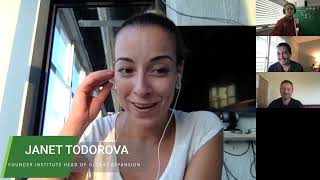
The recording captures a Founder Institute (FI) Global Hot Seat event held on July 23, 2021 via the Airmeet virtual platform. Host Martin Martinez welcomes a global audience of ~180 founders and investors, introduces FI’s accelerator model and the “Mad Libs” one‑sentence pitch format, and brings on three panelist judges – Janet (FI Bulgaria director), Jeremy (serial entrepreneur and former VC), and others. Six pre‑submitted startup ideas are read aloud, each followed by rapid live feedback from the judges and audience. The pitches span a cycling‑social app, a 360°/VR live‑event platform, a sustainable home‑decor brand with closed‑loop recycling, a low‑cost hydroponic micro‑green garden for kids, and a musician‑fan co‑creation mobile app. Judges probe problem relevance, existing alternatives, business goals (venture‑backed vs. lifestyle), differentiation, revenue models, and go‑to‑market strategies, while repeatedly urging founders to clarify their core mission, keep the pitch concise, and seek concrete feedback and networking. The host also addresses technical hiccups with Airmeet, advises using Chrome/Firefox, and repeatedly encourages audience engagement through emojis and the chat. The session ends with a call to action to join FI programs via fi.co/join.
Chapters
Welcome to Airmeet. If this is your first time on Airmeet, welcome. This is a browser-based event networking tool that allows you to not only watch this amazing event, the Founder Hot Seat, with the Founder Institute, but also network with each other. We got a packed house this morning, afternoon, evening, wherever you find yourself. So please introduce yourself in the chat right now. I want to see where you're all coming from, okay? Actually, I can't even see the chat anymore. Airmeet's got a lot of updates, ladies and gentlemen, but please tell everybody here in the audience where you're coming from because we have a global audience. I'll tell you a little bit about the Founder Institute, but let me tell you a little bit about me. My name is Martin Martinez, originally from Texas, based in Austin, Texas, but I'm currently coming to you live from Palo Alto, California. I serve as the Executive Director for the Founder Institute Texas chapters. We currently have programs in Austin, Texas, Houston, as well as Dallas. Applications are open for all of those cohorts if you are interested in joining the upcoming programs. I also now serve as the Entrepreneur-in-Residence for Founder Institute headquarters, working on a bunch of projects that you'll learn about soon in the months ahead. We got a great event lined up in store for you. If you're just joining us, welcome to the Founder Institute Global Hot Seat event where we're going to be reading pitches live from you, you amazing people coming from wherever you are. So please light up that chat, get to know each other, drop some LinkedIn, meet some people. Just because we can't do this in person doesn't mean we can't connect as people. So I want to see that. A couple other things about Airmeet. If this is your first time on Airmeet, as I mentioned, it is a browser-based networking and event tool. So there's a couple of things down here at the bottom that you'll notice. One is this little emoji right there. Click that thing. You're going to see a bunch of little emoticons. See some claps. Y'all are— y'all do well. Y'all are doing great. I think I'm going to like y'all. I think I'm really going to like y'all. So here's what I was going to break down, ladies and gentlemen. All these claps. All these claps. I'm going to introduce some amazing panelists for our event. They're going to be— we're going to be reading your pitches that you submitted in advance. Using the Mad Libs tool. So if you aren't aware of how we like to structure pitches, we'll talk about that here in a little bit. But first off, let me tell you a little bit about Founder Institute. So the Founder Institute is a global accelerator program that helps entrepreneurs just like yourself launch enduring, scalable, venture-backed businesses. We usually start just right at the idea. You might just have a cocktail napkin sketch of an idea. You might just have a little, a working prototype, but you still need to figure out how to build the business, how to find teammates, co-founders, and also raise venture capital. Founder Institute is a great place to do it. We're in over 200 cities in over 65 countries around the world, and we're only launching more cities. Throughout the pandemic, we have noticed that entrepreneurs are ready to take that leap. They've seen the world that's been broken and they want to fix it. So whatever it is that you're working on, we want to help. And more than likely than not, there is a city near you that is running virtual or hybrid-based programs. So please check us out at fi.co. And if you're ready to take the leap, go to fi.co/join and sign up for some of our fall virtual programs. So without further ado, I want to introduce a couple of amazing people that are gonna be joining me to the stage right now to help with our hot seat event. So Janet, Jeremy, please let's get those cameras on. Let's get those mics going and let's introduce ourselves to the audience. So Janet, tell us, how are you? Tell us where you're coming from. Tell us a little bit about yourself. How are you today?
Hi, Martin. Thanks for inviting me. Hi, everyone. It's great to be here. It's my first Global TalkFit event, although I work with F5 for a lot of years. I'm actually right now based in Sofia, Bulgaria. I'm one of the directors running the Founder Institute in Bulgaria. Right now, thanks to the virtual format, we're actually running a joint program together with our FI Romania directors. So we're running an Eastern European program. I saw many people from the region coming, coming from the region here in the chat. So hi guys. Looking forward to hear your pitches.
Awesome. We're happy to have you too. Again, we're a global program. We're bringing people from all around the world to participate and build the future together. Let's meet our next panelist judge for this morning, evening, afternoon, wherever you find yourself. Jeremy, welcome.
Yes.
My friend.
Hello. I spent about 10 years helping to do startups and grow startups in Japan, Korea, China, India, and Australia. I then went to the Foundry Institute in Silicon Valley in 2009 to enroll in the very first program, left Japan to— so I could join the first, first cohort. I was a big success. I was awarded the hot company of that program and went on to build a business, raise various rounds of funding. I went into VC, worked for Google's chairman, Eric Schmidt, and his fund Tomorrow Ventures and then went on to grow a whole bunch of startups all around the world.
Awesome, thank you. And yeah, throw down some of them emojis, give some claps for our judges this morning, afternoon, evening. I'm gonna keep saying that just because I don't know where y'all are. All of you are from everywhere, I love it. We have over 165 people joining us for the hot seat right now. We're not going to get to all of you on your pitches, we're only going to do a handful that were pre-submitted. So let's talk about that, right? Let's talk about that. So ground rules for this event. Attendees have to submit in advance. If we do have time, we might get some from the audience, but, you know, part of the event is that we want you to interact in advance with us because we want to select some of the best pitches that we get, and we want to read them out loud to the audience and provide some immediate feedback on what we read. We have a format on how to do that. It's called the Mad Libs format. We've been using it for years and years and years with our founders that join the FI Core program to help them refine that initial pitch. And there's a reason why we do that. Let's drop that link in there if we can. Is we want to— we want you as founders, you have a ton of ideas. It's a cloud in your mind and it's hard to articulate it early on, especially when you're trying to get other people to buy in on this idea, to help you, to give you advice. So we want you to get to the point. So using this Mad Libs tool, you know, we really are helping you focus this idea into something that can be distilled and understood in one sentence. Because if you can't do that in one sentence, it's gonna be really hard to capture people's attention in a longer format, in a minute, in 3 minutes, in 5 minutes. You'll be using this one-sentence pitch in a variety of ways. In many cases, it's through networking. It's when you're talking to people for the first time and they're asking you what you do, why you do it, and who it's for. So for many people that might come in in the beginning, it can be a little jarring. It can be a little off-putting. But we do this for a reason. What makes the Founder Institute so unique and really so pivotal in many an entrepreneur's life that joins us and graduates is that they're one of the best pitchers that anybody, and pitcher not in the baseball sense, pitcher in the entrepreneur founder sense, is they have the ability to articulate their vision with such clarity, with such confidence that people are inspired, that people are motivated to say, tell me more. And that's what we want for all of you, whether or not you join the FI program, though we hope you do, we hope you're able to articulate that same vision with confidence and clarity, just like our graduates. So, Let's talk about what that looks like. So if you did click that link, fi.co/matlibs, you'll notice that we look for a couple things. We're looking for audience, we're looking for who you're trying to— who is this serving, what's the secret sauce, and how you're going to pull it off. So we're going to read, looks like, 6 pitches this morning, evening, afternoon, that have been submitted in advance, and it looks like all of our submitted pitches are in attendance, so we are gonna— I'm gonna read them in my best game show host possible voice, and we're gonna pull you on stage if you are willing and able. So let's get started, ladies and gentlemen. We're gonna start with our first pitch of the morning. It's morning for me, and this pitch comes from Ali Reza Alikhani. So judges, how are we feeling? Are we ready? Are we ready for this?
Absolutely.
All right. Hot seats, ladies and gentlemen. Throw down some emojis, audience, for our first pitch. Ali Reza's pitch: My company, Soloc, is developing a mobile application to help cyclists and athletes in the future to easily find each other to enjoy cycling together. Through a platform that lets them define and share cycling events on a specified path they choose. It also lets other people join their events so that they can explore the world together through cycling. Interesting. I'm excited about that too. I'm an avid cycler. So let's jump right into this. Alireza, thank you for joining us. I know it's gonna take a little bit of time, gotta tweak your microphone, you gotta tweak camera, but let's just get into that feedback. Jeremy, Janet, tell us, what do you think about that? Y'all are both on mute, y'all.
Would you like to start first?
Yes, sure. Oh, go ahead, Janet.
All right, I'll be brief. I'm not a cyclist, but I do know that this community is like pretty hyped, especially around the pandemic. A lot of people are doing more and more outdoor activities, at least what I see around here in Europe. So I would, I would like to maybe ask a few questions. So one is like, what are the alternative solutions that these communities right now use? Because my experience is that people just use Facebook groups and it's easy for them to connect, meet, and this solves their problem. So maybe can you say a little bit more about what's unique about the idea?
Alireza, I see your camera's on, my friend. I see your mic's on, so you are on stage. Welcome to the hot seat. You don't mind answering some of those questions? Welcome. Nope, still got some audio issues there. Gonna keep talking. Now one second, keep tweaking on that. Looks like we got you coming from Canada. Again, we got people from all around the world. While you're working on that, No, Iraza, give us something. We got 180+ people in the audience right now. Uh, while we're working on that audio issue, Jeremy, any thoughts to that?
Sure. I mean, I'm just— I really start at the basics here and would like to understand, like, why— what is the purpose here? Is the purpose here to build a venture-backed business, um, and get VC funding and grow this thing and, um, you know, exit the organization? Or is this really just more of a a hobby topic that you'd like to do so that you would have a more efficient time with your friends, or what is the goal of this business?
We're looking at that. Ali, you're still— you're on mute again. Looks like we do have a limited connection where you're at. Got you back on the mic. Give us a hello. Can we hear you, Ali?
It could be the browser.
Could be the browser. Again, if you're on Airmeet and you're getting kind of buggy, ladies and gentlemen, just always hit refresh. Refresh is your friend here on Airmeet. Browser-based platforms can be a little finicky from time to time. Thank you for that happy, laughy emoji. A few of them. All right, okay, all awesome. Any other thoughts before we get into the questions? Because I know Mr. Alekani is still working on some audio issues here. Maybe give yourself a quick refresh and then we'll get back to you. Any other thoughts, impact, you know, maybe words of advice, Jeremy, Janet?
So the reason why— the reason why I asked this question is because sometimes we founders fall in love with a solution, but maybe people out there already have a very simple solution that is using existing platforms and tools, and it wouldn't be easy to change a habit of a person. So that was my question, and actually that's a very common thing to receive it such a question during an investor pitch or an acceleration program and so on. And a founder should be prepared either to have a solution— sorry, to emphasize an issue, part of the problem that only the respective solution can solve, or maybe change the idea.
Brilliant. Jeremy?
Yeah, it looks like we lost Aloriza. So anyways, yeah, I mean, I guess for everybody on the, on the call here, I mean, I think this is really critical to understand what is the purpose of the business, and because everything, every subsequent decision depends on that. I've seen a lot of companies like make decisions in terms of hiring, in terms of marketing, in terms of other things, following playbooks for other that have worked for other venture-backed or other venture-backed businesses. But in fact, they themselves are actually, their main goal here is to build a sustainable business, a lifestyle business that's going to throw off cash flow every year to them and be able to put that in their pocket. And everything in their business, every business decision is going to be different if that's your goal versus your goal is being to exit this organization to, you know, and have an outcome to another organization or do an IPO.
Fantastic. Thank you all for that. Looks like we lost Mr. Ali— Mr. Alireza Alikhani. So for those of you who might get called up for the hot seat, We do appreciate that y'all are putting yourselves out there and coming on stage for us. Just make sure that when you do, couple things. Airmeet, again, it's kind of a finicky tool from time to time, though we love it. It allows a lot of networking, a lot of really great interaction. So if you are using a particular browser, make sure it's going to be Chrome or Firefox for optimum performance. Unfortunately, just the other browsers out there in the world just aren't agreeing. With kind of air meets from time to time. So just a reminder, if you are being called up to the stage, just check that out. But otherwise, let's keep moving. Let's keep moving. And thank you all for the kind messages wherever you're out in the world. And we got nearly 200 people here. It's a very fun, fun time. But let's keep it going. Our next pitch, ladies and gentlemen, is coming from Stefan Eder. Stefan's pitch. Is coming up right now. My company, XR Experience, is developing a platform that offers live events in 360-degree format, especially for VR headsets, to help music or sports enthusiasts join experience together with family and friends, even if the event is far away or the tickets are sold out. So, Stefan, welcome to the stage. We'll give you a couple minutes to test that audio and visual out. But please keep quiet. Janet, we started with you the first time. Jeremy, we're going to kick it to you right now. Welcome, Stefan, to the stage. Jeremy, what are your immediate thoughts there?
Yeah, well, I mean, I definitely— this is very timely, of course. And what I would— what first thing comes to my mind are like, what are the advantages or things that can be done in the virtual world or in 360 that cannot be done in the real world? And, you know, how much are customers or potential customers willing to pay for that? You know, I could imagine First thing that comes to mind is backstage, and just love to hear the thoughts on that for this business or this solution.
Fantastic. Yes, y'all are using the emojis very well. Give some claps for Stefan, putting himself up out there, much a room full of strangers all around the world. Jeanette, what do you think? Oh, had to hit refresh.
Yeah.
Again, the refresh button.
I did.
I don't know, Stefan, are you going to answer the question first or maybe I'll go first with my feedback. How does it work?
You can, you can proceed, then I will answer your question, both from Jeremy and yours.
Okay, so quickly on my end, I believe it's perfect timing for such solutions. Locally, I'm involved in organizing a few conferences. One of them is like the largest on the Balkans that is related to tech startups and so on. And I saw that it's 10 years old. So we were very reluctant to move to some kind of hybrid experiences to test out new things. But once COVID started, we were forced to do so. And actually, we ran a 3,000-people event on a completely new platform that was just released 2 weeks before the conference. So what I'm saying with this is like, people are willing to risk right now and adopt new tools. So as a person out of this kind of industry, also a little bit experienced in this kind of industry, I think it's a good timing now to test things. And another thing I noticed from the inside, what was important for us when we were choosing the platform and the tools around it was how easy it was to onboard speakers and like all the admin side of the crew. On the platform, how easy was it to plug it into existing systems like ticketing systems, tracking systems, and so on. And also one useful thing was to have some— someone like an account manager, so someone who is solving your technical issues prior to the event, during the event, and so on. So I don't know if you have thought about this part of the solution. Maybe you're early on and you're focused on the hardware/software side.
Thank you for your thoughts and for your questions. I'm with you, Janet. I think it's good timing because we are a little bit in the middle of COVID and we want to experience events together even though we are not able to. And so with 360-degree format and with the VR headsets, we can have a really good live feeling. And what my USP will be is that we can connect together and that we can see each other with very realistic avatars and that we can talk together on the events. So it can be music or sports. And with these technologies, we can do in future things that we are not able to do now. That's what Jeremy is talking about. If you think about, we can not only watch a Bon Jovi concert or something, we can ride on a dragon over the concert, you know? And the pay system, what Jeremy asked, is very simple. It's like the system like now is pay-per-view or a monthly Abo. And the thought with backstage is very good, so we can do things that we cannot do now. So if we put a camera on the stage, 360, or behind the stage, we can view with the VR headset looking around and have a feeling right here in the middle. Exactly, you are right there, and that's my USB and that you can connect together and with friends. So that's, that's what I, I wanna realize.
Fantastic. So thank you for that, Stefan. I'm gonna ask you one question before we let you get back to the audience and bring up our next pitch. Um, in many of these cases that we ask our founders, um, you can't really do it here in, in the one-sentence Mad Libs format. And again, if y'all are still Looking for that, head on over to fi.co/madlibs so you can follow along with how these founders are pitching their ideas. What can we do, what can the audience do to help you maybe achieve this idea and turn it into reality? And the only thing I ask is don't ask for money. Don't ask for money in a one-sentence pitch, don't ask for money in a 60-second pitch. But what can the community do to help you realize? Is it networking, is it advisors, is it resources? What could we do?
I think to get realistic feedback is the best thing I can get. So if you give me realistic feedback, write me back on wherever you like, via email or LinkedIn, and then Yeah, that would be the most valuable thing you can do for me. Give me realistic feedback.
Fantastic. Well, one more time, ladies and gentlemen, give some claps using that emoji tool to Stefan. It's always hard coming up and pitching in front of a room full of strangers, let alone in a virtual format. So thank you, Stefan. We're going to send you back to the audience. And if y'all are sticking around for networking towards the end, Be sure to meet him at the tables or with the one-on-one networking tool. So coming up next, ladies and gentlemen, we are hitting almost the top of the hour. We're holding strong at over 180 attendees. So welcome from all around the world. Our next pitch is from Bhumika Gupta. Apologies on that. My name is Martin. Most people can't pronounce it either. So if I struggle with your name, please correct me. Because I like to do it right. Umika's pitch follows as such: my company Intricate Inc. is developing a sustainable home decor brand with a focus on building things that last with closed-loop recycling for more conscious consumers looking to pay reasonable prices. Umika, welcome to the stage. Claps all around for her. Jeanette, hold on one second. Welcome. We'll get your camera going. Everybody's doing well, giving her claps.
Perfect.
Can you hear me out there?
My mic— Welcome, welcome, welcome. Hang back for one second. You're good to go. Let's kick it over to our judges based on what we just heard. Whoever wants to go up first?
Well, maybe just to make sure everybody here in the audience is seeing eye to eye, could you talk a little bit about what you mean by closed-loop recycling?
Yeah, definitely. So the idea is that when you are having some sort of linen, linen, or some clothing decor items around the house, like your seat covers, cushion covers, blankets, etc. Like, the idea is to aid that they are made of pure natural fibers, like 100% cotton, 100% wool, and that at the end of their lives, though, either they're worn out or you just got bored of looking at them, that you can send them back in and we can recycle it into a mat or a rug or something that you can use at the house and then send it back to you at cost. So the idea is that you're not only getting more life out of your product, but you're also more attached to the product because it's around for longer. It's natural fibers and that you're able to use it for longer.
And what do you see as the advantage and disadvantages of your organization doing this in a a closed box versus having this more as a platform? Like, I could imagine that you could sell this item and then have it sent back to maybe an ecosystem or a platform of other companies that could then, you know, recycle it into other products. Have you thought about those two things? And why have you chosen one over the other?
I'm sorry, so do you mean that I could do it for other companies, or I could send it back to companies who already do recycling, or?
So I could imagine a whole network of companies that are working together, right? Like, you may have a specialization in a particular product, type of product, but maybe you could build a network of other companies that have specialization in, you know, other products or other categories or other materials or other designs. And, you know, the advantage of that would be that there would be a larger awareness and a larger ecosystem But obviously the disadvantages of that being like, you know, you're going to be losing control of that. But I just feel that like building a standalone brand also has its challenges and, you know, having some network effects where multiple companies could join together to promote this and to work together. It seems like there could be some advantages as well.
Um, just so I could get a bit more clarity, so how would you propose that multiple companies work together on promoting something like this?
Like, I'm just, um, yeah, so I mean, if you, if you contacted a company like a leader in, I don't know, wood furniture, and a leader in, um, I don't know, um, uh, sheets and, and different fabrics in different areas, they already have an audience, right? So if they were to promote that, hey, we have this new line of products that can be, you know, it can be recycled and reused, then, you know, it helps generate awareness among the potential audience here, and it gives them more, a wider range of, you know, designers and products and materials to be able to work with.
Right, and that is a great idea. Now, the thing with that is it's not— so as a company, if I'm taking in a lot of materials, so the amount of clothes or linen, let's say we stuck to that, gets discarded in the world is massive, like fashion and clothing is one of the most polluting industries in the world. So to do that is not very— you could say it's not a very business that you could make a lot of money on. It's not very high margin, like either you're selling those sort of recycled mats at a really high premium to these companies that then sell them on to their consumers. And that sort of also defeats the purpose, right? Like if you could just buy a recycled mat, at similar price as a new one, then like, even though you want to be conscious, then people might not go for it. The idea is that when you— when I have my own brand, and then when I'm asking people to recycle and send it in, it sort of attaches, gives a bit of a USP around sustainability. It allows them to get a bit more attached to the brand that, oh, that once the shelf life of my product's finished, but I can send it back with this brand again and get something more out of it.
Yeah, point taken. I think there are other examples like, you know, like a Patagonia brand using, like, let's say a Gore-Tex product or something where there's like a usage of another material where the other material actually gets sort of co-promotion as well. But I'll hand it over to my colleagues Jeanette and Martine to follow up with their questions.
My turn, I guess. Sustainability is a favorite topic of mine. So, and I see this trend, anything related to this topic in terms of startup ideas is like, let's say, given an advantage in terms of like, okay, I'll spend a few more minutes to listen to your pitch and I'll dive deeper to understand your business model and so on. I have a few comments. So first of all, I believe for a general audience, the short pitch has to be simplified. Use words that people, you know, immediately understand. Your pitch is of course different depending on who you pitch to. So if it's like an investor specializing in sustainability and so on, feel free to use all the special words, or if it's Zara and you're pitching to them partnership for this co-created brand sustainability and so on, and they already work a lot on this, of course. So that was one thing. So I'm glad that Jeremy asked the question in the beginning because I just realized what you're actually working on once you had the opportunity to add more context. Second, One thing that usually I see with founders pitching is when you pitch in the one sentence format, this is basically the big vision. However, this is not something you're going to work on day one. So you start with something really small and I like the direction that Jeremy suggested, but basically you start with something really small. For example, you can start by being just the middleman between brands that already use recycled materials and then just figure out how to source the secondhand clothes and only two types of fabric, for example. Then you can expand on the fabric side and then on the other side, you can expand on the partners. And then step 5 maybe is like, okay, I create now my own brand. So depends on what's important for you to create the brand or to focus on the recycling part. But I would start with one piece and then build around it.
Yeah, no, I think that's good. That's good advice. I, yeah, I think on the B2B part, I think like you said, it might make a bit more sense to maybe focus either on B2C or B2B, one of those, and then maybe pick it up.
But yeah.
Thank you for those comments.
Awesome. Any final thoughts for this current pitch that we have?
German?
Spanish? Seems like y'all are good on there. Audience, we do want to make this as engaging as possible. We are running a little bit early. I like that, though I want to make sure we get time to recognize all of you. Look at all these emojis. Everybody likes this pitch. I love it too. So if there is any audience QA, please use that QA tool. I can read some out there, but I have one final question. Same thing I asked Stefan earlier on Free U. Es gut. So outside of money, outside of money, because this isn't the format for that, what can the audience here— what are you looking for right now that can help you potentially turn this idea into reality?
I think for the stage I'm at, it's an early idea stage. I think at the moment I'm just looking for feedback on the idea, how it sounds, if it's reasonable or not, which is exactly why I came here for. It's great to have that comments from both of you and the rest of the audience. But yeah, I think it's just in general feedback, like the person previous to me said.
Awesome, awesome. Well, thank you for joining us. Thank you so much for having me. Thank you so much for putting yourself out there. We'll go ahead and move you back into the audience. And if you have any thoughts, ladies and gentlemen in the audience, for any of the pitches that you heard, please connect with them. They do a lot of work just to get themselves up to this point. And in many cases, for all of you that are at that idea stage, just like our last speaker, Founder Institute is an amazing place to start. So I'll do that again, uh, head on over to fi.co/join, check out a local chapter in your city or surrounding area, and let's help you turn that idea into a reality. Um, we're doing great, everybody. Y'all are doing great. It's probably the best audience I've had virtually in quite some time. So give y'all self a clap for you and a pat on the back wherever you're at. So we're bringing up our next pitch, Sylvian Picker. Sylvian, hang back, I see you. Nice green tit and very F5 branded. I love that. And we're gonna— I'm gonna read your pitch out loud and then we're gonna kick it over to our panelists who are gonna give you some quick feedback. So Sylvian's pitch: My company, Seed the Globe, is developing the world's cheapest hydroponic microgreens mini garden for parents who want a fun way to get their kids to eat more vegetables. We make growing microgreens easy, clean, and inexpensive by helping to distribute this mini microgreens garden. It will allow companies to show that they care about the future and children's health. Love this. I'm gonna hold my thoughts and hold my tongue.
Jeanette?
I'm going to go back to you, once you close out the last one, and get your thoughts there.
I was just Googling because I've seen a similar idea. So if you're based somewhere in Europe, Sylvian, I see there is a big hype around the so-called farm-to-fork concept. The European Union is working on this, I don't know, goal to become a carbon-free continent in 2050, I believe. Anyway, and they want to start with food. So similar solutions are already out there and are getting funded. I guess the twist is different here because you focus more on the educational part, like parents and children interaction and so on, which is actually great. Over there, the twist was like shorten the supply chain and basically grow your veggies at home versus like deliveries and so on and so on. So I know that similar products are already out there. So I guess the question here is like competition, what markets are you planning to start with? What is the difference to position this as a parent-children type of product?
Oh, good. So this is the idea. I've been working on a microgreen, micro mini garden for about a year, and I've found very, very good products, but I was They didn't have enough money to start the other designs. I have two other very good designs with higher end. And I just wake up in the middle of the night with the extremely cheap design. We can make an efficient mini garden for, let's, $1. We can have a version that costs $5. Or we can have a ceramic version that would costs maybe, I don't know, $15, $30. And so it's so cheap that I thought that company could use these gardens to advertise and show to everybody that they care about children. And this is also a very good introduction for people that just don't want to put too much money because the other, the competition costs cost quite a lot, but depending on how much money you have. But for a lot of people, they cost a lot of money. And if you have something that is really cheap and easy, you can try this system.
So, yeah, so the comment I'd make is, I mean, right off the bat, as Martine was reading the pitch. I mean, the one word that really, really stood out to me among every other was the word cheapest. So, you know, I think, again, I would go back to one of the questions I asked one of the other pitchers before, which is like, what is your goal here? So is the goal here to increase sustainability in the world? Is it— is the goal here to increase health of children? Is the goal really make that super clear. I mean, generally when you are trying to pitch a startup that wants to attract VC funding and things, the word cheap is generally kind of contrary to an investor's goal of making money here. So I just— maybe you want to sit down, have some quiet time for yourself about what is your goal, and maybe then actually bring that into the pitch like into that top-level messaging about what your goal is for this product or for this company, so that becomes very clear and so that people can self-select as to whether, oh, I as investor, is this something that I want to get involved in, or I as a philanthropist, is this something I want to get involved in, or what have you.
Yeah, sure. So my idea was to use low-tech designs, gardening tool designs, to help city people grow food. So I have other designs. I've worked on seed balls, very good, very simple tools to make them. But I don't know, it's like my— this product is like my minimum viable product to start up the company. And it's a gardening company and we will sell seeds. The name is Seed the Globe and we will begin by selling, yeah.
Yeah, so maybe just to make that clear then that the infrastructure to get started is the cheapest out there and therefore it'll be, you can get very quick adoption of the platform, so to speak. But then you have, like as an investor would talk, like ongoing recurring revenue in terms of the seeds, uh, selling the seeds, or similar to like the, you know, the razor blade, um, uh, strategy. Um, and that could then attract, um, you know, investors as well to this opportunity as well.
Yeah, yeah. Wait, and, and, and I see this company a little bit like Apple, so we can, we can, we can get other products. There's a lot of, uh, I think there's a lot of opportunity in the low-tech sector for gardening products. And let's have a lot of imagination about that and a lot of experience in farming and gardening too. So yeah, but I think a cheap microgreen mini garden, I mean, if we make— if we find— use this, we use this for advertising other companies that not necessarily work with gardening, just so they show that they care about all this ecology, food, and vitamin, etc. But I think that the— and schools for introducing these microgreen growing to school. I mean, every year you get new kids. So that's also a recurring process. But this idea that having something so cheap, I think the market is unbelievable. I think it's— for one of my competitors, one of my competitors is making, uh, they are making, um, something with a mini farm to grow microgreens, but it's nearly $200. And there's lights and everything, and they estimate that they will get 200 200,000 customers in 3 to 5 years. I think with a cheap mini garden, you can really build a brand and get an enormous market. And you're building a brand, so you just— I think we can sell much more than just the mini garden.
I mean, I can see that. And if advertising is a part of it and something like a unique aspect of it, maybe that could be weaved into the high-level message about the company and the product as well.
Thanks.
Right on, Sylvian, great pitch. We have a question from the audience that I hope you can answer for me. Towards the end of that pitch, you mentioned that company— it allowed this product to allow companies to show that they care about the future of children. And children's health. So a question from Jean-Michel in the audience is, how can— can you elaborate— companies can benefit from this?
I mean, it's— every company have social responsibility aspect and try to have a good image in the public. There's some stuff in this, I don't know how to, sorry, my French has some problem. So the question is how a company, yeah, that's basically, it's so cheap. I mean, it's a small thing, it can be given as a gift, the company can show that We are helping this thing where we're giving, say, 100 of these mini gardens for a school or an organization. There's all kinds. The idea is very new, so I'm still trying to find ideas.
Got it.
Thank you, Sylvain. And one final question from me, and then we'll take you back into the audience You can take a breather. Again, it's not easy to be on the hot seat. That's why we call it the hot seat. My final question for you, again, outside of funding, Sylvia, what can we do, or what can the community here today— because we got 160-some-odd people here right now— what can they do to help you kind of turn this into a reality? And don't say funding.
Oh, you can, you can connect with me on LinkedIn, and I'm looking for, looking for people people that would like to advertise for their, for their sustainability, uh, aspect of their company. But, um, I would be happy to, to have a conversation with any of you. And so I'm, I'm very active on— not very, but I'm active on LinkedIn. I really like this network. Easy to find me.
Awesome. Well, thank you, Sylvain. Be sure to drop that contact information in the chat so you can get in touch with some people in the audience. But we're going to go ahead, take you back into the audience. Your time on the hot seat is now complete, and thank you for putting yourself out there. We're almost out of time. We do have a couple pitches that came in from the audience. If we can get to them, we will. But we do have one formal submitted pre-advance pitch from Olusegun. Olu Segun, Gabdebou, and so let's bring them up to the stage. And while we give them a little bit of time to work on their AV, I'm gonna read the pitch. So here it goes, ladies and gentlemen. Final pre-submitted pitch of the event today. Welcome to the stage. My company, Guild, is developing a mobile application to help establish urban musicians create new revenue streams and immersive audience engagement. By enabling a platform that embeds the audience in the musician's creative process. Very interesting, right? So welcome to the stage. I'm going to kick it over to my panelists for this event to provide their feedback, thoughts. Jeremy, let's go to you.
Yes, I think this is a very intriguing high-level pitch and it makes me want to know more, and that's exactly the purpose of creating a little brief summary is to get more engagement, for get investors to want to know more. So congratulations on that. And would you be able to take us to one level deeper so we could understand a little bit more?
Yeah, absolutely. So the idea is to have a mobile application where you have a platform where the audience of fans audience of a musician or content creator can actually co-create an end product or project with the content creator. So for example, a musician wants to make a song, then reaches out to his audience and gives them the opportunity to make the song with him or her. So they sign up onto the platform, And then the artist takes them through this process of making the song together. So, they are part of it. They're able to give their opinion on different components of the song, whether it be the instruments, the way they sound. He gives them options in regards to the verses, the music, the different tonalities. So, the idea is the audience is carried along through the process, and at the end of it, they feel that they've actually built this project with that artist.
I love this. I love this. Can I want to get involved with Snoop Dogg? We're going to make a song together. So if you want, once you sign him up, give me a call and I'll be your first customer. I'll hand it over to— that's awesome. No, you got to do this, man. This is awesome.
Thank you.
So I really like the way you explain the product. So it becomes clear to me. I'm not like, what's the word for this? Like a person who is very much into music and I don't have favorite songs and bands, but I definitely can see this as a kind of a marketing tool from the perspective of the musician. So if you think of this as these two important audiences that you have to bring on board to make your product work, which is like the fans and the musicians. If you bring the right incentives to the musicians, I believe they will help you bring their audience on your platform. I've seen a similar— so, not similar solutions for this particular product, but let's say solutions for audiences and musicians. So, I know it's a challenging audience, so it would be good if you can If you're either yourself involved somehow as a hobby musician and you already have a network of similar people so that you can have your early adopters on the platform, that definitely helps. But yeah, other than that, I believe the strong component could be the marketing type of influential part that will help you bring this to life. So maybe you can tell us about your background. How did you come up with this idea? Is it something you personally would like to use?
Yeah, thank you for that feedback, Jin. I really appreciate it. And I agree with you from a marketing perspective. I really think it's going to be a really powerful marketing tool because the buzz of it and just the excitement of an audience, especially if the artist has an established fan base, I think could be a really big one. In terms of how I came across the idea, actually— so my background, yes, I am sort of a musician. I used to be part of a band years ago, but didn't really make it to the high level, or else I wouldn't be here with you folks. I'd be living the large life. But the idea actually came from a book I was reading a few years ago, and a lot of people on the call are probably familiar with it. How to Influence— How to Win Friends and Influence People, right? So there's a part in that book where he talks about— he gives a specific example about this painter that was trying to sell a painting to a customer, and the customer wouldn't buy the painting, right? And then he went back and then did the painting halfway, right? And then asked this customer what he would like to see. In a painting, and then the customer gave his suggestion, and then he went off and incorporated the customer's feedback, and then the customer bought all the paintings, right? So for me, I just felt that, you know, there's so many layers in regards to the benefit of this approach, where first you're getting that iterative feedback in terms of what your audience would like to see. And, you know, this is something that— music, I believe, is just the entry into this. I believe it could actually work across multiple industries, just from a product development perspective, but, you know, you get that iterative feedback from your audience, and when you end up with something that you're almost guaranteed or closer to a successful end product because you have that direct feedback in the creation of that product, and then so you get that good foot in with your audience that you've created it with, but then going into the market, right, you actually have a higher probability of success going into the market.
Dude, that is exactly what is being done right here with you, man. Like, we are all listening to your pitch, we're providing our ideas, we're getting excited about it. We now feel like, hey man, we, we discovered you and we want to make you to make be successful, and we're going to be now your customers. So like, this is, uh, just, uh, one example. Like you said, this can be— this concept can be applied across very forms of media. And I mean, absolutely, this is so topical in terms of like, you know, people who are on the, you know, musicians who are on the road not being able to do that now. I mean, you obviously know all that. I also know like, you know, musicians kind of like, how I've often asked, how can I support this musician? I love this musician, but if I like download a song from iTunes, like at the end of the day, that musician's gonna end up with like 3 cents. Right? Like, I really want to show, like, I love this musician. I want to really contribute to them. I want to contribute to their success. I mean, this hits all the needs of the industry, and I think the customers or the audience of these musicians as well. So make it happen. Please publish. Keep us all informed about your progress. We all want to be involved. Make it happen. Join FI. That will help you make it happen.
Amazing. I definitely will consider. Jeremy, I will find you. I'll hunt you down. Customer number one, right? So absolutely. And it's great that you bring up that point because a similar product actually already exists today. I don't know, you might have heard of Patreon, right? Which is a platform where, you know, people that really care about artists that they're into, they can subscribe to the services of that or actually pay, make a payment to the artist every month. Month, and then the artist gives them a specific offering, right? Exclusive offering, which I think is great. Now, Patreon did say themselves that they're only kind of scratching the surface, and they've been in existence for about 5 to 6 years. They have about 200,000 creators on their platform. They've made $2 billion in the last 6 years for those creators, which is wonderful. However, kind of like the My unique perspective is this is going to be focused on creation, on co-creation. So, it's a totally different experience in that regard. So, you're going to create something. It's really going to be focused on that, creating something with your audience.
If I could just throw in one last comment, I mean, I, you know, there's also in that general category, you know, I think there are platforms where like, You can get, you know, you can pay, I don't know, $500 and get Snoop Dogg to say happy birthday, Jeremy, or whatever like that, right? It's also in that vein, and that's also an area that is really, you know, attracting more and more interest. So, but this, you know, leveraging the musician for what the musician's good at, which is making music, at the same time makes so much sense. So I'll stop it there, but Thank you, sir.
Awesome, awesome, awesome. That's a great— I love the hot seat. Great way to wrap things up. Thank you again for that awesome pitch. I'm coming to you from— or I'm not right now, I'm in Palo Alto, but I live in what's called the live music capital of the world. I have a lot of very close friends that are musicians that live in Austin, Texas. I'm not on the judge panel, so I'm going to hold my thoughts, but I would love to connect again at some point, maybe chat a little bit more about this, because I agree with everybody here and many people in the audience. This is an interesting idea. We'd love to see it turn into reality. But with that said, we're going to send you right back into the audience. Thank you for joining us. And that's, that's a wrap, at least for this segment of the Founder Hot Seat, ladies and gentlemen. We were so grateful that you stuck around and joined us. There's still a great amount of you, about 150 of you, so don't go anywhere just yet. This is concluding right here, the live segment, but we want you to connect. This is a community, a global community of people. You just met plenty of people that were in Europe, that were in East— or Eastern Europe, that were in India. People from all around the world engage on this, and there's tons of great feedback. You can see it right now in the audience, in the chat. I've never seen anything like it, at least in a very long time. So we want you to connect with each other. Immediately concluding this session, this is all going to disappear. My ugly mug's going to go away, all that's gone. And then you're going to see a few tables, a bunch of virtual networking tables. We encourage you to take a seat at one of those and go connect with some of those people that are in the audience, and maybe some of us will be bouncing around. So stick around and network, get to know each other, shop around some of these ideas, maybe connect with one of the presenters, the pitches that you saw today and see how you might be able to help them. There's also right above it a networking tool that'll allow you to do 3-minute speed, speed networking one-on-one. So if you don't want to sit at a table, you can just do and have quick one-on-one conversations with another member in the audience. Something great about this tool that we love. We love Airmeet. We hope you're able to join us again for future events. And if you're one of those people that either presented that pitch today or want to in the future, we definitely encourage you to not only sign up for the next global hot seat, but also think about turning it into a reality by applying at fi.co/join. Check out one of the cities near you, if not a city in where you're at, and, and join us for our fall programs. And let's help you turn this idea into reality. Let's take this 60-second pitch and turn it into a company. All right, so without further ado, we are hitting the top of the hour I want to thank all of our, all of our pitches. I want to thank you, Jeremy. I want to thank you, Jeanette, for coming in and being such amazing, amazing judges. But with that said, we thank you all again for joining us for the, for another great round of the Founder Hot Seat. We hope you stick around for the networking. Wherever it is you are in the world, we hope you're safe. We hope you're well. We hope you take care of yourself and others around you. With that said, we'll see you next time.










