Global Startup Report, powered by Founder Institute (4 March 2022)
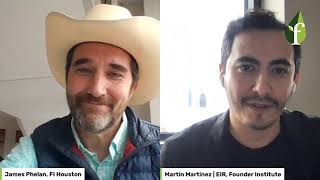
Martin Martinez and James Phalanx, Managing Director of FI Houston, discuss recent portfolio wins including Mentessa's €1M seed round and Kangaroo Time's $6M raise. James outlines Houston's startup advantages: energy, healthcare, space, and the Port, plus a collaborative community. The FI Houston cohort launches late April.
Chapters
¡Hey everybody! Welcome to another amazing episode of the Global Startup Report. I'm your host, Martin Martinez. Entrepreneur-in-Residence for Founder Institute. I'm coming to you live. You could probably tell this is not my usual backdrop. I'm here in downtown Houston at the University of Houston. I've been here all week. We've had some amazing Founder Institute events, both virtual and in person. We're gonna learn more about why I'm here for the Houston Tech Rodeo with our special guest, Managing Director for the FI Houston chapter, Mr. James Phalanx. But before we get into that, I hope you're all well. Please light up the chat. We're using Restream that allows us to go from all across our socials. So if you're coming in watching on LinkedIn, I see you, Greg. What's happening, Maria? Hello to you as well. If you're watching us on Twitter, what's happening too? Come on out, come on out. We're gonna have a fun day just talking all things Texas, um, sharing some really cool news about some founders all around the world, funding and otherwise. And then talk a little bit more about what's going on with the Houston Tech Rodeo. JT in the house, how we doing? Let's bring up my magician producer on the back end, Dustin, so we can get into the news before we get to our special guest. Dustin, what's going on, brother?
Hey, Martin. Yeah, happy Friday. I know you guys are gonna be talking all about what's going on in Texas, but yeah, to get to, I guess, our opening segment here first, we have a couple of news stories as usual to share with our listeners. And yeah, the first story we're bringing to you is from Munich, Germany. This is a Munich FI portfolio company called Mentessa, and they raised this week a €1 million seed funding round. Basically what Mentessa does is the platform connects organizations for know-how exchange, specifically for improving employee onboarding as well as engagement and just sort of matching people based on skills and things like that. It's sort of in the virtual-first world. There's sort of something missing from the corporate tech stack layer of knowledge exchange. And that's what Mentessa software product implements. So yeah, congratulations to the founders, Tina Ruseva and Andrei Andreev, for raising their $1 million seed round. Very exciting.
That is some great, great news coming out of Munich. We're going to bounce over another Texas company. We're talking all things Texas today for some reason. I don't know why. Maybe there's a reason over here coming out of Austin. One of my founders who I've been able to get to know and just watch him grow over the last 3 years. David Franklin, founder and CEO of NoirX. NoirX has just been highlighted in Community Texas Startup Spotlight featuring him. His background's incredible. A veteran came into and started NoirX after, you know, after some— after he lost a parent, and he's trying to change how we engage clinical trials. So check out that interview. We're posting that on the Twitter thread. If you're on LinkedIn, bounce over to Twitter and pull up that link. But it's an amazing story. And he's also going to be a part of some things we're doing for South by Southwest next week. But I'll tell you that after our special guest. Let's keep that rolling, Dustin.
Cool. Perfect. Yeah, I didn't know that Dave was going to be at South by, but I know he's from Austin, so that's very cool.
Yeah.
So the third story here to share is 6 pet care startups were selected to join Leap Venture Studio's 5th cohort, and of those 6 pet care startups, 2 of them are actually Founder Institute alumni. So one is PetHub, they're an FI Seattle company, and the other is called Betsy, and they're an FI Calgary company from Canada. And so PetHub was founded by founder Tom Arnold. It's basically like a modern tech-enabled pet identification system where your pet's ID tag that they wear is linked to a free and secure profile and a database with lots of features for, um, if your pet gets lost or something, they activate and like notify all the local shelters around you. So it basically is tech to help ensure that your best friend always stays by your side. And then, uh, the other company that was accepted into Leap Venture Studios cohort, Betsy, was founded by Alex Chang, and, uh, it's essentially a full tech stack for modernizing veterinary care for vets. So it's like how veterinarians communicate with their clients, and all the features are purpose-built for veterinary clinics and their clientele. So yeah, congratulations to both PetHub and Vetsy. They each receive an investment of up to $200K for being accepted into the studio with Leap Ventures.
Fantastic news from all around the community. I think we're done with news for the day. That's the thing. We're on that. We got one more.
Uh, there's one more down there if you want to read the, uh, from Kangaroo Time.
Oh yeah, come and go. Going to the West Coast, LA. We got Kangaroo Time, uh, CEO Scott Wayman, also was a former director of our Buffalo chapter, um, just secured enough— just secured some more funding. Uh, they get the bounce, as they've called it, they've dubbed it, $6 million, uh, for child care. Uh, and they're, they're kind of a tech, uh, centered provider. So we'll drop that link as well. Congrats to Scott over at Kangaroo Time, longtime friend of the family and grad. Well done on that, on that $6 million investment. Big, big, big money, big money all around the world going on right now. But great, so far so good, Dustin. We're starting to get in a rhythm with these shows, don't you think?
That's right. Yeah, we're cruising right along here. Time for our special guest. I'll let you introduce them and I'll maybe be back on later, but you guys take it away.
Yeah, we'll catch you a little bit later, Dustin. Thank you. Thank you for everything you do. All right, as Dustin so nicely mentioned, I want to bring up our special guest, good friend, amazing leader, awesome human being all around, coming in real hard Texan right now, full-blown Texan. I mean, I got my Texas shirt on too from friends that play in a band, but you know, James got the boots on today and everything as well. You can't see the boots because you can't see them. James, managing director, FI Houston. How you doing, brother?
Doing great. Coming to you hot and live here from the University of Houston downtown. Seeing great sessions today, all week. It's been really wonderful to have you here with us, Martín. And it was amazing that we got our own Texas Founder Showcase off with some great pitches, some great AMAs, and about 80 people turned up. Even Gita with her amazing plant-based food, Spoon and Sprout, you know, nailed it.
So awesome. Yeah, well, we'll dive into that a little bit more here, uh, but let's learn a little bit about you first, my friend. Um, tell us, you know, tell us about kind of your journey. Tell— and, you know, I know this, but our audience doesn't. So let's learn, let's dig a little bit more about what, what you've been up to and kind of how you came into FI and started supporting startups here in Houston.
Sure. Well, I mean, partially because of you, Martine, but a lot of it also had to do with Neil Murthy and several others in our local, you know, Houston as well as Texas ecosystem. And one thing I've focused on since becoming an entrepreneur in, you know, roughly 2009, 2010 is how important it is to have a strong ecosystem of people who are really here to support to assist, to give first, to, you know, be that servant leader, which is a value that I'm blessed to possess and try to carry forward and enable others to do what they're doing. So when you brought me in and we formed our dream team here in Houston, you know, now we've had, what, 5, 6 cohorts and keep, you know, paying it forward, getting really good companies, you know, putting people through the cases, the SEFI program is no joke, as you know, and anybody out here probably does. So, you know, getting it done and making sure to then connect, you know, really make sure that our companies have that support, not just from local directors, but then building that mentor team. And I think, Martín, you know, I like to bring in amazing mentors to, you know, not only help our founders, but actually to introduce to investors and even help us as directors. Mentors, because if you can get great mentors who have amazing experience and are, well, you know, know how to communicate that, that's magic.
So, oh, fantastic.
Well, tell it—
yeah, tell us a little bit more about, like, kind of your entrepreneurial journey, your background. Um, how has that kind of shaped how you approach leading our Houston programs?
Uh, there's the successes and then there's the dumpster fires, right, my friend? Um, so, uh, But luckily I got success at the beginning. I rolled out of UBS Bank, was where I sort of started this part of my professional journey. There was this derivatives thing, it happened in 2008, 2009. And so it was managing some assets for them and well, they were valuable, so they divested them. And that gave me some runway to become an entrepreneur. I wasn't gonna be out in the cold. So, um, started a company with a co-founder who had just finished her PhD in transit nodes and, and understanding how to connect communities to transit, uh, and she did that in the UK. So she came back from the UK to Houston, and we then acted as a consultancy and mostly a data gatherer, um, and, and helped educate, uh the municipal entities, commercial entities. Worked out well, rolled through it pretty fast, and we made some money. Yay, exit! Um, and then, but in that adventure, uh, found out about coworking. And in 2012, coworking wasn't really a thing yet. It was, it was early days in the space, and I was really enamored with the idea of, well, look, here's a bunch of digital nomads, and they were starting then nothing to the degree that we're now accustomed to. But it was the same things that Newman at WeWork or others were looking at in some of these things, but they hadn't really grown yet. They were in Manhattan, but they had not really gone out off the island yet. And so we set up a lab here in Houston and did a lot of research, set it up, had some really great companies that you've heard of, like Instacart or Uber or whatever. They did their soft landing in Houston at our space. And one thing I learned really fast, uh, was I couldn't keep them. I didn't have enough space. It was expensive for them to stay with me. So, uh, so they rolled out, and, and, and then I rolled out of that business. Had to close the doors, uh, after about a year and a half. And, and that was fine. It wasn't— we didn't lose a ton of money, um, but I did build a nice digital asset that then became Company 3, that, uh, what we called Clayson. And it was a digital asset sharing platform that was supposed to go wide, but then we were baited inside of a company that's based, or at least has big operations in Oakland, California. And they decided that they just wanted it for themselves. So they made that acquisition in 2015, and I stayed on the board and partially active on that project until 2019. And it was in that period that I came on here with FI and really had a little bit of time to be able to do that and enjoyed it and then started advising and mentoring and helping ecosystem growth, not only in Houston, but as you know, around Texas and maybe even further, but really with the Texas focus. And then now I find myself on a— where I do not recommend folks, by the way, don't do it— multiple startups at the same time. In early stage. It's painful. I love it, but it's painful. I love all my teams, um, but one is in the, uh, it's a community management software system called Village Insights. It's terrific. Um, have a fantastic team. It's been really good growth over COVID. We have acquired many customers, acquired some decent funding, um, and I think we're approaching to close on a million bucks right now, which is awesome.
Um, good to hear.
Uh, second, or my second two, or are both sort of loosely in the cannabis space. Um, one is, is a premium hemp soda that we've developed, a hemp nano infusion. And, uh, so we've been getting great traction, FDA full nutritional approval, and that's exciting because that means we can go truly mass market and be on grocery store shelves, not just head shops. And then, uh, the other is last mile delivery for legal cannabis delivery. So, um, we're only going to be doing that in where regulatory exists But the thing is that regulation is growing and we want to get right in front of that. So that's what we're working on.
Fantastic. Yeah, you got— sounds not like you have anything going on, James. Nothing.
Nothing.
And nothing happened at all.
And it's rodeo here.
And it's rodeo. Well, let's dive into that then. You know, I've been here all week. It's been a really cool time. It's been— it almost feels normal again after 2 and a half long, long years. Of this really too. But, um, so you got the hat, man. Like, tell us what's going on. Tell us about, tell us about Rodeo. Tell us about Tech Rodeo. Why is it such a big deal here in Houston?
Well, I, I'm a big fan of the Houston Tech Rodeo. It was stood up by the Houston Exponential organization, which acts as kind of the Chamber of Commerce for startups and innovation here in Houston. And, uh, several friends who are part of that organization or have actually moved beyond that organization now, have set a whole week of really impactful programming. They did a thing up and down the light rail that's a spine here in downtown Houston and Midtown Houston for various saloons that had different focuses in the mornings and afternoons all week long. And then ours for Founder Institute, we were one of those on Wednesday afternoon at the Downtown Launchpad in the Amegy Bank Tower with our friends at the Cannon and our friends at the Downtown Launchpad, Central Houston Inc., Robert Pieroni. Thank you, sir.
Um, thank you, Robert. Thank you.
Absolutely. And then, and that really worked out great. It was, it was so many people were so thrilled, Martin. And I know, I mean, you and I have already expressed it. Here we are in person being able to pitch again, be able to do an AMA and a panel where you're in front of the people. You know, it's not just, I'm on Zoom. No, it's, it's, it's great. And, and I think that people responded really well, um, on both sides— those who were presenting as well as those who were in the audience. Everybody felt an authenticity, everyone felt, uh, a part of something. And that FI fam, you know, in Texas we take that seriously. And, uh, so I think our Founder Showcase was a home run and, and And now, I mean, this morning, I'm thrilled to be at the University of Houston downtown. Dr. Sonny Zhang is a professor at the University of St. Thomas here in Houston, and she has put together a whole day of Born Global. So in Houston, some may or may not know, but 145 languages are spoken here daily. And we had 6 general counsels, or consul generals, sorry, from Angola, Australia, France, Israel, Indonesia, and Mexico speaking on a panel that I just caught, and it was, it was hot. It was like, how do we bridge innovation between not only Houston but Texas and their respective nations? And the doors are wide open, the opportunities are there, and they're happy to share them. People are thrilled to hear it. And, you know, as you can hear, there's, there's excited people. It's This is good stuff.
Yeah, yeah, it sounds like there might be a session breaking over there. A little-known fact, ladies and gentlemen watching us from all around the world, we're actually in the same building, but we wanted to separate it a little bit for the sake of the stream. But I'll be sure to high-five you a little bit later when we're done with the show. So as you mentioned, you know, we've got the whole world kind of converging right now, at least trying to bring it to Houston at the moment, and Maybe, you know, I'm sure for a lot of you out in the audience that may have not or aren't too familiar with Houston, you might know about NASA, you might know about, you know, big hats and oil, but what is something about Houston that maybe our audience doesn't know, coming from a Houstonian like yourself?
Sorry, we're going to have a little bit of a technical difficulty because we have some super excited people who are over here. They look like they're going to be doing some kind of performance. Performance, which I'm intrigued. I'm looking at these folks, they're pumped. I'm kind of getting pumped. So anyway, so I'm going to ask you to repeat your question.
Oh yeah. So what is something you would say to somebody about Houston or some tips or knowledge about Houston that maybe our audience doesn't know on a regular basis? Something uncommon, little facts about Houston.
Oh yeah. Full of fun facts. Full of fun facts. Houston is now almost— Chicago and us are in line for being third and fourth largest city in the United States. As a global city, Houston has more interconnectivity than most. We can connect to all continents any day of the week out of our three airports. We are now borderline 7.5 million people in the greater Houston area. And our areas of focus— everybody knows energy, everybody knows oil. Some people may also know that healthcare is a big deal in Houston. The Texas Medical Center is considered the largest medical center in the world, and it's where the first heart transplants take place— took place, um, and on and on. So much innovation happening over there over the years. And then space. I mean, there's this thing called the Johnson Space Center. Pretty much whenever you watch the launch, whether it's now, you know, from SpaceX that's happening down in Brownsville to, uh, the Kennedy Space Center in Florida. Houston is mission control. So that's been a real proponent to building the space industry here. And now space is hot again, Martín. I mean, space is back and it's not in any small part to, you know, what some may have seen performative, the theater that has been some of these launches, but they're not doing it just for fun. I mean, this is testing. We're in the startup world. I mean, all of us here should know this well. Iterate, iterate, iterate. And that's where we are. And then we have the Port of Houston here, which is the largest tonnage export port in North America. We are also the port of Mexico City because we are the largest deepwater port close to Mexico City. And thanks to NAFTA, we can truck and train it over the border. So there's a lot of fun facts.
I have— that's a lot about— I think I want to find me on LinkedIn or whatever.
Let's connect. I'll bore you to death.
Oh, that's great. Well, so let's go back into some FI stuff. Tell us about some of the companies that have been coming out of Houston lately. Uh, what are they working on? Who's excited?
Well, I mean, there's a lot of exciting— I think right now the one that I'm most upbeat about is, is Taya Dronis's Tempest Drone Works. He's creating drone battalions. Drone battalions, folks, are swarms that are land, sea, air, and space, all connected and threaded so they can really— and he also has the chops to do it. He's come out of the right location. He has the right patents that he already owns. That's helpful, and it's a good space. And he comes from an authentic place. He actually was from Paradise, California, and his home was destroyed in the fire. So that's the one that I'm really paying attention to a lot. I also very much like Maria Burgos and Trendy Seconds. I think Trendy Seconds is onto something in the reusable fashion space. It's not the same. It's not just like chop it up and turn it into, you know, insulation or something. It's like, let's use real clothes, nice clothes, recondition them, work with brands, work with, you know, help them pick up their, their SDG profiles and things like that. I think that's exciting. Um, of course I love Mario, um, Mario and CleverFi. I think there's some hard tech, that high tech that's coming out of that. It's fun to see him iterate, man. Like, I love seeing companies that, that can, you know, jump a little. And it's not about pivot, it's about focus. And, and that's what we're seeing out of him. And, you know, some of these companies are recent Maria's from an earlier cohort, and Mario was from our, what, second cohort? And, you know, and he went through paper, and now he's done other things. And everybody's connecting up to good stuff, um, that they're engaged correctly, they're speaking to investors, uh, appropriately. And, um, I don't know, I'm hot on all of them, and I could keep going on and on, but I just bore you all.
So— oh, you're not boring anybody. That's why we're here today, to learn about— hear about everything going on Houston. So I've been here all week. Um, so yeah, it's, uh, let's dive in a little bit more on that, man. Like, what's exciting you the most, uh, not only about just all this innovation that seems to be coming into Houston— people talk about Austin all day long— but, you know, what's making Houston so special right now for startups?
Well, I think Houston, you know, we have a little bit of special sauce here that's, that's a little different than what you might find in Austin. I mean, Austin's great if you're going all tech global tech, Austin's your place. Houston has plenty of it. It's just, it's a much bigger system. We're, you know, we're the home to what, the third most Fortune 500 companies in the nation. So it's very corporate, and in corporate, innovation in corporate can be challenging. Many of us know that. But what that also is, is those middle management or upper middle who are ready to go and strike out on their own we can get some smart, fantastic talent that's coming out of that direction. They, they're going to be experienced, they're going to come with chops, and they're going to come with ideas that I think you've seen. You know, we're validating with them and we're doing a good job. Houston's big, you know, like it's, it's, it's, you know, it's the largest city in Texas by far. And but the thing is, we're also an inclusive society here. This This is a place that you, you can walk right up to a stranger anywhere and someone's going to say hi back if you say hello to them. Um, you know, it's, it's, it's a little different than some of our, our regional counterparts. Um, it's a friendly place and, and all the resources are here. The cost of living is a bit lower. Um, we've got great schools, fantastic neighborhoods. I wish our mass transit were a little better, and that's close to my heart, as you may have heard in my story. But, um, but the thing is, it's, it's, it's here. It's getting better. It's iteratively working itself out. But we're on a century plan here in Houston. We think way far in advance. It's not— yes, sure, there's day-to-day, but, but we're way out ahead of big problems. And that's, that's what we do. We solve large problems. If you're doing a dog walking app, don't come to Houston. But if you're going to solve a big thing, you know, like food scarcity on a global scale, come to Houston. If you're working on something in the space industry, come to Houston. If you're doing something that's, that's really in that, that transition or beyond, like in energy, come to Houston. That's what we're here for. That's what we're working on. And through this pandemic, there's a, a big shift that's occurred in terms of innovation around our big silos, which is acceptance of new ideas, much more than maybe we saw even 3 years ago. And it's because people saw this is what gets things done. So come on down, visit. Do you want to know more about it? Reach out. I don't bite.
No, you don't, James. It has been fun this week. We got a ton of people just lighting up the chat, Greg. Milo, JT, Crystal Ball. Thank you all for watching Global Startup Report. And look at the cowboy, that's hilarious. Hey, we had a cowboy right here, genuine cowboy here on this Global Startup Report here with James, managing director out at Houston. Uh, we are just about running up out of time, so while we still have you, James, I know you've been— you're a steadfast ambassador for the, for the Space City, the Bayou City. It's got a lot of nicknames. But if there's anything else that might be worth sharing to the audience, maybe one final thing, maybe some advice for founders trying to build that dream either in Houston or wherever they are finding this all around the world. What would you share?
Well, I mean, A, we have launched officially our next cohort. We'll be kicking off in late April. So we are open. Go to fi.co/houston and you'll get into our project. But the thing is, We did this last time and it worked well, Martine. We're— come to Houston, we love you. But the thing is, we're working with our friends throughout Texas, and that's, that's what we're, we're doing right now. And if you have the Houston spin and you want to come on down, do it. Um, gosh, there's so much I could go on and on. Really, what I'm going to ask is if people want to follow, uh, what we're doing, you know, across social media at F5 Founder Institute Houston. We're on Twitter, we're on LinkedIn, we're on Facebook, we're on IG. Um, you know, just tune in and see what's going on. I mean, I'll post stuff, other people on our, on our team are posting, you know, just interesting things. And, and we're not doing it for our own edification, we're doing it for your benefit. So we want people— it's, it's our little own FI Chamber of Commerce, y'all. So anyway, come on.
Hey, awesome. And one final question. I'm trying to do this for every show, every guest that we have. If there is one thing that you could tell a founder or somebody that wants to become a founder, what would that be to help them get off the ground?
Build that grit muscle. Have grit. Sometimes ideas don't work out the way you want them to. But if you have the grit, the thing is, then you can pivot. You can find a focus. You can adjust. It's not failure, it's learning. Have grit.
Have grit. I love that, man. I love that. I appreciate you, James. Thank you for being on the show today. It's been so much fun this week, as always. Looking forward to many, many more of these, many more semesters in Houston with cohorts, community building. There's something magical going on in the city, and I love it. So thank you for being a leader for it. Making sure that we're staying on course in the Bayou City for many, many years to come. Thanks, Mark. You have a good one. I'll see you here in a little bit once we wrap up. I'll see you in a little bit.
South by Southwest and see both of us. We'll be there.
Yeah. On that note. Yeah, that's exactly what we're going to get into. Thank you again to James. As he did so allude to, ladies and gentlemen, thank you all for joining us. Just about out of time. We got some really cool things coming in the pipeline that I want you all to be aware of. So next week we have— I'm gonna be coming to you back in Austin, but over at the Dell Experience House at South by Southwest. South by Southwest has obviously been on hiatus for the last 3 years. You know, the last one was in 2019, and for the obvious reasons, with that grand social experiment of quarantine and lockdowns. So we're gonna come back in person. On March— this Friday, or next Friday, excuse me, on the 11th, we are going to be working with Dell Technologies. They're going to be hosting 8 Founder Institute Austin companies as they pitch on the live stage. I just saw my first live pitch this week for a Founder Institute event that we had here in Houston over at Downtown Launchpad. Thank you again, Robert, for hosting us. And it felt so good. It felt so good. I mean, I see pitches all the time, but actually to see it with people standing up with a clicker and a presentation screen. It felt so good, like we're just getting back to the old days. We're gonna be doing that with Dell. 8 amazing companies, uh, and we're gonna get a chance to see their— see them showcase on the big stage at South by Southwest. Thank you, Dell, for being such a great supporter, uh, of Founder Institute, many of the chapters that we have in North America. Um, so head on over, learn a little bit more Dell, Dell for Startups. And their Dell Entrepreneurship Program. I'll tell you a little bit more about that next week. Also, you know, stay tuned. We have some more great global events coming up in the month ahead. Mark your calendars for April 6th for our next Founders Showcase. It's going to be featuring our special guest keynote, David Cohen, co-founder of Techstars. We're going to talk about how, you know, he came to getting into Techstars and scaling that thing up. Into a global powerhouse where you find many Founder Institute companies over the years have gone on to join Techstars programs around the world. Just in Texas alone, we've had about 4 companies get enrolled into Techstars programs all around the country. It's really exciting to see, and we hope to continue working really closely with organizations like Techstars to help our companies scale up. So mark your calendars, April 6th. Dustin, do we have anything else on the calendar? You want to come back on, maybe share some, some things that might be in store? Some other news or updates?
One final announcement. Yeah, yeah, yeah. So just really quick here, we just released a report this week about fast-growing FI portfolio companies from all across Europe, Middle East, and Africa. So we're calling this our EMEA FI 50 report. And yeah, it's brand new and just highlighting about 50 companies from all across that sort of half of the hemisphere. And you can go to fi.co/50-emea to check out the report. Besides that, I think you mentioned everything else. Upcoming events, you can go over to fi.co/events if you want to join the showcase you were talking about, which is a little about a month from now. That's April 6th. And yeah, that's about it.
Awesome. Thank you again, Dustin. Thank you all again for watching. I'll be coming to you again live at South by Southwest for the next Global Startup Report. Same time, different place, uh, same team. I'm looking forward to telling you all about that. So wherever it is y'all are finding us, we hope you're safe, well, take care of yourself, take care of each other, build the thing that's going to change the world for the community around you, and we'll see you next time.










