Growth & Traction Through Business Development—Suhas Ghante, COO of ChatWith.io & Partner at SVethos
In this 30‑minute live presentation, Suhas Ghante – COO of ChatWith.io, partner at SV Ethos and former 500 Startups alum – shares a hands‑on playbook for early‑stage founders to generate growth with limited resources. He begins by distinguishing business development (BD) from sales, defining trust as credibility + reliability + authenticity over perceived self‑interest, and introduces a modern, circular BD funnel that lets prospects enter at any stage. He then walks through concrete guerrilla tactics: cold‑email outreach, mining competitor customer lists, using organizational charts to navigate B2G sales, and a “no‑question” follow‑up technique that forces a clear response. He stresses persistence (80 % of prospects say no four times before saying yes) and presents the feel‑felt‑found objection‑handling framework. Ghante explains network‑effect models (Sarnoff, Metcalfe, Reed) and argues founders should aim for Reed‑law‑type group dynamics. He emphasizes picking a single One Metric That Matters (OMTM) appropriate to stage and business model, citing examples from Airbnb, eBay, Dropbox, and recommending 7 % week‑over‑week growth. He shares tool stacks (Reply.io, Growbots, HubSpot, Close.io, SugarCRM) and book recommendations (Never Split the Difference, Extreme Ownership, Venture Deals). The Q&A covers CRM choices, common founder mistakes (over‑reliance on a single corporate partner, insufficient experimentation), partnership timing, pitch structure (the “traction sandwich”), and future trends toward democratized entrepreneurship via messaging‑first sales. The talk blends anecdotal email screenshots, frameworks, and actionable checklists for founders seeking rapid BD‑driven traction.
Chapters
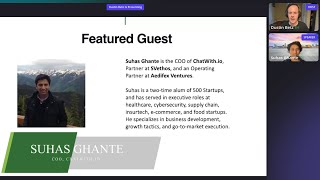
I am thrilled to introduce today's featured guest, Suhas Gante. He is the COO of Chatwith.io, a partner at SV Ethos and an operating partner at 8FX Ventures. He is a two-time alum of 500 Startups and has served in executive roles at healthcare, cybersecurity, supply chain, insurtech, e-commerce, and food startups. He specializes in in business development, growth tactics, and go-to-market execution. Suhas, thanks so much for joining us today.
I am happy to be here. It's gonna be a fun time today.
Awesome. Well, I'm gonna turn my slides off now and turn the stage over to you and hide myself. And then, yeah, well, please, I wanna tell the audience again, like, don't hold back on your questions. We have somebody in the background who is helping gather them. So if you have questions for while Suhas is presenting, just go ahead and drop them in, and then when we get to the AMA portion, we'll have them queued up to ask. But the floor is yours, Suhas. Please take it away.
Thank you, Dustin. You can see my slides?
Yep.
Perfect. Okay. Well, thanks for the introduction. I am super happy to be here. I've given this talk a number of times at FIA and various other venues. So I have a lot of fun with this talk, and hopefully you'll get a lot out of it over the next 20 to 30 minutes or so. So to get started, let me introduce who I am. As Dustin mentioned, I'm based in Madrid. I spent nearly a decade in San Francisco prior with about 6 or 7 startups over there. I've been privileged to be part of very early teams, either as an early employee or an advisor or early executive at companies like Innovacer, which is now a unicorn, Chef, which was a, is a YC company, I've gone through 500 twice and I've also been on the other side. I've started the company, went through 500 Startups, raised a bunch of money and also failed. And honestly, I learned a lot more from the failure than I did from the other ones that went pretty well. So my specialty is primarily growth and marketing and business development. So today I'm going to be sharing a couple of tactics and techniques to really help you guys go from 0 to 1. In the sense that figuring out how to grow and scale with limited resources and constraints is a skill, and there's certain ways to get beyond some of the challenges we all face. So the focus of today is gonna be on the business development, sales, marketing, growth angle of getting from zero to one. So we're gonna start with a couple of background material, some definitions, go through some tactics, and leave you with some, some toolboxes, you know, on communication software, etc. So let's dive right into it. I want to get some definitions out of the way immediately, and there's some common misconceptions around this which are really important to understand to make sure this talk is as effective as can be. So we're going to focus heavily today on business development, not necessarily sales. So when we hire business development executives on your teams, The currency of a good BD person is trust, right? How quickly can they walk into a room and build trust? The currency of a good salesperson is closed deals. How many deals have they closed over their years working? What is the deal value, etc., right? So today we're going to focus heavily on the BD side of the house and focus a lot on trust. It's also really important to understand what trust means when it comes to a company, right? So trust is essentially your credibility, your reliability, and your authenticity divided by the perception of self-interest. So when you walk into a meeting, you wanna have as little self-interest perception as possible and as much credibility, reliability, and authenticity as possible. This is extremely important, especially in early-stage startups, as it's difficult to build trust, especially if you're selling to a larger company. You're gonna be a young company, you're gonna be new, they're not gonna know you or trust you as much, so how do you, how do you get over the hump? So we're gonna focus a lot on, on that today as well. The other side of this house I wanna talk to you guys about a bit is sales and BD funnels, and we're gonna talk a lot about hacking the funnel and all of that, but first I wanna define what a traditional sales or BD funnel might look like. For you guys, right? So this is a very traditional funnel from about, you know, 10, 20 years ago that was quite popular. When you're selling a new product, there's typically 5 stages to sell, right? You need to get awareness of the product, get people interested in it, get them to consider it, evaluate it, and eventually buy it. And alongside each of these, there's various ways to do so, right? With white papers, cold emails, demos, pilot projects, and eventually a closing meeting. So the problem with this sort of a linear funnel is it's a bit outdated, and it just does not work for an early-stage startup, especially with a lot of constraints around time and money. In my opinion, I think the funnel should be more like this, a bit more circular, where people can enter in as they need to. So when you're selling your product nowadays, it's a consumerization of enterprise B2B. A lot of today is going to be on the B2B side. but this can also apply to consumer products as well. Essentially folks explore what they want, they research it, they evaluate it on their own, maybe they talk to you via chatbot, they might buy a trial version from you, use it, and then share it amongst their friends, right? And people can enter in any phase of this funnel as they see fit. They're not limited to the linear way of doing business from 20 years ago. So this is something really good to know because the collateral we need for each of these areas is quite distinct from from what we need in the linear way of doing business. And so today we're gonna talk a bit about how to hack the funnel, especially when it comes to very early-stage startups. You know, I'm talking pre-VC money or, you know, a bit of angel money where we have to be very scrappy and do a lot of things that might be uncomfortable, honestly. So I'm gonna take you through a few of those uncomfortable things or a few of those unorthodox things to really get you guys to help go from zero to one. Quickly. And the way I like to do this is honestly just to be as open and transparent and authentic as possible. So I'm sharing screenshots of my own challenges and endeavors and emails I've sent to get meetings, to get VC money, to, to do, uh, guerrilla marketing. And so this is the first one I'll share with you guys, and this is something that happened, uh, in 2016. It was a company I founded that eventually ended up failing Learned a lot from it though. And this, in this example I'm showing here, I wanted to meet this particular investor. And you know, this is very early days. We did not have any, any significant capital to spend on going to a conference. So I simply sent out a lot of emails that looked very similar to this that said, hey, I'm the co-founder of this company. We do big data cybersecurity for banking. And then I would say, hey, after seeing your presentation at this conference yesterday, which I could not afford to go to, I said, I thought I'd shoot a quick note as I believe our company is well aligned to the insights you shared. Can we have a meeting? I'll share a bit more about, you know, my company and give you a deck. And this investor who's a tier 1 investor who I really, really wanted to meet wrote back to me the exact same day saying, yeah, sure, send me your deck. I can quickly see if there's a match and, you know, connect back. So sent the deck, we ended up meeting, and some things happened from it. So this is just one, you know, sort of use case where you guys can, you know, if you don't have the money to go to events, you don't need to really travel a bunch right now, you can send emails like this to get meetings. I'll share a few more examples. This is just things that I've done. If you don't wanna do these sort of things, that's okay. I just wanna share what I've done personally and has led to some success. So another thing I did with the same company is, I would really mine my competitors' customers' lists almost every week. So essentially here there was a competitor of mine who put every single one of their customer logos on their website and they did very similar things to what I did in my company. Our product was quite similar. So I simply took a screenshot of this lead list and basically paid somebody offshore to get me the email addresses of the founders or executives at these companies. and I would email them saying, hey, I heard you're using, you know, X software. We do very similar things, but it costs half the price, or, you know, or some other value proposition. Should we have a conversation, right? And so this ended up leading to a number of conversations and customer leads as well. So again, just some guerrilla tactics for you guys to be aware of that you can use, and, and at least work for me, to get you over the hump of initial initial sales, which I know is very, very difficult. I'll share a couple more. We used to sell a lot to the government, municipalities, and one of the things you'll find if you ever sell into— if you do B2G or even to NGOs— is there's a lot of politics involved. You really got to figure out who reports to whom, who has to be pleased in some certain ways to really move the contract forward. And so what really helped us a lot was getting the organizational charts from governmental organizations. This is the city of Boston, and so when we were having meetings with them, I could kind of tell who the next gates would be that I have to pass to get my contract through. So this is all public information. I— if you are selling in the government, I advise you to sort of really understand who you're talking to and who they report to. It's much more important there than when you're selling to a large private organization. Okay, so I'm gonna switch gears a little bit and walk you through a potential scenario that I have faced many a time, and I'm sure many in the audience have also faced quite a bit. And if you haven't, I'm sure you will face it very soon. So the scenario is, is, is this. Let's say you met a potential angel investor about a week ago or so. You went through your deck, your pitch deck, They said, this is amazing, I'd like to invest some money, uh, you know, send me the documents. So you sent them everything you had, all the investment documents ready to go, and it's been about a week and they haven't gotten back to you after 3 touches. You've emailed them, you've, um, you've left a voicemail, uh, you sent them a text, you LinkedIn, you've done everything right, and they have not gotten back to you. So in this scenario, what would you do, right? Um, you know, ordinarily, I, I'm originally from DC where we're a bit more reserved and polite when it comes to these sort of things. We— I would simply think that this is not, um, they're not interested, they're just being polite and they want to respond, you know. But I've learned, especially in startup land, is just you just have to sort of go after them and see if they're going to say yes or they're going to say no. And so I use something called a no question to trigger a response. And again, these are real emails, this is a real scenario that, that happened. And it's same scenario. I simply said to the investor in an email, uh, hey, uh, you know, first name, should we postpone discussions for the time being? Okay. And he said, in about, you know, less than half an hour, he said, Suhas, sorry for the delay. Had prepared to reach out to you this afternoon. I will be wiring a total of X amount, which she ended up doing that day. So the point of this pointed no question is it gets straight to the point. It's basically, in less polite words, put up or shut up, right? And usually when somebody gets an email like this, they understand that they are a bit in the wrong for having ignored you for a week or two, and so they almost always apologize, and then they'll either say yes or they'll say no. And by the way, getting a no is much better than a maybe. Very similar scenario, except instead of asking for money from an investor, I was asking for somebody to sign a contract with me on a BD angle. And so I had emailed her saying, hey, it's been a while, you know, I haven't heard from you, didn't hear anything from her. So I sent her a no email saying, hey, first name, you know, should we cancel further discussions for the time being? And again, notice the timestamp within a day she responded. She's saying, hey Suhas, thanks for following up. Apologies for delays in responding. They almost always apologize. As I mentioned, I had a quick chat with my boss and you know, it's not the right time. We're not gonna buy your product, which is fine. I would rather have a hard no than a maybe, you know, I'm not gonna waste more time on this, on this lead. So I encourage you all to try these no questions and especially when you're stuck in certain sales scenarios that just are not moving. It's something that's worked a lot for me. The other thing I wanna mention about following up and being persistent is it's truly an art to following up. I mean, from, this is just from statistics here, 80% of prospects say no 4 times before they say yes. So don't be afraid of going after 'em many, many times. Nearly half of folks in sales give up after just 1 follow-up call. So don't be, like them, go after them, you know, 3, 4, or 5 times. And more than a third of folks read their emails on a mobile device. So a lot of these screenshots that I'm sharing with you, you'll notice that they're very, they're very short. I like to make it iPhone-friendly. If you can't read it in the first screen of an iPhone, it's too long. So I want to make sure it's very punchy and to the point. So I recommend that as well. Follow up and keep it short. So I'm going to fast forward a little bit to a meeting. I talked about how to get a meeting, how to move things along, but let's say you actually have the meeting and you, and you are now going to handle all kinds of objections, right? Especially in an early stage startup, um, you're going to hear this, these objections, and many, many more. I encourage everybody to make an objection handling, uh, playbook, and I'll sort of, I'll tell you how to do it right here. So these are the common ones that I've heard a lot. Uh, now's not a good time for me to buy. I don't have the budget for your Your product is very inexperienced, your company is too inexperienced, et cetera, right? So the trick is not to really write down every single objection you can think of, but it's to go with a framework that'll work for you regardless of the objection that they pose. And it's a bit of verbal judo, as I like to say. It's a framework called the feel, felt, found framework. And the best way to understand that is just to walk through an example. So there's 3 parts, and let's say you're selling your product to somebody and they say, look, I just don't have, I like your product, but I don't have enough money. I don't have the budget to buy your product. So you could simply respond with a feel statement saying, hey, I feel your pain in working with a limited budget. Or look, if I was also end of budget cycle, I would feel similar concerns, right? Basically sort of empathize with them, create harmony, tell them it's okay. And then the second part is the felt side. Here you would say something like, look, I know, you know, it's a lot of money. Several other clients have felt similarly. Or when I was on your side of the house, I felt that way in a similar situation when the amazing startup came by and I did not have the budget to buy it. Et cetera. So basically, tell them how you or other clients faced very similar obstacles. They're not the only ones with this objection. And then finally, you can hit them with the found statement, which is something like this: even with a large capital outlay, even though it costs a lot of money, other clients have found a 3x return on investment within one quarter. So basically, a differentiating factor that caused other customers to buy your solution regardless of the objection held. So feel, felt, found, right? You create empathy, you harmonize with them, you tell them they're not alone, you've heard it before, and even though they have the objection, other people have felt or found otherwise, that the benefit outweighs the initial objection that they raised. So I'm going to share these slides. There's a lot of interesting examples in here that you can just pull and pluck and customize for your own, needs. So I'm going to now switch gears a bit more and talk a little bit about growth. And the way I want to talk about that, um, this is shifting gears from, from BD and getting meetings and things of that nature, is to really talk about network effects, which I think in my experience has been probably the most profound way to really create scale quickly, especially at early stage startups. So to understand network effects, it's really good to understand some of the math and the frameworks behind it. There's 3 kinds of networks in the world. On the left is a Sarnoff's Law network. It's very similar to a radio station. You've got a node in the middle and you've got all these listeners all around you. So the value of network is simply n, the number of nodes that are connected to the radio network over here, right? It's linear, it's not that great. The next best one is Metcalfe's law, which is V N². This is more like the internet where you have the internet here and everybody can talk through the internet to each other. And so the value here is exponential, it's number of nodes squared. The best kind, which everybody should be going for as early as possible, is called a Reed's law network and it's 2^n. So basically this is like, Facebook groups or groups on LinkedIn. Basically, this thing in the middle is LinkedIn. Everybody's on LinkedIn, but then you can make groups within LinkedIn and sort of connect with each other. So that makes LinkedIn extremely sticky. It makes you stay on LinkedIn, makes you make more groups on there. And that's a way to really build stickiness and hypergrowth through network effects. So V equals 2 to the n, which is much, much better. So as you think about this, for your own startups, try to think more along this side. How do you make groups? How do you make your platform very sticky? Um, that'll help you a lot in terms of exponential growth later down the line. And then one final concept I want to share with you guys in terms of growth is, um, the notion of, of the one metric that matters, OMTM. You know, I've been through 500 Startups twice, and, and the thing that they meant, drill into you heavily, is you gotta Pick one metric at the start of the program early and make sure week over week it grows a certain percentage. And as long as it grows that certain percentage, at the end of 3 months, you're guaranteed to have a nice J-curve that all investors love. The trick is though, you gotta make sure you choose the right metric. If you choose the wrong metric, you're gonna have a business you don't want in 3 months, which happens more often than you think. Choosing the right metric is an art. There's usually 3 things you should know before you choose it. What type of company are you? Are you B2B? Are you e-commerce? How early are you? How late are you? And then you want to make sure whatever you choose is extremely easy. So if you hire somebody tomorrow, they can work on improving the metric within a day without too much, too much assistance. So some really good OMTMs from around the world: Airbnb, they use nights booked, okay, to figure out how well they're doing. eBay, if you're a marketplace, you almost always use GMV, gross merchandise volume, how much sales happen on the platform. Dropbox, interestingly enough, you know, before I studied this heavily, I thought Dropbox measured revenue, but they actually focus more on megabytes stored. If you think about it, the more you have on Dropbox in terms of megabytes, the less you are likely to leave Dropbox or Google Drive or Box or whatever else is out there. And so they want to make sure it's very sticky. So think through your OMTM, really think about it heavily and make sure you pick the right one and then just emphasize growing it. Week over week. I, I recommend about 7% week over week growth is, is recommended. So I'm almost out of time here, but I'm going to end with a few recommendations in terms of books and also some software I've used over the years that have helped me a bunch. So I send a lot of— I used to send a lot of emails, uh, mass email campaigns, cold emails, drip campaigns, you name it. So I've used a lot of tools out there. I highly recommend Reply.io if you want a nice, easy, fairly inexpensive solution to do outbound mass emailing. If you're doing prospecting, you don't have, you know, 1,000 leads just yet to send emails to, I highly recommend Growbots. It's probably one of the best tools I've used for this, and it's fairly affordable. Productivity, follow-up, then to-do lists are my favorites as well on that end. And then in terms of books, the no question I talked about earlier comes from this book, Never Split the Difference. It's probably the best negotiating book I've read, written by a former FBI hostage negotiator. Amazing book. I highly recommend it. In terms of leadership, managing growing teams, Extreme Ownership is one of my favorite books out there on that subject. And then if any of you are looking to raise money soon from VCs, Venture Deals by Brad Feld is the holy Bible of venture capital. So I recommend you guys read that as well. I will end there and leave my contact info and website up there for further questions. Thank you.
Awesome, Suhas. Thank you so much. That was a very awesome presentation. I feel like some of those tactics that you showed, especially the real-world examples, were super interesting. Everybody, if you have questions for Suhas, please do drop them in the chat and we'll get to them right away. Uh, first question here I guess is from Cindy. She's asking if you have thoughts, I guess, about HubSpot as a CRM. Uh, yeah, my opinion, Cindy, is it's one of the more approachable CRMs as opposed to some of the others that are— have so many features built on. I think HubSpot's pretty good for, um, for startups and small teams. But Suhas, what do you think? Uh, any experience using HubSpot?
Yeah, approachable is a very good word to use for HubSpot. So it's exactly that. It's, it's, uh, it's inexpensive. I think it's free. No, I think it's still free. When I used it up until a certain limit. It's great, a lot of integrations. As you grow in your business, I recommend, I've used Close.io is quite good or SugarCRM if you're all in Gmail, but HubSpot's a very good place to start for sure.
Perfect, thanks. Okay, so I have some other questions here I can get to, but yeah, please don't be shy if you have questions for Suhas, drop them in the chat. But I guess I, Over your years, you know, you've been a founder and now you've been on the investor side too, I guess, what are some of the biggest mistakes that you've seen founders make, I guess, especially early on? So the business, on the business development side, are there specific errors that you've seen a lot of other founders maybe in your cohort at 500 Startups or yeah, things make that you've seen go wrong often?
Yeah, a number of things. I mean, personally, I made some early mistakes where I put all my eggs in one basket with with a big corporate partner. And, you know, you being in a startup, you forget the politics of being in a big company. And so those really drag you down and can really lead to a death of a company if it just takes too long and not enough runway to see the deal all the way through, which is what happened to us. Some other big red flags or things to watch out for, I would really, really focus. I mean, so now being on the investor side, my opinion is if you're getting angel money or seed money, it's for experimentation, it's not for scaling. So I recommend doing 5 to 10 experiments within a year in terms of distribution channels, marketing. Try Facebook ads, try LinkedIn, try doing webinars, just try everything you can. And at the end of a year of the 10 experiments, maybe 1 or 2 will work extremely well for you. And then when you come to Series A, then you pour all the money from Series A into those 1 or 2 things that work for you and really scale up. What I hate seeing is people would raise angel money or something and, you know, go a year or two doing the same thing over and over again and not really experiment enough. So highly recommend experiment, experiment, experiment early on.
Yeah, that definitely seems to make a lot of sense and totally agree on the eggs in one basket, be it with like a large client. That org chart that you showed of Boston was pretty scary to me personally, but yeah, I can definitely see the advantage of even with a big corporate, like having something like that that helps you navigate who's the key decision maker, the next gatekeeper is, that looks, that's definitely daunting for the large, large organizations.
Yeah, it can really bog you down having been there.
Yeah. Yeah, so I really liked what you ended on there talking about the one metric that matters and I guess I understand it. Yeah, it depends on, like you said, the type, the stage and of the company especially, but, or do you have any favorite growth KPIs? I mean, a lot of founders are familiar with some of the alphabet soup of of acronyms, the CPC, LTV. I really liked the equation that you showed at the beginning too, but are there, I guess, yeah, specific KPIs or metrics that stand out to you that every founder should understand, maybe especially if they're like a first-time entrepreneur and some of these acronyms are like less familiar to them?
Yeah, I'll tell you some ones that you should not pay attention to. Maybe that might be even more helpful. Vanity metrics out there that people will put in pitch decks and then it just doesn't make any sense because 'cause nobody, you wanna make sure you're measuring something that actually has an impact on your one metric that matters in the sense that if you're targeting CPC, click-through rate, for example, but you're really focusing on selling large deals, it doesn't matter, right? If you're in B2B and you're early stage, I would really emphasize the KPI of number of demos and demo conversion rate. To pilot or to, you know, a long-term contract. So it's, it's— so the earlier you are, the higher in the funnel your, your OMTM or your KPI that you share to investors should be. The later you are, the, the further down it should be. Ideally, ideally you're tracking everything at once and can show the whole funnel and, and it getting better over, over the months. Um, but I would just focus on where you are at the stage and peg yourself in the funnel right there.
Yeah, that definitely makes sense. And I really like that, yeah, you started with the funnel because some of the kind of, that was where my thinking was having not seen your deck before you presented was going back to the traditional funnel. And I think the way that you talked about, yeah, it being more of a circular construct for, I think, what, how did you describe it? So consumerization of enterprise. Yeah, like it's just like a bit different. I guess the question I was going to ask is, uh, in like the broadest awareness consideration conversion kind of stepwise sequence, is there like a spot where you, uh, see founders getting, you know, stuck, especially like early stage ones? And, um, uh, or, but feel free to speak to that. I don't know, in the circle framework or like where.
Yeah, definitely, definitely. I mean, I personally got stuck a number of times when it comes to evaluation in the sense of selling a pilot deal. Selling pilots, uh, especially if you're selling large contract sizes, a large ACV, it's very tricky. And you know, I made the mistake of overthinking it. I made the mistake of putting too many things in the pilot and milestones and all these things to just overcomplicate it. I recommend now as advice is just to make the pilot as simple as possible. You know, one-page LOI. This is what you're gonna do, this is what you're gonna get. You'll get, you know, you'll pay us this amount, amount, and that's it, you know. Don't make it too complicated. Just get the logo and get out of there, you know, and then go sell to the next person. Especially early stage, you're honestly just getting validation from the market that somebody will pay you something for your product, right? So just go logo hunting in the early days and worry about sort of making it more standardized later on. I think they're making it too, too corporate too early. And make sure they just focus on getting logos.
Yeah, that seems like, yeah, really, really great advice. But maybe not put them all on your website so that somebody, you can go and scrape your competitors like you did. I love that example too, though. It's really interesting. And I think that's a really good tactic for a lot of founders to employ because, you know, surely, you know, if you say you don't have any competitors, it's not, it's not true. But, and a lot, it seems like so many companies that sell B2B do this that you said put the logos. So yeah, very, very interesting thing I think to do. Putting, I guess, your investor hat on, you know, you've likely probably now heard probably thousands of, uh, founder pitches over the years, or, you know, your peers of 500 startups. Uh, are there attributes of a winning pitch, I guess, uh, that hook your attention as a founder, uh, and/or investor? And specifically, you know, around business development or growth, things that stick out to you when you hear a pitch that—
Absolutely. Yeah, that's a very insightful question. So, I mean, I, I really— I heard something many years ago, and I've been using it in every pitch, like, you know, I personally made, and I see someday else doing it, I get very excited. It's a concept of attraction sandwich pitch. So basically you usually have 10 slides in a pitch deck, in an angel pitch deck. And the concept of attraction sandwich is, you know, slide 2 or slide 3 has a really interesting piece of traction, like, hey, I've got, I don't know, 10 LOIs signed, okay? And then you have the usual fluff, you know, competitive analysis, the TAM, Product overview, the usual stuff everybody sees. And then at the very end, slide 9, slide 10 has another piece of traction, right? Like, hey, I've got my co-founder, CTO has, I don't know, 2 PhDs from MIT or something, some sort of traction-esque thing like that, right? So traction sandwich, usual fluff, really interesting things, uh, you know, first thing, last thing. So when you do that, it really gets somebody's attention because people just see so many of these pitches all the time. So just stand out and make it Make it worthwhile, make it worth something that is interesting in terms of having some traction. Everybody has traction, you just gotta market it the right way.
Yeah, I think that's really good advice and I've never heard that one before, the traction sandwich, but it definitely makes sense to have something at the top to grab the attention and then kind of a closer as well. So yeah, I feel like that's also something that most founders can put into practice in their short slide decks. Question here from Julie is, "what do you think about the importance of partnership development?" And she asks, "at which stage would you start to give attention to building partnerships for business expansion?" How does partnerships fit in the framework of your, how you think about business development?
Yeah, yeah, yeah. I mean, it's important, but I would say it's less important the earlier you are. The earlier you are, it's all founder-led sales, founder-led partnerships. I mean, the earliest partnerships I had were just with, honestly, with just friends. Companies or prior companies that I was at, or fellow founders who sort of put me into touch with some people. Um, later on, you know, post, post-seed round, you might have a VP of Business Development, for example, who really goes out there and does partner development. It's, it's, it's tough early days, but, um, it's something that you should probably think about and, um, and and get some frameworks around. One thing I did that actually was quite interesting was certifications around partnership development. So if you sell plugins or you sell something that depends on another infrastructure, getting them certified, getting them a little badge from your company does wonders for building credibility and that trust equation I told you earlier on. If you're doing partnership development, think about that a lot, that helps a lot.
Yeah, I think that's good advice, definitely. With the hour, you know, that might get you sort of featured sort of on this partner's website in a more prominent place by being certified. Yeah, yeah, yeah. Um, great, great question there. Uh, okay, I think we're running over and I want to be conscious of your time. So, uh, final, uh, question that I have for, for you here is, um, just about technology. I mean, your company chatwith.io, you know, you're— and then I look at the meeting booking app Meetsee, you're kind of providing the tech to, uh, help businesses facilitate their, um, their business development or the customer journeys that they take their customers on. And I know your users also use WhatsApp and one-to-one customer messaging. So what do you— I guess the question is, what do you think is changing most in the next couple of years, say like a decade, specifically in technology and how companies, especially tech-savvy ones, startups, are connecting, doing this kind of business development or sales prospecting, I guess. Any insights there on— I guess it's just back to tools, but Yeah, yeah, definitely.
I mean, I, I, uh, I'm very involved with that day to day. I moved from SF to now Europe, and I'm seeing, um, just a whole different world out here. Um, so I think, I think the next 10 years, it's really— this is an overused word, but it's true— it's the democratization of entrepreneurship, uh, which is what we're, you know, me, my company right now is really focused on, is helping people sell whatever they want to sell through WhatsApp or through their iPhone, through the phone. Not needing website, and that opens up a whole other arena of, um, the underbanked, right? Uh, and really democratizes entrepreneurship for everybody. So I think you're going to see more and more freelancer, more and more entrepreneur-type folks in the next 10 years, more so than corporates. Uh, and that's what— that's, I think, where we'll be.
All right, well, yeah, super interesting. And, uh, yeah, for those who haven't checked it out yet, go look over at, uh, ChatWithData to see the product that, uh, Suhas is the COO for, because It's definitely interesting and it points to what you just said there for the way that micro entrepreneurs are moving. Thank you so much for your time, Suhas. Feel free to hang out if you like, or if you got to go, no problem at all. But yeah, super insightful presentation and I will follow up with you. If you have that slide deck, I would love to share with everybody who's here because there were other tools and specific things on the slides that I think people would want to see. Sure. Yeah. Awesome. Okay. Well, so here is just the final reminder, I guess, about using Airmeet before we move to open networking. Again, it works best if you're joining from a desktop or laptop, if you're in Chrome or Firefox. Please be respectful of everybody's time in the little group networking tables. Just kind of try to be brief with your own introductions and then take turns speaking and asking questions to one another. And the other final pro tip is that if you meet somebody and you want to connect with them further, don't forget to exchange contact information or, you know, send them a direct message or exchange social links or something like that so that you don't lose contact with the connection that you just made. And yeah, final slide is just to have fun. Yeah, we're excited to be hosting these VIP alumni networking summits, and we hope that you will enjoy the time here to connect with others. And yeah, I will see you all out in the Airmeet lounge shortly. Thank you.










