HealthTech Founder Institute Demo Day - March 2020
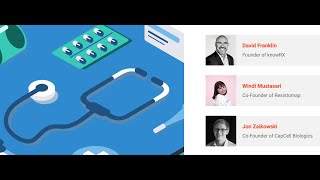
The video records an online Founder Institute HealthTech Demo Day moderated by Jonathan Grecian, featuring three startup pitches and live Q&A. The first presenter, Wendy (Co‑founder/CEO of Resistomap, Helsinki), explains a service that monitors antibiotic‑resistance genes in hospital wastewater and other hotspots using SmartChip qPCR, delivering results within a week. She outlines the market need (rising antibiotic use during COVID‑19), business metrics (19 customers in 13 countries, €250k revenue target, €500‑€35 per sample pricing), growth plans (Asia lab, global mapping), and asks for partners and customers. The second presenter, John Zajkowski (Co‑founder of Capsule Biologics, New York), describes a NASA‑licensed carbon‑nanotube mesh capsule that encapsulates engineered cells to continuously secrete biologic drugs, eliminating infusions. He targets Fabry disease as a first indication, outlines the regulatory pathway (combination product), development timeline (Phase 1/2 in ~4.8 years, Phase 3 2‑3 years), cost advantages, key technical challenges (long‑term implant stability, immune response), IP (NASA patent plus proprietary manufacturing IP), and a $500k seed raise. The third presenter, David Franklin (Co‑founder of KnowRx, Austin), showcases a mobile app for medication adherence that provides scheduled reminders, accountability partners, analytics, and integrates with pharmacy and provider data. He emphasizes a patient‑first design, addresses privacy/GDPR, outlines market size ($350 bn annual cost of non‑adherence), business model (SaaS for providers, free consumer app), traction (pilot pending, awards), and a $500k raise for pilots. Throughout, the moderator encourages audience questions via chat, and each founder answers queries about cost, competition, regulatory status, privacy, and future milestones. The session ends with a call for collaborations, funding, and promotion of the Founder Institute’s global chapters.
Chapters
Hey everybody, uh, welcome to this Founder Institute Health Tech Online Demo Day. My name is Jonathan Grecian. I'm a co-founder of the Founder Institute. I hope you're all being safe and secluded, secluded and healthy in your homes. I, it's the first time I put on a collared shirt in about 3 weeks, which feels kind of nice. So I hope you're all being safe as well. Um, and by the looks of it, we have now over over 600 people that have registered for this event and just taking a quick look at where the registrations were coming from, we have over 80 countries now are in attendance, which is awesome. So I guess a lot of people out there are stuck in their homes and also a lot of people out there are interested in learning about some really cool health tech companies, which is great to see. So we have over 4,000 alumni at the Founder Institute and given the state of the world, we obviously thought that doing a demo day to showcase some of the ones that are doing cool stuff in health tech was, was pretty apt. And let me explain how things are gonna work today. So we have 3 companies. They're all, we got one from Helsinki, one from New York, and one from Austin, Texas here in the United States. And they're gonna be giving you a live presentation, should take about 3 to 4 minutes or so. Then after that, I'm going to ask them a couple of questions, but really what we like the meat of this event to be is for them to answer your questions. From the audience. So please, at any time, don't be shy. We have members of the Founder Institute team that are in the chat. They're ready to go. They're ready to take any of the questions that you have, feed them to me so that I can ask them to the presenters. So please, at any time, don't be shy right there in the chat, throw in any questions that you have, and we'll queue them up for the presenters. Okay, so with that being said, I think we're ready to get started. First up, I'd like to invite out Wendy onto the screen.
Wendy, you there?
Hey, Wendy.
Hey, thank you, Brian.
Yeah, so Wendy, and I was apologizing to Wendy before, she's based in Helsinki and we had forgotten that most of Europe, or is it all of Europe, I'm not even sure, change their times on Sunday. So it's starting to get a little late there in Helsinki, although it's still bright out 'cause that's what Helsinki's like at night. Wendy's actually a PhD turned entrepreneur, so excited to have Wendy on. She's the co-founder and CEO of Resistomap. And Wendy, if you want to fire up your presentation, we can get started. All right, I'm gonna hide my face and we can get started.
Resistomap. We fight with the superbug, bacteria that cannot be killed by antibiotics. Antibiotic resistance in hospitals is a real problem, and it is happening globally. Especially now, during the COVID-19 outbreak, the use of antibiotics is significantly increasing to treat the secondary bacterial infections in patients. High use of antibiotics can increase the level of resistance in bacteria. Can you imagine if all antibiotics in hospitals are not working anymore? Are we ready for the next outbreak? What can be done to prevent the outbreak of antibiotic-resistant bacteria? Together with the infectious disease control unit at Helsinki Hospital, we monitor the level of resistance in hospital wastewater. We monitor the resistance levels to all antibiotics that are used in hospital. So we receive the wastewater samples, we analyze the samples, and we deliver the result within 7 business days. This is an example of study case in Helsinki. We compare a level of resistance in two different hospitals. B is a big one, S is a small one. Big hospital doesn't necessarily have higher level of resistance, so the level of resistance is more likely to be associated with the number of bacterial infection cases. We monitor the level of resistance over the time. This information can provide an early warning system before any potential of antibiotic-resistant outbreak is happening in the hospital. That's what we hope. And why use our service? Resistomap offers an easy access to state-of-the-art technology, no upfront investment, no expertise required, quick turnaround time with comprehensive result. Resistomap business idea started in 2017 and a year later is incorporated. I graduated from Founder Institute Finland last spring and since then we have served 19 customers from 13 different countries, mostly in Europe, and we target €250,000 revenue by the end of the year. In average, we acquire 4 new customers quarterly. More than half of the customers in 2019 are using our service again, and each customer spends usually between €2,000 to €25,000, depends on the project. We target to enter the Asian market next year by opening a new lab in Singapore, and we hope to go global by 2020. In Europe, public investment on antibiotic-resistant research is increasing 55% yearly. Resistomap is opening a new market. So to our knowledge, we are still the first and the only company that offers a commercial service to monitor antibiotic resistance directly from environmental samples. William and I are the founders of Resistomap. I did my PhD and postdoc research at the Department of Microbiology in University of Helsinki, And so I spent more than 10 years working on antibiotic resistance in the environment. I have the know-how knowledge for antibiotic resistance monitoring, and I want to bring this technology that's available in research to be available, accessible for everyone. William works on automation of the analysis so we can deliver fast results. Currently, we have 9 members, including 2 in the production team, 2 project managers, branding, and 2 interns. We have advisory board in business, science, and hospital. The technology that we are using now actually first developed at Professor Tiches' lab at Michigan State University, so it is nice to have him on board. Our project is not only monitoring antibiotic resistance in the hospital, but also other hotspots such as animal farms. More than 60% of antibiotic produced are actually used for animals. So the first step to preventing the spread of antibiotic resistance is to identify, characterize, and monitoring the hotspot. Prevention is better than cure. Thank you.
All right, that was great. So as I said before, anybody who has questions in the chat— I obviously have some questions for Windy, but really we want to get questions from you in the chat. I see Neil just put in a question. Thank you, Neil. Everyone else, be like Neil. Throw your questions into the chat and we will get them get them up for Wendy. But I guess, Wendy, my first question for you, and this may be a stupid question, to be honest, just because you're a PhD and you've been researching this stuff for many, many years before deciding to build the business. But, you know, why are you the right person to build the startup? And, you know, who are some of the other people that you've brought onto the team that maybe fill in some of the expertise or skills that maybe you don't have, you know, to build it out?
Yes, I think maybe the first, because I have the big passion to solve this problem. So, and it's important to have this passion to, you know, to solve the antibiotic resistance, because maybe because I spent for 10 years, so I know the problem is quite big and I really want to do something to solve this problem. And I realized that by bringing research, you know, like in research, there are already kind of some solution. But usually not in the practical, in their real life. So that's why I think why I'm the right person, because I'm willing to move this academia to the entrepreneur's life. I don't know how is it for the others, but it's not easy change the work life from academia to entrepreneurs. And but it is very important. And that's why I think What we are doing now is, I hope, that can bring the research solution in, in the practice faster.
Yeah.
And yeah, and about the expertise, maybe because in the marketing and business, as, as you know, I'm very person working in the lab.
Yeah.
So the need is in the business side to make sure that what we have can be deliverable.
Okay, interesting. All right, so back to Neil, and people are asking questions in the chat, so please, thank you, just want to keep encouraging that. But Neil's first question was, just wondering who actually conducts the test. Does it require a lab partnership or custom equipment?
So the technology is available. It's using the SmartChip technology, SmartChip qPCR, if you're familiar. So it's like just to detect and quantify the genes of the bacteria. And this is already in research since 2014. So if you search in the publication, there are many research using this technology. So what I do is like only make this technology available for everyone or accessible in this case.
Great. And is there a hard cost? This was just the second part of Neil's question. Is there a hard cost to each test?
Yes, there is a— Of course, the cost, like, you mean like the production cost?
Just the cost for each test to conduct was what he was asking.
How much?
Yeah.
It depends on the assay you want to monitor. So if you monitor many genes that I show in the example, so you can like pre-screening quite a wide range of different antibiotic resistance, it costs around €500 per sample. And then if you later on only choose a few genes or like few bacteria that you are interested, and it can reduce to the price of the sample up to only €35 per sample. So this is why this technology is quite flexible and it can fit to your need, research need.
Cool.
So Reed asked, you know, can you explain in greater depth what the, what the hospital actually does with the information that you're providing?
Spanish. So we are working now with the infectious disease control unit. So this is not the hospital, the doctors who are using this information, but more in the management level. Especially this information can be used to make the policy on how to use antibiotics in the hospital. Because the idea, of course, we want to prevent the potential outbreak of resistant bacteria to certain antibiotics. That's very important.
Mm-hmm.
Mm-hmm. Okay. Davi asks, are there— now, I know you mentioned that as far as you know, there aren't really any direct competitors of people who are doing this in the environmental realm. Are there other indirect competitors, substitutes, or something like that in the field that are doing similar stuff in antibiotic resistance?
Yes, of course. It's mostly the researcher itself who are doing this research. So they usually can use metagenomics methodology or sequencing or by cultivation. So of course they are like, in this case, like people who are working in universities or in the research institute, they can use method whatever they want. In this case, it's indirect competitor. But then when I introduce the, the solution that I have or the service that Resystomap have, most of the people or most of those researchers are tuned to become our customers. Because, yes, because we can deliver fast results. I think that's the make, make they choose us in this case.
Right? Yeah. And that should help. And that sort of can lead into Frank's question on the sales cycle. Right. So if you're already having some of these researchers using your tools just to, just to so that they can make progress on their research faster, that should help you on the sales cycle front. But, you know, just in general right now, do you guys have an idea of what that sales cycle looks like?
Yeah, because it's a new market, so most people actually not aware that this needs to be done. So the sales, it depends also of how we try to first educate the customers that how important it is, and then after that, actually quite pretty quick in the sales, because every time I meet the potential customer and explain the situation and how we provide the service, it's very easy to turn into customer. So sales-wise, it's supposed to be getting bigger or increasing, because the situation of antibiotic resistance unfortunately is not slowing down.
Sure.
It is increasing, especially as I mentioned, because of this COVID-19 outbreak, the use of antibiotics is even higher. So I'm a bit worried actually after this COVID outbreak, what is the level of resistance.
—higher use leading to more adaptability for the pathogens. Yeah. So Gerald asked a question here, and there's a lot of like very technical questions in here, Wendy. So what I would recommend is I'm going to try to not get into the most technical questions, but the ones I would definitely recommend you, when we're done with the on-air questions, you go in the chat and get into some of these technical— I mean, there's words I've never even heard of in here. So I'm going to try to keep it to some of the more high-level ones. But to everybody in the chat, keep them coming. Wendy will come in there and answer some of the more technical questions afterwards. But Gerald asked, how does, and I guess this is just kind of the basic science behind it, but how does measuring antibiotic drug concentration in sewage, how does that tell you about the antibiotic resistance of bacteria exactly?
[Speaker] Okay, so what exactly we do is we collect the genetic material in the wastewater. So I mean every genetic material including the bacteria and virus in, in, in, of course in our cells also, but all this genetic material is the DNA. And then in our technology we have this called a primer set. So it means that kind of hook, you know, if you go fishing, if you have this hook, that specific hook to catch the fish. So it's the same, these primers is the same like hook to catch the certain resistant genes that carry by bacteria. So then in this case, we quantify the number of the genes in that samples. And that's why we can have the result that what type of the resistant bacteria there and how many, like the quantity of the bacteria there. But in this case, so we, yeah, it means that we are using the genetic materials. Got it.
And then the next steps, Angelica was asking, once you see that there is that resistance, then what are the next steps that are able to be taken quickly?
Yes, what we do now at the moment is a prescreening in different kind of hotspot. So one case, that example, like in one in Sweden, so they monitor the different source of river into reservoir for drinking water. So there are like 6 different rivers enter this reservoir. And then when we monitor the 6 rivers, there's one river actually quite high level of resistance. And we were like, of course, wondering what happened. And this water management tried to check in the upstream of the river. It turns there is an animal farm there, like small animal farm owned by a family. Then we realize, okay, so So then they need to inform that the waste shouldn't throw directly to the river. So this is like one of example case that this data can be used.
Right. Okay. So yeah, there's a ton of questions in here, Wendy. So I would definitely go into the chat, but I'm going to finish with two quick questions here. So the first one, and obviously this is going to come up because we are all suffering in one way or another from this global pandemic. You know, are there— now you had mentioned as a result of COVID-19, you think that the our tracking of the resistance of bacteria is gonna— that's just gonna become much more important just because of the— right? Now, are there other applications related, you know, or impacts of COVID-19 where you think your business can and your research can play a really active role?
Yes, actually, we try our best now to improve our laboratory for infectious samples. So we also can add the surface to monitor this SARS-CoV-19 genes because it's important, like, okay, let's be past this outbreak, and then, but how, how about if this virus ends up in the environment and still lingering there? So there is the potential we need to also monitor routinely. So then if there is some potential, this infectious, and I mean not only this virus but any infectious in, in our environment, that we can pinpoint or like kind of an early warning that there's maybe potential outbreak occurring. So that's what we try, but let's see. But this is now, it's kind of very important for us now to do preparation or like prevention. Of course.
Before it's too late. Unfortunately, this is not going to be the last pandemic. So, and then the last question here is from Federico and a very apt question, Federico. It's, you know, how can we help you, right? How can the audience help you? Are you looking for funding? Are you looking for partners? Are you looking for new clients? You know, what is sort of your ask here?
I would love to have a network to get more clients and customers around the globe because our vision is to map antibiotic resistance across the globe. So it's nice to have this Funder Institute network around the world, like 80 countries, So please spread the word. I mean, we should do this together because I cannot do, of course, by myself, like alone in— not alone, with my team, small team in Finland. This needs to be done together around the globe. And then if you have laboratory in your country that have the— at least to do the molecular genetics, ring me the bell and we might can collaborate together to provide this system of service also in your country. So I already done now in Singapore. And then, you know, like I hope to get more access to other people in other countries and so that we can, you know, do this together. Awesome.
All right. Well, thank you, Wendy. Anyone who wants to contact Wendy, her information is here. And anybody else who's watching, you'll also receive the information and the video of all the pitches via email. So thanks, Wendy. Thank you.
Bye-bye.
Yep. All right. Why don't you close out your presentation and we'll bring on the next presenter. So from, I guess, oh, we're going, we're going from east to west here. That's not how it was planned, but now we're dropping into New York where you could see John's been stocking up on some food, as I'm sure we all have been during these times. So welcome, John. John is co-founder of Capsule Biologics, and they're doing some interesting things in the biologics and cell encapsulation space. So John, if you want to fire up your presentation. Same drill goes for everybody in the crowd. Please don't be shy, ask your questions in the chat, and, uh, and we'll, we'll get to them. All right, I'm gonna hide my video, and John, take it away.
All right, hi everyone, my name is John Zajkowski. I am the co-founder of Capsule Biologics. We're a NASA spin-out, and we're developing implants for advanced drug delivery. So biologics are a new class of drug that's really taken the pharmaceutical industry by storm. 7 of the top 10 selling drugs in the world last year were biologics, but they all share a common problem, and that's how they have to be delivered into patients' bodies. Biologics have to be injected or infused right into a patient's bloodstream. It's a time-consuming process and it produces suboptimal medical outcomes. So Capsule Solution is an implant that's essentially a miniature biologics factory. It goes right underneath the skin and is able to steadily secrete target biologics right into the bloodstream. The technological innovation that NASA developed that makes this possible is a mesh capsule that's made of a special material called carbon nanotubes, and I'd be happy in the Q&A to get into all the technical details. For now, I'll just suffice it to say the mesh capsule contains living cells that are engineered to produce the target biologic, and so the implant is constantly producing and secreting the biologic right into the patient's bloodstream and eliminating the need for infusions. Over the summer, we developed a prototype cell line to test the cell engineering techniques we had in mind to make sure they worked, and they did. We signed a license agreement with NASA in November that gives us select exclusive rights to the capsule, and essentially, as soon as New York City comes out of lockdown, we will be renting lab space and developing our first prototype. And that first prototype will be to treat a rare enzyme disorder called Fabry disease, We chose Fabry because it's a rare disorder, it gets accelerated FDA approval, and there's also just really phenomenal product market fit. Now, once we validate with Fabry, we can really expand the technology platform out because this can treat a range of diseases including diabetes, cancer, other enzyme disorders. The list goes on and on. In terms of the development timeline, I draw your attention to the gold star at 2024. That's when the value inflection point for companies like ours typically occurs. And investors could expect to see their return. Also in 2024, the global biologics market will be worth about $300 billion, with the US accounting for $180 billion and Fabry, our first target, $840 million. Now, what sets our implant apart from others is the combination of safety and convenience that it offers to patients. NASA developed this implant for astronauts on long-duration spaceflight for drug delivery, so they needed a product where you could just set it and forget it, which is what this offers to patients. The company was co-founded by Ben Young and myself. Ben has a background in biotechnology and molecular biology. He's a researcher at Weill Cornell where we did the cell engineering. My background's in healthcare and business development, and we have a pretty phenomenal team of experts and advisors, including as well the inventor of the implant himself at NASA, Dr. David Loftus. We're raising $500,000 for prototyping and a set of studies called your pre-GLP safety and toxicity studies. Once again, we're CapCell Biologics and looking forward to answering some questions.
All right, that was awesome, John. Thank you. So please, yeah, everybody throw your questions in the chat. I'll start with just a few simple questions for John. So John, I thought it was interesting you had mentioned in that slide there's a value inflection point for these types of businesses. Can you explain a little bit more kind of what, you know, exactly how that works and how you work out that timeframe?
Sure, so with biotech industry, because it would take just too long essentially for companies to be able to go through the entire FDA approval process and for them to then have their maximum point of value, generally it's after the Phase 2 trial is complete when there's enough data to be able to see, okay, is this product really going to work? What's going to happen? And at that point then, that's when companies— when you've got solid Phase 2 data, that's when you really have sort of a clear path to be able to get approval from the FDA and just have to complete that final Phase 3 trial. And in the case of rare diseases, you actually combine the Phase 1 and 2 trial together, and so you can get what's called a Phase 1/2 trial. And so as soon as that would be complete, we'd have fairly solid evidence that the product works and be able to see some kind of liquidity event resulting from that.
Makes a lot of sense. I mean, and is there, is there sort of for that Phase 3, I mean, I don't know, this may be a stupid question, but is there ever like kind of a a ballpark of how long that may take, or is it just going to vary wildly?
Yeah, so it does vary. In the case of rare diseases, or what's called ultra-orphan drugs, which is what we're dealing with, the typical timeline for the entire process is 4.8 years from beginning, from phase 0 to phase 3 completion. Typically, the phase 3 is the longest trial and takes about 2 to 3 years, just depending on what happens.
Okay, and I guess, um, uh, you know, how did you, how did you connect with, with NASA and get, you know, get— I mean, when, when did it come to you like, oh, NASA, they're doing stuff with astronauts?
Yeah, I know, it's a great question. We get that all the time. So my background, I'm in the bioethics program actually at Columbia University, and my background there, my area of expertise is space health and ethics around sending people on spaceflight. And so I'm just generally familiar with NASA technology. And one day I came across the NASA catalog of the technologies available for licensing. I had met my co-founder Ben a few months earlier and we hit it off. So I got back in touch with him, told him about this technology, this catalog of technologies available. And so he and I went through the catalog, we looked at everything in there in the health and biotech space, and we thought, what's just the most interesting revolutionary technology that really has the ability to do something interesting and important? And the carbon nanotube capsule stood out as real game changer in the industry.
That makes sense. And just for anyone else on the line as well, Founder Institute has since— now you made this deal, I believe, before we had this partnership, but yeah, we partnered with NASA as well because they got a lot of really cool technology that they just don't have the wherewithal, time, and/or the priorities to develop commercially. So yeah, for anybody doing stuff in the biotech or deep tech space, right? Again, you wouldn't think that A biotech, something like this, would be a NASA-licensed thing, but there's a lot of opportunities like that. Yeah. So, all right, let's get into some questions here. So, let's see. Nish asks, Sarah, what's the cost differential of using a capsule as opposed to a traditional infusion? Yeah, that's a great question.
So infusions for patients with rare enzyme disorders, with what they call lysosomal storage disorders, they range about $5,000 to $6,000 a year just in terms of the equipment. That's not to mention as well, you got costs for overhead just to host the facilities. Plus you have to pay the medical professionals in order to perform the procedures. And so that can rack up into the tens of thousands of dollars that somebody has to pay for somewhere along the line. So that's sort of the standard cost for it. In terms of making the implants, it'd only be a couple thousand dollars per implant in terms of the actual COGS of it. And then in terms of implanting it, that's also a simple outpatient procedure that's fairly similar to how birth control bars are implanted and to some— equipment now. And that's again an afternoon of a provider's time. And so pretty, pretty, uh, pretty good cost differentials in terms of equipment, professionals, and just the cost of the material themselves.
Got it. And I think I read somewhere as well that it's one of the fastest growing, um, you know, kind of delivery mechanisms on the market, right, as a result?
Uh, yes. So yeah, cell encapsulation is definitely— it's a technology that's really starting to take hold now, and there's really some interesting advances being made in it, you know, Capsel being one of them.
Yep. Is there, all right, let's see here. Other questions. Hold on. All right, yeah. So Barry's asking like, what do you, you know, you put that chart there, what do you think is the toughest milestone or, you know, maybe to rephrase Barry's question, the, you know, the most at-risk milestone that would be sort of in that roadmap that you presented before?
Yeah, so I think the challenge is being able to make an implant that can last a long time. Because you can put implants in that can last for weeks or maybe a couple months at a time. That's nothing that's really too revolutionary, but being able to have cells that survive and an implant that doesn't get overwhelmed either by fibrotic response, which is essentially scar tissue growing around it, or your body's immune system responding, those are really the challenges. And carbon nanotubes have a real strong advantage in that regard of they are highly compatible with your body's immune system, and they also offer the ability to actually control what proteins stick to it. And so that can control whether there's a fibrotic response, how your body's immune system reacts to it, and can offer that potential for years at a time. The reason NASA wants carbon nanotubes for their implant is because they want to use this on astronauts on a mission to Mars and back, which is 3 years. So their goal is to have an implant that's safe and effective for 3 years or longer at a time.
Got it. Brad Scott has a question here, which I believe is probably regulatory related, but are biologics treated as a medicine or a medical device or or some sort of combination in their eyes?
Yeah, so biologics themselves, the actual drug, those are considered a drug. Now, there is a division for biologics specifically at the FDA. Now, what we're doing, it's something called a combination product, which is it's a medical device and a biologic together. So the actual specific pathway, it would be primarily it's a biologic with the device consult is what would, is the easiest way of putting it.
Okay, and Zid asked, you know, if a patient takes antibiotics, is that going to impact the implant itself?
No, that shouldn't have an impact on the implant itself. The way the implant is able to work is it keeps the cells isolated from the body, from the remainder of the body, and only allows for sort of the basic minimal interaction needed to be able to keep them alive and healthy while still being able to effectively produce and secrete the drug.
Okay, so I'm just going to take a couple last questions here, maybe one or two, and then we'll move on. But once again, John, I'd recommend you get into the chat as well. Lots of technical questions coming in here. So let's see, a couple questions, you know, just on for the NASA technology that you've licensed, right? I mean, some of these questions I'm not going to ask because they're probably going to violate some NDAs, but, you know, in general, the general gist of a lot of these questions is you know, it's not your IP, it's NASA's, you know, how would you sort of alleviate any concern there in the eyes of, you know, someone who may be looking at this project?
Yeah, so it's— yeah, it is completely NASA's IP, the initial patent. We have licensed it, so we do hold exclusive rights for a range of diseases for this patent. It's exclusive? Okay. Yeah, we do have exclusive rights for the diseases we're working in as well as future targets. So we do have that aspect of it locked down, plus also as we develop the implant, there's going to be a derivative and additional IP that's developed from that, from the process of manufacturing, assembling. The whole process really is prime for development of original cap cell IP. Got it. Okay.
And as far as, I guess I'll finish off here with just the general, you know, COVID-19 question. I mean, do you think with the outbreak going on, are there ways that this, this types of, these technologies can help either for future outbreaks, or, um, or, you know, how is it going to impact what you're doing at the moment?
No, that's a great question. We've already heard that patient— there's a number of patients, um, with lysosomal storage disorders are beginning to skip their regular infusions. Remember, they have to go every 2 weeks, um, and they're starting to skip them because they're afraid of going to the hospital because some of them are immunocompromised. There is also just the drain on resources of if you're taking the time and the equipment for medical professionals to go and provide infusion, that takes away from their ability to go and treat other patients. So this reduces burden on the healthcare system by just having less medical procedures, as well as being able to keep patients away from having to go into hospitals or infusion centers or other medical centers like that.
Got it. All right. Well, thank you, John. Everybody, if you'd like to follow up with John, his information is here. And once again, we'll be sending you all— everybody who's registered will be sent a video of all these presentations and all their contact information, and John will be in the chat to answer some other questions as well. Thank you, John. Thank you so much. All right, and now we're gonna fire up the last. So John, just, just click close. Yep, there you go. All right. Hey Dave, how are you?
Very good. Thank you for having us today.
Yeah. All right, so Dave's piping in here from, from Austin, Texas, veteran of the US Navy and doing some some really, really cool stuff that should help decrease patient readmissions to hospitals. And I think pretty apt in a time like this as well, just with most of the world's healthcare facilities at way over capacity. So, all right, David from KnowRx, why don't you throw on your presentation and we'll get started.
All right, thank you for having us today. And it's great to be a part of Founders Institute. We finished Founders Institution last fall of 2019. What we're about to go over today will take you on a story and introduce how medicine mismanagement is a serious problem, not just within the United States, but globally, and how our solution is there to help you, the patient, become a superhero throughout this challenge. So what is KnowRx? KnowRx is simply a mobile application that allows patients and doctors to simply efficiently manage medication management treatments for better outcomes. The problem we face in the healthcare ecosystem today is that patients are failing to take their medications as prescribed. This is one of the most serious and longstanding challenges in healthcare. On average, the physician appointment is 13 minutes, and within that 13 minutes, 80% of those visits result in a prescription order. Of those visits, 50% of those patients do not take their medication as prescribed. And 24% of those prescriptions are not even picked up. The result is 125 million readmissions, 110,000 deaths, and the cost of healthcare goes up. As you see on the screen, this is my father who was impacted by this statistic in 2018. And we lost him due to medication mismanagement. It's a human problem as well. Patients continue to stay sick, and we can help address the issue. Doctors don't intervene because they're not aware of what's happening. The current ratio between a physician and patients are 1 in 2,300. Physicians are overworked, they're stressed out, and they have a heavy workload. As consumers of the healthcare system, as patients, we leave the office confused, misinformed, and don't remember our schedules in a very busy life that we have. So it's hard for us to take our medication on time and to completion. But we have a solution that we've been working on at KnowRx. We allow physicians and patients to effectively manage their medication treatments. In doing so, the patient becomes empowered through alerts, notifications, accountability. They build trust with their physicians and reestablish those relationships. The physicians gain valuable insight to who their patients really are. They're able to save time, reduce their burnout, and this net result is that patients are healthier. We reduce readmissions costs and we save costs for every person within our healthcare ecosystem. Our product that's shown here on the screen has in real time drug analysis intake. We have medication schedules. We digitize the pharmacy label. So most of the times when somebody would throw those away, we have those captured on your smart device for you. We also have complementary services around nutrition, mindfulness, wealth, wellness, And then we have easy one-touch outreach to telehealth, to your primary care, to your accountability partner. In, in the recent COVID epidemic, we're rapidly releasing new features to address virus symptom tracking. Our team is very strong and we're very passionate about healthcare. As you see, myself, David Franklin, I'm a Navy veteran. And been in technology for over 20 years. My co-founder, Dr. James Powell, 24 years as a clinical research executive. Our advisory board, we have 5 people currently. 2 of them are nationally recognized physician, pharmacist, psych— in the psychiatric field. And then we have a president who's former president, CEO of 4 healthcare systems. And the Assistant Commissioner of the FDA. Because of our team makeup, we can address a huge problem, and it's a financial problem as well. Readmissions and non-adherence, or medication mismanagement, is a $350 billion per year healthcare cost. This is due to 50% of the prescriptions not being taken as prescribed. Our plan to market is acquiring customers through community care centers, initiating specific pilots locally and regionally at care centers, and working through health advocacy groups. Our business model is a SaaS model with recurring revenue based off monthly fees from 3 types of customers today. The provider network, health institutions, and contract research organization. The application is free to consumers on their mobile device where they interact with the physician. We have competitors in the space that validate the work that we're doing. Some of the differentiators that we have are our accountability system with somebody close to you and in real life drug management and analytics. The traction to date upon closing out on the Founders Institution, we have a pilot pending further conversations, and then we've been selected as finalists and received some recent awards. South by Southwest Innovation Award finalist, Startup of the Year finalist, and we've also been selected to pitch at Rice University and Hofstra University in the coming months. So far, we've been bootstrapped by our founders, myself and Dr. Powell, and we're seeking $500,000 over the next 15 months for operations to complete 1 or 2 pilots and to secure 2 or 3 paying clients. Thank you for your time today. I'm David Franklin, and I'm ready to take your questions.
All right, that was great, David. Thank you. So, um, and it's a touching story about your, your father as well. I'm sorry to hear that. Um, but I guess if you could build out this business and, and save a lot of other people, it could be, uh, it could end up being a positive, right? Thank you. Yeah. Um, so a lot of questions coming into the chat here. Uh, And let's see, so a lot of questions that I've seen is about, is on the differentiation front, right? You know, there are a lot of other competitors in the space. You know, how would you, what do you think is the biggest thing that's going to give you guys a competitive advantage as you move forward?
Yeah, thank you for those questions. One area that we're addressing is making sure that we're patient-first, consumer-first model. Most of the solutions that are already longstanding within industry focus on industry metrics and changing how adherence is done from the inside, but adherence is really a problem with individuals on the consumer side, is patients. So one, we keep the patient first within our design, and this is why we have accountability. We don't necessarily have, say, video capturing tools, which are out there, and those are sent in to be viewed that you're actually taking your medicine, or even medication taps that are Bluetooth-enabled to see if you opened it. At the end of the day, only the patient knows what they're doing and how they're adhering. And when they're off schedule, somebody who's close to you can help monitor that and remind you what to do. So we rely on people helping people. To address a personal problem.
Got it. And I think you, you would refer— that's the accountability partner, right? Yeah. Okay. Um, yeah, I mean, there were a couple questions in here as well, which I think, you know, how do you track if patients take their medications is what Luca asked. EL asked, how do you take patient cognitive difficulties into account? Um, and I assume that that's some sort of a combination of, of with the accountability partner and the design of the Yeah, so you have caregivers.
You know, since my father passed, my mother moved in with me, so I am now a caregiver. And then she actually is interacting with Alexa, which can feed into the application. She has Parkinson's, so we're learning the challenges from a caregiver standpoint as well. So those are different ways with newer technology, connected devices, Bluetooth devices that can feed into the application.
Okay, so Bjorn asked, you know, and I guess it's, is the app already live? And so I guess it's more, and I've seen other couple other questions here too, and just like the actually the status of the development and, you know, has the app been released yet?
So we've closed out our MVP, but with the recent COVID pandemic, we've accelerated some newer initiatives to bring features forward, and we're looking at releasing that. It's basically a virus symptom tracker to— on the patient journey to navigate you through various symptoms, interact with telehealth, and then appropriately assign and navigate you to an ER that is— that have ventilators, that are properly staffed, that are appropriate for COVID symptoms, that can manage the workload and help them understand who's coming in and when. So we plan to have that released— well, it's April tomorrow, so it'll be released this week in April. Yeah, next month would—
yeah. And it may be April. We had a bunch of people joining from Asia as well, so it's already April for some of our viewers. So, okay, let's see. So Shweta asked, you know, how does it work? Is it like Are there scheduled notifications, reminders? And I guess is that information is being shared with the providers as well, correct?
It can be shared with the providers, but one of the things that we're sensitive to is administrative fatigue on the provider side. So they can solicit what type of alerts they want to see. In a normal daily routine, the care team can look at what patients are coming in and see their NARX statistics. And not only can they see those statistics, but they can benchmark against other patients as well outside of their provider care system. Most systems are siloed to their own information, where we provide a larger umbrella. For the consumer, they have scheduling, so they would go to the physician. When the physician places the order and it goes to the pharmacy, we're in that supply chain and we would also receive that information and then we would send you a push notification saying your medicine's available, please schedule it. And we're asking you to be accountable to schedule when you want to take it and put in the duration. So as you're doing that, we do send push notifications. There was a recent clinical study on what they call nudge, nudging, and nudging from an adherence standpoint, you're 6 times as likely to take your medication as prescribed. We also incentivize and reward the patient. So if you're taking your medication on time and to completion, then we work with— we have a nutritionist on staff as well. Well, we may need to augment your diet, for example, or you may want to participate in mindfulness if your side effect is depression, for example. Got it. Or anxiety. And then based off that, we reward you through a coupon system with local retailers that focus on health, wellness, and lifestyle changes for your benefit. So you can be rewarded through the system to go somewhere for better eating habits or health-changing habits.
Got it. Yeah, I mean, one of the— and this is a follow-up, so Veronica is asking, you know, and I think it's in relation to the statistics that I found most, most shocking from the presentation, which is that 50% of people basically are not taking their prescriptions as, you know, as prescribed. Do you think that that's a question of, like, mismanagement, of noncompliance? I think somebody else mentioned that it may also have something to do with the, you know, just the short amount of time that people have to interface with their, you know, with their health providers. You know, in your opinion, what do you think the core of the issue is?
The core of the issue is patient education. We're in a very busy world. There's so much information coming at us, and oftentimes we will take the pharmacy label and disregard it, or that pharmacy label will scare us, or through the medication regimen, we start to feel better, so we stop taking our medicine all the way through, and we don't understand the long-term effects of withdrawing or stopping that medication. Medication. So it's very important that we digitize that label and then we can help you through that process. But it really comes down to patient education. We have to be more informed, we have to be empowered, and we're empowered through engagement, through education, and being involved. Got it.
Okay, and I'm just gonna finish up with another question or two here. So let's see, a couple questions regarding privacy issues, GDPR and whatnot. Raj is asking, you know, are there customer data privacy concerns? And how, you know, how are you guys addressing those?
Correct. So we've covered a lot of bases from a security and compliance standpoint already, and our data centers, so forth and so on. We do invoke patient consent, so the patient can consent to having their information. New legislation has allowed a patient to be able to pull their information from the EMR, so we want to be able to solicit certain information based off the current off the patient's needs to manage medication management. It's very difficult for a patient to be able to pull that information out of the hospital and have it actionable. We want to make that actionable and protect the patient at the same time. So our application is simple, safe, and very secure in regards to these metrics.
Got it. Okay. And then Manuel also was asking just in regards to funding that you may seek in the future, like what are sort of the biggest, you know, the next milestones that you would want to be reaching on as part of that next step?
Yeah, so when we close this round, we're working on a couple pilots and then obtaining initial customers. And by the end of that, as you know, funding kind of never stops. We would look at a Series A round couple million, $2 to $3 million to project this out even further. But initially it's securing the pilots and getting early adopters. That's, that's on the clinical side, the provider network side. We will continue to release the application out to citizens, consumers, patients, even if they don't have a physician tied with within the network, it's still very beneficial to them.
Awesome. All right, well, thank you very much, David. Everybody, if you want to reach David, his contact information is right here, and I see in the chat as well we're throwing in all the contact information.
So thank you, David. Thank you. Take care.
All right, so I think that just about wraps it up. Is everybody still on the line? You guys all want to throw your faces on here again. All right, all right, cool. Here we are now, like the Brady Bunch. So thank you everyone for joining. Thank you all for presenting. Everybody who is watching will receive a video and all the contact information for everybody on here. I'm sure they'll appreciate if you want to reach out and collaborate with them or help them in any way, shape, or form. And just to wrap things up at the founder and institute. We are enrolling many chapters around the world. Many of our chapters have gone fully online because of the crisis. You could see all the enrolling chapters at fi.co/enrolling, and if you're interested in leading a program, you can also go to fi.co/lead. All right, thank you everybody. Have a good morning, afternoon, or evening wherever you are, and I hope we'll see you on the next Demo Day soon.
Take care. Take care. Thanks, everyone.










