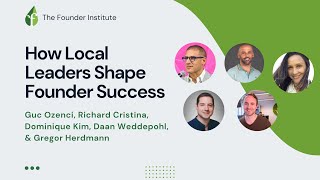
Founder Institute local leaders are seasoned entrepreneurs and investors who mentor first-time founders through customer development, product validation, and investor connections. They guide founders through early-stage ideation, help assess feedback objectively, and leverage personal networks to open doors across the startup ecosystem.
Chapters
Wouldn't it be great if all founders have someone to guide them through their journey as they are trying to solve problems they deeply care about? Well, at Founder Institute, they do. They are our leaders who help us run chapters all over the world. You're probably wondering, who are these leaders? They are seasoned experts who have built and exited businesses of their own. They are investors, they are educators, and they help governments and so much more.
Yeah, I'm an exited entrepreneur, so I've been there. I've been in the tech industry for over 25 years. First, I was a professional working for global vendors like Cisco and HP, and then I turned entrepreneur. So I, you know, I did the journey. I've been acquired and I exited. So the critical thing and what I am passionate about, what I do here is to bring the whole ecosystem together and and initiate or trigger collaboration and help all those first-time, mostly first-time entrepreneurs.
Just like Gucci, the leader of our Washington, D.C. program, leaders have one primary goal, and that is to give back. They have built and scaled businesses, and now they are channeling all that knowledge to nurture it back to the next generation of entrepreneurs. Their motivation always stems from their desire to contribute to their local ecosystem, drive innovation, and pass the mentorship they have once received. What exactly do these local leaders do? Their role is multifaceted and very crucial in the startup system.
The local directors, they're your main point of contact, right? They're, they're running the program and they They are the ones that open the doors initially. And if you make it through the program, they're the ones that are going to open the doors really to the international network and giving you the validation and authenticity that you are part of the family. So without the local leadership and an involved local leadership, there is no, there is no Founder Institute.
They were so many hats. They act as mentors, offering strategic advice and support. They are also connectors. They connect startups to investors, potential partners, and customers. And they are also educators, helping startups navigate through the complex world of operations and go-to-markets, and so much more. They're kind of like a Swiss Army knife in a way. One of the most critical periods in startup's life is the early idea stage. This is where the foundation for future success is laid, and it's an era where local leaders provide immense value.
You know, and it's something that I usually work on with founders myself in the ideation at the start, the first session. We used to call it ideation, we used to call it vision. It's changed a few times over the years, but in this session, we're talking to founders about how big a pain point are they solving for a specific audience? And when founders go and explore that and do that well in terms of the validation process, which I'm known for in FI to, to be working on with founders, this really gives them the best chance of, of improving and progressing in the program. But, you know, the best chance of success beyond the program as well, because they've They've done the validation process thoroughly, so they're questioning.
Rich underscores a crucial point here. The early stage phase is where ideas are refined, the first customer is determined, and the business model is starting to take shape. And especially for first-time founders, this guidance is absolutely pivotal in making sure they are taking the first right step. One of the most valuable services that local leaders provide is honest and unbiased feedback, and this can be especially crucial in customer interviews and product development.
The common thing we see in courageous founders, they jump up into the sea, right? And they take risk, and this comes with ego of those founders, and they usually think and believe in their idea, which is totally normal, but they think that they know everything. But actually the reality is they don't, right? The only way to know the reality is to test. And the structured program that we apply, the FI curriculum, starts with customer development, which involves interviews with potential clients. So we encourage them to do those interviews and they immediately realize that they don't know so much, right? They still have to go ahead and test and then maybe even pivot, right? Or change multiple things in the business model or other things.
Since it's very natural for founders to get attached to their ideas, sometimes this attachment can cloud This is why local leaders help startup founders to step back and objectively evaluate the feedback taken from the customers. They encourage founders to listen openly, even when the feedback is harsh and critical, and use that information to iterate and improve their product. Beyond their personal expertise, leaders bring another important asset to the table. It's their network.
I mean, also they're the ones that make sure that the local mentors are joining the program. So if they're not well connected, it just doesn't work. So the local leadership is vital, very much so in the program.
Leaders can connect startups to subject matter experts, investors, potential partners, and so much more. And what truly sets local leaders apart is their unwavering commitment to support the startups in their program.
Back then it was Jim, Joris, and Diederik who led the Amsterdam chapter, and I think they did an amazing job. Their network was incredible. So the people they were able to bring in was, that was just amazing. Their, I think their dedication to really pushing us to be the best that we could be. I think was very powerful. And I think their excitement and their encouragement and their willingness to, their sort of their belief in the fact that we could be successful also helps, I think, to become successful. The trust that they put in you to make it through the program.
Dan's words highlight a crucial aspect in the founder-leader relationship. These leaders aren't just some casual advisors; they are truly invested in the success of the startups in their program. And their belief in the potential of the startup can be a strong motivator, especially during challenging times. And honestly, this support can sometimes be a make or break for some startups. And given the time and effort local leaders provide to support the startups, One might wonder what drives them to take on this role.
And, you know, I love working with founders. I love exploring why they may be thinking, you know, the idea that they have is a viable business. And I was working in the ecosystem a few years before I met FI and went along to some of their events and saw what they were doing. And I genuinely love working with founders and want to help founders launch their ideas.
For some, it's about more than just giving back. It's also about staying connected to the pulse of innovation. It's a symbiotic relationship where leaders offer their expertise and wisdom in exchange for a fresh perspective and infectious enthusiasm from the startup founders. For us, leaders are the unsung heroes of the startup ecosystem. They bring experience, connections, and support to early-stage founders, significantly increasing their chances of success. And their impact extends beyond individual startups, shaping the whole ecosystem and driving innovation forward.
Both share what you've learned over the course of your, your life and your career in whatever specialty or area that you thrive in, whether it be just business generally or a vertical like health tech. But at the same time, you're always learning in And so the, the no-brainer for me about doing this work as a, as a local leader of my vertical is that you get to mentor and you get to teach and get to guide and see the fruits of that labor as founders reach such a better place after the 16 weeks of the program in our case. But you also get to learn every day. And if you're a lifelong learner like I happen to be, and if you love learning as much as you love teaching, This role is a slam dunk. I mean, it's, it's so much. You get so much out of it.
If you're interested in leading a Founder Institute chapter in your city, anywhere in the world, check the link in the comments. Your knowledge and experience could be a catalyst to help the next groundbreaking startup succeed.