How They Did It: Success Stories & Tips from Top Entrepreneurs in Tech
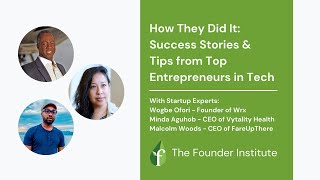
Wobi Ofuori, Minda Aguhob, and Malcolm Woods discuss what got them through early-stage founding: curiosity and perseverance, bootstrapping and angel networks, pre-sales before you're ready. They stress treating VCs as partners, asking the second question, and daily gratitude as a mental health practice.
Chapters
Hello everyone and welcome to this Founder Institute event. The title of this event is How They Did It: Success Stories and Advice from Top Entrepreneurs in Tech. We have an incredible panel of founders and investors for you today, and I'm excited to kick things off as your host. My name is Mike Shcherbakov. I'm the Managing Director of Founder Institute San Diego. And I'm also a venture capitalist and general partner at The Veteran Fund. Just a quick context on Founder Institute. Since 2009, Founder Institute has grown into an international sensation, 6,000 portfolio companies across 200 cities with a mentor network of 25,000 mentors, and most recently crossing that $1.75 billion in funding. So if you're interested in learning more about Founder Institute, we're currently enrolling across 6 continents. You can go to fi.co/enrolling. But without further ado, now that you know about Founder Institute, I'd love to introduce you first to the topic and then introduce you to the incredible panelists that we have here joining us this evening. So building a startup is hard, but we found it's often even more challenging for underrepresented founders. So on tonight's event, you're going to hear from the startup founders, leaders all around the world who are going to share some of their stories. Some of their successes, some of their failures, best practices, pitfalls to avoid, and ultimately at the end of the day, helping put you on a path to success despite challenges that you may encounter in the tech industry. And I wanna say here that I'm very much in learning mode as well. We're very proud of the impact Founder Institute has made across the world and knowing we can always do better, happy to host incredible events like this. So without further ado, I'd love to introduce you to the incredible speakers that are joining us this evening for this panel and fireside chat. I'm going to hand it off first to Wobi. Wobi, if you can give us a quick background and let us know where you're coming in from.
Sure. Thanks, Mike. Wobi Ofuori, and I like to say that I am a middle-aged Jedi still trying to find his way in the world. And my background is very varied. I mean, I've done a lot of different things from architectural planning and programming working in wellness, doing consulting with Rand Corporation, all the way to what brought me to where I am now, Houston, Texas. Well, actually, what brought me to Texas first, Dallas, was I was recruited to help build a company that bought, built, and operated airports around the world. And people say, you know, well, airports, you know, small airports. And now these were international medium hub airports. And so we invested in airports as infrastructure assets backed by a Canadian pension fund. And then on the project side, would form consortiums with sovereign wealth funds, with multilateral lenders and other local partners to develop these projects. So we were an operator, investor-operator and developer. We were the only one in the US at the time called Airports Worldwide. And after winding that down, I decided to hang out the advisory shingle and hung out, started a firm called 360 Approach that was doing boutique advisory, generalist, industry agnostic. That has now led me to pivot, actually, because once I started working with startups, started work, I started realizing that startups weren't great advisory clients because they weren't paying. And as a matter of fact, they kept asking for money. And so I thought, I think I might have to reconsider my life choices. And that's led me now to Works. So we've reimagined 360 Approaches Works, which is an emerging venture development fund that— well, actually not fund, firm, excuse me— that invests in hard tech ventures as an institutional co-founder.
Incredible. Wobie, I look forward to diving deeper into your personal story here in just a minute, but thank you for that great introduction. Next up, we have Minda. Minda, if you can come off mute and share a little bit of your background with us, please.
Hello, so I'm Minda Aguhob. Hoping you all can hear me now. Um, great. And I am a Filipina American middle-aged Jedi as well in Silicon Valley. I'm in Sunnyvale, California, and I actually spent most of my life growing up in DC and New York City. I only moved here 8 years ago to bring my a startup health tech company, Vitality Health, and that was about 8 years ago. Since then, it has evolved to include my nonprofit that is connected fully with the community work we're doing with the refugee crisis in Afghanistan and Ukraine. We have the vision of creating a world that is connected, well cared for, and vital in this time of long disaster. I like to use that phrase, long disaster, because we find ourselves in an interesting transitional time, and you probably can guess what that phrase means, and I'll define it specifically as the fact that we are in what seems to be a long continuous disaster. And once one thing seems to slow down, another political or health or whatever situation pops up. And so the work that I'm doing with my amazing teams is really to build an infrastructure that can roll and partner more robustly from the large institutions that already exist to your neighbors. Just people on the front lines. And I'll tell you, a lot of the experiences I had growing up as a Filipino American in Washington, D.C. has really informed a lot of the reason why I do what I do and recruit the teams that I do and building this company. And so I'm really excited to share with you guys what I've learned and to actually hope that some, some of you might be interested in becoming part of our community, the Code Caring Initiative at code-caring.com. And if you want to read more, I actually presented our work at the United Nations a couple years ago, and you can see that video on code-caring.org. But it is really wonderful to be here and possibly make great impact with all of you just through this conversation.
Wonderful. Thank you so much, Minda. And last but not least, we have Malcolm Woods. Malcolm, if you can share a little bit of your background with us, please. Yeah, yeah.
So I'm Malcolm Woods. I'm a 10-year software engineer. So most of my post-college career, I've just been writing code. I'm based out of Houston, Texas, but I'm all over the world depending on the month of the year. Currently, I'm calling in from Thailand. I graduated from Founder Institute in 2021. Where I built a travel startup during the pandemic. So ask me about that later. But yes, I'm in the trenches. Everything is fresh, fresh on my mind as I think we're all in the same sort of boat building startups. So I'm really excited to talk to some of you.
Wonderful. Well, thank you all again so much for being here. Thank you for those great introductions. And just a couple high-level logistics. The format will be— We'll have a fireside conversation. The panelists are going to answer some of the questions that I've prepared beforehand. But certainly, this is not just about us. This is about the audience and providing value to you. So if you have questions, and we encourage, please ask them in the chat. In the background, we'll make sure all these questions are compiled, and we'll try to get to as many as we can, hopefully all of them. So for the next 20, 25 minutes, we'll go into the pre-prepared questions. After that, we're going to go into the audience questions. So as these incredible speakers, they're sharing their insights, their background, and a thought comes to mind, please drop those questions in the chat. So without further ado, I'd love to kick this off. And the first question I have kind of comes from my insights as a venture capitalist at the Veteran Fund. So I know at the Veteran Fund, we make investments into underrepresented founders historically who have not received the same resources. These are military veterans, military spouses. What we've seen is at the stage we invest in, which is pre-seed, of course we're looking for some type of traction, but more so we're looking for certain values that these individuals embody. Those values include leadership, resilience, purpose. So what I'd love to start with here, and I'll hand this off to you, is what are the character traits that you feel that you've developed through your journey as going through this entire startup journey? And of those traits, which ones do you think have been the most success, the ones that have mostly impacted you to get to the point where you are today? What traits have you developed?
It's a good question. I think that the number one trait and the one that I tell my kids is my sole superpower is the ability to learn anything. And it's also the willingness to learn anything. And I think that that's a very important one. Curiosity goes along with that. So sometimes we call it asking the second question. So there's sometimes the obvious, you might ask, okay, this question, but then I find that a lot of times people fail to ask the second question. And an entrepreneur And the way, by the way, that I define entrepreneurship is very simple. I define entrepreneurship as being more opportunity-centric than risk-averse. And so I think an entrepreneur who's seeing an opportunity has to be curious to push past the first barrier or even the first sign that this is gonna be a hit, this is obviously gonna be a hit. Ask the next question, you know, and maybe the next question after that. And those, I think that that's probably the number one trait that I've developed and developed it into a skill of asking questions. I do wind up talking a lot. I think I run my mouth probably more than I need to, but I also ask a lot of questions. I think you can't really have much to say unless you've asked some good questions and gotten some good input.
Thank you. And Minda, how about you? What, what quality or trait do you think that you've learned or developed through your startup journey?
That's a really great question. You know, I think that if you're an entrepreneur and you've gone through all the things it takes to develop an idea, probably most of us, if you're not already there, you're probably already developing this, is believing in what's not possible as being possible. And that's actually how I define leadership, is the ability to see what other people can't see and just make the impossible possible. And, you know, that's not enough though. I mean, I think there's a lot of aspects to that and, you know, things that we all hear about, you know, grit and, you know, You know, just getting through the obstacles, obstacles that most normal people will never see. I really love what Lugo said about being a Jedi. I mean, you are taking on a Jedi journey when you are becoming an entrepreneur, at least one who is going to persevere. So that word perseverance is what I would emphasize getting through obstacles, but really learning from those obstacles. You'll see a lot of obstacles. And getting advice from people and just building a system for yourself where you really sense and perceive what's going on so that you can flexibly react and get more mastery at getting better and better at reacting. That's really important because, you know, this journey— I love this analogy of it being like marbles rolling away and you gathering up the marbles. I mean, there is nothing in our education that teaches us how to deal with that. It's something to learn how to be okay with things not being complete and not perfect, and instead using your sense of senses and perception to find solutions and find ways to structure. I mean, there's just a lot of wisdom out there that's not necessarily in all those popular books. Sometimes you just gotta ask someone who's in your situation and be continually connecting to new communities and not going crazy, like meeting zillions of people and not doing anything about it, which I think I know that I did that in my early days. I learned how to build the communities whose advice I trusted. And it was really awesome to be part of an accelerator like this one. I wasn't part of Founder Institute as a startup founder for too long. I've been here longer as an advisor. And I also have found how people have really benefited from the wisdom that's in this group. I was in a sort of a related women's accelerator, which was awesome to be a part of as a woman of color. And I do want to say something about being a woman of color, since in many ways that brings you less access to different things, and at the same time more access. To different communities and networks in this particular part of the world, in California and Silicon Valley. So some of the things that I would encourage people to be perceiving and responding well to is just the dynamic nature of the communities that are around you and who can really share wisdom versus people who really— there are people out there selling not good information. Or telling, you know, see through and test the things that you receive as advice and listen to your own wisdom, test things. And so I think that's a really important piece of, you know, while you're doing the impossible, really perceiving, testing the things that you learn, and then your successes will just build. As you perfect that process. So I would say that's really my response to it, this character question.
Well, that's, that's great, Minden. There are a couple areas that, uh, you touched on that I'd love to double-click on here in just a moment, including the resources available and obstacles you've encountered. So we'll get there in just a minute, but I'd love to hand this off to Malcolm. Malcolm, if you could answer, what qualities, um, do you feel, or traits that do you feel like you've developed through your startup journey?
Yeah, I love that question. So I think I've developed selective memory. It's very important. You're going to get told no a lot, you're going to get the runaround a lot, and if you remember those things, they'll haunt you, right? You have to go into every experience brand new. So, you know, after a while, you know, I got told no so much it was like a nickname, right? And so I said, I need to be able to block things out so I can go into my next meeting energetic. In high spirits because that stuff really, really resonates with, you know, who you're talking to, who you're presenting to. So I say, you know, developing a selective memory is super important. Energy means a lot. And if you get caught up in that world, you know, it'll bring your energy down, it'll bring your delivery down. And so, you know, after a couple of months I said, okay, I need to block that out and then go and do the same I'm gonna give the same pitch I just gave and hope that people aren't gonna, you know, boo me. But yeah, selective memory was big for me. It changed my whole outlook and it really put me on a good trajectory to build Fair Repair.
That's a great insight there, Malcolm. And just so everyone in the audience also knows, we're gonna start with some more of these kind of personal questions that are more around qualities to embody. In the startup journey, then we're going to get to more of the tactical, and then we plan on ending around some questions around fundraising, because I know a lot of the founders in the audience are wondering what does that landscape look like. So Malcolm, I think what you just shared is a perfect segue into my second question, which is encountering failure and those— you use selective memory, which I think is such a great tool there. But my question to Wobi first here is, How does a founder develop a sense of confidence in self when getting those nos? And I'd also love for you to— before this conversation started, you introduced me to a really great term, VUCA. I'd love for you to tell everyone what VUCA is, but how do founders develop a sense of confidence in self with VUCA to ultimately then create VUCA? And this will all make sense here in just a minute.
Right on. Yeah, so VUCA is an acronym and it It stands for volatility, uncertainty, complexity, although WOBI's version also goes complexity can devolve to complication, can devolve to chaos, and ambiguity. It's something that was developed and taught in the Army War College. And I think it's a great description for the environment that we've been in for a couple of years, particularly now, the environment around tech, tech stocks, et cetera. Right now as it's happening in the news. And so there's a response to that. And the response also has the acronym VUCA, which is vision, understanding, courage, and adaptability. And I think one of the biggest things that founders could do, and I like Malcolm's selective memory thing. It's important though to look at every experience. And I think that Minda, touched on this earlier, look at every experience as an opportunity. So if, if an entrepreneur is more opportunity-centric than risk-averse, every experience is an opportunity. So if somebody comes and gives you something that seems like negative feedback or resistance, what have you, I think you need to be able to have maturity or develop the maturity as an entrepreneur to put it into one of three buckets. Take it, take it and say, okay, first, Is that true? Do I agree with it? If I agree with it, then that means great, something was pointed out to me that now I have an opportunity to act upon and hopefully improve the next time I go there. Do I not agree with it? All right, if I don't agree with it, why don't I agree with it? And I think that that helps you develop a better sense of what it is that you're working on. I was just helping somebody with pitch practice yesterday, actually. And I told him that one of the keys in really having a successful pitch, which, top tip, entrepreneurs are pitching all the time. You think you're pitching because you're always trying to convince yourself as well that this thing that you're doing, which may be non-consensus or non-obvious, is something that is worth spending your time, which is precious, on, and possibly your resources and maybe other people's resources. So you're always pitching. But one of the things I told them was, look, a successful pitch is one in where the entrepreneur comes off as really knowing what they're talking about. I may not agree with everything that they say, but you can tell that the person has thought things through. And so I think that You know, when you're facing adversity, you have to use that as an opportunity to re-up and say, all right, again, do I agree? Do I not agree? If I do agree, this has been a great thing for me to be— have my eyes opened or have something reinforced. If I don't agree, why not? Do I not think that's right? Why don't I think that's right? Is there something that I can do differently in how I present and how I communicate and how I convey whatever it is that I want to convey, the value proposition of what I'm talking about? Or is it just that I'm not talking to my people? And that's the last thing that I'll say. You have to also realize that not on the journey, not everybody is not your people, are not your people. You know, there you got to find your people and there are going to be people who are going to say, I get it and I value what you're doing and I'm all for it. And lots of times those people are beneficial. But you also have to realize that sometimes those people are just saying it like, you know, because they like you. You also want to have the people who are saying, listen, I'm going to be brave enough to risk a social faux pas or risk the relationship by telling you what I really think. Those are the real people you need in your life and on this journey, because that's really what helps to stress test any good idea.
Wow, such great insights. Thank you. Minda, I'd love to get a little more tactical with you. VUCA, I think, is such a great term I'm going to end up using in the future. But if we went a little bit deeper and talked about maybe a more detailed example of it, specifically a challenge or that obstacle that you've encountered, can you give us an example again, on this founder journey of maybe a notable or an obstacle that you've come across, a very specific example, and how you managed to navigate that volatility, uncertainty. I know I'm putting you on the spot. They didn't know I was going to ask them this question.
I'm just thinking there's just so many. Can I throw a Rolodex at this? I have, uh, um, let's see, what would be the most useful and powerful one for a lot of folks here are, are probably early, very early stage, right? And one of the things that most of you are likely dealing with is just surviving as a person who pays rent and food while you're pursuing this idea. And especially for people like us, you know, and women of color in particular. I would say that it's easy to feel like a complete failure when you're working on this startup and trying to raise money and get your idea really developed, right? It's not easy. And then you're trying to just survive. And part of just getting through survival and finding a part-time job or, you know, you see, I was even Ubering, honestly, I was doing Uber. I took that feeling of failure, you know, and I'm someone who was educated at Ivy League university, I'm trained as a data scientist, and here I am driving Uber. And I reframed that failure in my mind. I love saying that, you know, reframe the failure. And what I became was a startup-savvy founder who took all those hours I had in the car to talk to venture capitalists, investors, partners, people who all over the Bay Area and having the opportunity to have 20, 30-minute conversations with them. And That view allowed me to have the confidence and the savvy to develop and go as far as I went. And it was really hard because my parents— my father's a physician, you know, my parents did not get what I was doing at all. And my brother is a very successful entrepreneur. I'm like, you know, he had a completely different journey. And so seeing them doing this was very painful. I turned that opportunity into seeing what people who are doing full-time work like that are really dealing with and how painful it is, and was directly connected with the mission that I was developing with Vitality Health, building a world that's connected, well cared for, and vital, and seeing how everyday people are, how they disconnected from the system. I ended up becoming an organizer in some ways for the Uber drivers. All of that helped me understand the different kinds of markets that I connect with and don't connect with. This has not been an easy journey because the mission that we're building is very complex and there's a whole world of it. But reframing the narrative for myself, Keeping my vision in front of me and sharing it shamelessly with everybody got me resources to keep surviving beyond Uber. I've been bootstrapping all along. Now we're at the point where I spoke at the United Nations a couple of years ago. We have a ton of donors to our nonprofit. Took a long time to get to seeing that vision, but I hope that brings some clarity to a concrete answer to that question.
That is an incredible story. I actually find more lessons are learned through those kinds of experiences than the successes oftentimes. I've heard before that like the worst thing that can happen to a first-time founders' success early on, because then they feel like, "Oh, this is going to happen all the time," and they're not used to that first roadblock they encounter. Minda, that was an incredibly powerful share. Most people have probably heard this as well. If you haven't, I recommend watching the Steve Jobs commencement address, but he says, "You can't connect the dots looking forward, you connect them looking back." And so I'm sure as you look back, "Oh, I was driving for Uber, but then I built community there and met these VCs as I had these 20 to 30 minute rides with them. It makes sense looking back, but in that moment, it's certainly a lot of uncertainty, to Wobie's point. Malcolm, I'd love to hand that off to you. Given how powerful, you know, a story, a personal story of overcoming a failure can be, do you mind sharing with us what you think, or maybe what was a seeming failure for you at the time, or an obstacle you encountered, and how you overcame that? And you're still on mute.
Yeah, I think my story is a bit interesting. You know, like Minda, when I started this startup, no one really knew what I was doing. They were like, you know, what are you doing? I came from a low-income family, so a family and friends round was just an imaginary word to me. You know, I didn't have any friends or family I could ask, you know, for money. But, you know, when I started the journey, I set out to make some of these friends and fam— like, make some— not make family, but make some of these friends. So I really had to put myself out there. I had to leave my coding dungeon, you know. I joined Founder Institute. I started going to every single event in the city related to startups. And just really started to get my name out there. So when I started the friends and family round, like people actually were familiar with me. So I think, you know, that's just a lesson about getting outta your comfort zone, right? You know, I don't wanna pitch. I just wanna sit in my room and code and build a great product, but that's not really gonna put, you know, money in the bank. So you really have to break outta your comfort zone and put yourself out there. And so that was a great challenge for me, you know, someone who considered themselves an introvert, right? So I think coming from an engineering background, probably a lot of us have this sort of introvert sort of personality. But yeah, I think my biggest challenge was just really, you know, putting myself out there, publicizing what I was doing, and really getting to know people and building a brand for myself. So I think that's going to be, you know, an upcoming challenge for lots of folks.
Malcolm, I think you touched on a really important point that I'd love to now come back around the horn and bring to Wobii. You said when it was time to get money from friends and family, so just so everyone's aware for the newer founders here, when you're starting your startup, you mentioned you heard terms like bootstrapping. Bootstrapping means that you're building this business without any outside funding. You're essentially doing this thing yourself. Generally, If you need capital for your business early on, the first place you go is what we call FFF, friends, family, and sometimes people say, and fools. Only fools, but they're believing in you. They believe in you, maybe there's viability in the business too, but they're saying, "I believe in you." And then at that point, you may go to angel investors, and then once you've built some traction, you go to venture capitalists and you do your seed, Series A, and beyond. So what Malcolm's talking about is kind of this first round saying, "Okay, I really need money. I need capital to grow the business." And you hear about the successes. You go on LinkedIn and Twitter and you see Crunchbase there. Everyone's announcing these rounds and they talk about them after they've raised them, but they don't address how challenging it is in that moment, especially if you don't have that immediate network of friends and family and fools that are willing to just write you big checks. So, Wobi, is this something that you've experienced? And I'll tell you, we have Well over 100 people on this webinar, I will say most of them don't have that network of friends and family that are going to write them checks. So how do they overcome that hurdle?
Yeah. This is a really great point. And I think it's one of the things that has been the greatest challenge to finding folks who are not the usual suspects get into the game. And a lot of people haven't realized that One of the primary reasons is that when you're raising money, whether it be like what I'm doing for an investment firm or for a company, it's almost how your network is the one of the most valuable things that helps drive that fundraise. Now, one of the great things about where we are right now in terms of startup ecosystems around the country and around the world, is that there's a lot more infrastructure specifically and particularly for startups, not quite as much for new firms, new investment firms. And I'm really hoping that that develops out too. There's a lot of infrastructure for startups like FI and a lot of other great startup development organizations that help provide that infrastructure to develop networks, to get your stuff out there, to develop how you pitch, to develop how you present. All of that. So, but one thing that you— that Malcolm brought up, this is very common. I think for a long time, people— I used to say Silicon Valley hijacked this concept of what entrepreneurship means, and that the— what has happened in the venture world in the last 25 years has seemingly framed that, and that the archetype for the startup founder is Mark Zuckerberg. And it's some white kid who dropped out of an Ivy League school who gets to start a company in their upscale, upper-middle-class suburban garage. And the majority of people, we don't even have a garage, man. So where do we start our startup? And so I think that the whole, oh, you know, used to have a— I used to hear it all the time. You'd hear investors say, well, before I can do anything, you know, I want to see that you've gained some traction with friends and family. But like you said, the friends and family are just struggling just to get by. Maybe that entrepreneur also is contributing to the family's— meaning even the larger family's household income. And now they want to go and try to do something to push it to the next level, to actually not just survive, but create opportunity and wealth. It's really difficult. Um, and now, like I said, there are more opportunities because folks are realizing that, okay, just because they didn't get a friends and family round, that doesn't necessarily mean that they haven't gained traction. I definitely have seen progress even in the short period that I've been messing around in this has been, but, um, I think that there can be more in terms of the, uh, investor mentality of opening that up and saying, Really what we're looking at is we're looking at the strength and the quality of the idea and the strength and the qualities found in the founder. And let's then get behind that. And I think there's been a lot of downward pressure, even starting from the top of the funnel with massive institutionals, non-traditionals who've been pushing, pushing, pushing down. So even the traditional venture capitals who had moved up in the value chain, meaning they moved out of pre-seed and moved up to seed and Series A, and that's the only— now they've been forced to move back down. And so there have been a lot more who are getting involved at earlier stages. You have more angels, and angels is another one because there are some angels that are really like quasi-VCs. They just invest their own money, but they do so with a similar type of mentality and motivations as an institutional or as a professional VC would. But then you have what I call, uh, classic angels. And classic angels have different motivations. And some of these people are other entrepreneurs, or they're people who have just had success in some manner in some other field, but like to see what you're doing come into the world. Or they appreciate the fact that you are making a run at it and say, okay, I'm, I'm going to support you. And so those are also the people who are coming out more, and you see more of these angel networks and angel clubs, investing clubs, and a lot more innovation just even in the last couple of years in terms of the mechanisms that people are using to invest in, using SPVs and rolling funds, what have you. So I think that things are starting to open up, but it has been a challenge, and for a lot, it continues to be a challenge. But this is also why, coming full circle, organizations like Founders Institute and other SDOs are great places to get into a community where you can build that network to make those connections.
A really great answer. Aminda, how about you? How do you— how have you experienced supporting founders or going through that journey that are ready to raise their first round of financing and don't have the friends and family that are able to write them the big checks.
Well, I want to bring this back to the fact that there are people who think they are ready for funding and may find that they actually have an idea or an industry that isn't ready for them to have that funding yet. And I want to hold up the bootstrapping entrepreneur, you know, the and those who are just using their grit to get through, because that bootstrapping activity is really essential to proving yourself worthy of funds. Once you have, you know, that small step turn into something that can sustain and build upon itself, I actually have a framework that I use to look at actions and ideas, say, what is the most powerful thing that I can do? And once you have, you know, done a few of these tests, you'll find whether you are indeed really going to be able to move forward with getting this funding. And I found that really sharing those experiments and focusing on that just as much as reaching out to founders like you would be in this wonderful group with Founder Institute. That's got to be for some of you, the more time that you're spending is on getting successful experiments with traction and building a product. I found honestly, you know, we are Some of us are just going to have less access to capital. As a woman of color, there's still a very small percentage of us who are going to get capital. And you are going to have to figure out how to bootstrap. And unfortunately, that's the reality. And I'm not saying that to get you all feeling sad and depressed. It's really just how do you reframe that narrative? It's just good information. What you will with that information and come up with the most appropriate plan. And what I did is I realized that I was in some ways with this, with this idea was so very firmly planted in the nonprofit world that this idea that I had is really more, more appropriate for a nonprofit endeavor for now as far as receiving funds and being sustainable. So that's why I formed a nonprofit and that was after many, many, many experiments with trying to create something from this idea that was a for-profit venture. And again, you know, I reframe that failure. And I think now with this work, ironically, I've been able to develop many more experiments that allows me to go back to the original for-profit vision of a platform that supports mission-driven work in communities at the ground level. Now that I have created really robust experiments with community through our nonprofit work. And let me be straight with you, this was 8 years of work. Every overnight idea, it's not, it's got 8 to 10 years behind it, people. Don't believe it for a minute, all the Silicon Valley myth. You know, unless it's somebody who had already been building towards it with a, you know, with a career or solid network. I really do want to hold up the bootstrapping entrepreneur. I write about on my blog on Medium. Just look at my name in Medium and just be okay with that. That may be your journey, but at the same time, if you've got traction and you've got a product, people listen to you and it's networks like Founder Institute that will get you there. Even when you're at bootstrapping stage, as you are for a long time, I've got a whole group of investors who I'm friends with on Facebook. They know my story, and that's incredibly valuable for when you are ready.
Mike, can I riff on that real quick?
Please, please go ahead.
Just because she makes a great point, and just 45 seconds. One, a lot of times founders can do more than they think they can when they're on this journey, and they should look for what is the next thing I can do, not waiting for somebody else to give you the permission or the funds to go and do it. I, you know, if you're coding something and you're like, well, I don't know how to code, learn, go and take a master class and go and at least or at least, you know what, even diagram it out and say, this is what I wanna do. Take just that next little step. So everything that Minda just said about traction and the bootstrapping thing, I think I, what I find is that a lot of founders are so focused on the, on the funding source, on VCs in particular, that they treat the VC like the customer. So top tip, the VC is not your customer. Go and find the people who wanna buy whatever it is that you're making and selling. And convince them to buy it even before you've made it. One of the things that I've told people, if you can convince a customer to pay for something before you even made it, a VC is gonna write you a check right away. It's like, hey, we have X amount in pre-sales because our customers who this is meant for found the value in it and they, and they've already given us pre-sales or they put down deposits. That's, man, that's gold right there. And then, and then all you're saying to the VC is, I just need you to provide the capital facility to help me fulfill the orders I've already put in. But go out there and sell, sell, sell, sell, sell. That's what, at the end of the day, that's what we're doing. Sell. So I just wanted to give that top tip because I think that again, a lot of folks, I see stuff popping up in the chat. A lot of people are worried about getting funding. They're worried about in this environment, how do you get funding? I see it oftentimes. There's a lot more that you can do to move your idea forward and get closer to your customer and convince that customer that this is the thing that they need. And if not, if not, go back to what we had said, what, 15 minutes ago, reassess and reevaluate. If you're unable to sell what you think you could sell with funding now, Maybe you need to reassess or reevaluate whether this thing is really marketable.
Those are all really great insights, Roby. Thank you so much. I love—
can I just—
I'm so sorry, don't apologize, let's keep rolling.
Thank you, Ubo. You know, one thing I feel like is missing from what I'm saying here in building out your community of funders, potential funders, like I said, I became Facebook friends with a bunch of really great investors, you know, these are folks you'll be collaborating with. And I want to just come back to, you know, the fact that we're talking about being folks who are, you know, diverse. And the thing is, your cultural communities— like, I'm Filipino American. The Filipino investor and entrepreneur community was the most powerful community I connected with. The most powerful. And that is the people to tap into. Look everywhere in your local network, even remotely on the web. Find those people, get to know them, become Facebook friends, share your story, hear their story, because they're going to have stories too.
Absolutely. And I love that you share that. I think community— I say this often— I think community is the answer to a lot of our individual and collective challenges. And just a quick plug for Founder Institute. In addition to being the largest company creator in the world, it's now also the largest fund creator in the world. They have a program called VC Lab that I went through to launch my venture capital fund, the Veteran Fund. And the amount of— the level of diversity in that program was incredible. I mean, Isabel Stark was a classmate of mine and started Black Tech Capital investing in Black founders addressing clean tech, building clean tech companies. We have Stella Labs here in San Diego, Sylvia Ma investing in female-led companies. So people are creating, individuals are creating these communities to support wherever they're seeing there are gaps in the market. So I love that we're kind of covering all the bases here. So we have 12 minutes left and we have a lot of great questions coming through. So what I would love to do is go lightning round and I'm going to try to get through as many questions as we can. I think the most efficient way to do this is if one of you wants to, after I read the question, hop in and we can, you know, popcorn style and address it. Feel free, and then maybe up to 2 can answer, but let's focus on maybe 1 or 2 of the panelists answering the questions, and we'll see if we can get through all of them.
I'm going to start with—
thank you so much. Valeria has a question: What are some of the limiting beliefs you had to let you had to let go of in order to build your business? And why don't I just start with Malcolm and then I'll have, uh, Wobierman to jump in.
Yeah, I'm gonna go real quick. Um, like I said, I built a travel startup during the pandemic. Uh, lots of people said, oh, you can't do that. Uh, I didn't believe them and I thought travel would bounce back and here we are.
Here's what I want to say. I think, um, my limiting belief was I absolutely need to have a huge $500,000, $500K seed fund before I can really get started.
You know, say that again, say that again, Linda.
My limiting belief was I cannot get started unless I have $500K dropped into my bank account, right?
Right.
And, you know, per your point, no. And for many of you, that's the last thing you need to be thinking about. And I'll tell you, you know, it's not been an easy journey bootstrapping, but now I'm, you know, I've gotten myself to the point where it is now appropriate to, to have that ask. And I think really learning the other things, which, Rubo, you beautifully covered, you know, just getting a product, building a community, a real community, and understanding how it all works. It's, it's really priceless. That's really the way to go.
Thank you. Trina asks, what would you tell your younger self before you embarked on your entrepreneurial journey with regard specifically— I love this question— to managing mental health and stress? I think this is something that's not talked about nearly enough. Again, I think we celebrate the big milestones of we reached this much in ARR and this much funding, but how often do we talk about mental health. So what would you tell your younger self embarking on this journey about mental health and wellness?
I'll jump in there. So what I would tell my younger self, and I tell my, my currently not as younger self, is rest, relaxation, and resetting is very important. One of the key things I would tell my younger self that my younger self didn't do didn't do, excuse me, is end each day. Top tip, end the day. Typically entrepreneurs, all right, and I know I did this, have run-on days. So I used to only have 3 days a week, Monday through Thursday, Friday and Saturday and Sunday. And so ending each day to actually close out, this is what I saw, this is what I learned, and now let me just put it to rest. Then get some rest and then start next in the morning. That's it. And then the last top tip that goes along with that, do not start your day looking at your phone.
Great.
I'm going to add in a little tip here. And anyone that knows me personally knows I do this. For those of you that have an iPhone, you can do it on any phone, but I set an alarm. At 11:11 every day. You can do it on whatever time you want, and you can change the title of your alarm. So when the alarm goes off, it says whatever message you want it to say. And so every day, 7 days a week, mine goes off and it says, "Stop, breathe, and be grateful." And oftentimes, more often than not, I'm in a meeting. Sometimes I'm with my son, sometimes I'm with family, and it goes off, and whoever I'm with in that moment, I just think it— gratitude, I know, kind of talked about a lot now, but I think it's important in addition to all the great things Wobie shared to stop, breathe, and be grateful for this journey that you're on. And that's a simple daily tip to do there.
Now, if you do, if you do that, you gotta do it. See, some of us will actually go and put that in and just, oh yeah, okay, it's just you saw it. No, you gotta do it.
That's right. Okay, we're gonna get into a few technical or tactical questions here. Cynthia asks, how do I find a co-founder?
I think that when you are doing this development work and researching your product, researching your market, you're going to be meeting people who are interested in this stuff and are wanting to build with you. I think, you know, when you actually put together project, really good experiments, like, um, when I found my co-founder, I was actually at the accelerator I was part of, and he was one of my advisors. Did not expect that one of my advisors in my accelerator would want to join, but what happened is a lot of the work that he was doing was parallel with mine. We started doing work together and then it just naturally came together. So it's not about jumping. I'm seeing you guys in the chat going, I'm looking for a technology co-founder. Sorry guys, that's not how it goes. I mean, it can be, but you know, devise activities that people can participate in. And then invite people and really get yourself out there, you know, community, you know, all people you might not expect to be great co-founders. You know, you got to be open.
I have some thoughts on this. As a technical person myself, technical co-founders are always sought after. And so one of the things I always talk about is like, All of the good technical co-founders with the good skills are already working on something, right? So you have to be presenting a great, you know, sort of some great progress, just like they're an investor. Like, can you present something to me better than what I think I can go build on my own? And so that's sort of what's going through a technical person's mind. Like, you know, do I want to join this startup? You know, I have the skills to go build this myself. So you sort of have to have like all of the other, you know, T's crossed and I's dotted with like designs or business plan or your deck or your pitch. And then when you come to a technical founder, he's like, oh wow, yeah, I want to be a part of this. So that's just some thinking from a technical co-founder's mind.
And real quick, I'll just jump in there too. Uh, one, when you, when you're looking for a co-founder, don't just look for somebody who's going to do a job for free. That's not what a co-founder is. Co-founder has to be somebody who's gonna bring additive value that wouldn't have been— that would've been difficult, very difficult to access otherwise. Two, when you do find and look for that co-founder and you think you've found one, look for somebody who's complementary. So somebody who's aligned in the principles and your— and the way that you kind of think about things, approach things from the fundamentals, but somebody who's complementary, not exactly you. You don't wanna find you, you wanna find somebody who's complementary in terms of perspective, in terms of skillset. And number 3, when you do find a co-founder, give yourselves the opportunity and the space to allow the relationship to mature. So a lot of times co-founders put a lot of weight on the relationship, like as if you're just married somebody after one blind date, and that's a big mistake. If things come up, air them out, address them, and that's all part of the process because it's a development of a relationship. It's learning how to work together. And if it's not working, address that early on. And even if you have to wind up going separate ways, better to do so early on than to do so later.
Great insight. Thank you.
Weibo, that's really wonderful advice. That's why I say that it's important to work together with somebody and take the time, take 6 months before you put anything onto paper, you know, because you don't— you really got to know— get to know somebody. Thank you.
All right, we've got our last 3 questions. I think we're perfect with timing now, lightning round style. Hassan asks, startup founders can lose touch with their employees amidst the busy nature of being a founder. How do you keep good employees? I'd love to have one of you answer that, please.
You just regularly connect with them. I think that If you're running around, I have a regular meeting with these folks and at least one of them, we have the ability to just go around and just check in. Put that into your meeting time and even set aside a separate meeting time. We have a heart meeting that we put together once a month when the COVID stuff started happening a couple of years ago. Taking the time, you would be amazed at how much it really refreshes people and yourself. You know, get connected with the heart of what you're doing.
All right, thank you, Minda. Marta asks, successful marketing for a growing business is challenging and it takes time to make meaningful impressions. Any suggestions on successful marketing? Maybe just a number one marketing tip from one of you.
Number one marketing tip is don't confuse marketing with promotions and advertising. Sometimes that's confused because even in, even on P&Ls, you'll see them in the same line. But marketing is about positioning yourself and your brand within the market that's been identified as who is going to connect with it to create economic value. So don't think of it just in terms of what you're doing to, to promote, but think of it in terms of how you show up in the market that you have defined as yours.
Wonderful.
And Maddy asks— this is the last question, then I'll have one final closing for panelists to share their closing remarks— but Maddy asks, how do you fundraise high-capital projects and ideas when you're just starting out without a lot of resources? We kind of touched on this when we talked about not having access to that friends and family, but if they're working on something that's capital-intensive, Do one of you have any resources that can be helpful to them?
I'll jump on that too, because in hard tech, that's, that's, that's kind of the name of the game. There are a lot of government programs depending upon the area that you're in. So, you know, I-Corps, NIH, there's a new thing that NSF is doing called Engines that's going to bring a whole lot more money into it. And hopefully if Congress gets their act together, they're going to pass some new legislation here soon that's going to bring more A lot of it's gonna be in non-dilutive funding and opportunities again, wherein you can team up with people who are potential customers and where those customers can also invest by, and that investment can be in pre-ordering where they say, okay, you give us certain amount and we'll, we'll do this and we'll get here. And sometimes those are called co-development agreements, but there are, I would say a lot of times you're gonna try to look for non-dilutive ways of finding capital, and those are some.
Thank you, Wobie. Yeah, we're big fans of non-dilutive funding. The SBIR and STTR program is something that a lot of our portfolio companies have actually used. So let's go ahead and start to bring this home with final closing thoughts. So I'll ask— we'll start with Malcolm, then to Minda, and over to Wobie to finish us off. What is one final piece of advice that you have, considering most of the those in attendance today are these early-stage founders, many of them ideas, some have turned their ideas into something that they're building, but fairly early on. What's one piece of advice that you have to them on the personal or professional front?
Yeah, I'm gonna say on the professional front, in your own city, go to everything, show your face, be known as an entrepreneur, as a startup founder. Just be all over the place. Like, you want people like Woke Bay or whatever, you know, where if he goes somewhere, if he's heard the name Malcolm, people know who I am in Houston. Like, just be everywhere in your domain. Like, I'd say start there, and then opportunities will just start coming.
Hey, apply for this.
Hey, are you fundraising? So just be all over the place in your domain, I'd say.
And I would agree with that. You know, and there's just so many opportunities to present yourself and really shape yourself and your idea into something that's real. And at the same time that you're doing that, you can get a very scattered feeling. So I want for you to also consider that as you're reaching out to all these communities, that you also develop a wellness practice that gets you grounded, something that is like, something you can do 15 minutes every morning. Like I meditate for 15 minutes every morning, and that really grounds me even during the day. So you need to be able to take all that energy you're putting out there and put into something in yourself that is solid so you can really sit with it, perceive what's going on. And the one question I really find for when I feel like I'm all over the place and I don't really know what to do next, I ask myself this question: What is truly the most powerful thing I can do next? What is the most— what is the one most powerful thing I can do next? And maybe it's a project that has other things underneath it, but maybe you just need to develop your story and make it really clear. Develop your elevator pitch and make it really, really clear so that people get what you're about. I got a Time magazine coverage of our company early on because I had this elevator pitch that had been rehearsed and really practiced. And you know, sometimes it can be like, you know, kind of a pain in the neck, but it's worth it. So what is the most powerful thing I can do next? And getting yourself grounded with a wellness practice like meditation, powerful stuff for you as an entrepreneur.
Thank you, Minda. And Wobie, bring us home.
All right, if you're a I'm going to speak to somebody, some people who may not be on the call, but maybe if you're an entrepreneur and you're considering getting into this game that Mike and I are in, in investing, here's my top bit of advice. Don't base your decision-making on certainty, rather base it on clarity. The clearer you can get on what it is that you're looking at, the better. If you're a founder, Stay hungry.
Nice.
Stay hungry. And on that note, a big thank you to Wobie, Linda, Malcolm. Thank you so much for your invaluable wisdom, your insights. I know that this community is stronger because of you. Thank you, everyone, for joining us this evening. For us, this morning. For some of you, wherever you are around the world. You will receive a video recording recording to your email. We'll also let you know any upcoming webinars we have scheduled. You can always check out more free online events that Founder Institute hosts. And again, at the end of the day, I hope that you found this helpful. I know we're grateful for this incredible community of these great talented founders. So thank you all so much for your time. Let's go forth and do great things. I'll see you all.
Right on. Thanks, everybody.
Thank you.
Cheers.
Same here. Thank you.










