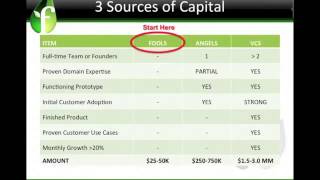
A venture capitalist breaks down three funding stages: friends and family ($25k-$50k), angel investors ($250k-$5M depending on location), and VCs ($3M-$10M+). VCs now avoid the middle ground, preferring either tiny early checks or massive later rounds. Approach them only with a full team, finished product, and proven monthly growth.
Chapters
There are 3 sources of capital in the world today. There's Fools, which are your friends and family, and you can raise $25,000 to $50,000, sometimes more. It's probably going to be a debt vehicle, so And they're probably going to have to loan it to you personally because there's all these laws about how someone can give capital to companies, things like OneVest is solving. But if you're just starting out and you don't know where to go, usually a good place to start is with friends and family, and they're probably going to have to loan you money personally. Here's the nice thing, you can get that money basically at any time, right? It's like, hey mom, I'm going to quit my job and start my company, can you loan me $5,000? And you get simple paperwork in place. There's actually a few companies now that are providing the tools and technologies to do that. If you search, you know, friends and family financing, we have a graduate that does it. There's some options there and they provide loan paperwork, etc., out of the box. The next group that you're going to go to— so by the way, just to be super clear, I strongly recommend that everyone raise money from their friends and family for one major reason. You need to get good at asking people for money, right? Raising money is asking people for money. Now, if you can't ask your friends and family for money, right, you're not going to be good at asking strangers for money, right? It's just— that's a fact, okay? If you can't ask your friends and family for money, you're not going to be good at asking strangers for money. So if for no other reason than just practice, you should get off the sofa get out of bed and raise a friends and family round. Now, by the time you go out to angels, you're going to need a full-time team of at least one person. You're going to have to prove that you understand your market. You're going to have some sort of functioning technology, and you're going to have to have some sort of initial customer adoption. If you don't have this, you can't raise angel money today, right? So this is the minimum that you need, and you can raise nowadays like $250,000 to $750,000 outside of major hubs, and you can go $750,000 to $5 million inside major hubs like maybe London, New York, Silicon Valley. These are minimums, right? It's not, "Oh, I got one full-time person and I'm a pretty good expert and I have a somewhat functional prototype, I can raise money." If you can get two full-time people and a functioning site, that's better. These are the minimums. Then if you want to go to VCs, You really, you know, over 2 is an understatement these days. Any sort of rule that you think you know about funding is gone. There are no rules anymore. What's happening is because the world's in flux, so what's happening today is VCs are moving earlier and they're moving later. And it's creating what's called this Series A gap. So you got a lot of people who will fund you at the early stages who were once venture capitalists that would fund you at later stages. And those same people, as well as some of their peers, are also moving a little later. And what's happening is they've created a sort of gulf where if you I want to raise like $2 to $5 million, there's not too many places that you can go to do that today. It's a lot easier for you to raise like $1 to $3 million and $10 to $20 million, but that sort of $3 to $10 million range is— there are not a lot of people who will fund you. Now, why is that? We'll answer what the minimum requirements for VCs are. Well, the reason there's that hole in the market is because people now look for home runs, right? So, like, Uber is a home run, Pinterest is a home run. You see these growth charts that are incredible, so this gulf has emerged because Once you start getting that traction, right, and once you start moving up the curve and your growth rate is very high, so doubling every few months or doubling every year, and your user acquisition and all this stuff is going up, at that point the venture capitalists want to put as much money as possible to work in your deal So they don't really want to invest $3 to $10 million in companies that might get the curve. What they want to do is give a lot of companies a little money and hope that they get that curve. And then once you start getting on that curve, they want to give you a lot of money, right? So there's this gulf really. And so what I would recommend is be very cautious dealing with venture capitalists because they'll give you money if they think you might get on the curve, and then the second you don't hit that curve, they'll never fund you again, right? They'll throw you away like trash, unfortunately. But once you're on that curve— and this is the nature of the business, right? And we're— so, and, you know, as a venture capitalist and an entrepreneur, it's just, that's what it is, right? It's not good, it's not bad, those are the rules. But once you're on that curve, you can raise as much money as possible. So there is this gulf where you think that your business might be doing well, but you're not doubling every year, doubling every few months, so your growth curve doesn't look great, ergo you don't get funded. So be very careful dealing with VCs. Understand what their motives are, and that will help you deal with it. So your best time to go to a venture capitalist is when you're on that growth curve. So you're going to need a full-time team, you're going to need a finished product, you're going to need proven company, and you're going to need huge monthly growth.