How to Attract Investors to Your Startup with Vinnie Lauria
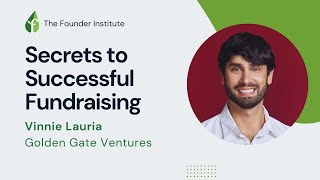
In this hour‑long Founder Institute webinar recorded on July 18, 2024, host Ryan Micheletti (Head of Global Operations at Founder Institute and GP at the Veteran Fund) interviews Vinnie Lauria, founding partner of Golden Gate Ventures. The session is a live Q&A aimed at early‑stage founders seeking fundraising advice. Vinnie shares practical guidance on the current funding climate, the importance of timing (being the first mover is often a disadvantage), and how to position a startup for angel and VC investment. Key points include: the market is “cold” everywhere, fundraising cycles are 2‑3× longer and valuations are depressed; pre‑MVP angel rounds rely on personal networks (friends, family, former managers); investors care about growth delta, month‑over‑month user increase, retention ratios (e.g., 20% DAU/MAU), and a realistic $100 M revenue runway rather than abstract TAM; typical dilution is 10‑30% per round with 20‑30% for a Series A, and advisor equity ranges from 0.25‑2% with a two‑year vesting schedule; solo founders are not a deal‑breaker but co‑founders provide emotional and operational resilience; diverse, complementary founding teams are valued; international expansion should be delayed until a core market is solid; patents are viewed as low value compared with execution; Golden Gate Ventures sources most pre‑seed deals outbound, looking for sector themes and strong teams. The webinar ends with Vinnie emphasizing a clear vision, culture, and hyper‑focus as the North Star for founders.
Chapters
Google wasn't the first search engine. Facebook wasn't the first social network. So when investors are writing those really big checks, it's usually not the very first idea of, you know, the only one doing it. And I actually had a VC say this to me when I was in the Valley, like, if you're the only one doing something, you're too early.
My name is Ryan Micheletti. I'm head of global operations for the Founder Institute. I'm also a venture capitalist and general partner at the Veteran Fund. For those of you who don't know Founder Institute, Founder Institute is the world's largest pre-seed startup accelerator. Over the last 10 years, I've had the pleasure of leading the operations team, helping us scale to over 7,500 portfolio companies across 200 cities with a mentor network of 35,000 mentors. I've run dozens of accelerator programs, invested in many companies, and, you know, I think the intention for today is really to get your questions answered around fundraising. So we decided to bring in Vinny, who's a fundraising expert venture capitalist and part of the Founder Institute's Venture Network to ask questions and answer your questions today. So in a moment, why don't we go ahead and bring Vinny up? We'll do a quick introduction, and then I will discuss and share what the agenda for today is. So Vinny, when you get a moment, come join us on stage and we'll, we'll do an introduction to the topic. Vinnie, it's good to see you. Thanks for joining us today.
Cheers. Great to join you as well.
Yeah, well, um, do you mind— maybe let's kick it off with just a really quick introduction on you, and then I'll go ahead and lay out the agenda.
Okay. So, uh, Vinnie Luria, uh, founding partner of Golden Gate Ventures, a VC firm that started in Singapore. We've now expanded from Asia into the MENA region. We launched in Doha, Qatar earlier this year. The name Golden Gate Ventures, the bridge, the local logo clearly harks back to Silicon Valley, and that's where our roots are. All the founding partners who spent time there, I've myself built two companies. So I fundraised on Sand Hill Road multiple times. I've gotten more nos than yeses, as, as would be the norm. Um, so I do have experience on both sides of the table. Um, that's definitely been the DNA of our firm, that we kind of really understand entrepreneurs, want to back great entrepreneurs, are pretty empathetic, uh, with founders.
Yeah, awesome. Well, for today, let me just kind of share a little bit about, um, what we'll be doing. So, um, for the members of the audience, you'll see, um, in the— there's a Q&A function. So there's the chat where you can kind of chat with other people, but then there's an actual Q&A section where you can ask questions for me or for Vinny, and we'll, we'll do our best to get to as many of these questions as possible. For the next hour, we'll just do, you know, the, the Q&A part to, to review these questions. And then at 10 AM Pacific, so in about an hour, we're going to kick off a networking session so that you and the audience can meet with other founders, investors, and people in a networking session, using this, this app we use, Airmeet. So, um, I guess to just to kick this off, I mean, Vinny, you've invested all over the world and we do have a global audience. I think we've got around 300 people who registered for the event today. Um, maybe could you share some, some advice or insights of maybe funding rounds in California or in the US compared to maybe Singapore, compared to maybe what you're seeing in MENA? Like, do you have any kind of insights that you would want to share with the audience?
Uh, sure.
Yeah.
Uh, so the one thing I can say is it's cold all around. There, there's not one place that is, you know, uh, better than the other. So basically, um, the US drives a lot of it, uh, the US economy. And so, uh, everybody's uncertain. Investors, institutional investors are uncertain. So money does not move as freely, and that trickles down eventually to even VC. So the one thing I will just say is, yeah, no matter where you're raising, it's going to be harder. It's going to take a lot longer. We had one company in Asia in the property tech space. They got 3 term sheets for a Series B, but it took 9 months. In a better market, that would've taken— So it can show they're a competitive company, a lot of interest, but normally would've been a third of the time. So expect at, you know, 2 to 3 times as long, valuations definitely being depressed, you end up raising less capital. The other thing I would say is if you've already raised VC money, historically, you know, A+ companies would always raise, but even B+ companies would be able to raise that follow-on round in terms of like their quality and still trying to figure it out. It is much harder these days. If it's basically you aren't top of your game, phenomenal unit economics, know exactly what you need to be doing, it's a harder conversation. All that being said, doesn't mean that investments aren't happening. We're investing. We just gave a term sheet to a company last week. VC money is moving around. It's just harder.
Yeah. I think that's good advice. And that kind of ties into a question here from Johar. Um, which is, what is the best strategy to convince angel investors to invest in you when you, um, do not have a functional MVP?
Uh, uh, great question. So basically, those angel investors are going to be people in your network. If I think of one of the first angel investors I had in my first company, he was a former manager of mine at IBM, um, and he's now invested across multiple companies. He's even invested in my fund. Us, he kind of built up that relationship, but that was one of his first experiences investing in startups. So the reality is for a lot of the, you know, pre-MVP, you're not going to AngelList and raising from people you don't know. You're raising from literally friends and family, former bosses, managers, uncles, aunts, friends. So that's usually what an angel round looks like. If you're a first-time entrepreneur, you don't have that sort of typical angel network and you If you don't have an MVP, it's going to be in great times or hard times. It would be incredibly difficult to do a cold email to somebody and, you know, land that sort of conversation.
Yeah, so the earlier stage you are, the less amount of capital you should be raising, and the warmer the people should be to you, like your friends and family, to invest.
Correct. And again, it may be like, but they don't do that, and that, yeah, that is That's the point. They're not startup angel investors, but they're saying, oh, I know you, I trust you, I want to support what you're doing. I will take that sort of risk and do it in a way that I can share some upside.
Yeah, that makes sense. I think that there's a lot of, especially for first-time founders out there, there's this misconception that you can raise money off an idea from professional investors, and that's just certainly not the case. I mean, it's extremely competitive. Out there. And unless you have a full-time team, a product, and some traction, you should really be— one, you probably shouldn't be focused on fundraising. You should be focused on building a team that could then build the product that can then get you to some traction. But if you need a little bit of capital, that capital is gonna come from your friends and family. And so that— I don't know if you— go ahead, Vinny, if it sounds like you wanna add something to it.
I was gonna add, 'cause I hadn't heard that in a little while, but The thing is, I do, I used to hear that all the time. I still hear like that people think that they can just raise off an idea. And again, even in like bumper times or money moving around, that is not the case. So like people see things on TV or Shark Tank or something, but even Shark Tank, like people have a product, you know, there's revenue there, there's something built and it is so cheap to build something today. So cheap. And yeah, you as a single founder or you have two co-founders, you should be able to do everything, develop the product, do the marketing. You know, do the design, do the email campaigns, buy the AdWords. You need to wear all those different hats and you should be able to do that on a razor-thin budget. My first startup, Mitro, we were 7 guys living in a 3-bedroom house. So our only expense was the rent in Palo Alto off University Ave, which is a little high, but for 7 people it was manageable. And ramen. And then everything else, we were just coding and developing and building. And so we had 8 months of runway that way. Um, so you need— and, and we had to launch product and users before you're raising any capital. So for the past few decades, that has always been the case.
Yeah, I, I think that's a really good insight. I mean, you know, a lot of people think they need capital to get started, but the reality is like, you don't. It's very easy to get— I mean, it will require a little bit of your own capital, but you know, if you're not willing to put in some money into your company, whether it's time or sweat equity or, you know, $1,000 to incorporate incorporate, you probably should not be going down this pathway because it's going to take a lot longer and be a lot more expensive than you think, right?
And the one thing else I'll say, use the word easy, it's not easy, like, I don't want to— so it's, it is, it's difficult. And, you know, uh, for 1,000 companies that apply to us, you know, there's a few hundred that we might meet with over a year or whatever. So like, you know, just only 10% we get that land that meeting Out of that 10%, it's another 10% that land something in terms of investment. So it's generally less than 1%. So it's not easy, but it's doable.
Yeah. And I think the more passionate you are about what you're building, the more likely you will be to basically survive through those odds. And that kind of ties into a question here from Mohammed, which is really around He's asking, what kind of data do investors look at into startups when they're assessing whether or not it's worth investing in? I think, you know, what are you seeing, Vinny? Like, you know, it depends on the stage, right? Maybe you could share a little bit about your experience here.
Sure. And just give me one second. I have a few things popping up that I just want to close so it's not a distraction. Could you bring that question back up? Is that possible? Yeah.
So, so what, what kind of data do investors look into in a startup to assess if it's worth investing in?
Sure. Um, so this is where, you know, there's no, there's no absolute number. Like you want to see this many users or anything like that. And it's so vertical dependent. And as you mentioned, Brian, stage dependent. At the end of the day, I think the, the metrics that I share is it's around that delta, the growth, that change. Basically, investors just want to see change. So is there a month-over-month change? So whether you have 200 users, 2,000, 20,000 users, it's the story that you're going to look. We've had this sort of hockey stick growth curve on users, or for every user we bring in, they bring 2 because they're telling their friends. There's a social element. So what you're lucky about is there's no bar in terms of size. The bar is in terms of that growth rate. And that growth rate needs to be consistent. And think about gravity. Gravity is a consistent force, but it means you go faster and faster and faster. So that is ultimately what an investor is looking for. So, you know, things like 20% month-over-month growth. When you're really small and really early, that should be easy. Like it should be 50%, 60%, you know, it should be just really having this hypergrowth sort of curve. If you're a mobile app, you want to see the relation of users coming back. So like a quick metric, your daily active over, yeah, daily over monthly should be about 20%. So at least 1 in 5 are coming back. These ratios, sorry, weekly over monthly. So 1 in 5 are coming back every month. These ratios just help us understand, do you have that product market fit? Is there traction? Is there retention? There was one company, so really famous company, I mean, they're unicorn now from Singapore, Carousell. It's the eBay Classifieds of Asia and again, multi-billion dollar company. But when they started and I met them, their traffic on Google looked like a heart monitor in a hospital, you know, like the beeps. And when I saw it, I was like, I know exactly what that is. They're like, what? And I was like, I had this at my last startup. You have a retention problem. Those beeps, that's when you do press and news and, you know, some blog covers you and you get a bunch of new users and then atrophy and it just dies off. And that flatline isn't retention. That flatline is actually just low churn. Um, and I was like, you just need to focus on retention features, things that would get people coming back, notifications, even, even email today still works. And back then that was a big thing. So again, for an investor, what we're going to want to see is growth. Is there retention? You know, basically for every user coming in, are they staying? Are they engaged? Do they like it? And then with that, depending on the vertical, the stage, the geography, the competitive nature, there's going to be a million other questions, but that is a basic framework to have.
Yeah, I think growth and momentum is really important. I do want to just quickly share this. I put it in the chat, but I think it's worth kind of sharing with everyone. So if you go to fi.co/benchmarks, this is what we typically see when it comes to fundraising. And like the first thing I'll say is there is no like set in stone rules, but there are indicators and there are things you're looking at. And so depending if you're pre-seed versus seed versus Series A, you know, you're going to have different metrics and different kind of categories that might be attributable to you. And so some things that, you know, you could look for in the pre-seed traction, you know, if you're SaaS or deep tech or consumer audience, I recommend kind of taking a look at this, right? Poking around and just realizing like there should be two things that are clear. One is that, you know, even if you're like pre-seed and you have like no revenue, but you're trying to raise capital, you should at least have, you know, two team members. You should at least have an MVP with some users. You should, you know, you're probably gonna raise less than $1 million and your valuation's gonna be, you know, 1 to 6 really depending on where you are in the world. And so in order to raise that pre-seed round, you should have some paid pilots. If you're doing deep tech, you know, like we had a quantum computing company that raised a couple million dollars without a product because it takes millions of dollars to build a quantum computer. But you can kind of see here that these are just benchmarks that you can track against and make sure that, you know, you're tracking in the right way compared to other companies that are also vying for the same investment dollars that you're looking at. So let's keep going down here. So there's another— so again, this kind of, it's a little bit repetitive, but I think it's worth doubling down on, which is what are the top 3 to 5 things that investors seek when being pitched a new product or idea? You know, it looks like she's got a clickable prototype. It has feedback from customers?
So it's a great question. My view, and it may be I'm a little skewed because I'm out in Asia, so my bias is the markets Vietnam, Indonesia, they tend to be years, if not a decade plus behind a lot of other parts of the world. My view is they basically want to be able to point to something else that's similar to that. And so while that I can say with 100% certainties in Asia, it's like a lot of— I don't want to use the word copycats, but people are looking to approach in the parts of the world. That even in the US, that is the case. Google wasn't the first search engine. Facebook wasn't the first social network. So when investors are writing those really big checks, It's usually not the very first idea of, you know, the only one doing it. And I actually had a VC say this to me when I was in the Valley, like, if you're the only one doing something, you're too early to the market. So in terms of, you know, what does that MVP look like? I think if it is something so novel and so new, if it's a web service or mobile app and it doesn't exist anywhere in any form, you're actually gonna have a very uphill battle. Now, if it does and you're saying, we're going after this because it's legacy, you know, it hasn't been updated in 20 years, it's the airline luggage software network, we wanna replace that and, you know, it crashes when it gets over 10,000. Like, if you can point to like, it exists and these are the problems and this is, you know, our solution to it and we already have some customers that really want this, that's really, really powerful. Or, You know, there's competitors to Twitch that have definitely started up and gotten funded. So the ability to say like, hey, we're like this, but we have something more, we're doing something different, they're missing the bigger picture, they're not partnering, or they only exist on platform, we exist off and on platform. There's always an angle there, but you're usually gonna be, wanna be able to point to something.
Yeah. Is there anything else that you would share? Like, you know, Well, let me put it this way, right? So there's a couple of questions here that are really asking the same thing, like, you know, what do investors look for before investing in your business? What do you look for in non-tech startups you invest in? And I think there's a couple of things to be really clear about, at least from my perspective. Vinnie would like to hear yours. And we said this at the beginning of the call. Before you go out and try and raise investment capital from professional investors, you really need to have a full-time team that's working on your startup. You need to have a product that you've built. It could be an MVP or a prototype, and you have to have some kind of traction. And it varies depending on what industry you're in. Again, deep tech versus SaaS versus consumer. But those are really the table stakes to raise capital. And the reason why is Vinnie, you said you get 1,000 deals a year. I'm sure you get more than that in inbound, but you're only going to meet with 100 and invest in 10, right? So if you're looking at, you know, be like, can you, for the founders on the call, can you honestly look at your company and say, I'm in the top 1% of companies that are talking to this investor? The truth is that if you don't have that product and don't have some kind of traction, you probably aren't. And so you need to take the right action to become in that top, you know, 1 to 10% to get the attention of those investors. Because there's a lot of companies that are out there, and that's something that we focus on a lot, both in the Founder Institute core program where, you know, we help you get to that traction and funding point, but also in Funding Lab, which is the program I run for our alumni, helping them raise capital. And so really, you know, there's a lot of different ways that you can get to the team product and traction stage. Maybe you raise a little friends and family round, Maybe you spend a lot of time just really building out the right team that can build the product. But I would strongly recommend until you hit those metrics of team, product, and traction, don't even waste your time trying to raise capital because you're going to waste months and months of your time. It's okay to talk to investors, but don't tell them you're raising capital yet. Build those relationships, and then when you're ready, you'll have those relationships ready to go. Vinnie, thinking about more of the pre-seed and seed side, I mean, do you have anything you want to add to that?
Uh, yeah, so it's reminding me of something I say all the time, which is investors don't invest in great ideas. And I remember when I was an entrepreneur, I really thought I was like, I have a great idea, I have a great product, I have a great offering, I just need to get this in front of an investor, any investor, and that's what they want. Uh, yeah, and see, you're laughing, but yeah, I remember, uh, it was the same with me.
It's, I don't, what, I mean, is this like the Shark Tank effect or like, you know, why is it that like when you first start off, you just think like, oh, I've got this killer idea, let me go and get money. Like it seems systemic.
Yeah, this is, so for whatever reason, you know, how we learn about things in school, how we think funding works or whatever. Yeah, you're right. Like it's the norm. And so only after now stepping over the other side, being on it, it's so clear, black and white. So then to share with everybody tuned in, investors have a really specific thesis framework, things that they're looking for, and you need to understand that. So number one, the first rule of sales is you don't actually go in and sell something. You go in and you ask a ton of questions. What is it? You know, you like, what is it you don't like? What is it you want to buy? And if you think of the investor as a buyer and you're a salesperson, but you use 20 minutes to kind of qualify what, and you can do your research on their website before that, what is it that they want to buy? And that is really, really helpful. And so, you know, easy ways to say like, you know, I'm not ready yet would be stage. You're talking to a Series B investor or seed company that's, you know, they're not ready to buy, or you're building a consumer app and they and the VC mostly invests in B2B SaaS, they're not gonna be sort of a good fit. So to understand not all the VCs are the same, number one. Understanding how to position yourself. And then the third piece of advice, I did not realize this early on. I used to think, you know, my last company was an online community platform, LaForo. And so if you're in the community space, forums, message boards, again, this is dating myself now, it's 14 years ago. I used to think if any VC had some exposure to that space, we didn't want to speak to them. They've made their investment. But now what I realize being on my side, if they have some exposure, if it's a direct competitor, they're probably not going to talk to us. But if they're exposed to that space, that's actually the best investors I talk to. They understand it. Hopefully they like it. They know what works. They can, you know, to an entrepreneur, they can give a lot of feedback and advice. So your kind of hottest targets will clearly be around stage, but it will also be like, have they invested in kind of similar companies around this space? And if they have, I would move them to the top of the list.
Yeah, really, really good feedback. There's a question here from Deepa. You know, she says, hello, Vinny, is there a minimum market size in USD for investors to invest in? So think of TAM, like when you're looking through DEX, like I guess what is like the floor of the TAM that you think would be reasonable for a company to try and go after?
I think I would think of it this way. I know investors, we ask that it's on things. At the end of the day, you can make TAM anything you want. I mean, you can think really big, really easy, but basically investors need to see it's a billion-dollar idea. So they need to see that's $100 million of revenue. So the question you should be going into it is how can this business make $100 million of revenue within the next 10 years? And if you can put together projections like that and they're, you know, uh, realistic, uh, yeah, optimistic but realistic, um, with the idea that the, that the market is growing, this is a new sort of space, a new opportunity, um, you're going to have a conversation. So it's less about what is the total addressable market size, it's Can you build a $100 million business within 10 years? And if the answer is yes, you're going to have good conversations with VC. The answer is no, you're going to get VC saying things like, this feels like a lifestyle business, this feels more private equity. And that sucks. I've had VC say that to me and that sucks. You're like, this is a huge opportunity. What do you mean a lifestyle business? But at the end of the day, the way that— so here's another tip. Like, I did not know this. I'm just I'll have to give out any sort of advice now that I've learned along the way. We invest in 20 to 30 companies per fund. We launch a fund every 2 years. So the hit rate for us is 1 in 10. And that's why we need these billion-dollar companies, $10 billion companies, because the reality is an entire fund is returned from 2 to at most 3 companies. And there's a lot of failures in there because we're taking huge risks, so there's huge failures. So that is why for every investment, we're not saying, "Oh, this is a safe bet and it could be a $100 million exit." We will pass. If it can't have this billion-dollar potential, so the $100 million in revenue, then we're saying, "That risk-reward ratio just isn't there and we're not going to write a check." That is how the VC business works. We're looking for that incredibly high risk, incredibly difficult disruptive. And so the chance that, hey, there's a greater than 50% chance this may not work, we might be willing to take that because of the potential reward.
Yeah, um, let, let's unpack that even further because there's, there's sort of the top-down approach of TAM, like what's this big market size, and then I 100% agree with what you're saying, Vinnie, about like more the bottoms-up approach of like, okay, how can you realistically get to that $100 million in revenue What are the assumptions around user acquisition? What's the price per user? You know, what does that growth look like over time? And so, and that's one thing that we really emphasize in the program is going bottoms up with that, with that approach and looking at that. Is there anything that, that you would recommend when they're, when they're looking at building up those financials? So for example, I mean, you've probably seen, you know, models where it's like, hey, if we just capture 50% of the market, then we're gonna, you know, be at $50 million in revenue or $100 million in revenue. But I mean, that's a pretty aggressive market share. Do you— is there anything that you would recommend to the founders as they're thinking about that 10-year journey? Because a lot can change between year 1 and year 10 in terms of revenue growth that might be helpful as they plot out their startup journey.
Great question. I am, different investors have different philosophies or whatever. I would be the very bottom up where I don't want to see that overall market size and you claim you just get a few percent of it. That's maybe the conversation starter, but I want to see, hey, this is projections that we have for the next 10 years and how we get to $100 million in revenue and assumptions that we must have. I am much more that direction because I think you can make a market very large, very easily by going into side businesses and stuff like that. So I definitely hear that they want to see this $100 million and get a few percent of it. That's not going to capture my attention. It would be the bottom-up sort of approach that these are optimistic yet realistic projections.
Yeah. And I mean, you know, when you're looking at using or at user acquisition in those projections, um, you know, it, it does tie into the founder's go-to-market strategy. And I think, um, one of the things that I've seen is, is a lot of attention— and maybe this is like the Shark Tank effect— but like a lot of attention is put on the pitch, a lot of attention is put on like the product and even like, you know, customer development. Um, but where I see a big gap, at least in the early stages, is like, go— how are you going to go out and acquire customers at scale? Like, what is that killer go-to-market strategy to, to get to the traction needed to start building up to that eventual $100 million in revenue? Um, it depends on the industry, whether you're consumer, B2B, deep tech. Um, there's a lot of different strategies out there, but have you seen— have you come across any interesting go-to-market strategies that have maybe emerged recently, whether it's due to AI or maybe like new business models, uh, product-like growth, those sorts of things that, um, founders should maybe be aware of?
Um, good question. So have I seen? Nothing is sticking out. That's not to say that there isn't. The way I look at it, and again, I remember being on the other side, that was the, what's your get-to-market strategy? And that was like 2 to 3 slides of our deck and spent a lot of time with that. As the investor, the way I look at it as this is a billion-dollar idea, you're going to have competition. So what, how smart savvy are you to move faster than the competition in terms of all these channels? So it is less about show me the real creative and something new and more of show me that you've done your research, you're mature enough, you understand all the different channels you're going to need to hit and which ones you're starting with now. Which one's gonna do later? Do you need to hire to support that? At what sort of timeline? So that's how I look at it is it's almost a, how do you beat the competition slide? Because yeah, you know, you could literally ask ChatGPT, this is my startup, what's my go-to-market strategy? It's gonna give you a printout of exactly what you need to do. So now, again, you can plan anything very easily, but actually doing it is executing on it's different. So that's where I'm going to press you and see the questions and understand what your assumptions are for these different channels. And can you beat out your competition?
Yeah. Let's go to our next question here. So this is from Ibrahima. Is being a solo founder a showstopper for investors even though key strategic partnerships are built?
So great question comes up. It's not a showstopper, but I, so I'm used to be pretty active in the Founders Institute when I was starting, know ADEO very well. And ADEO was always like, if you can't convince another person around your idea, how are you going to convince an investor? And that's always resonated in my mind. Same sort of thing. If you can't convince somebody to give up their time and resources because this is a billion-dollar idea, you're going to have a hard time for an investor. So that is one way to look at it. The other way I will look at it— I saw a few thumbs up or hearts— the other way I look at it is like, you need to build a team and you need to influence people. And the reality is a startup's really hard. You have ups and you have downs. So one, you need a colleague, an ally, a partner to go through those ups and downs with you. Because at the end of the day, I, you know, I won't— we're friends, I'm an investor, but Investors are always going to be on the other side of the table. You're not going to be able to tell an investor, I'm about to run out, you know, I'm really stressed about this sort of cash runway. Like, we'll talk about that, but you won't be able to emotionally open up. You can do that with a founder. You can even do that with a competitor because the market's so big. Like, even competitors in my companies, we used to pitch at times. You know, maybe you have to fire somebody or really difficult sort of situation. Again, that might be hard to turn to your investor. You can, I've had those conversations with founders that are going through it the first time, but having a co-founder really makes sense. That gets through the hard times. And then at the end of the day, let's talk about like the CEO-CTO relationship. That's pretty much the magic basic pairing that you need for a founder. If you're a CEO and I just started a startup today, you know, CEO at the top, and then there wasn't even a CTO anywhere. They were like all the way down the side, too many layers. And that's the problem. Like if you think of yourself as the one brain of everything, you've kind of set yourself up for failure. You need a CTO to challenge you in terms of resources and spend engineering time, data center time, whatever that might be. So they need to have buy-in to the vision and the product so that together you're challenging and counterbalancing each other. If it's purely top-down from a CEO, you're going to run into huge problems.
Yeah, I agree. It's also a single point of failure, right? If that CEO gets hit by a bus, and there's been scenarios I've seen where things like that have happened, it's hard for the company to—
Continuity.
So yeah, thank you for sharing that. There's also, there's actually data out there that solo founders tend to have a higher failure rate Investors are well aware of that. Part of it is the stress, part of it— and Vinnie, even for you on the VC side of this, right? How much more difficult and how much less fun would you have if you were a solo GP and you didn't have Jeff or some of the other people on your team to work with? I think there's this camaraderie piece of having a co-founder or having this really close-knit team around you. That just makes the journey a lot more enjoyable and easier to manage.
100%. And so, yeah, I'm part of a partnership. So yeah, so where Jeff and I were co-founding partners, the partnership has now grown to 5 partners and we complement each other and we're stronger for it. I've even used like the Marvel Infinity Gloves sort of like ratio, like we all bring something really unique and together it is like super powerful. So yeah, I'm a big believer in that. And Jeff Dean, who started the Founder Institute in Singapore, we're opposites. Opposites attract. I'm not even that extroverted, but I'm just being American in Asia, just more out there and a bit more boisterous. Jeff is much more reserved. He's much more analytical. So he's the left-right brain, the analytical. I'm more of the intuitive sort of guy. Together, that's a really magical combination. Yeah, so I'm a big believer of opposites attract and they're, you know, that 1 1 3, you get way more value out of bringing people complementary. And to that point, like, if you look through our portfolio, it's an incredibly diverse portfolio. And I say that because I see the opposite of that in Asia where they'll only invest in a certain type of background. That could be a class sort of background, that could be an ethnicity sort of background. I see that even in Silicon Valley. I mean, there are VCs on Sand Hill Road that only invest in Stanford grads. That is really homogeneous sort of pool. And yes, there's a lot of really smart people that come out of Stanford, but like you want to have diversity across your portfolio. You want to have diversity of founders. Diversity in the team. That's where innovation comes from. I'll only say that I'm seeing some hearts, like saddens me, like all this stuff that's happening in the US where they're pointing about like inclusion at the board level and that's why companies are doing bad. Silicon Valley is all a mix of people and it's, that's what makes Silicon Valley so magical. It's basically, it's the Hollywood for tech. It's this giant magnet. It brings founders from every corner of the world, Latin America, Eastern Europe, like, "I want to make it there." And it supports that immigrant sort of entrepreneur. Kauffman did a study, a foundation of the US, 51% of all startups in Silicon Valley have at least one foreign-born founder. And then when you look at companies that have gone public, whether that's Facebook, whether that's even Apple, There's a foreign-born founder as part of the story. So really, really big in this idea of diversity in the team and complementary background. Don't all be the same.
Yeah. You know, a question here so we can get into a little bit more of the equity side of things. So Ayokunle is asking what amount of equity or advisory shares is appropriate to offer board members during pre-seed rounds? So maybe we, maybe we could talk about, you know, how much dilution per round, like maybe you could share some insights there and then we could focus it on, on pre-seed.
For advisors, um, I mean, that is a range. It could be anywhere from as small as a quarter percent to up to maybe at most 2%. Um, and I would say with, it's really important to put like an advisory agreement Literally, again, you can ask ChatGPT, give me an advisory agreement for a startup. This needs to be 2 pages, maybe at most 4 pages long, but it should outline like this equity, you know, it will vest over a 2-year period. It's, you know, 4-year for employees, but for an advisor, maybe like over 2 years. And we're expecting, you know, to join quarterly calls, in-person events, meetings, or weekly meetings, whatever that might be. You know, just outlined that. Um, but yeah, so on the lowest end, that's a quarter percent, and that's somebody who's like very low touch, is a great name to kind of market, put on the deck. Um, and even that, sometimes it's none, you push like write an angel check, write a small check. Um, and then at the most, I would say like really high touch, 2%. Um, I mean, there might be cases where it goes higher, but I think that that's definitely fair.
Yeah, I just threw a link in the chat to our FAST agreement, which is the gold standard for using, you know, advisor-founder relationships. Um, so take a look at that. And then, you know, in terms of equity and dilution, right? I mean, how much should founders expect to be diluted per round of funding?
Great question. So this is where I look at like valuations. It's crazy to me that Some VCs will spend so much time on the valuations and the modeling, and we can all do that to push a valuation up or push a valuation down. But at the end of the day, the reality is if you're raising a round, it is 20 to 30% dilution. Okay, you're going through like a Y Combinator, then that's 8 to 12% or whatever. Maybe it's an angel round, people will be okay with like 10%. But once you start raising a formal VC round, you're doing a Series A, 90% of the time it's going to be 20 to at most 30% dilution. Anything more is actually kind of scary. Like, that's not really a good VC, you know, like good VCs aren't asking for more because they don't want to be running the company. They want to be clearly a minority. So expect 10 to 30% per round. And when you start doing really well and you get those later rounds, Series B, that's where it can start dropping to 15 and maybe as low as 10%. uh, but definitely for, you know, that, uh, formal seed round, if there's an investor coming, a VC type coming in, or Series A, 20 to 30%. Yeah.
Um, there's a question here, uh, it's along those same lines. Lenny is saying, I'm afraid that investors could take the company away. Are there tips or strategies to avoid that? Such as like investor equity percentages. Maybe you could address sort of the fear here and what happens in reality.
So just want to— things keep popping up on my screen and closing up. You know, the one thing I want to say is like, make a great company. So I'll go into like investor— we're not interested in taking companies at all. But as long as somebody's making a great company, you're going to have investors very interested in supporting and putting in more money and bringing in great sort of partners and great talent. And so if the goal is to make a great company and you can actually achieve that, you're not going to have issues with investors. And even if you had some predatory bad investor in the beginning, if you have a great company, You're going to bring great investors around you and they're going to help you remove that sort of— buy them out, whatever that might be. So again, I think the easiest way to avoid that is build a great company. Now, where things get hairy is where things don't go as planned. And then again, a really great investor is just going to be willing to write it off. We know 30 to 40% of our portfolio is going to fail, so we're not going to spend time trying to squeeze those few droplets out of that lemon and just, all right, we'll try a few things that are constructive for everyone around. Maybe we'll hire, but if not, then we're okay just walking away. Where you're going to see things get painful is maybe then if it was only an angel round with some angel investors, their expectations, they're not typical tech investors. Their expectation might be like, I need my money back. So that's where you want to be pretty clear up front of risks that they would be doing. Um, I've definitely seen predatory investor behavior. So predatory investor behavior would be, um, trying to shut down a company to get cash back. Um, I, I've seen where CEOs tried to be replaced. In all the cases I've seen where I'm on a board, or I, I'm even sometimes like for that decision, there's always major sort of issues on the CEO. I have not seen a case where it's a CEO that's doing well and the board's trying to replace it. And the issues then that you generally have are not clear financing or money that's kind of like leaving the door. Like it's the really negative sort of issues where those conversations happen, not because somebody's saying, oh, the product didn't take off, we need a new CEO. Usually very questionable behavior that's happening. And then the other scenarios I have are probably when there's a VC that invested on an idea and that idea is not doing well and the startup wants to pivot. And I would say investors fall into two camps where they're, okay, we backed you as a person, you want to pivot, go for it. And that's the majority of VCs, but I've also seen VCs that are like, no, we backed that one idea. Yeah, you're pivoting, give us our money back. I don't think that's helpful to anyone around, and that puts on pressure for all the stakeholders. So going back to how do you avoid that? Build a great company, number one. But so that doesn't feel too tongue-in-cheek, I would say make sure you're bringing on good people, you know, VCs, brand name, ask around, they have good reputation in the in the market. They've done this, they know what they're doing. This is not a first time out in left field sort of investment for them. And then bring in, just like you want a team that complements each other and co-founders, bring in complementary investors. So no one investor has outsized sort of weight. A lot of times when we do deals in some of these really local markets like Vietnam, we're looking to bring a local Vietnamese investor on the cap table alongside of us. They were taking two-thirds of the round, they're taking one-third. But now you have different stakeholders, different opinions around the table. Again, I see that as a really valuable sort of thing. So as a CEO, you can engineer that and say, at every round, I want to bring in these two different sort of complementary investors. They're independent stakeholders with independent desires. And if things were to go negative, I'll trust that independent people are going to make good decisions. I'm very free market in that sense.
Yeah, I think that's good advice. There's a question here from Saber. Uh, what advice do you have for startups looking to scale internationally? Um, how can they effectively navigate the challenges of entering new markets?
Uh, great question. So as somebody who invests in a lot of international company, I would say don't think international, you know, in your first year or maybe even your second year. And when you start thinking international, it's, you're not thinking internationally, you're thinking, what is my next market? And so, you know, if you're launching in the US, you definitely don't have to think of another market for at least 2 years. If you're launching in a smaller country, you might need to think on a shorter horizon. But the reason why I'm saying don't do internationally is a few-fold. So like, you need to have this get-to-market strategy, you need to have a network effect that's easier when it's kind of concentrated around certain geography. People start hearing the brand or talking about it, or there's press or whatever. Investors were very geographic-focused. I used to think it's like in Valley, like Again, VCs will invest in great ideas or even Golden Gate Ventures. I used to think we were going to have a lot of Asian startups that get Silicon Valley VCs to follow our investment because of our network. But that's not the case. As an investor, we want to invest in what we know that tends to be around us, our backyard. I want to know what big giant company is going to be competing in this space. I want to know what founder is about to be a founder that's going to build a company in this space. With a company. So there's a lot of like gossip, you know, uh, word of mouth, like backroom chatter that's happening, that happens very, very locally. Um, so that's another thing to just realize, that you're building an international company, it actually makes it a little bit difficult early stage to find the right investor because you'll meet investors in the US that say we're focused in the US if you have revenue, you know, heavily revenue from Europe, um, or you're a US company and you're split between Europe and the US and then You go to Europe and they're like, oh, but you're a US company, you should talk, you know, show us a US lead and then come back to us. So it tends to be early stage, very geodomain.
Yeah, there's a question here from Warren about, you know, revealing ideas without a patent in place. And I think the underlying question is like, is someone going to take my idea if I start talking about it without having like intellectual property? So Two pieces of this, like one, what's your opinion about people stealing ideas? Like, do you see it? Is it common or is it just like, again, sort of a systemic fear for first-time founders? And then two, like maybe we could talk about patents and how you look at patents and in your investment decisions.
Sure. So my view, there's no new ideas. Like there's no new ideas. So to me, it's all about execution and building upon something. So I have that view. I've never ever looked at a company having a patent as something valuable or I would put value on. I kind of look at that, that's just for like predatory patentories to sue the large tech companies, get them as a defense mechanism. They don't get them to build value. So the other day, I'm looking to invest in value growth creation. And so now, that being said, I have definitely seen in some markets in Asia where, again, it's not a VC, it's a family office, a conglomerate, a corporate, you know, in China, in some of these countries, You have a few families that run 80% of the country. I definitely seen things where stories of, yes, somebody pitches and then they're like, no, I don't want to invest, I'll just build it myself. That happens. But 9 times out of 10, that doesn't get very far. If somebody doesn't have the drive and the passion and they just heard a pitch and that's where they're going to copy it, it's probably not going to get very far. And again, I would really challenge There are no new ideas. I would challenge somebody to give me an idea that I have not come across before.
Yeah, good advice. Let's see here. There's a lot of questions around— Yeah, so, all right, let's go back to this kind of international expansion piece. Shubham is saying that His startup is a mobile app. They've achieved significant traction with 20,000 users globally. They're now looking to expand into the US market. Is there anything specifically to entering the US market, like key strategies or steps that they should take for being an international startup going into the US?
Great question. So I would pose a question to that question, which is, do you want the US to be your main market? And if the answer is yes, then you got to move there. That's the simple answer. I live in Vietnam because I'm saying Vietnam's going to be— or expand. We as a fund, we're doing more in high-growth emerging economy. I need to be on the ground. So to me, if the US market is a market that you want to be a majority market for you and you want to compete in, you have to be there. Clearly, there are exceptions to the rule, but if you're going— if it's a good idea, an opportunity, you're going to have competition. And if the US is the market, then you're going to have competition in the US, and then that means they're going to hire people in the US. That means they're going to have business development in the US, they're going to have distribution, they're going to have money— raise money from the US. So you're just— you're at a disadvantage if you're competing If the US is a minor market, now that is my question. If the US is a minor market, that also is kind of hard because if you've been able to build a really valuable sort of business in other parts of the world, then it should be able to be really valuable in the US. And that is a high spend, high income sort of market globally. And again, so then somebody's going to build something there. And so if you just have your toe in it and somebody's focusing on it, then you're never going to win it. So I almost look at it as like, if you're looking at the US, it's black and white. You need to hop and move there. Yeah.
Going back to team, there's a question here from Fabiano. Where do you look for early stage technical founders. So any advice for team building specifically on the technical founder side?
So that question being like, I'm a CEO, where do I find tech co-founders? Go to tech meetups, you know, go network at really nerdy events, Python, AI, things that you may not be totally familiar with, but you're going to start meeting some people there. And then my whole thing with networking when you go to events is like, be the most interesting person in the room. Like, you don't need to talk about your startup or pitch about your startup. That's what everybody else is doing and it just gets lost. Like, tell the funny story of what happened to your dog walking out the park today or whatever. Just like be memorable, like make some like informal sort of connections, see people over a few times, build a relationship that way. And then you pitch the idea like, hey, you know, you I like you, you seem to be technically really bright. This is something I'm working on, would you be interested in maybe partnering up? Because at the end of the day, you're gonna— it's all about— if you're a CEO, it's all about influence. And so you're gonna need to influence that other person to take that risk. It's not like you need to find somebody that has the exact same idea as you. You know, find somebody that, you know, it's like a marriage that you want to spend intimate, a lot amount of time together. And they may be open to getting behind whatever vision it is that you have. So that would be my approach to finding a technical co-founder. I would just go to every sort of tech event I could meet, could be pretty open about it, you know, like, hey, I'm working on something, it's a little too early, so I just wanna meet people in this space and maybe we can think of something together. And then, you know, just like dating, you know, take a few sort of interactions.
Awesome. Well, I know we only have about 4 minutes left, so we'll get to a couple other questions here. Um, let me just see what, um, for— maybe we could talk a little bit. I think a lot of the founders here are more like the pre-seed stage. Um, what— one, do you guys invest in pre-seed? And then two, like, what sort of, um, indicators or things do you look for at the pre-seed stage that would get you excited to invest in those companies?
Sure. Yes, we invest in pre-seed stage, but almost exclusively it's outbound. So there are certain themes or sectors or verticals that we want to invest in. And so then we will go out and we will knock on everything that is door of everything that's early stage. So these could be companies that have raised seed money. This could be, again, it's very geographic-based. We're asking around. I'm telling friends, investors, our LPs, our investors, competitor investors, our CEOs, like, I'm looking to invest in this. And we've done so many deals that way where it's literally somebody who's like, oh yeah, I know this person and they're thinking about quitting this job in this space. Why don't you meet with them? And so I would say a lot of our pre-seed is actually outbound from us. That 99.9% of the time, if it's kind of pre-seed, our focus, we say early stage, our focus is kind of Series A. If it's inbound, it's generally going to just be a pass. And I look at it as there are, you know, like a 500 Startups that does 500, you know, startup investments. Those are great sort of things, or, you know, Y Combinator or whatever to kind of pitch and they really take a look through everything and they're willing to. But once you start talking to a more Series A-ish investor, that pre-seed is generally going to be more outbound or founder bet. We've had founders in our portfolio or people that were really senior that broke out of a company to start a new company. That's what you'll end up seeing for the pre-seed from a Series A investor.
Yeah, that's helpful. Um, before we kick off the networking session here in a minute, what final advice do you have for founders who are on the call today when they're looking at fundraising or even just building their companies?
Um, stay hyper-focused. Um, you know, have that vision. I'm a big believer in vision. Takes you really far. Like, even so I can talk personally, like the vision of Golden Gate Ventures is to be top VC in emerging startup ecosystems. And where we started in Singapore, that's what took us to the Gulf region because that's an emerging startup ecosystem. There's more money that's moving around there, there's more activity that's happening. So to set a big vision that's flexible enough that over a decade or 15 years can really grow the company. I think is important. But, you know, that vision shouldn't just be like, I am the everything app for everyone. There needs to be something kind of tied into what you're building and that becomes a North Star. And it's not only for where you're going to open new business, but it's going to be how you hire employees, what you talk about in an interview, and can they get behind that vision and align with that vision? Because ultimately, if you're building a fast-growing startup, It's about you scaling yourself with phenomenal top-tier talent around you. So that vision, the culture is so important.
Yeah, Vinny, great advice and thank you for joining us today. We're gonna go ahead and kick off the networking session. So for all the founders here, you're gonna be, after we end this session here, you're gonna be brought back into the networking room. Where you can either join a table with other founders. You could also do speed networking where it matches you one-on-one with individual founders. It's a great way to kind of meet new people and see what others are working on, potentially find co-founders. Vinny, really appreciate you joining us today. Thanks for sharing your insights. And yeah, founders are interested. We're enrolling in many different programs all over the world to help founders get through this idea and pre-seed stage to traction and funding and beyond. So looking forward to meeting some of you here shortly, and we'll talk to everyone soon.
Sure. And I was gonna say, if anybody does wanna reach out to me, just Vinnie Lauria on LinkedIn, can drop me a message there and follow up. Great.
Thanks, Vinnie. Good to see you, man. Take care.










