How to Raise Capital for an Impact Startup: Best Practices from VCs & Founders (August 2022)
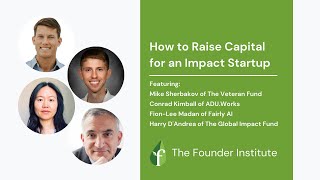
Mike Shcherbakov, Conrad Kimball, Fiona Limadhan, and Harry D'Andrea discuss raising capital for impact startups. They introduce the quadruple bottom line (profit, people, planet, purpose), explain how to find aligned investors using Crunchbase, and cover impact measurement through UN Sustainable Development Goals and custom KPIs.
Chapters
Hello everyone, and welcome to the Founder Institute event on Impact Startup Fundraising: Best Practices from VCs and Founders. We have a fantastic panel of startup leaders from the FI network for you today, and I'm excited to kick things off as your host. My name is Ryan Micheletti. I'm Head of Global Operations for the Founder Institute, and for those of you who don't know, the Founder Institute is the world's largest pre-seed startup accelerator. Since 2009, we've grown into an international sensation, launching over 6,000 startups across 200 cities with a mentor network of over 25,000 mentors. And I've had the pleasure of leading the Founder Institute's operations team over the last 8 years, and I've directly launched over 600 startups through my accelerator programs, working with thousands of founders throughout the world, helping manage the different programs that we operate in. And so let me just give you a quick overview of the agenda, and then we'll do some introductions here. I'd love for the panelists to do a quick intro, and I'll call on them one by one here in a minute. And then we really want to kick off a panel discussion around impact and fundraising. It's a super hot topic right now, and what we'd like to do is really get your questions answered. So for the people in the audience, at any moment in time, you can go ahead and, you know, raise your hand, you can, you know, put your questions in the chat, and then we'll be sure to get to it here in the list. And so for those of you who don't know, this is a live event. So please, you know, use the chat, tell us where you're from, and we'll be able to welcome you across the network. And then finally, at the very end of the event today, we're gonna host a networking session on a tool we use called Airmeet. So think of it as like speed networking, doing one-on-one meetings and breakout rooms. So if you wanna meet with other founders and mentors and people across the network, then go ahead and join us for that session. So without further ado, it's my pleasure to introduce the founders on the call today. So in addition to introducing yourself, maybe talk about your fund or your company a little bit and give us a brief intro. So Mike, maybe we could start with you.
That sounds great. Thanks, Ryan. My name is Mike Shcherbakov. I am the managing director of the Founder Institute program in San Diego. I also run and co-lead the veteran vertical of Founder Institute. And when I'm not running that program, I am the fund manager and general partner at the Veteran Fund. We are a newer fund. We actually popped the fund up at the beginning of this year. And we are a $20 million early-stage venture fund. We invest in veteran-led, military spouse-led technology companies. We also invest in dual use, which means a government and commercial application, and we like to write $250K to $500K checks. We're very actively investing right now and looking for great startups. And to kind of answer your question on the impact side, Ryan, I spent 5 years on active duty as a Marine, and when I graduate— when I ended I went to college and became a founder, I always felt a pull back to the military community, and I kind of identified, self-identify as an impact investor. And so this is my way of being able to serve the startup community at large and to be able to support this community that had such a big impact on me. So really grateful to be here and excited for the conversation ahead.
Amazing. Thank you, Mike. Next up, I'd love to introduce Conrad Kimball, the founder and CEO of ADU Works. Conrad, I know you had a camera issue. I don't know if you want to share the backstory there, but why don't you do a quick intro as well?
Hi everyone. I apologize for not being on camera today. Excited to hear more from everyone else here as well. My name is Conrad. I'm CEO and founder of ADU Works. We build low-cost, no-compromise accessory dwellings out here in California. If you're not familiar with an accessory dwelling, it's basically a secondary dwelling or a granny flat on someone's backyard. It's been a huge movement here in California because of the issue with affordable housing. And so, as I'm sure we're going to get into later, we've got a huge socially-backed component to our company. It's kind of at the root of what we are. We're a California-licensed B Corp. And our whole thing is making these homes on people's properties a lot more affordable for everyone to live in and make sure they're sustainable and quality at the same time. So excited to be here at the events and, you know, chat further.
Awesome. Thanks, Conrad. Next up is Fionn. Fionn, let me just start this off by saying, you know, we haven't had a chance to meet yet, but I've heard you've been absolutely crushing it from both Jordan and Sunil. So it's really great to finally do an event with you. So you're the co-founder and COO of Fairly AI. Why don't you do a quick introduction?
Well, thank you. Thanks for the kind intro. And Jordan, Sunil, if you're listening, thank you. I'm Fiona Limadhan, co-founder and COO of Fairly AI. We are an award-winning solution for AI risk management. So our mission is to accelerate the safe and responsible use of AI by helping organizations build faster AI models to market. So we, my co-founder and I, actually met at Founder Institute, and we graduated from the Kitchener-Waterloo Spring 2020 cohort. And since then, we got a lot of traction, and we won, been winning awards. We actually was then in the Founder Institute funding lab. For those who are thinking of joining Founder Institute, definitely Also check out Funding Lab because it helped us raise our first round of funding. It was a $1.2 million pre-seed round that we raised last year. We went through the process. We can talk more about it, I'm sure, later in this, in the session, but in the panel. But yeah, definitely we couldn't have done it, become where we are today without Founder Institute. So thank you.
Awesome. Thank you, Fionn. Yeah, founders love Funding Lab, and I just put a link to it in the chat here for those of you who might be interested. So last but certainly not least, Harry D'Andrea, general partner at the Global Impact Fund. Harry, great to connect. Why don't you do a quick intro?
Ryan, thank you for that introduction, and hello to everyone joining us from around the world. This is Harry D'Andrea, as Ryan said, joining this evening from just outside the Washington, D.C. area. As Ryan mentioned, I am a general partner with Global Impact Fund. Global Impact Fund is a relatively new fund. We've been in existence for about a year and a half, investing for venture returns, but in companies that have a social impact. Prior to that, I was general partner, managing general partner for a venture capital firm located here in the Washington, DC area. Valhalla Partners. So I've done about 20 years of venture investing. Prior to that, I was on the other side of the table, CFO for a number of private and public startups. And prior to that, got my start in business with companies like Xerox Corporation and Marriott Corporation. Glad to be here tonight. Look forward to the conversation.
And thank you for joining us. I know it's getting later in the evening on the East Coast, so it's a pleasure to have you here, Harry. Thank you. So let me start off with this. So again, founders here in the audience, we wanna get your questions answered. If you have questions around fundraising, impact, how to tell that story and what the connection is between the two, definitely tell us what you're working on and then ask the question and we'll be able to put it here in the queue. So let me ask the first question here, and it's really more about like kind of tying impact goals and like the purpose behind the work you're doing A lot of the time, like we see that, you know, markets are moved by greed and fear, but you're starting to see almost this like z-axis forming of impact. And it's starting to drive more and more of human behavior as we become more mindful as a people and the actions that we take and the consequences of those actions. And so what I'd love to get from, and Mike, maybe we could start with you, is like, what is the purpose behind your work and what's the impact that you're hoping that you achieve?
Yeah, I think that's such a deep question. I don't know if we'll be able to get to the depths of it in this conversation, but I love that you say that there's this Z vertical, the Z-axis emerging, because I see the same thing. I see what's happened, what I call the quadruple bottom line, where at first we know that businesses were strictly driven just by profit alone. And then at some point, Everyone decided, "Well, I think it's important to kind of take care of our people." So then it was profit and people. Then it said, "Oh, we're having a big impact on the planet, so why don't we do this triple bottom line?" This is kind of the movement of conscious capitalism and what John Mackey from Whole Foods kind of started. And I think especially in this last decade with kind of the rise of B Corps and really kind of the social entrepreneurship and impact investing as a fairly vague term, I think there's a quadruple bottom line, and that is this fourth P, which is purpose. I think a lot of founders are asking themselves, "How do I create a business that's not just making money?" And let me be very clear, as a venture capitalist, it's very important, as it's a fiduciary responsibility to our LPs and our investor base to generate returns. In fact, we don't invest if we don't think it has the potential to 100x, but we believe in founders. The very first question that I ask them when I get on the call is, Why are you doing this? I want to know what their purpose is. And so I know my purpose, and it happens to be— I think this is the best job in the world, being a venture capitalist and talking to great founders. But I need to feel that sense of purpose from founders and why they're building it, because at the end of the day, you're going to wake up on days where you don't feel like doing it. And if you're only driven by that profit and there's not a deep why there for you, you're going to quit. And I tell all the founders this. So that's what I look for, is a deep sense of purpose. And I'd love to hear what the other panelists think about that.
Awesome. Thank you, Mike. Fionn, let's go to you and like maybe you could talk, I don't know if you have a comment on what Mike said, but we'd love to kind of get your thoughts on like the purpose behind what you're doing other than preventing Skynet and the apocalypse from like Terminator AI coming to fruition. Like tell us a little bit about your work.
Well, first I would say that pitch actually works in some cases, the whole Skynet thing. But I love what Mike said. Definitely about the purpose. Like both my co-founder and I have built successful careers. My co-founder previously had another AI startup that he sold. I had run a multimillion-dollar consulting business myself. So I think what you said is exactly right. If there's a really good days and really hard days in these early days when you're building a startup, and if all I'm after is money, there's a million ways I can think of that's easier. Than doing what we're doing now. But having that purpose, believing in what we're building ultimately is what drives us every day. And the other thing I have to say is having a co-founder that have gone through the experience with me together so we can share that up and down is definitely like why we are still here today. For those of you on the call, like I'm sure some of you have to heard this, that 90% of startups fail in the first 18 months. Like we are beyond that first 18 months. So we are, you know, in the top 10% already. So we feel lucky that we are able to do what we do. And personally, I've lived in over 10 countries in the last 15 years. So I've seen how technology can help improve lives, but as well as like, if not properly managed, can create a lot of disparity. So I think that is what attracted me to start a company like fairly, I have to say like fairly is my co-founder's idea because he is the one that has the AI expert experience. But it's something that I also have a computer science degree. My career journey actually started in the e-commerce space, Web 2.0. So I'm old, but the company that I was working for was, you know, the first generation of ecommerce companies that generate AI, using AI to generate personalization. So I know enough about AI to be in my current role. And that's the other big thing about purpose. I really feel like all my past experiences all boil up to this moment in my life that helped us succeed as a startup. Like, I have an MBA with a marketing concentration. After I, you know, move from the ecommerce space, I kind of went into a product marketing role with the e-commerce startup, which was sold to Oracle for $1 billion in 2010. So after that is when I start my consulting business. So running a consulting business, I have to say, is 100 times easier than running a startup, because when you're a consulting business, the client tell you what the problem is and you just have to figure out what the solution and help them solve it. But in an AI startup, I think a lot of you have heard of the term product-market fit. So we know AI needs risk management. We know like there's a lot of, you know, bad AI examples out there right now. And, you know, it needs to be properly managed. There needs to be guardrails in place. But what is the right solution, right? It's what we are all trying to, like, this is a relatively new category of software. So that's what I feel like all our competitors and including ourselves are trying to figure out. But we are definitely seeing traction. And going back to like our customers and the customers' customers, I definitely feel like they don't want to just make money. They want to make sure whatever technology they put in place is safe for humanity basically is what ultimately drives us as a north star. So I do see that not just profit first anymore. And there are VCs we talk to, same thing. Like they want to make sure that the technology they are investing in is, you know, safe for ESG purposes. Like ESG is another word that probably a lot of you have heard and have been gaining traction. There are companies who have mandated ESG report now, and part of what we do is that governance part.
Yeah, so many good things that you mentioned there, Fionn, and appreciate you sharing that with us. What I love is like, you know, in the chat here, like some founders here are telling us about like their company, but also like the purpose behind it. And I see a few good questions here I'll ask momentarily, but let me go over to Conrad. Conrad, I mean, obviously there's a huge housing crisis, not just in California, but that's where, you know, you're starting, but kind of across the world. And so, you know, maybe tell us a little bit about like the genesis behind ADU Works and the problem you're solving and then tie it to kind of your purpose.
Sure, yeah. So 80 Works is kind of the second iteration of this. As you noted, I was an alumni. 80 Works was not the first company I went through Founder Institute with. I started another company called Container Works, and I was out of college, I was working at a SaaS startup at the time, just doing sales, and I was kind of looking for something a little bit with a more meaning. I started asking around, got into architecture, urban planning, and started learning about this new movement called ADUs. Thought I wanted to be a planner, met a couple planners, decided I didn't want to be a planner, and then decided to go build one of these ADUs myself. I basically had $30,000 in my bank account. Everyone was telling me it was going to cost at least $100,000 to get anything built here in California. No one else would lend me the extra $70,000 and I didn't want to wait. So I said, "Forget it. I'm just going to go try to get this thing built as much as I can." And I didn't have property, so I went out and started hustling and spoke to pretty much everyone I possibly could about building an ADU on someone's property. And so I finally found this wonderful woman in downtown Fresno that would let me essentially lease land from her in her backyard to go build one of these ADUs. And so, you know, got a partner involved, started building the ADU. Everyone was telling me that, you know, permits would take, you know, 3 months and it would be a somewhat seamless process. And once you actually get into it, you know, all of a sudden the same planners I spoke with that were telling me it was going to take 3 months were all of a sudden nowhere to be found. The project ended up taking 8 months, 8 and a half months, and The woman that I had partnered with, who I really grew a deep friendship with and really thought we were starting to get pretty close, essentially the project went and backfired on me. The project took so long, it ended up getting canceled, and I pretty much almost went bankrupt. It was not a fun experience. All that to say, my first purpose in starting ADE Works was I just didn't want anyone else to deal with what I had to deal with. It's building an ADU in California right now is a terrible experience. You've got multiple contractors that are all trying to, you know, they all have their own incentive base. You have to go be a project manager if you want to do it yourself, and no one's got the time to do that. It costs way too much and it's not streamlined. And that's what, you know, today we're trying to solve. In terms of like the social purpose, I never found more— When I first started the project in downtown Fresno, my whole purpose was I just wanted to make money. I wanted to get some extra rental income coming in. And then I found out maybe a month, 2 months into it, I didn't even think about the money 2 months afterwards. I just wanted to figure out a way that I could make the woman I had partnered with as much money as possible because the more money that I had been making renting out, the more I could afford to pay essentially on a sublease from her. And that was the enjoyable part to me. She was a low-income homeowner. She had kind of been down on her luck. She was a minority. And I just found so much enjoyment in that. And so when the project went and backfired, I just essentially said to myself, not only do I want to make the process better, I want to make it accessible for anyone to build an accessory dwelling unit, whether they're a low-income homeowner, high-income homeowner. Everyone should be able to afford to build one of these things, whether they want to house a family member or if they just want to make some extra income, whatever it is. Because right now it's pretty much just wealthier, predominantly white individuals, which is fine, but that's not where we want to go. We want to be able to offer that to everyone. So that's kind of the story. That's my purpose, is really just making that accessible to everyone, not just more affluent individuals.
Conrad, thanks for sharing that. And I see Tiffany here in the chat is asking for the link to your company. So if you could drop that in there for ADU Works, that'd be great. Harry, let's go to you. And my question for you is kind of two-part. I mean, being part of the Global Impact Fund, I can guess what your purpose and your impact is, but I'd love to hear from you. And then Tell us a little bit about, as an investor, how does the Global Impact Fund think about impact when assessing startups for investment?
Sure. So let's start with the first one in terms of purpose. The stories that we heard from Fionn and from Konrad are interesting, and I think they demonstrate a larger point Think about these numbers for a second. Philanthropy spends about $390 billion a year. Government, about $3.9 trillion. The capital markets, data— sorry, debt and equity are $65 trillion. They dwarf everything else. We face a number of ails in society today. And markets are gonna have to be used to address those. And so our purpose in terms of what we do at the Global Impact Fund is try and do our small part in terms of funneling resources to those companies that are addressing some of the ills of society. We are unabashed in our desire to have— through a social impact screen. Addressing some issue that's—
Hey, Harry, I think you're breaking up a little bit.
I don't know if you have to be an entrepreneur of color or a female.
Okay.
I'll try to turn off my—
Yeah, maybe that'll help if you turn your camera off.
Hopefully that's better.
There we go. I think we can hear you now. So you were talking a little bit about your thesis and the types of founders that you guys look at when you're funding companies. We might have lost you.
Yeah, sorry. Can you hear me now?
Yeah. Harry?
Yes.
There we go. Yeah, it's breaking up a little bit. I don't know if turning off your video has helped, but you were talking about your thesis and then also the types of companies that you fund, like in terms of the founder archetype. Maybe you could pick it up from there.
Sure. I think what I was explaining was that it's basically approach company and whether issue. We also look at CEOs regardless of the mission of the company, CEOs female presented.
And that's— I think that's a really good point. Sorry, Harry, you're still breaking up a little bit.
Of course, it's financial. We're on a path seeking better returns. Sorry about that.
Yeah, no worries. I think you bring up a good point, which is the female funding rate and how it's extremely low. I think the last stat I saw was somewhere around 2%. Fionn, you might know better than me and be able to confirm that, but let me ask a question here. And this actually comes from Angela in the audience. She's asking about how many people on the founding team should be attached to purpose. I think this is a really good question because really, if you were to ask any investor, "What do you look for in good companies?" They're going to say, "Well, we look for great teams." Well, how do you find great teams? What's the thing that connects them together? What's the mission that they're on that are going to allow them to jump through thousands of flaming hoops to accomplish that mission? And it comes down to purpose, right? It comes down to attracting people who are part of the same cause. But I would love to— maybe we could start with Mike here. What would your response be when Angela is really asking, does only the founder need to have purpose? Do other early team members need to share that purpose when they're going out to fundraise?
Yeah, I think it's a great question. And I also, I think it's important to clarify because there's a lot of what is called in the impact space, there's a lot of greenwashing happening. There's a lot of impact social entrepreneurs that are just saying social entrepreneurship or impact investors that are just saying they're impact investors. And I want to clarify, purpose is very important. And let's not forget what we're talking about here. This is also hosted by Founder Institute. It's the world's largest startup accelerator. The goal after these companies are launched is to get them funded, right? And the goal of Founder Institute is to create companies with venture-style growth, venture-type growth. And so to have that kind of growth, I want to be very clear that there needs to be very strong business fundamentals at the core, right? And I say that because purpose and profits are not mutually exclusive. And so I'd be remiss if I didn't share that because I think it's important we're talking about it, but also, It's very different to run a nonprofit or it's very different just to run a lifestyle business. And for me, I feel, as I talked about, a deep sense of purpose in the work that we do, but there's also this— I support different nonprofits like I'm sure a lot of other people do. So I just wanted to share that. Ryan, can you ask the question one more time because I wanted to just share that quickly?
[Speaker:RYAN_LAWRENCE] Yeah. And I think that that's a good point. I'm looking here in the chat, everyone's like, "I'm fundraising. I'm fundraising. How do I find angel investors? Where's the money?" That's totally fine, but I do think like defining that and, you know, if you want, like, you know, cause I think this will answer a lot of questions for people here. So let me, let me ask you two questions here, Mike. The first is like, as a VC and you're, you know, we're kind of in the like late pre-seed stage. So, but still like early, what are some of the metrics that you look for? So if someone here in the audience was gonna, you know, sign up to pitch the Veteran Fund, what are you looking for in terms of like quality of investment, metrics, those sorts of things. And then I'll ask a purpose question right after this.
Okay, that sounds great. And whenever we kick these webinars off, I always like to say, I didn't share this at the beginning, but my intention is to be as helpful as possible for this hour that we spend together. So I hope that if you're walking away from this conversation feeling like you're equipped with some tools, some resources, and you feel like you're a better founder or investor because of it, then I and we have succeeded. So I'll just say that, take everything I share and we share with a grain of salt. Works for you, take it. If it doesn't, leave it behind. So I think, Ryan, there's kind of a sub-answer to that question, and what I mean is impact— someone just asked in the chat, well, what does impact mean to you? Impact means something different to everyone, and I think here are like some very tangible, helpful tools for founders that are listening, because I know a lot of founders are fundraising. That's the title of this webinar, right? Fundraising in the Impact Space. So it's important to find the investors that are aligned with your definition of impact. So for example, I am a general partner at the Veteran Fund. We obviously fund veteran-led, military spouse-led companies, dual-use technology. We have this focus on national security and defense. And so if someone is a founder in that space, they can find me and they know I'm aligned with that thesis. We know Fionn is working on AI. So it's important, and here are some very tangible tools, it's use resources like Crunchbase, find investors that are actively investing in that space, in whatever impact is to you, and then connect with them on LinkedIn far before you ever actually need to fundraise. There's this kind of sage advice where if you ask for money, you get advice, and if you ask for advice, you get money. I think it's always a good idea to reach out to investors and just start a conversation and tell them what you're working you're working on and ask for advice and start to build those relationships early on. But let me clarify, not just building a relationship with investor because they have investor in their LinkedIn profile or because they say they're a VC, but are they actually in your industry? Do they care about the thing that you're building? That's super important. So it's important to niche it down, go from really big to really small, and the investors will thank you for it because I also try to be as helpful as possible. I talked to a founder this morning and they're not only the industry they're in, but the stage that they're investing in. So I hope that's kind of very tangible advice to take away.
Yeah. And I appreciate that. And I see Harry's back here. Harry, I have a question for you, but I want to go to the purpose one first. So going— Yes.
Sorry about that.
Yeah. No worries. So going back to what someone was saying in the audience is like, do you need to find people on your team that are purpose-driven, right? Or is it just like the founder just has this purpose and then they go out and execute and it doesn't matter if the co-founders or early team members share that purpose? I have some strong thoughts on here, but Fionn, let's go to you because you've— you're part of a co-founding team. I would assume that you've had, because of your success, you guys have the same kind of mission and purpose, but like, could you talk a little bit about like that almost like early stage culture and that connection on mission and the importance of team? And then how that actually helped you fundraise.
Yeah, I actually think by being a purpose-driven startup helped us recruit talents, especially in this area. Okay, maybe not recent months because of all the late-stage layoffs lately, but like last year when we were trying to hire after our fundraise, it was definitely a very tight market, especially for technical talent. But by being, you know, doing what we do, having a purpose-driven mission, it was actually a way to attract talent because there's a lot of, especially I feel like the millennials and Gen Z generation, we definitely see there's a shift of, you know, and I think COVID changed a lot of people's thinking too, like, do I really want to work at a bank even though I may be getting paid more? But is it something that is going to help, you know, with their own purpose, align with their own purpose and their own goals in their life? So I feel like I don't actually need to go out and find purpose-driven people. They find us instead.
I love that. And, you know, something that I learned very early on is like when you as the founder have that clarity of purpose, then that clarity is going to attract the right people around you because you're going to be able to communicate it super clearly, right? And the right people will come to you. You don't— like, the most successful startups are not just kind of like doing shotgun marriages of, okay, you're a developer, let's just like jam you into this like puzzle piece here. There's kind of this organic growth and movement that happens, like from meeting someone at an event to then working together on a project, like kind of growing the relationship. So there's this like organic pull that happens when you're very clear on your purpose. And, you know, I think Mike said something really important. Purpose and impact are separate things, right? You can have purpose without having impact and vice versa. So like, but the very first thing is like, you have to be clear on your purpose and in order for you to then be clear on what that impact will have based on the purpose. But Harry, I want to go back to you and apologies for the connection issues here. A while ago, I was given the advice from a VC, and this was when I was building veteran startups, going back like a decade ago. And he was like, "Son, I don't care if you have a greenhorn coming out of your head. I just want to invest in good companies." So we've seen this transformation happen over the last decade of investors caring a little bit more about impact, But at the end of the day, the advice that, you know, I've heard from investors is start with talking about like why you have a really good business, because that's like the table stakes to get into the door. And then back that up with the impact that you're having and the purpose behind it. Would you agree with that? Or like, have you seen any trends change? Like, what would your response to that be?
Well, I think that if you are an investor an investor for profit, then it goes without saying that you wanna invest in good companies. That's sort of table stakes, right? So not very helpful advice from the guy. I think the point that I was trying to make before we ran into the connection issues was that investors will migrate to impact because that's where the money is. It's where the money's going to be and investors will follow the money. So when you think about Conrad's company, for example, we've spent decades in this company funding something called HUD to try and address housing issues. But when private industry gets involved and there's a profit motive there, you'll see those problems being solved very creatively. And Conrad is sort of a manifestation of that. And so the money will follow the impact because the impact is where the money is. It's where the problems are. The people that solve problems are the ones that make money.
Yeah, I, I love that. I think that's a really good piece of, uh, like point here, right? Like you have to be solving a problem and like the old adage is that, you know, people will pay you to solve problems, right? If my hair's on fire right now, I'm gonna pay you, you know, whatever, $100 for that bucket of water right now.
There.
And so you have to be clear on the problem that you're solving because that's where people are willing to pay you and there's the market. So I appreciate that feedback, Harry. Conrad, I mean, let's go to you really quick. How do you balance the story of like, hey, California has this massive housing crisis, we're doing this to make a big impact, versus telling that story about how you're a great business and it's going to make a lot of money for investors?
Yeah, that's a good question. I would say even before I answer that, just on the piece about who makes up your team, I kind of made the decision early on, no one, I wasn't, it wasn't going to be a requirement for anyone else to have ADU building experience to be a co-founder, to be a team member. I just wanted to make sure they cared about the problem we were solving and they cared about the people we were solving it for, which is homeowners across California. So that's the minimum requirement for any member that joins AD Works. But again, I don't expect them to have the same drive or passion about these issues because they didn't have the same problems that I had. And then when it comes to presenting our company, we present it as a great company that has a great social impact cause to it. We push it forward, kind of the narrative first about how we're making money, How sustainable, how we build the way that we build, how we're innovating, not just with the building methodology, but also on the tech side. And so we get them really excited about the company first, and then just like you said as well, then we go with, oh, and we're also helping alleviate the housing crisis, and we're also just way more sustainable than the current building process. But those seem more to us, even though I'd rather not be, but more like amazing features and amazing things that we can do because of the company that we're building. So it's part of our mission, but it's not the first thing we lead with, with most investors. There are some investors obviously that are more green tech-led funds that we would lead with something like that, but 80% of the time, 90% of the time, we're just leading with, "Hey, we're a great company. These are all the amazing things we're doing. This is how much money you're going to make." Get that out of the way first, and then, "Oh, these are all the great things that we can add on to it as well." And then that helps their PR teams, that helps their public profile as well.
Yeah, that's a really good point. And, you know, I think there's some good questions here in the chat from Peter, Jaime, and Mark. Let's start with Peter's because I think it kind of dovetails on something that you had just said. So Peter's doing like B2B data integration, right? And he's like, look, I'm not saving the whales with this, but like, it is— it could be a good company. It's B2B. It sounds like it's software, right? So it's like, it's an attractive investment. If you don't have like a super clear impact, what are some of the things that you can do to kind of tie that company to impact? Do you have any tools or resources out there? I'm happy to share a few in the chat here, but let me, let me ask this to anyone on the panel here.
I'll just jump in and say, you know, this is why I aligned with Founder Institute is to do, to even apply to the accelerator. You need to pick which of the 17 UN SDGs, the Sustainable Development Goals, that you are working towards. And I think that that's important, Founders, to kind of coin this term of IKPIs, of impact KPIs. And so I think it's really important because I've seen this happen with large organizations. They get to a point, they get so big, then they try to implement some, you know, like what's the impact we're having? How do we kind of undo some of the damage we've done? Where I would much rather have it set from the beginning. And I think it's so great that we're kind of talking about it in this order. You know, the first question, like I said, that I ask founders is, what's your why? That should also be a question that founders ask their co-founders. I know Fiona said that she does that as well. It's like, and Conrad as well, like, what is, why are you doing this? And then from there, how do we integrate this into our work? Right? And what are our impact KPIs? What do we define as impact? And what do we want? What's the change that we want to make? What's the impact that's going to have on to get people, planet, profit, purpose over the next year, 5, 10 years. And you're signing up for a 10-year ride. That's why I say at the core, if your purpose and your why isn't there, you're just not going to stick with it.
Anyone else want to throw in an answer there?
I would say don't fake it. If you're not having a social impact, you're not having a social impact, and you don't need to apologize for that. There is still room for companies that are not strictly social impact companies, and they are doing good. I think venture investing as a whole has lifted our living conditions in society. Just look at how we're interacting tonight, gathering people from around the world. Wouldn't have been able to do this even 5 years ago with the ease that we're doing it today. But impact investing right now is something of a segregated piece of the venture business. And again, in my view, that is going to meld together and we'll find venture firms that are doing investing in both social impact companies as well as, let's call them, you know, mainline companies.
[Speaker:IAN_CASSEL] Yeah, those are really good points. And I think the authenticity piece is spot on. You don't have to be an impact company these days, and you certainly should not fake it because that's going to be very disingenuous. And that's going to a question down here. That's one of the red flags I think for investors is when they feel like the founder might be a little too slick or they're trying to force this narrative. You know, that said, like some loose things here for, you know, the companies that are like more like B2B SaaS. You know, if you look at the progress tool I put here in the chat, I mean, I'll just throw it in here again. You know, there's things in here like industry innovation and infrastructure, right? It's, you know, there's one here on the economy, right? Building out, like reducing inequality. So there's a lot of things in here that you could tie it to. But if I have one piece of advice for the founders here is you need to make sure if you're going to raise venture capital, if you're going to go and raise angel investment, that means that you're a high-growth technology startup, which means that you need to fit within a particular mold. And if an investor took two equal companies, but one with equal revenue, equal market opportunity, but one was doing good for the world, I think that it's an obvious choice. They would go with the one that's doing good for the world. But if they took two companies, one was a really high-growth company, the other one was like a nonprofit that was doing good, of course the nonprofit is not going to get the money because it doesn't fit the mold. And so you need to make sure that before you go out and fundraise, you have those boxes checked to make sure that you're solving the right problem with the right solution for the right customer, you have the market opportunity. And so I think especially right now in impact, there's this big movement towards public benefit corporations, So there's a question here, I think it was from Mark, around these public benefit corporations or B Corps. For those of you who don't know, B Corps are essentially corporations that also add fiduciary responsibility to impact and not just on the profit margins and the shareholders and increasing that shareholder value. Your question, Mark, was around impact and how do investors view these B Corps. I have my own opinions that I'll share after, but I'd love to to get the thoughts of either Mike or Harry or Conrad or Fionn, if you have input, would you fund B Corp and how do you view B Corps versus in the US, the traditional incorporation type is a Delaware C Corp?
I'll start. Sure, we would and have funded those companies. I don't see much of a difference, to be honest with you. This might be heresy for saying this, but in some ways it's something of window dressing in my mind. Those companies are still looking to make a profit and I think at the end of the day they optimize for that.
Harry, I agree with your heresy. My personal opinion here is like, You know, there's certain companies like maybe Patagonia where it makes sense to be a B Corp. Maybe if it's like really important for your marketing and your brand to like tell people you're a benefit Corp. But as a Delaware C Corp, you can have just as much impact, if not more impact, than a B Corp. That's not where your impact is. That's just like, it's literally like words on a, on a, on your bylaws. So, but there is a risk though for being a B Corp. And, and this is just my opinion, would love to get maybe Mike's opinion I mean here, the standard for investors is the Delaware C-corp. So if they're doing due diligence and all of a sudden they see like, oh, there's this, it's a B-corp and like there's a different charter. Now all of a sudden, it's not a bad thing, but you're throwing friction in the closing process. They're like, wait a minute, we haven't funded a B-corp yet. Like, let's push this to the investment committee and see if this is something we can do. And so you just want to be mindful of that because, you know, you shouldn't go out of your way to become a B-corp. I would actually encourage like probably 95% of founders should stay a Delaware C-corp. But if it is important to your mission and if there is some marketing angle that can like increase your customer base, I think it could make sense. But just be mindful of that. You never want to throw friction into the closing process with investors. Does anyone else have an opinion on this?
I actually do, because we actually tried that route from fundraising perspective. I can tell you that from our experience, it did not make a difference. It only cost us $500 because as a startup, they have a startup B Corp certification that only costs $500. So we did it anyways. But then looking back, I don't think I would advise any founder to go, go through that process, especially at these early stage. Like you said, you know, maybe it makes sense for a bigger company like Patagonia, but when you're early stage startup, there's a million things you, you need to do to actually get the real certification. There's actually a lot of steps you need to go through. You have to implement certain policy, things like that. We just didn't have time to do it. So we just did the startup package for 1 year and then we didn't actually go for the full certificate after that. And like I said, again, we didn't notice any difference when we were talking to investors.
And what I love about that point, Fiona, is that what they cared about was, is this a good investment? And then if it is, they're willing to jump through whatever the, you know, extra like legal cost is to do it. Right. So I think like that might reinforce one of the points earlier, which is like, you have to make sure that you're, you know, a good company and a good business that will get the funding. It's not whether or not you have impact or not, that's going to help with the decision. And it's great for customer development and go-to-market and like kind of team and culture. But at the end of the day, the investor is not going to invest solely on the impact. They're going to invest to make a return. Uh, Mike or Conrad, any, any additional thoughts on that?
I think everyone touched on it. I think it's more— Ryan, you said it really well. You want to reduce any friction in the system. And when we're doing our diligence, it's nice to be able to go through a data room and just look at articles of incorporation, look at the cap table. And if everything just looks good all the way down, it's so much easier of a process. The moment we have to start digging and double-tapping and going deeper, it starts reducing pressure again, and you essentially don't want the investors asking more questions, and I think it puts up more potential roadblocks than necessary. I also think in general though, it's more of a consumer-facing opportunity. So on the consumer side, if someone— Ryan, you talked about two investment opportunities, and if one of them, exact same revenue, same market opportunity, and the investor says, "Well, this one has the social impact. I'd rather invest in this one." Again, they don't care. They just want it as simple as possible. On the consumer side, it's the same thing. If a consumer's in a store looking at two different brands that are comparable price points, comparable ingredients, whatever it is, and they see one is a B Corp or has some kind of social impact, again, you can have, in fact, more often than not, the companies that are not B Corps are actually having larger impact. So it's kind of a nice thing to have. And I've been through the process. Had a PVC. And so my recommendation is exactly what Fionn and Harry said as well. I think it's a great movement that's happening, but at this point it's more, it's a little more like window dressing.
Yeah, and you know, that's a good point, like mentioning the customer-facing side. There's some good statistics out there that customers would prefer to buy products that have some kind of like positive benefit or impact. I think it was like something to the tune of around like 70 to 80% would prefer a company that was doing good for the world. And so again, that comes back to like the culture and the why. And so it is important to kind of integrate this impact into the DNA of your company when you can, especially in the beginning. But at the end of the day, that's not going to necessarily be the decision point for investors. Jaime, you had a question here in the chat. We talked a little bit about it, You mentioned that you've heard investors care mostly about ROI and the timeline on it. How does that relate to impact and problem solving? We talked about that a little bit, but your question here is like, what is a reasonable timeline for ROI? Maybe one of the VCs can talk about like the length of the fund life and like the active investing period, and then like when they're expected to like make returns.
Yeah, Harry, do you wanna take this one first and then I can hop in?
Sure, sure. I, I mean, the first thing that I would say is in terms of diligence and looking at financial returns, we don't discriminate. An impact company has to be able to deliver venture returns. What's the timeline? Your guess is as good as mine. Timelines over the past, Over the past 20 years that I've been involved in, longer than that, if we go back to my days as a CFO, back in the '90s, timelines were 3 years. If you weren't public in 3 years, you were a failure. Today, that's not the case. It's taking longer. Companies are taking longer because it's more difficult to be public. And so they're staying private longer. And it's just taking longer for companies to mature before you see some sort of an exit. In answer to your specific questions, typically for VC funds, you can make initial investments within the first 5 years of the fund's inception. And then typically funds are lasting 10 years. Now I will tell you, most of them get extended. It's rare that you would see all investments wrapped up within 10 years, especially if there are investments being made towards the end of the investment period. If you put a gun to my head, I would say you're probably looking at a timeline that's 5 to 7 years.
Yeah, Harry, I think that that's really great advice. I'll just clarify some terms because I see, I mean, we have over 300, nearly 300 people right now on the webinar. And I know that these terms sounded like Greek to me when I first entered kind of the startup and VC ecosystem. So when you're a startup, the first type of funding that you go out and try to get, if you can't bootstrap it— bootstrapping means I'm doing this without taking in any outside capital— the first thing you do is FFF, right? Friends, family, and fools. And that's kind of a joke, but it's really the people that kind of believe in you, that know your why, that want to support you. After that, those are kind of your immediate network. You go out and you get angel funding. And I'm kind of going, there are other ways to do it. There's equity crowdfunding, there are bank loans, there's a bunch of other stuff, but we're just talking about kind of this traditional venture route. And angels are going to write checks as small as maybe $10K up to $150K or so. So that's like early, early. We're talking pre-seed. Then you go out and get your first institutional, and this is where venture capital comes in. And the difference between angels and venture capital is angels are investing their own money. Venture capital is investing their LPs', their limited partners' money. So their diligence process is a little bit longer typically than your traditional angel investor. And again, they are fiduciaries. They have a responsibility to their LPs', their investors to create these venture-style returns. And so at the pre-seed stage, and again, we call ourselves a late pre-seed venture capital firm at The Veteran Fund, our fund life is 10 years. And I actually love the way venture capital is designed because it's really milestone-based financing, meaning when you raise a pre-seed round, historically, you're raising for about 12 to 18 months of runway. Can you get to the next goal, which is your seed round? Right? Then you're raising your seed, and can you take 12 to 18 months and get to maybe a Series A? Now, because of market conditions, although it's very investor-friendly because valuations have come back down to reality, I also say it's a really great time to be a founder because if you're a great founder with a great product, you're going to stand out in the market. So I want to clarify, it's a really great time. I know a lot of founders are scared, but there's a lot of venture capital available to really great founders. And the runways of instead of 12 to 18 months, you're going 18 to 24 months. And so think of it in those cycles, as long as you're hitting those milestones along the way. And as Harry mentioned, it's a 10-year fund. Our investment window is 3 years, although we're looking to deploy into these 25 companies in the first 2 years. And we are hoping that we're going to see some type of liquidation event, an acquisition, a merger, something, at years 5 to 7, but realistically, especially what's happening now, as Hari mentioned, a lot of these companies are staying private much longer, we're looking at about 7 to 10 years. So that's just— it's important for you to know that kind of looking through a VC lens. And I know the last webinar I was on, I recommended this as well, a great read. It's by Scott Gupur and it's called Secrets of Sand Hill Road. And he was one of the early— I think he was number 1 at Andreessen Horowitz. He worked with Marc Andreessen and Ben. And I recommend it because it's advice for founders through the lens of a VC. I think if you're building a company with venture-style growth, it's important to understand what VCs are looking for and how they kind of assess and look at companies. I hope that's helpful.
Yeah, that's super helpful. And Harry, just to reemphasize the long timeline and how private companies are staying longer. Out of the very first Founder Institute cohort back in 2009, Aaron Bolly created Udemy, and Udemy raised like hundreds of millions of dollars, and they still have not gone public or been acquired yet, and they're worth billions of dollars. That was like 14 years ago. So it can take a while. And so like that's the— but that's the timeline, right? People are looking at, and it's going to take you as a founder like a decade plus to really become a master of your craft and build something meaningful. So if you don't have like a 10-year outlook and a 10-year time horizon to do this, you should probably look at maybe switching to a different type of company or career. Let me, I know we have 5 minutes left and then we're, you know, at the end of this as a reminder, we're going to do some networking. I'm going to share an Airmeet link here in the room, in the chat in a few moments. But let me just kind of ask the panelists one more question. I'll just kind of go one by one. Conrad, maybe we could start with you. What is one piece of advice for the founders on the call that are starting a business? Maybe they're fundraising or maybe they're just getting going. What's something that you learned that you would want to bestow upon them as they go on their journey?
You know, I think the number one thing is just don't wait. Just get started, you know, regardless of how you do it. Even if you have connections, you have all the money in the world, You still need to find a problem to solve and you still need to find customers that are willing to solve that problem. Like I said, I built this thing off of scrap and blood and sweat and tears and everything that comes in between, and it doesn't look pretty. I think the day I got really lucky getting involved with Founder Institute, Founder Institute helped change my life. Main investor in our fund was introduced to us through Founders2. And so at the end of the day, aim for a goal. Things are going to change. You'll deal with it. Life will go on. Some days are going to suck, but for the most part, as long as something you find interesting, it's something you're passionate about, you want to keep going, you'll find ways to accomplish it. I guess one good recommendation, if you're there's any Star Wars fans out here, it's an amazing read. He's not a traditional founder story, but George Lucas, when he first created and developed the first Star Wars, is an amazing founder story. And that's how I try to, you know, that's one of my heroes.
So I love it, Conrad, thank you for that. And I full-heartedly agree with you. Fionn, maybe we could go to you next. Like, what's one piece of advice you'd give founders on the call today?
Start that newsletter. So it's one of the exercises we have to do in Founder Institute, but actually is what brought us to our lead investor for our last round, because one another investor received our newsletter and basically referred us to this other investor that fits like squarely in her thesis. So that's how we found our lead investor.
I, can I just emphasize that I, you know, I've worked with so many startups and I can't tell you how many of them do not send me an update or a newsletter. And it's a shame because I'll read it and there'll be something that I can be helpful with. And then there's 1,000 other people like me who want to read it and be helpful. And just make sure you create your monthly investor update and send it out religiously because it's going to keep you accountable and it's going to help bring your network back to you to be able to help you. Mike, let's go to you. What's one piece of feedback or advice you'd give founders on the call today?
Yeah, I love, I love that you all said that. I'm just going to quickly share another resource, PaperStreet.vc. I think is the free version of that is a great way to send updates. If I'm not hearing updates from founders or startups, they're probably not doing well. The ones I hear from are generally kind of up and to the right. I'm also a mentor with Techstars, and Techstars is incredible at getting everyone to stay consistent with this. So to Fionn's point, absolutely develop those relationships. At the end of every call that you have with investors or supporters in the community, ask them, is it okay if I add you to my distro, my investor update list? And I get hundreds of them and I glance through them. It's nice to know what everyone's doing. The piece of advice I have, and I hope those resources have been helpful so far, I'm going to kind of like last time, take it a slightly different direction. And that is, you've learned a lot about the business strategy. Hopefully, you've got some helpful business resources, but coming back to the why, we've talked about this, but the best way I found to do that is a consistent mindfulness practice. I always have to give credit to Chris Gosselin, who's one of the best at this, who's been integral in our growth at the Veteran Fund. Daily meditation practice, whatever that looks like to you, even if it's 10 minutes, using things like Calm, using things like Headspace, things like Sam Harris's Waking Up app, but taking 10 minutes at the beginning of the day or whenever you find it to just be quiet, be still, and come back to that why. Why are you doing what you do? Why are you waking up every day? And what is that purpose? You're dedicating your life to this. Like, I hope that you're doing something meaningful with your time. So coming back to the why and having a consistent mindfulness practice.
Yeah, I love it. I fully agree with that. Harry, we'll let you close it out and I'll send the Airmeet link here in the chat momentarily. But Harry, what's one piece of advice you'd like to give founders on the call today?
Well, Ryan, first of all, let me say thanks for allowing me to participate today. It was, it's a great session, great panel. And I found it very, very useful. Here's what I would tell you. Startup work is difficult work. It is not for the faint of heart. You have to be committed to it. I think that's why Ryan, Mike makes the point. There has to be a purpose. You have to be— I describe it as a missionary in terms of its work. You're a missionary and you're trying to sell the world the way things are supposed to be. When I was in this, when I was in a startup, I will tell you this story. The most successful startup I was involved in is one that we sold to Lucid Corporation for $1 billion after we had just posted $80 million in annualized sales. That was a really good day. 30 days before that, I didn't think we were gonna make it. So in a, in an industry, in a practice where your best day is only 30 days away from your worst day, That's difficult. And you really have to be dedicated. Never give up, just keep pushing.
Love it. What a great story to end on. Harry, thank you so much. I look forward to collaborating further. Founders, thank you once again for joining us today. We're gonna switch over to Airmeet for our networking session. I'm gonna leave this line open for the next couple minutes. And that way everyone can switch over. If you're a founder looking to join an accelerator and you want to be backed by the largest one in the world, Go to fi.co/apply. We'd love to work with you, especially if you're building an impactful startup. So thank you once again, panelists. This was awesome. We'll make sure to send you the recording and we'll see you on the other side. Take care, everyone.
Thank you. Thanks, Ryan.
Bye-bye. Thank you.










