How to Raise Capital: Insights and Feedback from Veteran Investors
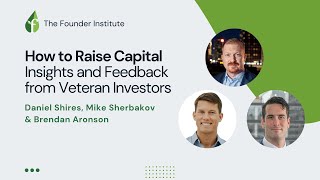
Mike Shcherbakov and Brendan Aronson, veteran investors, walk founders through raising capital: when you actually need it, what VCs look for in team and product, and how to build relationships with investors. Most U.S. companies never raise VC. Red flags include integrity issues and misaligned data.
Chapters
Welcome to our session from Founder Institute on how to raise capital. Welcome everybody. So this session is hosted by Founders Institute's Veteran and Military Family Cohort. I'm Daniel Shires, Managing Director for the cohort and longtime champion of innovation at the intersection of national security and technology. We've got a great program today. And first, I want to give you a short overview of the Founder Institute. Then we're going to hear from our two featured guests, both veteran founders and investors. And then finally, we're going to open it up for some Q&A. So what is the Founder Institute? The Founder Institute is the world's largest pre-seed startup accelerator. Since 2009, we've helped launch over 6,600 companies who have collectively raised more than $1.7 billion in capital and created an estimated $35 billion enterprise value across over 100 countries. Our mission is simple: we help idea stage and early pre-seed founders build fundable startups through a structured, mentor-driven program. Whether you're working nights and weekends or full-time on your startup, we meet you where you are and help you get to product traction and capital. Um, we find great people, we give them a devoted and global support network, we put them through a structured growth process, and provide a lifetime of support. And we created this veteran and military family cohort because we believe that service-driven founders make exceptional entrepreneurs. Your ability to lead under pressure, solve complex problems, and commit to a mission gives you a serious edge. The program itself is a 4-month accelerator that focuses on real company building. Each week includes a live feedback session, mentor talks, and hands-on assignments. You'll work alongside global peer group and get feedback from seasoned founders, VCs, and executives. We have a network of over 25,000 mentors worldwide. So whatever business problems you're trying to solve, there's a mentor who can provide insights and assistance. Now, we do hold you accountable. It's a challenging program, but if you do the work, you'll graduate with a legal entity, a go-to-market plan, a compelling pitch, and a clear path to funding. We also tie you into a global ecosystem of post-program support like our funding lab that helps you find and secure your first lead investor. If you're still at the idea stage, or if you've got a product and early traction, this program's for you. We believe that great founders are made, and many of our most successful graduates started without a product or a team. So if you're interested in learning more about the program or to explore the broader ecosystem, you can visit fi.co/veteran. Or you can reach out to me directly after the session. We run 2 cohorts a year, and the next one kicks off on August 25th. So if today resonates with you, don't wait. Our deadline to apply is this coming Sunday. Now let's get into the heart of the session. Today's event is about giving you real insight into how early-stage capital works from the people who've done it. You'll hear hard-won lessons, mistakes to avoid, and how to think like an investor. And I'm excited to introduce our two featured speakers, two leaders who've not only served their nation but built outstanding companies and investment platforms to support others. First up, we've got Mike Shcherbakov, general partner at The Veteran Fund. It's a Silicon Valley-based VC firm investing in military veteran-led startups. Mike's journey spans active duty in the Marines, founding three startups, mentoring at Techstars, and building a global philanthropic venture through Greatness Ventures. He's also the previous director of the military and the veteran and military cohort here at Founder Institute. And he's a true force for good in the veteran founder ecosystem. Joining him is Brendan Aronson, a Marine Corps infantry officer turned founder turned investor. Brendan scaled the Military Veteran into a premier executive search firm focused on placing veterans into leadership roles. He's a Wharton MBA and now a managing partner at the Valhalla Group, where he's investing in companies driving US national security. Between them, they combine military leadership experience and Silicon Valley savvy, all aimed at helping you succeed. Now let's dive in. Mike, Brendan, thanks both for being here. Let's start with the real question on everybody's mind. How do I raise that first check?
Awesome.
Well, Daniel, thanks for having us. I'm gonna hand this one off to Brendan.
Well, thank you, Daniel. It's a real treat to be able to join you guys. Mike, you're a great American, one of my favorite people on the planet. I know you know that. A few things. I mean, in order to raise your first money, I think the question that people should start with asking is, do I need to? Right? These kind of sessions always jump into like, how do I raise venture capital? And like, what techniques or tips, what are the TTPs that will get the job done? But before you raise money, the natural and most obvious question is like, should I? I talked to a lot of military veterans who are either aspiring entrepreneurs or in the early stages of their entrepreneurial journey. And I always hear from people, well, if I had X amount of money, I could build this, this, and this and then build something profitable and something big. And I would just kind of challenge that assumption because there are a lot of venture-backed companies that get a ton of news, right? They're flashy, they're high growth, they're exciting. But that is not the only way to build a company. And in fact, the vast majority of companies in the United States did not raise venture capital money, right? It's only a very, very, very small few companies that have done so. And so I encourage people to think about that question first is like, should I raise money? And the reasons that you would want to raise money is that you absolutely have to. Like that is kind of the only reason, right? Is I have something that's really, really valuable. I have a method of pouring gas onto this fire that I know will be repeatable. It'll be scalable. And so venture might then be a good fit because this is the type of company that I can scale from, you know, $0 to $100 million in revenue in under 10 years. But that's not every company. And a lot of the time, and I think I suspect a lot of what our conversation today will encompass is that investors like to see companies that have traction, companies that have some sort of product market fit, right? Someone is paying you money in exchange for your product or service. And so if you don't have that, I think the first question that you should be asking instead of how do I raise money is do I have to raise money? And the reasons not to do so are long and significant, right? You're going to give up a portion of your company. You're going to get into relationships with people that are going to last 10, 15, 20 years. As your investors, you need to have really high conviction that there's a great fit there because they're going to outlast many relationships that you have in your life. And, you know, it adds a certain level of like stress to the equation as well. So a bit of like a circuitous and also maybe not necessarily the direct question that you were asking, but I would just really encourage people to think about, can I, can I start to generate revenue with my business? What is the simplest, simplest thing that I can sell to people and just start there? Instead of starting with, well, I've got this idea and so now I've got to go out and raise, you know, $2 or $3 million in order to build a company because you don't have to for every single company. But Mike, I'm sure it's about 1,000 things.
No, no, I couldn't agree more. And just also want to start by saying, Brendan, one of my favorite people, great American, incredible entrepreneur, investor, and a couple of the adjectives that I'll leave out for now, but great human right there. So, Brendan, great words. Could not agree more in that before you ever think about raising VC or any capital, do you actually need it? And Brennan talked at length about that, and that is very important for you to consider. In fact, most folks I talk to, I think, are not necessarily a fit for venture. We look at a lot of startups. For context, we looked at 5,000 startups to make the 25 investments we did in Fund 1. The overwhelming majority of those were not a fit for one reason or another. Many of them, these are just not venture-backable companies. It's a very specific type of company that is high growth. Brennan talked about this, generally targeting $100 million in revenue. I'm overgeneralizing and looking for some kind of liquidity event if you're getting an investment at the early stage in that 5 to 7-year window, but really up to 10, 15, sometimes 20 years. So are you that high-growth company? If not, it's incredibly respectable and great to just build a company that you care about that delivers value to your customers. So that's, that's just important to discuss. Let me also, for the folks that aren't, that don't understand kind of the funding lifecycle of things, if you are going to go down this path of raising venture, which by the way, so many great low-code and no-code solutions, so many great AI platforms to help you launch businesses now with minimal capital costs. So most folks can do this, you know, bootstrapping at the early stages. And so speaking of bootstrapping, when a founder is initially getting started with the company, They are doing exactly that. Bootstrapping just means you're kind of doing this on your own, right? You're kind of funding this out of your own wallet and you're getting things up and going. And the goal is always to show either yourself or future investors that you're getting what we call kind of product velocity. And Brennan talked about product market fit, which, you know, a lot of times we don't see until a Series A or later. But at the early stages, you may see what we call kind of a demand signal. You're trying to do that. Build, measure, learn, MVP, minimum viable product feedback loop. So initially you're bootstrapping, then you go out and you raise what we call friends, family, and sometimes fools, FFF round, which are, you know, folks in your immediate network. This is maybe like a rich uncle, a family member, a friend that, you know, had a successful outcome, and they give you a little bit of cash because they believe in you, right? Then you kind of expand that circle out a little bit wider and you go out to angel investors. And angel investors are folks that are going to be writing out of their own personal checkbooks. And Oftentimes these decisions can get made pretty quickly because usually it's just them deciding that that's what they want to do. After angel funding, you typically go into now VC, venture capital, and it's very important for founders to understand in VC, yes, as fund managers, we've put our own capital into these funds, but we are also fiduciaries, meaning we have limited partners, aka investors in our funds that we are responsible to deploy that capital for. So the decisions we're making are not just for what we do with our capital, but what are we doing with our investors' capital? And that's why VC, you know, the timelines are generally a little bit longer. The thesis is usually much more narrow. They look at a lot, invest in very few because they're aiming for what's called the power law in venture, right? You're trying to find those few portfolio companies that are going to return the entire fund. So they're not targeting a 10x investment. When we make investments out of the veteran fund, we're not targeting 5x, 10x, or even 50x. We're targeting 100x. And again, I hope this is helpful because for the founders listening, you have to understand the lens at which we're looking at your companies through at the early stages. We're asking ourselves whether explicit or not, do we think your company can 100x from where it is now? And again, I'm talking as pre-seed and seed investors. The further downstream you move into then a seed, a Series A, a Series B, you're now de-risking a little bit, but you're also minimizing those returns. So instead of 100x, at that point, you're now targeting maybe 50x, 20x, 10x. And as soon as you move into like private equity and those kind of growth rounds, you know, you're fine with a 2x, 3x, 5x on a single investment. I do think it's important for all founders to understand that and understand how the investor is looking at their company. A great book on this that I recommend whenever I'm on a panel or speaking at an event like this is Secrets of Sand Hill Road for founders and investors alike for you just to understand how kind of the whole VC ecosystem works. And again, step one, coming back to what Brendan said, is are you even a venture-backable company? Do you need to go after VC? So I hope that is helpful. One additional thing I'll add, because Daniel, I believe your question was like, how do you go out and raise venture capital? It's important to know every investor, whether anywhere in that stack I talked about, the friends and family, the angel investor, the VC, all of them will be looking at 3 primary things about your company. They're going to be looking at team, product, and market. You could obviously say product velocity, you know, we talked about product-market fit, these things kind of fit into one of those 3 buckets. But you have to understand, for most founders that are on this call and are on the earlier side of their journey, at the seed stage, think about what makes you different, right? How is your team different than all of the other companies that these investors are looking at? How is your product unique and differentiated? We like to say, what's your defensibility or what's your moat? And do you have a big enough market that you're going after? Of course, a number of other factors we're looking at, but just really those three, if you can think about those, what makes you different from a team, a product, and a market standpoint, that'll at least put you in a really good position to have those initial conversations with investors. So over to you, Daniel.
Yeah. So I think, you know, amazing points from both of you. And I always tell startups that I'm working with, like, hey, it's kind of a time versus money. Before you raise venture, you've got unlimited time to build this business and you can build it whatever rate you want to. You have low money, high amount of time available. As soon as you raise venture, you've got a high amount of money but a low amount of time. So when are you at that inflection point where you're going to accelerate? So it may not be that you're not venture-backable at all, it may be not right now. You may not be ready for it. So the timing is really important. You really should be raising that round when you're about to accelerate growth.
Yeah, I'd like to add one thing to that, Daniel. I think it's important that I personally, not only am I just wildly passionate and curious and love everything about kind of the startup and VC ecosystem. This is, I feel grateful to be able to do this for a living. But I also think it's just a beautiful system. In that it is really milestone-based financing, right? There's a reason you go from a pre-seed to a seed to a Series A and a Series B. It's not arbitrary. It's not, to your point, Daniel, you were saying kind of time or money and you just throw a bunch of cash, you don't have money. It's actually very intentional. And this is why professional investors exist, because when you receive that capital, it's not, here's a bunch of money, good luck, go out and build. No, here are the milestones that you've hit to this point, and here is what this capital is is going to provide and get you to that next milestone, right? From the seed to the Series A, generally 18 months, if I'm generalizing, sometimes as early as 12, sometimes even sooner if they're really rapid and high growth. Sometimes, you know, in down cycles in the market, it may be 24 months of runway that each one of these rounds gives you. But to Brennan's point, you're giving up a piece of equity every single time you do one of these rounds, but you're also given milestones or goals to hit. And I think it's a beautiful system because it encourages people and founders to, to build and grow at a pace that kind of aligns with that high-growth venture-backed company. So I think that's an important point.
Absolutely. So now we talked a lot about team. Let's go back to Brendan first and then Mike. What is it that you're looking for in a founding team specifically when you're investing at pre-seed or the seed stage? Or maybe other— said another way, what are the signals that you see that say, hey, this founder is backable beyond just their pitch?
Yeah, I mean, you're looking for, I mean, because to Mike's point, like a big part of what venture investors are doing is backing the individual person. Right. And so you are looking for founders that are exceptional in order to put money behind them. They have to be truly exceptional people. You've got, you're placing a bet and saying, I think that this person will beat the odds. Like the odds are not in their favor. They are, you know, 95% of them are not going to work. And I think this is one of the people who is going to work. So you need an exceptional team. What I think about is just like people use the phrase product market fit, I think of founder market fit. So like, does the founder have some sort of unfair advantage in this market? It can be a variety of different ways that you can demonstrate that. But a lot of times what I think of is, does this founder have the distribution channels required to be able to make this work? The biggest question that you're going to have to answer at the pre-seed and the seed stage is, and really, I mean, honestly, every stage is, can you grow sales? And at the pre-seed level, growing sales from zero to maybe $1 million a year in revenue, it is about who, who do you know? Do you know the right people that can get, that have access to or have the ability to purchase whatever you're selling? So I think about distribution channels a lot. Um, like an example of this is an investment that I made personally and we made out of a venture fund that I worked at called Context Ventures, which also does seed and pre-seed investments for veteran founders, was a founder that was building a piece of technology for people in the private wealth business. And this person had spent the last 15 years in the private wealth business. Right. And my thought process was like, look, like the person is exceptionally talented human being. He had an amazing team around him that can build, which is something I'll get to in a second. But my other assumption is like, man, this person knows a lot of people in private wealth. He could probably just go through his phone book and make calls to people and say, hey, this is what I'm working on now. I know that this is a huge problem because it's a problem that I've dealt with for the last 15 years. Do you need a solution? I've built a software solution for this. And so having that kind of distribution channels and having preexisting relationships with potential customers, I think is like a huge, huge box that if you can check that, that's really great. So distribution channels, experience in the industry, I think is really helpful for just a basic understanding of where is there value in the particular industry that you're operating in. You know, most industries have different, um, ways that companies capture value. There are different kinds of business models. So is this someone that really knows their industry and understands where value is going to be created? You're also looking for a team that has the ability to raise capital, right? So a little bit of like a self-fulfilling prophecy here, but if you're making a venture investment, you're expecting them to go on and raise subsequent financing rounds. So you got to be able to look at the founding team and say, will this team be able to raise money from the next round of institutional investors. I also think about a complementary founding team. So one thing I've heard quite a bit is like one founder who can build and one who can sell. They are both very, very important. You have to have both. You can't have a team of purely people that can build. Someone's got to be able to sell the product or they need to hire someone immediately who can sell the product. So someone who can build, someone who can sell. Ability to learn, I think, is huge. I had a founder who reached out about investing in their company. This was in 2022, and it was like, hey, you know, I'm building this company that does X, Y, and Z. And I was like, okay, look, this isn't really a fit for me. I just don't know that as much about your industry or whatever. And then they were like, okay, that's fine. I'm just going to keep you up to date. And every month they would send me a newsletter that was like, this is what we expected to learn last month. This is what we actually found out. And here's how it's changing and influencing our strategy going forward. And then they just rinse and repeated that for like 8 or 10 months. And so the next time we had a conversation, there was not like this building trust over time. It was like, man, I see your thought process. I see how you learn and iterate over time. And that's super helpful for me to be able to build conviction. And we did end up investing in that company. So ability to learn. And then the last thing is the adversity quotient. So people talk about EQ, right? Your emotional quotient. Like, can you connect with other people easily? Your IQ, intelligence, right? But I think AQ is another really important factor. Military folks should have that in spades. But it comes down to like, have you done really hard things in the past and been successful with them where few other people have been successful? Because I'll say like there were plenty of challenging things that we dealt with in the service. And I will say like entrepreneurship and the private markets have their own set of unique challenges. I think they are— it's really, really, really difficult to build a startup. Hardest thing I've ever done. And I feel like I've done some difficult things in the past. And raising money is another one of those gauntlets that's just really, really challenging. And frankly, it should be hard. I remember my first company I raised venture money for, and then my second we did not. But like the first company I built, I was like, man, just like, can we get some investors? This is really hard. Like, why is it so many nos? And in retrospect, it's like, man, That's a really good thing. Like, it should be really hard to raise money because someone is trusting you with their hard-earned money and you need to be a really good steward of that trust. And it just frankly should be difficult because, you know, it's another moat to preventing people from losing folks' money.
Absolutely. Well, Mike, on that note, what are the red flags that you see in startups or what are the biggest mistakes that folks make when they're pitching? That kind of give you pause?
Yeah, from a red flag perspective, I, by the way, plus one on everything Brennan just shared and to actually double down on it, I would say the red flags are kind of the opposite of that. Brennan finished what he just shared by saying, are they good stewards of that capital, right? If I get the sense that a founder is not going to be a good steward of capital and there is a lack of integrity, it's game over. And to be honest, it's not just game over for me. It's probably game over for just raising VC from because it's a very tight ecosystem. Once there's trust broken, we all talk with each other, we share deals together. And that like if there's a word of caution I would recommend to everyone, first of all, just be a good human, but also like high integrity in everything you do. And this is partly why we have this thesis. It's called the Veteran Fund. We invest in military veterans. People ask why we say, well, because number one, they're incredibly mission-oriented. They're going to run through walls to accomplish their goals. And in general, there's incredible leadership resilience and purpose. A lot of the things that Brennan talked about earlier, right? They've been through hard things. They can overcome that. If someone's raised their right hand, more often than not, there's just a very high level of integrity there. And that's, that is what we're betting on. Of course, you know, having strong technical co-founder, if they're not technical themselves, I love the idea of one sells, one builds. So like all of these things, but to me, the red flag is integrity. Here's a very simple example. I know it's glamorized to be on this incredible hockey stick growth, and it's glamorized to go out and raise VC and to talk, you know, about all these customers and all the revenue that you're bringing in. But if you're saying one thing, and in our diligence process, and just so every founder understands, we have an initial conversation with you, we'll have a second conversation where you generally meet the team, a third conversation, a fourth and fifth, and you go through this process, eventually we do what's called DD, due diligence, where we're not only vetting you and all the team members, but now we're going deep into your data room. So looking under the hood of the company and looking at financials and looking at legal and, you know, incorporation agreements and everything. Imagine like, no, you know, a good diligence process leaves no stone unturned. And it's often in this process where we discover, wait a second, there was a gap. And I'll reference the first conversation we had where they said, Oh, we have this much in MRR. And then I look and say, wait, but it's only a fraction of that. What is that? Oh, actually, it's— we don't mean MRR. This was our service-based revenue coming in. We just turned on the subscription software side of this. And I've seen this more times than I'd like to admit, but there's a giant gap there. You told me one thing and I discovered another. And it's important, although, like, I understand you want to always show investors that you're high growth and that you're hitting all these milestones, that cannot come at at the Dutch, at the, you know, with gaps in integrity. And beyond that, like, I think other things are figureoutable. We can work through them. But that is the biggest red flag that I see. What was the second part of the question, Daniel? Maybe I'll pause there and hand it over to Brendan.
Yeah, no, I think it was just biggest mistakes when pitching, you know, was the second part. But yeah, Brendan.
Yeah, I guess I would add just like not knowing what is a venture-backable idea. But I would also say I just want to double-click on what Mike said. Like anything trust-related at all is an automatic DQ, right? And what you should be thinking about is, you know, you see a lot of people in this ecosystem who are looking to get rich really quickly. And I would just encourage people to think with a much longer-term mindset. My personal view is like, look, we're all going to be swimming in parallel swim lanes for like 30 years. Like we've got another 30 years and we're like stuck with each other, so we might as well make it fun and we might as well all really like each other and try and do what we say we're going to do. And if it takes us 30 years to get to where we want to go, then that's great. And if we get there faster, then we help other people along. And we still got to find something to do while we're hurtling through time and space on this rock. So we'll probably still be swimming in a parallel swim lane. So anything that prevents you from being able to do that in the long term, i.e., breaking trust with someone in our community, is like just don't do it, right? So yeah, I wanted to just double-click on what Mike said. Yeah. So the second red flag is just like, it's not really a red flag in terms of like, I question this person's integrity, but rather like, it's just not something that you can invest in if you're a venture fund, is like a venture-backable idea. So like, does the company have the ability to grow really, really rapidly into a massive company? And to Mike's point, like the vast majority of companies that he was pitched of those 5,000 companies were just not venture-backable.
Model, right?
They aren't, you know, there's a reason why 80% of venture capital dollars flow to, you know, B2B software companies, right? Is like, that is a model that can scale from $0 to $100 million in revenue in 10 years, right? And there's a lot of investors who target things outside of that. It's not to say if you don't have one of those types of companies, you can't raise venture money. It's just to say, if you're building a services company, then venture capital is just not the right weapon to target match. Right. There's nothing wrong with building a services company. The firm that I built prior to Valhalla Group was a services, is a services company, and it does awesome and does good work and it's a ton of fun and it makes money. And it's like we get to be of service to the community, like huge win for everybody involved. And but it's just not a venture-backable idea, like, because that's not how services companies grow. They need labor to grow and labor is it just doesn't have the kind of margins that a software business would necessarily have. So anyway, yeah, a little bit tangential, but that's like, it's a red flag from the perspective of like, we just cannot do this investment. It doesn't mean that we don't like you or want you to win. We just, it's just not a fit for what we do.
Right. So maybe just a short answer on this one. Just out of curiosity, are there any questions that you always ask when you're doing diligence that kind of surprises founders or catches them off guard? Is there something that they should be prepared for?
I want to double down on what Brendan said earlier, which was we talked about product market fit. He said about founder market fit or founder product fit as well. Both really. I, one of the most important questions that I like to ask is why they're building what they do. And this is where I think there's a lot of value in the Founder Institute program. Again, I got to run it for 4 years and Danny You're going to do an incredible job running it. I love that in the curriculum, the very first week is vision and mission before you do anything else, before you're doing, you know, all the legal incorporation and think about marketing and doing your financials and talking to investors. You really have to ask yourself, why are you building this? Because the reality is, and Brendan's hammered this home and I'm going to keep hammering home, it is incredibly hard. And there are days where it sucks and you want to quit. But trust me, if you haven't come across those as a startup founder, you will. We've all— we've been there and we'll continue to be there. Honestly, even as fund managers, we have those days. And yet if there isn't a deep conviction into why you're building what you're building, then it just won't work. Because on the days that it sucks, you need that deep why to keep going, right? There needs to be that sense of purpose. And if a founder doesn't have a good answer to that question of, wait, why are you doing this? I'm concerned. You know, you're signing up for something. Again, this is not a get-rich-quick kind of thing. It's not you build this for 6 months and a year and you make, you know, hundreds of millions of dollars. You're signing up for a decade, probably 2, 2 decades of your life. And let's just all, you know, you don't have a lot of those. Okay. So hopefully you're spending your time building something that matters to you and you're getting values-aligned folks that you're bringing onto your team and customers and investors. And so that why is probably be like the most important thing for me when I, when I talk to founders, one of the first questions I ask.
I don't want this to turn into like a commiseration session for life being hard, but I'll tell you guys just a couple of quick stories. I think they asked Elon Musk like what it was like to build a company. And he said it's like chewing glass and staring into the abyss at the same time. Like it's just miserable, right? And they asked the founder of NVIDIA, if you could go back and do it again, like what advice would you have for yourself? And he said, I wouldn't do it again. I just— it was too painful. Like, this is one of them. This is probably one of the most successful founders of all time. And he was just like, look, like, for what I had to give up to make this work wasn't worth it. So it's very, very painful. The other person or story I'll tell you guys really quickly is there's an amazing entrepreneur in our community named Franz Huang. Franz is an incredible person, has this like unbelievable founding story. He's been very successful through a number of different startups. And he told a story to a group of veteran entrepreneurs about withios, which I will edit myself since we're being recorded. But it's basically we're, we're screwed. We'll go with that instead of the F and it's over with. Withio is like you would be going through your day as a founder and in the morning you'd be like, man, we're on top of the world. Nothing can stop us. We're going to be like the next unicorn rocket ship, whatever your preferred metaphor is. And then in the afternoon, you get some piece of news that was like, oh man, olithio, like, we're screwed, it's over, like, we're just— this is not gonna work, like, I'm gonna be on the breadline, what is next? And then by the evening, you'd be back on top of the world because you got another piece of news and you're like, oh man, everything's changed now, it's totally different. And so those— that emotional roller coaster is very, very difficult to endure. Um, I am personally of the belief that entrepreneurship can be— for me, it has been one of of, if not the most personally fulfilling and like character-building experiences that I've ever had. But that is because of the fact that it's really hard. So I believe in business as a tool for personal growth and think that this is like an incredible way to grow as a human being across every domain. But what that means is that you have to be able to put a ridiculously high level of effort in for a very, very long period of time while getting zero positive feedback. Right? Because revenue is a lagging indicator of a ton of work that you put in on the front end. And then success, financial success especially, but any sort of success is always a really lagging indicator of all of that mountain that you have to climb in order to generate it. And again, it just takes a long time.
So, so you guys have both talked about how trust is really important and a lot of this is kind of relationship driven. So So what are smart ways for founders to begin kind of building relationships with potential investors before they're raising so they can start building that trust and that foundation?
Yeah, if folks haven't heard this, you will hear it at some point. It's the whole ask for money, you get advice, ask for advice and you get money. And essentially said another way, you want to start building relationships without before you actually need those relationships. When I say need, you know, relationships need to be a two-way street. It, uh, and again, especially with investors, I tell founders this all the time, make sure just as much as they are vetting you as an investment opportunity, you as a founder are vetting those investors. I've heard horror stories of founders that took on capital from folks that became a nightmare to the point where they eventually had to shut their entire company down because That investor was so bad. So it goes both ways. Make sure that this is someone that you, you are signing up for a long-term relationship with. People talk about the whole kind of marriage concept of initially you're dating, you're getting to know them, right? And then you kind of build that, build, build into, you know, what is hopefully a good, long and positive and positive outcome kind of marriage. But it is really important to think that way when building relationships. If someone is coming in as a founder and immediately going for the ask, of I need something from you immediately, write me a check today. It's like, that's a giant red flag. Similarly, if you come across an investor and they have incredible, they're just incredibly predatory, there's something that feels off about them, or you're noticing in their behavior, there are gaps in integrity, that's not someone you want aligned with you, right? You're bringing an investor, kind of becomes someone that's part of your team, especially if at a seed or Series A, you're bringing them on your board. And there's governance now issues as well, where they're helping make decisions on the direction of the company, but that it's about— I'll say high level, like I talked about earlier, comes back to being a good human. It comes down to having high integrity. And I really love, you know, what Founder Institute does because you're for 13 weeks as you're going through this program, you are building relationships with investors without ever asking them for capital. They're learning about you personally, they're learning about your company. And I think that's the way to build a relationship. Instead of immediately going for some kind of ask. Techstars, also another great program which I highly recommend to folks as well. Their motto is give first, and I recommend that to founders as well, is how can you give first, you know, in a call when you're on in discussions with investors? Yeah, you may be pitching them, but at the end of the call, and be genuine about this, don't ask and not follow up, but ask them also like, thanks so much for your time. Is there anything that I can help you with. They may be going through something personally that you have some connections with, or they, you know, there are a number of ways, but I think it's important to kind of look at the world through the lens of how can I support this person. And I think that's generally a good rule of thumb for building relationships.
Yeah, I'm just going to tag in real quick on what you said about how you're also vetting the investors when they're vetting you. So I had some founders that I was advising not too long ago that went to finally got a pitch in front of someone that they really thought they wanted. And, you know, this investor, for whatever reason, maybe they have a bad day, was, you know, cutting them off, was not giving them a chance to finish, was kind of having almost an adversarial relationship up front. They came out of that kind of feeling dejected, like, oh man, we think we messed— we messed that up. You know, my advice to them was like, look, something about that relationship was off. And if that's the initial interaction you're gonna have where it felt like there was a, you know, a little bit of a lack of respect on, on one side, is that really somebody that you want to have that continuing interaction with over the next decade? And so it's actually, I think, you know, really important. Don't take money from anyone that'll give it to you even though it feels really hard at the beginning, right? Be, be careful about where you take that. So yeah, Brendan, sorry. And, and, and what were your comment? You know, you, Let's follow up on that. How would— how do you think— what are the best practices for building those relationships early?
I mean, what Mike said at the end there is, is all of it, right? Give without expectations of reciprocation. Like, that's just like par for the course for being someone that people want to have a relationship with. Like, relationships are not transactional, right? They are first and foremost, how can I be helpful? How can we be helpful to one another? And how can we be friends with each other? Someone that I turn to when I'm going through something difficult. And that makes them by definition the opposite of transactional. That said, of course we want to be able to do business with each other because it's fun. And if we're working on something that we think is going to be very successful, we want to bring other people along for the ride and we want to be be able to help their ventures and businesses. So relationships are not transactional. It doesn't mean that you shouldn't do business with people in your network. But I would just basically say make friends, be of service to them, try and figure out how to give without expectations of reciprocation. The other two things that I would mention is one, just keeping people posted over time, like relationships and trust just take time to build, right? Like, I mean, when Mike, Mike, we've known each other for like 4 or 5 years by now. I think that's probably right. And like, we didn't have the level of trust that we have with one another when we first started because it was like, I don't know this dude, you know, he's a fellow Marine. I love that. But like, you know, we just didn't know each other. And over time you build that relationship by keeping one another posted, by keeping them up to date on what you're doing, not only from a work context, but like personally as well. So it can take time, but keeping people posted over time The other thing I would say is like, you know, you see entrepreneurs on Shark Tank who paint like a rosy picture of everything, but like, dude, business is really hard. Like, and nobody's— once you look up close at any business, it's like, man, this is like got some ugly stuff going on here. Like, it's, it's never— it's not perfect. Things might look pretty and flashy from the outside, but in the inside of any business is like organized chaos. That's how Ray Lewis used to describe the defensive, you know, team at the Ravens was like, it's like we want organized chaos here. And so I think that there's like a time and a place for when you're in a conversation with venture capitalists, you should be pitching them and selling them and telling them about all of the upside that you expect to create and capture and to allow them to help in that journey. But I don't think that you should shy away or like gloss over the fact that like there are probably some things that you don't know. And so one of the questions that we like to ask people is like, what would What might cause this to not work? Like, what would be some downside scenarios and why would those happen? And if you get a founder who's just like, oh, it's like impossible, like it's going to work, like for obvious reasons, then it's like, all right, well, there's probably more to this story. So yeah, I would say like, should own some of those vulnerabilities, but of course, like, I probably wouldn't lead with them.
Right.
So assuming, you know, founders come in, they've got their initial, you know, meeting and they've done the pitch and you've had a conversation, what's the best way for them to kind of follow up after that initial investor meeting? Like how do you, how, how, how can they do that in a way that doesn't seem very intrusive or, or maybe needy, you know, in some sense?
In my opinion, you answered it with the question, which is follow up. I cannot tell you how many founders I've had a conversation with that I give them very explicit instructions, you know, please follow up with me and send me, open up your data room or do this or do that. And they just don't follow up or they don't do it when they say they will. So number one, I think, is the actual follow up. Any time you've had a meeting, whether it's the first, the second, the third, the fourth, a simple follow up You know, thank you for your time. And here's maybe either like what we discussed, and here's what I told you I would send over, whether it's the deck, the data room, an introduction to a team member. It's important. It's very important. And the second part is not only the follow-up, but there's a cadence and a consistency, and there's, it's going to be a little bit different with everyone that you engage with. And I would actually ask the investor this on the call. So, so in terms of running a call, here are just like lessons learned the hard way that I'm going to to teach you all because it's very helpful. At the start of every investor call, usually the first call will be 20 or 30 minutes. Start with, you know, some pleasantries, basic stuff. Where are you based? You know, those are just always nice, right? Like connect on a little bit on a personal level. You may find the investor wants to just jump right in right away, and that's fine. But like in general, start out with some of the personal stuff, like first 5 minutes. That's kind of common. The second thing is before saying, okay, Hey, I'm going to jump right into my deck, screen share, and you're in it for, you know, 29 of the 30 minutes. That is the absolute worst thing. And I've had founders, I still have founders that do this and I get to the end. I'm sorry, I didn't have any time for questions. Thanks for your time. I've got to run to my next meeting. Usually we're back, back to back to back to back. So I like to start out by saying as a founder, hey, I have a deck prepared, but how would you like to run this call? Would you like me to run through the deck? Maybe you've already sent the deck in advance of the call. Maybe they've already seen it, but how would you like to run this? I'm happy to breeze through it for a few minutes open it up to questions, or I can go a little more in depth for 10 or 15 minutes. How would you like this? So put it in there, Court. Let them run it. Okay, so that's like— this is the best way to book in. You start with that, how would you like to run it, and end with, I really appreciate your time, how would you like me to follow up, right? Would you like any of these materials? And what kind of cadence, like, works for you? Hopefully— and maybe this happens on a first, second, third call— let's say it's not a fit and they say, honestly, right now it's not a fit, but I'd actually love to stay updated. Right? You can ask them, is it okay if I add you to my investor update list? And to Brendan's point, he had some folks that, that gave him those updates. He got to see them building. They're continuing to grow and do what they say they're going to do month over month, quarter over quarter. We did the exact same thing with a company called Aerofuse, where first it was too early and it was a pass. And we said, hey, we really like you guys. We think what you're building is really interesting. Please keep us updated. They did. Every month we saw they continued to build, and a year later we made the investment in the company. So just know that a no does not mean no forever. It may mean a not right now. And also get a sense from the investor what a good cadence for them is. If on the flip side, last thing I'll say, you somehow find— this happened to me last week and it was just unacceptable in my book. I did not give anyone my personal cell phone number and they were calling back to back to back, not a one-time, leave a voicemail, this is a nice thing. That is never okay. And so this is like the extreme end of this is getting to the point where you're annoying someone and that becomes an automatic no for someone. But the other side of that is not communicating enough. So find where that balance is for you and it'll be a good kind of rhythm between you and that investor.
Masterclass. I'm like over here scribbling notes. Really was like I— that was terrific, Mike. Everyone listen to what Mike just said, like, over and over again. It was really good. I would also just add, like, send a thank you email after meeting with, like, a quick synopsis or summary and maybe a proposed next step.
Or—
but at the very least, at the minimum, like, just send a thank you note. Like, hey, it was really wonderful to meet you. Here's something that we talked about that I thought was really interesting. And, like, I'm really grateful for your time. Let me know what works for you for next steps. Something like that is really helpful. Add them to your newsletter, send a newsletter out once a month. Like, that should go to everyone because your main challenge, I think, at the pre-seed level especially, is that nobody knows that you exist, right? So it's like the more people who you have rooting for your success, the better. So keep them updated. And then in the newsletter you can include like, here's how you can help us. Like, if you really like us, maybe you don't want to invest in us, but like, here's how you can help. We need to meet people that are trying to buy X type of software, or do you know people that work in this industry Right? Sometimes people will come out of the woodwork that you just wouldn't expect. You'll be like, oh, like I know someone that does HR at X, Y, and Z company. And do you want to meet them? It's like, yeah, I definitely do. Thank you. And then the last thing I'll say, which is a little bit of a counterpoint to what Mike said, don't blow up Mike's cell phone. That I do agree with, or mine. But like follow up until someone tells you, stop following up with me. And that doesn't have to be, in fact, it should not be every day, but maybe like like every other week or every month, right? And I've had times when I followed up with people 5, 6 times, and I'm like, certainly this is like a lot here. Like, I would have heard from them if they were super interested. And you'd be surprised how often on the 6th or 7th one they'll be like, oh, like, sorry, I missed this, the other 5 went to spam. Or, oh, like, I have had a family emergency for the last 4 months and been completely unavailable, but I'm really interested in talking So just assume most charitable interpretations of other people's actions, I think, is like a good motto for life. And so I would just follow up. And then another trick, this is just like a quick tip, like if you're going to stop following up with someone, I would let them know that too. Like in the last email that you send them, like, hey, I certainly don't want to be annoying here. So I'm just like, not going to follow up with you again. But like, if this is of interest to you to continue the conversation, please do let me know. Or if you circle back to it in the future, like, I'm happy to have a conversation and like, let me know how I can be helpful to you in the future. You get a lot of responses on that one where it's like, hey, I'm going to stop, stop sending you these. And people be like, wait, I'm actually available.
Yeah, Brandon, that is spot on. We did— we had actually one of our LPs at this last summit we hosted in February that said, hey, you sent me 10 emails without response, without me responding. And I had a lot going on. I'm sorry for that. I'm glad you did because this is one of the best decisions I made. And so they were incredibly grateful for that follow-up. But again, no, you know, if you get to the point where someone says, stop, you're annoying, then stop. But absolutely keep following up until you do get some response. Or I love that final message of, hey, if I haven't heard from you after our first, our initial conversation, I won't plan on giving you any further updates, not bother you. I want to kind of also add one thing because as Brendan was speaking, it reminded me me of like what he's a master at. Brendan is so good at this. I'm not anywhere near. I kind of aspire to be at this level that he does, but it ties in a lot of things we were saying where you said, how do you build relationship and how do you do follow-up? I feel like LinkedIn is underutilized, but LinkedIn done right, and Brendan does such a good job. And one of his business partners, Tim Shaw, is also kind of like the master of this, where they will just, they'll go to an event and after the event they'll post photos of, I went to this event and shout out to all the people I met. And they'll tag them, right? It was really nice. I enjoyed our conversation with this person and I met with this person and I met with this company and they're prolific with their LinkedIn game. Again, I'm not anywhere near that. I aspire to be as good as they are, but it works so well because you're connecting with everyone either in person or that you've had a conversation with. Hopefully after you, you know, having a conversation with an investor, you add them on LinkedIn and then they kind of see in addition to your monthly updates, they see, whoa, like Brendan's everywhere. Wait, and he's meeting with this person and I know that person. And there's a little bit of this like social credibility and social proof that's being built because they see you in the space, they see you, you know, active. They may say, oh, like they're connected with this person I already know. So now again, that trust barrier is down. So I would, I think it's massively underutilized doing it right and is a way of building relationships without having to send necessarily updates because hopefully they end up seeing it.
Alright, so we're in our last, you know, few minutes here. I'm gonna do a few quickfire questions here and also get to you. There's a question from Nate and Mike. I saw you already like sent him a link for that. Appreciate that. But maybe we can just do a quick short answer on that as well. First quickfire question. What's the biggest founder mistake that you've seen?
Integrity.
Like, do you have a story around it? Is there like—
It is actually that. And it's again, all too common where one, they told me one thing on an our initial conversation to look really, to look good. And when we look under the hood, the numbers told a very different story. So just don't do that. And again, I see it more than I'd like to admit.
I would say like jumping in casually, right? Like, oh, I'm gonna like quit my job and be a startup founder in a space that I don't know anything about selling something that I know nothing about. And I have no ability to build, you know, the product for this particular space. But like, you should jump in on things when you have very high degree of conviction and you are going to gut it out through all of the difficulty. There's like a million ways to make money in the private sector. And like having a W-2 is— there's so many blessings that come with having a W-2. You can take time off and not have to actually think about your job in a lot of the cases. Be your experience as a founder, ever. You will just be on always, and you will be thinking about the business, and it will take over every moment of your life that you give it. And it's just not for everybody.
All right, pre-seed— team or traction, if you had to pick one? I know they're both important.
Team.
I go team. Oh, look at that. Okay.
I mean, like a great team—
I guess I should say team attraction and why.
I mean, they gotta have both is the answer, cop out. But like, you know, a great team that is going to fight its way to success is going to pivot probably. Like lots of companies pivot into something that's better and they learn over time, they evolve. Like, you know, but if you bet on the individual and they're going to gut it out, then it's like you— I would guess that they will pivot their way into something that'll be successful. It's just a question of like, will they be able to do it do it quickly enough before they run out of money.
Okay. And I've had this question before with Founders Institute because we have a lot of folks coming in with kind of that idea stage. Would you back a solo founder? And if so, what would the conditions be that will, you know, make you decide to back a solo founder? Like, not going easy.
So yeah, look, we prefer— there are— we have preferences. We prefer second-time founders because they've done it before. We prefer co-founding teams, 2 to 3 individuals, maybe up to 4 depending on if every one of them is a kind of a unique value add. At the very minimum, 2, like Brennan said, you kind of want the sales, the builder, and then the person who sells. We have backed solo founders, but as I talked about in team, product, and market in those 3 buckets, in order for us to you know, it's higher risk. Each one of these kind of has their own risk profiles, and a solo founder does come with higher risk, uh, namely being if they quit individually on their own, or if, God forbid, something happens to them, right? Again, we are fiduciaries. We, we— people don't realize this— we can get sued by our investors in our fund if we make investment decisions that are not aligned with their best interests. And so if we, you know, if let's say anomaly, every single portfolio company that we have is a solo founder and something crazy happens to all of them, that's a very bad situation. And so you also understand that on the rough days, you have team members picking each other up and co-founders. So I know you asked specifically about co-founders. If they are a solo founder, as long as they've surrounded themselves with A-players on their team that are maybe not necessarily co-founders, but are there for the long term, and we can see that based on, you know, the cap table and their ownership in the company, we want to see folks that are fully bought in to the company. And that's kind of how I would de-risk this in addition to having a really unique product and big market.
I would just add that like the question, the natural question is like, why are you solo? Right? Like, can you then— and then the second and third order questions are like, can you not attract great talent to want to work with you? And like, do you not have like the ability to, with limited resources, get other people excited about your mission? Because that's basically 100% of the job of the founder. The last thing I would say is, well, two things. One is, you know, they say if you want to go fast, go solo. If you want to go far, do it with a team for exactly that reason is like they'll pick each other up off the mats. And sometimes someone will be cycling and they'll be excited about it. And other times, you know, they'll need to pick up the other teammates and vice versa. The other thing I would say is just like on partner selection, like don't found a company with someone haphazardly. Like put some real thought into it for sure. Like, do you have complementary skill sets? Do you like working together? Like, it's going to be the longest and probably one of the most important relationships of your entire life. So just don't do it with— you got to put real critical thought into it. The razor that I use for thinking about partnerships is, do I see something in this person? Do I want to become more like this person personally? If I became more like them, would I be happy about that? And if the answer is not a resounding, like, absolutely, I really want to be more like that person, person, then they're probably not a good partner because you'll become more like the 5 people that you spend the most amount of time with. So you're deliberately selecting to pull someone into that group to become more like them. And just, you got to be careful with that. So your founders should be, your co-founders should be like really aspirational people. Like, man, like if I was just more like that person, I would be really proud of myself. Like, that's how I think about partners.
That's a great metric. That's a great metric. All right, last question, and we'll keep it short, but kind of zooming out, what trends or trend are you most excited about right now within earlier stage companies?
I'll jump in really quickly and just say I love that folks are being more intentional with what they're building. I think we came out with this thesis. Our tagline at the Veteran Fund is Advancing America through Venture Capital. After our firm started a couple of months later, Andreessen announced American Dynamism. We started to see more firms. We start to see the reindustrialized. We started like, I love that there's this movement happening towards great American companies, American leadership, dual use defense, critical technologies from like the private and public sector. And I think what that does is when there's capital available, And again, we are active investors in the space. Brennan, fund of funds, actively investing in funds, building companies in this industry. What that does is that encourages the kind of younger generation to think about, well, why don't I build companies in these sectors? And so I'm glad that we're moving away from kind of like the widget and let's just build something for the sake of building it and much more first principles thinking about like, what do we care about most? How do we move this country forward and how can I advance and how can I, my mission be part of advancing that?
That.
So I love that trend personally. I'm curious what Brennan thinks.
I wholeheartedly agree. I mean, like, I love that there's so much emphasis now on what we're building for our country and the national mission. And I love that veterans have just like a better, bigger and better role to play. If you rewind the clock 15 years, there were no veterans in venture capital. There were no veterans in alternatives more broadly for some structural reasons. And today there are more of them and we have a lot of wood to chop. We like— fundamental, like, driving philosophy of my life, both personally and professionally, is I think that veterans should have a say in the flow of capital in the United States. I think it's important to our country. I think it's really important to our community. And then the second is I think veterans should have a say in the leadership of private sector companies. And that's why we started the MilVet. That's why we started Valhalla Group, is just to try and rectify those two things. And I see more and more of it, and it just gets me really fired up because we love veterans. We really believe in your abilities and what you guys are capable of, like wholeheartedly. So, yeah. And I would just close out by saying, like, for those of you that are veterans that are listening, thank you guys for your service. Really grateful for for it. I know that's always really like weird thing to hear, but genuinely mean it. And if you're a military spouse or partner or family member, like, thank you. I think you have the hardest job in the DOD. So thank you guys for tuning in.
All right, thanks guys. We are at time. I really appreciate you guys giving us this hour. Mike, Brennan, it's a pleasure as always. And for those of you, you know, watching, uh, just two great examples of the types of mentors that, you know, come in and help with, with Founders Institute. To. Um, again, yeah, I saw the comment. The recording should be sent out to you if you've registered for this. It might take— it might be tomorrow before it comes out, um, or a few hours, but you should get a recording. And, uh, yeah, feel free to reach out to me after this if you have any more questions. And Mike, Brendan, thanks so much. I appreciate it.
Thank you.
Thanks, Daniel. Thanks, Brendan. Good to see you guys.
Great Americans.










