How to Recession-Proof Your Business: Coach Mike Video Podcast, featuring Bryan Janeczko
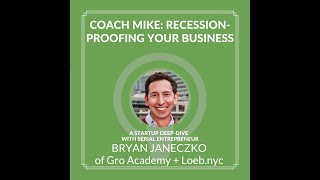
In this Founder Institute podcast episode, host Mike Supravici and community lead Dustin Betts interview serial entrepreneur Bryan Janeczko, former FI NYC director and founder of the fresh‑meal delivery service Nü Kitchen (sold to Nutrisystem). Drawing on his experience launching and exiting a business during the 2007‑08 recession, Bryan shares a practical framework for making startups resilient in economic downturns. He emphasizes three core pillars: (1) selling an outcome rather than a product, (2) deeply understanding the target customer’s psychographic profile, and (3) creating value that exceeds price through partnerships, complementary services, and mission‑driven branding. He discusses lean operational tactics such as maintaining a small core team, leveraging outsourced partners, and avoiding costly office overhead. Bryan highlights the strategic advantage of mission‑aligned impact, noting that purpose‑driven brands can retain customers and attract talent during a recession. He advises founders to prioritize strategic partnerships over traditional fundraising, build supply‑chain redundancy, and cultivate cash‑flow positive unit economics. The conversation also explores broader macro trends, including which sectors tend to thrive or suffer in downturns (e.g., education disruption, subscription fatigue) and how founders can use fear as a catalyst for proactive planning. The episode concludes with a concise founder checklist for recession preparedness, covering outcomes, customer insight, value creation, cash‑flow management, credit lines, and talent retention.
Chapters
Hello everybody, welcome to this edition of the Founder Institute podcast. My name is Mike Supravici, I lead the Alumni Success Group here at the Founder Institute, and this is Dustin.
Hey, I'm Dustin Betts, I'm Head of Community and Content at the Founder Institute.
And today we have a very, very special guest, and I'm gonna let Brian introduce himself to the world here, but we're really, really thankful because this is a great topic and we're gonna dive into some really important really important things and also really important, very timely topics. So Brian, would you mind introducing yourself?
Yeah, sure. My name is Brian Genesco and I am a serial entrepreneur. I launched my first business about 15 years ago as a pioneer in what is now the fresh meal delivery business. It's a multi-billion dollar business, but back then we were the first. And ultimately after doing enough things right, we were able to scale the business. Raise a little bit of venture capital, and then ultimately we sold the business. It started in 2008, but we actually sold it in 2009 to Nutrisystem, the weight loss company. So definitely a very timely topic for, for today's discussion on what might be going into a winter season for us right now. But from that experience, I learned a number of things that will apply to many of the areas I've been involved in the last several years, notably how to build a company that creates value, that gives back to the community, the value of helping entrepreneurs get going. And those have really been core to me as not just as a seasoned exited entrepreneur, but also in terms of what we can do to help create the next generation of scalable businesses that have impact and meaning. Or as I think Founder Institute says, building businesses that are both meaningful and enduring. I love that particular statement. And I am a former director of a founder institute here in New York. Gabe Zickerman and I launched and ran that for a few years. Gosh, that was a few years ago at this point, but, you know, it was so exciting to be able to be part of the founder institute and understand what they were doing to help early-stage businesses really get going. And what I love about the model is it's, it's very unique in many regards, certainly compared to other accelerators. And I think you're uniquely positioned to really help these dreamers, these emerging entrepreneurs really get going. And I'll kind of tie up to where I am today. I am working with Michael Loeb, who had co-founded Priceline and built a number of other multi-billion dollar opportunities, and he's backing some of the ventures that I'm working on today, including Grow Academy. So I'm very fortunate to be in an area surrounded all day, every day, by successful entrepreneurs, business builders, and working with people like you who are really trying to help incubate the next generation of scalable startups. How's that?
So if I recall— no, it's great, it's great. Thank you so much for providing all this knowledge for our community. This is really, really helpful. You know, back to Nue Kitchen a little bit, you know, that sounds like it was a pretty tough time for you to be building this business. And then not only is it just, you know, the business itself, but also just doing this in '07, '08. Those are some pretty rough times.
Yeah, and it's interesting because so much, so much has happened since the last recession, and I've been very fortunate to be involved with a couple of other successful ventures. So I really haven't given it much thought, but as with anything, the economy is cyclical, and we are in the longest bull run market in US history, and winter is upon us, if we think of it in the spirit of seasonality. You know, I think the coronavirus, I think what Apple cutting their profit forecast, Microsoft announced recently that they're cutting their forecast, showing another number of companies that are cutting their forecast because they're not able to produce production, a lot of companies in Portland, China, a lot of production needs, so that's gonna make a swing in the economy. So I do believe that we are entering probably a recession area, at least a market downturn for sure. How deep it is, I can't predict that. And then frankly, I don't know how much of an impact coronavirus ultimately will have on our, on our society from a health and human standpoint. But from a business standpoint, we're already seeing a slowdown and it was just accelerated or aggravated by the coronavirus. I didn't really answer the question you were asking about starting the business in 2008 or '09. Should I jump into that a little bit more or what would you—
Yeah, well, I mean, I think every economic downturn is obviously a little bit different. They tend to be triggered by different things. I think 2 months ago, you know, we wouldn't be talking about the coronavirus being the trigger for, you know, what might or is very likely to be the next economic downturn. But maybe tell us a little bit about your experiences through the recession period in particular at Nue Kitchen, right? Like what kind of changed in the business versus stayed the same? Yeah, and how much of that do you think was a result of recession versus, you know, things that were just happening naturally as the business changed and grew during that period?
Well, I think you always need to be mindful of economic conditions, but at the core, I think for all of us as entrepreneurs, we're trying to solve a problem. And if you're very focused on solving that problem and you think you've got a great solution and you've actually got customers who are engaging with your product or service, and/or opening up their wallet, which is demonstrated proof of that relationship. I think you're onto something. And in the case of NUKITCHEN being a fresh prepared meal delivery service, look, people were time-starved and cooking and preparing meals is a challenge. And one might think during recession, well, that's gonna change. And certainly it may, depending on the type of service that you're offering. So for us, when I look at, as a recession hit in 2007 and '08, There were really 3 things that I thought as I was preparing for today to really think through. There are 3 elements that I believe are critical for any business, especially if you're positioning yourself as a premium product. Number 1 is, are you providing an outcome? What are you actually selling to your customer? You're not actually selling them a product, it's an outcome. That's number 1. Number 2, it's really understanding who your consumer is and really understanding The behavioral, psychographic data elements about that consumer. And that will help you think about how you target that person, retain and acquire new customers even during a downturn. And then number 3, how do you create value? It's really creating more value, giving the customer more value than they're paying for. So we look at those 3 elements. I think we did those things pretty well. And let's start with number 1. When I think about providing an outcome. I wasn't selling you food because you had a long day at work, you're coming back, you just didn't wanna cook that night. That wasn't it at all. What it really was, over the course of a month, if you ate healthy, delicious, organic meals that were fresh prepared, delivered to your door, not only are you gonna have more energy, you're gonna feel better, but you can lose weight, be in the best shape of your lives. It's often during these downtimes when we're selling this outcome that over a 30 or 60 day period, you can be the best you can be. Because we all have to step up our game, especially when we think we're at risk, our lives are at risk, we wanna be the strongest players we can. And we did that. And I think for the investment that I took, buying Nü Kitchen as an investment in your health and your wellness, people came to sort of rediscover themselves, to transform themselves, and they stayed for the convenience. So while people may have eaten our meals 24, 7 days a week for 4 to 8 weeks. After that period, they were continuing to enjoy meals at a more ad hoc basis, but we were able to extend the revenue lifecycle of that particular customer. So that's number 1. Number 2, really understanding who that consumer is, because there are certain consumer segments, if you don't have a strong connection with, you don't have a strong bond with, they're gonna leave. And so we understood that our primary consumer was a person in their mid-30s that was a time-starved professional They were working parents. They needed a solution. And so really understanding, leaning into that, helped us address those needs a little bit better, which then led to point number 3, creating more value without having to cut prices. Sometimes there's inevitably a little bit of discounting that goes on. However, we can't discount our way to the bottom. You've got, you've got to pay salaries, you've got to pay overhead, you've got to pay for the product itself. So what other ways can we create value that would lock in the customer. So obviously, by knowing who your customer is and understanding what's important to them, discounting may not be the most relevant thing to them. Offering them some other solution, additional meals, other— in the case of New Kitchen, we added a lot of complimentary services. We worked with different healthcare facilities, gyms, fitness facilities, and other places where you could go to create a better life. Whether it was, you know, Equinox as an example, you get a complimentary membership for a month. Equinox was happy, we were happy, the customer was happy. Those are things as we try to find partnerships for complementary brands. So I'll stop there.
That's really interesting. I kind of want to riff on that a little bit because there's a lot of tidbits in there. So, you know, definitely provide a solution to a problem that is a real problem. It seems like a very big thing here. You know, how did you go about managing through this time with your employees and everybody that's involved in the business, right? Obviously, you mentioned this part about the bottom line and making sure that your unit, that you're profitable in a unit or unit economics look really good. And how did you manage through all that during that time? And what are some of the best practices there that you can share with all of us?
Well, I think we really didn't do, we did some discounting, but it was really reconfiguring —how we sold this. So obviously there may have been some— maybe we would have done more sales beforehand. I'm not sure. We don't have another data point, but we didn't fundamentally shift anything that we were doing other than the fact that we weren't spending a lot of money on offices, lavish offices, doing expensive activities that I find a lot of startups that get funded, they tend to overspend or they try to ramp up very quickly. We were very deliberate with how we grew and scaled the business. And we work with a lot of outsourced partners. So I think that's probably onto something really important there is having a lean team and then making sure you work with outsourced relationships, whether it's the marketing side, product development side. You know, in terms of our co-manufacturer who helped us produce the products, you know, we put in orders every day, we had certain minimums, and as long as we hit those low thresholds, we were able to manage that pretty well. And any capital investments that were required were, those costs were borne by the partner that we had. So that's how we really managed that. I do think employees tend to be a little bit more committed to you at that point because you're doing well. You tend to see not as much job hopping. So for us, it actually was a great opportunity to attract some, some, some better quality folks. But we didn't do a whole lot of hiring during that period. We did a lot of working with outside partners and we continued, we leaned into that. Obviously provided more flexibility and it worked to our advantage, I thought.
Awesome. Did you, did you create any sort of like plan or some sort of planning beforehand? Obviously it's really hard to plan against like a black swan event or whatever, but like at least have some kind of like measures in place that you can share with us, if at all?
Well, I don't think there's anything overt, but the idea of creating value, sort of that last point, always be in a place to create value, that, that's been a fundamental philosophy something I've always subscribed to. So I want to make sure that I'm adding value to those I serve, and that's at the core of everything that we do. And I believe that is what will differentiate products, because you're always trying to go above and beyond and make sure the customer has an incredible experience. I can't say we hit it out of the park every time, but at the same time, I can say that it served us well, and it's serving me well today. So I think, you know, what's shifted between then and now, I believe, are models that are really focused on mission, social impact. So if you've got a product or service that's really aligned, truly and authentically aligned to the product or service you're selling, I believe that you stand a much better chance during a recession as well. And what I mean by that, and the difference is, in the past, We always supported causes for hunger. When we first launched Nü Kitchen, we were working with WHEDCO, the Women's Housing Economic Development Council in New York, to help at-risk moms, young moms who didn't really have a place to live. And this particular building gave them shelter and they rented out a kitchen space. That's where we started the business. And we got to know firsthand some of the people who were struggling with not just hunger, but with how to eat healthy. And so it was, it was such an incredible eye-opening experience. And so we were able to partner at an early level. Now, we didn't focus on that, we didn't make that part of the brand DNA, we didn't promote that. But what I'm finding today is if that is part of your brand DNA, make that front and center. It doesn't have to be serving, you know, the homeless or feeding the hungry. I think whatever is important to you, whatever that core value to your business is, make that front and center so that the consumer who identifies with you can also identify with that because As you may know, millennials want to make sure that their dollar has impact. They want to make sure that they're buying products and services that align with their core values.
Yeah, we agree 100%. And as a matter of fact, our, you know, as a side note here, we also want to agree with that. So we want to have 80% of our businesses over the next 10 years be impact, have some sort of an impact focus. And that's a big core to our DNA as well. You know, I want to double-click on that a little bit though. You know, why do you think that, that in, let's say, in a recession, you know, these companies tend to have a possibility to be more robust? Do you think it's, it's more from a marketing perspective and people just are going to want to continue to vote with their dollars because of that? Or is there something else? Is it easier for them to recruit employees because maybe there's the mission alliance? Or how do you think about that?
Well, that's a great question, and I think it could be a little bit of all of that. But, you know, during recession, people are going to cut back. So it's typically subscriptions, things that are viewed as nice-to-haves. And, you know, meal delivery clearly could fall into that category. So I can see a lot of people not getting that, you know, meal kit delivered once a week where you spend an hour preparing a meal with your loved one, if that's what you do. Again, if you're positioning it as that, I think those items tend to be cut. It's a matter of how you position it. And I think you can think about, you know, how you market it and the value that you provide and really the outcome. So I'm gonna come back to what we did. I mean, we provide fully prepared meals. And like I said, if you ate with us for a month, you're gonna feel better, you're gonna look better. It's a pretty strong value proposition. And even during a downturn, people wanna make sure they're at their best. And if you can guarantee that and provide 100% satisfaction guarantee, you're in a much stronger place. So I think from the consumer perspective, that's how I would address that. From an employee perspective, I think you can attract and retain talent much— and even today's consumer who are employee who could be considered— businesses might say that they're a little more fickle since job hopping is so common. I think people should always be looking for opportunities that can help them be the best. But at the same time, a recession really makes you think about, should I dig in here a little bit more? What value can I continue to add here? So I actually think it's— better for companies during recessions with the employees they have in terms of attracting and retaining talent. You know, oftentimes marketing might become a little cheaper since budgets sometimes are freed up. And, you know, some other companies are pulling back on marketing, companies that are struggling. And so you're not going to push the demand up for pricing, whether it's on Facebook or other channels or offline channels as well.
You know, um, that I— yeah, that makes a lot of sense. It just triggered some other questions. Sorry, I know Dustin's got a bunch of questions for you too, but for the entrepreneurs that, uh, have never been through this type of an event before, or, uh, are, you know, maybe have never even lived through it as an employer or whatever, what generally happens in, in a recession?
You know, fear, fear, fear. People get scared. Um, it's natural, and, and I definitely had an element of that when I sold the business. Um, I realized we were doing really well, but I thought, how much longer is this gonna go on? So I kind of, you know, that weighed in a little bit. And I was actually not looking to sell it. I was looking to find a strategic partner. So it was the fear that drove me to say, I need to find something bigger than myself so we can plug into their network for additional distribution. So I was really looking at how we could extend the brand life value. That led us to NutraSystem at that time. But in full candor, I will admit that there is a fear factor. And I think that's the biggest thing that happens during recession. Frankly, it's an opportunity for all of us to take a deep breath, step back, and recognize that there is opportunity whenever there's chaos, whenever there's a downturn. I don't know if these stats are correct, but most of the Fortune 500 companies today were formed during a financial crisis, during a downturn. You know, whether it was fr, pt, mo— most companies were formed during rough times. And so, um, if that is anything to take note in, because if you can do well during these times, or at least get going, as the economy improves, hopefully you will improve with it.
So from a fear perspective in '07-'08, what are some of the things that happened? Like, what are some of the things that— where you went through that, right? So obviously I think capital probably was a little lower, but tell us a few examples of some of the things that fear drove.
I think capital definitely dries up. People, the purse strings tighten. So that is a real manifestation. So it's challenging. So if you have a great business and you're looking to get funding, there are a lot of people who may love you and think what you're doing is great, but they're nervous. And so a lot of people pull back on the funding. Venture capital dried up in 2000 during that crash, and then clearly again in 2008 and '09. Started in 2007. It was tough. And even if you're trying to get a mortgage for a house, I mean, there was no, it was very difficult to get money. So, and again, I'll go back to fear. Fear is what drives that. But if you understand that, how can you work within that? Again, I'm not saying it's easy, but if you understand that psychology and if you even haven't been through that before, listen to people who have been through that and who were able to manage and navigate some of those moments more successfully. And I think you can try to at least counterbalance some of that. So in terms of raising capital, you know, for us it was finding a strategic partnership as opposed to asking for money. But what Nutrisystem needed was a way to differentiate itself. So try to think big and broad with whatever business product or service that you're offering. Think about who— what other big company, what other organization might benefit from partnering with you or being associated with you. And as soon as you get stuck, small, not big, there's a whole host of things that may go through your head. Forget about all that and think about who would be that ideal sort of distribution partner that you can help them, they could help you. And by doing that during these, some of these harder moments, maybe some— whether it's a direct infusion or it's actual partnership, it's probably more steps that indirectly results obviously in more cash. Or the business. Is that helpful?
Super, super helpful.
Yeah, yeah, I really like kind of what you said, um, or I find it very interesting that, you know, a large amount of businesses are actually founded during economic downturns. That, yeah, you know, I think like you never know what the next cause of the economic downturn is going to be, but then when you look back in retrospect, sort of like it's the causes kind of eventually they always seem obvious in retrospect, or, you know, opportunities that emerge kind of seem obvious maybe. So now we're going to have you play kind of maybe armchair, uh, you know, speculate a little bit. You know, what kinds of products or services do you think tend to be more successful or maybe tends to fail more often during a downturn? Uh, and then maybe if you want to extrapolate that out and bring it to the ball, you know, what do you think possibly given kind of the macroeconomic conditions that we have right now in 2020 Opportunities that you see possibly to be disrupted next in the next downturn?
Well, I think education needs to be disrupted in a big way. So number one, the cost of education, higher education is out of hand. And that's one area that for whatever reason has not been touched. So I'd like to see that disrupted in a big way. But in terms of products that people will start to cut, I may have touched on this a few moments ago, but subscriptions. If you look at, you know, you've been on TV, do you need— I don't know, I probably subscribe to 20 different things, and even now I question, do I really need all of these? Because I end up going back to Netflix and Amazon, Hulu for everything else. So those are things people will look at. They'll look at some of the other models that aren't essentials in their life. So if you are a product that falls— that's certainly if you're premium priced, you're going to be in a position. But things that people know and love, things that are important for that outcome, you've got some kind of, you know, a beauty regimen, something that you— skin cream. You may try to look for a less expensive version, but if you have something that works and you like, that's providing an outcome, it's making you feel better, it's making you look better, maybe it's anti-aging, whatever the case. Those are things that people will continue to buy. Maybe they're not going to see an uptick in that. So as a company, you've got to figure out what other products and services can you sell to that consumer who's already loyal to you. So while customer— new customer acquisition may be difficult during recession, extending the lifetime value of customers through, you know, additional products and services is a great way to experiment and to grow. Yeah, so I think on— I don't know if you want me to— I can continue to riff on this, but those are things that I think are important. And you brought up something earlier about the type of recession. Usually a recession is precipitated by a credit crunch of some sort. In the case of 2000, —cheap capital, low-cost capital. There was a lot of venture money in the world and it went into a lot of tech startups. And as soon as you hear the proverbial taxi driver talking about buying into an IPO of a tech startup, that's time to be scared. That's when you should be selling. And that's exactly what happened. And we had a crash that was really precipitated by that buildup in easy credit, easy capital. And a lot of it was flowing into products that were you know, not necessarily proven. It was based on eyeballs. There was no sense of ability. It was all eyeballs. And actually, the crash of 2007 and '08 was really a credit crunch. It was a housing crisis. That was a different kind of bubble, that crash. I think the one that we're going to experience now is probably related more to 2000. So if I had to compare the two, it'd be something more like that. Cash is incredibly cheap today. You've got a lot of funds, a lot of venture groups, a lot of family offices with a lot of excess cash that are just fowing money, and you're starting to see that fall apart with WeWork, with Uber, a lot of these companies. So it's already happening. I believe we're already at the start of a recession. And so when you look at what's already happening, you know, it's just gonna get a lot worse and funding will dry up for those kind of businesses. I think business models in 2020, you need to think through what is your path to profitability? What are you doing to try to drive that? Market share. There may be exceptions, but I can tell you everything I'm hearing, and I just want to mention right now, everything is about what is the profitability.
Yeah, yeah, we agree as well. I think that having profitable unit economics is just absolutely important these days. It's difficult to scale. And from, for founders, alumni, being that most of you are not in Silicon Valley, the access to the level of capital that you would need to try to build kind of an eyeballs business is just tough anyway. Like even if you were in the best of times, but your company is headquartered, I don't know, in Africa or something like, you're just not gonna have that capital anyway. So either way, you have to figure out a way to basically from the first time, and the more direct you are to that capital, the better, right? So if your business model is like, hey, I have this thing, pay me for it, that's very direct. If your business model is like, oh, I have to get these people over here and I'm gonna sell them to this other third-party thing that is, you know, a double loop or whatever you want to call it. Like, for example, like the people that sell like analytics, you know, type of data businesses, that's much more difficult to make. So try to provide a product that is so valuable that people want to pay for it, you know, solve a real hair-on-fire kind of a problem that people want to— they need to spend money on.
You're absolutely right. And we're talking a lot about consumer products, which we know the middle class drives a lot of the consumption, the bulk of the economy. But we can't forget about, you know, B2B enterprise, biotech, other solutions. Certain sectors obviously dry up and it's just really hard. But when you look at some of the business-to-business, if you're in a mode of figuring out how we can create more value or what we're actually doing and convince the person writing the check on this side that you've got something and you're able to execute it in a streamlined way with that path toward profitability and solid business model economics, you're obviously in a much stronger, stronger place. And I firmly believe that. I've been trying to promote that within the walls here at Lowe where I am, and we've got about 40 early-stage businesses here and thinking about profitability and how are you gonna get there? What are you doing today that's gonna get you a little bit closer? And are you hitting some of those metrics?
Yeah, no, B2B, I mean, speaking back, bringing it back to fear, right? The B2B buyer, you know, part of their fear is, am I going to get fired, right, if I make this decision? And so you really need to provide a lot of value to the buyer and to everybody involved. So you got to think about that when you're building your product and your go-to-market and all that. And it's super critical to do that now. Before, you know, you find yourself down the line after you spent all this, all this money, days or whatever, building this product that's not really quite, quite where it needs to be. So just food for thought. Yeah.
And I think one thing that's also interesting too, just to bring it back to kind of the social or impact startups is like, you know, I think we believe that some of the next trillion-dollar businesses are going to be these kind of impact companies that are solving really, really big problems. And that also, the thing underlying that comes back to, yeah, value and outcomes, right? And similarly, I think that the big opportunities that are going to present themselves are going to be to solve some of these huge problems.
I agree. I'll bring up a company that I was just with before speaking to you here, Bombas. I was with the co-founder of Bombas Socks, and they literally have built a $200-300 million mall in 5 years. You talk about the traditional hockey stick curve. I write these plans, I've given these plans, They have, and they're profitable. They're a great business and a great mission. And how a company like that positions itself for a potential downturn is you've got economies of scale, you're producing your production. So both on the cost of goods side, you've got that supply chain managed well, and you can continue to improve efficiencies there. You've got a loyal base of followers. And then you can, for them, you think about expanding into other product areas as well beyond socks potentially. So that way you don't have to worry about acquiring so many new customers as you can extend the value to existing customers. And look, it's all cyclical. It's unlikely we're gonna be in a prolonged recession. You know, downturns always result in upturns. Unfortunately, in the mid-19th, early 19th century, when we had the Great Depression throughout the 1930s, there were a lot of bad macroeconomic policies. Credit was, instead of loosened, it was tightened, and we now know better. So hopefully we won't have such a prolonged period. Even with the 2008 recession, that could have been a lot worse, but we did all the right things, I believe, as a country to help get us out of that. And look, it's been happening straight. As soon as we got into it, we did a number of things to help us get out of it. It took us some time, but we've been doing it.
Anyway, can you talk a little bit about some of the strategies? I know you're also working with a big portfolio of companies at Lulub and just your experience on some of the strategies to maybe even build some sort of redundancy into your business. For example, if you have vendors, do you want to have a set of other vendors just in case, whatever reason, they can't make it through tough times? Redundancy on potential employees or anything like that to basically try to give you a little bit more, uh, you know, more peace of mind, I guess, if things do go—
Yeah, yeah, no, I think that's a great— it's a great point. I think, um, the redundancy, having backup vendors, uh, it's always critical during a good or a bad time, but during a bad time, I think because of the market, things are aggravated a lot worse, and it's easier for your vendor to go out of business, provide subpar service and a host of issues that impact your quality and how you present yourself to your end consumer, whether it's in Spanish or in English.
So I do think, you know, you have anybody that you rely on in a big way, you need to assess that. I would attempt to help, you know, now understand whether there are any potential ways or solutions. And what's unique is that's only going to get worse during the downturn. So yes, find potential off-the-shelf solutions discussions now so that you can be better prepared for something like that. I didn't hear any more Portuguese, and I had a discussion with some people who are from Guadalajara.
I think my best guess is that if, you know, they're employed right now, they'll continue to do so, and they may even work harder. At least potentially that's the expectation. And then you still have freelance help. So I think you can test and learn with a lot of different resources much more easily. I know we've tried to bring on people in the last year as a consultant or advisor in a limited capacity. It's been tough. People want to have full-time. There's a whole different experience expectation that I think becomes a little easier. So that's the one thing that does, in my mind, become a little bit easier. There's less wage pressure. There's more people willing to dig in and commit to you, especially if they believe in your vision and align with your core value. Yeah, did I answer?
I don't know if I gave a perfect— it makes perfect sense. I mean, we just sent out an email yesterday with regards to, you know, to the whole entire FI community, mentors, alumni, things like that, about just kind of how to think about this potential like coronavirus outbreak if there is gonna be one. And one of the things we said is like, look, in 2020 you should just have redundancy with regards to your supply chain, particularly if you're a hardware company. You know, if you working primarily with China for— to build your product, you know, you probably want to think through like maybe somewhere other places in the world where you can have, uh, be able to have similar outcomes just in case something were to happen. And either way, it's a good strategy irrespective of the virus, irrespective of whatever.
Yeah, it is. But also, um, speaking from an early stage business perspective, it's very expensive to do that. So that's, that's the biggest challenge is while in my question 5 competitors lined up. You know, but one of the other startups I'm working on, it's tough to have many, you know, vendors, co-manufacturers set up because you need to get them, you know, you need to have them for the one. So, but you still need to have them lined up just in case. So I think your situation's a little different for an early stage business. So my suggestion is to really make sure that the product person or entity you're going to be partnering with is prepared. And look, there's going to be exogenous risks. I don't think we could have predicted the coronavirus right here and now. What we could be predicting is a downturn, because it's been 12 years, of some sort. So we can think through that. I know we've had some challenges with China in the last 2 years under the current administration. Some of that was brewing well before that in the previous administration. I think naturally we wanna just dig, you know, dig deep and look hard and try to find alternative sources. But as an early-stage business, you're still a little limited. So it's good to identify them, but you may not be able to sign a contract or partner with multiple ones. Kudos to you if you can, but not always gonna be the case. But with that being said, I do believe that certainly with Founder Institute and even with Grow, I do think that there's such an incredible opportunity to even think, if you're thinking about starting a business— evaluating that. And then, you know, you have the added benefit of people leaving jobs or being, you know, fired. You know, there's a lot of shrinkage that goes on for companies that are poorly managed, that are cash flow constrained. You know, good folks are let go. So if you are thinking about starting a business, maybe this is the catalyst that you need, or you band together with other people who maybe share your vision and you start something together, and you think about how you can test and learn that in a cheap way, which Again, I think is a great segue into both, you know, GROW at a high level, validating your idea, and then going to Founder Institute to actually get the practical steps that you need to actually, you know, plan, fund, and launch the business in a meaningful way in a supportive community. I've been a huge fan of Founder Institute, and for years I think the model is the only one of its kind for such an early-stage entrepreneur. But this is the way you test it, and you see, is entrepreneurship right for me? Is this model gonna do well? Get the community to launch it. And so I'm a huge fan, and I think anybody should really, who's got something in their head, should really start to just, just see if there's a there there. And if they think there is, go to Founder Institute and then, you know, test it. And, you know, there's not— you don't have to launch, but you're obviously encouraged to do so.
You know, sometimes these conditions are really good forcing functions, whether it's to start your own or join something. Yeah. So it could be a good thing if you look at it on the positive side.
Well, we do, and look, everything is cyclical. Yeah.
Oh yeah, yeah, well, I wanted to, yeah, I guess just kind of give another second to kind of put it, to put it all in a wrap. Yeah. Let's put this scenario sort of in place. The downturn is here, you know, my startup, we're doing our kind of best to deal with it, just to recap. You know, what are the kind of potential techniques that founders can put in place to improve their chances of survival? Things you kind of talked about again were like looking at outcomes, looking at your customer, and then looking at your values. Yeah, so anything else you kind of want to say about just in terms of founder planning in conclusion?
Well, you're right. You've got the 3 pieces. You've got create an outcome, make sure that you're not selling a product, it's an outcome. And understand your customer, that you can create more value. It's really about always creating more value, and it's more pronounced during a downturn, and it will help you stand a better chance. And in terms of managing, you know, during a downturn, because, you know, capital could be tight, what can you do in terms of belt tightening? What can you do to secure lines of credit beforehand? What can you do to foster those relationships with investors before you actually hit the downturn? Because it'll make it a little bit easier potentially when you're actually in one. And then have a focus on actually creating a cash flow positive business. What are your business model economics? What are you doing to move to a path of profitability? Day one, we recognize most startups are not profitable. It may take a few years, but that's okay if you're hitting key metrics to get there. And I think attracting— the fundamental premise is always attract the right talent and team to execute. I think that is, you know, evergreen. You need that. But obviously during a downturn, I think that becomes even more pronounced. We talked about the idea of making sure that your supply chain, you've got a potential backup solution. So if something should go down, even in the case of a startup where you have the one provider, the one co-manufacturer, that they go out of business, you have another one lined up so that maybe if you're not producing, you're not producing for one month, maybe two months at most. Puts a dent in your business, but doesn't necessarily have to put you out of business.
Awesome. Well, this is— How's that for summary? A great conversation with, I think, a lot of practical tips and really timely for people to start thinking about this now before the recession is really, really clearly upon us. So thank you so much, Brian, for your time.
We usually appreciate it. Thank you so much for your time. Really appreciate it.
Yeah, and remember, be the change that you want to see in the world. I wish I said it, but it was Gandhi. So, uh, I, I too am a huge advocate of, of making sure we have a business with impact and purpose.
So let's get going.
Thank you so much. All right, I'm gonna—










