How to Transition from Employee to Entrepreneur: Tips from Ivan Francis & Taj Adhav
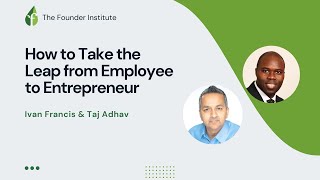
In this Founder Institute live session, moderator Martin Martinez interviews two alumni, Ivan Francis (underwater tiny‑house venture) and Taj Adhav (LeaseCake, a location‑management platform for restaurants and service‑based retail). The conversation explores why and how they left stable corporate jobs to become founders, the pivotal moments that triggered the switch, and the practical steps they took within the FI program. Key themes include the importance of asking for advice rather than money when pitching investors, rigorous customer discovery that led Taj to pivot from a landlord‑focused solution to a tenant‑focused market, and Ivan’s iterative product development using VR prototypes and custom acrylic windows. Both founders discuss fundraising strategies—bootstrapping, grants, and selective seed/Series A rounds—emphasising the need to choose investors wisely. They share tactics for building advisory boards, protecting intellectual property (patents vs trade secrets), recruiting co‑founders and technical talent, and deciding when to quit a day job. Martin highlights the FI curriculum (first six weeks of customer interviews, demo‑day pitch, mentorship) and encourages the audience to leverage the global FI community. The session ends with actionable advice: share ideas early, execute quickly, and stay tenacious.
Chapters
is the moment that you say, hey, Mr. Investor, you know, Mr. Mrs. Investor, I've got this great idea. I'm going to run through your pitch deck. We're raising $100,000. Are you in?
No.
Biggest mistake.
Yep.
Always get them to give you feedback and say, what do you think? What do you think? And draw them in. So ask for advice and then you'll get money. In the same way we did this, and it's not anything that is wrong, but you're doing—
What is happening, everyone? Welcome. Thank you for sticking around a little bit. We started a little late, but all for good reasons. I'm gonna let y'all slowly get settled into here. My name is Martin Martinez. I serve as our partnerships— head of partnerships for Founder Institute headquarters. But I've been running our Texas programs here in the United States. I'm based in Austin. Texas since 2017. Um, so feel free to get settled in. I'm starting to see a lot of y'all trickle in. I can't see all of you right now because things change when we go live, but do me a favor, welcome to Airmeet if it's your first time on the platform. It's a fun one. A bunch of these things popped up at the beginning of the decade during the pandemic, and this one is really the tried and true one that's still here. That's why we've kept it for for so long. It's very interactive. There's networking tables. You're seeing the chat right now. Tell us where you're coming from. We got folks in the Bay Area. We got Napa, SF, Jersey. What's going on? What's going on? I know it's also the evening, so we probably have some folks over on the other side of the world. Houston, LA, thoughts for y'all over there. Australia, there it is. Good morning, Australia. Canada, NYC, New Orleans. Y'all got like 13 inches of snow last week. That was wild. Um, well, we got somebody from Austin. How do y'all— well, again, keep doing that. Drop your LinkedIn, connect with each other. You know, we're a global community. We're in 200 cities, 100 countries around the world, and we love doing these kind of events. We do them all the time. We're probably the most prolific event producers, uh, for the startup community in the world, and we've been doing that for 16 years. But at the end of the day, you know, we help entrepreneurs launch companies. We teach you the things that I wish somebody had taught me being an entrepreneur when I was younger and building that and giving you community. So today, uh, for this event, as you're joining us, you know, we've got Detroit, Vancouver, more ATX. Wow, we've got a few ATX homies in the house. Great. Um, we're gonna meet a couple founders who have gone through the program over the last few years. Had a chance to connect with them just now. We're gonna bring them up here shortly. But again, let's level set, okay? Again, you're on Airmeet. It's your first time here. Again, there's networking tables, so when this disappears, you can connect with each other. Definitely use that chat. There's also a little function down at the bottom over here somewhere. It's got like emojis, right? So if you're vibing with what I'm saying, you can give me some reactions like a heart, a thumbs up, a laugh, all that kind of thing. So you can hit that button. There you go, you're doing it right. You're doing it right. You're doing it right. Yeah, we got an hour. And we're gonna, we're gonna bring our two individuals up, they're gonna tell a little bit about their experience with Founder Institute, but also their story on how they found us, you know, what they got out of it, what they were trying to do, what problems they were trying to solve for the people that mattered to them. So, you know, me running programs for the last 8 years across the state where we have Houston, Dallas, Austin, obviously, and San Antonio, our newest chapter. I can only tell you so much. It's always better when you hear it from someone who's really seen it and dealt with folks like me, leaders who motivate these individuals, who push them, who connect them. So let's bring them up. Let's get to know them. Our team in the back is going to be answering questions, dropping links. But let's bring up Ivan. Let's bring up Taj. How we doing, gents?
Doing well.
Doing great. Yeah, looking forward. Right.
Well, again, everybody give them a warm welcome. Use them emojis, because again, I can't see you clap, but emoji clap. There it is. Love it. Love it. Love it. Drop those LinkedIn's in too. We're going to be dropping links, stuff. So connect, connect, connect. But again, this is gonna be a really thoughtful, hopefully, hopefully insightful conversation for all you in the audience. And I can't see too much on how many folks are in the room, but in the back chat, if our backstage manager can let me know. I always like to see how many folks are happening. But let's start, let's start from the top. Okay, so Ivan, I see you here in the middle, so we're gonna go with you first. Um, tell us where you're from, um, just who you, uh, in general, and then, you know, how'd you find Founder Institute?
Yeah, so originally from Toronto, Canada, um, have been living in the Raleigh-Durham area for about the past 3 years, and, um, You know, a couple years ago, I've been a scuba diver for over 20 years, and I found out there's this other style of diving that really just captured my imagination. Uh, essentially it's living underwater for extended time frames. And so I tried this out, and it was a combination of one of the best experiences of my life but also one of the worst experiences of my life. And in that moment, I said, I think I can change all the things that aren't working to make a venture-backable business But with this audacious idea of people living underwater as a business, I needed some way to validate the business idea, to kind of walk through the different steps of building a business. And so I actually went online and started looking for what are pre-seed accelerators and really saw the offering from Founders Institute and said, yeah, I think this is the program for me.
Awesome, man. Awesome. Thank you for coming. Um, yeah, I'm looking forward to hearing more about what you have to say. Taj, What's going on, amigo?
Yeah. Hey, Martin. Listen, thanks so much for having me on. I'm first generation, youngest kid, immigrant family, born and raised in Canada, Ivan. So moved to Central Florida. We're based in Winter Park. And I founded LeaseCake 7 years ago. And I would say a big part of that journey was absolutely successful because of the Founder Institute. And I was fortunate to be a part of, as a mentor, a Global Startup Weekend event. And I had kind of no idea what I was doing. I was there as a mentor, and a gentleman had planted the seed in my head about, geez, where's the app for real estate? And it stuck with me. And lo and behold, I said, you know, if I'm going to be a mentor at this event, why don't I— why don't I get the domain name LeaseCake? It's a piece of cake. We're leasing location management made easy. And And it turns out we won across 200 cities in 58 countries. And I was between jobs, everybody. And what that meant is, as an employee in Fortune 100 companies, I worked at Disney, I knew that, boy, if it's been vetted globally, I need help. Founder Institute was the first email that I saw when we won, but I chose to wait. I waited about a year because we had a prototype and we started to socialize the capabilities of it. And we learned very early on. And when I joined, I was part of the Silicon Valley cohort. This is in 2019, pre-pandemic, Martine, as you mentioned. And it was a wonderful experience. It really tested what my thought process was. And we really leaned into landlords. But where we are to date is 95% of our business is tenants. Tenant-driven. So think about all of the retail-based restaurants and service-based retail that you drive by every day. You go to Burger King or a Jersey Mike's or a Tropical Smoothie. Well, guess what? They have a different kind of pain in terms of managing the real estate leases, much different than what a landlord faces. So no one was really looking at that market at all, and we created frankly, really are a brand new market, a new category called location management. And I'm so glad we were part of that cohort because we learned how to listen— excuse me— listen to your customers and focus and ultimately scale up a company that's now, you know, we're venture-backed and we're definitely well on our way.
That's fantastic. Well, again, thank you, gentlemen, for joining me this evening. And again, for all of you that are just now filing in, because again, now we're about 11 minutes past top of the hour. Um, again, employee to entrepreneur, you know, it starts somewhere. For many of you in this room, this virtual room, listening to these gentlemen about to tell you some great stories about their experience with FI, you had a day job, right? You had something that was not really cutting it. It was probably the safe bet, you know, but you wanted something more. You wanted to— you wanted to build something that matters for people around. You might even have the domain experience to, to build something. You've seen it, it's been validated. Or maybe it's just hard left, I want to do something different. Founder Institute is a great place for it. But for you two specifically, what was that one thing, if it was one thing, or maybe it was an amalgamation of things that just said, you know what, screw it, I want to start a company. And now with Founder Institute being a vehicle for it, I'm gonna do it. What was that moment? Let's start with you, Ives.
Yeah, so as I kind of touched on a little bit, I think it was You know, I was 20 feet underwater living in this underwater house, and I'm like, wow, what a fantastic experience, you know, experience. But I'm like, there's just so much wrong with this. It's over-engineered. The location is not where it should be. Um, they don't do any marketing right. And, you know, um, and I— it was kind of maybe a combination of things. I said, I think I know I can iterate to product-market fit. Right. I think how I can get a cost structure that's different. I think, you know, my experience in design thinking comes to play. You know, as a former consultant, I'm used to learning quickly, right? So I can go in and figure out what the market size is and whatever. And it's just in that moment I said, yeah, there's something here. And as I continued on that journey, I started finding out facts that I just put together in a way that no one else has, right? So I'm like, Well, there's this piece of information and there's this piece of information. If I put these together, wow, that can make a difference. And I started talking to subject matter experts and validating to say, yeah, this is, this is real, right? And it's just odd for me because I'm like, in this planet of 6 or 7 billion people, no one else has really figured it out. But the answer was not really, or just a handful. And so that was for me to say, look, I can kind of stay in my day job. As a thing, right? And I'm doing okay there, or I really have an opportunity to literally change the world. And the business I'm working on, not only is it recreation, but we're going to be restoring coral reefs, which are under a lot of pressure. We're possibly finding medicines from the sea. We're helping people with health. So the use cases of this business are pretty significant. And for me, it was, it was an easy choice to say, yeah, I like the security of the corporate job. I'm doing okay. But this really is fundamentally a possibility of changing the world. And I can't say no to that. I just gotta lean in and execute.
Yeah, taking that leap. Taj, yeah, please.
So when you said that you were living underwater and they weren't in the right location, I mean, everybody's looking for waterfront real estate. Well, you're like in the middle of waterborne or underwater real estate. So it's pretty freaking cool.
Literally.
I love it. I love it. Yes, for me, I would say, I think the biggest question is, are you fulfilled in your job? And generally, people say, well, what does that mean? And I think for how I was spending a decade at Disney and then working for a tech company, I kind of saw both sides. But frankly, I wasn't fulfilled at Disney. I left after a decade and we launched some crazy, really cool businesses. I left a company that had a nice exit. I didn't make life-changing money, but I still felt like I wasn't fulfilled. And the moment that an idea hit me, someone came to me and said, Taj, you should build an app for real estate, basically, kind of like you, Ivan. You just kind of say, well, maybe now is the time. And you just have to continue to ask yourself questions because you, working for someone else, working to make a rich person richer was never something that fed me. So, I frankly was never fulfilled until that moment when I said, "Holy cow, I need to make some phone calls." We won globally across 200 cities in 58 countries. And I said, "I think now's the time." And really right then, I was between jobs, as I said earlier. So, it wasn't like I was leaving corporate. I was trying to find my next corporate job. And that's when it was like full stop. I need to literally lean into this and do it and just continue to iterate and grow. So that's a little bit of kind of, you know, the thing that was my calling. I was never an accountant. My parents told me to get into business. My parents told me to become a CPA. I said, yes, yes, yes. I was average. I was good enough. I spent time in the Big Four. Then at Disney as a controller managing lots of capital dollars. But at the end of the day, I wasn't fulfilled. So there you go.
There's a commonality I meet with all of the founders that I've been privileged to work with in Texas, and I see it in both of you. It is, again, it's— there's a fear of mediocrity, one, but also two, it's just, yeah, the safe bet is okay, but I want to do something better that's more meaningful for the people that matter to me, for the problems that I see them dealing with that matter to them. And that's kind of where it goes. Quite literally, Ivan, you are underwater when it happens, which is fascinating.
You're drowning. The workload is literally drowning in your work.
But yeah, to survive, so other than drowning, but maybe you're not drowning.
Yeah.
But in any case, So we're getting into, yeah, so now you're at Founders too, right? You have these assumptions, you're taking that leap, right? What was some of the things that you thought it was gonna be like that just completely just proved you wrong? But also maybe some of the things that you just didn't know that just opened the door for even more opportunity. Let's start with you, Todd.
When we looked at the opportunity, you know, the TAM, SAM, SOM, uh, get out of the building, you know, talk to as many people as possible, make sure the prototype worked, and, and it— there was— you're starting to achieve early product market fit. We really leaned into a completely different starting point than where we are today. We were thinking that we're a landlord-based solution. Landlords are going to buy our software, brokers are going to buy it. We knew that tenants are what makes businesses successful because you can't have landlords that own buildings without tenants in it. But we really leaned in that direction and we found out very quickly, which was fortuitous. Again, it's about getting out of the building. You start to listen to— well, landlords will say, if my tenants succeed, I succeed. And then the tenants that we were speaking to, they said, man, if my landlord succeed, I succeed. So in other words, they just wanted to get out of each other's way. And, and we shifted very quickly into the tenant space, and people said, I need LeaseCake more than rich landlord. Here's 5 more people to talk to. And we kept going and going and going, and, and, you know, before you knew it, we shifted completely from where we started.
And again, that happens, you know, like Part of the first 6 weeks of the program, both of you know this intimately, we're pushing you, we're driving you, it's go talk to as many people as you can. I tell my founders, we call everybody founders in the Founders Institute, y'all, but it's up to you to become that person when you graduate, right? So, but for all intents, it's a mindset. You have to go and talk to people and it can be terrifying. It can feel daunting, impossible in some cases. Cases, but we push you to do that. And for those, again, those first 6 weeks before you get to that first big pitch, you know, what was it like for you?
So a couple things I'll draw on. So number 1, let's say through my college career, through my work life, I've won awards or kind of been recognized as a good public speaker, let's say. And so I'm very comfortable with presentations. And getting candid feedback during those first few sessions and scores where there's no 3, right? It's either 1, 2, or 5. It was a gut check. It really was. And I had to go through maybe some psychological adjustment to say, look, it's not about who I think I am. It's about who I want to be. And so let me trust the process. Let me Basically for me, I just had to say, am I in this to win this? Am I going to go all the way or am I just going to, I don't know, bow out? So it was tough. It's tough for everybody, but that was one period of adjustment. Yeah.
And it's totally, that is by design. Not every idea has the strength or the scale of a problem that can be a company, but not every person that walks into that room understands what it means to be a founder as well. Um, and that, and that's always the hard part, gents, you know, when you're talking to people about what you're trying to do. And I'm sure you all had that adversity, you know, the people that love you, they're calling you crazy and not in a constructive way. They're like, why are you doing this? Why don't you just keep with the safe bet? Right? That's not what's driving us. I'm giving you passion. It's not what's going to give you that change that you want to invoke for everyone else around you. So that's what brings people like you two, Founder Institute. But it's hard. You said it's hard again, getting those gut checks. You're successful, but there's still a lot of things you still don't know. Um, so as you've— as you got through those first few weeks, and then boom, you know, obviously there's more requisites. The Founder Institute's structured in the course of about 4 months, right, for everybody in this room. You know, you get first 6 weeks, you're just talking, talking, talking to people. You finally have a business case and you pitch it. Then it's like, all right, let's put this on paper, make it real. Are you serious? This is like really indicator, are you serious person? By the end of it, you know, we're going to put you on a stage, especially for you, Taj. I mean, we do a lot of our stuff online. In Texas, we're in person again. But Taj, if you were— you're one of the last ones, you know, pre-pandemic, you know, you actually did like a pitch event, right? You're pitching in front of investors. Going from that, from just the idea, maybe conceptually, or just the frameworks of it to now having the confidence to be on a stage in just 4 months. How does that feel for both of you? Right?
Well, I would say, Ivan, I'll ask you this question because I think in general, whatever stage or whatever your comfort zone is, if you're comfortable talking to people, you're comfortable presenting, it's the feedback that you have to be prepared for. So our saying really from the very beginning, or my saying was, ideas are better when shared. And what does that mean? That means if you've got an idea, don't keep it a secret. The moment that you unleash it and share it with others, it becomes stronger and more durable. But along that journey, you will find those people that will throw daggers and sharp objects at you saying, "That's the stupidest idea I've ever heard. I'd never buy it." You have to be very strong, very strong internal fortitude because end of the day, exactly what you said, Ivan, You're not building this company for what you are today. It's what you also can become. And making certain that you're open to feedback, good, bad, and ugly, is essential to make sure that this idea can foment into something that starts to multiply and get bigger and frankly stronger and better over time. Because then you use that to recruit really capable co-founders if you need one, or a team as you grow. And then people will get you. They will get the fact that you're a fighter, you believe in this product, and you're not afraid to speak your mind and not go, I got this really cool thing, you know, you got to sign this NDA before I talk to you. Oh, you have to get that out of here. You got to get that out of your mind. Free it. And it will begin to happen. I don't know, Ivan, I'll turn it to you if you want to elaborate on that.
Yeah, so I think for me, I was able to see the transformation from, let's say, the day I walked in the door until we did our demo day. And I think it's just being able to mentally work through the content. Just that level of commitment. It's, you know, being able to accept that feedback. And in my case, just being candid, there in the early on, I was thinking, is this thing even possible? Like, is this really a business? And by going through the steps and, you know, having the mentors give that feedback, even though some of it was candid and it hurt, I started to say, yes, this is real. They're more tweaking the content than shooting it down. Or people are saying, I can connect you to this person. Your TAM shouldn't be this much, it should be that much. So all of those were things where at the end of the period I had more confidence. You know, I had, you know, my data room set up, I had all these other elements, and those were, you know, it was just a great feeling to say, wow, I have made it through this. I feel more confident now at other aspects of my entrepreneurial journey. And early on I said I think it's going to take 10 years to build this business. I'm in. At the end of those weeks of the program, I was even more, yes, I think I can do this.
Yeah, I love this, y'all. I feel like I've known you forever. This is great. Um, because it's stuff we say, stuff we— anybody that leads a program in the world, and the leaders that ran y'all's, understand this too. And that's why we do what we do, um, for you. Uh, because again, it's lonely, it's hard, but you need patience. It's— this isn't a get-rich-quick thing. There's other programs, or actually they don't exist anymore because they suck, you know, that, that you want to get rich quick. This ain't the place for it. This is for something that's enduring, that's meaningful. The beginning, pre-pandemic, we used to take from our founder Adeo. He'd have this whole slide about picture a world in 10, 15, 20 years, a generation down the line. What impact have you made? You go through this thought experiment and immediately half the people walk out the room because that wasn't what they were looking for. They were looking for a quick buck. But for founders, that's not, that's not the mentality, right? So, so let's drill in a little bit more. I know we've been getting a little extension. We're about the half hour mark, and as I last checked, we're about 120 folks in the room. So just to check on everybody here, thank you all for joining. Us. We've got a solid group. Don't be shy in the chat. Talk to each other. Definitely drop some LinkedIn. Keep it going. Tell me more about where you're coming from. I saw Texas, I saw California, saw Australia. Let's keep that. Use emojis. And if you have questions, we'll get to that in about 15 minutes. So if you have some specific questions for each of these two gentlemen here, or founders at large, use that QA function. Use that QA function and start upvoting those. You'll see that over on the left side or on the right side of your screen. And then I'll be able to prioritize and we'll ask those and show them up at the front. Right. So let's drill in a little bit more now. Tactics. So both of you have very focused kind of companies. Let's dig in a little bit. Give me what we always ask you to do. Give me a quick hot seat on what you're doing right now. If you can dust off the old bike, give me a hot seat, Ivan. All right.
So We're focused on building underwater tiny houses for people to have short-term stays of 3 to 5 days. And the purpose is that we are going to be able to help improve ocean restoration, ocean research, and also ocean recreation.
Fantastic.
I'm in. Yeah, I'll write the check now, Ivan.
Spanish. I'll take it.
Nice. Yeah, for LeaseCake, the pitch is we're lease and location management made easy for restaurants and service-based retail. Because at the heart of every great business, it's all driven by a location. And the more locations you have, the more leases you'll end up having. Because in business, everyone owns or leases real estate. But where's the app that helps tenant operators specifically in those two verticals to help them scale and grow so they don't have to worry about missed lease renewal provisions or keeping track of permits and licenses? There are a myriad number of headaches and frankly very costly landmines that could jeopardize their entire business. Simply by non-complying with a real estate lease. We're LeaseCake. Join us, it's a piece of cake.
I like it. I like it. You know, we kind of beat this into all our founders every time, so it's always there. Um, but again, thank you all again on the pitches. I know it's, uh, it's like we, we— you do this every week, y'all, uh, watching. Every week we have you pitch. You become a really great public speaker. You really train a lot of those things. But again, what we're looking for, and what you two have in spades, is not only just the fluid intelligence, you're taking new knowledge, you're applying it, and then you're able to utilize it in very effective ways to continue to improve. But you're also keeping an open mind. You're aware that, yeah, I probably don't know most of what I don't know. And that's why I'm here. And that's what those mentors with that hard feedback, that pushback, You need to have that open mind. If you have rigidity, you know, and you're not gonna really, you're not gonna make it through this program and you probably won't build a business that's gonna be enduring, right? It's probably not a good lifestyle for you either. It's stressful, it's lonely. But so how's progress been so far? Let's talk about, you know, after the fact, you know, you get through the program, you have this grounding, you know, what's been challenging, you know, or what's maybe unique to your location or maybe just at large? Ivan.
Yeah, so a couple things is, you know, getting industry experts on board and committed, right? So I have people who advise and, you know, they're a little bit on the periphery, but one of the things I loved about FI was, you know, I think it was a structured document for mentors to say, here's the level you are in your growth, you know, here's where you are in your business, here's the comp structure. I mean, it's nice and it's clean, agreement. And so getting them to transition from informal mentors who are subject matter experts, the best people in the world at what they do, to signing on the dotted line has been a little bit harder than I thought. It's taken a little bit more time, and sometimes they just want to stay more so on that informal case. So that's been a little bit of a struggle. And then I think also just things that should be easy are difficult. So in my case, I've engineered very special windows underwater. Most windows are small and kind of submarines and circular. I have these big gigantic square windows. So I'm going out and I'm getting quotes. They're like, oh, there's, I think, 12 suppliers globally that can make these windows. Only one got back to me with pricing. And I'm like, what's going on here, right? So that's just an example of a challenge and we'll work through it. And, you know, I think as we start to grow and we have more reputation in the marketplace, people will realize, oh my God, we have to partner with them, right? Because they're gonna be the world's largest purchaser of acrylic windows for aquatic usages. But I think that's just part of the journey, right? Sometimes things take longer, there's more pivots, things to work through. And I think that's why it's so important to have that right entrepreneurial DNA, right? To keep you pushing during those tough times and get things done. So, you know, we won some non-dilutive grants in North Carolina. NCID is an organization where we really won an award, recently won an award. We're getting local press, which is great. We're working towards our next scale of MVP. We're getting government officials contacting us saying, "We want your product in our market." So these are all great indicators that we're in the right direction. And some of these industry experts who initially said, "That's not going to work," they're like, "Oh yeah, that makes sense." And the other thing I think is kind of interesting is there are 3 companies in the world trying to do what I'm doing. I'm one of them. And just seeing others enter this space is confirmation that I'm in the right direction. So that's really cool as well.
So yeah, don't be afraid of competition. Competition validates you. And kudos for everything you've done so far and what you've accomplished. There's a thought, if I can share, because not only does it apply to fundraising, it also applies to bringing on an advisory board or bringing on new team members. I don't know if, if you've heard of this, but if you want advice, ask for money. Because the moment that you say, hey, Mr. Investor, you know, Mr. Mrs. Investor, I've got this great idea, I'm going to run through your pitch deck, we're raising $100,000, are you in? Biggest mistake. Yep. Always get them to give you feedback and say, what do you think? What do you think? And draw them in. So ask for advice and then you'll get money. In the same way we did this, and it's not anything that is wrong, but you're doing this to get validation and you want those people, like for example, when you said you've got government officials contacting you, you've got other companies that said, oh, you know what, I poo-pooed you, you know, a year ago and now I think that's right. If you lean into that and have them be part of, you know, this listening tour, well, give me some feedback, give me some advice. You're trusting their brainpower because they've been, you know, experts in whatever their industry is specific to undersea living as an example. Before you know it, they'll go, hmm, hey, can I join your team in some capacity? You know, maybe there's warrants, or I've got somebody that I think might be willing to put some money in. So there's a way to make sure that you play this. But what you're doing is you're helping build an entire ecosystem around supporting your business. And it's more than just asking for money. It's more than just saying, hey, would you be an advisor? You don't want to lead with that. You say, give me your thoughts. And then have them come to that natural conclusion. And it might take a moment, or it might take a week, or it might take 6 months, and they go, I keep hearing you guys, I keep seeing you in the press, uh, you know, like, what was that guy's name again?
Ivan?
Like, oh shit, I need to find him.
I love it. I haven't—
I mean, that, that all, all resonates. And, uh, you know, we're, we're still pushing ahead and making progress. So yeah, loving the journey.
That's amazing. Again, I love what you said that, Taj. Yeah, the full adage for everybody in this event right now is gonna be, if you ask for money, get advice. Ask for advice, you might get some money. Write that down, y'all. Write that down. And it's true. So let's shift into that investor question. That's always a question people ask. I'm gonna ask for you now. And because founders at this point, especially the ones that just don't know what they're doing, it's like, oh, I need an investor. When they give me money, then I can build it. You know, like, what? It's not really how it works. It's not how the world works. I like the podcast or the movies. It takes a lot of work. And they're not ATMs either. I have a lot of friends that are investors. Many of them are like investors in residence for our Texas programs. And, um, and they can tell the difference between kind of a wantrepreneur and a true founder because they understand the difference. How, how has that been for you navigating those processes? You talked about grants. Tosh, you talked about working with investors. How is that? Again, you guys still— you guys still— you gotta live, you gotta eat, you know.
This—
it's not going to be just the ramen and, you know, the peanut butter sandwich diet forever, you know. How are you navigating that right now and what's been happening?
So, so for me, I think, you know, if there's anything that's— I've deliberately slowed down my employee to entrepreneur journey it was because I wanted to boot— I had to bootstrap further and longer. And in fact, you know, being candid here, my last career move was specifically because I said I wanted more money for my venture, right? So as a director level at this corporation, I said, hey, you know what, it's gonna sound weird, but I want more money to bootstrap. And I made the jump to VP to actually increase my income and get more bonus and get whatever, because I had that ability. But it's also hard the more senior in the organization balancing both of these things. And so my initial period when I thought I was ready to get some outside funding, whether it's angels or VCs, had a lot of skepticism, even though I was asking for feedback, etc. And it had to continue on that bootstrap journey a little bit longer. But now I'm at the point where, like, yeah, I think, I think this is the right time. So that was one thing for me. I think that was a little bit interesting to say that. Yeah, I mean, the angel money, friends and family, you know, I had to kind of think about it a little bit differently because you're not— I'm not going to find investors in this space. They're probably going to be in an adjacency, whether it's hospitality, whether it's blue tech, whether it's whatever. And I've been happy with that decision. It's worked out well for me. But yeah, that's a little bit about my story and where I am right now.
Nice.
Very cool. Very cool. Yeah, we've raised our Series A, Series A1, we just closed an additional $10 million, but it's not easy. And I would say that you have to make sure that your story is compelling. I think it's really important beyond just saying, hey, I got a business plan or I got a pitch deck. Your pitch deck is the most compelling vehicle upon which you can articulate your idea that a potential investor can get behind. I want to just answer a little question that came in through the chat. Just to be clear, Ivan and I are in the US, but by no means is this particularly true for the US. There are incredible entrepreneurs in Canada. My parents are one of them. There's so many different VC funds. So, please don't ever think in this world of crazy geopolitics. I wanted to make sure that that was addressed. So, end of the day, your story and when I mean story, I mean it very literally. Never ever forget where that aha moment came from. Make sure that that story is conveyed in your pitch deck. And, you know, definitely join Founder Institute to learn more about that. But there's a ton of resources around it. Because the moment, like our Series Seed round, I think we had, you know, maybe just a few hundred thousand in annual run rate. And we closed a $3 million seed investment because we found the investors who believed in us. They saw our pitch deck. They saw our traction and they said, we want to invest in the right jockeys. And we were fortunate enough to have the team, very small, lean team. I think we had 4.5 people, literally half of an FTE because we had a part-timer, probably for about 2 to 3 years. And getting those investors to back you, it's a process and you have to make sure that you're choosing them just as much as they're choosing you. Don't forget that. You don't have to always take the first deal that comes to you. Uh, and obviously the, the adage— and I love how you said that, Martin— is that you always want to find smart money, but make sure you take your time and find the right investor that fits where you are in your stage, that believes in you, not just, oh, it's a great business plan, holy cow, let's pour a bunch of money in it and let's see where it can go. You are the leader of the company. You're the leader of your idea.
Yeah, absolutely, absolutely. And at this point in the journey, all again, for you gents here, but for those of you that are aspiring in the room right now, um, that's what investors are looking for. Why you? Why are you the person that can actually solve this problem versus everybody else that's tried and failed? Why are you dedicated? That's what a founder is, right? If it's just like, oh, get-rich-quick opportunity, in and out, yeah, you know, if you're thinking of it that way or if you're projecting that to somebody else because you perceive that they are the investor, they can give you money, you are not going to get out the gates. This is not the journey that you should be taking. Yeah, maybe just stick around with that accounting job, you know, respectfully, respectfully. Um, but we got, we got 19 minutes. And this crowd has been incredible on the questions. I haven't seen this many questions come up so quickly, so, so soon. So I'm just going to dive right in, do some questions. Y'all cool with that?
Let's do it.
Cool. All right, so from the top we got Randall. Um, yeah, he's getting there. Uh, so let's see if we can get Randall's question up in the, uh, there. Once you start a company, you got the proof concept, you've got the business plan, you got the pitch deck, what do you recommend in terms of reaching out to VCs and/or pursuing funding to get to that next step? That was the first question we got from Randall.
I would say validation from as many customers as possible. Get as much feedback from the marketplace, because everything you just outlined— your proof of concept, your business plan, and your, and your pitch deck— it means nothing until you have feedback directly from your customers. Says, I love this product, it solves X, Y, and Z for me, and get that in spades, whether it's testimonials, even write down the quotes that they are— they will put their names behind if they're uncomfortable or they don't have the time. Getting that feedback is absolutely invaluable because that's the only way you can validate and get really true product market fit. And you're going to need to do that over and over and over in the coming years.
Absolutely. I mean, any follow-up to that?
I didn't—
yeah, no, no, I agree. And just to connect it to a thought, uh, earlier, so sometimes we're afraid to throw ideas out there because someone's going to steal it, whatever. But really, whatever the idea is, you want to get it in the marketplace to get that, that feedback and then iterate to what the idea really will be or what the product really will be. And you don't have that idea, that ability to iterate and show that traction and proof points to possible investors until you have something in the marketplace and people are trying it. So that's how it all ties together. Someone might see your, your thing right now and say, I'm going to copy it. 6 months later, you're going to have something completely different because you've been iterating. And so they're not seeing all those iterations as well. So agreed, you have those ideas, you know, let the market tell you what it thinks. And for me, that's my secret sauce, is have a cost structure that allows me to iterate quickly, uh, to get the product market market fit, which is something that is unique in this whole idea of ocean engineering and things like that.
Yeah, and be careful when you might have the best idea, the best pitch deck, the best everything, and they look at you and they say, oh my gosh, I'm gonna write you a check for $4 million today. That's like a signal that you be careful what you wish for. I walked away, and I'm glad I did, within about 3 weeks before the Founder Institute had an investor said, you know, I can give you a term sheet. In fact, we got a term sheet for $4 million. It would have been the stupidest thing I ever did. I waited until we got the validation, and then I joined Founder Institute, and then, then got the business and the model and everything much better perfected and allowed us to be where we are today.
Oh no, I'm glad you did that too. I'm glad you did that too.
Oh man, because it's like, you know, you have to choose your investors just as much as they're choosing you. So it was a great lesson, and I didn't— it wasn't, wasn't a mistake that I made. I was just like, I don't, I don't think, you know, you get what we're doing.
Yes. Yeah, well, again, it's a good check again, that— but also, again, you, you have to think from the perspective of the investor as well. Again, if you just have— that's dumb money, right? Yeah, that's dumb money coming your way. And, you know, if they, if they're just throwing it at you, they're also thinking the same way. It's just that different level. There's like, oh, I can flip this $4 million, blah blah blah, and then boom, they just set it on fire because they're just making crazy bets. Look at the crypto market. Oh well, that's another conversation for another day. Let's get another question. Uh, I have a great idea for my business, but I don't know how to move forward. This is from Richard. Um, I have some expertise, but I don't have any dev experience. I get this question all the time too. Thank y'all for bringing that up. Richard out of Canada. Out of Montreal. I get this question all the time. How did y'all approach it? Well, yeah, sure.
So, you know, I'm not a tech guy, but you have to know enough about who to call and who you trust. You absolutely need to bring in someone that is part of your core team, whether they're going to be a co-founder, whether they're a very early hire. And there's an incentive for them through equity, et cetera. But you gotta find the right dev talent. I mean, I tried to learn to code thinking that, oh, let me go to Udemy and learn to build an app. And I'm like, that's stupid dumb.
Which by the way, Udemy, that was our, out of the very first cohort in 2009, also our first unicorn.
Good name for it.
Yeah, I know.
That's why I bring it up. And I think the gentleman who, founded the company, he was the first 5 that I got.
Really?
I think so.
Yeah. Was it, was it Gagan or was it Aaron? Uh, we've, I've known both.
Oh gosh.
Aaron pops around a lot more. Gagan, he's been, uh, he's got Maven now on the—
oh yeah, yeah, yeah.
But yeah, I mean, in, in my case, uh, I'm an engineer by training. I'm a mechanical engineer. Um, I love design, and this is probably the intersection of two of my skill sets that came together. So, I mean, some things I just built it on my own, but on my journey, I was like, what are ways to be able to have versions of this concept even if they're not physical, right? So initially, we did some things with virtual reality, um, not my expertise. I had to call in some outside help. We've been scaling prototypes once again where do I get the outside help? But the vision setting, the technical details, the what are we trying to test and prove with each one of these is something that I architected. Even when we did some testing on Facebook and A/B testing and whatever, which was quite insightful for us, that vision was something I established and I had to actually learn the backend of Facebook, which was really frustrating. But just as you're going through Founders Institute and you have this tenacity, it just helps you with all the other roadblocks you're going to have on this journey. And so that was the case for me. I'm like, I need a way— I mean, I don't have a half million dollars yet to build a prototype. How can I get something in the hands of users to get feedback? And trust me, when someone puts on those VR goggles, they might as well be in the actual one. Um, and so that's, that's been great. So whether it's software development, not really my thing, but the idea is What do I want to test? How do I test it? And, you know, what can I afford to test is kind of my philosophy, and just get it done.
Yeah. And I mean, and to build on that too, as a more recently, you know, I, we host a lot of events in Texas. We just hosted, uh, I always host an annual State of the Union, so to speak, of startups in VC for Texas. We've been doing about 6 years. We just had it on Wednesday. And, um, obviously the AI news came out, you know, again with China, just the whole thing, just the whole economies of scale has been kind of just flipped over. The ability for you to kind of iterate, prototype, and design products, uh, software has been more easier than ever to do. You know, you don't necessarily need to wait for a technical co-founder to just fall into your lap. You can start playing with no-code solutions and AI solutions to start developing and prototyping very quickly. You can do this all on your laptop right now. So don't let that limit you. Don't let that inhibit you. And don't use that as an excuse to not move forward on the journey. But because that's all it becomes, an excuse. Let's see, let's get another couple questions. We got about 11 minutes left. So we only have maybe a few more time. I want to be respectful for these gentlemen's time because they got companies to build and companies to run. So let's give me a quick refresh. But we've had some great ones. Keep upvoting, everybody. Oh, here's a little more tactical one. This is from Sam, Sam Jordan. He's talking about more about IP, protecting IP while being out in the open and building in the open, right? It can be cutthroat, right? So again, the hesitation, you know, how have y'all had to navigate those waters?
So for me, IP, I did go down the path of getting a design patent, process utility patent, thinking about a patent portfolio. But I think a bigger concern for me is probably more so trade secret. At least that's how I think of it in terms of IP. And so I think about what aspects of my business am I sharing with other people? Is how I'm really going to protect what's unique about this. And I'm always constantly thinking about what is going to be my moat. So I just gave you one example, right? My ability to iterate quicker, iterate faster than any of my competition is going to be part of my secret sauce, right? So you can try and copy me, it really doesn't matter. I don't even know what this thing's going to end up being because I'm going to keep on changing it based on, uh, user feedback. Um, and then also as I'm thinking about my patent protection, these are the things that are going to be unique and defendable. The reality is defending a patent's expensive, right? Especially if you're early stage. So that's probably not the way to lean in. Um, but yeah, I've gone through the formal stuff, but then I'm kind of thinking about here's how I actually want to, uh, protect what I'm doing.
Awesome. Good stuff.
Yeah, I would say that ideas are dime a dozen. And it's execution that matters. So exactly how Ivan put it, in that you're working to get your product out to market faster, better, sharper, uh, and quicker in the, in the, in the best way possible. And if you pay attention to the competition or potential, oh my God, somebody's going to copy me, like you're, you're going to be just going down this complete black hole of, of disappointment and fear and paranoia. It's always good to be paranoid, don't get me wrong, but everyone probably has come up with the idea of living underwater at some point. I mean, I was thinking about it probably when I was 6. Man, why can't we live underwater? Every one of the businesses that are out there has existed, I'm sure, in someone's mind, it's, it's some stage, but it's the execution. It's, it's taking that and making it into a business that scales. So don't get your, uh, don't get your worries so much on, oh, I need to start with a patent because my investors or people that are in the market say, oh, you should get a patent. It is expensive. We have two patents, we're fortunate, but we were careful as to when we started the process And you just have to make sure you have funding and is your IP, you know, secure enough. But getting a trademark, I think, as you start to look at what's the first step when you think you have something like maybe your company name should be trademarked because you don't want to have anyone rip off that company, may create confusion in the market. You know, LeaseCake is a very unique name, but we're making sure that that other cake-related names that are tied to, to our IP are protected. And a trademark isn't too expensive, it just takes a little bit longer. But take your time on protecting the IP through the legal channels because you just, you just want to get your product out there and, and create that really wide moat and distance yourself from the others that are the wannabes.
Yep, I love that. Again, that's the common question at this point in the journey. You're worried about people stealing it. An IP can only give you so much protection as long as you have the money to defend it, right? Takes a lot of money to get it, takes a lot even more money to defend it. So be cautious when you're just throwing money at IP because it ends up just being scribbles on a piece of paper if it's nothing, if you can't do anything to protect it, right? Um, so again, good stuff. We got about 6 minutes left, y'all, so let's make it count. We got a ton of questions. I know y'all are blowing up the chat, but I'm only going to be able to see those questions in the QA tool, y'all. So if you want to get them in, make it count and do it that way for me, please. So let's look at Steph. Steph is saying, I'm stuck trying to find the right people to help bring my idea to life. Where can I find those people? You know, maybe this accelerator, but you know, but is there any other ways to find people to help me build this?
Yes, I mean, for me, it's just getting out there, right? So I was at a local conference a couple months ago, sat down at a table, someone was sharing their story. And I was like, hey, you know what, we should chat, right? Person followed up, made a connection, now is on my team. Right? So just organically being out there. You know, my co-founder, someone, family friend, Right, just turns out that we have interesting backgrounds that work together to start a business. And I said, are you interested? Yes. So I, and I know Founders Institute also has co-founder matching sessions, um, and so it's just saying, here's what I need, uh, going out there and finding it. Once again, I can't say enough about tenacity, right? If A doesn't work, try B. If B doesn't work, try C. There's a book out there called Grit. I think the author's name is Angela Duckworth. That's the whole essence of it, right? Just kind of figure it out and be tenacious. So, um, that's worked for me. Um, you know, recently I took a class part-time. Why? Because I wanted to meet other potential founders, right? Um, just whatever it takes. So, um, yeah, that's a little bit for me.
Yeah, I would agree. Not a whole lot to add there, but you've got to invite people into your world and also invite yourself into theirs. So take a class, uh, go to these, you know, dev meetups or investor roundtables. You'll— you— it's amazing how many potential free events or speaking things you could get invited to if you just pay attention. And frankly, that's how I got to where I am. I went to a startup event that was all about crypto and— not crypto, it was, uh, security and securing your website. Well, I showed up there and before you knew it, you know, 24 hours later I got invited to this Global Startup Weekend. And then boom, just one thing led to the other. So be in that, be in that ecosystem where you want to be, where you're needing to find talent and finding people that share your dreams.
Nice, nice. Again, we got about 4 minutes left, y'all. So I'm gonna take one more and then we're gonna wrap up here. But it's always— this is always a fun one too. Um, it's gonna be from Rick. Uh, when should I quit to work full-time? When should I quit my job as an employee to become this real entrepreneur? And I'll actually combine it with another one that I saw down here as well. Do VC Yeah, it's an existential one for sure.
Yeah, I would say if you're, if you're in between jobs and you're trying to, you're thinking about a transition, um, talking to a VC may be a bit too premature. Uh, I don't know if they'll spend a whole lot of time with you unless it's really, really compelling. And you've got the background to pull it off. But you have to be prepared mentally. I think you also have to be financially prepared. Do I have what it takes? Do I have the savings? Do I have the friends and family that can help me along the way, whether it's a 3-month or a 6-month or a 1-year journey to build that prototype and to have that product-market fit that you're desperately looking for? So there's not— it's never one right wrong answer to when are you ready. You just have to take stock of all of your, all of your assets, intellectual assets, your advisors, people that are in your network, as well as your financial.
Yeah, I'm not much to say, right? So where are you in your life stage? You know, how much risk can you have? Um, you know, how much belief do you have in the business? Um, you know, Yeah, not much to say other than that. I mean, you can get advice from other people, but at some point you just have to make the decision on your own. And, um, yeah, I think that's all I have to say on that particular topic.
Awesome. Yeah, well, going in, let, um, this has been such a fun hour. I feel like I've known y'all forever already. I can't wait to meet you in person at some point. Maybe I can bring you to Austin for Founder X.
There you go, there you go.
Founder X, talk more about that. But that's for the community. For those of you watching that aren't enrolled, that's a conversation for another day. But yeah, March 4th, 5th, and 6th, Founder X Texas coming to town. Can't wait to see everyone. But in any case, Taj, it's been a pleasure. Final thoughts. I always like to end with this too, but if there's any calls to action or ways to connect with you too, please share them. But immediately following this question, I pause. If somebody wanted to start something today, start to build that future, what would be the first thing you'd recommend they do? And then tell us anything else that you might want to say or share so that they can follow you or connect.
Ideas are better when shared. Don't hold that idea inside hoping that, oh, maybe one day I'll get to it, one day I'll get to it. Before you know it, it's never gotten to, and then you live life with regret. So just make sure that you socialize that and your world may change.
I would say be unapologetic in terms of leaning in, right? Just saturate yourself in all aspects of the idea, execute quickly, and of course join Founders Institute.
Oh, that was a good hook right there. I haven't— gosh, that's for the last.
I love it.
Fun one, gents. Um, I wish you all well. I'm gonna let y'all head out into the sunset while I wrap up and give some calls to action to this group. But it's great. I hope I can meet y'all in person sometime soon.
Until next time. All right, have a pleasure. Thanks, Martin.
So, all right, for everybody else hanging, um, while my backstage team kind of brings them off, it'll just be little old me for a last couple minutes. Thank you all again for attending. We host events all the time, all around the world. You know, if there's a program running throughout the world, we're in 200 cities, 100 countries globally, join them. You know, we host a ton in person in Texas, so I hope you get to come out if you are local. I saw a few Texas folks in there, Houston. We're kicking off our first cohort of the year in Texas next week. And, you know, If you want to apply and jump in early, or you might already in there, you might know a guy to help you, uh, right here in this seat. Um, but Austin's going to kick off in the fall. Uh, we have San Antonio coming up in later in the spring. But in any case, wherever you are in the world, um, there's a reason why Founder Institute's been around for 16 years and why we've been doing this so well. Um, and it's case in point, those two individuals and the many thousands we've helped. Over the course of those 16 years. So maybe a few of you might be inspired to do it yourself. But in any case, until next time, I wish you safety. I wish you wellness. Be inspired by the people in this room. Hope you get to connect with more. Don't be shy. Keep coming to these events. Build the future that you want to build for the people that matter to you. And I'll see you next time.










