Insights from Entrepreneurs Who Took the Leap with Alexander Leonida & Dan Huru
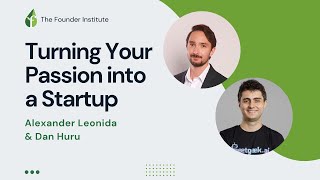
The webinar, hosted by Founder Institute Entrepreneur‑in‑Residence Jordan Jokas, features founders Alexander Leonida (CEO of SilkFlow) and Dan Huru (CEO/co‑founder of MeetGeek). The discussion explores the transition from employee to founder, emphasizing the importance of validating ideas before building a team, using low‑cost landing pages, and leveraging personal networks. Both founders share their personal journeys: Alexander moved from finance and consulting to building an AI‑automation strategy platform after recognizing a market need, while Dan transitioned from software engineering and a PhD to a meeting‑assistant startup, balancing family responsibilities and bootstrapping. They discuss building founding teams—technical vs non‑technical roles, hiring cadence, and the challenges of finding co‑founders. Fundraising experiences are contrasted: Alexander’s bootstrapped approach with revenue focus and limited VC, Dan’s modest VC seed after a long bootstrapping period, and the importance of vesting, cliffs, and founder agreements to protect against co‑founder fallout. The panel also covers AI product development, noting that AI is becoming commoditized and the real value lies in contextualizing data and solving specific problems rather than chasing hype. Practical go‑to‑market tactics for B2B SaaS are shared, including LinkedIn outreach, AppSumo launches, and building waitlists. Advice on sharing ideas, networking, and the role of the Founder Institute’s programs (FI, Founder Lab, VC Lab) is provided throughout. The session ends with audience Q&A on customer acquisition, MVP timelines, and founder agreements, followed by networking and calls for hiring and investment introductions.
Chapters
Before you start building a team, first thing to do is to try and validate your idea and make sure that you're not wasting your time and their time, right? Do a lot of stuff like Dan said, you have to do yourself, the marketing, everything like that. Try and build a simple web page. It's really easy now, really easy. Most of it is quite free as well. Build a landing page, try to do some designs or I think I first Most of my UI is still from some designer that I paid a few hundred quid at the very beginning of my journey. And it's been used to this day, rinsed and repeated.
Hello and welcome. If you've made it here, then you should be hearing us live. So we're just letting people kind of come into the room. This is Founder Institute Employee to Entrepreneur. My name is Jordan Jokas. I'm the Entrepreneur in Residence Innovation here at Founder Institute. So we're just gonna let people come into the room. As that happens, I'm just gonna share a brief kind of introduction as to what Founder Institute is, if you're unfamiliar, and then we'll get into bringing on our panelists. Before we bring on the panelists, we'll also do like a short poll so we can execute that poll in a second here. I'm just about to share my window. So you might see a poll come up that will ask you what type of partner you are. So if you're maybe a founder, maybe you're an investor, maybe you're just an ecosystem partner and what that looks like. And then I'm just going to share a slideshow here of Founder Institute. So for myself, part of the reason why I got involved in Founder Institute is because, you know, locally there just wasn't the supports that I kind of needed from an ecosystem. We were building a lot of startups, we were doing some deep tech stuff. I'm based in, for example, Waterloo, Canada. So you probably had a BlackBerry at one time, don't anymore, I'm sure. And we just needed support from an investor perspective, from a mentorship perspective on how to scale globally. And You know, and then Founder Institute came along and never really looked back because it provided kind of out of the box a lot of solutions that we needed as startups, which was, you know, we need a global mentorship, we needed a pipeline to Silicon Valley, um, post-program we needed a way to be able to figure out how to fundraise, um, and you know what that looked like. So we have what's called the funding lab, we can assist with that. So over the years, you know, we've now graduated over 7,000 alumni. We're in 100+ countries, portfolio value of over $35 billion. And, you know, whether or not you like it or not, you're going to be a global company if you go through the Founder Institute program. So this is our co-founder and CEO, Jonathan Grecian, and our other co-founder is Adeo Ressi. He used to be actually, strangely enough, they built a hacker house at University of Pennsylvania together with Elon Musk. And then Elon went on to create SpaceX, and then Adeo went on to chair the XPRIZE. And then subsequently, you know, he's moved on to be the CEO of VC Labs. And now we have the world's largest venture capital accelerator as well. And so what that kind of looks like is, you know, we can help build accelerators. So we've done that, for example, with Portugal, training their startup ecosystem on how to run more efficiently with their accelerators. Two are then our core program, a Founder Institute. We also have what's called Founder Lab. So it's a post-program. So when you complete Founder Institute. So you can come in with an idea and then come out with an incorporated tech company. And then with Founder Lab, we can then teach you how to go actually fundraise. So we work on your deck, we work on your, um, your deal room, we help shortlist investor list, and then we can also assist because we have our FI Venture Network where we can syndicate deals that are ready for investment. And then now we also run VC Lab, which is the world's largest venture capital accelerator as well. So now today, over 7,000+ portfolio companies. So as an example, we were the— with the directors in Mongolia, the first accelerator in Mongolia, and then also the first venture capital fund that was built in Mongolia thanks to Founder Institute. Along the way, we worked with SoftBank, Google Ventures, Y Combinator. You may have heard of Udemy, they're one of our companies. And then now in our portfolio, we're We're averaging about one liquidation event per month. So that kind of terminal velocity isn't really achieved by almost any other fund. And then along the way, we've built a world-class platform. So, you know, I can attest to, you know, the fact that we've been building this out over 15 years. We have directors around the world, and then we do weekly calls with those directors. We get their feedback in our iterative loop. You know, we can then tool that software platform. So now we have, you know, one of the most advanced software platforms, just period, but then also for acceleration for sure is the number one. We also have Founder Showcase. So we have a couple coming up. So these are some of the top portfolio companies that are actively raising. Founder X is our user conference that we host in Silicon Valley in November. And last year, it was at Oracle. We've had Elon Musk as a keynote last year, Jason Calacanis, also Peter Pham with Scionce. So they created Liquid Death as an example, the fastest-growing energy— well, the fastest-growing beverage, I think, of all time. And then venture trailblazers. So for example, Tim Draper, one of the most respected investors on the planet. And then along the way, you know, we've worked with Siemens, NASA, 43North, DePaul University. And so that's a little bit about Founder Institute. I'm going to stop sharing my screen and then we're going to start welcoming up our panel for today. And so first I'm going to bring on our— we have two esteemed panelists. The first is a founder and Founder Institute grad and the founder of SilkFlow, which is a strategy platform for companies looking to adopt, govern, plan, and measure their AI and automation solutions. So he used to have a consultancy and he led like multi-million dollar digital automation projects across several organizations. So finance, insurance, consumer healthcare, telecoms, and retail. And then now has kind of brought those skills into the new startup that he has. So please put your hands together for founder and CEO of SilkFlow, Alexander Leonida. And then our other guest, um, is the founder of AI Meeting Assistant that records, summarizes, and extracts insights from online calls. He has extensive experience in software development, team management, and Java programming. He's the CEO and co-founder of MeetGeek. Please put your hands together for Dan Huru. So we'll put their LinkedIn into the chat so you can you can connect with them there if you want. And then I think we'll get right into some of the questions. So thank you both for joining. And maybe I'll just kind of ask you both, maybe we'll start with Alexander because we started with you, but, you know, what's been the biggest challenge that you've faced making that leap of faith from, let's say, an employee or, you know, a gig worker, let's say, to an entrepreneur and actually launching a scalable tech company?
Yeah, thanks. So Alex is fine. So I started off in finance as a full-time employee, many different jobs in terms of like trading, I think as HSBC at one point, then like a hedge fund company.
It just wasn't for me.
So I decided to kind of change tack. I originally went through uni with a banking and finance degree, but it wasn't what I hoped it would be. I remember seeing my manager who was at the same table as me, same desk on his laptop, just, you know, 10 years older, for example. And I just didn't see myself in the same position. So, you know, I thought, okay, what can I do about this? Tech was a big thing and it was, you know, there was a lot of changes going on, especially with automation tools and stuff at the time. I think this was around 2016, 2015. So then I started learning how to code with Python, started to join hackathons and luckily got headhunted by the consultancy Deloitte. Particularly the UK digital transformation branch. And there I got to learn a lot of technologies. Again, it's that constant learning, the constant iteration. I then thought, hang on, I can do this myself. So I started my own— I made the change. I started my own consultancy in the UK, started to win, started to learn how to sell and win my own clients. And then kind of built up a team around that and did that for at least 7 years. It wasn't until after the 7 years of experience with lots and lots of different client implementations of new technologies. Like, I mean, AI has been around for a very long time and I've dealt and implemented every single version you can imagine. GenAI was around way before ChatGPT. But it's only really just become more accessible. So worked with all the technologies and everything and just decided that, well, every company, or found out that every company who's trying to implement these technologies has the same foundational issues, mostly around visibility into what parts of their business they can apply these new technologies to and where the use cases are, understanding the kind of governance, the total cost of ownership of implementing these tools, and the real-time benefits that they can get, the ROI. And most of the tools that they were using for that, such as Jira, spreadsheets and such, and they still are using those to manage these intelligent automation programs, are antiquated and they don't really solve a major problem. And they act as a blocker to stop companies from scaling up these new technology adoption. So decided to throw my hat in and build Silkflow.
So was the event horizon for you kind of seeing that person and you just didn't want to be them?
Yeah, so that was the original turning point. I saw the manager and again, finance is kind of a soul-destroying industry. I enjoy the, you know, the certain aspects of it, but it's tough, really is tough. So that kind of spurred me to try and do my own thing.
Okay, and then maybe Dan, for you, and actually before we get into it, Dan, how often do you get comparisons to Daniel Radcliffe? Is it on a daily basis or a weekly basis?
Never had one.
Never.
That's fantastic.
It's a good compliment. He's great. So yeah, maybe for you, uh, was there like an event horizon? Was there a moment in time where you said, you know what, I just want to become an entrepreneur? Or what was that journey like?
In my case, I think it was— I always kind of knew that I wanted to do, uh, something more than just, you know, more than just working for a company. So, throughout the, you know, my adult years, I would say, I always tried different things, you know, side projects, sometimes alone, sometimes in a collaboration with others. Then when I wasn't doing this kind of like side projects, I was constantly learning or being interested about doing more. I also did a PhD, so I was a software engineer most of the time, then an engineering manager, and then also did a PhD. So I had this constant drive to do more than what I was doing at the job. So I kind of like knew what I wanted and what kind of like the direction was. But, you know, speaking about challenges when doing the actual leap, I mean, the first time, midgeek is basically the first real startup that I started, which is like kind of like full-time, you know, with actual, uh, with all the actual things involved. Uh, so, um, Founder Institute was a good— when I did the Founder Institute program in, uh, I did it in 2020, I was actually having two small children at the same time, and I was took like a paternity leave. So I said, okay, I have 2 months now free. So 1 month I will do, I will, you know, just take some days off, and 1 month I will be doing the FI program and see what's about. So it was kind of like in a, let's say, part of my life where I had some, like, you know, some pressure, like why would you start this now, you know, it's not maybe the best time to do it. And then also I was kind of like used to the financial, let's say, comfort of, you know, having a good job. You know, we were, we were in a great team in the company, we were, had a great team, had great projects, great access to technology. So kind of like not really an obvious reason to quit. So I had to kind of like overcome first the financial comfort and then the actual, you know, am I able to do this? Do I have the right skills? Is it really for me? You know, so even though I tried a few times doing side projects, this was more serious. So actually doing the program helped me like kind of like reinforcing, you know, through feedback. I got myself reinforced that, oh, I can really do it. It looks like, you know, people are, people like, you know, the ones that were judging us, like, oh, they actually think it's a good idea. They, I think I can do this job and I can also recruit other people. And another challenge I think you mentioned at the beginning is like, how did you recruit other people or how did you convince others, other people to join? For me, since I was involved in the software space, I knew a lot of people and I always kind of like tried to identify those people that I could do a startup with. So not just like very good software developers or the very good people in the role, but also like team players, actual team players that you can really have an honest relationship and you can, you know, exchange honest feedback without, you know, uh, you know, without big ego problems or anything like that. So, um, that's the thing that I kind of like thought about before actually doing Founder Institute. So when we did Founder Institute, I already knew who were the persons to talk with and kind of like convince them to jump. I didn't tell them like, hey, we are going to quit our jobs and do this. Um, I, you know, I kind of like tell them, hey, let's do this side project, let's see what we get, like feedback. Let's do a proof of concept, let's present to investors, and then we see what happens. And it's kind of like the, you know, the motivation for them came along the way, not like from day one. You cannot really convince people to jump on your ship when you have nothing, uh, instantly. They have good jobs, you know, they Why? Why would they do it? So that was kind of the story for me. You know, a lot of challenges actually, I would say. Not easy.
Interesting.
Yeah.
Sorry.
Yeah, go ahead.
It's interesting you mentioned that. So I'm from the non-technical perspective, right? So I'm a non-technical founder. It was a nightmare trying to find someone to, especially at an early stage, trying to believe in the idea and just get me to the next step. And, you know, I think for me to make the first jump, I had to have my finances in order, something you mentioned, right? So I, luckily I was doing the consulting that was helping to pay for, I was doing the consulting alongside building Silkflow alongside Founder Institute. I think at one point I was, I like, it was almost like a second job, Founder Institute. It's not easy. It takes a lot of time. To do what's required. But it was a good kickstart, a good kick in the back to really get going and to solidify a lot of the concepts that you were just umming and ahhing about for quite a while. But once I had a decent nest egg of finances, I decided to jump full-time into SilkFlow. Didn't, hasn't been a smooth ride. There were times when I had to dip back into contracting just to pay for 'Cause we had, I actually, I ended up having to pay developers eventually because I had a co-founder who I managed to convince to join me. That ended up being toxic after about, I don't know, let's say a year. Lots of different reasons for that, but it didn't work out. Ended up having to hire 2 developers or something just to help me out. Been doing that for another year and a half. We lost like 6 months of development time. It's just been literally ups and downs. So yeah, make sure you get finances in place. And yeah, if you do remember anyone that you've worked with that was a friend or something that, you know, was a developer, again, still reach out to them, see if— try and get them interested in your idea. But again, be careful because, you know, working with friends is is always a tough one. And make sure the expectations are set at the beginning and do get a founder agreement in place.
That's all I can say.
Yeah, so, yeah, some sort of shareholder agreement. And I also find it helps too if you define the roles, especially if you have co-founders, defining the roles so that everyone knows, okay, this is my role, these are my responsibilities, so that it can try and alleviate the co-founder differences. So maybe just really quickly then on building on that. So, cause we always get a lot of questions about building the right team. You know, Dan, in your case, you're a technical founder. Alexander, in your case, you're like an industry professional and you know the industry cold. But if you were kind of like starting from scratch, let's say you weren't even, you were just overseeing it, you're like the general manager for this startup, you know, what would be kind of the cadence of hires that you would look for? So like, what would you look for in a founding team? Then what would be your first, let's say, 2, 3 hires? Um, yeah, Dan, go ahead.
Yeah, yeah, I think it highly depends on the type of startup that you want to create. That's the first thing. In our case, we knew that we wanted to build a technology product. So technology being the core, it was good that we started as a technical team. We had some challenges afterwards to actually get people that had marketing experience. For example, I had to do basically marketing at the beginning. And put myself to a lot of learning curves, which is great now, but, you know, that was also a challenge. So I would say that it highly depends. If it's a core thing, then you have to recruit people with the core skills and have them in your founding team. Even if it's just technology, you can just focus on the core technology and then work with consultants or, you know, other people for side technology parts that are not core to the business. For us, for example, marketing and technology are core, so we keep this internal. But sometimes we outsource other stuff, maybe, you know, I don't know, stuff related, maybe it's very specific things related to maybe sales or partnerships or those kind of things. I guess that in Alexander's case, it would be a totally different story. I'm not sure.
So yeah, so Alexander, maybe from your perspective, like coming as a non-technical founder, like what would be the technical— what would be the cadence of building out your team?
Ah, it's an interesting one because, uh, obviously a non-tech founder trying to start a tech startup, um, what would you do? I mean, honestly, before you start building a team, first thing to do is to try and validate your idea and make sure that you're not wasting your time and their time, right? Do a lot of stuff like Dan said, you have to do yourself, the marketing, everything like that. Try and build a simple web page, it's really easy now, really easy. Most of it is quite free as well. Build a landing page, try to do some designs or I think I first Most of my UI is still from some designer that I paid a few hundred quid at the very beginning of my journey, and it's been used to this day, rinsed and repeated. So try and get some initial designs done, and that initial effort should hopefully unveil some subscribers or whatever you need to validate the ideas if it's a tech product or if it's an actual physical product as well. Just try and Drive some traffic to that site, try and drive some subscriptions. Or you could do this sort of thing in person as well, depending on the business, but try and validate the idea. Now in terms of the team, obviously I had to start with tech, but that's mainly because I think they say there's like 3 different types of founding team members you should have, right? Tech, commercial, and design or something like that. Something or marketing.
Yeah, exactly, exactly.
So I had to be the hustler, the other one.
Yeah, I guess.
Yeah, I never don't have time to hang out. So yeah, so I had to be one or two of them and then I had to try and find the third one. Again, that was really tough. We had to, there's a lot of promises that I was making, especially to, you know, domain. I've been in the domain for a while. So I knew a lot of people to reach out to for the contacts, for the sales and everything, you know, you had to back up your word, right? So you have to try and get MVP out there, you have to try and, yeah, it was hard at the beginning because I didn't realize my product was enterprise until I actually started like, I don't know, halfway in really, like 6 months in. And then I started realizing, yeah, this is gonna be, this is gonna be quite big. So the MVP again, The whole thing about minimum viable products is a tricky one. Because our minimum viable product, our minimum viable product needed a lot more features. Right? So I had a lot of companies drop out at the beginning purely because it was nowhere near what I said it would or could be. So yeah, just be careful. Just be careful. Yeah, make sure I, for me, it was first just finding a tech person to to help build, whether that was equity at first or with cash.
Yeah, we definitely see that there seems to be a trend from like the angel side of things where, you know, there used to be that solo founders could raise and then they would get investment and then they could go out and hire a team and scale a team. I think that is getting much more difficult to fundraise for. What's more likely is like, let's say 3 co-founders, maybe 4 co-founders that can bootstrap just with the co-founder team on their own sweat equity where it's like, yeah, you have someone that can manage the tech. You have someone who can probably act as a CEO and knows the industry cold. And then, you know, one person's a hipster that like maybe they're, they're UX/UI. And maybe a little bit of sales, let's say. And yeah, it's, it seems to be moving into sustainable teams. It seems to be. Just as a reminder for everyone, there's a Q&A portion on the tab to your right if you look at it. And so if you have questions, you can just put them in there, and then in about like 10, 15 minutes, we'll start getting into user submitted questions. So AI is all the rage, everyone's talking about it. Just to put things into perspective though, and it was interesting because I talked to like a CTO, chief architect for like a unicorn company, they're in cybersecurity, and you know, this person's attitude on AI was, yeah, AI is popular, but really in the grand scheme of things, it's, it's, it could just be seen as a feature, and that feature is the most important feature in the toolbox right now. Um, but it's still obviously very important, um, because, you know, one killer feature can make the entire company. Um, so on that, like, what, um, you know, what does it take to build? Because you're both building AI companies, you know, just how difficult is it actually to build an AI company? What's really involved? 'Cause I think that a lot of pitch decks are just throwing in the word AI and they haven't really even done anything. Maybe it's just a little bit of machine learning, but you know, how actually difficult is it to build an AI company? And maybe we'll start with you, Dan.
Yeah, sure.
We are actually, we call ourselves more as an infrastructure company rather than an AI company. And why is that? Because of course a lot of what we do is infrastructure, not AI, although AI is a big component as you mentioned. But it's important to contextualize how you deliver the AI features, and with the right context it becomes more relevant and it becomes you know, something that can be, can bring more value. So in our case, it's the meeting infrastructure and all the contextual data that can give a lot of value to the actual AI that will deliver, you know, the results. And I guess the main challenge is to understand how you build that context, for whom, and how you deliver. What's the user experience look like around AI? Because It is more or less becoming a commoditized technology in a lot of ways. If you look at transcription, I'm just like giving examples from our domain more. It's like if you look at transcription, speech-to-text, or even summaries, they are becoming commoditized. You will have all types of applications having some kind of summarization layer or like captions layer or transcribing layer. So, it's more about what you do with this data and how you contextualize it rather than, you know, generic use, I would say. So, there is a challenge from a technological perspective, but I would say the bigger challenge is how you design this whole thing and how you, you know, how you communicate it to users and customers. And that's the main challenge, I would say.
Yeah, maybe for you, Alexander?
So from my point, it's— Silflow is a tool that helps— it provides a platform that helps companies actually implement AI and automation or process automation, right? How it does that is through a number of different, a number of different pathways or steps. So first, we're ideating, like, what use cases are there in the business and so on and so forth. Second part is assessment, so assessing the feasibility of AI and automation. So we've got different assessments in the platform, you know, whether what the cost would be to implement, what the benefits would be if you were to go ahead and implement it, and once it's go live, and just basically give you the full kind of project planning and business case for those new technology solutions. Like, we've seen it used for other tools as well, like cybersecurity, but focusing on AI and automation at this point. There's also some project management in there, which, you know, trying to get companies away from Jira. And then also a final part, which is analytics. So once these models are built, once these automation solutions are built, they can feed that back into SilkFlow, and we showcase the ROI of these, you know, versus their estimates. So it's like a strategy platform for the end-to-end lifecycle. Now, where do you put AI into something that helps you develop AI? That's been the question. And going back to Dan's point, it really is about the value. Now, I've— in my field, I'm selling to people that I used to be. So, you know, heads of digital transformation, innovation leads, intelligent automation leaders and stuff like that, right? Change leaders and such. So what the real key is, like, where, what problems they are having, and can we use AI to help solve that in the platform? When last year everyone was talking about the hype of, you know, using LLMs and different GPT models and stuff, we were kind of on the sidelines because we didn't— and we still are very a bit on the side— couldn't really see the value of where that would fit into our platform versus all the other features that clients were actually asking for and needing, right? So they're not necessarily wanting like a, a thing that summarizes a, a process, for example, that they're doing and they know well, because, well, what is the point? Why are you going to have an AI tell you how your business runs stuff when when like some general LLM model take a title of your process and then generate a script or generate like a map when they have no idea what you're talking about and you have to redo it anyway. So there's loads of different areas where we've had to literally sit and think, where can we, how can we use this? And there's different types obviously, but there's, it doesn't mean that thing, depending on the problem, it doesn't mean that things like the, statistics could be used, or machine learning, right, or data science, you know. So we've seen more value in, say, prediction, and we see more value in forecasting. But what we're really seeing, at least what we're going to move into, is more like agentized work. And that's where, that's where we're going to focus our efforts. So yeah, there's a lot of hype around AI. Don't jump into it like we tell our clients who are still trying to jump in, jump, jump on the bandwagon. Really think about where it can add value. And in this case, like Dan said, there's a lot of commoditized use cases. Like, God, if you look at any project management tool, they've got some summarization, they've got some translation stuff, they've got, you know, expand, retract, all that kind of thing. Um, auto-generated task names. And they say, oh, we're AI-powered, but that's, that's weak, really weak. And yet it's what drives the conversation now. So, um, it's interesting. The capabilities, just, just from my perspective and seeing a lot of companies implement this stuff, the capabilities in the market from businesses are very low still, and, and we're still at the early stages. 85% of AI projects fail. Well-known statistic in our field, and that was from 2018. It's worse now, I think. I think it was like 92% currently, and it's purely because the use case isn't there. The costs outweigh the benefits. So if— and if you're implementing AI and there's no ROI, you're doing a bad job, basically. So just be cautious. So focus on the problem you're trying to solve.
I couldn't tell if we were talking about AI or the NFT market circa 2020.
Honestly, any technology, this, you know, don't, don't— as long as you're not chasing something that's new and shiny, then you're fine. But a lot of people do that, especially in the consumer market. So be careful.
Thank you.
It's like the general advice, like don't fall in love with the technology, fall in love with the problem.
Yes.
And then you see what technology can be used to solve the problem.
Yeah, totally. Okay, so we're going to get to audience questions in a second. Just before we do that, last thing, um, just on fundraising, because we always get questions about it. Um, so, you know, every startup founder has like a different fundraising story. So for example, um, you know, yeah, may start as a consultancy and then the consultancy kind of spins out into a startup and they just are naturally really good at pitching because they were running a consultancy. Or like we've seen, um, you know, some startups, they're just really good at writing grants. Yeah. Or other ones, maybe they're really, really technical and they're able to get like technical tax credits, things like that. Um, I mean, the sad reality of a lot of startups are that like, you know, ideally you've already have access to capital somehow. You know, we've seen angels, that's one of the first questions they'll ask is basically like, how wealthy are the founders? Because they don't want to be the only ones backing them, which is unfortunate. So I mean, for the two of you really quickly, like, you know, what's that entrepreneurial journey from a fundraising perspective been like? And/or like, do you have any tips or tricks in this state of the economy? So maybe Dan.
Yeah, I can share my story. It's not the bulletproof story, but silver bullet story. So in my case, we started as a side project, as I mentioned. So we were still working, didn't have any funds or like bank deposits to fund us. So we just continued to do this working a lot, like doing a full-time job and then doing this a lot of hours in the weekends. So we kind of like sacrificed one year. And then actually through Founder Institute, we met with one of the local VCs in Romania that actually they wanted to invest. But still, like from initial, you know, initial an initial verbal yes to actual money in the bank, it took another 8 months or so. And then we actually could afford to go full-time. But even like that, even in those conditions, we had to cut down, you know, we were paying us much less than we used to be paid when working and had to be like really frugal about our expenses. We didn't raise too much money, even though it was a VC, it was a local VC, we didn't raise much money. We had competitors with much bigger amounts being raised in, in US and so on. So in a way, it was, you know, now I look, looking back, I see it, you know, it was a problem because we didn't have enough money to, you know, build as fast as we could. At the same time, it forced us to think in a different way and to, you know, make decisions about the unit economics and like think it from the perspective of a real business and try to be closer to the customers and actually monetize it much faster. And I think, you know, it was actually— actually having less money was an advantage in a way. But that was our story. We had some funding, we were able to go full-time, and it was okay like that. And then We were in situations where we were almost out of money. I didn't pay myself for a couple of months, and not so at the second round when we did the second convertible note. That was very stressful, as you can imagine. And yeah, I mean, until we got to generate revenue, it was, you know, physically quite tough, even though we had money. VC.
What an amazing concept, trying to bring revenue into the company as opposed to just fundraising. I love it. Alexander, what's your story been like?
Uh, so completely bootstrapped on my side. Um, I'd say unfortunately, uh, it's bloody tough. So I think I originally tried to go out and get funding for the idea itself, but every investor I went to just turned me down. Didn't understand why companies needed help implementing AI and automation. They were wondering why I wasn't just building an automation tool. There's thousands of them out there. So in the end, I just said, well, look, maybe I'll just come back to you when I have revenue. So me and the team, we're building for about maybe 1.5, 2 years now. We released We've been literally launching constantly. I think the first version of Silflow was launched about a year ago. It was terrible, really embarrassing, but it gave us the feedback we needed, and now it's informed our whole roadmap to the point where we know what we're building. Everything else, including adding AI, is just a nice to have. So we carried on heads down. I was lucky enough to have to fund it, might be able to be able to fund it myself through my consulting work and my previous, uh, previous company. Um, so I put like $20 grand into the business or $30 grand, um, and that's managed to make that last for one whole year. We released like a new version of Silkflow back in December last year. This beginning of this year, we won a US bank, um, a US house builder, like a construction company. And we're trialing two large firms at the moment, one global healthcare company, one global charity, and a number of other firms. So we're on track hopefully this year to be cash flow positive. And I think I'm going to win two or three more. Again, most of these are like enterprises, so they're brand names. I'm going to try and win 2 more of these brand names, take that to investors and say, hey, look, I've done all this work, I've got this amount of revenue, this much in the waitlist, we have an MVP, it's being sold to— I managed to sell it to these big, big industries, regulated industries and, you know, big names. Now I just need to scale. And hopefully that's a much better argument.
Yeah, B2B is tough. It takes time to close those sales. Okay, so why don't we transition into some audience questions? So we're gonna pull, um, you'll see a question come up on the screen here, and then, um, whoever wants to jump into it, just give us a second here. Uh, so how did you get your first 10 customers while staying below the radar on your day job? Details please. Don't use your, uh, employee email, that's for sure, or employee computer.
Um, I'll jump in. So I was doing this while running a consultancy. Um, I, I'm in automation, so I had to automate a lot of it. So I was automating emails, I was automating some outreach, trying to cold call any method I could, a lot of LinkedIn outreach. And I guess while I was working, they weren't necessarily customers because the product wasn't there. It was more just users, people that I— who were in the space that I wanted to try the product. And a lot of them can't because again, they're using company company emails and accounts and they have to, in my space, have to go through a lot of procurement just to be able to get to a certain level. So I managed to get a few to go through all the paperwork and get it done just on the basis of trying it out. And yeah, it was tough. So lots of late evenings with, again, so we're a UK company, but the majority of our customers so far have been US. So a lot of late nights for me trying to pitch people. I had to learn how to sell. So I went on LinkedIn, found some salespeople in kind of not adjacent companies, but companies that were kind of similar, not similar, but I don't know, let's say people that were selling project management tools or strategy tools or innovation tools, going to the heads of sales, just asking them if they could give me some advice, jumping on calls with them, you know, back and forth, trying to learn like, how do I build my sales process? What steps should I do? How do I, I've received this objection, how do I come back to that? Obviously I can't afford these guys, I'd love to have them do it for me, but I had to learn all that myself. Still am learning. So yeah, it's a lot of hard work, a lot of graft. It's not easy, especially when you're trying to sell like a technical tool for transformation teams. Yeah, it was tough.
Dan, from your perspective?
Yeah, I mean, for us, we didn't have customers while I was still working because we were still working on the prototype, but I personally did over 200 or 300 Zoom calls in that period with anyone I could get in to give us feedback on the concept or on the prototype. So they weren't actually paying money. In our case, it was kind of like easier to, in a way, since it was kind of like related to meetings. So there are many people that have meetings, so it could, I could get a lot of opinions. At the same time, it was challenging because those opinions were widely different, like, oh, go for that company, go for that type of customer, do this, do that feature, do this feature. So kind of like difficult to find the actual product that you want to build even if you have the product, even if you have the prototype. So no actual customers, very early users, or many, many discussions. The first year just doing customer development, so calls and product work, nothing else. No conferencing, no nothing, just meeting people, talking about the product, talking about the potential use cases and so on. That's what I did. So that kind of like helped us to gain a good understanding how we reach to people. Started with of course friends, then tried all the networks that I was part of, including Founder Institute, reaching out to other FI alumni, asking for advice, asking to take a look at the product. That actually helped a lot because there's— it's a wide network from different countries with different perspectives, all types of roles and people. So that was kind of like, like the first step. And then the second step, we did an AppSumo launch. I'm not doing promotion for them in any way, but that's how we kind of like— but because of the nature of our product, which was kind of like addressing, you know, consultants, small businesses at that time, AppSumo was a good way to reach out a lot of people with an early-stage product, I would say, and get a lot of feedback from the community. And yeah, there are other things that you can do once you have some kind of prototype. But I think, I believe, like, you need to iterate on the MVP and, like, try to do, as you know, not a lot of development work up front, trying to validate the idea as much as possible. At the same time, you need to kind of, like, take that leap and invest more time into some kind of functionality to actually, you know, deliver value. Because if you only do something very superficial, you'll not get much, you'll just get opinions. So you need to kind of like take that leap of faith and say, okay, I will work on this 2 months maybe, and that's it. I'm taking a risk, I'm working, I'll deliver it, we'll see the reaction. But that's it. It might not work at all.
So, um, yeah, yeah, it's definitely a trap we see with, um, like very technical teams, you know, especially if they're in universities, let's say, where they just start building and like the thought of solving a problem or trying to actually just go and sell this product is usually an afterthought, which is why we're seeing really progressive let's say development companies, when they have companies that want to build a new product or something like that, they're actually pushing the client to not build first and instead to act like a startup and try and validate that there's a need for this in the market. And ideally just getting sales right away, because there's like sales and then implementation and they're two separate things. And getting those sales aligned and then building it out, because then you may realize that, okay, maybe this isn't a full platform that we need to build out. Now that we've validated this, really we're just building a feature and scaling a feature. So it just seems to be like the same idea with Sonar. Yeah, totally right. Okay, why don't we get in another question because these are pretty good. So how long did it take for both founders to get from idea to MVP? So maybe we'll start with you, Dan.
Um, MVP, difficult definition, but I would say that the first MVP that we actually presented, roughly 4 months, 3 to 4 months. When I went, started in Founder Institute, I only had an idea on a paper. We graduated after 3 or 4 months. And at the end of the program, we already had an MVP to show. The program helped to kind of like—
And you validated it with multiple customers, right?
So that's when we had our first version and we started like, yeah, validating with users for 5 months. But in our case, it was easier because we already had the team technically to actually develop and create this, you know, page website where they could actually try it out.
Then Alexander, how long did it take for you idea to MVP?
Oh, so I had to do it while I was in Founder Institute. I used, I think it was Figma. I had to learn how to use the design tool like Figma and I build. Okay, so it's a bit of a mix. So I paid a UX designer guy on Fiverr to do it for me, at least the basics, and then I had to build out the rest of the application. So I created a clickable prototype in Figma, and then I demoed that to initial clients, initial clients who said they were interested. I got some decent feedback on what, what could be improved and so on. but also, you know, people that were happy to join the waitlist for when I eventually finished it because it was filling a need that they had. So for me, once I had enough, I'm going to set myself a certain number of yeses or a certain number of, yeah, a certain number of interested parties. And then from that point onwards, that's when I started actually trying to build it. Well, sorry, it's about, uh, yeah, 2 months or so to do myself.
I've seen that, uh, like for non-technical founders, like I always recommend, I mean, if you're putting your limited resources anywhere, a lot of times it's like find a good designer to just mock things up to make it look as real as possible and then use that to, yeah, go sell, to go fundraise. To just try and make it real before you develop anything. Because yeah, that feedback can be really important and you realize, okay, maybe we don't need to develop this whole thing. And the other thing too is like, I think there's, there's an interest to go out and just hire development firms sometimes to go develop things, which is really expensive. But like, we've also seen it where then like, they use a development firm, they pay a lot of money, and then they realize they have to bring it in-house anyways. And then when they bring it in-house, they realize like they may just rebuild the entire thing and then just use like the previous dev product as a, just a validated mockup really. And so it's, so yeah, I think the sooner you can bring everything in-house, investors want to see that. Uh, but it means you're just getting a better product for sure. Uh, okay, let's get into another question here. Uh, so what are the first steps that a solo founder should consider when pursuing a unicorn idea? So for example, um, that solves human networking problem, will be fun to use, and has reverse— I'm sorry, revenue-generating options.
Okay, so I'm going to jump into this. I've got a friend with pretty much a similar idea. He's had this idea for at least 5 years or so, hasn't done anything with it, and you can't do anything with it. Um, unicorn idea— I, I'm very skeptical about that term. Everything sounds like a unicorn idea once you have it and you think it sounds fantastic, but until you have 100 subscribers on a waitlist or 1,000 subscribers on the waitlist And if you're building a social networking or media platform, my God, you need to build a marketplace. If anything, you need a whole bunch of people dying for your product who already use 7 other different products of the same type for different reasons. And you also need to find people that are going to pay you for marketing, advertising, and so on, however you're going to fund that. So for the love of God, be careful with that social networking thing and don't sinking all your time and money into it. That's my final thought on that one. Sorry.
Yeah, no, I agree. I think, Dan, do you got any input there?
Yeah, I mean, yeah, just again, the problem should be the the focus, not necessarily the solution. I would say the problem first. And if you want to— let's say I'm just trying to translate the unicorn idea into a big market or a big market with potential. If you go for a big problem, you have big chances of having a big market. Um, but, um, that doesn't guarantee that you will become a unicorn, of course, because you will likely have a lot of competition as well. So if you go generic from the start, you will have a lot of competition. I'm not saying it's not possible. We, we kind of like did the same. We went for a generic problem, a big problem with a generic solution, in a way. Not very generic, still focused, but, you know, not like very vertical focused. So we had a lot— we hadn't had competition, and we had to be— there's a very big pressure on your shoulders to keep up, keep up and innovate continuously. But the market can be rewarding since there is— it's a big problem. I wouldn't say necessarily. I mean, I know there is the general advice like focus on a niche thing and then kind of like expand and, you know, expand to other use cases and become, you know, widen the market so you can become a unicorn. I don't think there's a silver bullet for this as well. But if you want a big market, make sure that you kind of like have a right team to attack it, some resources in place to be able to sustain this fight, which is a tough fight, I would say. And yeah, it's not easy to start.
For social media, please try to build up a waitlist or a bunch of subscribers and then try and validate. That they want it. That's the very first step.
Yeah, yeah, they say execution is the chariot of genius. So I think the— yeah, I mean, if you have the right team and the team is on fire, then, you know, that's one thing. But I think if you don't have the team, either you got to go build the team, otherwise, like, if you can't execute, um, it's going to be difficult, especially in social media space where it's so saturated and it's so competitive and it's like a, it's not even David versus Goliath, it's like David versus the universe. Yeah, it can be really challenging to do. So the, so yeah, I think build a great team for sure and then a team that can really execute and then just keep trying to get as much traction as possible because it is possible. It's just very difficult. Okay, maybe time for a couple more questions. One of my ideas was used by a friend of a friend. How to go about, how to tell them and how much? I'm sorry, how to go about who to tell and how much?
Right, I think this is all around like sharing the idea. I don't think you should be afraid of sharing your idea as long as it's got a good foundational problem that you're solving. Tell as many people as you can and because again it's 99% execution, 1% idea. That phrase keeps going around, right? They won't do any— the majority of them won't do anything about it because they've got their own lives to deal with and they've they don't want to have to put the effort in. If you're willing to put the effort in, then tell everyone because you never know when someone might turn around and actually offer assistance or advice or a connection or a new door to open that could really set you up for the next step.
Yeah, I agree with Alexander here. And yeah, there's no risk associated to sharing the idea because others will not really pursue it. And it's about execution as well, and if you're dedicated to that idea. And also, your initial idea might change drastically, but the whole concept might change drastically, um, as compared to the initial, uh, thought process, initial idea. So share as much, get as much feedback as possible. Yeah, honestly, we have like a 100-person team and you want to kind of like— you are working on something secret and you will launch it in 6 months and boom. But if you're not in that situation and you don't have like the, you know, that kind of setup, uh, you don't have a community to go in day number 1, which will give you a lot of feedback and subscriptions. So I would say let's just share with it there, to share with as much, as many people as possible.
So I was at a networking event recently and I was talking to one founder who's already raised money somehow. I think he mentioned it was through a family member, so that's probably why. Um, or his, uh, his co-founder had a family member and they raised money that way, but they were running out of cash and, and all that. I was like, okay, great, what's your idea? Maybe I help you with connections in that field or domain, or maybe I can help you with maybe an investor that turned me down previously, but they might be investing in that field, right? Um, but they were in, uh, they were in stealth, so I had— there's nothing I can do with that information, and he didn't— there's no way I can help him. So just tell everyone and anyone that will listen.
Yeah, I agree. I think the it's a turn-off for investors when you won't share the idea because like, I don't, I don't think I've ever seen a VC— it's very rare where like they sign an NDA before they hear the idea. Like, they just want to hear the pitch. And I think the, the only time that I've ever seen it really happen is like in deep tech where there's a lot of funding. So let's say it's like a quantum company They're building like a quantum computer and they're working on something very, very sophisticated and they got like deep backers. But other than that, like, yeah, you want to get your idea out there and validate it as much as possible. Okay. I want to do one more question. The one from Vasilica, if possible, because I think it's a little bit of a detailed question, but it's an important question because it comes up a a lot. And then we'll get into, uh, kind of networking, and I'll explain what that looks like. Uh, okay, so what are the most important points in your founder agreement? Um, and I think this is just important because, um, a lot of founders don't ever think about this, and they don't even put together founder shareholder agreements. Til later on in the process, um, and then it's almost too late. So what, um, you know, for yourselves, like, what did it look like? Are there things that you would do again? So maybe I'll start with you because you mentioned you had some issues.
Yeah, so speaking from someone who had to get rid of their co-founder initially, um, founders agreement was massively helpful. Um, and again, had to pay a lawyer to do so. Cost me money, not my co-founder. So I was putting all the funds for the business at the time. So clause, I think we stuck with the main thing. So 1-year cliff and 4-year vesting. So after the 1-year cliff, which is basically like, I guess, like a testing period, if either of you drop out, all of the, all of your equity, all your promised equity goes to the other person because they're the ones carrying on the fight.
Right?
After that 1-year cliff, the first part, or let's say if it's a 5-year period, 20% of that equity that they were promised goes to them automatically. And then obviously, you know, year 1, year 2, year 3, year 4 afterwards, that's where— sorry, 2, 3, 4, 5 afterwards, that's where they start vesting in 20% increments. So there's that. Make sure there is a one-year cliff. Make sure that there are kind of concrete clauses around that. So for me, it was, you know, if you're not working full-time on the business, at the time my co-founder was not working and had not been working on Silkflow for about 5 months. I found out he was job hunting. That sucked.
So make sure that there, you know, you have little clauses like that. So, you know, are they putting in the effort?
I don't know if you have— if it's a— there could be anything from, you know, revenue that they have to be getting, maybe not at this stage, but clients, a number of set number of calls that they're making, set number of clients, that kind of thing. Just make sure that you think about all the different— well, the roles that they have, going back to Jordan's point at the beginning, and going thinking about what specific metrics those roles have to entail. So for example, if it's tech, can they release the MVP in time? If not, maybe they're not great. Or can they hire people? Can they manage people? Things like that. But mostly just the typical legal bad clauses, you know, are they toxic to work with? Have they been abusive? That kind of thing. Just make sure they have those pieces in there as well so that If there is a reason where you have a fallout and there's no way you can logically get back on track and agree, you can then say, well, look, you've violated this point where you're supposed to be working on the product full-time, but you haven't. Two, you were abusive verbally and so on and so forth. I know it's a small thing, but at least it's important if you're working with someone. 3, this, that, and the other. 4, you didn't do this. 5, you didn't do this. And these are the reasons why I don't think this is gonna work out. And therefore I'm calling our founders agreement clause, blah, blah, blah. So make sure you have those pieces in place. And then on the nicer side of things, you know, if you get acquired, have like a shotgun clause where all of the equity ramps up straight away. I think that's what I think of for now.
Yeah, Dan, do you have anything to add?
No, I would just like double down on vesting. Yeah, that's the most important. And usually the FI has some good templates around founder agreements or founder advisor agreements and the amount of hours that you have put in. So if you recruit a co-founder, be sure that they do this full-time, uh, possible, uh, if you're doing it, everyone is doing it. But vesting, I would say, I would say is the most important because that kind of covers you from, uh, you know, uh, any— protects the company even from yourself, right? So even if you as a CEO might want to quit it can protect the other, uh, the company and the co-founders. So make sure you have that in place and make sure you have some, um, uh, roles assigned. They don't have to necessarily be in that agreement, but have those roles clearly set up from the beginning. That's the most important thing for us, clause, I would say.
Yeah, and that everyone gets along, is honest. I think I've seen some terrible stuff over the years. It's like, uh, some of the common ones that are always bad are like, uh, yeah, job searching, as you mentioned, Alexander, and like not telling the rest of the team that they're actively job searching, and then just one day they leave and then they still want their shares. Um, or like, um, I've seen a coup. I've seen coups before where like they try and lobby the board to oust, uh, oust, uh, founder. And like, let's say the founder's great, they just want to seize control of the company. Um, so I think like, yeah, one thing to add would be like investors a lot of time will do due diligence and they'll actually follow up with references. Um, the references are always like a little bit subjective because, uh, you provide the references, right? Like it'd be ideal if you could just phone their previous employer that they got fired from or something like that. But yeah, doing the due diligence to at least follow up with previous people that have worked with them because it would bring up a lot of red flags, I think, that have come up before. And again, yeah, just outlining the roles and responsibilities, I think, is really important. So, so what we're going to do So we're going to open this up for networking. Um, so we'll conclude this and then we'll go back into kind of the main room and you'll see like tables and you can join one of the tables, um, and talk. So hopefully the founders can stick around for a little bit, um, and a little bit of network. Um, you'll also receive an email, uh, with the replay link so you can watch this. So look out for it over the next kind of 48 hours. So we'll get it out. And then thanks for everyone for joining. Be sure to check out our upcoming free online startup events. We have that— there's a Linktree in the, um, in the chat there where you can see, um, some of the events that we have upcoming. We also have our Entrepreneur DNA assessment, so if you haven't done that before, it's free. You can log on, you can fill it out. Takes about like— some people can do it in 10 minutes, other people takes about an hour Um, but then that way you can get an idea as to your strengths and weaknesses with entrepreneurship. And, uh, most importantly, and before we go, Alexander, Dan, thank you, both of you. And for everyone attending, um, you know, to, to be, to have a positive impact in startups, I mean, you just got to be involved in the ecosystem. So thanks for being involved. And I guess last thing before we jump into the network room. Alexander, Dan, is there anything you guys want to plug? Are you looking to hire? Are you trying to fundraise and you need help with investor introductions? Um, like, how can we help?
Um, yeah, sure. Um, so we are looking to raise a pre-seed this year, so if you have any, uh, intros that you can make to investors who are keen on pretty much helping the world adopt AI and automation responsibly, then feel free to get in touch. I'll be happy to demo the product and talk more about it.
Awesome. And Dan, from your perspective?
We are always looking for people that want to work with us and have an impact in meetings. So, yeah, if it's design-related, development, software development, marketing, you feel like you want to get involved in a kind of like scale-up, I would say right now, reach out, feel free to reach out. We'll be happy to talk more.
Awesome. Thanks so much. Huge round of applause. We'll meet everyone in the main room and talk to you soon.
Thank you for inviting us.
Yeah, thanks. Been a pleasure.










