Intelenz Pitch from Founder Institute Online Demo Day
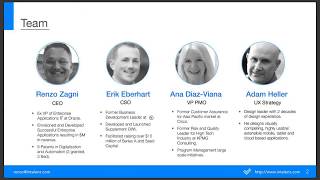
Lorenzo Sagni pitches Intelenz, a no-code automation platform for regulated industries like oil and gas. The team has 20 years at Oracle and prior exits. They're targeting $1.8M ARR by end of 2020 and seeking $500k to close 15 pipeline customers.
Chapters
Good morning everyone, I'm Lorenzo Sagni, founder and CEO of Intelance, and I'm gonna talk to you about what Intelance is doing in terms of digital process automation for business users in heavily regulated industries. This is the team, starting from the left, myself, founder and CEO, Prior to starting Intellens, I spent 20 years at Oracle developing and implementing enterprise applications. I envisioned and developed innovative solutions that were introduced in Oracle product lines, then had a huge customer adoption and generated millions of dollars in revenue for the company. Beside me, Eric is my CSO. He brings a wealth of experience in business development for heavily regulated industries. He ran two startups with successful exits. Ana is a former executive from KPMG and Cisco with extensive experience in process and risk management. And lastly, Adam Heller, he was my designer at Oracle, he joined SHIP to join me in this venture. So what is the problem that we're tackling? The problem is that business users in heavily regulated industries struggle to manage their internal processes. There are solutions in the market but these are expensive and extremely complex. There are no solutions designed to satisfy the needs of our target customers. You know, if you think about it, existing solutions are too complex, difficult to sustain and adapt, and designed to connect systems, not users. The solution is a process automation application specifically designed for business users in heavily regulated industries. Solution that is intuitive, that is flexible, allowing the users to introduce process changes, manage exceptions, deviations in real time. And more importantly, a solution that connects people, processes, and systems. We built this product, is currently on beta, and we pilot this product with companies in heavily regulated industries representing oil and gas, food and agri-business, and healthcare. Our product was designed for business users and it provides real-time visibility of processes and resource utilization. It's very easy to learn and to use. Processes can be implemented in a matter of hours or days instead of weeks or months. And process and activities can be implemented with zero coding. We also have 2 patents that we filed and that are currently under review by the US Patent Office. For our business model, we're charging $50 per user per month. We estimate 200 users per customer for $120,000 annual recurring revenue. Our recurring revenue projection for December 2020 is $1.8 million. Our annual recurring revenue target for 2021 is $6 million and $40 million for 2022. The $33 billion global productivity tools market is growing very fast. Analysts estimate this market will grow to $96 billion by the end of 2025. Regulatory industries— the regulated industries that we are targeting represent for us a $2.8 billion obtainable market opportunity. Our competitors can be organized into the two categories that are important to our target customers. One is the ease of use and flexibility, which is the y-axis, and the other one is risk management and regulatory compliance, which is the x-axis. You will notice that as existing solutions become more complex, and the term that we hear from some of our customers is become over-engineered, what they gained in their ability to manage risk and regulatory compliance, they lose in ease of use and flexibility. Our product was designed to solve one problem and one problem only for very specific users, and we solve these problems better and faster than anybody in the market. Our primary target market are oil and gas companies. Once we consolidated our presence in oil and gas, we will look at other heavily regulated industries where we are having great receptions and created a lot of excitement. We are asking, we're raising $500,000 and we will invest these funds to sign 15 customers that are already in our pipeline to reach $1.8 million annual recurring revenue by the end of 2020. Thank you.
Awesome. So the first question here is, you know, why are you, why are you doing this?
Well, Mike, I realized throughout my years, particularly working for companies like Oracle and advising for Fortune 500 companies on their enterprise applications, I noticed there is a huge need on the business units. And I partnered with business units and I helped them automate and optimize their business processes. And a lot of these optimizations resulted in products, the new products that Oracle introduced to the market, and even into patents that were granted to the company. And then I realized, you know, there is a need, but there is no solutions for the business users to automate and optimize their business processes. And I do have a passion for process automation and process optimization. So it pretty much the two things came together, and that's why, you know, resulted in us building this wonderful solution.
Why do you believe that the time is now to build Intellimse?
There is a market trend in anything that is process automation, process optimization. You have digital process automation, you have robotic process automation. There is a need on the business units to become more agile, to be able to react faster to market changes. And also from technology point of view, the introduction of SaaS and, and, and PaaS makes it very easy for startups like mine to be able to develop very complex solutions at a very low cost and implemented very quickly. So it's also a combination of two things, a combination of the needs, the market needs, a combination of the technology that is readily available.
And why do you believe that your company has a high growth potential?
Well, if you, if you look back at my— let's go back to our market slide. What the product that we're building is, it really differentiates itself from anything that is on the market. We believe that our solution is going to be ubiquitous in any medium and large enterprise. It's the same way that you have seen products like Slack and Jira really hitting it hard. We believe Intellency is going to be the Jira for the business users.
And Carl asks a question that's somewhat related, like, why, why, why do you, why did you, why are you starting with oil and gas? Why the oil and gas focus?
That's a very good question. When we started, when we were looking at product market fit, which is the first thing that we did, we identified heavily regulated industries are our best target. And this is because heavily regulated industries need to maintain, need to manage risk and need to be able to provide, you know, audit records for regulatory compliance. We talked to several industries. We talked to oil and gas. We talked to food and agriculture. We talked to healthcare, life science. But really, oil and gas is, first of all, it's a very large market. And secondly, as the productivity of oil wells is starting to decline, companies are looking for ways to optimize their production and reduce their cost. And when we presented our solution to companies like Pemex, Petronas, PetroPerú, Magdalena Prom, they were very excited about, you know, how much savings— it's about 10% of their operating costs— how much savings did Intellect provide. To their drilling operations.
How, how is your solution achieving compliance in comparison to your competitors?
Well, let me just go back to the competitor strategy. So basically, if you look at productivity tools, Kanban tools, and the low-code BPM tools, they really were not built— even when you look at the big BPMs, they were really not built with risk management and compliance out of the box. So when you have, in my experience, E&Y came to the company to do a quarterly audit, it was really painful for us to provide all the traces and proof of process execution. And we spend, you know, weeks working with E&Y, which was very expensive, to be able to mark our company, you know, German and SOX compliant. And the same thing happens with ISO 9001 and others. Our tool pretty much is out of the box, generates the report that Sarbanes-Oxley or ISO or OSHA or any regulatory body would need to see to be able to complete an audit in record time.
And, you know, why, why do you think that your customers care about your service? Like, what, what, what is it about it in your opinion?
Well, from one side, it certainly helps them provide the visibility of the enterprise. He can see, you know, even if he's an executive or the head of a division, a process owner or process manager, or the manager of the organization, they have a 360-degree view of all the activities happening in the enterprise connected to the process that is invoking those activities. It's certainly the operating cost reduction is a very appealing benefit for our customers. But when it comes to risk management and compliance, that's where we make the big difference. For example, when we work with Del Monte, the cost reduction was very appealing to them. They pretty much could pay for our software with, you know, a year worth of software license with the savings of one month. But when it comes to risk management and liabilities, we were able to reduce the huge liabilities that they can have, which is in the orders of millions of dollars.
So Jackie asks, you know, who are your target users within your target industry?
Target users, it's mainly our main target customers is the process owner, the people responsible for developing and implementing and management processes in the enterprise. We also have other target users, which is the head of a division, a COO that wants to have a visibility and real-time reporting of where are the resources invested, how many, you know, what is the portion of our process that are automated versus what portions are manual, where are the bottlenecks, or how much time I invest in a mission-critical process versus non-critical process. And the last but not least is the people, the business units that execute or perform or participate in the execution of these internal processes. So those are 3 main customer segments or user segments. Let me put it that way.
Is this, so Sammy asked this question, is this mainly for manufacturing industries or would this work for banking too?
These are also highly regulated and getting even more regulated every It works for many different industries. We are not, you know, right now certainly our focus is oil and gas, but we see good product market fit in any of the industries within the heavily regulated industry landscape.
Permoda's question here is, you know, can you talk a little bit about your sales strategy? What is your sales strategy? How do you go to market?
Well, we have two sales strategies. One is we have an outbound sales strategy. We are working— one interesting thing of oil and gas is even though it's a very large market, there are like, you know, 200 large companies and 10,000 small companies in that market space. It's a very tight community. So when we talk to Pemex, they immediately introduce us to PetroPerú and to Petronas. We talked to Chevron, they introduced us to BP. So we are building that network of connections using other customers of reference. So this one outbound sales strategy, and the next one that we're probably going to start sometime next year is going to be an inbound marketing strategy where we're going to use, you know, social media, ads, etc., to, you know, capture customers.
Final question here. So final question from Jackie. So who are your decision makers and your like economic buyers? So who's, you know, who's writing the check and who's making the decision in the enterprise sale?
Yeah, that is something very interesting and it applies to SaaS sales. You know, right now on SaaS, you know, the head of a department or anybody who can pretty much swipe a credit card and expense it is our potential buyer. And with that said, we are working with mid-level executives, directors, senior directors of business units. And also we are talking with executives, you know, the CIOs and the CEOs of the enterprise.
Got it. All right. Thank you so much, Renzo. And thank you for everyone who attended this Demo Day.










