Launching a Fast-Growth Startup in 2020 with David S. Rose & Gust Launch
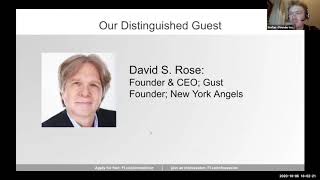
David S. Rose breaks down the choice between a small independent business and a venture-backed startup, covering entity structure, equity, and hiring. He covers remote team management and virtual pitching tips for 2020, then answers questions on VC funding, early hiring, and equity negotiation.
Chapters
All right, participants are trickling in. Welcome everyone to a beautiful evening wherever you are. We are mostly New York, located in New York. I'm currently in Germany but heading back to New York on Thursday. So welcome, Launching a Fast-Growth Startup. Is the reason why we're here tonight. And we have a wonderful guest, and we will do a very brief round of introductions here. I kick it off with the man of the hour, David Rose, who is kicking off a presentation here in a minute. David, if you want to briefly introduce yourself before you take over.
Sure, my name is David S. Rose. I am a serial entrepreneur turned serial angel investor. I'm the founder and chairman emeritus of New York Angels. Here in New York. I'm a mentor for the Founder Institute. I'm the author of a couple of books on both angel investing and how to create a high-growth startup. And I am the founder and chairman— executive chairman of Gust and a whole bunch of other things which we will discuss during the presentation.
Awesome. Thank you so much, David. I really appreciate you taking the time tonight and sharing your wisdom on the topic here over the next hour. And then on the other side of the table, we also have myself and Reid. Reid, if you want to briefly introduce yourself. Yeah, hi guys, I'm Reid. I'm one of the co-directors of the New York chapter of Founder Institute along with Stefan here. And yeah, long history in the startup space, primarily working with life science companies, but but more recently tech startups of all different stages. All right, and then myself, I'm Stefan Clotzbuecher, love startups, living in New York, part of the Founder Institute, second co-director next to Reid. This is sort of a global event. If you are thinking of founding a company, fi.co is a great way to get in touch with us. We will touch on our personal email addresses towards the end. But this session tonight is fully about David and his wisdom of sharing the knowledge on how to grow a fast-growing startup. So we will jump right into the presentation. Everybody, please, if you have a question, we are going to select a few selected ones towards the end. Please write it into the chat window. That's where we see them, or we'll pick them up. And then, yeah, we'll briefly talk about Fauna Institute and if you want to get in touch with Reid and myself towards the end of the session. But at this moment, I would hand it over to David. I'm going to stop my part of the presentation here and then David, you can take it from here. And yeah, take it away.
All right. There we go. Good evening, everybody. It's a pleasure to be here. We have quite a crowd this evening. And you're all here to learn how to start a high-growth business. Lucky for all of us, I've written a book on that subject called The Startup Checklist, uh, and what you're gonna hear tonight is taken partly from the book, partly from my experiences of having started companies and working with startups all the way around the world. And so, just so you know where we're going for the next hour, we're gonna discuss different kinds of businesses, and what is a high-growth startup, and what is not a high-growth startup, and what are the differences in how you start each one of them, number one, then we're gonna start to go through some of the specific steps that you need to do if you're starting a high-growth startup. Then we're gonna talk a little bit about what happens now in COVID, how you manage a team, a high-growth startup that is distributed, where you're not all in the same place, and then because many of you I know are looking for funding, we'll discuss briefly how you pitch for funding remotely, and then we'll open the floor to Q&A about any subject related to startups or the fundraising process in there. So, with that said, let me start by discussing the single biggest problem with people understanding startups. And I found this to be universally true in the US, internationally, among business accelerators, and business schools, and small business development centers. Everybody is laboring under one really, really universal, but wrong, assumption, and that assumption is that when you have an idea, you like pops like an egg out of your head, boom, you've got a new idea that there is one path to get from that idea, and that path goes all the way to the end, and at the end of the rainbow, at the end of the pot of gold, at the end of the rainbow here is your Apple computer, the world's largest company, you're $2 trillion, and it's a direct path from having an idea to being Steve Jobs and Mark Zuckerberg and Bill Gates. and that's it. And because there's only one path, and of course, not everybody becomes Apple Computer, what happens is you then fall off that path at some point. So if there's a single path, and you fall off before your Apple Computer, well, you're a public company. You've had your IPO, your initial public offering. You just didn't quite get to be as big as Apple. And if you didn't quite get as far as an IPO, well, then maybe you were at least a unicorn worth over a billion dollars. You didn't go public, but maybe you were acquired by a private company. So an acquisition, that's a pretty good exit. But it's not an IPO. Well, what if you don't get an acquisition? Well, at least maybe you got venture capital, and you raised tens of millions of dollars in venture capital. And you didn't quite get there? Well, maybe you fell off a little earlier, and at least you got an angel investment of a few million dollars. And you didn't quite get an angel investment? Well, maybe you got a seed investment from friends and family of a few hundred thousand dollars. But the bottom line is what everybody believes, that there is this one path from idea to past IPO, and the only question is how far you go. And you know what? That is wrong. That's just simply not true, because there isn't only one path. In fact, there are two paths, and there are two very, very different paths. And the very first thing you need to know about founding a startup is which path are you on, because there are different ways of operating, different goals, different everything about these two paths, and neither is right or wrong. One isn't better than the other. They're just different. And so, the first path is that of an independent small business, and this is the backbone of entrepreneurship around the world. It's the backbone of the American capitalist economy. It's the backbone of every economic society in the world today. This is a, somebody who's starting a company and creating it, and the goal being a profitable, small, standalone business. That's one. And the other path, well, that's what we think of as the startup. That's the high-growth startup. That's the go big or go home, scenario. And which one of these you are, and you're aiming for one, you can't aim for both. You're aiming for one or the other, and that determines a whole host of things that come down the pike after that. So let me give you some specifics on this. So let's say that this person wants to be an independent small business founder. What does that mean? That means they are probably likely to be a solo founder, a solopreneur, somebody who was starting the business on their own. It means that they are likely opening a business in a physical location, a store, a bakery, a restaurant, an office. They have one, a place, a physical place they work out of, and they hire employees, typically a few employees, employees who are either retail people in a store or helping to manufacture something which they can then ship and sell, or employees in a restaurant, typically fewer than 10 employees, and those employees get paid appropriate salaries out of the business, but those employees rarely have equity. They're not owners of the business. Typically, the solopreneur, the small independent business operator, owns the whole business him or herself. But the nice thing about that is that that business typically starts generating revenue pretty quickly. If you open a restaurant or a bakery or a retail store, the minute you open your door and you get your first customer coming in and paying you cash, that's revenue. and having revenue starting relatively early in your process, real revenue, means that then you have some options open to you in terms of financing, including the ability to go to a bank and say, "Hey, I've got a profitable business. Please lend me money, and you know it's gonna be paid back because I have revenues coming in from this business." And so typically, you can get financing from a bank. You may have to personally guarantee it, but it'll be based on the fact that you have a business that is generating revenue. These small independent businesses typically in the U.S. and globally will have revenues of under $1 million. Not every business needs to be Apple or Microsoft or Facebook. A million-dollar business is a very, very nice business. And typically, it escalates pretty quickly from a standing start to up somewhere in the range of a million-dollar, a profitable business of $1 million or so, and then typically that growth tends to level off. So it doesn't skyrocket, but it becomes a steady profitable business business growing profitably. And you say, well, is this not a bad thing? This is a great thing. And that's why over 80%, maybe even 90% of all businesses are these small independent businesses. And why do people do it? Because it provides support for them and their family. The goal here is to provide the fun and the, and the economics that come from owning your business, controlling your life. The goal here is not to have an exit. You're not looking to create this building and sell it. You're looking to create this building and manage it. And typically, at the end of the day, instead of having an exit, when the original owner gets to a point where they're comfortable, they don't want to continue operating the business on a day-to-day basis, what happens? They may pass it on to their children. They may sell it to their employees. They may just shut it down. They may sell it to another owner-operator who now doesn't want to start a business, but wants to buy an existing business and continue to operate it. So that's what the path looks like for a small independent business that's the backbone of US economy and the global economy. In contrast, what I have a feeling that many, but not all, many of you on this call are, are looking for the other path, and that's the startup path, the high-growth startup. And so what does that path look like? Well, typically, it means you're not gonna be doing this solo. You will typically have a co-founder. Most startups have two co-founders. Some have as many as three, four, or five, because it takes a village. You're looking to go really, really big. And that means it's not just you and your co-founders, you're gonna have employees. These high-growth startups grow high and fast, and they typically have more than 10 employees. And as you've been around, if you've been around the startup universe for a while, you'll know that in startup land, everybody has equity because they're being asked to join a very risky thing. Most startups fail. That's part of the nature of the beast. And so, in order to accept a lower-than-market-rate salary from an existing profitable business, and come into a business that might fail next week, typically, you want to incentivize your employees with equity, so that as the company gets more valuable, they make money as well. And because these businesses are going really, really big, and they wanna get there really, really fast, it means they may have to feed the kitty. And so, you're not gonna necessarily be profitable day one. And so if you have to pay employees and grow a business, and you're not yet profitable, you're not making money, where does that money come from? It means you likely will need to have investors, people who are gonna put money into the company while it's losing money in order to help the company grow. And that's because both you and the investors are thinking big, thinking really big, because this is go big or go home. What you are buying into here, and your investors are as well, is that you're either gonna be a big success make a lot of money for everybody, or you're gonna fail, and you're gonna go out of business, bankrupt, lose everybody's money, lose your job, have no jobs for your employees. It's a very high-risk, high-return scenario, and that means in 2020 and beyond, if you're thinking big, you're thinking global, because these high-growth startups are operating in a global world. This is a global village. You can't be provincial anymore. I don't care whether you're TikTok coming out of China, or whether you are Skype coming out of Scandinavia, or whether you are Facebook Facebook coming out of the US. These are all global businesses, and you are thinking global from day one. Also, in this world, you're not just thinking about desktop as a computer, you're thinking about mobile. And as you all probably know, Google now prioritizes mobile sites over desktop sites. So if your site is mobile-friendly, you'll rank higher on Google than if you are just a desktop site. So you're thinking global, you're thinking mobile, and you're thinking growth. And the essence of a high-growth startup is that you're growing. You're growing all the time. This is like a shark swimming through water, which is you have to keep swimming to get, uh, water over your gills, or else you're not gonna get enough oxygen to live. So the minute your high-growth startup stops being high-growth, or being any kind of growth, you are in big trouble. And because this is getting big, and because you're not the whole owner of this company yourself, you have a very different mindset from the small independent business owner, because your focus now is on the company, not on your job. So it doesn't matter to you, or at least it shouldn't matter to you if you're doing this correctly, whether you get fired by your company, whether you were the CEO or are there forever, because the important thing is what is the company worth? You start out owning, you and your partners, the whole company, and even when it gets down farther down the road after several levels of investment, you will still own a significant piece, and that's where your real economic value is. Believe me, Mark Zuckerberg has made a lot more money from his shares of stock in Facebook than from the salary he gets in it. Same thing with Bill Gates and Steve Jobs, um, and Larry and Sergey. These are all about the economics of ownership, which means you have to focus on the company and not your own particular job. And therefore, following from that is, you're looking for an exit from day one. This is not a business to pass on to your children and the family. You are looking to what's the exit, who is gonna sell this, or how are you gonna go public, public with this because that's where the big money comes from. So those are the two completely different kinds of business. And part of the problem that entrepreneurs have, and part of the problem of the whole ecosystem that we're in, not the Fanner Institute, not people like us, but a lot of the other folks in this universe, is that unfortunately, they often give very bad advice because they don't know any better to startups. So small business owners who are told how to pitch to angel investors, when angel investors would never invest in their, in their independent businesses. And startups are pointed to SBA loans, but SBA loans don't work for a startup, because you're not gonna personally guarantee it. You don't have the income there. You have all these small businesses being incorporated in Delaware in the US, which doesn't make any sense, because why do you wanna bring another state in it if you're located not in Delaware? And startups are being formed as LLCs, when if you really are a high-growth startup, you need to be formed as a C corporation. So those are some of the bad pieces of advice that startups often get. And the challenge here is that these two different paths are apples and oranges. They are literally completely different, and here's what that means. So if you are somebody who, after thinking this through long and hard, realizes that what you are doing is starting a small independent business, your goal is to create a business that's gonna provide you with work-life balance, be great for your families, your employees, grow steadily, give you a good income, maybe pass it to your kids, or sell it to somebody else down the road, that's all fine. And so then here's, if you're in the US, what you need to do. Similar things in other countries. So first of all, you don't want to be a Delaware C corp. You want to incorporate your business in your home state. Why do you want to pay Delaware taxes as well as your home state taxes? You're not gonna have investors, so it's not gonna matter. So incorporate in your home state. You want to incorporate as an LLC. An LLC is a limited liability company. And what that means is you get to pass through your taxes. So the taxes, the, instead of having tax paid at the corporate level and then getting the profits in the form of dividends and paying taxes on them a second time, by incorporating an LLC, you can make the company invisible for tax purposes and just pay a single set of taxes, which is great. You're eligible for SBA loans, Small Business Administration loans, which you may have to personally guarantee, but you'll have a business for which these are appropriate. There are often local grants by either large companies, or local cities, or governments to try and help the economy in their area, and these are great because you're a local business. These could be great for you. And most importantly, perhaps, is that as a small independent business person, small not being a pejorative term here, you can center things around you. You are building a company in your own image, and therefore work-life balance, and what you want to do, how long you want to work, when you take vacations, all that stuff is in your control, and that's great. So that's what it means to be a small independent business person. On the other hand, if you think that you really are a high-growth startup, and you've made that, you've taken that fork in the road, and you've made that decision, well, whoa, once you've made that decision, what that means is wham, you have just made a dozen other specific decisions that you didn't even realize you were making. Because those are all the things that you have to do as a high-growth startup. So let's walk through what those decisions that you've made without really realizing that you've made them are, and I'll explain why you've made them. So first of all, you're not an LLC, you're not a partnership or a sole proprietorship, you are gonna be a corporation, because that's the only way that investors are gonna be able to invest in the company. So you're gonna be a corporation, you are gonna incorporate yourself in Delaware, the state of Delaware, if you're a US corporation, which is where investors, for a lot of reasons, wanna see companies incorporated. You're gonna incorporate with different kinds of stock, different series of stock, common stock and preferred stock. Common stock is what founders and employees and advisors get. Preferred stock is what investors buy. So you'll have two kinds of stock, and for, you'll have stock yourself, your founder shares of common stock, but for your employees, if you give your employees their ownership in the company day one, well, if you give somebody, say, 5% or 10% of your company day one, and then they leave, what happens? They still have a piece of ownership of your company, even though they're no longer working for you. So therefore, you have to have a stock option plan. A stock option plan is where you say, hey, come to work for me as an employee, and as every day that you work, or every quarter that you work, "Look, we will provide you with an ownership. I'll tell you right now, at the end of the day, how many shares of stock you will get, what percentage of the company you will end up with, but you will earn that over time," and you will get them in options. And an option is literally the option to buy stock in the company at a specific price, over a specific amount of time, for a specific number of shares. And that's all governed by a pretty complex, what's called an incentive stock option plan, which is what you give to your employees and your employees get options on a vesting schedule. And a vesting schedule says, here are the numbers of shares we're giving you, here's the timeframe, and you have to work for this company and stay here for typically a year before you get actually any of that stock. But on the 1-year anniversary of your joining, assuming you're still with the company, then those options vest, and now you can purchase those, say, typically 1/4 of all the options we're giving you. And then every month thereafter for the next 36 months, another 1/32 1/36th of the shares vest. So over 4 years, all of your shares will have been vested. And so the terms of these are in the grant of the options, and they're also in an employment agreement. So if you're in a restaurant and you're hiring a waiter or a cook, you're not having them sign an employment agreement typically, but if you're in a high-growth startup, you absolutely are having everybody, including yourself, sign an employment agreement because your investors will insist. And the employment agreement makes it clear that they can quit at will, that you can fire them at will, that how many options they're going to end up getting, what their salary is, what their duties are, where they're working, the fact that they typically can't compete. They can't leave you and go work for a competitor right away for at least another year. They can't go solicit and steal your customers. They can't leave and take some of your employees with them. All of those things are covered in an employment agreement, which typically you will have for every single person in your company. and then because you're giving options to your employees, you've got shares of stock, you have co-founders, and you and your co-founders are all going to be on vesting schedules as well. Now you might say, well, wait a minute, if I start out owning the company, or we start out owning the company as co-founders, why would we want to limit our ownership by requiring us to work for 4 years before we own our stock? Well, the answer is, what happens if you start the company with 3 other co-founders. So now there are 4 of you, and you each own 25% of the company, and you get that stock outright. Well, that's fine. That's great for you. But now let's say one of your co-founders tomorrow morning says, "Okay, that was great. Thanks. I'm out of here. Bye, guys." And that co-founder walks out still owning 25% of the company with no need to give it back to you, and they can go do something else while you're stuck running the company, but they own a quarter of it. That wouldn't be good. And that's why you as a founder, as well as your investors, want every single person in your company, including all the founders and all the employees, to have a vesting schedule. And if you think about it, figuring out who has what stock, who got what options, what your investors get, the kind of stock that they get, where you are in the vesting schedule, that gets to be very complicated very fast, which means that for any high-growth company, you're gonna be starting with a managed cap table. A cap table is the capitalization table, which shows exactly who owns what shares in the company, where they're vested, under what terms, and, and the like. And so you'll be managing your cap table from the minute you have one share in one person's hands. And then also, because remember, this is a high-growth company, you're going to be existing almost entirely online, whether you are creating a SaaS platform, software as a service, where your software is delivered online, or even if it's retail and you're shipping keeping things online. Amazon has warehouses, but it's all about internet, internet amplified. And what that means is instead of having people come to your storefront and pay you cash, or even swipe a credit card on your iPhone with your Square reader, instead, you're gonna be taking electronic payments all the time for everything through your website. And now that you have employees and, and all of these capital stuff coming in and electronic payments coming in, and you have investors to whom you have to report, who wanna know what's going on, you don't have the luxury as you would if you were your own small owner of a business of keeping your receipts in a shoebox. You have to have a pretty powerful accounting system which tracks every single dollar that is spent, and typically that too will be cloud-based on a SaaS platform, 'cause it's easier that way, it's more powerful, and ultimately, for due diligence, other people, your accountants, and ultimately your investors, if it's appropriate, will have access to your accounting software. And because all of this gets very complicated, and all the hiring, and all of the terms, and the option plan, and the payments, and the taxes you're filing, and you better pay your taxes from day one, or you'll be in big trouble, um, you're gonna have to have corporate attorneys. So, there's no such thing as starting a high-growth company without an attorney somewhere in the woodpile over here, because they're gonna keep you on the straight and narrow, and they're gonna make sure that that you do things appropriate, and you're gonna be paying them, but that's what attorneys are for. You can't do this on the cheap. You can't do this without that kind of professional advice. And just like you're gonna be internet amplified, you're gonna be international aware, because now that you're living in virtual space instead of in a physical storefront location, because you are, the whole world is your oyster, you have to think about how you're gonna be dealing with your product. How do you take payments from overseas? How do you deliver your things overseas? Are you shipping a physical product, are you providing software as a service? How do the laws of the overseas place where people are using your service affect what you're doing? When the European Union put in a very, very powerful privacy law a couple of years ago, it had an enormous ripple effect on the US market. Why? Even for companies that weren't operating entirely in Europe, the fact that they had one customer in Europe, they had to be complying with all of these terms of the GDPR regulations. That meant that all American companies still had to follow these European regulations. And now, because as you've seen, you've got this managed cap table, your employees have equity, your investors have equity, the company is growing, growing very fast, and the goal here is gonna be for an exit. What that means is you have to think in your head about separating your role as an employee of the company, even if you're the CEO, from your role as an owner, a founding owner of the company, which is the shares you have. Because what happens if the best thing for the company to make the company a big success is that you not be the CEO? You know what? In that case, you had better be smart enough to say, "Okay, I'm gonna step down. I'm gonna find a better person than me as the CEO because I know," The big money that I will make from this company is not gonna be in my salary. It's gonna be in the value of the shares that I own. And the perfect example of this is a guy named Piero Midiar. Now, many of you may not know the name Piero Midiar. He was a product manager at Apple, very smart guy, and he had the idea for a new type of company, which is to sort of take a flea market and put it online. Um, and that company was eBay. And he started eBay, and he was running eBay, and he realized very, very quickly that although this was a great idea, he was not the person to be the CEO. So he brought in a president, and then he brought in Nick Whitman as a CEO, and the company grew very, very fast, and he grew very, very, very rich, but not as the CEO. So I hope you have that same understanding of where your bread is buttered, and it's buttered on the equity side rather than the job side. And then finally, with all the stuff that you're doing for the company, because you're gonna have investors, and investors are gonna wanna see exactly what's going on here, and they're gonna wanna check on it, You have to be able to track every single piece of paper you sign, everything you do, your option plan, your employment agreements, your investment agreements, your accounts, all this stuff, all your legal agreements. They have to be tracked because under due diligence, which is what investors do when they look at your company, they would be remiss in their duties. It wouldn't be due diligence if they didn't look at every piece of paper and check it. So that means you have to track all of this stuff. So these are all the decisions that you have made, have voluntarily chosen to make, once you've decided to be a high-growth startup instead of a small independent business. And if this sounds complicated, it is, but luckily for both paths, the independent business and the high-growth startup, there are some really good books that are helpful to help you get through that. Um, the independent businesses have been around for a long time, and there have been all sorts of, of books that have been written over the years to help you figure out how to start a business and how to do all the appropriate things about hiring people and complying with laws and so on. You can get all these online at Amazon and in person at Barnes Noble, from a bunch of different places. There are big-name franchises, you know, Dummies and Idiot's Guides and Money Magazine and Entrepreneur Magazine. Of all the things that are out there, and these are all really quite good, the one that I think is probably best if you're looking at an independent business is a book called Small Time Operator. Now, don't let the name put you off, right? It's not that you're not worth anything. It's that you know exactly what you are, and you're creating a small business. And this small business, um, this small, uh, business you're creating is covered in this book. Uh, the subtitle is, you know, "How to Start Up Your Own Business, You Know, Fire— Pay Your Taxes, Um, You Know, Hire Your Employees, and Stay Out of Jail." And so that's what you want to do. On the other hand, if you're a high-growth startup, there have been all kinds of books written recently, um, by lots of friends of mine, um, who have written books about the high-growth universe, and that's the one that you've probably seen reviewed in all of the blogs and in all the entrepreneurial magazines, whether it is The Lean Startup by Eric Ries, or Zero to One by Peter Thiel, the really great book, The Startup Owner's Manual by Steve Blank, one of the giants in the field, one of the very first ones in this universe, The Art of the Start by Guy Kawasaki. These are all great books that tell you about different facets assets and aspects of starting a high-growth company. The Lean Startup has all to do with the concept of what lean means, and be very helpful. I strongly suggest that you read that. The others give you pointers about various components, but on this one, my suggestion for the best book, if you're starting out right now and you want a step-by-step recipe book to this, and this is where an advertisement comes in, ta-da, it's mine, surprise, surprise, um, The Startup Checklist 25 Steps to a Scalable High-Growth Business. When I was approached by Wiley, the publishers, to write this book, I said, "You're crazy. There were all these other books out there, hundreds, thousands." And I actually checked, and there were something like 90,000 books on Amazon in the entrepreneurship startup category. I said, you know, "Why do we think the world needs another book on how to do a startup?" And their answer, which I verified, was that all of those books were either theoretical, about, you know, Zero to One or things like that, or they were about concepts like The Lean Startup, or, but they were not about how to actually file your certificate of incorporation. Why should you be structured as a C-corp? What does it mean to give options? What should your vesting schedules be? How do you find angel investors and raise money from them? And that's what my book is all about. Um, The Startup Checklist covers, you know, all these things in the very beginning, figuring out if the business you have is actually a scalable high-growth business that would be appropriate for investors. It goes through how to build your team, and how to divide the equity, and how to incorporate what your lawyers should do for you, how you create a public profile, how you then reach out to investors, at what point can you reach out to investors, what are they looking for, how do you assemble a pitch, how do you build your pipeline, how do you pitch, what are crowdfunding platforms like, and then ultimately, how do you exit. So this is the pitch. You get that for getting me as the speaker for the book, which I think would be very useful for anybody who is starting a high-growth business. It's available in hardcover. It's available as a digital book. It's available in audiobook, where you have me read it to you at even slower speed than this. And that's, I think, a very good way to start. And then, one last pitch, because it's even more useful, or at least as useful as the book. And if you're American, and unfortunately this is not available yet for international international startup founders, although in the not too distant future, it may well be. But if you're an American founder looking to start a high-growth business and do all this kind of stuff, well, luckily, we created a platform at Gust. It's called Gust Launch, and Gust Launch takes everything in that book and turns it into a software as a service. In fact, it's in a whole new category of creating a business that we call a company as a service. So if you're starting your business, you literally come onto Gus Launch, you press a button and wham, we do all that stuff that I talked about. We incorporate you as a Delaware C-Corp. We set up your cap table. We file you with the IRS. We file you with your home state. We set up your cap table and issue stock to your founders and your co-founders. We introduce you to your lawyer. They give you free legal stuff. We open your bank account. And then we do all kinds of things to help you get going, including giving you a $75,000 $10,000 worth of free services, $25,000 Amazon Web Services, $50,000 of segment, you know, up to 20% discount at WeWork, give you your financing documents and the whole bit. And because you happen to be here today, special for the Founder Institute, uh, in this particular seminar, we've actually got a discount code for you. So if any of you wanna just check out that URL at the bottom of the screen over there, uh, dsr-fi for Founder Institute, is your special discount code, which will give you, so you can start your company for as low as $255 plus filing fees, and that's to get yourself started exactly the right kind of way. All right, so that's how you start a company. The two paths to starting up a company, two very different paths, and the details for how to be a high-growth startup and what you have to do, as well as some resources. And so typically, That's where I'd stop and we go into Q&A, but before I do that, today, we live in very special times, and something back in February and March happened that nobody was expecting, and for those of you who are Monty Python fans, as you well know, nobody expects the Spanish Inquisition, um, and ultimately nobody expects a pandemic either, and so the pandemic has thrown into disarray the way companies in general are managed. And so what do you have to do when instead of managing your startup company of 2, 5, 25 people in your one office, in a co-working space like WeWork, instead you're dealing with people in a remote universe where everybody is working at home, where people can be working in Germany as well as New York. Um, most of the people I know are not here in their home city, they're in other places. And so this has caused some serious challenges for startups and for big companies as well. And what are some of the challenges that you're facing if you have to supervise, you're the founder who's supervising a remote team? Well, first of all, you don't have face-to-face supervision. If you're working in the same office, you know what somebody is doing all the time. You can talk to them, you can see them. You don't have that if they're working remotely out of their own home. If people are working remotely, they're sitting in front of their computer and they typically don't have access to the same kind of formal and informal communication that they would have in an office. They don't see things on desks. They see things on bulletin boards, hear conversations at the water cooler going around. So, that's the challenge for giving people the full picture of what's going on. It also, if you're working at home in front of your computer 24/7, leads to increased social isolation, and that turns out to be a very serious thing. Some people are content, like Thoreau, to go off and live live in the woods just by themselves, but most people need to interact with other people. And so, that's a problem if you're sitting all day in front of your computer and only occasionally seeing people on the screen. It's very difficult to have a social life, a social life related to your business. And then, finally, if you're working at home as your remote location, you have a lot of distractions. Not only is your kitchen there, as someone who knows, has put on quite a bit of weight during the pandemic, not only is your family there, your nice couch and bed is there if you wanna take a break. Um, there are distractions galore, which you don't typically have at the office. So, how do you deal with these kinds of challenges as a startup founder with a small startup team? Here are a few, few of the best practices, uh, in doing this, and I'll give you a link to a Harvard Business Review article, which is really good, going into more detail about this. First of all, you wanna establish a structured daily check-in. This is really critically important. If you just say, "Hey, everybody go do your own thing and come back next week and send me your stuff," that's not gonna work. If you're talking about a real company, you wanna have a structured daily check-in. One of the companies I'm running right now, USREM, the US real estate market, we have check-ins every morning and every afternoon, the entire team, for half an hour. These are standard daily stand-ups, um, where everybody says what they're doing, what happened since the last meeting, what they're I'm gonna be doing today. It lets everybody share information. It keeps you accountable. It lets you know that you're part of a team. Critically, critically important. Next, the question of communication. In the old days, maybe you could have survived just on email, but today you can't. If you are using a remote, if you have a remote team, there are a lot of different communications platforms that you will need to integrate because different ones are good for different types. We still rely a lot on email, email, but obviously we're all right now on Zoom, so all of the replacements for face-to-face conversations are happening online. But face-to-face conversation is not always right for everything. If you want a quick answer to a question, an instant messaging solution like Slack has become ubiquitous in the workplace. If you want to work on documents together, you can't hunch over somebody's desk and, and use the same keyboard. Instead, you're gonna be collaborating using a collaborative process such as Google Docs. And in order to keep everybody on the same page and know who's doing who's doing what and see where things are in the critical path. You wanna have some kind of workflow system. Monday has been very useful to us, Trello, things like that. And so knowing which one is appropriate to use when is really important, which is why you wanna establish rules of engagement. And those might say that everybody has to be on the Zoom call in the morning and the afternoon. If you have a quick question, use Slack and the like. On the other hand, you have to let people know when they're off work as well as they're on work, because it's very easy in a universe in which you're sitting in front of your computer in your home all the time to be working 24/7, and that's not good for anybody. There should be expectations that at a certain point people are off the clock. You don't expect them to answer email in the middle of the night, that they have downtime, private time as well. Other engagement rules might be that on the stand-up meetings, meetings on Zoom, everybody has to turn their cameras on, which means they have to be dressed and dressed appropriately, because that provides the face-to-face communication that you need. Another thing you need to do is provide for social interaction. And this is something that people didn't think about originally, but as we've been over the last 6 months working in a distributed environment, it's become increasingly obvious. So, for Gus, for example, we have a— we used to have in person, best guess, a toast to the week. Every Friday afternoon at 5 o'clock, we get together in our kitchen, we'd open a bottle of wine, and we'd have cheese and wine and paté, and everybody would do what we call shout-outs, shout-outs of good things that people had done that week. And it was a time to get together socially, informally. Well, we can't do that in person anymore, but we just moved that online. So, now we have our toast to the week happens online on Zoom, on actually on Google Meet, and everybody is encouraged to bring their families. So, we see people's spouses and kids, and it provides a very strong glue to tie everybody together doing that. And then, finally, one of the other things that you have to be aware of if you are the founder who is the leader of your business is, in this era of virus, of a pandemic, of social isolation, it's really, really important that you maintain the level of emotional support for your people. This can be very tough if you're not a touchy-feely kind of a person, but you have You have to be aware that some people need to talk. You have to try and read, look at people's, you know, eyes when you're on Zoom, see who's having trouble, ask them if they have challenges, and be as helpful as you can, understanding that it's not just work, that people have lives as well. So those are some of the challenges, the internal challenges that are involved in running a business during a pandemic. On the external side, facing your potential investors here, well, all of a sudden, whereas all of us used to be pitching, pitching to angel groups, pitching to VCs, having pitch meetings and lunches, going standing outside the Shake Shack and stuff like that, trying to find an investor. These days, 100% of pitching is being done online. And it's possible to spend 2 hours going through a seminar on how best to use electronic communication to do your pitching. But instead, I'm just gonna give you some of the high points, and you can read up on them. A lot of stuff available online. Later. First of all, in terms of the technology that you're using to make your pitch, don't necessarily rely on the webcam built into your computer. Instead, because those are typically low resolution, particularly on older computers, what you want is you want a high-resolution computer, something like the 4K Logitech Brio, which gives you a 4K resolution and autofocus and things like that. Critical, you want to make sure that your lighting is correct. If you take a look at people's faces just on this webinar, you will see that a lot of people are in shadow or backlit. And you see that I'm pretty clearly lit over here, right? That's because I have lights just like these that are shining on me, that are carefully balanced to let you clearly see me. And in the same way that you have to see me, you have to hear me. And so one of the great undersung things is a solid microphone. And not just the mic from your computer, which is, can be 2 or 3 feet away. You want to have a USB mic that feeds directly directly in as close as you can to your mouth. Mine is about 5 inches here off screen. It's picking up directly what I'm saying, high quality, putting it into the system. Something that people would not have conceived of doing before this pandemic in pitching is something that all the pros do, but you wouldn't think of doing it yourself. And that is the idea of a teleprompter. And a teleprompter does two things. One, it can feed you information, a speech that you can read. Whenever you see President Trump or even Vice President Biden, President Biden, or even President Obama doing an official speech, they're reading from a teleprompter right in front of them as they're talking to you. But part of the challenge of doing a pitch remotely is that the camera is not in the screen. So unless you can train yourself to look directly at the camera instead of at your screen, which is very, very hard, something like the setup you see there is a teleprompter which fits over your monitor and lets that lets your camera shoot through the mirror so you can see the screen while the camera is looking at you. Then you want to have a background, a nice clean background that looks appropriate. And some people have natural senses of style and some people don't. If you can set yourself up with an appropriate work environment that looks really good and classy for your Zoom calls, that's great. But if not, you can fake it, and that's what green screens are for. I'm sure you've seen You've seen that in Zoom and every other program. There's a little button that says, "I have a green screen." And yes, it can work virtual green screen without it by picking up the difference between you and your background. But green screens are not that expensive. You can get a big piece of green cloth behind you, a pop-up screen like the one you see here, and that gives you a lot more flexibility in terms of background replacement and the like. Which brings us to backgrounds. So you can get hundreds or thousands of backgrounds. Backgrounds, most of them free, many of them free, that you can drop yourself into. So if your background doesn't look as good as this nice little background over here, that's okay. This is available as a virtual background that you can drop in. But another thing that we do for some of my companies is create a standard backdrop for everybody in the company. And so here you see the one for USREM. And so everybody in our company is using the same backdrop, which looks very, very professional when you're on a group call with third parties, partners, or investors, or the like. There's all kinds of software available. The fact that you now are all on Zoom means you understand how Zoom works, but you can do things. There are other things, a great product called MMMHMM, M-M-M-H-M-M, which is now just in beta, lets you do all kinds of overlays, and shrinking things, and show slides, make yourself disappear, add all kinds of video, backgrounds and foregrounds, a lot of stuff Minicam, things for PC as well as Mac. There's a lot of powerful tools that are coming out that let you do that. But probably the single most important thing you can do for an effective presentation online is to make sure that whatever you do, you look at the camera. This is really important because when you're looking at the camera, the camera is standing in for the person you're talking to. And this gives you the ability to make eye contact with them, even even if you're not really making eye contact, it comes across to them as if it is. It's sincere, it's a conversation, you're talking to them, and it makes it much, much more effective. So that's just a quick overview of the areas that you need to dig down in if you really wanna be an effective presenter in the era of pandemics and remote pitches. And with that, I've taken 45 minutes. We will stop the official presentation here. And I see we've got lots and lots of questions. So team, let's get the questions and we'll take it from there.
David, thank you so much for walking us through the presentation. You might wanna have a little bit of water. There was a lot of talking, a lot of great stuff. We received quite a few questions along the way and we'll dive right in. So first question is from Zika. What are some signs that a company is VC backable? What is a company— what does a company need to have to actually even being considered receiving VC funding?
That's a good question because that's a good way to frame the question. Often you hear that same thought framed as, what do I have to do to make my company investible? And that's— and there's a very subtle difference between those two things. And the first question asked, what is it that makes a company investible, because if your company is not investible, you can't make it investible. It's not like putting lipstick on a chicken, right? You can't do it. So instead, the kinds of things that make a company investible ultimately are a potential, a real viable, expectable potential for the company to grow really big and make investors a lot of money. That's the bottom line, what it comes down to. And so therefore, investors are trying to figure out, okay, can this company start from where I am now and have a reasonable probability of getting really, really big on my money? And so what do they look for? They look for a company in a market that is growing. If you're trying to sell a new kind of buggy whip, that's not gonna work, 'cause the market isn't growing. They want a team that is a great team. Most important thing, the team of people that they're looking for. They want a business model that will scale. And so that's why, for example, businesses that could be great businesses that are consulting businesses or personal businesses, like a graphic design or a, a restaurant, it's really hard to scale a restaurant if you're basically putting everything on the back of one chef, because to scale it, you got to find another clone chef like that. Similarly, if you're a consulting organization, every doubling of your business requires another consultant who's as good as the first one. and so what investors like to see are businesses that don't rely on bodies, on people coming in. That's why things like Amazon, which are SaaS businesses, software as a service, scalable businesses, the bigger it gets, the more lucrative it gets. So they want to see a scalable business in a big and growing market with some kind of way to get to the market that makes sense, that is not going to be too expensive, with a competitive advantage, with a team that can actually deliver deliver on doing it, led by an entrepreneur who they are prepared to put their money behind. So those are the kinds of things that investors look for, and then they look for the pure numbers. Typically, angel investors are looking for 30 times their money within 5 or 6 years. So that means you have to look at the amount of money that the investors would pay to buy a share of your business and say, okay, 6 years from now, are they gonna be able to sell their share for 30 times what it put in, that's a very, very big business. Or put another way, if you are raising money at a $10 million post-money valuation, 30 times means that you have to sell your business for $300 million in 6 years, and not a lot of businesses get to be that big that fast.
Very good. We have a follow-up question from Zika here, and anybody else, if you have a question, just drop the— drop your question into the chat window and we'll try— we'll try to get to it as well. The next question from Zika was then a follow-up: What aspects of coaching is required for startups that may want to get VC backing in terms of coaching?
So the question of coaching is an interesting one because there's mentoring, there's coaching, there's education, there's learning about things, and it's very difficult to find a mentor. I actually wrote a Quora answer on this some time ago and pointed out that you can't just say, "Give me a mentor." It doesn't work. Mentors, mentorship, and protégé relationships are things that are natural, that take years to develop. What you want to do, there is a lot of information. All those books I pointed you to, mine and all the others out there, you can learn a whole, whole lot from those books. So start there. Learn first. Take the time to read those books. Read the myriad amounts of sites that are out there. If you wanna have a growth scalable business, read things that are put out by First Round Capital and Sequoia and Jason Lemkin with SaaStr and things like the Founder Journey Space online that I curate on Quora. These are all wonderful sources. So start from there before you look for some magic coach to magically make your business grow. Perfect.
Um, one of the questions that Anon, uh, hope pronounce the name correctly, is asking: What are the most common reasons companies, uh, David, in your portfolio fail?
Unfortunately, it's really the other way around, which is why does a company succeed? A company succeeds only because everything happens to just gel perfectly right and you have a lot of luck. I know many, many, many businesses where people worked hard and were smart and just one thing didn't work, or they just had bad luck, or the world worked in an oddball way, something happened in the market. And so there is no surefire formula for success. There literally is. I wish there were. If there were some surefire secret to success, I would do it, and every single company in which I invested or started would be a mega success. You know, hint, they're not. Um, so what you can do is you do the best you can to, to read all these books, do the right thing, hire smart people, incentivize them, build a great team, figure out before you start that the market you're in is one that can sustain what you want to do. Figure out, don't be, you know, wild-eyed and, and futuristic. Oh, I'm going to sell to 10% of everybody in China, I'll make a fortune. Well, how do you get that first person in China to buy what you're doing? So be be really realistic about it. And ultimately there is nothing that can guarantee the business will succeed, but you try and have to give it the best shot you can in every single area.
So I think there's a nice follow-up question in regards to the team. Team, super important. How do you build a great team at such a pre-seed stage, right? Like you start out, what is a great way to build a team?
Well, how do you build a company? There is no one magical way, and ultimately what it comes down to is leadership, and that's what entrepreneurship is all about. Entrepreneurship is creating something that doesn't exist, is building a team out of nothing. It's getting people who have better things to do with their time, who can make more money elsewhere, to throw in their lot with you and work toward a common goal, which means you have to have a really good idea, You have to be really rational about how you're gonna get there. You have to be passionate about your idea and understand what you know and what you don't know. You have to be so convinced that your idea is right that you can then sell that idea to somebody else to get them to join with you. There was a wonderful TED Talk by Derek Sivers all about the most important person is not the originator of an idea, it's the first follower. The fir— and he illustrates it with a guy dancing on a hilltop where some guy, Crazy guy gets up and starts dancing. And if it's just that one guy who's just dancing crazily on a hilltop, people think he's crazy. But the minute a second person gets up and follows that person and is the fast follower and starts dancing, all of a sudden, as Arlo Guthrie said in Alice's Restaurant, it's a movement. And then people are saying, oh, well, there are two guys dancing, so this clearly is something I should be doing, and they come and join. So you have to convince people that they want to join you and then, and you wanna give them equity. You wanna make sure that they are fulfilled. You wanna understand what makes them tick. And it's always like family hold back. The founder or the entrepreneur for a business is the one who gets the lowest salary, the least cash, works the longest hours, does the most grunt work. And only if you do that, can you inspire a team to work with you.
Very good. And it's also something that I could attest, also what we see at Founder Institute quite a bit. One area that you technically need to get really great at is telling a compelling story, telling your vision. And that starts with your friends, but also with the first team members, first employees. You always need to be able to share a really compelling story on why you are the person that's going out and changing the world. The next question is from Josh. Josh mentions, I'm currently negotiating a pre-seed $5 million raise. Most likely pre-revenue but has other validations. How do they determine how much of the company they should give up at this stage? At the early stage where there's no revenue, how do you find the value of the equity that you need to give up if you go for the early raise?
And the answer is God doesn't come down and say your value is X. There's not some magical value that exists in the universe. And frankly, if you have no revenue, you have no business. Your company isn't worth anything now. So what the question you're really asking is, if somebody's gonna put in $5 million, and by the way, $5 million is not a pre-seed. $5 million is a seed to a Series A. Used to be a Series A. It's now sort of a late seed, early A. That's a lot of money. I mean, most companies don't get— the vast majority of companies don't get a $5 million first investment round. So don't be sure it's something that's gonna drop out of the sky for you. But if you are actually negotiating with somebody who has $5 $5 million and will be put— willing to put it in your company, this is a market transaction. And so, they are get— you don't have the, the right to say, "I think you should invest in my company at $100 million valuation," because you do have the right to say that, and they have the right to say, "Thank you, goodbye," and go somewhere else. So, ultimately, it's a market negotiation, and realistically, anybody who's putting that kind of money into your company has a pretty good idea of what the market rate is. Because what they're doing here by putting their money into your company for a share of the ownership is not so much saying, let's say that they were to get 25% of your company for their $5 million investment, right? That would mean that the company before, after your investment is worth 4 times 20, $5 million is $20 million, right? And so take out the $5 million they're putting in, that means the pre-money value for your company would be $15 million, right? So by saying that, "We're raising a $15 million pre-money, $20 million post-money for this $5 million." Your company isn't worth $20 million today. It's not worth $15 million when you're coming to him if you don't have any revenue. What you're saying is, in exchange for your cash coming in, you'll get one quarter of the good things that will happen in the future. And so it's really a mathematical equation, and it's a market transaction, and you will negotiate this with your investor, Typically, investors know a whole lot more about it than you do, and so what you want to do is look around, look online, see what typical valuations are for companies like yours. The range is really pretty narrow, and if you take 5 or 10 different investors and ask them to write down on a sealed piece of paper what your valuation should be, they'd all come within 5 or 10% of the same number.
Very good. One, one question that sort of plays into that: How does How does bootstrapping fit into the overall picture, Ian, and how long should a founder bootstrap?
Bootstrapping is great, and you should bootstrap for as long as you possibly can, because when you're bootstrapping, you are in control of your universe. You are in control, you make the decisions, you can pivot, you can do whatever you need to do. You're not reporting to anybody else. I mean, you're being— the discipline of bootstrapping means you've gotta be lean lean and mean and tight and look at every single dollar. So you're building a company that is lean and mean and very effective. And the more you can build your company by bootstrapping, the more valuable it'll be when you finally get to a point where you really need investment. So you wanna bootstrap your company for as long as you possibly can while continuing to grow and develop your company. And at some point you will realize when that point comes, you can no longer do it by bootstrapping and you need outside money. And hopefully at that point you have developed something big enough and good enough with your bootstrapping to warrant a significant outside investment.
Very good. David, thank you so much for sharing the wisdom, for sharing everything, or a lot of what you have experienced, what's required for building a high-growth startup. Really enjoyed the presentation. If the folks that are on want to dive into your book, It's The Startup Checklist, a fantastic read covering all the topics that David hinted at earlier today. So that should be it for tonight. Thank you again, David, for joining us for the evening. This was an event hosted by Founder Institute. So if you have an idea, if you want to test an idea, you want to have mentorship, very, very similar to what you have heard from David, accelerate the journey or the founding stages of your company. You have an idea and you want to execute within 3.5 months, then Founder Institute can be a perfect vehicle to go through the founding stages of a company in a very structured process, including the mentorship, including a lot of pitch sessions. We have mentors coming in for all different topics. Every week that are related to founding a company. So check out fi.co. If you are close to New York City, then please feel also free to reach out to myself and my co-director Reid. We're looking forward to answering your questions if you have any additional ones about FI or founding a company. Reid, did I forget anything? You want to jump in here? Nope, I think, uh, great session, David. Really, really appreciate your time, uh, and wisdom.
My pleasure. It's a pleasure being here. Founder Institute, great, great fun. I've been mentoring at FI for years, um, and we've seen some really great companies come through. So my book, their institute, good deal all around. Good luck with your businesses.










