Leading Institute Info Session (8 April 2021 - Presentation Only)
The recording is a presentation by a Founder Institute representative (Speaker A) that explains how entrepreneurs, mentors, and investors can become local leaders who run a Founder Institute accelerator in their city. It outlines the Institute’s mission to solve humanity’s problems through entrepreneurship, its global scale (over 5,000 startups, 20,000 mentors, 90+ countries), and its position as a pre‑seed accelerator feeding later‑stage programs such as Techstars and Y Combinator. The speaker describes the target founder profile (idea‑stage to early‑company pre‑seed), the 3‑month core curriculum (weekly operational deliverables, evening mentor‑led sessions, office‑hours, peer working groups) and the virtual‑first delivery model adopted during the pandemic. The bulk of the talk details the local leader’s responsibilities: building a director team, recruiting mentors, partners and sponsors, running recruiting webinars and the 14 weekly cohort sessions, and acting as the program’s figure‑head. It then explains the economics for leaders – the Equity Collective (warrants that generate upside for leaders, founders, mentors, and FI HQ), sponsorship revenue (typically $5‑10k per cohort, 80 % kept by the leader team), and course‑fee sharing (25 % of fees if 20+ founders pay). The presenter emphasizes that the FI headquarters provides extensive back‑office support (global marketing, admissions funnel, software platform, legal, billing) so leaders can focus on community‑building. Finally, the session introduces the “Leading Institute” training program that on‑boards new leaders, outlines the application process, and sets expectations for launching the first accelerator cohort.
Chapters
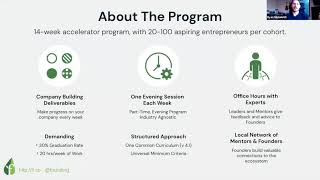
Welcome everyone to the Founder Institute information session. So all of you are here because you're interested in launching a Founder Institute accelerator in your market or becoming a local leader. We have people who, you know, participated in VC Lab and they're interested in launching a fund and now they're kind of looking at building a venture portfolio. We have other people who are mentors from Founder Institute that are interested in launching in their city. So we're We've got a really sort of diverse group of people here. We'd love to kind of learn more about you and what your intentions are. So the presentation today is all about how to become a local leader for the Founder Institute. So the first thing I wanna share here is that, you know, we sort of see entrepreneurship as the solution to most of humanity's problems. And so most of you might already know Adeo Ressi, our CEO. And, you know, his quote here I think really hits the mark in that there's no shortage of problems facing humanity, but there is a shortage of entrepreneurs who are working on those problems, right? And so about 12 years ago, we— Adeo created the Founder Institute, and at the time the goal was to launch 1,000 startups worldwide. And, you know, fast forward 12 years later, we're at over 5,000 startups. We're the largest startup accelerator in the world. With 5,000 portfolio companies, 20,000 mentors, and we're in over 90 countries and 200 cities. And, you know, frankly, like, I've been here, you know, for the last 6 years. We're just getting started, right? We've got some really great programs that we're rolling out later this year. We have VC Lab, which is like crushing it right now, where we're launching venture funds all over the world. And so we really see ourselves as like the feeder system into the global startup ecosystem. And so on average, we create somewhere between 800 and 1,000 companies every year. And we've had to move the program to a virtual format because of the pandemic. Previous to the pandemic, everything was live and in person. After the pandemic is over, there'll probably be some kind of hybrid, like I think most of the world will have some kind of hybrid solution, and we're working on that right now. So let me just give you a brief overview of the tech ecosystem, at least how we see it. You know, on the left-hand side here, you see like a bunch of events that are in the ecosystem, whether it's Startup Weekend or Startup Grind, those are some common global ones. Founder Institute sweet spot is at this launch and pre-seed accelerator stage. So you can kind of think of us as like a pre-Techstars or pre-Y Combinator. And we're the largest in the world by, orders of magnitude. And so, you know, the way that we think about seed and pre-seed is that, you know, the earliest stage founder in our program that we can help is someone who is at, you know, the idea stage. They're thinking about a problem that they want to solve. They're maybe a professional, 32 to 34 years old. They have some industry experience, but they've never launched a company. But they have some insights into a specific problem that they think that they can build a company around. But before they quit their day job, they want to validate it through the program. This sort of middle average founder, I would say, in the program already has some kind of MVP. Maybe they're incorporated, maybe they have a co-founder, but they're still, you know, kind of pre-launch, or maybe they've launched and have a little bit of traction, but they really need like a structured approach to help them scale and grow their company and really bring it to the next level. And then kind of the later stage of pre-seed is what we call early company. And this is where you have a founder who's full-time, maybe their team is full-time, they're already incorporated, they have a product that's in the market, and they're looking at joining the Founder Institute to be backed by a major global accelerator. And so, you know, personally, I run the Silicon Valley program as a local leader, and I've had founders who have joined with $10,000 a month in recurring revenue. I've had founders join who've already raised $750,000. So you can kind of see that that spectrum of pre-seed is actually pretty big. And so our goal is to basically create these companies that can then be fed into other seed accelerators, coworking spaces, investment groups. And that's really our role as a global startup ecosystem builder. So we are very collaborative with everyone in the ecosystem because we focus on this niche. We're probably the largest referral source into Techstars globally. We have lots of companies that go on to Y Combinator and Launch and other accelerators. And so we want them to join those other accelerators because they're gonna help those companies grow into the future. So one very important thing that I really wanna stress to the leaders on the call, as well as to founders in the program when we start, is that Founder Institute isn't just this like 3-month accelerator program. You're joining the largest global network of startups for life. And so once someone graduates the core program, which is what you see here on the left, that's the 3-month accelerator program that you as a leader will be running. There's a lot of post-program support that's centralized by Founder Institute headquarters. So we have a bunch of structured post-programs. Most notably, we have something called Funding Lab, which is a fundraising accelerator. Where we help companies raise their seed or pre-seed round. We also have something called Product Market Fit Lab and Venture Lab. All of these are structured programs that can help the founders get to the next level. And as an alumni, not only do you get access to the entire global network, so 20,000 mentors, you know, 200+ chapters, leaders from all over the world, plus the alumni, but you also get lifetime and, continued support from our alumni success team. So we have a team at Founder Institute HQ whose sole job is to help the alumni of Founder Institute grow, fundraise, scale, and provide support at every level of the company's journey. So whether that's making appropriate introductions to people within the network, it could be like just giving some advice or sharing best practices, it could be setting up office hours, We take a lot of that support for the startups and we centralize it and provide it to our alumni. And then, you know, on the right here, you see something called VC Lab. This is a separate program. In theory, founders could, or alumni could join this, but this is really for like the leaders and the mentors and sort of people within the network where we will help them raise a venture capital fund. And so we're on VC Lab 3. So far we've created, you know, over, I think 45, funds globally over the last 2 programs. The current program had over 1,700 applications, and we're going to create about 100 funds out of VC Lab 3. So we're on track to create about 1,000 venture funds by 2025. So let me tell you a little bit more about the core program, which is the one that you're going to be running for 3 months in your local ecosystem. So, uh, we're really good at creating structured programs, and there's a lot of information that we have on how to operate them very efficiently. So the program is structured, and some of you may be mentors already, so you know this, but there are weekly company building deliverables that the founders have to work on every week. And so it's about a 20-hour per week workload. And these deliverables are 100% operational and practical, right? We're not here to teach entrepreneurship theory. We're here to kick founders in the butt and get them working on their companies to build something really epic and amazing. And so not only are they working on these weekly company deliverables, but we also have a weekly evening session that has a different theme from week to week. So if you look at our curriculum, you kind of start off with vision and then customer development, you go into revenue and branding, and then there's some legal sessions and some review sessions that we have. And every single week builds on top of each other. So the work from week 1 and week 2 will then be augmented by week 3, and that's how we help the founders make progress over time. So you can kind of think of this as we're putting these founders on rails, and if they just focus on the work that we give them, because we've sequenced it in, in a way that will help them grow faster, they're going to be light years ahead. Of where they would be when they graduate the program compared to if they were just to meander around the ecosystem and do it on their own for 3 months. And so those evening sessions are really what you're gonna be mainly focused on as a local leader. And I'll get to that in a moment. But the way that it's structured is we bring in mentors, there's some pitches, and I'll break it down here momentarily. The other thing is that there are office hours with experts. So that includes you as a local leader, as well as the mentors that you bring in for your program. So founders can set up one-on-one meetings. We have a tool in the backend. And so the combination of a structured curriculum with a weekly recurring evening session with one-on-one meetings with mentors, and then in addition, there's local working groups where founders are actually broken into working groups with each other for peer support. That's a very powerful combination to help build camaraderie within the program and also help those founders make great progress on their companies. So here's what a session looks like. And Jeanette, maybe what we should do is invite everyone here to one of the Silicon Valley sessions that we run. We run them Wednesdays at 6 PM Pacific, and at a minimum, we have some recordings we can send you. But the session that you will be running on a week-to-week basis during this 3-month program looks like the following. So you'll start off with what we call founder hot seats, and this is just founders pitching their companies to a panel of mentors. Every week you're gonna bring in 3 local tech CEO-type mentors who will help give feedback to the founders. So you'll do about 45 minutes to an hour of pitches. The founders will pitch, the mentors will give feedback, and the mentors will also rate the founders using our system. So we track everything through our software. Everything is managed through that. And the mentors will input the ratings to help, you know, track progress over time. After the founders are done pitching, we'll then transition to the mentor talks. So every mentor that joins the session is in charge of creating a 15-minute presentation that's related to the subject of the evening. So if you're a branding expert, you'll create a branding presentation. If, you know, at the fundraising session, you'll probably bring in some investors or angels, they'll create a presentation on fundraising. And those mentors will basically share their best practices and insights that they create that they've experienced over their career as a professional in the startup industry. Once the mentor talks are over, and again, 3 mentor talks, 15 minutes each, we'll then do a Q&A session. And so that's where founders can interact with the mentors, ask them questions, the mentors can kind of answer it in a group format. And then, you know, once that's over, we'll do a post-session social either on Airmeet or through Zoom. Where the founders can sort of meet each other and meet the mentors and again build that camaraderie. And so the sessions now in the virtual format last about 2 hours in total, plus the networking session afterwards, which could last anywhere from 30 minutes to an hour. It depends on, on how engaged the founders are. So, you know, you're going to be running 14 of these sessions, and your main role is to basically get the mentors out there because the sessions are very easy to run. And you just want to stay organized and bring in the mentors. So let me tell you a little bit about like the why of being a local leader, and then we'll get into the what. So most of the local leaders around the world, when we surveyed them, we asked them like, why do you want to be a local leader? And there are kind of 3 things that really stood out. You know, the first was kind of giving back to the community, right? They wanted to help startups. These leaders are professional entrepreneurs or CEOs. Maybe they had an exit. Maybe they're looking for their next role and they want to give back to the community, right? And so it's fun working with startups. So a lot of these people are sort of startup mentors that want to take it to the next level. The way I kind of describe it is Founder Institute is like a bolt-on startup accelerator that helps local leaders give them a global platform to augment whatever it is they're doing. So many of our leaders are VCs or they run other accelerator programs or meetup groups, working spaces, and FI acts as like a very part-time thing that they will do that gives them access to like this global network and some increased status. So as a leader of the program, you can kind of leverage the global platform to position yourself as a startup leader in the ecosystem. And then, you know, the other kind of main thing that leaders said, you know, as in terms of why they run the program is to build a venture portfolio. And so, you know, personally I've run, you know, somewhere between— I lose count now, it's like, you know, over a dozen. If you count the programs that I've run in Toronto, it's probably over 20 founder institute accelerator programs. And I've built a venture portfolio of 400 startups and counting. And so as local leaders, you're looking at this as instead of investing money in startups, you're investing your time to build an accelerator. And then later on down the line when those companies are ready to fundraise, you know, you or your mentors or whoever can absolutely invest in those companies. But in the beginning, you're really looking at this as like, okay, how do we help founders at the earliest stages, which, you know, arguably is the most important stage because you're setting them up for success in the future. And, you know, the time commitment is somewhere between 6 to 10 hours of work a week for a local leader. So it's actually easier to be a local leader managing the program than it is to be a founder running and actually participating in the program. And so we can get into that in a moment. So here are some of our leaders. I work with Sunil Sharma, who's here at the top. He runs our Toronto program. He's also managing director of Techstars Toronto and the co-host of Collision. Him and I have been running the Toronto program together for like the last 4 years. Emna is great. She's out here in San Francisco, but she's, she's a Tunisian citizen and she wanted to launch a startup in Tunisia. And so that's a very nascent, emerging, and now developing startup ecosystem. But, you know, we're— because of our position in the tech ecosystem, we're able to create brand new companies that didn't exist before. And that's super, super important for emerging startup ecosystems because you sort of need to feed the ecosystem with that deal flow to then proliferate it throughout, you know, the rest of the startup community in that region. Harold Hughes, Harold's great. He actually went through our first Greenville program, like, I think it was like 5 years ago. He raised some money, he built his company, and he's doing really well as an alumni. And then he moved out to Austin, and he wanted to get involved with the leadership team there to kind of get plugged into the startup community in Austin. And now he's helping run as a co-director the Founder Institute Austin program, and he's doing really well. And so he saw this as a way to kind of be an effective transplant to go in and tap into the resources of the startup ecosystem through Founder Institute. So the common theme with a lot of our leaders is they have some kind of tie to the local startup ecosystem. They have a startup background where they can give good advice to the founders and They also have like a level of credibility where if you're a first-time founder and you're looking at the leadership team to like help guide you to the promised land of startup success, that you have that background and credibility. So here are some of our portfolio companies. This is actually out of date. There's some bigger fundings here that I can't talk about for some of the logos you see here, but this is just an example, right? I mean, we have 5,000 companies Many of them you've probably never heard of, but a lot of them are doing very well right now. And so this is just sort of a way for you to kind of see the different verticals and regions and industries around the Founder Institute portfolio. So here's what local leaders do functionally, right? So when the program was live and in person, it was about an 8 to 10 hour commitment per week because you had to secure a venue, you had to drive to the venue, and you had to set it up and do all these things. And in addition to that, the program sessions were long. In the virtual format, everything is run on Zoom. So it actually takes less time than previously to run the program. And if you have questions on the difference, I'm happy to dive into some of the best practices for running it virtually as the workload has shifted a little bit. But essentially, your role as a local leader is to first build a team of 3 or 4 other local leaders in total to launch the program together. So the, you know, the example I use is that the director team is the nucleus of this, right? If you have a really, really strong director team, that's going to attract really strong mentors, that's going to attract strong partners, and that combination as a whole is going to attract really great founders into the program. If you bring great founders into the program, you're going to graduate great founders. Right? So really, like, the most important thing here is to build a rockstar team. You want the best people in the startup ecosystem involved because that's just going to make the rest of your, your career at Founder Institute much easier and more fruitful. So start by trying to recruit the right people, not just the low-hanging fruit or the easy people. Go for the rockstars and the top people in the ecosystem, and I can't stress that enough. Um, Your other role, and so once you build a team, you're effectively hosting and managing local online events. So there's a 3-month sort of recruiting phase where founders can apply to your program. And during that phase, you're gonna host about 4 or 5 online events, right? And, you know, functionally, like, we'll teach you how to do it. There's like a structured process and training that we'll give you, but you're really just going out and bringing mentors, so startup industry professionals, and bringing them into these events. And again, the better mentors you attract, the better founders you'll attract. And so you're, you're going to get really good at basically just setting up online events, um, public ones during the recruiting phase, and then the 14 private sessions during the actual accelerator. And I can tell you this, it's actually really easy to do. Most mentors you talk to want to become a mentor for, for multiple reasons. The first is that we're one of the only programs that actually compensates mentors with equity, so that's kind of a big plus. And then two, a lot of mentors want to give back, and frankly, they, you know, if you look at the work that they do, if they join a 2-hour-long session and they get equity in a portfolio of 10 to 20 startups, I mean, that's a pretty killer value proposition. So it's easy to recruit mentors. We'll teach you how. You also will give startup advice to the founders, and so one thing that we found in virtual is you have to go a little bit more hands-on. You gotta talk to founders that you're recruiting, you know, in the pipeline. You gotta give them advice on startups. And then in the program, through this office hours tool, you're gonna basically be hands-on and giving them advice on their companies. The curriculum will keep them busy and keep them moving in the right direction, but nothing can really replace the advice of someone who's experienced and has seen the landscape and can help guide the founder around potential obstacles and give them best practices. So you and your mentors will be doing this in the program. The other thing you'll do is you're effectively, as a local leader, you're the figurehead of the program. So you're gonna go out and you're gonna establish partnerships. And again, if you get the best partners in the ecosystem sharing our content, sharing our deadlines, we can promote them and we can do co-hosted events together. There's lots of ways that we create mutual value for partners. But if you have like, you know, 5 or 10 partners all talking about Founder Institute, you're going to attract a lot of really great companies into the program. And last but not least, you'll recruit local sponsors. This is optional, and I'll get into sponsorship in a moment, but this is a way for you to create some income for yourself. And, you know, during this time, like, if you're focused on this front-end stuff, bringing in mentors, talking to founders, you know, who manages the rest? Well, Founder Institute has a very, very robust back office support system for you. So, you know, I like to kind of explain this like if you were to go out and try and build your own accelerator right now, you'd have to go and raise a fund, probably a couple million dollars. You'd have to hire a full-time team. You'd certainly be working on it full-time, you know, at least 60 hours a week. You'd have to fund the companies. You'd have to create your marketing funnels. You'd have to do all this stuff. And what we do is we scrap all that. We allow you to run an accelerator at no cost. You don't have to raise money. You don't pay any money. There's nothing like that. We provide all of the back office for your accelerator. And all you have to do is basically be the figurehead going out, running events, talking to partners, and bringing in founders to the program. And so here's an example of some of the things that we do. On the marketing side, we run weekly global webinars. That we will promote locally in your ecosystem. So there's— even though you're going to run 4 or 5 events, we're going to run probably 25 events, you know, throughout your entire recruiting period that will be used to recruit founders into your program. The only thing you need to do is hit the share button on social media so that you share it with the local community. We have a global newsletter. We take care of a lot of the digital marketing and social media. So for every single one of your events, we're going to post it on Meetup, Facebook, Eventbrite. We're going to take out Facebook ads, and we're going to promote it, you know, through those channels. Your job is to basically share it through your social channels and through your partners' social channels as well. We have a PR team, we do tons of content marketing, we're probably the global leader in startup content creation. Just go and look at our blog, we have, you know, weekly articles that we've been cranking out over the last 12 years. And then most importantly, we have an automated email marketing system that manages your admissions funnel. So when someone joins an event as an event attendee, we'll automatically take care of the thank you emails encouraging them to apply. Once they've applied and been accepted, we'll send them the emails to, to join the program and enroll. So we take care of all of that back office busy work so that you don't have to, and you can focus on the fun things, which is working with founders, mentors, and partners. Now on the operational side, we have, as you can probably tell, we manage everything through our software. So we've built this like really cool custom accelerator management software over the last 12 years. Manages all of your events, your applications, the program itself, your mentors. And so it's, it's really easy to use and you'll, you'll learn how to use it through our training program called the Leading Institute. Every single week you're gonna have a call with someone like myself from Founder Institute HQ who has a lot of experience running programs and helping leaders run programs. And we're basically gonna say, you know, we're gonna give you the bullet list of things you should focus on for that week to optimize your time. I already mentioned this, but we have centralized admissions. We take care of everything when it comes to your pipeline of the accepted founders. The only thing you'll have to do on the admission side is talk to some of the accepted founders to answer questions about the program, but we also do a lot of that through our calls that we set up. We have legal agreements, we take care of all the billing, so, you know, the course fees, and then we also have sales material for sponsors. So there's a lot to that. Now let's talk about the economics, like how does a local leader make money and how do they benefit from the program? So the first and most important thing is through the Equity Collective. So some of you have probably researched this extensively, but what we want to do, and we had a global leadership call about this, We want to find people that can run the program for like 10 years, right? And, and we want to create a scenario where you love running the program and it's fun, so you want to run it for 10 years. And many of our leaders have actually been running the program for 10 years because it creates value and it's fun. And if it wasn't fun, I frankly probably wouldn't be a leader right now. So here's how this works, right? We want you to build a portfolio of hundreds of startup companies. right? And we also want to create a scenario where our leaders can potentially make $10 million. I know that sounds like kind of high, but we've actually done the math behind this. In order to reach that amount through this equity collective, you essentially need to create about $2 billion of shareholder value. And what we've found is that, you know, if you can create $1 billion of shareholder value through one of your companies, right, it's rarely going to hover at like the billion-dollar mark. It's going to be like, you know, much more than that. And so like really, like you, if you look at what kind of like portfolio math, you really just need like one really good breakout company to get that kind of return. But hopefully through the program and the process, you're going to have more than that, right? Now, this is a long-term game. This isn't something that's going to happen overnight. It's going to take 10 years to get to that level, right? Because, you know, on average, a company will stay private for, you know, 10 to 12 to 15 years. But that's sort of our goal and we want to help you get there. And so let me talk a little bit about how the Equity Collective works. And this is sort of our secret sauce of how we've been able to scale globally. But essentially, around week 8 of the program, the founders are invited to join the Equity Collective. And in order for them to join, they sign a warrant, which is essentially a stock option that gives Founder Institute headquarters the right to invest in the company of the future. Now, the price per share and the number of shares, that's all established when the company raises their first qualified financing, which is essentially a seed round where the company is priced. And that establishes the, the number of shares we can buy based on that 4%, as well as the price per share based on the valuation of the company at that time. So what we do is we hold on to the warrant, right? We don't invest right away. We wait until that there, there's a liquidity event on the horizon And because we're on the cap table as a warrant holder, they notify us that, you know, Microsoft or whoever is going to acquire you. You then go in and we'll buy the shares. We then sell them to the acquirer. And the delta between the two are what we call the proceeds. Those proceeds are shared amongst the people in the equity collective. So the first 25% tranche is shared by the leaders, right? The second 25% tranche is shared by the founders. So the founders actually have equity in each other's companies. In the program, which is a very big value proposition to them because the risk of failure is high. But if they have equity in 10 or 20 other companies that they helped co-launch, that's kind of an amazing value proposition for them. The third 25% tranche is shared amongst the mentors. So, you know, whereas the leaders might share the 25% amongst 3 people, you might have 50 mentors that all participated. So mentors, you know, 50 mentors are going to share that 25%. So they'll get a much smaller piece, but their commitment was also much smaller. Smaller, a 2-hour session perhaps. And then the last 25% is held onto by Founder Institute HQ. So I want to be very, very clear about something. We are literally giving back 75% of the money that we make as an organization to the local startup ecosystem. And the theory behind this, and it goes into ecosystem building theory, we on the front end of the program, we're creating brand new companies that didn't exist before that then get fed into the local startup ecosystem. They're going to go and raise money, hire people, join coworking spaces, all of that. Over time, maybe a couple of those companies will have an exit. That then creates a funding event where we can then distribute the proceeds back to the local ecosystem. And hopefully it's a large, uh, exit event that then turns those people who are part of that cohort into the next generation of angel investors. And a lot of founders who go on to be successful come back as mentors. They love the Founder Institute. There's this sort of like really cool network effect that we have. And so really what we want to do is help seed the ecosystem with more investment and more capital. Because if you look at what happened in Silicon Valley 50 years ago, that's essentially what happened. Companies were created and funded here, exits happened, the money stayed here. That then led to the creation of new companies and new innovation. And we're trying to recreate that in every major startup ecosystem around the world. And so, um, if you have questions on this definitely ping me. It can get kind of technical around the warrant, but happy to dive into your questions. The second way that leaders make money is sponsorship. Now, on average, a leader can raise about $10,000 through a legal sponsor, but it does depend on what startup ecosystem you're in. In places like, you know, India, where our course fee is much cheaper, maybe you'll raise like $5,000 per cohort. But for most major US markets and North American markets, in even Europe and other places, Australia, $10,000 is pretty easy to raise from a legal partner. And I can dive into the specifics of a legal partnership, but what you need to know from this is that you as the leadership team will keep 80% of that sponsorship. We see this as an optional thing that can add value to you because we're making you equity-rich, not cash-rich. We want to give you the opportunity to make a little bit of money so that it justifies the time that you spend. So, you know, if you have a team of 2 or 3 people and you raise $10,000, like you're gonna split $8,000 amongst your team of 2 to 3 people. So you can make a couple thousand dollars running the program, which is nice, right? It'll at least, you know, justify the time. And then the last piece here is what we call course fee sharing. So founders to join the program have to pay a nominal course fee in order to join. And that course fee ranges from, $200 to $1,000, and sometimes a little bit more. I think our Silicon Valley program's around $1,200, but this is sort of the global average, $200 to $999. And we base that course fee on the price elasticity of demand in that local market. So, um, in places that are emerging like Brazil or India, the price is like $200 or $299. In a major U.S. city like Chicago, it's $999. And that course fee is basically our way of breaking even, right? It goes to Founder Institute HQ to help with our operational costs and help run the program and provide all the support that we do. If you as a team achieve more than 20 paid founders in the program, then you get 25% of the total course fees, right? And so we have something called the refund deadline. It's basically in week 3, but you have to maintain that 20 paid after the refund deadline. and then that triggers the course fee sharing. In most major markets, you're able to achieve this, and this is really a function of the quality of recruiting that you do. So it's an incentive for you to recruit founders, but we also want to make sure that there's some cash compensation there. So basically, in a nutshell, you as a leader, you're going to make, uh, equity in a bunch of companies. You're going to raise some sponsorship per cohort, and if you run 2 cohorts a year, you know, you could raise somewhere between 10 and 20, and sometimes much more. We have leaders who raise like $60,000 in sponsorship and they keep 80% of it, right? And so you can really get creative with this. If you have like a friend who's like, you know, corporate development at like Microsoft or whatever, you wanna go and raise like $100,000 sponsorship, you're more than welcome to. We can help kind of craft packages based upon the opportunities that you have, but you gotta go out and raise the sponsorship. And then you can also make, you know, a couple thousand bucks off the course fees. But again, I just wanna emphasize, you don't do Founder Institute to make course fees, right? That's not why we do this. You do Founder Institute to make an impact. You do Founder Institute to help build companies that can solve some of the most pressing challenges that our world is facing. And you do it to build a venture portfolio of startup equity. So here are some of our leaders. You know, they talk about the program. I think we'll be sending out a recording of this. You can read through this, but We have leaders who've been running the program for 10 years. I've been running it for 6 years, and it's not only very impactful for the amount of time that I put into it, but it also is, you know, one of the, I think, more fun and interesting things that I do because, you know, every year I'm talking to founders who are building, you know, digestible medical robots or quantum computers, or they're going and like trying to build like some drone systems. It's really fascinating work, and if you're kind of looking at like trying to stay on the front line of technology and innovation, there is no more— there is no further of a front line than the startup formation phase of startup ecosystems all around the world. So let me just kind of pause here. I know this is sort of long, so thank you everyone for your patience. Here are the next steps. We have a program called the Leading Institute. This is our way of training local leaders to launch their accelerator program. It starts, I believe, April 22nd. Jeanette can send the details. If you have not already, you're going to want to fill out your application so we can process it and get you into that cohort. In the cohort, even before the cohort, you might have a team that you want to recruit and bring aboard. So you can, in theory, join the Leading Institute program without a team. During the program, like in the first 2 or 3 weeks, you'll be building that team. but it's okay to join the Leading Institute with a team as well. And then in that Leading Institute program, we're gonna help you set up and launch your accelerator. So it's a way for you to kind of test the waters, see what the local response is, you know, by reaching out to mentors and setting up your program. And, uh, and then once you graduate the Leading Institute, we'll do a big press release. We'll, we'll promote the open applications in your local market and we'll help you set up and launch your first accelerator program through the Founder Institute. So thank you for your patience. Appreciate everyone here, and I'm going to go ahead and stop sharing my screen so we can dive into questions.










