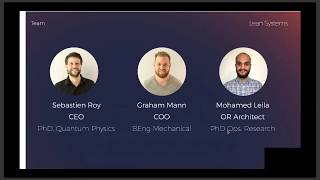
Sebastian pitches Lead Systems, an API platform that optimizes transportation scheduling using advanced algorithms. The company grew MRR from $4K to $7.5K during Techstars and targets a $30 billion industry. He's raising $1 million to reach $1.75 million ARR in 18 months.
Chapters
¡Hola! I'm the CEO of Lead Systems. I used to build fleet optimization systems for top airline companies like Emirates, UPS, and FedEx. And now I'm the CEO of Lead Systems, the first cloud-based platform for optimizing fleet and crew scheduling. Hundreds of billions of dollars are wasted by logistics and transportation businesses each year. This is ridiculous and a huge problem, and here's why. Everyone knows that routing and scheduling is a super hard problem. Today's fleet management systems offer primitive automation tools that don't fully capture the unique rules needed from each operation. This means they end up scheduling by hand, and since it's so difficult, this process generates schedules that are extremely inefficient and companies lose billions as a result. So our solution is to solve this problem by building a flexible API-based routing and scheduling platform that automates and optimizes the entire scheduling process using top-tier algorithms. Using Lean Systems is extremely easy, and here's how it works. Customers send the required data through our API. This includes the list of drivers, the tasks, the pickups and drop-offs, etc. Automatically applying the right rules, our engine returns fully optimized schedules and routes within minutes. Our system requires no training, integrates easily with the tools that companies already use for scheduling. With Lean Systems, customers save time, reduce costs, and make more money. While this all sounds simple, under the hood, Lean Systems combines column generation, with novel shortest path problem implementation and autotuned branch and bound. We combine this with a rules abstraction layer that can automatically capture the exact operational rules of any transportation companies. The advantage of our approach is that we are able to solve large-scale problems within minutes, and no one in the market has anything close. We charge a fixed amount per route depending on the industry, And here's a few examples of the size of the pricing that would come up based on the size of our customers. And if you have a very large operation, we can offer bulk discount. So during the Techstars program, we doubled our MRR from around $4K to $7.5K. And since then, we've signed contracts that will bring this up to $20K MRR by the end of September. Uh, and the other cool part is our customers are growing about 10% per year, which increases our revenues as they grow. So I previously worked for one of the top optimization consulting firms in the world. The algorithms that I developed helped save millions of dollars a month for top airline companies like Emirates, UPS, and FedEx. My co-founder Graham has experience in marketing and sales for startups making for a well-rounded founding team. We also just hired another great engineer, as well as the head of core engineering team from ADAPT that used to work for— so our ability— which guarantees our ability to manage growth throughout the next year. We're going after the $30 billion fleet optimization industry, starting with paratransit and business aviation, which represents about half a billion dollar opportunity here in the US. However, those spendings come from top tier of the market. With our approach, we can tap into the non-existing market that is at least 3 to 5 times as large. We're raising $1 million, for which $700K is already committed. This will allow us to reach $1.75 million of annual recurring revenue within the next 18 months. As the population continues to increase, smart resource allocation is inevitable throughout transportation. And although drivers will soon be replaced by software, the challenges of fleet management will remain. Our vision is to be the backend technology that enables everyone to leverage accurate optimization in real time. Lean systems is going to be the future of transportation optimization. If you're interested in being part of our journey, please reach out.
Okay, Emilia, if you could turn your camera and microphone off just to make it easier here. Okay, Sebastian, hi there. Well done, well done. Now you went a little bit over on time, so I'm gonna give you a little extra time on questions. We already have a question from Murray. What happened at Techstars to increase your monthly revenue run rate? Or was it simply just the move to New York?
Yes, it was a negative turn.
What?
It was a negative turn.
Explain what you mean by that.
So the customers that we have grew on their own. So like no sales, it's just the current accounts that we have that grew on their own.
So there was no net effect of moving to New York or joining Techstars and increasing your revenue run rate. It just happened organically?
Yeah, not during the program itself, it just happened. However, during that time we worked on the sales funnel and now the further increase that we'll see in the next, in the next couple months are the results of how we came out with a very clear recipe for our sales team to execute against.
If we can put Sebastian on the main screen just so he's the focus. Um, what about, uh, Andrew was asking, who are your customers? Trucking companies, Uber? What about simple customers like GPS users?
Right, so like our first few customers were taxi companies to public transit authorities that operate the adapted transport operations, but since then we put a focus on business aviation. So today our current customers are business aviation operations.
Business aviation, uh, I know what that is. Is it like ExxonMobil sending people to drilling platforms or—
Yeah, things like that. Like one of our customers does that for like mining industry in the up north Canada.
Yeah. Well, of course, Canada has some pretty remote locations that all the transport and, you know, Ice Road Truckers being a great example of a show about that very subject. So maybe just to continue with Andrew's question, if anyone else has questions, please pop them into the chat. Well, actually, Mel just wanted to know, does your system assist in help rerouting after delays due to accidents?
That's a very good question. So it depends on the data maturity of our customers. So we support it, but it really depends on if our customer already have GPS trackers installed in their vehicle so they can measure and monitor everything.
Right. So you can pre-plan, but if they don't have the tools to reroute, then obviously you can't do that. So you could if they have the tools, but if they don't, that's tough. Kim was asking, have you considered a revenue model where you share in the savings?
Yes. Okay. So it's a very good question. So the thing is, there's so many— like we increase raw revenues. And it's really hard to see what's the actual net benefit from that. So figuring out contractually how to make that work is incredibly hard. So what we're doing instead is we're doing back of the envelope calculations on the average cost of operation for our customers, like cost per mile, cost per hour. And then we come up with a number that we think makes sense based on what they're going to save and what we would like to capture in terms of value.
There are a lot of questions coming in and we might run out of time here. What channels are you— Ken was asking, what channels are you using to reach out to customers?
Okay, so transportation companies in any vertical are closed circles. So the most effective strategy is reach out during conference and then identify targets before getting there. And once you get the first customer, then you go through referrals.
Wow, they're just pounding in here really fast. Does your platform help with trade marketing and brokerage for cross-border transport? So managing any cross-border issues?
No, we don't handle the legal thing. What we do is what I think of as micro supply chain logistics. So by the time that all these things are figured out, we tell you how to most effectively use resources.
Excellent. Well, there's a lot of questions in the chat and we hopefully got a poll out on the 1 to 5. I'd love to hear the 1 to 5 for food room and the 1 to 5 lead systems if we were able to get that out. What we're gonna do now— thank you so much. Boom!