Lloyed Lobo's Guide to Successfully Bootstrapping a Startup
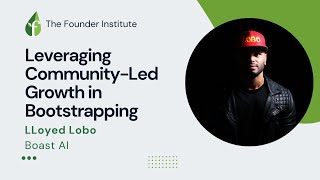
Lloyd Lobo bootstrapped Boost.ai to $10 million ARR and a $200 million valuation before selling a majority stake. He breaks down seven core lessons including the four Cs (Companions, Communication, Creation, Consistency), deliberate cultural alignment from day one, and a phased growth model from validation through scale. His framework prioritizes community-led acquisition and founder-defined success over venture capital chasing.
Chapters
Awesome day. My name is Daniel. I'm a part of the FI marketing team. Uh, what you saw there was an introduction to Founder Institute. So we're done with that. What I'll do is I'll kind of introduce the event, and I'm really, really excited about today's event because we have a speaker who's been here before. He is a speaker who we are big fans of here at the Founder Institute, and today he's going to be talking all about bootstrap, how he bootstrapped his startup to $100, uh, sorry, $10 million. Uh, before we get into intros for the speakers and we bring our speaker on stage, why don't you all let me know where you're all joining in from? I can see we have people here from Spain, we have people here from Australia, Sweden, Lithuania, awesome, Dubai, Australia, Indonesia, the UK, India, awesome, awesome, awesome. Uh, so we do get a very international audience here at the Founder Institute, and that's always very exciting because that kind of tells you how universal, you know, the desire to solve problems really is. So before we bring our speaker Lloyd on stage, just some brief agenda items. So if you have a question for our speaker, all you have to do is click the Q&A button right below the chat button and pop your question in there once we move over to the Q&A portion of the event. We'll answer all your questions. So over to the speaker now. So our speaker today is Lloyd Lobo. He is the founder of Boost.ai and Traction Ventures. He's also a bestselling author. So we're really, really excited to have him here. Hey, Lloyd. Lloyd, you're on mute.
I said thanks for hosting me. Super excited. Big, big fan of Founder Institute, been a mentor, done a few talks. Also a friend of mine, Gagan Bihani, started Udemy out of Founder Institute, met his co-founders, Aaron Bolly, and, you know, they've gone on to do great things. I mean, Udemy IPO'd, Aaron Bolly went on to do Carbon Health, and Gagan's doing Maven now after a couple other ventures. So huge, huge fan. And super stoked to be here. Hopefully some of my journey is relevant for the audience here. And I'm assuming everyone is early stage already, just starting out, have an idea, trying to navigate and figure those early days out. Is that right?
Yeah, that's generally what we get here, but it is sometimes a mix of people who are also aspiring founders, right? People who are thinking about that first step. So it's a good international audience and it's also a mix of different stages. So it should be awesome. What I'll do now is I'll hop off stage, but folks, just one last item. If you are enjoying what Lloyd is saying, you'll see a reaction button right at the bottom of your screen. Show him some love, let us know what you think. Lloyd, over to you.
Awesome. Hopefully my journey would be helpful to you. I will, I gotta do the slides again, right? Because I imported it previously. But I don't think it went there. Awesome. Cool, I'm gonna share lessons from bootstrapping a $10 million ARR. Now the company is over $20 and during a certain point in time was worth $200. So I threw that number there, big numbers sell, I guess. But the key thing is I'll share lessons on bootstrapping the company, getting our early customers, taking it to point of scale, Towards the end of 2020, we sold 52% of the company to a growth equity fund. And then, in the months that followed, maybe within a year, me and my co-founder stepped out of the day-to-day operations, and now we're very active board members. So, I could share my journey there, but a little bit about my background and hopefully, you know, I have 7 lessons here on building and scaling a company, but I'll give you 2 bonus lessons, which I didn't put in here, but it's literally from my journey. And lesson number 1 is, bonus lesson 1, I didn't finish high school, but I finagled myself into engineering and graduated with an engineering degree. And so this lesson number 1 is luck and risk are 2 sides of the same coin. The ones that get lucky are the ones that never stop flipping. From MrBeast to Warren Buffett to Elon Musk, they never stop flipping. If it sucks in the early days, but what matters is you don't stop flipping. So I'll tell you the story. I didn't finish high school. I was a bad rebellious kid. Most kids who won't finish high school will never apply to university. I took a different approach. I applied to every fricking university I could. One university called me for entrance exams, math and English. I was an okay student, I wasn't a bad student. I did well on those tests. And they asked me for my transcripts and I made up some BS excuse. And they said, listen, we're in a hurry so you can start the semester, but if you don't give us the transcripts within a month, you'll have to unenroll. So luck would have it, they never followed up. And without a high school diploma, I graduated with an engineering degree. Now, the second lesson here from my journey is to be successful at anything, anything in life, you need 4 skills, 4 things. And if you have these 4 things, I promise you, you'll do well no matter what you pick. Number 1, it's neither the destination nor the journey, but your companions, your community that matter the most. You become the average of the people you surround yourself with. So when I finished engineering, I didn't want to do a 9-to-5 job. I wanted to work in business. I want to start a company. Luck would have it that I ended up in my first job working for a founder. And because I worked for a founder in my first job, and this was 2005 or '06, 2005. My next job ended up being working for a founder because no other big company would hire me. And then the next job after that was working directly for a founder. Was the best skill I could have, but moreover, those were my companions. And so when the opportunity came, when my co-founder, my best friend from university, reached out to start a company together, I jumped at the opportunity. And I didn't even think of the risk because I had that risk appetite. I was surrounded by a community of founders. And so you become the average of the people you surround yourself with. So choose your companions wisely. Um, Ivan asks, what do you mean immediately? Um, I didn't quite follow the context of that question. Um, so I'll let you type that out because yes, um, what do you mean immediately? But yeah, so I had only worked for founders So it was a natural progression. I didn't think twice and I jumped headfirst because I had that appetite and I had that community of founders. The second thing that you need to be successful is your ability to communicate, communication. So when I finished engineering, I asked around and I'm like, "Hey, I want to be an entrepreneur someday. And what's the best skill I could learn?" And everyone told me that my communication kind of sucked. I was an awkward engineer. Now, here's the thing I realized. I'm not self-motivated. 99% of the people that I know are not self-motivated. Self-motivation is not sitting on the beach in comfortable conditions and showing up. Self-motivation is if you're repeatedly punched in the face, do you show up? My worry was if I took a public speaking class and 2, 3 people laughed me off stage, I would have like never gone to public speaking again. So I started to look out for what jobs would force me to communicate day in, day out. And it was sales, right? When you start out as an entrepreneur, everything is selling or communication. Convincing early customers to buy your stuff when you have no product. Convincing your spouse that you're not going to bring any money. Convincing employees to work on low pay, no pay. Convincing investors. It's all sales. It's all communication. So I started applying to sales jobs and nobody would give me a sales job. Now, luck would have it, one founder needed cold callers. And I started my career after engineering. My first job was cold calling. My parents freaked out. They're like, "Dude, your friends are working at Microsoft and that." My parents are from India. And they were, "Why would you study engineering if you wanted to do cold calling?" Fast forward today, I have everything I have because of that communication. So, you know, went from cold calling to then joining another startup where I was a Renaissance salesperson, meaning talking to customers, figuring out what to build, translating it into dev requirements and doing the whole shebang. And then I went to run sales and marketing for another startup. And that was probably the best experience I could get. Communication was everything. The third thing is your ability to create, creation, right? So we went through the three here is your community, communication, creation. Everything you do, whether it's creating content, whether it's creating products, or in the early days of a company, whatever you learn, you're going to turn them into playbooks. You'll be creating playbooks for the people you bring on eventually is creation. So get good at creating. And then the last one, without this fourth C, you have nothing. You may be the best communicator and the best creator and have the best community, but without consistency, you will never get anywhere. A lot of people, they get psyched out in the early days because they're not getting customers or things are not working out and they stop. And everything great is on the other side of risk and pain and suffering. It's a marathon. It's not a sprint. It's a long-ass slog. It took us like 12 years to build Boast to $20 million ARR. It took us 7 years to build traction to a community of 120,000 business subscribers. It takes a long time and you got to be consistent. You got to keep showing up. Compound interest and consistency is what we call overnight success. Awesome. So those were the two bonus lessons. Now I'll dive into my actual talk. So this is a little bit about our company. We automate R&D funding for businesses. Oh, oh, that's what he meant. What does it mean immediately? Yeah, yeah. So that was the Fox Business headline. What it means is people plug their tech stack and financial stack to boast. We analyze what they're doing in R&D. We see what government programs they can qualify for to get this R&D and product development money. But the government takes a long time to give them the money. They have a long laborious process. So we just fund them immediately. It's for US and Canadian businesses. Now I got it. Okay, awesome. And then after I left the day-to-day of the business, I wrote a book, "From Grassroots to Greatness: 13 Rules to Build Iconic Brands with Community-Led Growth." We had bootstrapped the company to $10 million ARR with no marketing team. We had less than 30 people, but we built a large community and that helped us grow. And that community also helped us, helped my book become a Wall Street Journal bestseller within a week of launch. And so that's a bit background on myself. Now, I will dive into the things I learned as I was building the company. Lesson number 1, you know, before you start anything, and this sounds like fluff, but trust me, it works, is great companies have great alignment. One of the biggest reasons why any relationship fails, whether it's founders or personal relationship, is a lack of alignment on values. The problem is, right, I started much like you guys. We bootstrapped the company. I was living in my co-founder's spare bedroom in Calgary, Canada, of all the places. I was in San Francisco. He was in Calgary, Canada, and I moved in with him and sleeping on his, on the futon of his spare bedroom. And when you're poor and you're trying to survive, you don't think about value alignment. You're just trying to make it work. But what happens when money comes into the play, when you start to make money, is your true values come out, right? And what they say is money doesn't change people, it brings out your real self out. And so it's very important to make sure you start whatever business venture it is, you start by aligning on values. See, a lot of times, right? So thanks for letting us know how it takes Years possibly, realistic information. Yeah, it takes years. Like anything worth doing is a long freaking slog. So we started the company in Jan 2012. In November 2020, we sold a majority stake, which is 52% of the company. And up until then, we were dumping everything we made back into the company because we are bootstrapped and wanted and had to profitably grow the company. And then when we sold 52% of the company, we became, overnight multimillionaires. But the thing is, that overnight took a long freaking time, a lot of pain and suffering, a lot of broken relationships, a lot of mental health issues. It was, it was like you are crushing it one day and then you're getting crushed one day. And that is a roller coaster ride of an entrepreneur, right? But nonetheless, what carries you through these hard times, and as you add people and add customers, is you start with alignment. Now, I want to share one lesson here. A lot of us founders, we chase venture capital and we chase investment. And I'm going to suggest you think about raising money a little differently, right? What we've done as a society is the society and the media has perpetuated this addiction to unicorn porn. In reality, the world is run by horses, camels and donkeys. And what that means is, you know, I've only ever worked at startups. Boast, my company, is the biggest company I've worked for. All of those startups prior to Boast, meaning the 3 that I worked for working alongside the founder, and then the couple I was on the founding team of, they were all venture-backed. And there was one thing in common, they all failed. A lot of the venture-backed companies fail, which doesn't get glorified in the media. Like 90+% of them fail. And so what we've done as a society is we glorify this addiction to unicorn porn and we say, "You got to show that TAM is massive and the market is big and win the deal. Win the deal." What they don't tell you is what happens after you win the deal. It's a long freaking slog. And so do yourself a favor and align yourself on a few questions as co-founders. Number 1, what is my personal definition of success? And that's not money. That is what would I do and love to do, the things that bring me joy when I have money someday. Number 2, how much money do I have in my bank account, need to have in my bank account to fund that lifestyle? And number 3, is there a version of the company I do not want to work for? That gives you your non-negotiable. And that is really, really important because there's multiple ways to build a successful company. And if your definition of success is in the next 5 to 7 years, I want to sit in Bali and do nothing and surf, then figure out what that lifestyle doing that forever costs. And maybe you never have to raise venture capital again. Maybe you build a company to $5 million in revenue and sell it for like, you know, 8x. If a company, if a B2B SaaS company is at $5 to $10 million in ARR growing over 50% year over year, has 100+ percent net revenue retention, meaning your customers are not leaving you, they're spending more, and you have gross margins of north of 80%, you cannot be killed, right? Because there's compound interest on ARR businesses and you will sell for a decent multiple. So think that through. VCs have only one path forward, and there's nothing wrong with that, but VCs raise money from institutions and high net worth individuals. I'm an LP in 10 VC funds. If the VC doesn't give me an outsized return in a 10-year period, why would I put my money in a venture capital fund? I will just put it in the S&P 500. The S&P 500 year to date is like 19 points up. Over a 10-year period, the S&P 500 has averaged 10%. The S&P 500 eShares portfolio is up 40-some-odd percent year to date. So why would I put my money with a VC if they can't generate me a very outsized return compared to an index fund? So VCs have this one MO is they have to find outsized returns. They don't play the middle game. They don't say like, oh, this company will maybe sell for $100 and this will sell for $50. They look at every company like it's going to be a multibillion-dollar company. That is their game and that's what they're looking for. Now, you got to realize before you start the company that you and your co-founders are aligned that you're going to want to build that kind of company. In the early days, growth is very fast. You can grow 100%, 200%, 300%. But over time, it becomes really hard. At $5 million, growing to $10 million in a year is hard. At $10 million, growing to $20 million a year is very difficult. Going from $20 million to $40 million in a year, is near impossible. So think about the stresses, the kind of people you need to hire, and the journey you're going to go through before you embark on it, right? Figure out that you're aligned on the kind of company you want to build, right? The other thing is this alignment also gives you the kind of culture you want to build. Culture is not what people do when you're in the room. It's the actions you take. It's not what's written on the wall. That's why that early alignment around Your purpose, your vision, your values will determine the company you build. The culture you create is the company you create. So your purpose is why do we exist? So Bose, yes, we give out R&D money to businesses, but our purpose was enabling innovators to change the world. As cheesy as that sounds, every dollar spent in innovation returns 20 to the economy. Vaccines, robots, clean drinking water is a function of innovation. Yet in the last 15 years, more than 50% of the Fortune 500 companies have evaporated and 99% of the innovations, they just die on the vine because they don't know how to innovate. They either don't have the funding or the know-how in terms of how to innovate. Our vision was we will accelerate innovation, meaning what will the world look like because of us? The mission is how do we do it? And we do it through R&D funding and R&D analytics. And our values are how do we behave? We built a community-led business, so our values and some of the most sustainable businesses I've seen, their values have to do with bringing people together. Connection. You want to drive people to connect with one another. Autonomy. You don't micromanage people. You give them— you hire smart people. You give them a purpose and a goal and you get out of their way. When you give people the autonomy, they run the damn thing. Mastery. Is people don't want to keep doing the same thing. They want to get better and better at what they do. Purpose, you know, what makes people stick? When you build something lasting, people stick because they're not showing up for your profits or your product, but they're showing up for a greater impact that's beyond that. Energy, if you keep driving people to do the same thing, we're not robots. They're going to get— their energy is going to run dry. The job of a leader is to build, inspire, and motivate a team to deliver. Deliver is the output of that equation. So how do you— Build, inspire, and motivate a team through communication by infusing energy, clearly articulating your vision to inspire and energize people. Because when you do this day in, day out, people who are inspired and energized can move mountains. That's why with less than 30 people and no marketing team, we were able to get to $10 million. It was the people. And the last one is recognition, right? Don't wait for an en, es, de survey or an employee review. Recognize people for whatever, small or big, and keep doing that. They will show up more often. The world thrives on appreciation and recognition, whether it's your personal life or your professional life. If you beat people down, most people will not respond to it. So that number one is like alignment and building your culture, alignment of values around the team and the founders, alignment around what you want out of this journey. Right? The unicorn porn may sound sexy, but when you align on, hey, why am I doing this? Like, what is the ultimate lifestyle I want? And most people get so afraid of saying lifestyle and get so afraid of saying why they're doing business. Like, hey, I want to go and retire in Bali when I'm 40 or whatever. Put that out there. It's fine. If no VC funds you, it's fine. You can get customers to pay you and generate that kind of revenue. If you want to build the next Airbnb, that's fine too. Just make sure you have alignment on the kind of business you want to build, because the kind of business you want to build and your personal definition of success will also determine the kind of journey you want to go on and the kind of partners and the kind of values. The second one is don't boil the ocean. Startups are built in phases, so let's walk through some of those phases. Phase 1 is validation. I have an idea. What is the first thing I need to do? Validate it. How do you validate it if it's B2B? My goal with validation, at least for Bose, was can I get 10 paying customers to try it out? That's literally what we did. And so what is the leading indicator of getting 10 customers to pay you to try it out? Phase 1, step 1, you got to figure out who your ideal customer profile is. Where do they eat, breathe, drink, sleep? What are their pains? What are their goals? And what stands in the way? And then also figure out what their aspirations are because their pains and goals will give you product one, but any company that goes to $20, $30, $50 million in revenue eventually has multiple products. If you understand and follow your customer's aspirations, you'll build product two and product three. So understand your ICP, your ideal customer profile, really well. The other thing you need to understand is their circle of influence. Who do they fund? Meaning what are the tools or products they pay for? This can give you a list of people to partner with. Who do they follow? Who are the influencers in the space? This will give you a list of people that, you know, you can get social proof from by aligning with them. You could invite them as guest bloggers or hosts on your podcast or whatever activity you do, so their social proof will give you social proof and you'll appeal to your audience. And the third one is where do they frequent, what platforms they hang out on, what blogs, magazines they read. If they are on TikTok, then why are you on LinkedIn, kind of thing. If they're reading like the local newspaper, then why are you showing up on TechCrunch? So those kinds of things are very important. Like figure out your ideal customer profile and figure out their circle of influence. But let's say you don't know who your ideal customers are, how to pick. So where do you start? There's 4 steps to figuring that ideal customer profile out. Step number 1, do I have any unique knowledge or any audience that I love? Building a company is a long slog. If you don't like the topic, and you don't love your customers, eventually as you scale, your company will become, your job as a founder will become about spending time with customers. And if you hate your audience, you will never be able to sustain. So figure out an audience that you're passionate about, that you love, that you want to keep creating for. Initially with Bose, we were targeting manufacturing oil and gas construction. We started cold emailing them and nobody would answer. It sounds a little scammy, right? Hey, give us your data, we'll give you money, no interest, no equity. And then we started going to their events. And we just looked like two guys wearing a hoodie on top, a suit jacket on top of a hoodie, and they felt like the cigars club. We just couldn't resonate. So dejected, we started going to startup events. And we found our tribe, and we found white spaces there that we could solve for. And we really like, when we started going to these startup events, we started hanging out with them, eating together, partying together, doing hackathons together, and we genuinely found our tribe. And today, over time, we built a big business servicing that market. In 2012, if you told people, "Oh, I'm building a product for startups," people would laugh at you. They would say like, "You're going to get bankrupt. They never pay." But you need to have some contrarian view on your market, and for us, it was startups are the only companies that are innovating. Over time, it's going to explode, and then you need to bet on that contrarian view, and if it turns out right, you'll win big. But because I love that audience so much, not only I built Boost for it, I built a large community called Traction for it. I wrote my book, From Grassroots to Greatness, for that audience. I'm sustainably creating because I love that audience. And my— anywhere I go in the world, I have friends now because of that audience. So think about an audience that you can sustainably build and create for because it's a marathon. The second thing is, is it a small but growing market? In the early days, it's very tempting to go and try to please everyone. But when you're trying to please everyone, you please no one. You want to be an inch wide and a mile deep. So pick an audience. If you niche down, for example, you'll find white spaces and you can be very specific to them and you can solve for them. So find a small niche. And if it's a broader niche, try to niche down before you niche up, right? So going after manufacturing, oil and gas, and construction is going after all business. We went after businesses that were doing product development that were also new businesses in the tech space in Canada. So we niched all the way down and then we started leveling up from there. We started opening offices in Calgary, from Calgary to Vancouver, Toronto to San Francisco to Texas, et cetera. So first go small, niche down and dominate that market and then keep going up. So your validation now, what is the leading indicator of validation? You have an ideal customer profile that's nailed. Meaning you called and talked and have many, many conversations with them and your value prop and your message is resonating with them. And the key metric there is you got 5, 10 people who are not your siblings or friends to pay you to try it out. Here as a founder, you're not a C-suite, eh? You're an individual contributor. You're a doer. So start— don't hire people. Just do the work yourself. In the early days, if you can't sell and distill your messaging, you can't hire some magical VP sales to do it for you. So your goal here with validation is, do I have my ideal customer profile nailed? Do I understand everything about them and their circle of influence? Does my message resonate for them? And the ultimate goal is, can I get 5, 10 of them to pay me to try it out? The next phase is product-market fit. Now this validation phase, you gotta keep it quick, yeah? Like don't spend 2 years trying to validate an idea. When we started Boast, I was on unemployment and my wife was in residency in med school and we're living in San Francisco. She's making like $5,000 a month. I knew if we don't validate this in 3 months, I can't make rent, right? It's a huge forcing function. And so what did day 1 look like? Scrape emails, look at the phone book and call and email people. Started calling manufacturing, oil and gas, construction, started going to their events. Didn't get pulled there, went to the next market, the next market. 'til we found that the message was resonating with one market and we signed customers. We had no product, okay? We had no product up until probably a million, okay? We had no product. Literally, we put up a veneer, a website, and we told customers that we'll get you this money. We sold an outcome. In 2023, there's a massive proliferation of software and tech. Remember, and I can tell you firsthand from my journey building and failing startups, customers don't want another piece of software. Customers want an outcome. Your job at validation and to extend to a product-market fit is to get them that outcome by any means possible. I don't want another marketing automation tool. I don't want to hire people to manage a marketing automation tool and do workflow. I want more leads. I don't want another fitness app. I want to get fit. I want a six-pack, right? Customers want an outcome. So figure out how you get them that outcome by any means possible. And I think Steve Blank calls it the Wizard of Oz MVP. But our first MVP was we put up a veneer, we got paying customers, we did the work on the backend manually. Our first version of the software was low-code. Today there are so many low-code, no-code tools like Bubble and whatnot. but we literally leveraged Zoho Creator, which is a hacky low-code tool, and Zapier, and we built our first piece of software, and that took us through like $2, $3 million in revenue. And at that point, at $3 million or so in revenue, is we built up a dev team and we started building the tech. Customers are getting an outcome, they were renewing. So just keep that in mind. Now at product-market fit, your goal is what? Especially as a bootstrap or capital-efficient company. Your goal is customers paid me to try it out, can I expand that cohort? And now anytime they have this problem, they keep paying me to use it, meaning they don't leave, high retention. Validation is they have a problem, I have a solution, they paid me to try it out. Product-market fit is they tried my solution, they love it, they keep using it, they're not gonna leave. So the leading indicator of product market fit is engagement, meaning they're in your product, they're using it, they're talking to your customer success people, they're spending time in it, they're getting time to value. And the lagging indicator is they don't churn. So the third phase after product market fit, and actually let's talk through this a few more things here. At product market fit, it probably take you 12 to 16 months to get to product market fit. Because it takes a lot of back and forth and finagling. You might pivot once or twice, that kind of thing. You might pivot at validation itself if no customers are talking to you. Your validation, don't sit on an idea for 6 months. Talk to 100 customers a week and try to validate it in a month. And if you're getting nowhere, either change the market or tweak the idea, like change the ICP, or tweak the idea based on the ICP kind of thing, based on the poll. But you want to get to validation very quickly and you want to be progressing every week. It shouldn't be like, oh, you know what, I didn't talk to anyone, so, you know, I'll keep trying to build this. No, talk to 100 customers, see what the data is telling you based on those conversations. Like, do I have a pain point? Is this solution a must-have? I'm going to pay you to try it out. And until you get to those benchmarks, keep trying to validate. Now, product-market fit may take you a year, ideally, year, year and a half, and at product-market fit, at the end of it, what you want to have is people who don't churn and at least half a million in revenue. Here you could raise, on half a million, you can raise a Series A round, half a million to a million. Now, the next phase, and by the way, here at product-market fit, you're still not the C-suite, you're tactical, you're a manager. At product-market fit, maybe you've hired one or two people, and you're managing them yourselves. So you go from being an individual contributor, doing things yourself, to being a manager. The next phase is product channel fit. At product channel fit, you need to figure out a repeatable, scalable channel to acquire customers. The leading indicator here is whatever channel you try, you're getting pull, meaning you're getting a volume of leads. If you try 100 things and they all somewhat work, you're going to be doomed. If you nail one you'll build a big business because it becomes like coin operated. The more money I put, the more leads come out. So whatever that may be, whether it's community or that is like sales, whatever that is. And the goal of product market fit is to have a low CAC payback period. Customer acquisition cost pays back within 6 months ideally. If you're spending $10 to acquire a customer and that $10 is, that customer pays you $10 in 2 years, that's bad business. To be capital efficient, you need to have your customer acquisition cost pay back quickly. And here now you're still tactical, yeah, because you're involved in product decisions, you're involved in GTM decisions. Now you've hired managers to manage the people you had hired, so you go to being a VP mentally. You may have whatever C-suite title you want. And a product channel fit, which might take like anywhere from, 16, 12 to 16 months to maybe 2, 3 years in cases, right, to figure out that repeatable scalable channel. But by product channel fit, you're $3 to $5 million in revenue. You can raise your Series B here, right? And now at scale, you have one kind of customer, your ideal customer profile, coming through one kind of codified channel, getting one kind of value, 1, 1, 1. So now at scale, what you do is you put 75% of your energy pouring fuel on fire. Let's get more of the same kind of customer. Let's explode this customer base and go very deep in this vertical. Like let's keep going up and up from there. Like we niche down, let's niche one up, niche one up. Let's go deep there. Let's dominate this ideal customer profile. And then let's add more and more value to the same product. And then let's like basically explore the channel. Let's go deep in the channel till we saturate it. 75% of your energy should be spent there. What happens a lot is at scale, people see this initial success and they get distracted. They're like, oh, let me just go launch another market and another product and another ideal customer profile. And that's when they fail because Focus is everything. You were very focused getting to here. Make sure you put 75% of your energy pouring fuel on fire. Now, 25% of the time you try new things. Don't distract the team chasing new objectives. Put your team that you've built until now, which are as you went from individual contributor to manager to VP. Now you've hired somebody to manage marketing and somebody to manage sales and somebody to manage finance. Their job should be making this business more and more coin-operated, meaning putting fuel on the fire. And now you as a founder, you've become an executive, a C-suite, a CEO. So you're a strategist. You carve out a small, maybe very, very small team to try new things. And don't try 10 new things, initiatives in a year. Have 1 or 2 initiatives in a year. So that 25% could be, I'm going to try out a new product. For the same audience so I can add more revenue from the same audience. Or it could be geographic expansion, so new market. Or it could be a new customer base, meaning I'm going to, I was targeting like startups, now I'm going to go after enterprises. Or it could be a whole new marketing channel. We built the business on community, now we're going to add sales. Something like that. But just try to nail that one thing. And once that's coin operated again, then put in the right people to manage it and move on to the next thing as the next thing. As you scale a company, your job of a founder— so don't get this wrong. This founder CEO title is very sort of, how do I put it? It's very deceiving because large company CEO comes, the title CEO comes from large company. and the job of a CEO in a large company is to stabilize the business. The job of a founder is to inject new risk in the business. Pain is the precondition for growth. When you keep adding, injecting new risk in the business, some will pay off and that'll explode your business. So you got to keep that in mind is like, as you become a CEO of a startup, a high-growth startup, your job should be to build a team that puts all their energy in making the business more and more coin-operated so they can squeeze more, put more fuel on the fire. But your job as a founder CEO should be, or co-founder, president, or whatever your title is, one of the founders needs to inject new risk in the business. Keep reinventing your job in the job. And don't distract the whole executive team on these new initiatives because that'll cause you to fail. Carve out a small team, 1, 2 people, and that team literally needs to operate like your startup in the early days. Focus on execution, velocity, urgency, right? And that's how your journey explodes. Awesome. Now, I think I talked through all of my slides in that one slide because it was all encapsulated there. But essentially, I'll walk through some ways in terms of when you should start investing in growth. Okay, so this is very important. A lot of us are in a hurry to grow, but one of the key things to remember is when you're not ready to grow. Two criteria to start investing in growth. One is you need to have an ideal customer profile. People come to your product to get a specific job done. And two, you need retention, meaning anytime they need a job, that job done, they keep coming back to you. I was on the founding team of this company called Speakeasy that eventually failed with 11,000 users. We had no retention. When we launched the product, we had all kinds of users, butchers, bakers, candlestick makers, but it was actually a calling app for salespeople. And I knew then and there that if we don't hone in on the ideal customer profile, we're going to fail because the feedback was just too convoluted. Now, one can say, oh, Slack and Dropbox are horizontal products, but if you look back at how they started, they did things that didn't scale in the early days. They built it perfectly for a small subset of users and they hunkered down. But we launched publicly and we had tens of thousands of users and literally I could draw no patterns and the feedback was so distracting. And by the time we decided to hunker down on the ideal customer profile, which was sales, and Salesforce was an investor, et cetera, we ran out of money, right? And so it's very, very important to not invest in growth if you don't have an ICP that's coming to your product to get a specific job done, and that ICP doesn't retain, meaning they don't keep coming back, right? The worst thing is to invest in growth when you don't have customers performing the core action of your product for, Without them doing that core action, your product basically wouldn't exist. What was that? Yeah, this we talked about, like figuring out your ideal customer profile in that first few slides, so I'll skip over it. We talked about how to nail your ideal customer profile basically based on passion, market, propensity to pay, and ease of access, meaning do you love this audience? Can you sustain? Is it a large growing market size or rather small but growing market size? Can they pay you and you have ease of access? If you can't access them, it doesn't matter how much you love that audience. You won't get off the ground. So we talked about this stuff. We talked about 1-1-1. Just a little framework on picking the right marketing channel. There's lots and lots of marketing channels. I like this framework from Intercom, which is RICE score, reach, impact, confidence, and ease. I like this framework of prioritization for anything. Reach stands for how many people it's going to reach. What is the impact to the bottom line? What is your internal confidence? And effort is like how much effort is involved. If it's going to take you like years to get somewhere, no matter how big the reach is or impact your business is, you will not sustain in the early days. So find things that have a massive reach that can give you quick wins. And what you want to do is brainstorm a few channels and prioritize them based on this RICE framework and then put small amounts of tests and iterate and then double down where it's working. So we actually at Bose, what we did is we built this massive community called Traction. And I'll tell you what we did. And in writing the book, actually my book is all about community. I found that every small idea that eventually became a worldwide global enduring phenomenon from Christ to CrossFit, had the same pattern. People listen to you or buy your product or service, you have an audience. When you bring that audience together to interact with one another on a cadence, it becomes a community. When that community comes together to create impact towards a purpose beyond your product or service or profit, it becomes a movement. And when that movement has undying faith in its purpose through sustained rituals over time, it becomes a cultural religion. Audience, community, movement, religion. Now the thing is in the early days, we were finding it really hard to get customers. We didn't have money to run ads. Cold calling wasn't working. So we're like, okay, you know what, what do we do? How do we do different? And as we started going to startup events, it was a very small niche. We found white spaces. The white space we found was in 2012 in Canada, nobody wanted to cover startups. And the second thing was, and nobody wanted to help them. And the second thing was all events happening for startups were like very high-level aspirational CEO talks. Now, if a startup founder has quit their job, they don't care about aspirational inspirational talks. They care about tactics like how do I get my first X customers or Y investment. They care about frameworks. So we latched onto these two things, reached out to the local newspaper, and convinced them to give me a regular column. Now, back then in 2012, LinkedIn wasn't huge for business content distribution. There was no TikTok. Instagram wasn't huge for business, but I needed to create an audience. And I knew if I blogged it at that time on our blog, it would never take off because folks like Jason Fried and Neil Patel, they were all exploding with blogs. I'm like, how do I become relevant? How do I stand out? And the newspaper said, "Okay, they'll give me a blog to cover startups." Now, here's another lesson. When you're an entrepreneur, unless you're doing something illegal, never ask for permission, beg for forgiveness. When they gave me that blog, I called it Startup of the Week. And I didn't just let that Startup of the Week blog sit on their blog and hope that the newspaper would distribute it for me. I reached out to my whole entire email list, my WhatsApp list, my LinkedIn contacts to like, share, promote. And it blew up. And the editor called me and is like, man, this Startup of the Week column, one, that word Startup of the Week implied that it was going to be weekly by the national newspaper. And the editor reached out and said, hey man, if you commit to writing it every week, I'll make it a print column. Even today, with the proliferation of social content, a newspaper from the national newspaper, is huge credibility. And so I got instant credibility because I was writing this column for the newspaper. I also got a backlink from the highest domain authority website to my website, which started improving our traffic. And I started building a list of our ICP, our ideal customers, because every week we had a form in there saying, if you want to be featured, apply. So that was the way I was building this audience through content on a third-party platform. Equivalent today, people are like, Building thought leadership on LinkedIn and Instagram, whatever. Now I knew though, I needed to interact with this audience because the blog was a newspaper article and blog was a very one-way communication. So I started hosting events. I started hosting small meetups for free at our coworking space. We had a free space and pizza was really cheap. Got a pizza sponsor and anyone who applied to be featured on this column, I'd invite them for a meetup and be like, hey, you know, founder, right? Hey, Ahmed, I got like John coming to talk about how he got his first $100,000 in revenue through tactical steps. There's going to be free pizza and Ahmed would show up. Now, the first meetup we did, maybe I think like 7 to 10 people showed up, but we never stopped. We kept doing this week on, week on, week on, week on, week on. Never got dejected. One day, 200 people showed up at the coworking space, and the coworking space is like, dude, now you're running a conference, and so you're gonna have to leave. That eventually evolved to being our Traction community, and we've had CEOs of Uber and Twilio and all these big-name companies speak. But as a function of these big-name people coming to our events, we started to get their social proof, and their credibility, and people were like, "Man, these guys seem very credible, so why wouldn't we do business?" Because think about it, we were a credibility play. When you're asking people for their data and getting them money for R&D, and you're looking into the guts inside the business, you need to look credible, and this was a shortcut for us getting credibility, and these companies are spending on average $20,000, in fees for us, right? We take a percentage of the money we get them from the government. So we needed a percentage of the R&D money we get them. So we needed that credibility. And so just showing up was very key. I wrote that newspaper column for almost 3 years, and we did these weekly events for a very, very long time before they kicked us out. So I think that is very key, is like whatever channel you are, do it justice, go deep, and be very, very, very consistent. And if it's not working, then, Pivot. And the other thing is, is very important with any channel, trust me, you can't just put it on that channel and hope it shows up, like people show up. You need to seed it, whether it's LinkedIn, whether it's Instagram, whether whatever you're doing, you need to seed it. If you're doing webinars too. What I did in the early days was if I was hosting events or I wanted people on the Startup of the Week blog, I would research and scrape the list and email them. Invite them, invite them to be featured. If I posted about it on LinkedIn or socials, I would ask people to engage with it because you want to train in the first little while the audience. When your engagement over the first several things that you put out there is high and you're getting pull, then it starts to become a flywheel. So keep that in mind. Just don't post stuff and hope people will show up. Even when we did over the pandemic, we hosted 110 webinars per year, twice a week. And they were live, these live things, because when the pandemic happened, we had to stop all our in-person events, which was a big driver of leads for us. So we moved everything to online. I would personally email and e-blast people. I wouldn't just like say, okay, we're doing this event and show up and put it out there. We just, forced to invite people, partner with people, send emails, and drive as much signups as possible. So, there's no other way. Yes, eventually things will get enough social proof and it'll become inherently viral where anytime you say anything, you'll get thousands of people engaged. But in the early days, you genuinely need to seed things yourself and the only way to seed stuff is to actually reach out to people to engage with it. Awesome, I skipped through some of this. Lesson 6 was make it stick. There's this concept of accruing benefits and mounting loss, meaning make your product such that the more you use it, the better it gets, or the more the customer uses it, the more they are to lose if they were to leave, right? So every product has a core action. First step is figure out what that core action of your product is, meaning what's the one thing you want customers doing in your product over and over again? And if they don't do it, your product won't exist. The second thing is like how do you incorporate mounting loss or accruing benefits? Meaning the more they use their product, the more they were to lose. Like if you have a massive following on Instagram and you're super engaged, if you got kicked out, you would be like really pissed off, right? So that is mounting loss. And the more you're engaged, the more social proof you build, the more you don't want to leave. Or like Salesforce, you have more and more of your data in there. If suddenly Salesforce doesn't work for your day, your business stops. And accruing benefits is the other concept, is the more you use the product, the better and better and the more relevant it gets. It keeps you getting hooked and gets you engaged. Awesome. And then the last one is understand the leading indicators of your business. We're so focused on like cash and revenue and growth that we don't understand what feeds those things. So it's very, very important to understand the leading indicators of business, meaning how do you find your customers? How do you get them to try it? How do you get them to stay? How do you get them to keep coming back? How do you get them to bring their friends? So for example, if you're driving so much traffic to your website, but nobody's signing up, then there's something wrong with your signup flow. Why are you focused on driving more traffic? Stop spending any money on traffic. Or if people are signing up, but they're not completing the core action of your product, they're not onboarding, then you have an activation problem. Why are you focused on driving traffic or anything else? Like, why are you fixing the lower end of the funnel retention flow? So, be very deliberate, right? Employee happiness is tied to business growth. Customer happiness and employee happiness is tied to business sustainability. Right? Like if you don't wait for an enps score to see if employees are happy or not, you can just walk the halls. The same thing, don't wait for like months to see why customers are not using your product. Somebody signs up, reach out to them right away. Hey, what made you sign up? Especially early customers. How can we add value to you? If you're getting lots and lots on traffic and nobody's signing up, then don't drive traffic. Like try to understand the leading indicators of your business Basically, whatever you're trying to optimize for, ask the 5 whys behind it. Otherwise, you're always going to be behind the buying track, right? Understand the leading indicator to your business. And that's all I had for the slides. Awesome. Summary here. You know, this is my quote that I say all the time. Yesterday's innovation will always become tomorrow's commodity, but if you build a community, you won't become a commodity. So focus on falling in love with your customers and making them successful beyond your product or service. And very few things are self-perpetuating or sustaining as much as a community that you invest in building will be, because ads, it costs twice as much every year to generate the same ROI. Everything costs money, but if you start building this community and this fan base, you'll have a sustainable acquisition channel, retention lever, and brand advocates. This is a whole nother talk that I can do some other time. I wanted to focus more on how to structure your business so you can invest in growth here and the early days of validation. Awesome.
Awesome, awesome. Thank you so much for that, Lloyd. Uh, I, I think you can see the emojis on the screen. The folks loved it. So yeah, thank you, thank you for that. So I know we're at the hour mark, so Lloyd, I just wanted to ask you if you have a little bit of time for a couple of questions.
Yeah, yeah, definitely, definitely.
Awesome. So what I'll do is I'll go into audience questions. Uh, we have this one from Sylvia. Have you ever assumed that users wanted something, but they completely surprised you when you started to ask them? Do you have any advice on how to understand their real job to be done?
Have you ever assumed that users wanted something, but then they completely surprised you? Do you have any advice on understanding their real job to be done? So here's the thing, never assume somebody wants something, right? I think you want to phrase it with open-ended questions. I like this framework called SPIN: Situation, Problem, Implication, Need, Payoff. It's a questioning framework where you have a hunch and you ask them a question like, have you ever been in a situation where you experienced X? How do you handle X? Is it working for you? Is it not working for you? What other problems does not dealing with X create? What are some of the other implications? Keep asking and just shut up and listen. And then say, in the perfect world, or if you had a magic wand, How would you see this working? I think that leads you to a better outcome than asking them closed-ended questions like they would use your product. Like ask situational questions, right? Everything is a use case or a situation. So frame it in terms of that. Like, have you ever been in a situation where you try to get money from the government but, um, it was too time-consuming, so you just dropped the idea. They're like, yeah, it's fucking painful, man. Or like, you could be like, have you ever been in a situation where you tried to apply for something? I don't know, let's just, just pick any idea. I actually— the best way is let's work, let's work, workshop this. Like, give me some like ideas and I'll frame it for you.
Awesome, yeah, so what I do want to do is I want to ask you a question about something that you mentioned very early on, which was about culture, right? So because everybody we have here is essentially an early-stage founder or someone who's aspiring to start to be a startup founder, right? When do you kind of very intentionally set a culture for your business, or is it like way too early as—
No, no, no. Like that's what I said. That was the first thing. If you listen to any of this presentation, I started with that. Your culture starts on day 1. Like if you wait for your culture for like day 10 and day 5, culture is, the culture you build is the company you build. So if you listen to anything I said, my number 1 slide was great companies are built on great alignment. Figure out basically your personal definition of success How long, how much money you need in the bank account? Is there a version of the company you do not want to work for? What are, what is the purpose? Like the forever, what is the vision? Meaning what will the world be? How do you do it? And what are the values? How do you behave? How do you show up every freaking moment? If you wait for your culture to build, like the greatest companies are built on like deliberate culture that sustains over time. Like what do you do? Like it's like getting married to somebody and not having an understanding of how you're going to behave. Then what happens? Like 6 months down the road, you start fighting, and then like 6 more months down the road, you start like, you end up in a divorce. No, it's like, this is important to me, this is important to me, this is how we're going to behave. Otherwise, like you have only yourself to blame if like there's anarchy in the company or people do stupid shit, right? Like, and people will inevitably do stupid shit. Think about it. Like it's a small group of people, you host an event, Let's say there are some women there, right? Now, if there are no common set of values, people are like, oh, you know what? Yeah, sometimes it's just a lot of young college people you have to hire in the early days. They'll be like, okay, I'm going to get drunk and like hit on my colleague or this other person like it's some college party because you don't have them to— you can't blame them because they just came out of college. That's all you could afford to hire. And that's how they behaved in college. So you got to reset the expectations by enforcing values. And you got to hire and fire people based on values. If you don't hire and fire people based on values, your culture will erode because people will think it's fricking lip service. Think about this, right? If you say, you know what, I don't tolerate toxicity. Okay. But then you have the salesperson is closing the deals, but this person is a douchebag, like he's harassing women and like not updating the CRM. And if you keep this person for long, despite them not changing, then people are like, it's lip service. Culture is a leading indicator of growth. 9 out of 10 times companies fail because the culture is eroded and people are just mentally checked out. So keep that in mind. Your culture starts on day one. That culture that you have, which is basically built on alignment of values around the founders, is what will proliferate. Now think about it. If you don't think about this deliberately and you want to retire on the beach in the next 5 years, but like you hire some execs without making it clear, and they all want to build this venture-backed unicorn, what will happen? They'll start moving at a different pace or thinking, moving about things and having conversations on a completely different wavelength, and then you'll be like, why are you having those conversations? Well, I thought you hired me because we're building a high-growth company, and the only way to shoot for is the moon and build unicorn, and you're like, I never said that. Well, you never said no either, right? So like, it's very, very important to define your values, your personal definition of success, what your non-negotiables are, and align on it, why you're doing it. What is the purpose? For some people, the purpose is to enable innovators to change the world. And for some other people is my purpose literally is so all our employees live a sustainable, balanced lifestyle forever, and that's fine. Just do what brings you joy. If you, if you build a company and start doing things that bring other people joy, that's the best way to get burnt out eventually.
Yeah, there you have it, folks. Culture from day one. So, okay, just to be my— to be mindful of everybody's time here, I just want to take one last question and then we can and kind of wrap things up. And we've received like a couple of variations of this question, right? I've been asked, what if my idea has more value to me and my friends than to a, than to like, you know, make a successful startup? So essentially we have a couple of people here asking like, how do you identify a startup idea that would be successful?
Yeah, but success is your definition of success. I mean, I said that in multiple ways, right? Define what your personal definition of success is. And if that personal definition of success is I want to make $1 million a year from the time the company is at product market fit forever, then so be it, right? So like, successful successes do not build society's definition of success. I'll give you an example. I chased all my life, did failure after failure. When I sold half the company, I almost died of COVID And to get there, I sacrificed my personal relationships. I have 3 kids who I never spent any time with. And then I'm sitting hospitalized on oxygen and I think to myself, if I die today, what good is this money? When that happened, I transitioned out of the day-to-day of the business eventually, obviously battled depression and everything else because, you know, I built my company around this, built my identity around this company. Eventually left San Francisco, rented my house there, and moved to Dubai where nobody knows me or cares about me. I live on the beach and I'm living my best fricking life. I went from being obese to having a six-pack, having the best quality of life, spending more time with my wife, my kids. It's like we're dating again. To me, that's what matters. What does it matter if you like burn yourself out till you're 65 or 60? And when you're not functional, and then live life in regrets. Do things that bring you joy and only work on things that bring you joy. Success should be your definition of success, not some venture capitalist's definition of success, because the venture capital definition of success, given I'm an LP in that fund, right, is to return outsized return to investors like me, and that's all they care about. They don't care about your personal well-being or none of that. They can say all this bullshit doesn't matter. They want to return the max amount. And you know, trying to build a multi-billion dollar company is a journey that's very different for different people. And if you don't want to go on that journey, just find what brings you joy and go on the journey that brings you joy, right? I think about life very, very differently right now, and it took me a near-death experience and potentially almost getting divorced to get there, and life lost its meaning for me. And now I focus on things that bring me joy. It's easy to say because now I have a little bit of money and I bought myself some time, but I felt like I could have engineered that to begin with, right? And so I think if you want to build a multi-billion-dollar business and you have some intrinsic motivation, something which is like some pain, some suffering, some something that's innately frustrating the hell out of you that you can't go to bed with every night, and that's your only liberation, go build it. But seriously, if you want to retire on a beach in Bali and work 2 hours a day eventually, then there's far more better ways to build a company than taking venture capital. Like literally, I'll give the math for you. That's That's literally like building a 10-15 person bootstrap company that you sell to customers, provide a very specific value. You can start by selling manually like a service, because for some reason today, I feel like people are more likely to pay for a consultant than pay for software. They have more inherent trust. Then automate those services, right? I wrote a good LinkedIn post on this, a couple of them. I will drop you, and they've got like, literally thousands of views. Like when I say thousands of likes, right? Like I think one post I made has on this topic has something like 200,000 views and another has like 400,000 views, but I'll drop it here. I'll drop the two posts, which will make sense so I don't have to repeat this. But again, it stems from what your personal definition of success is. And if that is to chill out in Bali, Then literally start with the ideal customer profile, the business model, how many such customers you need to get to X revenue to buy that lifestyle, and go all in there, man. Go all in there. I outlined the phases for you: validation, product-market fit, product-channel fit. And then that's it. I don't want to bullshit you guys because as somebody who literally left San Francisco and the Silicon Valley hustle and rented his house, to live and think about work and life very differently. I don't want to do that because a lot of friends of mine have burnt out, been pushed out of the companies. I lost two very dear friends in the last year because of this chase, right? I lost two very, very dear friends because of this chase. And so, I'll never advocate for something to do something to build society's definition of success. Whatever you do, make sure you're building your own personal definition of success. It's okay. You know, F anyone who tells you, oh, you're building a lifestyle business. Having a good lifestyle is not a sin, right? F any VC who says, oh, this is a lifestyle business. So? Dude, it's great. I spend more time with my wife and kids. I focus on fitness. I'm jacked. I live on the beach. Great lifestyle. I'll live this till I'm 65. You know what? Unfortunately, my lifestyle is not adding extra zeros to your bank account. But dude, I'm happy. I wake up when I want to. I go to bed when I want to. Don't build somebody else's definition of success. The quickest way to get depressed. And I know this because, um, in the last 2 years, what happened was people are raising at record high valuations, right? Um, what happened was COVID was a black swan event, OK? Everybody that was transacting offline needed to go online. That means what? You need Twilio, you need Shopify, you need Intercom, you need all these services. The market thought— and then the interest rates went down. When the interest rates went down, people who are not even investors, or rather people who are not venture capital investors, started flooding the market, and lots of money started coming in the market. 'Cause like obscene growth, low interest rate, let's hedge our bets. They started investing like crazy at crazy high valuations. You think the money that was going into the startups wasn't smart enough to think that the majority of them would fail? They knew. They was just hoping that they will do 10, 20, 30 investments and one will become the next Airbnb or the next Uber. That was the hope when this money was going in. When an investor is not upfront with you, Um, right, and they're investing willy-nilly at high valuations. What they're actually telling you is, we, we know we bought a lottery ticket and you might not work out. You not working out has less impact on them because one of them will work out. It has more impact on you mentally, personally, etc. So then what happened? 2020 happened, 2021 happened, good growth. If you didn't digitally transform in 2020 and 2021, you're not going to in 2022. They didn't mysteriously create a whole new market. They just rolled forward the market a bit. And that black swan event ended, interest rates went up, and every time the interest rates goes up, a recession follows, coupled with people weren't digitally transforming at that rapid pace, so projections went down. That combination led to the public markets falling, private valuations falling down. A lot of people who at $2, $3, $5, $10 million valuations raised at unicorn, at $1, $3, $5, $10, $20 million in revenue raised at half a billion, billion plus valuations now are zombies, right? Think about it. If you're a $20 million ARR company and you raise at a billion, but you didn't grow significantly, then what happens? You've spent all this money to raise more money. You would have to forego your whole cap table, right? Like at $20 million, your company at best is worth $150 in this market, okay? At best. But you raised at a billion. But now you spent this money and you need to go and raise some more money. What happens? You wipe out your whole cap table. There's a whole bunch of zombie companies. Media doesn't talk about this. Companies are being sold for assets, companies shutting down. Which media is talking about it? Which continue to glorify unicorn porn? So do not build somebody else's definition of success. I say every conversation, what is my personal definition of success? Then build that.
Awesome. Thank you for that very thoughtful answer. And with that, folks, we are wrapping up. Thank you so much for joining us today. Thank you, Lloyd, for taking out the time to be here. I hope you all enjoyed it. I think the emojis suggest that everybody did. So folks, I know a lot of you are asking, so what we'll do is we'll send you a recording of the webinar today in the next 48 hours. So you should have that. If you are interested in joining another FI event, do visit us at fi.events. Www.guy.fi.co/events. Lloyd, before we kind of close things out, any parting words for our audience?
No, man, that's it. Like, you know, focus on things that bring you joy. Don't boil the ocean. Make sure you have alignment of values before you embark on any journey and just do one thing at a time. Focus will carry you far, right? It's better to be an inch wide and a mile deep. And then the last one is like, Whatever you do, go beyond the sales of your offering and try to build a community around it. That'll sustain you for the long haul. Awesome, guys. Take care. Thank you so much. Love and peace. I've taken a social media break on LinkedIn. I'm just recently testing out Instagram. So I recently started a new Instagram account. So you can follow me on Instagram. I have a lot of, I used to get a lot of engagement on LinkedIn, and I don't know, after my book became a bestseller, I said, I'll take a break on LinkedIn through the end of this year. This year and try a new format. So follow me on, uh, follow me on Instagram. Take care.
Awesome. So everybody follow Lloyd on Instagram. I hope you all have a great day. We'll see you in the next one.
Take care. Bye.










