Mano Kulasingam: Why VCs Invest in Immigrant Startup Founders
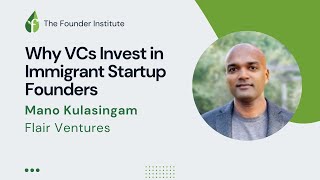
Mano Kulasingam, a Sri Lankan immigrant and founder of Flare Ventures, argues that VCs should invest in immigrant founders. Fifty-five percent of unicorns come from immigrants, who collectively created $1.2 trillion in value. His $5 million fund writes $150K pre-seed checks exclusively to immigrant-led startups in the US and Canada.
Chapters
Hey everyone, how's it going? My name is Ehan, I'm the head of global growth for the Founder Institute. We have an exciting global webinar planned out for you. It's with Manu Koulas, I hope I said that correctly. He's gonna be talking about why VC should invest more in immigrant startup founders. You know, if you've been with us, I think over the last few months, we've really changed the format of these webinars. I come on, I do the introductions, And then the instructor gives— or sorry, the presenter gives like a 20-25 minute presentation. We'll do some audience Q&A. Please use the Q&A button on the right-hand side. It's right next to the message box. So you click that and you can feed us your questions. We'll do maybe 20 minutes of Q&A and then we'll do some open networking for the last 10-15 minutes. So please stick around for that. Apart from that, it should be a pretty exciting session. You know, we're We had about 300 people sign up, so I think we'll get about 100, 150 people to join. While that is happening, you know, let us know in the chat where you guys calling in from. We have a pretty global audience. I think, you know, we usually get a few different ones coming in. I'm based in Dubai, UAE. Yeah, okay, it's coming in. We have Vancouver, Canada. Las Vegas, Nevada, Portugal, Nassau, Bahamas. Wow. Stockholm, Germany, Macedonia. Okay, it's coming, it's coming. Awesome. We have a pretty good audience for us today. I guess, Manu, you're already on stage, correct? I think I see you.
Yeah, I'm here.
Yeah. Okay, perfect. What I'll do is I'm going to run the poll now and then maybe if you want to give a little bit of an intro to yourself and then we can kick off your presentation if that works.
Yeah, absolutely. Let me just—
so while you're looking to share your screen, folks, I just threw a poll out there. So I said, what descriptions fit you best? Are you a founder, investor, VC, or other? So that will give Manu a little bit of insight on who he's talking to today, and then he will Kind of shortly present. Okay, so Manu, we have about 35, about 40 votes in. 78% is saying that they're founders, 4% is an investor, another 2% is VC, and then you have 15% that's other. So you have more of a founder audience, uh, that's here.
Amazing, that's great.
Yeah, I hope that's helpful for you. Uh, the last, uh, housekeeping is that everyone can see there's some emojis at the bottom. Please use the emojis to show us, yeah, exactly, show us the love, show us anything you find interesting. That's a good way to keep us engaged and give the feedback to the speaker as well. All right, we just hit over 100 people live. I'm gonna hop off. Mado, really, really excited to see you and hear what you have to say today.
Great, yeah, thanks, for having me. And hi to everyone around the globe. It's great to be here and excited to talk about why invest in immigrant founders. I'm gonna— here we go. Great. Hopefully you can see my screen. So if not, just let me know in the chat. But yeah, my name is Manu Kalesingam. I am A first-generation immigrant from Sri Lanka. I call Canada home now. And a bit of a story about myself. Sri Lanka, as some of you may know, had been through a civil war. It started in 1988 and I was around 9 years old then. And so, and there was a bloody civil war. And, you know, just being through that experience, fortunate enough that my parents were able to, you know, get our family out of Sri Lanka and move to Canada.
And—
Yeah.
Sorry, something happened. We can't see you anymore, but we can see your background and your audio has like It kind of disconnected and reconnected, but you sound very far away.
Okay, let me just double-check my audio here.
Yeah, no worries. All right, I guess while he's doing that, I'm just going to start reading the chat. Andy is pretty interested. He's building a community for immigrant founders and he has a podcast. Okay, that's awesome. Well, thanks for being here, Andy. Who else? We have different people come from different places. I'm just going through the list. Armando, are you back with us?
I am back. Let me know if I did make some changes.
Uh, you're on. Yeah, okay, you are back. Okay, you're— he went back off. Let's just get— all right, you're back now.
There we go. I'm good.
Yeah, you are back. We can see you. Thanks. All right, I'm gonna hop off.
Great, apologize. Yeah, just going back to, you know, my story. First generation immigrant from Sri Lanka, Canada's home now for me. You know, as I mentioned, in, you know, 1988, Sri Lanka started a civil war, bloody civil war. And, you know, I was a 9-year-old kid then and fortunate enough for my parents to really immigrate us to Canada around 1990. And having been through and seen war, it's something that really provided me the ability to see what freedom is and the freedom of speech, the ability for you to be who you are and you can do what you want in a country like Canada or the US, some of the Western countries. And it's really as an immigrant being here, an amazing opportunity to take advantage of. But also what I experienced in Sri Lanka has provided me— those adversities have made me, you know, really appreciate and sort of geared me for my path in terms of as an immigrant through the journey of entrepreneurship. And, you know, my story is that, you know, in 2008, I started a video streaming technology company called Digiflare, which we started as two founders, grew that business to about 120 people and exited that business in 2016. So that was my front row seat of building a company from the ground up all the way to, you know, to fortunate enough to be able to exit that business. From there, I, you know, had the fortune of investing in a lot of immigrant-led companies and also being able to mentor with various accelerators in coaching a lot of the founders through their journey as they built their startup and their passion around what the problems they were solving. And last year, 2022 of September, I did launch a venture capital fund called Flare Ventures. And, you know, going back to my experience as an immigrant, building a company and having really invested in a lot of immigrant founders, the venture fund's main thesis is investing in immigrant founders. And that's our core focus. And we truly believe that and we live that in terms of our core value. And we want to enable other immigrant founders to be successful in their journey in building their startups. And so when we look at the success of immigrants in, you know, US or in Canada, as an example, they've had a profound impact in the startup and tech ecosystem. And as you saw, you know, 55% of unicorns are founded by immigrants. And including immigrant-founded Fortune 500 companies are responsible for about 13.5 million people jobs. And so immigrants play a great deal in shaping these countries and they are the bedrock of what the business and the economic overall growth is. And so we want to continue to foster and grow and maintain this ecosystem because as more and more immigrants come into this country, we're able to really benefit from their, not only their skillset, their visions, their creativity. And so this really fosters a lot of that success. And you see that, you know, here's amazing companies that everyone will recognize. Are actually founded by immigrants. And total collective value that's been created by immigrants is about $1.2 trillion when you look at these companies that have been built by immigrants, right? And so we want to continue to really continue that success and be able to really foster that immigrant success stories as well so that new immigrants coming in can see that and believe that they can actually also achieve these dreams as well. You know, from my perspective, like, you know, immigrants really bring 3 unique advantages: resilience and determination. You know, my personal story of having really going through a war at a very young age and seeing that, you know, in my own eyes has made, you know, those adversities has made me really to understand what, as a person, for me to be able to achieve what I want. And that determination is, and the drive is there and allows me to be resilient in terms of what I'm trying to achieve. And this is not just unique to me. Many immigrants that are coming into this country have been through various types of adversities themselves. And that's been really what's been driving these immigrants to come here and really drive that. And I'm an example of that. And I really believe that that is a big, big advantage for immigrant founders. Second is really around, you know, the diverse perspective that immigrants bring. You know, being in a different country, different parts of the world, you have a breadth of understanding and a different perspective. And you're bringing that into this, into the country. And you're able to really drive a new fresh approach and in solving these problems. And so, That's a great, you know, advantage to have as well. And the third one is really around global connection, right? As immigrants, you've been to different places. You know, you're bringing those level of connections to, as founders, into these countries. And also, you actually, when your startup becomes a global reach, those experiences really help in terms of expanding the businesses to these various parts of the world. And so, that So that is another advantage that immigrants bring to the table. From an economic impact, it's massive, right? Job creation is what really helps drive the middle class, the economy overall. And when as immigrants you're creating and contributing back to the economy, you know, the country that really adopted you, you're able to now really make a valuable impact. And that's through job creation, which in results also helps boost the GDP. And so this is a massive impact that as founders you can really be proud of. And so, you know, this is one of the ways that you can help the country succeed in terms of their overall growth as well. Now, you know, with these success, you know, definitely a lot of immigrant founders that I I personally have had a chance to work with do face some challenges. And these are key challenges that, you know, certainly you're not alone. And this is something that we look to really help at Flare. I work with a lot of other organizations to also help founders overcome these hurdles. The first one is really legal and regulatory barriers. You know, in the US, certainly Over the years, it's been one of the drivers to get new talent pool into the country, especially in the tech ecosystem. If you look at Silicon Valley or New York or some of the big tech hubs in the US, immigration was the way a lot of these talents were coming into the country. Now, in the recent years, there has been challenges and, you know, certainly getting visas for talent in the country has been a bit of a barrier. Hopefully, that changes. And I know there are companies looking to really support and bring in additional legal support to help overcome some of those. And that's something that companies are trying to work with. Now, in Canada, it's a slightly different story. We are very friendly to immigrants, especially the current administration is very friendly. We have student visa programs. We have startup visa programs. And really fostering immigration as a forefront to help drive the economy. Just last year alone, and it's probably an anomaly, we had about 1 million immigrants coming into the country, and they're averaging about 500K going forward in terms of immigrants coming into the country. So Canada is very much really taking advantage of this as a way to help drive the economic growth. Access to capital. This is another one where, you know, a lot of founders that I work with, you know, really have difficulty securing investments. And generally, you know, if you're in this particular area, like if you're in the Valley, there's maybe a bit more support to help drive that. But if you're outside of it, this is something that, you know, startup founders have difficulties, especially immigrant founders, you know, capital raises are, it's all about storytelling. It's like, why are you solving this problem? What's— why are you the people that really drive this and solve this problem and scale this up? And so really helping founders understand the way to tell their story, establish that level of network to really, you know, spread that word is something that, you know, we look to really help with. And I think founders, you know, especially immigrant founders have challenges in this area. And so this is something that's, you know, I've seen over time over and over, you know, founders struggle with. And navigating unknown markets, you know, as someone who's new into the ecosystem or new into the region, certainly may not have the insight, understanding of how, how to navigate particular market segments. And so having that understanding customer behavior, they're buying habits, regulations. These are things that could be also a barrier for founders. Limited support for network, right? You know, when you're coming, when you're new to a region as an immigrant founder, you don't have a network. You got to build that up. You got to build it over time. And so that may be, you know, also limits your ability to either fundraise or to be able to go and acquire new customers. And so that, those are, you know, something that's to be aware and know that you will face some of these challenges. And the last one is really around cultural differences, right? How a business is done in, you know, maybe in North America is different than from another region. I personally have gone through this. You know, when I exited my company, the company that we ended up getting acquired was based in Sweden. Very different in terms of cultural barriers. And so, I had to adapt how to work with that culture and then the decision-making. And so, as immigrants coming into a new region, you really have to really pay attention to how business culture works and understands. And so, those are challenges that to be, you know, to keep in mind and know that as immigrant founders, like we need to be aware of all these challenges and how to overcome them and really set ourselves for success. And the other thing is like, you know, really getting support from available support systems in the region will also help you really overcome some of these challenges. I personally, you know, I'm a big believer in investing in immigrant founders, and that's part of the reason why I, you know, I am— my fund is focused on that. And there are 3 things that I believe that really resonates. High growth potential. Immigrant founders are fearless. They're willing to look at a sector and then look at the big potential growth in that sector. And that's where I think you see a lot of the growth that come out of it. And so for me, betting on immigrant founders is based on like really that high growth potential. Innovation is another thing. Immigrant founders certainly have filed a lot more patents. And, and that's continued to show that innovation is there. And again, part of that is having come from an outside environment into a new region, you're coming up with fresh new approaches and in terms of solving problems. And so I believe innovation is another asset in terms of what, why betting on immigrant founders. The last is like return on investment. I mean, the data is there. Immigrant founders are very successful. And, you know, for me, that's like as a fund who is looking to actually take investor money and invest it in immigrant founders, I am betting on that the return is going to be much better. And the data proves that as well. And so these are 3 areas where I really look at as a whole why I'm betting on immigrant founders. And last, you know, I want to leave you off with really around the power of immigrant founders, right? Immigrants play a vital role in the overall ecosystem. I mean, we are short on talent and you need more immigration to help drive and fuel these innovations. And you otherwise, as a country, we're going to get left behind, right? And so your talent pool is what really fosters this. I mean, you look at this AI race right now, If you look at that, like a lot of the vital key talent pool that are actually driving this are immigrants. And so, it's really important for countries to really value immigrants as a key component, as part of their ecosystem, and especially in the technology startup ecosystem. Innovation and growth. This is another aspect that, you know, I personally believe that, you know, that the mindset of immigrants, their experiences and adversities have, it brings really that their ability to grow and really push the boundaries. And so, that's another trait that, you know, the power of immigrant founders. The last thing is their diversity, right? Immigrants are diverse. They come from all parts of the world and they bring unique values and experiences that really foster the diversity, the culture, and it really brings that together to help this, you know, the innovation really flow. So those are the three, you know, power of immigrant founders. And I am, as an immigrant myself, I think we should continue to really bring more and more immigrants into this country. And I hope, you know, governments will really realize that and continue to allow for that to come because without the immigrants, when you look at the United States, it's like a lot of the foundational things and what has been there is because of great immigration success stories and entrepreneurs that have come through. And so, I hope they continue to really foster that and improve on that. With that, yeah, I want to stop and really answer any questions on that. But, you know, I will leave off with, you know, just maybe a tad bit on Flare Ventures. You know, Flare Ventures, we invest in pre-seed, early-stage companies. Primarily, we're currently just focused on US and Canada as our primary focus area. But we're pre-seed. We tend to really invest in as early as possible. We're okay writing first checks. And we really hope to, back amazing, exceptional immigrant founders. Thank you.
Oh, Manu, that was great. I empathize so much, and I think this was a— was well, very well put. I immigrated to Toronto in 2016, and actually one of the first things I did was I tried attending a bunch of networking events and stuff, and it was really, really tough to like just figure out how to get your stride going. And then I obviously through those meetups, I came across FI, joined an FI program, and kind of the rest is history, and now I obviously do some stuff with them. So very, very— I love the presentation, and yeah, like, I think very, very interesting ethos you have. I think even when we first spoke, like, a few months ago, I'm like, I have never heard— I've spoken to a lot of VCs, I've never heard any VC that says, okay, we're only gonna try and invest immigrant founders at the pre-seed level and give them that shot.
Um, yeah, but I think Yeah, it's important because I think, you know, pre-seed is a stage where a lot of that early bet happens, right? And I mean, it's easier for companies to, or investors to put money in like seed or Series A, because then it's like, you know, there's product validation, there's market fit, whereas, you know, pre-seed, we're betting on the founders. And really, it's, that's where a lot of that are our focus is. And I truly believe that, you know, that immigrant founders have this superpower to be able to make that difference.
Yeah, 100%, fully on it. It's also that mentality, right? That hustle, like, let's go and go. And it's not just for being a founder, it's like maybe part of your founding team or like someone that's important to the executive team. We'll jump into questions. Folks, please just start throwing in a bunch of your Q&A in the Q&A portion, not the chat. Just so then other people can upvote it and we can bring it up. What I wanted to do just before we do that is I'm just going to share a bunch of links in the chat. Some people are DMing me and asking me more about Founder Institute. Founder Institute, you know, we have a— we're a pre-seed accelerator. Mano is a mentor in Toronto. I'm a mentor in the GCC chapter. I also am the co-director over here. You essentially go through a 16-week program to take your idea, uh, pretty much to the next level from ideation to like really to, to launch, I would say. Um, so we run these events purely for educational purposes to educate more of the entrepreneur and startup community. Uh, we have a bunch of great content. Uh, I just link blasted everyone in the chat. Uh, go there, learn more that we have some other content. Like the last two are resources. We have these pillar pages on how to do funding. How to start validation and all that. And then we also have like these things called bootcamps, which are kind of like masterclasses we're running next week and the following week on like dilution and go-to-market. So very founder-friendly, founder resources all the way. So please take advantage of that. I wish I had more of this stuff when I was starting out. With that being said, let's jump into Q&A, the most fun part of this and the things that I really like. So Colby is asking, can you, you should be able to see it now. If you're starting a company today, what would it be after, you know, you've gone through an acquisition, you're doing the VC stuff now, like, is there any industries that kind of excite you or any technologies?
Yeah, I would say, I mean, I'm primarily come from the B2B software space. So for me, I would still go back to that. Space because that's very relevant and I have a lot of experience in that. And so, you know, anything in solving business-to-business problems is where I would focus my time. Certainly AI is hot. I love the sector. I still code, you know, my background is computer science. So I, you know, dabbling a little bit in terms of playing with these models. And so something along that line to help solve a business problem would be, would be it.
Okay, so are you just curious, are you just not interested in e-com or direct-to-consumer, or it's just not like—
I look at, yeah, you know, when I, when I bet on founders, I look at founder fit, right? And founder fit is really, you know, when you're solving a particular problem, why are you passionate about this problem? Also, do you have experience in this space that you're trying to solve this problem for, right? Because it matters. And so if you, unless you have a unique skillset from a technology perspective, but the domain knowledge is important. So if you're solving, if you're doing an e-com business and you have zero background on e-com and you don't have anybody that has that on your team, it's hard, right? Because now, as an investor, I'm— my thing is like, am I paying to learn also, right? Um, and so that's part of the reason, like, my choice of like, if I go back to do something that I want to do, like, I, I look at founder fit. And, and I, I, I have a lot of experience in B2B software and, and building B2B software, so that's where I would go back because that's where I have the expertise in.
Got it, that's awesome. Uh, all right, let's— I'm just gonna keep bringing these up. I'm gonna try to at least 7 and then we'll try and break up for networking. So, Moisua is asking, what information would you want to see from a company that you're looking to invest in? We can make that a little bit more generic. You know, if we have founders, we have 80% founders in the audience. If they were going to go invest— sorry, if they were going to go pitch for investment, like, what is something you'd like to see as a VC, not just you at Flare? Yeah, I know that's a large question, so if you want to just bullet point it, that'd be helpful.
Absolutely. I think I'll go back to sort of what I, I'll echo what I just said. You know, especially if I'm speaking particularly in pre-seed stage, you know, your, your team matters, your composition of your team matters. So like, who are your founding team that are the core founders? Because you should have a mixed skill set. You shouldn't have overlapping skill sets. So that's very important because if you have one business person and one tech person, if let's say if there's two co-founders, that's a good balance because you've got a good mix, mix of skill sets where if you have two overlapping skill sets, if you have both are tech and you don't have a business person, then you know, you don't have a good composition of team. And in, I would say in pre-seed, there's a big priority given to teams. And especially if you're a first-time founder, right? Second is the problem you're solving and if you have any particular insight into a problem. So if you're solving a problem that's in a saturated or crowded space, do you have a particular angle that is, you know, or unique insight that is, you know, no one else has and that it's gonna give you an advantage? If you're going into a totally net new space, You know, how are you actually going to really solve this problem quickly and show validation? So it's around those two are the biggest things we look for. And, and as an investor, you have to understand is like, and this is one of the things that I would advise a lot of founders is really pay attention to understanding investor mindset. So a venture capital investor is looking for companies that are gonna hit, you know, $50, $100 million in revenue in, let's say, 7, 8 years, right? And so, you have to show that you can get there, that you have to create that vision. And so, the particular problem you're solving has to— you have to be able to show that this problem is big enough that I can get there and I have the right team to really get there. Um, and so because we are— we take investor money and we're investing in companies, and we have— we're under pressure to make sure we show returns, right? We got to show companies that are marked up because they raised subsequent rounds. And so that's what we look at from our lens, right? So, you know, as founders, you should be aware of that, and you should go, okay, like, you know, if I'm pitching a VC, this is kind of what they're thinking of. As their investment. So when you're pitching, your pitch story, you know, those all have to like align to really create a compelling story that an investor goes, I believe in you and I wanna put money behind it.
Yeah, I think that was a really eloquent way of putting everything. 'Cause it's, so we've covered passion, we covered how big the market is and stuff. So you've hit a lot of the right, key elements. We have several questions here more about you, Mano, and Flare. Do you wanna just take like a minute to explain like how much do you guys typically invest in? Like what type of checks you write? Yeah, because there's questions here like, are you willing to invest in people outside the US and Canada? So like how big is your fund? What are the typical check sizes? Just like, just so that will get rid of, not get rid of, but answer a lot of the queries.
Yeah, no, absolutely. So we're a small fund. I'm a solo GP. Me. So I'm the only investor in the fund. And so we're a $5 million fund. We write average check sizes about $150K at pre-seed level. So we're co-investors, we don't lead, but we're happy to come in early and be the first or second check and help you with the raise, complete the raise, and find a lead investor or bring in additional investors into the fold. So that I have done that many times for other companies. And then in terms of, you know, in terms of our decision-making, you know, we're fairly quick because I'm the one that's making that decision. And our process is generally we do a first call, we do the, you know, quick call to really understand the company, the team, and then we would do subsequent calls just to really do a deep dive into the team, the product, and learn a little bit more about the overall approach in solving that problem. And after that, we'll make a decision if we're in or out, right? And so give or take, you know, within about a week or so, we can make a decision. So that's how we go about in terms of our process. And yeah, and in terms of sector focus, we don't have a sector focus. We, you know, we don't do hardware-based and we don't do biotech. It's just, we, those are just for our check size, it just doesn't make sense. And we tend to across, you know, generally, we would go across the board. I have one fintech company that's B2C. I have one company that's, that's a data company, that's an enterprise. So we, you know, we are in the spectrum. Because we invest early, we try to be more focused on the founding team.
Perfect. Just can you clarify then, where do you— are you investing only in North America or is it just strictly?
Yeah, so right now, yeah, right now, just given our fund size and the capacity that we have, we strictly focus on, say, 70, 60, 70% in Canada, the rest in the US.
Okay, and there's some people here asking, can they pitch you and stuff? Like, what's the best way to reach out to you or like, Do they need to kind of get away from—
Yeah, absolutely. Just if you go to flarevc.com, you know, there's a link to submitting a pitch and just mention that you were on this talk. And I mean, we respond to every pitch. That's one thing I do is regardless if we are yes or no, we respond back. Just sometimes it might be a little bit of delay just on the bandwidth, but we make sure to reply back to all founders that submit a pitch.
Okay, perfect. You guys, I hope that answers that. That should answer a lot of the questions around Mano and his fund. I'm gonna keep going. We are at 45, I think. Yeah, so let's do maybe a few more. I just wanna make sure there's enough time for networking. I really like this question by Amer from Toronto asking, you know, do you find that you see certain attributes you've noticed in successful immigrants? That, and like, what are those attributes that so founders can, on this call, can actually go and like develop those skills if they don't already have it?
Yeah, I would say the key attributes that makes an immigrant successful is really expanding your network is important and getting yourself out there. So, you know, when you're trying to network and you're like, it can be overwhelming, right? But I think it's important is that attending events, connecting with, you know, individuals, and then really looking ways where you can now build on those connections is a good way to really expand. So expanding a network is very important because in this early on, it's really, that's a very helpful way to really fundraise. If you don't have a co-founder, it's a great way to find a co-founder. You know, recruiting, it's a great way to attract some good talent because early on you need to, you know, you're not going to be able to pay a lot in terms of market value. So you're going to need to, you know, that person, you have to convince them that they need to be part of this journey and, you know, and join the company. So So, networking is one key thing that I would really, really emphasize and just get out of your comfort zone, go out, network, and you'd be surprised. You know, if you ask, most of the time, people I find is like they're scared to ask. If you just ask, people are willing to help. The second, I think, is it's the mindset. You have to— I think this is where I find immigrants are a bit more maybe index higher on this is sort of persevering. It's like startup is all about, it's a lot of ups and downs and there's a lot of downs. Like you have a lot of challenges and then if it was easy, everyone would do it, right? And so really staying core and not having an emotional attachment to the problem, but really making sure that you push through and just execute. There's a saying, the reason people say it's like ideas are dime a dozen, it really comes down to execution. So just having that mindset of just like really pushing through and not giving up is very important.
I love that. That should be like on everyone's t-shirt and like tattooed somewhere. It's like, you know, you just gotta keep at it. Keep at it.
Yeah.
Cool. Let's do a couple more here. We have a couple of questions. I'm just gonna, on female immigrant founders. So like any stat, have you come across any like stats or anything that you're willing to share about or anything specific when you see a female immigrant founder? We had like 2, 3 questions about that. So kind of summarize.
Yeah, I don't have a particular stat just specifically on female founders. You know, there are, there are, I want to see more female founders, you know, just in general, I think the data shows that they are more and more successful, like in my fund, you know, I have, out of the 7 investments we made so far, 2 companies are full female founders, like both of them are, you know, they're each of them have 2 founders, and they're both female founders. And I'm a big believer that there should be more female founders because they bring a whole new dynamics to the founder mindset and we need more of them. So I encourage you to keep networking and happy to help in any way if anybody's looking for support as well there.
Perfect. Thank you so much for the offer. Let's, what are we? Okay, we're at 42. Let's try to do a little bit. I'm trying to get as many as I can. This one is interesting. Viral is asking, you know, about the US, but this is specific to the US, but I think you can also apply to Canada, is like, you know, you're an entrepreneur, you're a founder, you're kind of in the system already, you choose to go and launch your company, and then you're gonna overcome certain hurdles there that like it might be due to your immigration status, you know, in both countries. What is like, what's your advice on that? Again, that's a loaded question there, but it'd be interesting to like, I think I've met a lot of immigrant founders who maybe start in one country and then they're like, hey, I can't be here because of my work visa or I have to go back home, family stuff. It's like, what would your advice be towards them? Or like, is it like just pack up shop remotely?
Yeah, I mean, so if you, you know, US and Canada, they have very different approaches in this. And I think US is, if you're in the US, my advice would be is there are venture firms that specifically support like on a legal side as well. So, you know, we don't have the capacity to do something like that, but there are larger venture funds that do provide. So if you're a founder, you can certainly work with the venture firms. They have legal support to really figure out avenues to help you with that. And the venture firms are, you know, there's Unshackle Ventures in the US, also One Way Ventures in the US, and Geek Ventures is another one. They're all like, they have a similar thesis of immigrant-focused thesis. Another way to do it is I would look at maybe finding a co-founder that has US, you know, green card or citizenship. And, you know, I think you have to get to a certain level of revenue in your startup before you can transfer your visa to that startup. And so maybe, you know, I've seen founders where they're creative, they work you know, in a company that provided them the visa and they, you know, on their, on their off time, they're working on the startup and getting it to a level where now there's enough revenue that you can then look to, you know, look to then transfer your visa. That's, you know, that's again, it's, it's not a bulletproof, um, uh, way to approach it, but there's, you know, there's, there's a lot of creative ways people look at this and, and approach it. And, um, in that, in Canada, you're— there are, you know, a couple of programs you could do, like, you know, Startup Visa. So if you're outside of US, um, or like, sorry, if you're in the US or if you're outside of anywhere in Canada, outside of Canada in the world, you can apply for Startup Visa. It takes a bit of, you know, I think it's now it's like 18 months, 12 to 18 months, I think. Um, and, um, there are multiple like, uh, companies or organizations that focus on this in helping provide companies relocate to Canada. That's an option as well. So, you know, if you're in the US and you need a place, like Canada might be an option for you to, you know, set up your shop there because you might be, you might have a better chance as well. So that's another option to look at.
Okay, awesome. Super, super helpful. Let's do one more and then we'll kind of wrap up our networking. There's a lot of commonalities on these questions, you know, we talked about co-founders, we talked about teams, we talked about actual investment ethos and how to like work with investors, so try and find something, I'm trying to find you a hard one, man, I'm trying to like try to get you, I'll just go with this because it's at the top and I think it's still pretty good, it's about pitching, but like what are your biggest red flags when it comes to pitching? And you kind of don't want founders to do? I think it's probably a good, good question to end on.
Yeah, I, so pitching is, um, you're, you basically have a short amount of time to grab somebody's attention. And so the, the red flags are really, you know, I would say one is like you're pitching, um, using decks and not really telling a story. And so I think the red flags are, if I were to say, is like really learn how to tell a story. And what I would recommend is like when you're pitching VCs, start with angel investors, pitch them, get better, get feedback. You know, always once you finish a pitch, my recommendation is always like send a note back and say, hey, also like, do you have feedback on my pitch? Did that resonate? Did you, you know, and you'd be surprised, they'll give you feedback. And so start with like, you know, angel investors, small VCs, like my fund where we're a small check. And before you go to pitch like big VCs, because when you get to the big VCs, you really wanna refine your pitch and you wanna know. So storytelling is important. And second is, you know, don't start off the pitch with like, you know, here's my solution. Like, what, you know, start with a problem. Problem is what you're really looking to solve, and what insight you have in that problem, um, really helps frame the pitch, um, as you go through with that. So, you know, the problem, and, and then really, um, then you follow up with a solution and the team. Those are like, especially early, early, uh, pre-seed pitches, that's kind of like the thing. And then, you know, if you have traction, validation, definitely that's important. But make it so that it's easy to understand. Like I've seen, I see a lot of pitches, I look at it and I go, I have no clue what this is, like what you're solving, what the solution is. I'm like confused. Like, so what I would recommend is like once you do a pitch, give it to someone who doesn't understand tech and say, can you read it? And do you really understand what I'm pitching? And that's a good way to just like assess. So That would be my feedback on pitches. And there's a ton of examples. And, you know, sometimes like, I hate to say it's like some founders don't do the homework. And so, you know, if I see a crappy pitch, it just shows that the lack of effort that's put into that. And this is what you're trying to get in front of investors to raise money. So you should put a lot of care into it. One tip I would have is like if you're, outreaching to investors, don't just attach a pitch, attach a 2-minute video of your pitch because your pitch deck is just, it's flat. It's like you just read it versus if you can do a 2-minute pitch of you going through that pitch on a video, that will resonate to me more than me just looking at a, you know, a deck and just assessing it. So that would be a, good conversion on getting calls.
Yeah, I love that. I think especially like 5 years ago, people wouldn't really do that, but I think now post-COVID and when people like investors are used to the remote environment, that's great. I highly, highly recommend other founders on the line to start doing that. Just wanted to wrap up here before we do, Manos talked about pitching. We host a pitch practice event. It's free. It's exactly the same event like this, but you have 6, 7 tables, you go pitch one mentor, get feedback, go and pitch another mentor, get another feedback, it's a very fast way to get feedback on your pitch, and we have a Find a Co-Founder event as well, both get about 200 people like to show up, you know, those are free to attend, take advantage of it, utilize it, like it's, we run them every 6 weeks, so, and you can meet somebody from from like West Africa all the way from Dubai to Canada. Like there, it's a really good, great environment to get as much feedback on your pitches and maybe find a potential co-founder. All right, with that being said, we have a few minutes for networking. Mano, thank you so much for today's event. Thank you so much for your time giving, answering the audience's questions. Any last minute feedback or last thing you wanna kind of end the audience with? Any words of inspiration or whichever?
Now is the time. Yeah, first of all, thank you to Founders Institute for having me and share my story. And I'm a true believer that immigrant founders will have the biggest impact in both in Canada, the US, and other countries that look at immigration as a way to help the economy grow. You know, to founders out there, If you're passionate about some problem, you know, put in the work and, you know, get out there and pitch. You know, don't— I think it's important for you to just get out there and talk to people and really express what you're trying to solve. We need more startups. This is the best time to build. I built my company in 2008 during a recession. And I'm telling you, it is— this is right now is the best time to build a company. So, you know, power to you and look forward to hearing from some of you.
Perfect. I think that's a great source of inspiration for everyone, everyone in the West Coast, for them starting their day. If they're in East Coast, they're kind of midway through their day. And if you're someone like me in Asia, we're kind of ending our day, but it's inspiration for the full day. Thanks, Manu. Folks, don't go anywhere. We're going to end the session, but you'll kind of see all these virtual tables pop up. Uh, join them, network with each other for the next 10 minutes, and then, um, so yeah, we'll see you at the next, uh, few events that we're hosting. All right, uh, enjoy, enjoy your evening, everyone. Thanks.










