Meet the Quantum & Photonics Startup Ecosystem, w/ Qubits Ventures, OneQuantum, AtomComputing & More
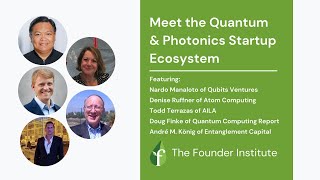
Quantum leaders from Atom Computing, Qubits Ventures, and OneQuantum discuss the state of the startup ecosystem. They cover how the U.S. stacks up against Europe and China, the technical trade-offs between neutral-atom and ion-trap computers, and why workforce shortages are slowing progress.
Chapters
Good evening, everyone. I'm Nardo Manlodo. I am one of the co-directors of the newly launched FI Quantum and Photonics Accelerator. Most of you already know that FI is the world's largest pre-seed startup accelerator. So for the last 8 years, they have helped over 6,000 startups spanning 200 cities and the large— and also the largest mentor network in the world with over 25,000 mentors. So if you are a deep tech founder looking to join the largest startup network in the world to help you launch, fund, and scale your company, we have open applications for the FI Quantum and Photonics Accelerator. So please go to fi.co/apply/quantum to learn more. Additionally, I am also the managing partner of Qubits Ventures, which is a VC firm that invests in pre-seed quantum and photonic startups. You can learn more about Qubits Ventures by going to our website, qubitsventures.com. It is an honor for me to host today's incredible event featuring several luminaries in the quantum and AI industry and ecosystem. Our panelists for today are Denise Ruffner, Andre Koenig, Todd Terrazas, and Doug Fink. So how are you guys doing tonight?
Doing great.
Excellent. I see I'm not the only person from Miami calling in from South Beach. Hi, Antonio.
Oh, great. Okay, great. So, well, before we get started, I just want to talk about the agenda for today. So first thing we're doing is just doing speaker introductions primarily here. Then we'll do about 30 minutes of a roundtable panel discussion. Then we'll move into audience Q&A. That's going to be an interesting part of this. So I suggest if you have questions during the roundtable panel discussion, go ahead and put them in the chat. And after that, we'll basically wrap up. All right, so that's the agenda for today. So what I'm going to do now is basically hand over the introductions to our speakers, and I will call upon each one of them so they can introduce themselves in greater detail, what they represent, and which company they're from. So let me start it off with Denise.
Sure, thank you, Nardo. Hi everyone, Denise Ruffner. I live in Pasadena. I think a lot of us are Southern Californians. At least speaking tonight. I love all the international people. I've been in quantum for a while, starting out at IBM Quantum, where I started the startup program and the ambassador program and did all sorts of great things around sales strategy. Moved on to Cambridge Quantum Computing as chief business officer, and then moved to IonQ as VP of business development. and I'm currently Chief Business Officer at Atom Computing, a neutral atom company based in Berkeley that I'm very excited to be part of.
Thanks for being here, Denise. Okay, let's go with Doug.
Thank you, Nardo, and I'm very happy to be here and speaking with everybody. My name is Doug Fink. I am the founder and managing editor of the Quantum Computing Report, which is one of the leading websites that reports on providing news and analysis about what's happening in the quantum industry. If you are interested in finding out more, you can go to our homepage at quantumcomputingreport.com, and Quantum Computing Report is all one word. I've been doing this since late 2015, and I've been the first one and I've been following the quantum industry ever since. And it's been quite a ride.
Thanks, Doug.
André?
Thank you, Nada, and hello again from South Beach. The sun set over the beach already, so no distractions for me. My background is as a management consultant, and I studied economics, which took up 15 years of the first half of my life and career before getting into startups with an artificial intelligence venture that I started when IBM Watson came to market. Then we did a small little accelerator in New York City for the German government. Can't compete with the Founder Institute, but I think now we had about 500 companies and did a bunch of mentoring. And for the last 4 years, 3.5, 4 years, I've been in quantum with really 2 ventures, similar to Duck in the business intelligence realm, providing data analysis, insights, and expertise. And One Quantum, which is the largest global quantum community in quantum computing that Denise helped start as well with the Women in Quantum chapter a couple of years ago now.
Great. Thanks, André. Last but not least, Todd Terrazas.
Hey, great to be here. So yeah, born and raised Los Angeles, actually grew up in Pasadena as well. My background is actually very different than probably most on this call. I'm a guy who went to film school at USC, worked in production for a while, and then decided to go into the tech world. And so I built a tech company that was focusing on chatbots, which then led me into building a community around chatbots that then rebranded to what it is today, the AI LA Community. And what we're really focusing on here is advancing AI literacy programs in the greater Los Angeles area. And then also developing collaborative innovations with stakeholders like LA County, different health systems, and other corporate partners to help advance, you know, blue sky thinking when it comes to how AI can actually solve big systemic problems here in Los Angeles, but then can be replicated across the world. So I am very much a nerd herder and not an expert in AI, but keep a pretty cool, smart group of friends around me. And so I'm glad to be here and I can't wait for the discussion.
Okay, well, like I told you guys, we have 4 luminaries here and they have all deep experience in creating ecosystem, tech ecosystems with their own respective rights here. So I'm going to start it off with my first question. So each of you are pretty much ecosystem builders. I mean big ones, big ecosystems. Can you give us a description of the ecosystem you built and how you managed to make it thrive?
Well, maybe I can start, and I would first point out that the quantum ecosystem is actually very complex these days. There's hardware companies, there's software companies, there's universities, there's government labs, there's partnerships all over the place, and then you have, of course, the venture capitalists, you have people who provide services like consulting. My— the way I see what I do is help provide a map for people in terms of helping them navigate the ecosystem and figuring out who's doing what. So I, you know, I do that by publishing news and just helping people become more intelligent. And, you know, for the industry to thrive, I think it's important for new startups to know who the potential competitors are and what they're doing, what new product announcements are, investors to know who's, who's doing what. And that's what I try to do is, is help people out just with information.
So I'll jump in and echo how valuable I feel the Quantum Computing Report is as a resource. And it's really good in this industry to get context and see who all the different players are. I use it quite a bit. Thank you, Doug. I use it quite a bit. I'm always looking at, oh, what's this? All the information is in there and organized very beautifully. Big plug for the Quantum Computing Report. In terms of the ecosystem that I've worked on has been with Andre. Together we started the One Quantum organization as well as a group called Women in Quantum. Women in Quantum has blossomed to probably over 9,000 members worldwide in over 40 countries. It's something we're quite proud of where we do different meetings. We've been doing a lot of in-person virtual meetings or at events, as well as we've had summits and career fairs and scholarships and annual awards. It's something where we're promoting diversity in the quantum ecosystem and trying to give people resources and mentoring and networks to help them move along in their careers.
And I will just add, Narda, to your question about ecosystem. Ecosystem and community are two very different things for me. Ecosystem is, you know, I mentioned Doug and I, our work earlier. Our job to create this map of the ecosystem, bring data and analysis. And what I'm most interested in is the international collaboration, or, you know, the challenges around that. And we see more and more, um, as the world evolves across borders and across oceans, being originally from Europe and now having lived in the US for the last 20 years. So the ecosystem And overall, it's still very small. You know, we, we try to count the startups and other vendors. There are about 500, 550 of them. Investment dollars are still very small, right? We now see these big SPAC deals and larger venture capital rounds, but overall, that is all still very small. What is very significant and very impressive is government engagement and priorities and dollars where national leaders are putting really not just money behind it but a lot of priority and attention. And I think you'll be asking about the new White House directives later, which is a great example for that. And on the other hand, you have community, right? And community is, as Denise said, how do you build that platform and offer an opportunity for everyone and bring diversity and equality to quantum, which is a challenge because it's a sport dominated by, you know, a very specific demographic and opening it up and broadening access to it is a hard job to do.
Thanks for your view on that, André. And Todd, you know, you're a big community and ecosystem builder as well. So would love to listen to your thoughts.
Yeah, definitely. I mean, being here in Los Angeles, right, we're, you know, multicultural, you know, mosaic really, right? I think there's over 200 languages spoken here. And obviously we're a very large city and a county. For us, yeah, it's all been around, you know, AI is very representative of who's building it and the data that's being used to train those models, right? And so for us, it's all about education. So we started AI LA Community 6 years ago. It was very much just meetup groups, it was bringing people together through events. We did it very consistently, right? I think that's what really builds trust, right? Is having consistency. And so we used to do events every third Thursday and every second Tuesday. And through doing this, we were able to talk about AI and a number of different industries, a number of different type of topics. And so what was really fascinating was that actually even the healthcare people were like, this is amazing. They're so bored about going to their own industry, talking about the same old things. There's a lot of, you know, transfer knowledge that can actually come from entertainment media or from, you know, the finance industry or a number of other different industries, right, where they've been already using these types of algorithms in a day-to-day, uh, how in production and how can they actually maybe leverage that in their own industry. And so for us, yeah, we came out as a community organization first and right now we're maturing more into this ecosystem builder where we're really connecting the dots from local governments, corporations that are here, the startup community, and then of course all the research institutions that make up Los Angeles. And so It's been a fun road and 6 years doing this, right? You get to meet a lot of different types of characters. But what really makes us keep on going is the fact that we're not just focusing on one industry, that we really do cover a breadth of different types of topics throughout the year.
Okay, thanks for that, Todd. And there's a, there's a reason why I got you last to say some stuff, right? Because the AI ecosystem and community has been maturing quite a bit, right? It has matured and really taken grasp in all different industries. And I think, you know, that took a significant amount of time, I think around maybe 5 to 10 years, right? Maybe even more. So I, you know, hopefully we get to see quantum mature in that space as well and, you know, thrive from a community and ecosystem that connects all of these interesting groups together. So let me switch over and basically, you know, in talking about ecosystems and communities, there are also ecosystems happening in different countries, right? So China is doing its stuff, Australia, Canada, Europe, UK, they're all doing a lot of things in quantum and advancing in what they're doing there. So my question to you all is, how do you think the US is doing? In advancing quantum technologies compared to the rest of the world?
Well, I'll jump on it first as the European. Um, I think you have to look at it from a few different angles. First of all, quantum has many different technologies and products, right? Most people talk about quantum computing when they talk about quantum, but you also have quantum sensing, quantum security, quantum communications, and Different countries put a different emphasis on different priorities. The US has been historically very quantum computing heavy, at least when it comes to the commercial side of what IBM, Google, Denise at Atom, and all the big startups are doing. Other countries in Europe, for example, the Netherlands, very, very strong on quantum communications, which is what we think to be the case for China who has spent so far the most amount of government grants on quantum as well. So different countries have different priorities. I think all of that is starting to converge. Different countries have different types of commercial maturity. You don't have IBM, Google, Amazon in Germany, in France, and you know, in China you do have Baidu and Tencent. Active, but you don't have the same maturity of commercialization. It is still really more about the research and development. However, if you look at the basic research and if you look at the ecosystems around this research, some of these international markets are very, very strong. And I think the leadership position is not yet decided. It's still up for grabs.
Yeah, one thing I would like to add is, you know, you see these articles every now and then that sort of position US versus China, but I think they're ignoring the Europeans. The Europeans are very, very strong. Each country has its own program, and then the European Union has a program overall. And it turns out that in terms of government-level investments, The Europeans are greater than the US by quite a bit, and the Chinese are even much more spending the money. But I think the area where the US probably is best positioned or has an advantage, US companies seem to do a better job of taking something from research to commercialization. As André was saying, you have major US companies like IBM, Google, Amazon, Microsoft, and what the US companies are doing is they are leveraging their strong position in things like cloud computing and classical computing. And I think that's gonna really help US efforts in quantum computing. So, you know, just don't look at the absolute dollars that are being spent, but, you know, look at what people are actually doing. The US is still pretty strong based on the fact that we can commercialize stuff pretty faster than others.
One thing I also want to add is we're seeing a lot more education programs being developed in the US. For example, UCLA now has a master's in quantum, I think quantum science program. I think the US is also as many other countries, but is looking very carefully at how we can educate more people to create the quantum workforce of the future.
Okay. Todd, when it comes to AI, I know there's a big intersection with quantum and AI. I think you're probably seeing the US leading the AI race, or where do you think we stand from an AI standpoint?
It's very much China winning us and kicking our ass actually. Just the fact that they have so much data on their citizens, they are, yeah, they have more freedoms or not freedoms, but they have more abilities to really capture a lot more data than American companies can right now. And so actually we're really seeing us trying to get our government in place. I know there's our new, what was it, Lynn Parker, I forgot her title in the White House, but she's leading an effort around the AI division there. And there's a lot of different other organizations, but Yeah, no way in hell, heck, is United States actually leading the effort within the AI. It's very much a foreign government like China, just based on the pure fact that they have control over the datasets.
Okay. Well, it sounds like it's unanimous. But anyhow, so are we doing enough? You feel like in, you know, this is geared towards all our panelists here. Are we doing enough at the institutional and corporate level and private level for the US ecosystem to compete? With the international players?
I'll answer. I think that we can always do more. I think that there's a shortage of people to hire. So I think we can always do more in education as well as more in funding. So there is— I think we can always use more help. And I'd love to hear Doug's point of view on that.
Well, you know, one thing I tell people is I think bottleneck in terms of how fast the quantum industry can grow is the workforce. You had mentioned it just a second ago, that is really critical. Just about every single company in the industry is crying for qualified people who can work in the industry. The one area that when I talk to people about where they'd like to do to help improve the workforce is perhaps being a little bit more flexible in terms of immigration. The semiconductor industry and the computer industry, they really thrived over the past 50 years because we were able to recruit some very, very strong immigrants, guys like Andy Grove, for example, or other people. And, you know, there is some concern that perhaps our immigration programs are perhaps making it a little bit more difficult to recruit qualified engineers. And that would be one area that I think, you know, people should look at improving. Okay, great.
So, you know, now, you know, I think Andre mentioned this. Let me talk about President Biden. You know, he came up with two presidential directives recently to advance quantum technologies. So what are the areas where quantum will have the highest potential impact, do you think? Based according to what he's said on his directives.
Well, based on his directive, I think there are four main points. The first one is that they want to remain the global leader in the technology development of quantum information. And we were questioning that a little bit on this panel, I guess. So that's a point that will require a lot of work. Then it is what Doug also reinforced, this collaboration, not just between the government and the private sector, but really enabling the private sector, which is one of the traditional strongholds of the US when it comes to new technologies. Then, and you know, as a really tiny little investor and being involved in investment, it's about how do you protect the technology without really shutting out the world. And there's this new CFIUS Act, the Committee on Foreign Investments in the US, which protects deep technology investments and real estate investments. By foreign capital investors in the U.S., but with an eye on making it possible. And lastly, fourth point is the threat of quantum computing specifically to our current encryption protocols. And that is something that is going to come to an end in the next few weeks with an announcement by the National Institute of Standards and Technology. But those are kind of the axes that those directives from the White House are directed at.
Yeah.
Well, one thing I'd like to add is, you know, perhaps one of the very few bipartisan issues we have in Washington is very strong support from both sides of the aisle on having a very strong quantum technology in the United States. You know, been bills that have been passed and proposed by both Democrats and Republicans. The original was called the Quantum Initiative Act, was actually passed in December 2018. At that time, one of the things that it called for was to set up a National Quantum Initiative Act Advisory Committee, which would have distinguished scientists who would advise the government on where they should make their investments, where they should make their grants. That was actually set up in 2019. I found the first of President Biden's executive orders a little bit interesting because this advisory committee was already set up, but it was reporting to the Department of Energy, the Secretary of Energy, And what he did is he moved it to report to the White House. I have no idea what that means, whether, you know, it's a political thing or whether it's, you know, just allows people in the White House to be a little bit closer to what's happening. But, you know, as far as I can tell, the fundamental charter has not changed, is that the government and the departments that give funding like the NSF and NIST and Department of Energy, you know, they they do have a strong advisory committee of recognized world experts on quantum technology to help them understand where to make the investments. The other one is interesting though, was his directive on quantum encryption, making sure that the US agencies start working now to make their encryption and their communication protocols quantum resistant. And that's a very good move. As André was just saying, there's been a competition that's been going on for the past 3 years. It's been led by NIST to come up with new algorithms that replace RSA that's been used to encrypt data that's— or keys that have been transmitted on the internet. And they are— NIST is expected to announce at least the first stage or the first batch of finalists within the next few days. And Biden wants the government agencies to jump on that because we are concerned about cybersecurity and the fact that even though a quantum computer may not be powerful enough for another 10 years to be able to break the encryption, the communications that's happening right now, people would be able to intercept the messages today, store them on a hard drive for 10 years, and then decrypt it. And, you know, certain pieces of data like health data or plans for military type of weapon of some type, that, that could still, still be valuable. But it's also a lesson not only for the government sector but also the commercial sector too. And that's one of the things I'm also advising people commercially is they should start working on their plans right now to make this upgrade because it will be a very, very large change in our digital infrastructure. It's going to take 10 years and we're going to have to upgrade tens of billions of devices over the next 10-15 years to make them quantum resistant. It's a big effort and there could be some dollars there, for companies that want to help people do that.
Thanks, Doug. Okay, so, you know, uh, we have 4 different kinds of perspective here. We have Doug, who is, you know, in the— an industry analyst. We have Denise, who works for a lot of large, uh, quantum computing, uh, type organizations. Andre, who's an investor and also an industry analyst and expert. And we also have Todd, who also, who came from the startup entrepreneur AI space. We have a lot of people here in the audience that are thinking about becoming a startup, right? So maybe they're looking at quantum and maybe looking at AI. So in your own each your own perspectives, right? Where do you think quantum would be useful? What kind of technologies would be useful for quantum, and which industries should they focus in on and maybe look into? Can I call on Denise first?
Sure. Good question. As everybody in the audience is probably aware, quantum computing— quantum computers are still very small in size, and so it will be a while before we can really see their impact on applications. Now, there are other quantum modalities that Andrei mentioned that may show some life and some business before quantum computing. So for example, quantum cryptography is going to become very topical as soon as NIST publishes standards. But for quantum computing, it's— there's a lot of speculation on which application type will be the one that will show advantage or show value to a corporation first. And that's really, in my mind, something based on opinion. There's no scientific evidence yet that the first area where we're going to see advantages such and such. I do see a lot of work going on in materials. There's a lot of work going on in optimization and AI. And so we can just say there's a lot of areas of emphasis. And I think time will tell and the creativity of the scientists who are doing the work where we're going to see more examples of quantum advantage.
Great. Todd, do you want to weigh in?
I would hope to see more innovations within healthcare. But again, I haven't been digging as much into quantum computing as much as the advances of artificial intelligence in the fields. But personally, right, I care about our planet and I care about ourselves. And so hopefully there's a means for quantum computing to help some— solve some challenges we have with climate change and within some of the deadliest diseases that we are facing here in society. So looking to see how quantum computing could really impact humanity through healthcare. Does anyone actually on this panel— I'd like to ask— have any examples of where there have been maybe pilots of quantum applications within healthcare? Maybe Doug, you know something?
Yeah, there's several companies that are working on drug discovery for quantum, you know, people have been applying AI and the goal is to accelerate the time it takes to discover a new drug and find out its effectiveness. And the industry is sort of moving right now from what I call a trial and error, where you may start with 10,000 or 100,000 compounds and just have to try them out to see what's happening, to simulating them and using a computer to find out the best candidates. So maybe you only have to do a trial, drug trial on maybe 25 or 50 or just a handful of them. But there are other areas where healthcare is important. You know, I would point out that every time you do an MRI that relies on quantum sensors today. One interesting thing is analysis of X-rays. There's some people who've been studying, you take an X-ray, which gives you basically a picture. Today, you might need a very experienced oncologist to look at it and see if they can spot the cancer that's sitting in that X-ray just by looking at the white and dark spots. But people are looking at whether a quantum computer using AI could do that and do a better job. I've seen some interesting results and that might be another area where healthcare could be impacted by quantum.
Andre, do you have a perspective on it?
Just to add that to me, these questions about use cases or where to get started, I'm missing the point a little bit. If you are curious about quantum and willing to dedicate yourself and, and work hard, then I think you should. Denise pointed out this challenge of the quantum workforce earlier. We need all the talent possible, right? And there's a question by Horacio in the chat who's a physicist for a long time. That is great, right? We need physicists, we need PhDs, and Horacio, yeah, you can help, you know, just network with us, network with the community. But you don't have to be a PhD, you don't have to be a physicist, and you don't need to have a use case in healthcare as Doug just rightfully described, but which is a great application. At this point, really, we need all the resources and all the help that we can get. Jovan is asking Finland versus the US, what country would you recommend to get started? Again, just get started. Finland has an amazing tiny little startup ecosystem in quantum, but extremely powerful, extremely well funded, extremely well connected. And that's the case for Canada, for Italy, Uruguay, for Germany, for France, for Switzerland, for Israel, for Japan, for so many places, and others are adding to that list every few weeks. So if you're serious about quantum, just get into it.
Yeah, thanks for that, André. To me, I'm really interested in seeing the impact of quantum in healthcare. Just having a big background, you know, I recently presented to several groups, QED-C regarding quantum in healthcare and life sciences. There's definitely a lot of things in the quantum sensing side of things that would provide quite a bit of benefit in these areas. So I'm pretty bullish on that one, and hopefully we get to see something in the healthcare space coming out soon. So let me turn over to the audience and see if we can get get some of their questions answered here. So we have a question. Can you compare the pros and cons of neutral atom quantum computing versus ion trap quantum computing? Who can take that one on?
Well, if Denise will take on neutral atoms, I'll take on ion traps.
That's a deal.
Okay.
Go ahead, dude.
Oh, you want me to do neutral atoms?
You first, yes.
Um, so neutral atoms is a really interesting emerging modality for quantum computing. There are 4 different neutral atom companies, and the computers are just getting on the market. And in neutral atom quantum computing, what you do is you heat up a rare earth element, and you trap atoms in a chamber, and you can pin them in place using a laser and cool them down. And so you can use the lasers to create this array of atoms. And what's exciting about neutral atom quantum computing is atoms don't take up much space, and you can literally put hundreds, or recently there's been publications of 1,000, atoms in a trap. And so our group of companies, and particularly my company Atom Computing, we believe that this is one technology that will scale very well over time. So we will be able to quickly add more and more qubits and get, you know, go move towards the holy grail of having a very strong quantum computer with hundreds or thousands of qubits that we can make very fault-tolerant and therefore very useful.
Okay.
You know, in ion traps, the biggest difference is an ion trap is a charged atom. It's, let's say, missing one electron or something like that, so you are able to control it electrically. You can move it, move it around. You don't necessarily need lasers. You can move it, move it around using electrical pulses. Ion traps have been around for longer. It's a more mature technology than neutral atoms. There are two very strong companies. One is actually a public company called IonQ, which just went public a few months ago in a SPAC transaction, but they have a lot of money in their treasury right now. To develop that technology. And then the another tech company is called Quantinuum, which was actually a merger of the Honeywell Quantum Solutions. So they have a lot of technology that they originally developed with the Honeywell Corporation, which is a 100-year-old-plus corporation that's involved in a lot of things. So they've been aggressively working on developing quantum technology. Both of those, there's some very strong companies that are perhaps a little bit more mature, but like all technologies, it's going to take a while to figure out which one is going to dominate. There's still a lot of unknowns. As Andrei said, the machines are still pretty small, and the challenge right now is to scale them up, not only in terms of the number of qubits, but probably more important is scale up the quality of the qubits with things like gate fidelity or the accuracy of how well you can implement a gate level. But both are very viable technologies, and I don't think anyone on this panel would be willing to say which one's going to win out 10 years from now.
Okay.
Wow. Very good explanation for both these technologies. Fantastic. Uh, another question from the audience is, uh, is quantum data transfer, quantum entanglement, or QKD anywhere near commercial use?
Absolutely. Um, we count, um, a little over 100 startups in this overall quantum security space. Um, some of these larger providers, Doug just mentioned Continuum made projections of you know, something like a $2 billion revenue potential in quantum security over the next few years. But generally you have both QKD and PQC. So QKD being hardware solutions to replace classical keys with quantum keys, as well as PQC, post-quantum cryptography, cryptography, I always struggle with this word, but you know what I mean, PQC algorithms to be able to roll out throughout security systems. And somebody asked about blockchain, ready out there, you can get them in the cloud, you can get them from a dozen different startups and other large vendors. It is a market that is again, smaller than quantum computing, but probably a little more mature because it doesn't have this technological and hardware complexity of building a large-scale, potentially even fault-tolerant quantum computer. So it is a market that is a lot more mature and near-term than some of these others in quantum.
Anyone else want to weigh in?
Yeah, I just wanna point out that a commercial network was just, or demonstration was set up in London. It was set up by Toshiba, and I can't remember who their target customer is. I think it was one of the banks that is sending quantum encrypted keys across town or around London, the various branches there. People are starting to implement networks now, and you will definitely— you can, if you want to set up your own, all you got to do is start issuing POs, and there's several companies like Toshiba and some of the other startups that would be happy to sell you gear to do that.
Okay, great. Okay, another question: comparing Finland and the USA, What country you would recommend to get funded by the government and private for a quantum innovative and for an innovative quantum startup? Denise, you're on mute.
Oh, I was reading the question. So Finland versus the USA, what kind of country would I recommend to start up and get government Funds. I don't have a good grasp on government funds in Finland. Doug or André, do you have any ideas?
About 600 million in Finland.
Okay. Versus in the US, the funding is?
We're getting close to 3 billion, Doug.
Yeah, I mean, it depends on whether you count private funds as well as government funds, but it could be more than that actually if you include private funds.
And Todd, you know, you come from the AI space. Do you feel like from an AI standpoint we have more of an advantage from a government funding standpoint, or other countries have the advantage?
You're saying If United States has more of an advantage with government funding compared to others?
Is that a question from an AI perspective?
Great question about the actual investments. I know right now in 2020— in 2010, they created a task force called NARE, and they're sort of going through the process of making these recommendations of like building out infrastructure for AI research and also understanding different frameworks for helping protect our civil rights and privacy. And so we're in motion. Has any of that money— I don't know necessarily if any of the money has been allocated or there actually is a full budget. But right now, the United States definitely in the last 2 years has been developing a task force to understand how they would build such a blueprint for our AI infrastructure of the United States. So I actually would actually maybe say, speculate that we are still behind. Compared to some other foreign governments when it comes to the investment in the infrastructure.
Okay, thanks. Okay, let me move on to another question here. This one is about— okay, let me just read it off. In addition to the push for commercial applications of quantum computing and information security interest, is there any funding for using quantum computing to help understand quantum foundations? Can it help here?
No, by quantum foundations, if you mean quantum mechanics, quantum physics itself, I don't know if that's the question. And absolutely, because to simulate quantum mechanics, we need a quantum computer that can run that simulation. So in that sense, absolutely, but not sure what, what is meant with quantum foundations.
Yeah, Jeff, I would take that as basic research in terms of fundamental quantum things. And there's definitely, if you look at several of the government programs, they are emphasizing that to look at that Now, you won't get any money from the venture capitalists to do basic research. You know, they want things that can be commercialized, but the government has a longer timeframe, and they definitely do grant programs that will study fundamental research that may not have a payoff for 10 or 20 years.
Okay. Yeah, I'd let this next question— I'd like, you know, I think we have a lot of quantum computing experts here. There are a very large number of platforms/qubits for doing quantum computing. Ideally, eliminating cryogenics is a key enabler for generating a commercial product. I am only aware of photonics-based quantum computing using optical waveguides for room temperature quantum computing. Are there other platforms where room temperature operation is inherent?
Well, Denise, neutral atoms don't require cryogenics, do they?
And you're on mute.
Right, I was just unmuting and smiling. Neutral atoms don't require cryogenics, but as we expand, it's again hard because as you expand in terms of the number of qubits and you expand these systems, we don't fully know that it's gonna be perfectly without cryogenics. Now the cryogenics that we're seeing in superconducting with the huge dilution refrigerators, we're not gonna see in neutral atoms for sure, but there will be, probably there will be some cooling involved, I think, as the size of the, number of atoms we have in our trap increases. Now, there is a lot of cooling that can be done by lasers, so generally that can be still a room-temperature device.
Yeah, you know, one thing that if you look at pictures of quantum computers, you see these crazy things that look like chandeliers almost, and those are called dilution refrigerators, and they're used with the superconducting systems like IBM and Rigetti and Google use. Those are very, very expensive, in the hundreds of thousands of dollars or millions of dollars, because they cool the chip down to 15 millikelvin. So that's 15 thousandths of a degree above absolute zero, which is orders of magnitude colder than, than outer space. Now, there are some systems that don't need quite that level of cooling. They need, let's say, 2 or 3 Kelvin. And you may not think that that's not a big difference, but in fact it is, because 2 or 3 Kelvin you can cool with liquid helium. And there you can come up with a refrigerator that is maybe a few tens of thousands of dollars. So it's much, much cheaper. But there are, you know, many technologies can either use that or even room temperature. NV diamond is another example of something that can run at room temperature. We talked about photonics. The ion traps don't need these dilution refrigerators. So it is, You know, it is something to watch in that if someone can come up with two systems, one that requires a dilution refrigerator and one that doesn't require dilution refrigerator, all else being equal, the one that doesn't require it is going to have a tremendous cost advantage and will probably win out.
Okay, so there's actually a lot more options on the room temperature side now as well, right? So that's definitely good news there. So what milestone does the quantum industry need to hit to feel confident that the universal fault-tolerant quantum computing will be achieved? If we've already hit those milestones, what are they?
I don't think that too many people are thinking about fault-tolerant quantum computing today. We are all very busy building these NIST error machines. And some people are starting to come up with, you know, nomenclature and labels for what the error after that might be, where we start to enter some sort of quantum advantage, but still not default tolerant regime. And I think that, that keeps all of us very busy from the basic science and research through the product engineering and the sales and marketing side. On the fault-tolerant computing regime side, you know, it's still a question of what qubit, what, what architecture modality will actually be best suited to deliver on that. There are companies out there like PsiQuantum that use photonics. Somebody mentioned that in the chat that make a claim to being able to do that. And they haven't proven that despite making progress. And that's still years out. Personally, I think it's still really a matter of discovering what the best way actually would be to build a fault-tolerant quantum computer before starting to do that. So milestones, personally, I don't see many yet when it comes to fault-tolerant. It is really more about milestones to make the current NISQ error computers and as we're scaling them to hundreds and thousands of qubits over the next few years, valuable and effective.
Thanks, Andre. There's a question here that related to AI and NLP here, so I'll read this out, Todd, so you could respond to this as well. In this regard, when we think of optimization and AI such as NLP use cases in healthcare, what are your thoughts on state-of-the-art to interface with quantum processing? What hybrid architecture seems to be the best?
That is way over my pay grade. Yeah, I can't personally speak to that. I know many people in my network that would be able to, but I just personally am not technical enough to actually understand how quantum computing plays a role in NLP.
Yeah, I think there's a lot of, you know, definitely a lot of interest in the areas of hybrid architecture, right? So getting classical computing and quantum computing to work together. And I've seen a lot of startups that are basically trying to generate quantum machine learning algorithms and classical AI machine learning algorithms and trying to see which of these algorithms are best suited for quantum machine learning versus classical. So there's definitely a lot of these hybrid, you know, quantum-inspired type scenarios that are being tested upon and being done by some startups out there. So I think, you know, in the world going forward, I feel like the— it's not going to be pure classical, it's not going to be pure quantum, it's going to be a hybrid scenario across the board as we adopt these different technologies. We're going to use more of the best of breed when it comes to adoption of AI and NLP into the quantum world. So it's more of a hybrid approach, definitely. Okay. And then there's this question that I like, and I think Doug would like, would like to— is there an updated source, website, wiki, database that you would recommend to keep always on top of the news related to quantum? From quantum basic science, quantum sensors, quantum applications, toolkits, information access to quantum computers freely, you know, especially for quantum startups. Kind of like the holy grail of websites for the quantum world. What do you think that is, Doug?
Well, yeah, I definitely would recommend the Quantum Computing Report. You know, we do focus a little bit more on the commercial side of things in terms of new product announcements and news and investments and those types of things. But we, we do have links to various things that will provide you with more— some of the technical papers. For example, once a month we run something called a Research Roundup. We're, uh, one of the PhDs that we work with looks through all the interesting papers that have been happening over the past month, and we publish that. And we'll actually, with next, later this week, we'll publish the May edition of that. Um, there's also, if you look in the, uh, I believe it's the resources section, there is someone who publishes a directory of all the new archive art articles have been published. So if you want technical stuff, that would be a good place also.
André, do you guys have— and Denise, do you guys have a favorite resource that you normally go to, like a favorite website?
All I read is the Quantum Computing Report.
Of course. Denise?
I'm trying to figure out the website, but there is a website, an archive website that Dave Bacon made that takes the top rated archive papers in quantum computing. So you can always pull up the website and find it. So I'll find the link to that and put it in the chat, but that's one of the places I go to kind of see what's new, what's the latest and greatest paper.
Okay, thanks. So it's 6:57, so I'll take one more question and then we'll go through a wrap-up, okay? So we have a question from Sahar. What would be the first few steps that a new graduate a PhD in quantum field can do to be part of the quantum movement, like joining a startup or starting one, or any other suggestions? Well, one suggestion for me is I think you need to join one of the better communities out there called One Quantum. So for you to be part of a community, you definitely need to join one. The other one is if you are looking into joining a startup, I think you need to kind of know whether you're the risk-bearing type of person versus not. Going through a startup is something very hard to do. And but you are, if you are interested in learning, we definitely have the Founder Institute Quantum and Photonics Accelerator specifically built for helping people like you get into the startup world?
And I think really just networking. Quantum is growing a lot and getting more commercial, but it is still a community where really most everybody is really happy to volunteer their time and help. So just reaching out to Doug, Todd, Denise, myself, and attending other events and panels. Doing the same has been one of the most effective ways I've seen in the past that works for folks. So don't be shy, send us a message on LinkedIn, on Twitter, and we'll connect you with other people that we think can help.
Yeah, and there are a lot of conferences on quantum that are happening. We, now that we do some of these things live, you can network with people and talk to them with hallway conversations. So you can look them up. I have a page called Conferences, again, on the Quantum Computing Report, and you can see, you know, where some of them— there's almost a new one every week.
Okay, great. So let's wrap this up. I wanted to get— well, first of all, I wanted to get each of the speakers' last thoughts on this, and then And then we can definitely wrap it up. Doug, you want to go first?
Yeah, you know, one thing I tell people when I go to these things, I like to quote something called Amara's Law. It was sometimes quoted by Bill Gates, and what some guy said about new technology several decades ago is that when a new technology comes on or comes about, people tend to overestimate its impact in the short term and they underestimate its impact over the long term. The thing people should walk away with is understand that this is a long marathon that we're in with quantum. It's going to take decades for it to really reach its full fruition. You see a lot of gee whiz articles in the popular press that you might think that platinum is gonna change the world within the next, you know, 2 to 4 years, that's not gonna happen. It's a very difficult technology and it's gonna take a while for the engineers and scientists to really be able to develop it such that it can really do some fundamental things. But when that happens, I think there'll be applications that we haven't even thought of You know, I like to say that, you know, when John von Neumann invented the digital computer in the 1940s, I don't think he thought of it was gonna be used for things like Facebook or Zoom meetings or Bitcoin. So I think similar things will happen with quantum. There'll be things, you know, 30, 40 years from now that people will be using quantum that we can't even imagine today.
Absolutely. Venture capital investments, um, in any type of startup last year totaled about $620 billion. Um, $89 billion of that were in artificial intelligence. Uh, and Todd, um, just over $17 billion in blockchain. In quantum, we're just around $3 billion now on a yearly run rate up from a billion and 300 million the year before that. We're at the very beginning. So don't overthink questions like use cases, this country versus that country, this startup versus another startup. All these things are important. The most important is to take the first step and get started. And everybody here is happy to help.
And I think that was a great statement. Thanks, André. I think what I'll add is that in the early '80s, Richard Feynman talked about quantum computing and that, you know, basically challenged scientists to come up and develop this technology. And as you guys know, Dr. Feynman is a local Pasadena Altadena, so one of our Southern California brethren. But what's exciting is that we've shown that, that this can happen. We can build quantum computers. And now the challenge is taking our knowledge and building them to be very scalable and very useful. And I think Doug's point to when you read articles to have— take it with a grain of salt and really try to understand what's here and what's real today versus what's projected because there's a huge difference. And so I just, I always caution people to err on the side of being conservative. We've proven that quantum computing is here and now it's all of our challenge to grow it and figure out how to best use it.
Todd, anything, any last words?
Yeah, to piggyback on Denise and Andrey, it's like, just get started, right? Get involved, whether quantum community or AI community, to start showing up to events that you can, start joining newsletters where, you know, get some information. Doug's publication, I'm for sure going to start subscribing to after this call. But yeah, when it comes to a perspective of AI, the reason what gets me going and keeps me going here in Los Angeles is obviously, one, great weather, but two, amazing people and, you know, connecting the dots, right? I'm in no way technical, but I hang out with very technical people from PhDs to masters in neuroscience to computer science. And just hanging around these types of people, right, have really helped me get a better understanding of what is feasible today and what Hollywood, right, is kind of making us believe is coming up, right, where AI is going to be used for very malicious means and could take our jobs, right, and destroy our world. But it's really going to be our community and us leveraging these technologies for the social good. I'm hoping that we focus more on how can quantum computing and AI be used for healthcare, or how can it be used to help save our planet from climate change. Hopefully, we're not just really going down the rabbit hole of how can this be used in financial markets. I guess that's my final word is hopefully we're using these technologies for good. And not just for capitalist gain.
Yeah, good thing there, Todd. Thanks for that. So I just wanna thank our panel here. Thank you, Denise from Atom Computing for sharing your knowledge and insights. Doug, as always, thank you for your vast knowledge of the industry, quantumcomputingreport.com, and André, And your, uh, your— in terms of your different perspectives from an investor standpoint, industry and, um, and community perspective, thanks for that. And Todd, for your angle on the AI piece and the technology for good aspect and not just for financial gains, that definitely, definitely appreciate that. So just wanted to call some people in the audience here are potentially budding startups. So if you are a deep tech founder, you want to join the largest startup network that we have in the world to launch your fund and scale your company. We have open applications for the FI Quantum Photonics Accelerator. The website for that is fi.co/apply/quantum. And we have our application deadline is June 26th. So that is just around the corner. So make sure you take a look at that website. And then finally, next week we are hosting a Founder Institute Quantum Funding event on June 7th at 6:00 PM. So please go ahead and sign up for that as well. And we will be posting the link on that on the chat. All right. Thank you so much, folks. I hope you found this enlightening and you learned something and, you know, just take the advice of our panelists. Go out there, do something, connect with people and make something happen. Thank you so much.










