Nailing an Online Pitch: Tips, Tricks & Hacks to Present and Raise Capital in a Virtual World
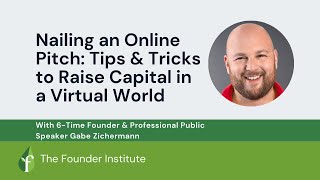
In this Founder Institute webinar, co‑founder Jonathan Grecian introduces the challenges of pitching startups in a fully virtual environment caused by the COVID‑19 pandemic. Guest speaker Gabe Zickerman, a six‑time entrepreneur and former FI director, shares a wealth of practical advice drawn from his own experience pitching over 100 investors during the dot‑com bust and more recent remote fundraising. The session covers how to reshape the opening of a pitch for a 10‑15 second hook, use clear section transitions, and modulate vocal tone to keep distracted listeners engaged. Zickerman stresses the importance of demo preparation: create a full‑PDF backup, build a clickable or self‑driven demo, and be ready to fail over after two quick troubleshooting attempts. Slide hygiene is highlighted – high‑contrast, large fonts, minimal animations, and a version with more text for PDF distribution. Technical setup advice includes using a dedicated user profile, turning off notifications, employing cheap green‑screen or virtual backgrounds, and ensuring a clean desktop. Collaboration tips focus on co‑founder sidebars (muting, private chat) and having both founders in the same physical room when possible. Investor hygiene is described: identify key decision‑makers, wait for them to join, and re‑engage anyone who drops off. The webinar also discusses advantages of virtual pitches (recording, partner presence, easier sidebars), optimal timing (under 10 minutes to spark a 30‑minute conversation), and the limited value of embedded promo videos. Finally, Zickerman offers public‑speaking guidance – take a short course, practice with a coach, accept filler words, and focus on honesty, composure, and being a founder the investor wants to work with. The session ends with a Q&A covering video use, logistics, and anxiety management, and concludes with reminders about upcoming online startup events.
Chapters
Hey everybody, welcome to this Founder Institute webinar. My name is Jonathan Grecian, I'm a co-founder of the Founder Institute. So really quick before we get started, just a word about the Founder Institute. We are the world's largest pre-seed startup accelerator. That means that we work with founders and teams that are at the pre-seed stages of their company, which basically means that you're pre-funding and you're pre-traction, and we help you get to funding and traction through basically two main things: through a structured growth process and through a support network for the lifecycle of your company. So we are enrolling now in more cities than we've ever been enrolling in, in our 11-year history. And you can see all the cities that we're enrolling in at fii.co/enrolling. All right. So I see we got a ton of people already, over 200 concurrent viewers in here, which is awesome. Hi, Krishna from Waterloo, Robin from Krakow, Poland. Josh from Austin, Salt Lake City. Awesome, everybody. Please, please let us know where you're from in the chat. We do have somebody in the chat who's ready to answer and ready to take your questions that you have so that we can answer them on screen during this webinar. Okay, so today we have a very topical webinar. Pitching your startup is hard enough, right? One of the main components of the Founder Institute is to help you go through your pitch every single week because it's not And it's not just a lot of people, I think a common misconception too is that you only pitch investors. Like, no, you pitch everybody. You're pitching people that you wanna join your team. In the beginning, you're even pitching, you know, individual customers to buy your product. You pitch journalists. You basically pitch everybody to get on board for what it is that you're trying to build to help you bring your vision forward. And now in the age of coronavirus, we've got a whole nother wrench thrown into the whole pitching process. And that is trying to do it in a virtual environment. Environment. So today we got a great speaker on board, and let me welcome Gabe Zickerman to the proceedings here. Hi, Gabe. So some of you might have been in on our webinar a couple of weeks ago, which was on founder depression with Gabe, which I think went really well. And we're going to switch tacks a little bit today and focus on something a little bit more, I guess I could say, tactical. In how to nail an online pitch, how to present in a virtual world. So Gabe is a 6-time entrepreneur, 3-time author, one of the founding fathers, so to speak, of the gamification movement. Gabe, anything else you care to fill in there?
Yeah, I mean, I was the Founder Institute director in New York for 5 years, and before that and after that, I've mentored all around the world. I was once, and I'm very proud of this, I was once Mentor of the Year for Founder Institute worldwide, which was really cool. So I've been involved in the community for a long time because I love mentoring startups. I really get energized by being in rooms full of people, like people joining FI who have an idea and really want to make their idea a reality. It's almost an addiction. So maybe someday someone will have a rehab for people who love startups, like startup rehab. It's an idea for you, John, to get the—
to remove the entrepreneur from somebody.
Yeah, I don't I don't exactly know how that would work, but it sounds kind of good, like founder rehab anyway. So, um, so when you guys were like, hey, can you come and talk about something? I said, you know, I thought there's two topics, um, that I want to talk about. You know, one is the founder wellness and this one is the pitching because I've done, got so many pitches and helped so many people with their pitches. And I think there's, there's important stuff. So gabezickerman.com if you're interested in following along with me. You can find me anywhere. This is beautiful artwork by Troy Litten, my friend, Troyland.com. Those are my pitches. Cool.
Yep. So yeah, check out gabezerkerman.com. And for everybody in the chat, this is great. I'm seeing— so Gab's asking, you know, questions here in the chat or the formal Q&A mechanisms. So for everybody, it's easiest if you just throw your questions into the chat. Okay, we do have a member of the Founder Institute team in there and they're being pretty active in there right now. But how this is going to work is Gabe's going to throw up a presentation in a moment. And at the end of that presentation, we're just going to go through and answer all the questions that you all have. So at any time, please don't be shy, throw your questions into the chat and we're going to queue them up. So as soon as the presentation's over, we're just going to go one by one. We don't have any agenda after that. It's just to answer your questions. Alright, so with that being said, do you want to take over, Gabe, and get that presentation going?
Yes, I love taking over. That's one of the things that I really enjoy. I enjoy it more than any of you should know. Alright, so here we go.
I'm going to hide my video and audio here.
Yup.
And take it away.
Alright, great. Okay everybody, gosh, so exciting, love having you here. Again, as John said, my name is Gabe Zickerman, and I want to talk to you about pitching remotely. And so here's the thing, ugh, corona, like terrible, and then now, you know, we also have these very important protests going on, you know, about equality and justice and fairness in the justice system, And I encourage you to get involved in that, get involved in improving your community as far as its response to the pandemic is concerned. But of course, there's been a huge disruption. It's been terrible for me, for my life, all the nervousness and anxiety about coronavirus and how it's gonna affect business. And I spend a lot of time doing public speaking. It's been very hard for us. So I know that it feels like it's created a major disruption. And to be fair, it has created a major disruption. And of course, leaves an open question about what's gonna happen in the future. Now, when many people talk about coronavirus, they like to talk about, you know, they describe it as the new normal. And I'm not really sure if it's exactly like the new normal. I don't know if we can yet say that this is how things are gonna be forever, or this is how we expect things to be forever. It might be temporary, it might be permanent. I think one thing that we can all agree on is that situations have changed, and that also applies to the way that we raise funding, how we do our startups, and how we raise funding for them. And I'm struck by, in this corona experience, how similar this is to my time in the early 2000s. And no, JNCO, the jeans company that makes these great bell-bottom jeans, I don't think They've returned from bankruptcy, but if everything holds true, there'll be more early 2000s kind of stuff. But I'll just relate my story to you. So in the early 2000s, in the late '90s, in 1999, I co-founded a company called TriMedia, which was the first really successful digital distribution company in the game space. And TriMedia was a startup that we founded, like I said, in 1999. We raised money. We raised another round of funding in 2000. Things were going amazing. They were fantastic. And then, you know, 2001 hit. And that was the bursting of the dot-com bubble, and all these companies went out of business. And we were in the unfortunate position of having to raise a round of funding at that exact moment in time. And so we had to go through this whole process of actually pitching, and I must have pitched 100 investors. Ultimately, we managed to kind of downscale, really get back to basics, really kind of re-bootstrap the company in a way, and ultimately were able to exit, you know, 6 years after it starts, so 2005, sold the company to Rovi. You know, we kind of survived that, but how we survived that period of time partially is related to the pitching that we used to do. And what's funny is that in the early 2000s, the way that you raised money with venture capitalists was you first did a phone pitch. You almost always pitched by phone at first, and then you had an in-person follow-up unless you were very warmly connected to the investor. You had to do a phone pitch. And so I'm serious, you guys, in the space of 18 months, my co-founder, who is our CEO, and I literally did over 100 pitches trying to get meetings with investors to do that. And so I think many of those skills can be— are important to understand now and are important to update for the current time. And so that's what I really wanna talk about. I wanna talk about new ways of pitching, but using some of the techniques and learning from that so that you can do it over phone or Zoom. The first thing that's important to remember, the people on the other side of this call are likely to be distracted, they're likely to be anxious, they're likely to be combative. All of these things are happening. They may appear to have a small amount amount of mental dysfunction and a difficulty understanding the world as it is and seeing other people as individuals and having empathy, all the range of things that you might expect from someone with a coke problem. I don't know whether or not the VCs you're pitching are going to have a drug problem or not. I can't say. But you've got to go in with the idea that the people on the other end of the phone, they're going to be really distracted. They're going to be kind of anxious, and they're going to want to have combat with you. Just hoping that they don't win 300 Electoral College votes. Anyway, open your opening of your pitch. So normally we want you to do a kind of more emotional pitch when you open, you know, and talk at length and really, really sell your story. When you're doing a phone or Zoom pitch, you actually need to be a much tighter opener, and that is the first 10 to 15 seconds of your interaction are the times when you make or break the connection that you have with the viewer and with the investor. And so you've gotta be really, really tight and you gotta be really strong at doing this sort of thing when you do it. And so we need to approach the opening from a slightly different fashion and make it a little bit tighter. So let me give you an example, okay? So let's say we're pitching an Etsy for for women who do sewing work at home. So when you're doing the regular opener, when you're doing the live in-the-room opener, you might be more evocative. When I was a young child, I watched my grandmother mend our clothes. She worked day in and day out as an immigrant woman to make ends meet. There are millions like her who do that kind of manual labor, but what if we could empower them to earn more money using technology? What if they could generate even more income for their families and do it without knowing anything about technology. Okay. When you do a phone pitch or a Zoom pitch for your company, you need to tighten that way up. And I'm not saying not to make it emotional. I'm not saying not to make it personal because both of those things are important. Remember that the opening sets up this idea for your investors that you are going to make this thing successful no matter what. What they're looking for is why this is an interesting idea that they should pay attention to and why you are the right person to bring this idea forward. So if I was going to rewrite that opener, I'd rewrite it as, "My immigrant grandmother worked hard as a seamstress. Millions are in the same boat. What if we can empower them with technology?" And one question, first question, not multiple kind of questions, right? A single question, tight focus, quick hit. You get basically the same material with equal amount of evocation, and it encourages people to continue to listen to you. Okay? So, again, emotional short, and the important detail is I want you to only go as far as the first question mark in the statement. So as soon as you reach the point in the opener where you're asking a question, that is the last question you will ask in a phone or Zoom call. You won't ask a series of questions of the user. The second thing you have to be good at is section transitions. I don't know, many of you are probably not old enough to remember this, but back when I was a kid, we used to have these books that came with tapes or records, and you would be reading the book and you would play the tape at the same time, and it would give you instructions, and it would say, "Bing! Now turn to page 16," and you would like, you know, wait a second, and you'd turn to page 16, and then the audio would continue. And so they were giving commands via voice for actions that people were taking visually. And that's an important thing to be able to do when you're doing a phone or Zoom call. You need to say— you need to sometimes break the sections up and say, OK, now let's move on to— and the reason why you're doing that is your anxious, slightly coked-up investor on the other end of the video may have lost focus on you for a second. They may have gone away, or someone may have texted them, and they're texting you, and you can't, of course, see it. It's not like being in the same room. So when you use these section transitions, you're bringing people back to that. And you're also, in case they're following along with a printed presentation, you're also bringing them back to that printed presentation, yeah? And you wanna do these transitions at bigger intervals. So normally we might think of your startup pitch as having 10 discrete sections, problem, solution, demo, team, go-to-market, competition, financing, blah, blah, blah. But in this case, you really wanna think about the bigger sections. So for example, problem and solution are one section. So don't say at the end of describing the problem, now let's move on to the solution. You're going to do that in one chunk, but at the end of the solution, you should say something like, okay, now let me show you the demo for the product. And that you would normally do that anyway, but you need to get into a habit, a little bit of a habit of doing that, um, on a regular basis and doing it at the bigger intervals. You know, one of the things about pitches that I think is useful for everybody to understand. You are telling a story, you know, much the same way. It's a different kind of story, but you're telling a story like a novelist would tell a story or a TV writer would tell a story. You are telling a story. And so you have to be thoughtful. You know how like when you're watching a TV show, they put the commercial breaks in at exactly the right time because they're trying to get your attention or get you stressed out or keep you hanging on through the next commercial. You kind of want to do that here too. You want those breaks to be placed at points that create tension and create interest and actually help advance your concept. So think of it that way. The other thing you have to be able to do, which you may not have noticed that I've been doing a bit so far, is modulate your tone. It's important to modulate your tone no matter where you're giving a presentation. Any kind of presentation, you should be modulating your tone. It's extra important if you're doing it via phone because two problems occur when you're doing a pitch by phone or by Zoom. One is that if you're at 100, so if you're talking up here with tremendous amount of excitement the entire time that you're talking, people will tune you out because it's just too much. It's too much. And then the other side, you have a problem, which is that if you talk at the same tone consistently, even if that tone is very friendly, it's very flat, it's something that people can really relate to, when people ultimately get distracted or when they zone out for any reason, even for a second, you're not doing anything with your voice to bring them back in. So that's what part of what modulation does. Imagine, you know, you're watching TV with, you know, while you're on your phone looking at Instagram, right? You're probably mostly looking at Instagram. The TV show is playing in the background. Then all of a sudden something will happen on the screen and you'll like look up, right, because you'll want to catch whatever is occurring, a favorite character, an event, a gunshot, whatever has occurred, right? Similarly, you need to modulate your tone in a presentation where you're not live in the room with people for that same reason. You need to be able to bring them back and create, you know, kind of excitement and— but just don't be like, don't be as cracked out as they might be. Alright, let's talk about the demo. So normally when we talk about demos in presentations, you could be doing a number of different kinds of demos. And, you know, we all know, we all prepare for the demo not to work, but we, you know, we spend a bunch of time making sure that our demo is foolproof so when we're up on stage, you know, we can give a good experience to people. Unfortunately, when you're not in the same room as people, regardless of the technology that you use, your demo is going to be different and it's going to have a different resonance. But most importantly, and first of all, you need to familiarize yourself with Murphy's Law. If you don't know what Murphy's Law is, it is the idea that anything that can go wrong will. And so even in the simplest form, some percentage of you who are watching this right now, the first time you launch Zoom, even though you've got Zoom on your computer or you're looking at it, maybe you're looking on Facebook or YouTube or whatever, You might have it on your computer, but some percentage of you, when you clicked on that link to launch the presentation, it did not work. It didn't work because your computer crashed. It didn't work because the link was broken. It didn't work because you were looking at the wrong thing. Whatever the reason might be, some percentage of the time, even technology that's established that you know how to use, that's very consistent, doesn't work. Now what if you're presenting to a group of partners and they— at a VC firm— and they use Microsoft Teams and you've never used Microsoft Teams before and all of a sudden you realize that Microsoft Teams doesn't allow you to pass through audio from your demo to them. So all kinds of things can go wrong. Your internet could cut out in the middle of your presentation. So you have to be ready for this with your demo, OK? So of course, in the early 2000s, we were operating under a slightly different philosophy in that we had to make the demos available to people separately, so we couldn't just assume that we could screen share and share the demos with people. But nonetheless, we always did this, and I still do this today, even when I'm pitching my new startup ideas. Number 1, you need to have a flat PDF of your entire presentation, including your demo. So the PDF document contains the whole presentation and your demo. You're going to send that PDF presentation ahead of time, not 5 minutes ahead of time, You're going to send it the day of the presentation or the night before if your presentation is very early in the morning. You're going to send it to the admin that organized the call with the investors, and you're going to tell the admin this is a backup, and if they can, print a couple of copies, put them out in the, in the meeting room so that folks can, can see them. If the conversation is happening purely virtually, the admin can forward the PDF to everybody so that they have this material just in case you end up having to close the Zoom call and come back in as a phone call. They have your presentation and they can actually look at it. Okay. The second thing is, if your product is, if it's possible for your product to have this, I would recommend having a clickable or self-driven demo. So that's something where you can, you know, you can actually like hand that off to people in the event that you can't get to the demo live. So they can actually see what it is that you are talking about and they can either do it in real time while you're talking on the phone, Or they can do it after the fact. Now, again, you've got to— many of you have built clickable demos or you've thought about how to build a clickable demo. You know, simple click-through demo is fine, which shows screens and they move and then you, you know, you don't have to fill out forms or whatever. But I really want to encourage you to do that, especially if you have a B2B business, you have some kind of representation, because often real-world demos of B2B products are hard to explain. But if you have a B2C product that's actually live, you'd be better off having a demo mode that you share with people, you know, kind of in that, in that context. So, so the whole thing is about preparing and having everything organized. Now I do want to leave a note for you about this, which is that decks which are sent ahead or left behind, and you should get into the habit of doing this, you know, regardless of the Zoom situation. They require more annotation. So often, you know, if you're doing your deck correctly for a live in-room presentation, you're not putting a lot of text on your slides. You're talking to things and using the slides. Ideally, if you're doing your job well, you're talking to things and using the slides to reinforce the point that you're making in the talk. Often when I give presentations, as you see today, it's mostly big big images with little, small amounts of text, no major text. But if the people are going to consume your PDF before or after your presentation, you may need to add more text to that version so that it's understandable. And that could be in the presenter notes, if you clean those up really nicely, or it could actually be on the slides. But just make sure that that PDF document is legible from start to finish by somebody who doesn't know your business. OK, so let's talk about doing demos on Zoom for a second. So Zoom and Microsoft Teams and BlueJeans and Skype and all the different solutions that you might use for a live, you know, demo in the fashion that I'm giving it to you right now, right, where they can see my face and there's also like something moving that they're supposed to focus on, all of those solutions tend to lag a little bit. So from the time I change the slide on my device to the time that you are receiving the change of slide, there is an approximately 1-second delay. And I have really good internet, and it could be longer depending on how people are calling in or what technology they're using. So one of the main things that you have to learn how to do is slow down. You want to make the vocal transition slightly before the slide transition occurs, but not significantly before. So you got to get in the habit of slowing down your speech, slowing down, you know, how you're speaking and what you're saying and enunciating more clearly so that you can put this thing into sequence. Now, if you are— if you have a co-founder, and again, I'm not saying get a co-founder for this purpose, but if you have a co-founder, I highly recommend that you have the co-founder move the slides or move the demo along. As necessary, because what will happen is they will learn the rhythm because they can actually see the presentation happening. So they'll learn the rhythm, the difference between your speech and what's actually being presented, and then be able to compensate for that to align things, because the software can't do it, but a human can do that very easily. So if you've got a co-founder, if you've got somebody that you're working with closely and they're available to do these pitches, that can be very useful. To have them there. I would encourage you to also consider this. You know, many times the tech doesn't work. You try something, your demo isn't loading, your computer's having some kind of problem, you know, you're running into issues, Zoom is glitching. Whatever technology is failing in the middle of your presentation, I highly recommend that you give it 2 quick tries to resolve, and if you can't resolve it, fail over to your fallback approach, okay? You can't resolve the issue in 2 tries in a minute or less. You need to fail over to whatever your backup plan is. And I know it's nicer if you give the demo in full resolution and people can see all the things that are happening and see people chatting, coming in and out of the conversation, but venture capitalists and all investors appreciate a decisive, clear, order from a CEO of a startup. They like that actually. So they would rather see you saying, okay, you know what, I'm cutting my losses, moving on. Let's do this via PDF. I'm gonna call, let's call back in on the phone, rather than seeing you belabor the point for minutes on end just so that you can show them the flourish of one part of your demo. Err on the side of being decisive and getting the material across to people, not on the side of the perfection of your demo presentation, as hard as that is, It's really— I get that that's difficult because you put your heart and soul into this business and into this product, and you really want people to get the full, beautiful experience, right? But if you're in a situation legitimately, you're in a situation where you, you know, can't do this, I think it's important. I think it's important to move on. I highly recommend having a virtual background. If, you know, if you haven't already done this, you could do it on Fiverr, you could do it on Upwork. Work. You do it, have your designer do it. You know, this, for example, this background, as I mentioned, is art from Houseplant Jungle, the puzzle series by Troy Litten. He's a dear friend of mine, and troyland.com in case you're interested in it. And the, you know, you can just as easily have backgrounds made that have your logo on them or show whatever it is that you want to show. Leverage the technology that enables you to up your game a little bit, right? And in fact, I have here in my recording studio, I have a green screen, a really cheap green screen that I bought, you know, on Amazon for, you know, for $30. And frankly, you know, it improves your game and makes things look better. So you've got, you've got cheap things at your disposal, but I want to encourage you to think about those little, those little details. You know, my co-founder in TriMedia, our CEO, he always wanted to wear TriMedia branded merchandise whenever we went. Out to a presentation. So we always wore our TriMedia logo shirts whenever we were out. And this is sort of similar. You just have more real estate to reinforce your name, your company name, how they can contact you, whatever that is, can live permanently inside the box of your presentation. So use it. Let's switch gears a little bit and talk about this sort of the softer skills. Let's call it, and I wanna talk about being able to read the room and what I describe as the straight-to-camera problem, and I'll tell you a little story. So when I was doing gamification, you know, my gamification startup, I ran a conference on gamification at which I brought in these amazing speakers, fantastic game designers, you know, to speak, and I did a tech workshop series with O'Reilly. I wrote a book for O'Reilly, and we did like an online digital workshop series. And so one of the things that I wanted to do is bring in all of these like famous, you know, I wanted to bring in all these like famous game designers to do little, little bits on the presentation. And so I asked this amazing game designer to come in and do like a short video on her philosophy. And she is a brilliant woman, incredible designer, a tremendous CEO. She gives a ton of presentations. I've seen her. I've Brought her on to present. She's fantastic in front of a crowd. Well, she got in front of the camera. This is somebody who does a lot of presenting. She got in front of the camera and froze because there was no feedback coming back to you from the people on the other side. If you were very afraid of seeing other people while you're speaking, this could be a plus. But for many people, the lack of feedback, you'd be surprised, it's really hard. Imagine talking to somebody live in person. And you're pouring your heart out. You're telling them about how, you know, the failure of your startup caused you to, you know, feel, have suicidal thoughts, and you're upset. And they're just sitting there and they're not even nodding. They're just like kind of staring at you with no, like emotionless and expressionless. Well, that's what it's like looking at the camera of your computer while you're presenting to the room, because obviously, you know, you can't see the participants. There's a number of reasons why you can't. One of them is you should be focused on your, presentation, but also because they end up in small boxes. Some of them will be calling in, many will have their video off, or even worse, everyone that you're presenting to is in one room and they're using one wide-angle camera and there's like 12 people sitting behind the camera. You cannot read expressions from people over the phone or over video, and I'll tell you, it requires a ton of discipline to not be unnerved by that. To not feel like, oh, I'm blowing it because they're not saying anything, because I'm not hearing anything. You've got to adopt a different approach to that in order to make these presentations really work. And as I tell people that I coach as startup founders, as presenters, you know, the only feedback that you're likely to get, the only feedback that you're most likely to hear in the middle of a presentation is not, you know, the affirming nods of people in the room or somebody like writing notes or, you know, yes, you know, getting really excited about what you have to say, it's going to be interruptions. And those interruptions are by definition, you know, really, really disruptive. There's a— someone's going to flush a toilet like they did on that Supreme Court case the other day. Somebody's going to— someone's kid's going to run in, or they're going to be driving, or whatever the case may be. So you've got to train yourself to be able to do these presentations with minimal to no feedback. From people in the room. And so I recommend a couple of different strategies for being able to do that, that, you know, that actually can work or that I've seen, you know, work for other people. So one of those strategies is to give your practice giving your presentation literally to a wall. Like, turn to a wall and give your presentation to the wall, and do that a couple of times and make sure that you're comfortable, that you feel like you're delivering your material correctly, that you're not being unnerved by the fact that there's absolutely no feedback coming at you, and you need to train yourself to do this in a different way. One of the things that I end up doing a lot is kind of playing over in my head thinking, you know, this is going well, this is going great. So just kind of affirming, even though I don't get that feedback from you. And enjoying the gestures that I make. So sort of enjoying myself in the middle of this can be very helpful. Q&A is often a big question in Zoom and phone presentations, and I think you have to think of Q&A a little bit differently from the way you might in a live presentation. So generally, when you're pitching your company live, whether you're in a sequence of companies or you are, you know, you're just you in a room. Usually these days, investors will wait to ask you questions until the end of your presentation. They've been trained to kind of take notes and wait for the end. But I think when you're giving a live presentation on phone or Zoom, you shouldn't wait until the end. You should only— you should wait until after the problem solution, and then you can invite questions at key points in the conversation. OK, now I'm on a webinar, but if you watched our founder wellness webinar, I was actually responding in real time to people chatting with us. In this particular case, because I've got a presentation to run and I'm talking to you, the only way I could deal with Q&A would be audio. So if we were doing a smaller presentation, I would be pausing at this point and say, or right before getting this point, and say, OK, are there any questions? Do you guys have any thoughts or things that are popping up for you? And the reason why you want to do that a couple of times in your presentation is you want to liberate the tension that those investors are feeling, because when somebody has something they want to say to you and they can't say it, they have to hold it back, they tend to get really anxious. So you actually are liberating that and engaging in a dialogue. It's also important for you to learn how to use the phrase, or some variant of the phrase, Oh, you know what? That's a great question. I'm going to get to that in a couple of minutes. So let's just hold on. Okay? And that is like when an investor jumps ahead. You're at your problem solution. You just finished your problem solution and the investor says, okay, well, you know, how much capital have you raised? You're going to get to that at the end of the presentation. It's not germane right now. You could, of course, answer the question right away, but I would recommend that if it's not telling the story properly, if it doesn't advance the story from that exact moment, Learn to say, you know, that's a great question. I'm going to answer all the financial stuff in just a few slides. Let me, let me get through the rest of this. You know what I mean? So learn to be able to do Q&A periodically as part of the experience. Now hygiene is very important. Hygiene in presentations is crucial, and I use hygiene in the broadest sense of the word, and we're going to talk about different forms of hygiene here. So the first thing I wanna talk about is your presentation excellence hygiene and how you get into the zone, how you get everything set up so that your presentations are awesome and that you're able to just like crush it, okay? So the first thing, I know that it's obvious, but I wanna stress this, you should shower and get dressed. You don't have to put on pants, but just shower and get dressed up so you look professional, you're wearing the clothes that you wanna convey, doesn't mean a suit, I just mean however it is that you would present yourself live, you are in fact wearing those clothes. And you know, if you know any people who are actors, who do character acting, what they will always tell you is the first thing you do if you want to get into character is put on the shoes of the character. And they tell you that because putting on the clothes of a character, putting on the shoes of a character, can actually help you get into their headspace. So you need to put on the clothes and shoes of the character, the side of you that is the go-get-'em, no-bullshit CEO that is going to raise this capital, and you need to get into that position. I also recommend that you do the presentation while seated, not while standing. You get a really different energy when you're standing, and you might be tempted to walk around or pace in your room. Don't do it. Sit down. Do it in a really quiet location. Don't be disrupted. Don't be interrupted. And really know your material. And that seems obvious, but you need to be really comfortable, especially in this, in this setting. You need to be really comfortable with your material. So know it. The second hygiene aspect that I want to talk about is about your computer. Okay. Now we've all had the fear that something's going to come up on our computers that we don't want investors to see, some kind of notification, or, you know, accidentally share the wrong app on the desktop or or even just seeing the tabs across your web browser open to stuff that, you know, probably they shouldn't see. And so what I highly recommend that you do for this setting is that you create a user on your computer that is your presentation's user. So you know how you have your admin and maybe other users? You have a user that is your presentation user. And that user has all notifications turned off. Right? It has nothing in that user's domain other than the things which are required to give your presentation. So that, that will go a great deal of the way to making sure that everything is exactly organized the way you want it to be, looks how you want it to be. You know, even small things like your desktop, your computer desktop. You know, if you're going to go through the process of switching apps and going from Zoom to, you know, let's say, you know, Chrome or whatever, that your desktop has your company logo on it, you know, or some image that's valuable. You know, this is all real estate that you're kind of programming and thinking about, and having that separate user really makes it easy to control the narrative. I also recommend, you know, having other presenters with you. If you and your co-founder work well together, bring them along, but try as much as you can to have them in the same room as you. And this is so— it's complicated, right? Because you think, okay, well, let's just be more efficient and let's do this pitch remotely from each other. And that's fine if you've got great chemistry. But one of the main values of being in the same room as your person but delivering digitally or delivering over phone is that you guys can have sidebars with each other. And I think back to Alex and I doing those 100 pitches, and man, oh man, we used to constantly, you know, push the mute button on the phone talk to each other for a second, then unmute the phone and come back. And we would allocate who was going to answer a particular question or what we needed to do or how things were going or whatever. And that allowed us to sort of build a rapport. And you can do that with private chat between you and your co-founder, but I, I think you get more advantage from being in the same room. And frankly, if the pitches are important enough, you should be in the same room. You should invest in the energy to be together. Just as you would invest in the energy to jump in a car together and go down to Palo Alto. And I highly recommend that you record all your pitches, review the pitches that you give, and adjust your pitches. Have a post-mortem with your co-founder or anybody who's watching, or even just yourself if you're a solo founder. Have a post-mortem with yourself and, you know, go over what it is that happened and how to improve it. And the third kind of hygiene I want to call your attention to is investor hygiene. So first and foremost, you need to know who the important people are in any conference call or Zoom presentation that you're giving. Who's the actual partner of this group, right? Sometimes you might be presenting to two associates, a junior partner, and a partner. And the two associates and the junior partner, as expected, are in the call on time. They're ready to go. Call is set for 11 o'clock, 3 of the 4 people are there, you know, so you're, you're going to be tempted to actually start the call at 11. But I highly recommend that you know who the key people are, who are the people that actually matter, um, you know, to getting your, your deal done, and that you try as much as possible to sort of delay so that they're on the call. Okay, it also means, you know, and you can even say, you can even surface them and say, oh, I thought that, you know, John was going to be on the call. Are we still expecting him? And if they say yes, you know, I'm sure he'll be here in a moment, then you say, okay, well, let's wait. Meantime, you know, where'd you go to school? The other thing is if you already have that person on the call, so that person is on the call, but for some reason they drop off, maybe they're driving, they're listening to you by phone, you know, maybe something happened, for whatever reason they drop the call, you need to pay attention to that, or your founder, your co-founder needs to pay attention to that. And when that happens, when the person returns to the call, you need to back up to where you were when they left and fill them back in. Do not leave it to their colleagues to fill them in. Again, you only do this if this happens to the important people on the call, not if it happens to one of the junior people on the call. But it is important that you go back and do it so that you control the narrative. And you can even say, oh, hey, John, I saw that you You dropped off, um, um, you know, do you remember where we were? Do you remember what the last thing was that we talked about before we lost you? Um, and then go back, do a quick fill-in, and then continue with the call. Obviously, if, you know, everybody is, uh, you know, if there's like 12 people in this call and one person is dropping and they're at the same level as everybody else who's in the call, you know, don't make a big deal out of it. But do pay attention to that because that's the person who's gonna write the checks usually, and that's the important person. That's the person that you need to focus on. As far as tone is concerned, a presentation over Zoom or phone requires a more conversational tone and a less pitchy tone than the kind of tone we might use in a live room, especially if we're doing like, you know, Founder Institute Demo Day, or you're doing some other kind of pitch competition you are expected to do a kind of call to action, you know, at some part in your presentation. But when you're doing this kind of presentation, I highly recommend being very conversational. You know, don't overact. Be friendly. Engage people in dialogue. I know many of you don't talk on the phone very much, but think about what makes a good phone call good. It's that connection. It's that back and forth and interaction. So there's a time in this presentation when you're you know, not going to be particularly interactive, but then, you know, you're going to want to tease out that interaction with the prospective investor and you want to be friendly. So here's an example. I know this is very like Shark Tank-y language, but just, you know, bear with me for a second. So, "Are you ready to invest today?" or "We are looking for $500,000 in investment today." That's how you would do it in a live you know, in a live presentation. In a virtual presentation, you need to soften that and you need to work towards that next meeting. Like, great, it was so great to chat with you guys. I'd love to come in and meet you in person so we could, you know, have a follow-up chat. Do you think we could set up a time when I'm next in Palo Alto or you're next at the office? Like that. It's a softer sell because here's the thing, you're very unlikely to raise money from investors without meeting them in person. So you know that this particular pitch is not the last pitch you'll give. This is a gatekeeping pitch that enables you to move from where you are now, you know, to the next logical place in the sequence. A quick note about slides: slides need to be high contrast, the text needs to not be very small, and you need to minimize the number of transitions or animations if you're trying to keep focus on what it is that you're saying or what it is that you're doing. So, you know, many of you, I'm sure you're looking at this right now and you can't read the first bullet underneath because I'm using bright blue and white. I don't know how good your screen is. So just think about that. Cleaner colors, bigger fonts, you know, everything so that it's more legible. You know, often when people are in a group, not a webinar presentation, but they're in a group presentation, part of their screen real estate is taken up by the people talking, or they're looking at it on their phone or their iPad because they're out and about. The text has to be, you know, kind of on the bigger side. And, you know, just a last couple things I think that are important to think about here, and then we'll get to the Q&A. So one of the things that my former investor and friend Jeff Lewis pointed out on Twitter the other day— he's a good guy to follow, GEOFF, his Twitter handle is I think @justglew. And Jeff pointed out the other day, he's like, I don't really want to see investment pitches from startups that assume that everything that's happening under COVID is the new normal and permanent. That's not a good investment thesis. Right? And he was saying, okay, I would wait a few months and then figure out where all the chips are falling, before actually like coming up with that. But I think there's an interim thing, you know, to not have to wait for the market to settle. I think what you do is assume that this is not forever. Assume that some semblance of normalcy returns, that people end up working again, that, you know, they're not unemployed forever, that, you know, we're able to gather and things are possible. But right now, if you're out pitching your company, your pitch must include something that taps into the corona— you know, into what's happened under COVID and this unrest. And so what you're looking for is trends that are accelerating because of this occurrence. So long-term trends, not short-term trends, long-term trends that are being fueled, that are being fired by these things that are happening, that are accelerating the pace of change. So for example, ordering food at home, is a great example, right? DoorDash and those guys were struggling before COVID happened, and now they are just blowing up, right? The long-term trends were always in their favor, okay? But you can't assume that the revenue will continue to grow at this rate once people are in fact able to go back to restaurants. So you want to, you want to tap into and you want to make reference to the current situation as your business leverages the trends that are being accelerated for the future. And when you think about what it's gonna take to, you know, build and launch a successful company that will thrive in this recessionary or depressionary environment, you really wanna do that. Don't over-rotate, focus on the trends piece of it. And ultimately, like I said, you know, the issue here is you're not gonna raise this money from this first meeting with investors. This Zoom call is a necessary gatekeeper step for you to be able to get the real meeting in person. And what you really wanna think about as you're crafting this online presentation is, you know, we always tell you in FI that you're trying to get the next meeting and you're trying to get the next meeting, and that should be obvious. But in this particular case, the bar is even higher, 'cause if we're still social distancing, we still don't have a vaccine, and you're trying to raise your money right now, you know, the investors are gonna have to do some kind of personal protection in order to meet you in person, right? They're gonna have to put on masks and sit in a weird room and actually come in. Most investors haven't gone back to their offices and they don't need to, so they don't, right? So you, in order to get an in-person meeting, you're going to have to like get them to put on masks and come into the office, and that raises the bar. That makes the bar higher. And so what you need to think about is how are you mask-worthy? How is your business, how is your idea, how are you as the founder worth the risks that they have to take to see and meet you in person. And so that's the bar that you need to aim for. And so, unfortunately, I think, or fortunately, as the case may be, downturns in these sorts of situations are forcing factors that separate companies that were weak from companies that are strong and create opportunities for new companies to enter and take advantage of these trends and take advantage of the situation and restructure whole industries and disintermediate whole sectors of the economy, make them more efficient, more transparent, and so on. But in order to do that, you also have to kind of thread the needle. You need to have something that works, that's worth the risk, that's worth the investment. And I know that if you really nail this first pitch, you really think about it, you've got all your pieces in order, sleep well the night before, eat well, don't do bumps of coke, that when you get to this presentation, you're going to be mask-worthy and you're going to be able to get that next meeting. So thank you. Feels like Q&A time to me.
That was great. That was great, Gabe. Thank you. And we got a ton of questions in the chat here. Once again, you can check out Gabe at gabezickerman.com and G's Kerm on Twitter and other social channels. His Medium is a really good place to get some nice writing as well. And I think you actually wrote a post on this topic a couple of weeks ago, right?
I did. I've written two posts on this subject. So one has been the logistics of presenting your company and how to do presentations. And the other one is how to ensure that your idea is viable in a recessionary or depressionary kind of environment. So both of those posts are up on my Medium, which is gzicherm, and may be worth reading. Awesome.
All right. So we got a lot of questions in the chat here, which is great. I just wanted to give a hat tip. The JNCO jeans and the Zack Morris phone really brought me back to my adolescence, basically. And a bunch of people also were asking, and I think you mentioned it's the this to me before as well. It was just, you were able to get a cheap green screen on Amazon for like $70 or something, you said?
Yeah, yeah, yeah. Not even, it's like $40.
$40, okay, nice. And it's just like a tent pole kind of thing that goes up behind you?
It actually looks like those, uh, it's like round and then it pops open, you know, like a big kind of, uh, oblong shape. Uh, that's the one that I got, but I— and those fold down nicely and they end up, uh, you know, fold them down to a nice little like circle, you know.
Very cool. Yes, um, and, uh, all right, so let's see, let's get through some of these, some of these questions. So I think, um, the first thing here, it was from iPhone, uh, which is basically anonymous, uh, in your opinion, you know, there, there are advantages, right, to doing a virtual pitch versus the, the in-person. I think you, you went over a few of those things. You know, do you want to summarize really quick, like, what do you think some of the advantages are?
Yeah, so the biggest advantage, the absolute biggest advantage, is if you have a co-founder, the ability to sidebar with your co-founder in the middle of the presentation. And anyone who's done sales pitches with more than one person is familiar with this strategy. Just, you're able to kind of mute and have a conversation. Now, you can also, if you're not in the same place, do this in chat, in private chat with you and your co-founder. Also very, very powerful tool for adjusting and zhuzhing your presentation on the fly. I think the other, you know, the other big advantage is that it's recorded. So you have record of this presentation that you can go over and actually leverage, you know, kind of for your benefit. And lastly, and I know that this is like not necessarily obvious, but it it, you know, it certainly can be, um, you know, can be possible. I, I do think that given the current situation, and one of the changes from the early 2000s to now, is that you are more likely to have partners on this initial call than we used to, because we really were pitching to junior people only at first, and then they would gatekeep to somebody who was actually, you know, important and can make decisions. That pattern has changed in venture capital a little bit, where partners are more involved in the preliminary first meetings, and Zoom makes it, or phone calls make it much more likely that that partner will actually be there for the presentation because they don't have to be physically in the room with everyone at the same time. So I think it's a sort of hidden, kind of a hidden advantage of that, that you might not get in the real world.
Nice. And I think I'll just throw something in there too. Like, I definitely don't consider myself a great public speaker. And so because I'm doing virtual events now, I have like I put this sign in front of me. These are the filler words that I'm trying to get myself to stop saying, right? So I literally just put this up here on a screen or on the wall behind my computer as I'm talking. So I think, you know, there's little benefits like that, especially if you don't consider yourself a very good public speaker, where we're doing the virtual stuff can help. And you can actually script out the whole thing too, if you really want to go that far.
Right. Yeah, yeah, yeah. I love that.
So a bunch of people, Catherine, Aditya, and there were a few others were asking about having a video within the pitch. So a 60-second promo video or a 30 to 45-second video explaining how your solution works. What are your thoughts on having sort of an embedded video within the pitch?
You know, I don't hate the idea of doing that. But it's also like, it's also a little bit jarring because it's not quite what investors are expecting, right? They're expecting to learn who you are. So if you've only got like, you know, 15 minutes to talk to them and you're taking up, of that 15 minutes, you're taking 1 minute that's not about you, where they can't get a read on you, they can't figure out if they like you and they want to put money into you, you are kind of disadvantaging yourself, even though you think, okay, well, that's like more structured. What I would recommend that you do is I would recommend that you link to that demo reel or whatever that reel is as part of your initial outreach or as part of your kind of leave-behinds or drops in advance. Don't take up your time playing your commercial.
Right. I think in a lot of those cases, those kind of promo videos, those are for your customers, right? Yeah. Investors want to know just as much, if not more, about you than the product itself. So let's see. So Mark was—
I will just add, unfortunately, the learning about each other is pretty much a one-way street in the phone or Zoom pitch world because they're getting to learn a lot about you. They're gonna get to see you, right? You're the only speaker, you and your co-founder. They're gonna see you and watch you and ask questions and see how you react to things. You're not gonna get to know them very well, no matter what happens in this conversation. So you do need to level set your expectations even for yourself. If you've got a hot company that you believe is worth, you know, worth investing in, you also want that in-person meeting because you want to get to know them.
And there was— so Driana is asking a follow-up, you know, would you send any kind of video or something to the investors before before Zoom meeting?
Yeah, I mean, again, with the package, I might send over a video or something like that, but don't expect people to view it. Yeah, I think when people will only turn their attention to your company when they— when the meeting announcement comes up on their calendar and they're like, oh, my next meeting is blah, blah, pitch. That's when they're first going to put any thought into your business. And you really want as much as possible You really want to control the narrative for that opener. And that's why I said send the presentation in advance, send it to the admin, ask the admin to distribute it or to have a couple of copies on hand in the event that, you know, someone needs a backup. Don't go too far down that rabbit hole.
Nice. And then a couple more questions about the logistics. And this is great because a lot of, a lot of these types of presentations don't get, don't get so much into logistics. But I think a lot of these sort of in the weeds logistics are where what makes the difference between a great and a great pitch.
We're not in the weeds, we're in the plants.
In the plants, the beautiful plants. So Mark and Gunnar were, you know, just starting to dive a little bit more into doing it with multiple co-founders and multiple team members, right? You know, so having them both in the same room, obviously, and I wholeheartedly agree with that. Even just a second ago, I caught myself talking over Gabe for a second, right? And that's because there's a little bit of a lag here in this virtual environment. Now, in that case, should— could it be other people except for the founders, I guess? And then outside of that, should one person still sort of drive?
Yeah, you see, you can have other people certainly in the presentation who are not just the founders if it's relevant to the conversation. So if you've been introduced to this venture capital firm by your advisor at university, so it's your advisor at university who has a relationship with the VC firm, and the lead— the partner is actually in this call, so not with the junior people, but the partner is going to join, you actually can use this external party to push up the importance of this meeting and ensure that everybody participates and listens carefully. Because while the partner may want, may be okay with giving, you know, being disrespectful to you if it's just you, they're unlikely to do that if your thesis advisor is in the room. Now, all that having been said, you know, the focus is still on you as the founder and/or the co-founders. There's— this is— you are the person that they're investing in, right? Your team are the people that they're investing in. Your advisors and stuff, they look good on paper, but they know that your advisors are not going to be there with you at midnight, like, you know, trying to figure out what's going to happen next. It's you that they want to see, so make sure that you get sufficient airtime as the CEO.
For sure. And Jimmy and Denise were asking, is there a best practice for the timing of some of these virtual pitches? Is it any different than what some of these pitches might have been in person, which would be something like a 20-minute or so?
Yeah, so I think for virtual, I think going that long, going 20 minutes is probably too long for most of these conversations. And certainly if you're not going back and forth with the people, 20 minutes is way too long for your company pitch, you know. I think you need to have a tight— as FI does the tight 5 or tight 7 or whatever the timeline is— I would have a tight under-10-minute pitch that you can give and hope that the audience is engaged enough and you're able to tease them enough that you end up having a 30-minute conversation about your business. Because the best of all possible worlds is that you and the potential investor are having an actual conversation. It's not lecturing. You're not lecturing to them, but rather you're having an exchange of ideas and they're excited about what you have to say and they have questions and they want to understand it better. That's great. That's how you know that you're, you know, you're making really good progress. So you can leverage this platform to, to encourage that a little bit more if you're good at talking to people.
Yep, for sure. And I love your point before where every interaction, every pitch, you're just trying to get to the next step, right? So for us at FI, what we do is we basically have the one-sentence pitch where a lot of people sort of dismiss that. They're like, oh, I don't need a one-sentence pitch. That's the beginning, right? The one-sentence pitch then can be sort of— it gets the one paragraph, which begins the one minute, which then we do a 3-minute, and then there's basically like a longer 15 to 20 sort of thing.
Right? Yeah, exactly.
So is there any argument, Charles is asking, to having the slides on a TV behind you, you know, rather than actually sharing them like within a Zoom client or something, just having a TV and kind of pitching from there?
I probably would not do that because I think that's gonna look kind of weird and get the camera angle to work properly. This is, now I'm being very LA, to get the camera angle to work properly to have you and the TV screen in the, you know, together can be kind of hard, and the brightness of the screen can be hard for the camera to focus on. So you, you know, you and the TV screen will go out of focus if you're using like your iPhone or a computer or something to autofocus in. I think, I think the most important thing is to be able to present your pitch without any slides or without any visual support. So you've got to be able to do that without the slide. And then you think of your slides, your demo, your visual support as this like great kind of sauce that you're putting on this tasty, tasty pasta. You know, if you ever cook pasta with sauce, one of the things that you learn very quickly in culinary education is that you need to salt the water that the sauce is— that the pasta is cooking in substantially in order to get it to have some kind of good flavor. And so you need to think about that the core material that you're presenting, your actual material is the pasta, and all the visuals, all that, the demos and everything, that's the sauce that goes on top. So even if I don't have quite enough sauce, the pasta should still taste good.
I like that analogy. Probably because I like pasta.
Yeah. You get some English spelling, but I like pasta, trust.
Just as a final question here, and it's kind of a— I know that we didn't get to everybody's questions, but I think this sort of sums up a lot of the other stuff, right? Like obviously Gabe does keynote talks for large, you know, Fortune 500 companies and all that kind of stuff, and obviously a lot of pitching just boils down to the arts of sort of public speaking, right? For people that maybe don't consider themselves you know, natural public speakers, myself included. Are there, you know, any kind of tips that you would give to them as they start going out and pitching to VCs in an environment where they're obviously gonna feel some anxiety and some angst, right? What are some of the tips that you'll give to people like that?
Yeah, so the first thing that I will say is, I think if you really want to be good at doing this, I think actually taking a public speaking course course is a useful strategy. So I've actually developed— I haven't yet published it online, but it'll be up soon. I've developed a course that's kind of more for the entrepreneurial mindset on how to do, you know, public speaking from an entrepreneurial start point. And I think you can take a quick, cheap, easy online course and get some of the basics. I do a bunch of coaching with people, so sometimes I coach people right before they go and do a big presentation or whatever and help them when you can find coaches or even someone in your life who's good at public speaking that can coach you. I'm gonna coach you, John, right now just for one second. I'm gonna say two things. First of all, you are a better speaker than you're giving yourself credit for. So you begin, thanks Marquez for the shout out. Yes, I love coaching you. So the first thing is like you're a better speaker than you let on, okay? And the second thing is, You know that list of filler words that you were just showing me? Here's the funny thing about filler words. I use a ton of filler words. A lot of public speakers who do it more extemporaneously use filler words because we're not reading from a script. It is okay for you to use filler words if you're not reading from a script, if you're doing it from a more organic and engaged place. The more important thing is not to have those filler words be a crutch that you that you sort of rest on. So, you know, you need to feel like you're moving forward properly in the conversation, but I wouldn't be overly obsessed with like, I keep saying, um, and that's terrible. People tend to really get in the weeds on that kind of thing with public speaking and don't realize that the most important thing is that people understand what it is that you're trying to say, and they're excited about the thing that you're trying to sell them. That's what matters, especially in this context. So that's why I was trying to give you some tone advice to not be overly pitchy, on the phone because it comes across badly, but again, you need to be excited. You want to convey your excitement. Someone I think just asked about Asperger's. You know, Bram asked about Asperger's or any condition that might make it difficult for you to interact with people. I would say two quick things to you. One, if you have issues with social communication, the Zoom or phone pitch may actually be better for you. There's some advantages to that for people who are not as good at social communication. So you may find that you are better in this context than you are, you know, when you have to get up in front of people on stage. So you may be one of the people who win in the middle of all of this. And I think that the second thing to remember, and this is really crucial, nobody is going to decide to invest in your company or not invest in your company based on you making earnest and honest and simple mistakes as part of your presentation. Where you lose the investment, where you don't get the investment, is A, if people think you're being dishonest, if you try to manipulate the data in such a way that they can see through. B, if you can't answer basic questions about your business without being combative. And C, if they don't feel like they could work work well with you and see you as a founder that they could interact with every single day. Because remember, they're thinking they've got a— you've got— you're going to be part of their world for potentially years now, right? And they got to work with you. So those are the things that you really need to focus on, and those need to be your north stars, your guiding lights as you think about, you know, your presentation skills.
Awesome. Thank you so much, and thank you everybody for joining today. That was— that That was great. We had almost 500 concurrent viewers at one point, which is, which is a high for us, I believe. So thank you, Gabe, as well. And for everybody on the line, once again, we are running a lot of online startup events. You can see more of those at onlinestartupevents.com. And yeah, Gabe, thank you so much for joining. Thanks for all the edification here. I hope we'll see you soon.
Thank you. I hope so.
All right. Thanks everybody. Take care.










