Navigating the African Startup Ecosystem: Tips from Abdulkadir Suleiman Lapai & Jerry Oche
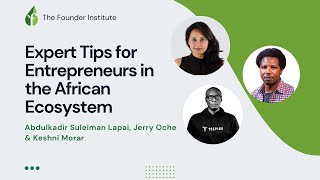
Abdulkadir Suleiman Lapai and Jerry Oche, founders of ed-tech and agritech startups, explain how to scale across Africa without treating it as one market. They stress finding your true customer (schools or ministries, farmers or cooperatives), validating hard before expanding, and building hardware alongside software.
Chapters
But back to you in terms of, um, the challenges in the, in the edtech space and the edtech solutions you find in Africa. Um, how do you approach, um, identifying for any, any others as well as how do you go about solving those problems? What guidance would you give our founders?
Yeah, so, um, it's pretty much exciting, you know, like, like I just gave you a backstory of where I'm coming from. A lot of these things we're going to be doing, I mean, you know, in Africa now, I think edtech has been facing a decline in terms of access to funding.
And you know, welcome everyone, we are absolutely excited to have you here today for an insightful session with our speakers that we have lined up. Before I move any further, I'm Keishni Morar, I am the MD of Founder Institute here in South Africa. I've been with the Founder Institute for over 4 years now and moving on to our 8th cohort coming up in May. Apart from that, I'm also an angel investor, venture builder, and I do tons of other stuff in the ecosystem. So if you are around, like, ping me on LinkedIn, let's connect. You'll find my LinkedIn profile in the chat. But nonetheless, we today, we are here to meet some alumni who have come through Founder Institute, both Abdul Kader Suleiman Lepaie and Jerry Oche. So today's webinar is actually more than just a webinar, and I always love these webinars with FI because it's always a chance to learn, it's a chance to connect with others, and most importantly, it is— it gives us actionable steps from people who have walked the path that helps you towards building the dream the business of your dreams and building the African ecosystem at large. So today, our goal is here— our goal here is to uncover what does it really take to scale businesses across African markets. We know this is not easy. Africa is not for sissies. So you definitely want to be tuned into these two amazing founders who are going to be sharing their wisdoms and full of knowledge and experience that's going to help you shortcut your way to success. We're going to be drawing on real-world insights from these founders who are also mentors, and we are also here to answer many of your pressing questions about the African ecosystem. Without further ado, I'm going to tell you we'll be kicking off with a frank, no BS interview with our panelists, followed by Q&A from our audience. We will end the session with a networking portion, which I really, really encourage every single person to join and attend and get connected to like-minded people from around the globe. So definitely stick around for that. It is one of the most fun parts actually of most of our connections and our webinars. You just get to meet some amazing people and build your networks and connections. Because you just don't know how important that is when you are building your business out on this continent. So without further ado, I am going to ask you to please join me in welcoming today's guests, Abdul Qadir Suleiman and Jerry Otchie. They're going to be pulled up onto screen shortly. There we go. So welcome, welcome, gents. It's an absolute Pleasure to meet you. A little bit about our guests today. Abdul Qader Suleiman is the CEO and founder of Testspire. He's a true visionary in the tech world. He's been in the tech industry for over a decade and he's really passionate about helping businesses grow. 9 years ago, he started JD Lab in an early— say in about early 2021, he founded Lab Space Innovation Hub. Currently, Abdul Kader is leading, uh, Testfire, an edtech startup founded, um, in 2022. So at Testfire, he's shaking up the education industry by helping schools plug revenue leaks and making it easier for edtech developers to build AI-powered applications. Now that's a lot to get through. So welcome, Abdul Kader. We are absolutely elated that you are with us this evening. Do you want to add anything? Did I miss anything? I hope I did you justice. Would you like to say hi to the audience?
Yeah, I mean, I think you've done justice to this. I'm just happy to be here.
It's wonderful.
Thank you so much for making the time and more importantly, sharing what you know. It's priceless. Jerry Orche, onto him, is the founder of and the CEO of Zoacel. I hope I didn't butcher that. It's an agricultural techn— he's an agricultural technologist. There's very few of these around. He's an economist and an entrepreneur. He has a very strong background in farming, and Jerry is passionate about using data science and technology to transform agriculture to make it more productive, more sustainable, and profitable for farmers. And we know how important that is across this continent. He operates out of Nigeria, Kenya, and Tanzania, and he's making a significant impact in the agricultural sector. So welcome, welcome Jerry. I hope I did you justice. I did like— you guys are like a powerhouse. Would you like to add anything about you, say hi to the attendees today?
I think you've said everything. Very accurate. Thank you very much. Nice to be here.
Thank you. And so you guys are based out of Lagos today, and I'm sure there's people from around the globe that are joining us, not just Africa, uh, because there's a lot of people interested in the African continent. So please let us know where you're from, pop your LinkedIn profiles into the chat, and let's keep going. If you've got any questions, also push it into the chat. Our producers at the back will collate all the questions that we are seeing, and we will get to the Q&A section around that as well post the interview. And if something interesting comes up, I'm gonna like try and plug it in in between. So please hang tight and post it in there. If there's anything else that you guys have a question about or commentary, please, the chat box is the place to put it. So I want just to kick off with the first question. Jerry, I'm going to ask you, what excites you the most about scaling businesses in Africa right now?
Well, I think it's the opportunity that the continent presents itself. As entrepreneur, key focus for entrepreneurs is solving problem. So the more we see problems, the more we excited. So knowing that there are problems across the continent that need solutions, so that's, uh, so that's, uh, so that's the—
that's very true. Hey, when, um, you look at the African continent, there's so many problems that we're trying to solve in so many areas, and you've really got to be industrious and very creative around solving those problems that make it real for the people on the ground, right? So yeah, that's amazing. I'm gonna ask Abdul-Kader the very same question. When it comes to growing on the African continent, what is it that excites you the most? Um, it's coming up. Abdul, you there?
Yeah, I'm here.
There we go. So tell me, what excites you the most about scaling businesses on this continent?
Yeah, I mean, uh, scaling a business in Africa right now It's incredibly exciting because the continent is at a pivotal moment of digital transformation, right? And one of the most exciting things about scaling a business in Africa right now is the share, like, amount of share scale of problems we are faced with every day that we wake up in our daily lives.
Yeah.
Yep. And it's different from country to country. It is so different. And people generally tend to make this mistake that Africa is a continent and everybody's got the same problem. But when you go from South Africa to Lagos, you, you just like, they, it falls apart, right?
Um, so, so looking at the landscape, right, uh, for instance, when you talk about Nigeria, uh, when you look at the educational sector, if we're gonna go down to the numbers, you know, how many public schools, you know, are functioning? So, so a lot of these startups just wake up and, you know, want to be innovative around these things, sort of like provide solutions to all these problems. Enormous amount of lands where peace be.
Yeah, I'm gonna now move to Jerry, and Jerry, we're gonna focus on a lot of what you've done in the agritech space. And let's, let's, let's just dive in a little bit around your origins and your vision. You grew up in, in a farming household, uh, and now you lead a data-driven agritech company. What was that defining moment that led you to start Zawassa.
Yes, thank you, Keshi. So there are a couple of things. I think one is, yes, I grew up in a majorly predominantly farming community and family. So before now, I have a background in media also, so I was working in marketing agency. And we apparently had a brief to work for the World Bank to look at the agri-value chain in Nigeria and provide solutions. So we came up with that research, and when the brief was sent in for us to look at it, so practically I'm clear that whoever answered those questions was myself without really going to the field. That was like speaking to me that way. So we did that work and it was very successful. So we got some insights about problems and possibly the opportunity. So that became an eye-opener. So at that time, I was CEO of that marketing agency, so I eventually set up a desk, just a desk within the agency to talk to people. To take that insight and see how we can turn it into something. That's how we eventually started. But interestingly, when we started, we started to test some of the models outside of Nigeria. So we did research across, even to South Africa. We did a couple of tests with We did in Gary, Indiana, in the US. That was usually where we spend a lot of time to test solutions. We did Kenya, we did Côte d'Ivoire, and we did part of the northern part of Nigeria and southern part of Nigeria, just to have an insight into what works. Because as a research company, so we understand how to do research. So that gave us an overview of the value chain, the problems, and solutions. So the next step we did was to put some money and test. And there's no better place to test is to also test from, um, from home. So we did some trials here in Nigeria and see how it works out. So, uh, so that's basically how we started. And after a couple of years, I stepped down from the marketing agency to focus, um, yeah, on Zora 700.
That's very interesting. I'm just going to ask you to speak a little bit louder so that it kind of translates. There's a bit of noise on the line, and I think it's more the connectivity problem. So if you could just speak a little bit louder so the audience can follow. Okay, so with that, what is the biggest problem that you've seen in the agriculture sector that you knew had to be solved, and particularly using technology?
Well, I'll say this clearly. I think the biggest problem today in the valley is the customer problem. What we've seen, from what we know, customers have not clarity about who the customer is. Now, it's very complicated in the United States because you're dealing with cooperative, you're also dealing with corporate. So it's actually defining who the customer is. Very, very simple. A lot of, like, small— so if you build around small farmers, frustrated at the end of the day. So, yeah, that's also the critical stage of defining the business, is understanding who is the customer and who is the beneficiary. So that needs to be very clear, uh, thought out from the onset. And I think another problem also is also understand that the value chain is extremely big, uh, possibly can't do end-to-end. So you also need to define your, you know, your— create your niche and try to focus on what you think is important to you. For us, we define to focus on two major, rather three major aspects, which is one is creating premium market access so we are better known as a marketplace. The second is to provide alternative finance for commodity sales. Then also to provide, um, a solution, uh, like maybe EUTR. So we try to stay within that space so that we are not doing many things at the same time, uh, because, you know, in the agricultural value chain, uh, when you set up to solve one problem, you probably have 5 other problems you need to solve for you to solve your problem and achieve. If you don't define exactly what you need to do, then you end up solving other people's problem and not solving your own problem. So that's very critical to define where you want to be. And also partnership and who you want to bring on board as a partner who probably have a solution or able to crack a particular value chain or particular So I think those are the major challenges in the business because these two challenges I mentioned, end of the day, even define the technology, at the end of the day define the market, at the end of the day define the sustainability of the business itself, right?
I'm gonna ask you one thing. The audience can barely hear you. I'm not too sure if it's the headphone, um, or something. Can we try Can you hear me?
That's surprising.
Yeah, we can hear you, but it's very faint.
So let me take off the microphone.
Okay, give you a second to do that.
Is it better now? Yes, that's much better. Oh, okay, so fine.
So we go much better. Yeah, they were struggling to hear you, but with it going in and out. Okay, so yeah, understanding your customer is so key. Also understanding where you're playing that value chain. A lot of people miss that, that they want to be everything to everyone. So quite a few great points that you covered there in terms of knowing your niche and targeting a very, very specific problem. Now, before we actually talk about scaling up your business, tell us a little bit about your business just to give the audience context as to What is it that you'll do and where in the ecosystem you are playing?
Yeah, thanks. So clearly where we play today, we are a marketplace, sustainable marketplace. We connect cooperatives. By the way, our focus is to work with big corporates. So we like to onboard some of the big processors, the big manufacturers, the big trade houses. Platform. So, uh, that's our model. Uh, focus on big players like Diageo, for example, big players like Olam, like Barry. Uh, yeah, so this big player— so those are the kind of customers we onboard on our system and focus on working with cooperative, uh, not the individual farmers themselves, but to work with them through their cooperatives and also working with other startups. So we have a lot of startups and lots of agribusinesses who use our solution. And what we do is to connect them with with the whole market. So across the market we operate, and also other— we have customers in other countries that we don't operate, like neighboring countries in West Africa. So the idea is you could put on what you have produced as a cooperative or as a startup, and you could put it to these buyers. So we provide the finance because the big buyers again don't pay immediately. If you really want to sell to the big buyers, to the big, big box, then you have to prepare for 30 to 60 days payment time. And no cooperative or no startup wants to hold for that long, right? You need the money, you need a working capital. So what we do is to provide access to markets and the finance to guarantee that you are able to get your money to pay the importators and make the commodity delivery. So that's what we provide. We also provide quality standardization and also enable logistics support so that you focus on your production and you can sell your commodity to anybody you want to sell, whether in Nigeria or whether it's in Europe, whether it's in Asia. So that's basically what, what, what is for the big, for the big corporate that we serve. So they, so they are moving away from just conventional agriculture, they are going into more sustainable agriculture. So again, where we have a solution called Cropilot. So our Cropilot enables them to use that solution to use across their value chain to track all their footprints and also report their climate change emissions and all of that. So that's basically what we are doing.
That's quite interesting. So actually, you now are operating in 3 different countries, right? You're operating in Nigeria, in Kenya, and Tanzania. Are those the only 3 countries you're operating in?
So, so we have, uh, so we have ground operation in those 3 countries, uh, people in those 3 countries, but we also have, um, uh, other customers in neighboring countries like Cameroon, like Guinea, like Côte d'Ivoire, who are also trading on the platform. Uh, and also we are pushing that now to go digital so that we don't need to be in any country. You can trade anywhere, uh, anywhere in commodity. We are seeking for commodity, commodity.
Yeah, well, that's interesting that you say that, right? Because my next question is going to be, what's like getting into these different countries? It's, it's not easy. The infrastructure is different. Each country has its own challenges, um, you know, the, the laws are different, etc., etc. What was the biggest challenge that you faced when expanding across these borders, um, and how did you navigate those challenges?
Yeah, so like I said earlier, we, we had like, um, over 5 years of research, um, travel, uh, travel across the continent, even out of the country. So we have, so we have understanding of what the markets and all of that. But interestingly, uh, the way we're structured is, uh, we, we came up with the expansion strategy to expand digitally so that we don't necessarily need to go and put up local registration. So we can operate all our stamps and anywhere, anytime. The second also is to expand regionally, to have regional offices. So the idea was at that time was Kenya will serve as the regional office for East Africa. So we have plans to go to Uganda, Tanzania, and all of those countries around, then Kenya being the regional office. So when we do that, one of the challenges that we face is that as close as as close as maybe similar Kenya and Tanzania are, they are totally two different countries, two different regulatory environments, two different— totally two different environments, right? So in Tanzania, for example, the system is so different from Kenya that you practically can't do anything if you are not a Tanzanian, right? Because Tanzania is more of a social state. Socialist society. So the government controls everything. The government doesn't endorse any system, nobody wants to use it because it doesn't show that it's good enough or trustworthy. So we have to absorb all of that. We have to go setting, begin to partner with the government, get local partners. But the system is totally different. So the regulatory environment in Tanzania is quite different from, uh, that of Kenya or that of Nigeria. So putting all of those things into context, I'm so— like, you know, Tanzania, it's heavily on Swahili. Swahili is the official language, right? So that means you, you practically can't do anything as a foreigner. You need to have— so initially we have challenges of getting, um, getting talent. Also using our model to expand because of getting people who are very entrepreneurial, are able to buy into our ideas and now sell those ideas to farmers to be covered. So it gave us a lot of problems, but later on we're able to fine-tune and get people on ground and also see how we can work with the military authorities. So again, it's in different environments, uh, what you get done in Nigeria or Kenya in maybe 2 hours, probably get it done in a couple of months, right? So you need to understand all the rules of the environment and how that works. So, and also the commodity— in Nigeria we focus mainly on cash crops and grains, but in Kenya, for example, those commodities are not very big commodities. So we need to look out for the competitive bean, that is very big in Kenya. Tanzania, they have their little mixture of both grains and cash crop. So, and also, so we need to understand the environment. And also, even the buyers who are buying out of, out of the continent also understand that dynamic. So that means that when you are shipping sisal or shipping soya from Nigeria, totally different than shipping the same commodity from Tanzania, because of course quality is different, the color quality is different. So all of those issues we need to deal with, and also getting local lawyers, local tax authorities, tax accountants, and all that is also a big issue to deal with. So unlike in Kenya, Nigeria, you probably can do this and probably send it very easy, but in Tanzania you just don't have right? So you can't have any— so that's quite sort of the interesting part of scaling up. And also, so we didn't envisage all of these changes until we got in and we can't run this ourselves. We need to have people who can speak the language, who can understand Portuguese.
Yeah, so it's exactly like what you said. Unless you actually go into the country, it's very difficult to say this is how you can operate in those countries, right? And so you brought the regulatory side into account. You also looked at like what types of crops you needed to be doing. So what is, what, what is it that you need to be focusing on in the different countries? Also being very cognizant of the fact that you need a local representation there. And as soon as you say lawyers, you just like, you see dollar signs and expenses, like you name it, right? So you've got to be very strategic about how you're actually entering these countries. Um, so when it comes to your tech portion, because you are a tech solution at the end of the day, your business, um, is— that's what, um, you'll offer to the clients. Being in the agritech side, it's not often that you find farmers quickly adopting these technologies. So how do you— how do you manage to actually onboard these clients, um, once you figure out all the rest of the stuff? Because at the end of the day, you can figure out all the best regulatory things that you need to go around, etc. You might understand the markets, but that adoption becomes quite difficult. So how do you tailor your sales approach and your adoption to push up adoption of your, of your solutions with farmers and other stakeholders?
Yeah, that's a very good question. So, so interestingly, again, I'll take you back to what I said earlier, also to define your understand your customer, understand your market. I think there's this saying in Funder Institute about the one company, one product, one market, one revenue model before you scale. So what we did was to keep to that process. For us, I think the first definition is to know that the smallholder farmers are not our customers, right? So that's the definition. So our customers are the big corporations, right? So we are sourcing from farmers through their cooperative, right? So we are not dealing with— so we don't expect smallholder farmers individually to use our system. It wasn't built for them, right? But as a cooperative, we normally try to have good cooperatives together or work with organized cooperatives. And if they don't have, we like the community, we like soil, then we can help them put up cooperatives. We can educate them on how to use our system. We have what we call the Zoa Self Crop Center. So the crop center is building, is empowering the cooperative to have their own remote infrastructure. So again, you know, in agriculture, unlike maybe fintech, you can't be successful if you don't have remote infrastructure and a digital infrastructure. Right, because you need hands-on infrastructure to be able to do agriculture, not just digital solutions. So that needs to be said very clearly. So mobile apps, web cannot solve all the problems in agriculture. You need to have hardware, you need to have remote infrastructure. So in our case, we build crop centers, and those crop centers enable us to upscale existing cooperative infrastructure or build new ones for them. And I will provide all they need from maybe weighing scale, digital gadgets, maybe motorcycle, maybe POS, for example, or maybe some have even have mechanization like harvesters or tractors. We provide all of that for the cooperative on a higher purchase basis, and over time we can take the money off the cooperative. Now the idea is that we empower the cooperative, we give them all of those solutions, give them maybe a tablet a mobile smartphone, then they can have the application, and then you train them on how to use the application. Then they can onboard all their farmers, use the system to trade their commodity, to put up requests for finance and all. So that makes it very easy for us. Now, on the other side, working with the big corporate, so they don't need remote infrastructure. They can use mobile apps, they can use web app. So for them, it's not for them. So it's just for them, just for them to log in to see the fruits of their orders. And even for them, for some of them, they are so busy that we need— that we have to put up account managers in the back office who take care of their orders. So what they do is just to tell us what they want for maybe for the month or for the week or for the entire season. So we have account officers who are assigned to them who are managing accounts, who are able to now manage the accounts for them. So that's some of the strategies that we employ in getting our customers engaged and getting them to use the system directly or indirectly.
See, what comes through is you know your market so well, you know how people operate in these markets, you know how the product moves, you know the value chain, and so that everything you're saying kind of almost fills in lots of gaps, especially if you don't understand like your value chain and you're coming in green like me, excuse the pun, but, uh, you know, uh, you've explained that quite well. There's a, there's actually a question in the chat, um, I'm not sure if this would apply based on what you've just said, but let's see if you can answer that. How do you deal with the security issues, uh, and in some hotspots, uh, and as well as some pilferage? As well as pilferage?
Yes, yes, so those are very critical, those are very critical. Issues and those that are actually dealing with. So in this business, you— so you are— if you are part of Nigeria, for example, uh, where we operate in, maybe around all part of the country actually, not just maybe the north, or maybe for example, we don't operate in a state like, uh, northeast state like, uh, Yobe or maybe— uh, fortunately that's my state of birth, but we don't operate there because of the issues. So we just protocols around which is where we are safe. There are places where we need to get security clearance before our team can travel. So that's also possible. We need to put somebody who manage our security and protocol. But in country like Tanzania, for example, there is no security problem. You can move anytime of the day, 2 PM, at 2 AM, 4 AM, anytime you can pick your bag and travel within the country. The only thing you'll be scared of is your animal. That's interesting. So in terms of the— I think also is also able to tie our system dealing with people. So now what we try to do, particularly in hotspot areas, we try to put our staff to undergo security checks. They don't come in because for staff who have direct line dealing with commodities Commodity is money, actually. So that's, that's the money. So we try to put them through security check to see if they have minimal requirements before we get them. Yeah, so that's basically what we try to do. But above all, we don't release cash until the commodity gets to the final destination, so we open it. So that further reduces the risk of having money in the hands of people or having people moving commodities. So there are just a little of security measures, but as a business, that's expensive because you need to put up the full security department who monitor movement, who advise, who are able to move quickly if there are any foul play. So that's something that we have to do because otherwise you keep having— you'll be having issues of theft, issues of security.
Okay, so I'm going to ask you one question, one more question, and I want you to be rapid fire before I bring Abdul Kader on. Um, what do you see most founders making a mistake with? What is that big one big mistake that most of the founders you meet are actually making?
Well, I think it's a common mistake everybody does as part of growing as as entrepreneur and also as we have even learning on what you're doing. It's maybe founders bias. Most founders don't want to be told how, how not. So, and again, for me, I think it's two things. So you need to learn how, how to and how not to. Yeah, but most founders don't want to learn how not to, right? So I, I, I, I had, I had a boss I worked with for some time, yes, years ago. So when I started, um, my first company, I went to him and I told him, and he asked me a question, wow, so what have you learned from me? And I said, no, I want to tell you about what the things I've not learned from you, how not to do it, since that you did that, I thought, I should— this shouldn't be— this shouldn't have been done, right? So I think that's how with most founders, we don't want to maybe listening to the other side of the story. Why not? So I think we need to challenge ourselves. We also need to listen from other people's perspectives. I understand how dream, vision is. Dream, vision, and say to build an empire, but at the same time, I used to take it step by step and also listen to— and it's also, there's also nothing wrong in, like, in our case, one of the system that we adapt, that every, every solution we ever do, we, we have to run it as a proof of concept. I know in agriculture, every system you are building, uh, you need one year to test it, right? Unlike maybe fintech that you can do today, you can test the next day, you can tweak and all of that. In agri, any solution you are building, it takes one year to test until the end of the season before you can tell if it's good or bad, right? So for us, one of the ways we work is So we put up a research center where we do demonstration, test it to see if it works or not before we can probably want to scale it. And we've done a couple of those solutions that never worked. We know that they're just— So I think for me, I would say founders need to be a little bit more flexible, take criticism and see how they can improve.
Thank you so much for that. I'm going to call you up again in a bit, so don't disappear. Please. But for now, thank you so much for those insights, because I'm going to latch on to some of those as we move on to Abdul Kader. And so I'm going to ask Abdul Kader, please come up. Thanks, Jerry. Sorry, guys, I preferred actually keeping it separate because we've got two different models that we actually speak to. And I'm going to ask Abdul Kader, can you give us your 30-second pitch on your business?
Can you come again, please? I didn't get that.
Can you give us your 30-second pitch on your business?
Oh yeah, uh, so, uh, I mean, as a founder alumni, I'm a final year student alumni, I think is what we used to— so I'm the founder of Testspire, and Testspire builds a web application that actually helps schools generate revenue, you know, by us giving them a tablet device that comes with a readily available internet, which makes it easy for them to get onboarded.
Guys, when you join Founder Institute, you will do a 1-minute pitch, you will do a 3-minute pitch, you will do a 30-second pitch, you will nail it. People will be hanging on to every word. So thank you for that. It is in the edtech space, and it's quite— it's something that I think a lot of schools need and education organizations. But there's a few things that I'd like to know around you, around you, right? Because you, you're very much tech-driven, you always looking for problems to solve. When you transitioned from running the innovation hub, which I'm sure was addictive, to launching Testspire, what was the gap in the education sector that you saw and you thought this is worth taking a leap for?
Yeah, I mean, I think— let me just correct the notion, you know, before I even ventured into, you know, business support, you know, ecosystem or platforms, there was that part where I had already been doing this for, you know, over a decade, where I was an undergraduate. And, you know, a lot of times where you go to the campus or, you know, go to the classroom for lectures, Back in the days, you have instances, especially those that actually have experienced schooling in Nigeria, you have a lot of instances where students, you know, just end up queuing up for one basic thing to another. So, so these were some of the, you know, things that actually inspired me to start EdTech, you know, even in the first place. So being in the business for over a decade, you know, there was a time that we established you know, one of these businesses that I found at Yedi Lab. And it's been, you know, started because we wanted to have instances where if we're coming to start our own businesses, we're supposed to have some kind of funds that will leverage anyway. So having to have done that, you know, in the most laborious way, having to have launched the process, you know, starting out, you know, without just having the, you know, strategic, you know, plans, strategic business models, and all of what you're supposed to have as a business, you know. So it was easy for us to, you know, carve out a niche and be like, no, I don't think any founder, you know, anyone that wants to do a startup should go through those sort of difficult moments that we found ourselves in. So that was how we came to establish a hub, and after establishing a hub, where like if we had done this and we know sort of like what it's like to be a founder, what it's like to be the right founder, what it's like to work on the right idea, I mean, it's going to be easy for us to impact on, you know, people when it comes to doing startups. So transitioning into becoming, uh, Tesprah as it is for us, I think it was easy. It is like we've been doing it for years. And so there comes a time where we had a lot of products on the table, right? and we're like, which products, you know, has the flair and, and, um, it's going to be easy to scale. So we saw that it was still education. Uh, we also asked that question where, uh, if we're going to scale, does this product has an impact, you know? So for us, education is something that is there to us because, I mean, if you solve an educational problem now, you're not just solving a problem now, like, uh, you're solving a problem in the future because you equip someone with the right access to educational tools or whatever, sort of like counts when someone comes to evolve or being in society. And also, if you look at what we're doing, we have just started to build the foundations of what we are going to be doing in the future.
That's— I'm actually a little bit speechless because I was following what you were saying. And, you know, because you've built businesses in the past and you've helped others build businesses, it was— you actually, like, trained your mind and your eye to catch these opportunities, right, before most others would. So it is, it is quite a skill that you build up over time. And even some people, they think they're going to be first-time blockbuster founders, and, you know, the first— like, the first— on the first try. And, and that's not always the case. Sometimes you'll get a founder that failed 5 times before they, they really, really got it right, you know, with their tech startup. So I think from what you said, just not giving up and, and being persistent about things as well is quite important and, and leaning into that, right? Um, but back to you in terms of, um, the challenges in the, in the edtech space and the edtech solutions you find in Africa. Um, how do you approach, um, identifying for any, any others as well? As how do you go about solving those problems? What guidance would you give our founders?
Yeah, so, um, it's pretty much exciting, you know, uh, like, like I just gave you a backstory of where I'm coming from. A lot of these things we're going to be doing, I mean, you know, in Africa now, I think edtech has has been facing a decline in terms of access to funding. And we realized that we are going to be in for a ride and it's supposed to be a long-term thing for us. So part of things that we did, because we know we're going to be facing these sort of challenges, sort of like put ourselves in a position where in building these companies we have different streams of income. So we would be able to bootstrap finance our way out of building some of these prototypes that would put us in a position where we'll be in good conversation with people that are going to be raising funds with, right? We also have instances where we have had to take affiliate marketing activities where we're in with some of our partners before we could even dare to dream of fixing this challenge. And coming to the challenge that we're faced with in the edtech space, You know, one of the major problems that you tend to see in African, you know, basic schools, particularly in Nigeria, is where you have, you know, these schools struggle with access to infrastructure, as basic as, you know, lack of access to internet, lack of access to electricity, lack of access to, you know, devices as simple as tablets or, you know, computing devices that will aid them to navigate their day or carry out their activities amongst staff, you know, students, and some of the proprietors or proprietresses of these schools. And for us to solve some of these problems, I mean, we've been there, you know, how we build management and systems apps like helping these schools to, you know, navigate and administer some of the activities they are used to. So we sort of like How do we democratize this process? How that is going to come cheap? It's going to come cheap that these schools could afford it without even having to break the bank before they can acquire our solutions. And part of things we did was I didn't even know SaaS, what SaaS was like 10 years ago, 10 years ago. And we started it because we are some of the pioneers that discovered SaaS here before, you know, people started copying. I didn't know what SaaS was. Experts. I, I just found myself competing with, uh, you know, high-level industry experts where the way contracts were done in the past, you know, where you see someone being paid over $10,000 to deploy a solution to a particular government institution or private institution.
Yeah.
So for us, because we have to be innovative around it, you know, we just have to find a way that, oh, this is a customer that we're trying to build to, so how do we make it so simple that they're gonna acquire us? Solution in the most simplest form. And best we could just do is like, why don't you take the solution for free or find a way to charge as you use the system, you know. Another challenge I, I know we were faced with as we introduced, you know, similar or such business models where, uh, again, uh, some of these schools, you know, because they're operating on a tight budget, so to use our system, you know, is a cloud-based solution, they might have to buy, you know, laptop or computing device to access us. And I was like, no, we can't do that. Why don't we have a situation where we build all-in-one hardware and software access, where as you are acquiring our solution, depending on the pricing plan, you're actually getting yourself onboarded to— you're going to be shipped a tablet device that comes with that readily available. So that way it's easy for you to have access to our platform. And then as you begin to use the system, or as students begin to pay, you know, some certain fees on the platform, we get to charge for access and it's like easy because the cost of acquiring you is sort of like negligible because when you compare it to the lifetime value of what we're going to get with you over 5 years, it's something that is worth investing. And I think some of the challenges we face too that were the resistance, like resistance to change. A lot of people are not used to technology here in Africa. So when you're bringing some certain new norms or new ways of doing things, it's always going to be a backlash where I'm like, just finding money, I'm looking for money to pay for, you know, some sort of services that are, you know, supposed to be paid for when it comes to setting up a school. And then reality is kicking in and you're like, oh, what's supposed to be my solution? So there's always going to be that technology adoption barrier where we have to do a lot of work, you know, to educate people on what it's like to adopt these systems. And when it comes to using this system, these are the solid advantages you get. Maybe it helps you to generate more funds. So how would you know that? It's only when you actually have a use case where you are supposed to set up a school, you are supposed to start charging parents for school fees, and then you now have an instance where these parents are not paying consistently. So how do you know whether this parent has paid or not? You know, so that's where we come in. We'll give you a technology that shows you how many, how many parents have complied, you know, and how many, uh, you know, students have paid fees. So it's sort of like easy. I remember when we were actually deploying for the first time, I was the one that wrote the codes, I was the one that was involved end to end, you know, because technology was somehow, you know, all impact at the time. I went to a school, and when I went to school, the school has a like a bank in the school settings. So you go to the school and you go and find like about 3,000, 4,000 students queued up just because they want to make payments to the institution. I'm like, what's this? You know, so when we were like, this queue, I think give us 2 weeks, we're going to make it disappear. And it was real, you know. So when we brought our system, within 2 weeks we installed and aligned all the processes. And a lot of people actually had to have or enjoying that convenience of having to pay fees, you know, from their respective homes. And you have more and more, especially for instance where you have yourself operating from an environment where you are regulated. Like, you know, in Nigeria now the government is very aware of, or very much aware of what we're doing. And sometimes because we are also pioneer of what we have introduced to the system right now. We have actually been, uh, you know, haunted with some of the business models that we have introduced. So a lot of people think startup, because of the mainstream hype, you know, when you go in, it's a lot of money involved in it. Of course, sometimes it's true, because when you find yourself being the first in the market, uh, you know, you have the opportunity to milk, uh, you know, that first mover advantage. So, um, you know, startup as it is, is technology. Technology can easily copy. So we started facing instances where, you know, some people build similar system, you know, go to government, tell them that, oh, you know, ours is better and we can easily just deploy it. And so these are instances that you get. So from that part of things, I will say government is also one of the key enablers helping us to do it right. But also there is that part where regulatory-wise, policy-wise, I think they need to do better. So some of us that found ourselves in this situation, we found ourselves building systems that actually put us immune from what government policies that comes up the next day. So you can be able to build a solution or a company that stands the test of time.
Yeah, you, you mentioned so many good points in what you've just said, you know, because like Africa, we think that, oh, you know, we can just deploy solutions and it's going to be fine. We got like in the health side one patient record, but in order to roll that out to a hospital or to a school or to anybody else. There's infrastructure that's, that's taken for granted in the Western world that we don't have on the continent. So it could be power, it could be roads, it could be networks. You know, there's so many things that we first need to get through and get down right, and in order for us to deploy these solutions, right? Um, and so it's quite admirable that you've managed to deploy, um, to these schools. How many schools are you supporting at at this point?
Yeah, so when we started last year, right, it was that part that we knew that the major market that we wanted to focus on was going to be difficult. So we had just, uh, you know, sat down, you know, built a strategic, uh, you know, process where it was going to be easy for us to launch in the market of these B2G, like business government. So yeah, with that first move, before you know, within a month or two, we're already in conversation with about 5,000 schools that the government was, you know, handling. So we wanted to have a very good footprint, so it was easy for us to have our way in negotiating with one of the governments or state governments that are handling, uh, because a lot of investors that we talked to, they were not ready to go through the route of, uh, let's do one school at a time. Like. So like right now, I think we have over 6,000 schools in our platform. A lot of them are actually publicly owned though. Is this year that we want to focus on, you know, privately owned schools, especially the fact that we want to have or build a sustainable technology that lasts.
And so talking to the B2G side, right, and this is, this is not a secret across the continent, working with government is difficult. Right? And there's no— usually people kind of shy away from it and kind of take backseat, like government's like the last option of dealing with, and like there's a part of regulatory that you've got to get through. But having them as a customer adds a lot of complexity, it adds a lot of uncertainty as well, to some extent or to a large extent, depending on the country you're operating in, etc. Nigeria is one of those countries that it's highly volatile, right? And so when you looked at your business model, your revenue model specifically, and you chose B2G, how, what did you think, what was your thought process about thinking about how do I make sure this revenue model of mine is scalable and I'll be able to take it and like, I'm not going to say copy and paste another territory or country, but what was, what is the thought process around that?
Yeah, I quite understand that dealing with government, it comes with a lot of baggage. Actually, they move slow. So I could imagine when we were actually doing some of our projections on Unit of Economics last year, we wanted to have about 5 state governments that were supposed to be in conversation. But dealing with just one state took about 8 months. But one of the major reasons why we actually focused on getting the B2B gives us. Because, you know, I mean, you know, we are early-stage startups, so we have short runways, you know. So we wouldn't want to have a situation where we're trying to acquire customers, you know, one after each, and, you know, we're actually out of cash. So one important thing that, you know, we need to focus more on is how do we stay alive so when our products, you know, becomes, you know, more, uh, attractive, more, more usable, you know, and how people want to have a taste of it or something. So we're like, I think it's going to take a long time. We actually need funding in all of this, right? So we have to go to government first, no matter how much long it takes, right? Because they are the ones that have, you know, all the strengths and financial strength to be able to give us, you know, what it's like. But dealing with private schools, you know, like I said, you know, in Africa, there's that low-level entry barrier where It takes a lot of time to also convince an average individual, you know, to jump on technology, except he or she has seen someone using it before. He gets convinced that, oh, I'm gonna jump on this, it's gonna work for me. So for us, we have to find a way to be innovative around it where we have to get cash input, also find a way to make sure that our goal remains the same, which is working with clients or customers that are going to give us or avail us with change it to last for a long time.
So I'm going to ask you the question that I asked Jerry. Um, what is the common mistake you see many founders making in your sector?
Yeah, I mean, uh, so there's a— there's that part where you think, uh, you, you have the right idea, you know, we just— common question here being sent to some random people, you know, your idea is validated. So I think a lot of founders don't really know what it's like, uh, you know, to be in edtech. So there's sort of like a reality check when it comes to settle down, then that, oh really, I don't think there are customers for this, after a year or two or something. So I, I feel some founders don't do validation as it should be, and I think it's one of those important things. Validation is key determining whether you should stay on solving a particular idea or not. Validation, to a certain extent, is not just sending questions here and there. At the time when we are doing validation at Testfire, after going through F5, of course, you know, we have had to come, you know, make calls, record videos, what were the responses like from, you know, this, what it's like to even have a system that works for you before we start to think of transitioning you to AI and all of that. So we know what they wanted now. That's why we are keen and focused on— we must provide this foundation for them first before we now join them through the AI path that we're supposed to be moving to together.
Yeah, it's all the things you learn in FI in the first 2 weeks, right?
It's—
we drum you on it. We, we like really grind it in. This is so important because if you do not do that Sorry, it's a market validation and customer development. Yes, it is key. If that doesn't work out, you're either gonna validate or invalidate your hypothesis. Either way, you're good to go, because if it's right and you're on the right, you'll know you'll be on the right path before you write the line of code. Whereas if you're in the wrong, you cut your losses short quickly, uh, fail fast and move on, right? And test your next hypothesis. So that is definitely a key takeaway for me in every cohort we run. I am going to thank you, but I am going to— you are not escaping me yet. I am going to ask Gerry to join us again. I have got a few more questions to ask the both of you before we get into a Q&A. So everybody, while Gerry is coming up, can I please ask that you pop any questions you have now into the chat to ask both Abdul Kader and Jerry in the next section. So I've got actually Nicholas who's asked here, what would your advice be to someone that wants to launch an affordable product which requires a large client base and needs leverage and needs to leverage government influence for large onboarding? 'How does one get the right context to affect this and the conversation?' That is a lot. It's pretty much how do they get into government to get the contracts. So I think both of you can kind of give your views on that because you both would have had to play in some capacity. Abdul Karim, you are quite straightforward. That's your, your niche. So do you want to kick off answering that?
Yeah, I mean, I think one of the mistakes we young founders do is is not to, uh, you know, dine and wine with the government. I think we think governments are hard when it comes to regulations, and I think government is not our enemy. It's just that you have a lot of barriers in terms of how, you know, there's even an age difference where you as a young person, you're trying to convince, uh, you know, some people that are older than you, different generation, to understand what you are building, you know. So you have to parley with them. So, and parleying with them, that's when you sit with them and meet them on understand that even as a government you can also gain from this. So for instance, when you look at the Uber model that is currently being copied around across different businesses in Africa, uh, if, um, Uber for instance, or any business that has similar business model, for instance, if I'm going to be in conversation with government, of course I have to go to Ministry of Transport or any agency that is responsible to regulate transport. Oh, this is it, this is how our business model operates, right? But as it is, we are going to be in some certain margins in terms of when we are in operations or something like that. So we might be willing to give government some certain commissions when it comes to regulating us, so that way when government is involved in taking some fair share of what you're gaining, I think no matter how much it's like to come and regulate or go hard on you or attract them, I think they would think it for a second time first before they come to shut you down. Or even finding it difficult to understand your business.
Yeah, that's so important because it's not pal pal buddy buddy, right? You need to show them you mean business. Jerry, I'm gonna actually ask you to answer the next question because it was very specifically posed to you, was in terms of expanding to other countries and other regions, how did you go about doing that? How did you set up your company to be able to operate in different regions? And I think this is kind of also a bit of a legal question Uh, where people are trying to figure out, how do I make sure if I am registered in Tanzania, how do I go to Mozambique or Nigeria, um, and expand? Uh, Jerry, you're on mute.
Registration. But I think the good news is a lot of other startups who are doing that, trying to help you to—
Sorry, Jerry, we can barely hear you.
Uh, can you hear me now?
Okay, let's try that again.
Okay, so I'm saying that, uh, it's easier today because you have companies, other startups are now offering that service where they can help you do registration, so you don't practically need to go and face individual governments or government officials. Once you pay in, you can help you go to the government. But I think what is critical also is also that aside just registering your business, you also have to find the right, right government agencies of the right license you need to review. In countries across East Africa, for example, aside from registering the business itself, license of every other business. Example, yeah, you need license for almost everybody. So once you are inside an active company, that's fine, you can register, but you cannot operate, let's see, or all of those. You need license for each of those commodities. I need to pay for them yearly, right? So it's also important to know that it's not just about registering business and you get to work. You also need to know the country regulatory requirements and what other things you need to have to drive your business forward.
Your signal is quite bad, um, so I don't know if you just want to swap your connection. Uh, but it's okay, it's coming in and out. So while, while you do that, um, I'm going to ask Abdul Ghader, in terms of the biggest misconceptions in your industry, what do you think, not just in edtech but in the edtech market in Africa, what are the biggest misconceptions out there?
Yeah, uh, so you know, there's that part where In Africa, our numbers are high, and so when founders are putting up their numbers, you know, they think the market is really that ready for them to, you know, bring up their system or whatever ideas they're working on. So I think founders are actually, you know, not— or maybe they don't get it right when it comes to understanding what African numbers are like. So they might be huge but that doesn't translate to having them, you know, come to become your customers when it comes to the products you're working. So there is a big misconception when it comes to how founders, or how people understand what's like when it comes to edtech ecosystem.
And how can, how can aspiring founders work around that, or note, what are the signals that they can pick up um, that'll help prevent them from falling into that ditch?
Yeah, so it's, it's, you know, these things, is that, is that I do it from the top, bottom approach, which I believe that is wrong. I think, you know, founders have to deliberately set milestones around how to contextualize. So when you are talking about building a solution in Africa, would you rather just be in London and build solution Africa, or would you rather be in the locality where that problem is actually being faced so you build it from ground up? So I would always, you know, recommend that, you know, founders come down to the local level, you know, see through the kind of problems the customers you're building for, you know, face with, and then you now start building from, you know, ground up. So 1, 10, you know, 50, 100, 500 customers So that way you can now be able to extrapolate and even determine the market, you know, better.
So walk the streets and live the experience is what you say. Get in market. What Jerry also said when he, when he got into the other market was be present in the market, understand the dynamics of that market. Jerry, I hope your— does your speaker work now? Can we try?
I've changed my network.
Oh, that's much better, much, much better. So I'm going to ask you, if there was one thing you had to change about your startup journey and your, um, what you've done to scale across the different countries, what is it that you would change and what is it that you would double down on? So what would you change or not do, and what would you double down on?
Well, I think, uh, some of the mistakes that we've done, uh, learnings, uh, I, I, so I think I would say we probably will not, um, try to do many things at the same time. If I do want to focus, uh, just on one, maybe even on one crop, for example, just focus to master on investing one quality don't scale to other languages. So maybe that's what to do all over again, because specialize on one crop. And also, I think, um, another thing, I think we'll have the opportunity, uh, but just to give you context, uh, so we have a different model that we scaled. We didn't go seeking raising money from investors, from VCs especially. We scale the business from using our customers' money. So we go to our customers and we ask them that if you like what we are building, give us advance or give us some grants or give us some credit. Once we're done, we give you some discounts and all of that. So that's how we raise a lot of money to scale this business. They also go to financial institutions to take debt financing, which we use to scale the business. So we did that because just like, um, said a lot of VCs don't understand how business works, and agriculture is even more complicated because you, you are not, um, you are not like a fintech that immediately you see results or you're able to see stuff. So you need to invest into, uh, of remote infrastructure. I keep saying remote infrastructure because from what we've seen across the continent, uh, most of the, um, some of the startups who have stayed who are still around, who have stayed the last 5 to 10 years in East Africa and West Africa, even South Africa, as a startup who have ground infrastructure, not just mobile. But mobile can solve the problem. So, uh, so from all that, I think if we do it over again, we'll focus on investing more in hardware than software, because you don't have the hardware, there's no how you can able to be successful in agriculture, no matter the money you have, after the technology, no matter the bots, the AI, all of that, they can't solve any problem because like you already said yourself, the farmers don't use, interact with this technology, right? So you need to get ground operation going. So if you do it all over again, I think we'll probably spend more money putting up ground operations before we now consider So we are up at time.
We've actually gone over. I could like really sit and talk to you a whole night about what you guys have done in the business, and honestly, we could have like a full day masterclass just on that. Um, but right now we're up at the hour, and I would like to take a minute just to say how much I appreciate your time and your insights. And the fact that you've come on to share your learnings and your experience in scaling your startups. And you know, what's phenomenal for me is that you guys are alumni of FI and it shows. So I'm absolutely proud to have you part of our network. And thank you so much for being here this evening. But the night's not ending because we are going to go into a networking session. So if there's any other questions that anybody has on the call, please stick around. We're going to have open tables. Um, Jerry will sit at his own table, Abdul Kader will have his own table. Please hop between them, get to know them, um, ask them all the questions. And apart from that, there's going to be more tables open where you can meet others. I will be on there as well. So if you've got any questions about Founder Institute, how we work, um, I see a few questions around shares, etc. Happy to answer those things, um, in the networking session. I do encourage you, like the networking session itself is priceless because these are connections that you would not ordinarily make out in the real world in person to person, bringing people around from together from around the world using technology is phenomenal. So take advantage of that. You can stay on the line, the webinar itself will come to an end, but the networking portion will remain open for as long as you need to network. Work, or as long as people are on the online chatting. So please stick around, join us there. And thank you so much for taking the time, everybody, to join us this evening. It's been an absolute pleasure, and I hope to meet some of you in the networking room shortly. Thank you to also FI HQ in the background, like, pinging me these messages and keeping me on track. Thank you so much, Sana, for being there and supporting us, and my team that's also online, and you'll meet them also in the networking room. Uh, thank you very, very much, um, for being here. Good evening, everybody, and stay safe wherever you are, or good morning depending on where you are in the world. Um, have a wonderful, wonderful, magical rest of your day or evening.
Thank you. Ciao.










