Phil Libin presents his Model to Answer All Startup Growth Questions
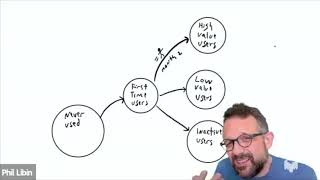
Phil Libin presents a five-state framework for tracking startup growth: never used, first-time, high-value, low-value, and inactive users. The model maps 14 transitions between states—acquisition, churn, upgrades, downgrades—and lets you measure each monthly and overlay financials to find which lever to pull first. He argues most startups use the wrong metrics and misalign incentives with actual user value.
Chapters
Hey everyone, my name is Phil Libin. I am the co-founder and CEO of Mmhmm and AllTurtles. I've been a startup person for a long time, I don't know, 25 years or something, maybe more. Was a programmer, studied computer science in Boston, started my first company with some college friends of mine, and I've been kind of in that, in the startup world ever since. Mm-hmm, is my 5th startup. So I've been on every side of this. I've founded companies, I worked as a VC for a few years, I was a general partner at General Catalyst. Kind of been all over the startup treadmill, and I think the central thing that I've realized is this. It's basically something that I tweeted a few months ago, right at the start of this pandemic, which is— and it's kind of weird to, you know, quote my own tweet, but I don't know, it's fun to do, and it's fun to do with this new toy— but it's this: it's that when the economy is strong, it's a good time to sell things, and when the economy is weak, it's a good time to build things. So basically, when, when times are good, uh, there's a lot of hype, there's a lot of attention, it's a, it's a good time to, to be selling things, to make money. And when times are tough, um, that's actually usually the best time to, to, to build, to, uh, to hunker down, to go heads down, to figure out what to make for the for the new world to make things of value. So we've been pretty busy at AllTurtles, at, at, at, mm-hmm, trying to make new things that make the world a little bit better. And I'm really pleased to be speaking to everyone here. Hopefully there are several people in the audience with kind of good ideas about what to build during difficult times. So what I wanted to talk about today is this, basically a very common problem that I've had in running various companies or investing in them. Is how do I know how well something is doing? People are quoting too many numbers and ratios at me, and they don't really understand how well our product is doing or how well our company's doing. This happened a lot before Evernote and at Evernote, and when I'm getting pitched with various companies. There are so many numbers and ratios, and there's so many things you can read online about, you know, ratios of MAUs to DAUs and all sorts of things like that that allegedly try to tell you how well you're doing. Well, most of them are actually pretty bad. And most early investors don't really understand what questions to ask or how to tell if a company is doing well. Most startup founders don't know. A lot of the things that you see online, a lot of the ratios, I'm kind of convinced that they're just there because I think, like, people kind of feel smart when they divide a number by some other number. Like, doing division makes people feel like they've accomplished something. And so there's a lot of stuff that are just like ratios of one number to another number. It's kind of weird if you really kind of poke at it. It doesn't seem to make a lot of sense. So I had this problem all the time, you know, for decades now, and at Evernote, and finally decided, okay, well, actually, screw it. I'm gonna solve it with math. There is a way to find out how well a product is doing, how well a company is doing. And, you know, it takes more math, not less math. So basically we developed over a few years, and this is something that we've refined over the past decade or so, and I use pretty frequently with a bunch of my projects, and advise investors and startup founders to do the same thing, we created this, I call it the amazing state machine that answers all startup growth questions, or at least some startup growth questions, but a lot of them. So let's just dive into that. So the question is, what is a state machine? Short answer is it's math. So a state machine is usually a diagram. It's a type of mathematical diagram that usually has states and basically circles and arrows, and the circles are, the state that a particular system could be in, and the arrows are called edges, are the transition points. So basically, a state machine that represents some, some system or some population shows all of the possible states that that population or system could be in, and the lines are all the transition points. So it's actually pretty straightforward. So what we're going to do is we're going to make a state machine. We're going to make a diagram for your hypothetical product, and this works pretty well for B2C products, B2B products, for a lot of stuff. I'm going to make a diagram for your product that shows every single living person on the earth and how they relate to your product, and we'll be able to just measure how well things are going based on that. So let's make a graph of every single living person, and let's put a few states. So the first category that we're going to list— and here we might as well go in full screen mode here— let's say the first thing is all the people who have never used your product. Let's make a circle. This is everyone who's never used your product. There's going to be approximately 7.8 billion people in this circle for most of you. You know, if you're Facebook, it's a smaller number. But these are people who have never used your product. And what we're going to do is over time, we're going to try to get as many people as possible from this circle, people who have never used your product, up here, people who are your high-value users, right? But there's stuff in the way. So really, this is the full graph, right? The whole point of your business, the whole point of your growth engine is to get people who have never used your product all the way up to being high-value users. We'll talk about what high-value means in a minute. And this graph represents everyone, except that there's a couple of things in the way. It's not usually a smooth path. So let's take it one step at a time. The way that you can draw this state machine, and we used to draw this all the time at Evernote and a few other companies, we would instrument this, we would measure all this stuff. And so the way that I usually do it is I do it monthly. Every step is one month. There's nothing magical about a month. You could do it daily or weekly or whatever. I just find more detail doesn't usually help, so I like to do most of these things monthly, but your mileage may vary if you've got an even faster growing product that you need to measure more frequently. Basically, each step is a month. Let's look at it like this. In the first month, month 1, some number of people transition from here, from this graph of, well, I've never used the product, at all to first-time users, right? So some number of people hop, they've never used it and they hop up to being first-time users. And then, so everyone in their first month is in the circle, is in first-time users. And then in the second month, they go to one of these three buckets. They either, from first-time users, they either become high-value users or they become low-value users. And we'll talk about that difference between high-value and low-value. It's pretty important. Or they become inactive users, right? So after the first month, either they're like, they are really using it a lot and getting a lot of value out of it, or they're using it a little bit, not really getting that much value, or they're like, they're not using it at all, right? That's in month 2. And then in every subsequent month, they basically travel along any of these other arrows, right? They go from any of the states to any of the other states. The only circle that they're only allowed to be in once is this one, right? Is first-time users, right? They can only be first-time users once, but Every month after that, they can travel along any of these other circles, kind of however they want, right? They can go from being low-value users and they can travel up this line to be high-value users. Then they can go back down to being inactive users. Then they can go back up to being high-value users, kind of, you know, whatever this takes. And then we can put in a few more lines just to make it complete, just for the sake of completeness, and number all of them. And this is it. This is the full graph. So there are 14 lines because we put in these little loops. So like you see number 14 here is this little loop. So most of the circles have loops back to themselves. So this is like someone who was inactive in a given month and then they loop back and they're still inactive now. So there's always 14 lines. So basically when I draw this from memory, I stop at 14. So I know once I've hit 14 lines, then that's all of it. It looks kind of visually complicated because I'm a terrible artist. But it's actually really simple, right? There's just basically 3 states and people are kind of going back between them. And so we just drew all of the lines and numbered them 1 through 14. And the interesting thing is every single person, uh, every single person on the earth is traveling across one of these lines every month, right? Everyone is either Most people are going to be on line 11. That's the loop back from never used it to still never used it. But some people are going from never used it to using it for the first time. Some people are going from being low-value users to being high-value users, and so on. So every single person on the Earth is traveling on one of these lines. And each line means something. Each line means something. And the way it's drawn, actually, each line is pretty unambiguously good or bad. All the lines that are facing up, that are kind of pointing in an upward direction, are positive. It's stuff that you want more of. All the lines that are facing in a downward direction are negative, stuff that you want less of. So for example, line number 10, right, this one, this is people who go from high-value users to being inactive users. That's really bad, right? It's pointing down. Whereas line number 9, people who go from being inactive users all the way up to high value, that's pointing up. It's good, right? You want people who get resurrected. There's only one line in here which is like a little bit ambiguous. You can't quite tell whether it's good or bad. That's number 13. That's up here, right? That's the people who, uh, go from being, uh, low-value users one month and then they're still low-value users the next month. You know, is that good or bad? Well, that really depends on your unit economics. If it doesn't cost you very much money or, uh, to keep low-value users, then yeah, maybe it's fine. Maybe you prefer that they stay low value rather than churning away. If it costs you a lot of money, then maybe you don't want line 13. So line 13 is the only one that's like maybe up for debate. Everything else is clear. So not only do each of these lines mean something, but each of the lines you can do something about, right? In fact, at Evernote, we had teams. We had a team of people on just about every single line, right? There was somebody whose job was to work on either getting more people or fewer people to travel on any line every month. And they would, you know, they would report in you know, what they had done, uh, that month. They make it better or worse. So every line means something, uh, but not every line is equally valuable, right? You can do things to increase or decrease it, but the question is, which one should you work on, uh, right now? Which one should you, should you work on first, right? And that really depends on kind of where you are in the, uh, in the startup process, right? They're not all equally valuable. So let's kind of take Some of these lines, and obviously I'm not going to go through all 14 of them because there's a lot of permutations, but we can kind of go through one at a time for a few of them just so you get an idea. The first line that most people start with is this one, right? It's number 1. It's sales and marketing. It's people who go from the circle of having never used your product to using it for the first time. Usually, what can you do to increase the number of people in that line? Well, it's the obvious things, right? You can do more PR, you can do SEO, word of mouth, paid ads, viral growth, channel sales, kind of whatever. The question is when, right? When should you really try to grow this line? When should you try to get more people on the panel? The way that I'm moving— I just saw somebody asking in the chat thing— the way that I'm moving around is I'm actually using a PlayStation controller to float around and move. It's super fun. When should you actually try to get more people here. And this is the first place where many, many startups get it wrong. Many startups try to focus on this right away, right from the beginning, right? Try to get as much hype as possible, try to get as many people as possible moving on the sales and marketing line. But I actually think that's usually a mistake because what's more important is this, is the second line, which is the bounce rate, which is people who go from being first-time users and then in the next month immediately afterwards they're inactive, right? So they start using the product and then they bounce away. They don't use it anymore. This is the biggest problem of most startup products that I see. I would say 75-80% of the startup products that I look at initially, if they haven't optimized this, they have a very high bounce rate. That means that a very large percentage of the people that they get through the front of the door just stop using it after the first experience or after the first couple of experiences, right? Whatever that first month is. And very often, bounce is actually counted as part of churn or as part of retention. And this is a big mistake. So at the beginning at Evernote, we used to count it like that. We would say, well, we thought we had a retention problem. We thought, well, too many people that used to use it aren't using it anymore. But what we realized when we looked at the numbers, it actually wasn't a retention problem at all, it was a bounce problem. So what we had, the problem was that a lot of people were bouncing, but of the people who stay, they're actually staying around pretty much forever. And the psychology that causes someone to bounce right away is very different from the psychology that causes someone who uses it for a while and then churn. So you've got to look at it separately. Usually, a high bounce rate means that you haven't set the expectations correctly. Right, like someone tried to use it, but it wasn't what they thought. Maybe the quality is poor, or maybe they thought they were getting something else, but kind of one way or the other, they, they, they bounce away. And until you get the bounce rate to a decent state, there's really no point working on the sales and marketing number, right? The, the answer to like, when should you work on this, is you should have just enough people coming in to your product to get a statistically significant measure of what the bounce rate is, right? You need to make sure you have enough people, that it's not just you and your friends and your family to actually measure, you know, what the bounce rate is. But once you have that, you really got to make sure that the bounce rate is taken care of. What's a good bounce rate? You know, it really depends on your product. I've seen these be as high as like 90%. So like 90% of the people who visit your product, you know, they leave after the first couple of experiences. That's pretty bad for most things. As a rule of thumb for a consumer product, I like to see below 30% before you focus on anything else. Obviously, depending on your unit economics, that may be too low or too high, but I would think about it like that. Okay, so that's the most common problem. I would fix this first, or at least measure it. Then you have this. Now we're actually getting into churn. So you have low-value churn, right? These are people who were— low-value users, and then they became inactive, right? They didn't use it. So why is that happening? And contrast that to high-value churn, people who were high-value users, and then stopped using it and became inactive. Why is that happening? And again, the psychology between these is very, very different, right? Someone who was a loyal user who was getting a lot of value from you and then churned away is probably doing it from a different reason than someone who is a low-value user. If someone is a low-value user and they churned, well, I don't know, maybe they just got bored, it wasn't valuable enough, maybe it's not that big a deal. But if they're a high-value user and they churned away and they stopped using it, well, maybe there's some bugs that are affecting your best users. Maybe there's a new competitor. Maybe there's something really wrong going on. So you have to fix this fast if you see it happening. Of course, you have no idea if it's happening if you don't measure it. And so most startups measure things like retention, but retention ridiculously combines high-value churn with low-value churn with bounce— three radically different things. But usually the way that you're taught to measure them, you just sort of express it as one number. It doesn't tell you anything. So I definitely think you should separate these things out and see what's actually going on. So, okay, let's talk about a little bit about what high value and low value means. I want to be clear about this. So by high value user, I mean that you are giving them high value. These are your customers, your users who are deriving a lot of value from your product, right? Not the other way around. Not like you're getting high value from them. They're getting high value from you. How do you measure that? Well, it's a good question. Depending on your product or your business, you should come up with ways of measuring who's actually getting the most value from you. And I think this is now the important point, is your business model is going to be much, much better, much, much stronger if the people who are high-value users, the people who are getting the most value from your product, are also the people who you, your company, is getting the most value from, right? If you have a well-aligned business model, this is, this is how you know it's well aligned. So a well-aligned business model is one where you are getting the most value from customers who are getting the most value from you. And very often, especially in the tech world, business models are poorly aligned, right? So let me give you just an example. ClassPass was a company that we had invested in as part of General Catalyst. You know, great company, really good value, very popular. But ClassPass had, you know, a fundamental problem in the beginning, which is their highest value customers, the people who were getting the most value from ClassPass— ClassPass basically lets you like go to any number of like gyms or yoga studios or sessions per month. You just paid in the beginning, it was just like a flat fee, and then you can go to any number you want. The people who were getting the most value were the people who were going to, you know, a different gym or studio every day. They loved it because, you know, they were saving them so much money. But those people were costing the company a lot of money because, you know, we just like, we couldn't afford to pay the studios and the gyms, right? So the people who were getting the most value from the company were actually like the users of the company could least afford to have. That's a fundamental disconnect, which, you know, took— it took many years to kind of write that, you know, to reverse that, to write that business model. Um, you know, a slightly Less dramatic example is like Netflix, right? Like, how much Netflix does Netflix want you to watch? And the answer is probably not like 20 hours a day, because they don't make any more money from you if you watch 20 hours a day than if you watch, you know, 2 hours a day. It's the same subscription fee. But the people who are really addicted to Netflix, who really are watching it, you know, 10 hours a day or whatever, they just cost Netflix more money, right? Because of the bandwidth and kind of other stuff and licensing fees. So Netflix's— their economics are very different. They can afford it. But it's still a misaligned business model. The, the most glaring example of this is Facebook, right? Facebook has a very misaligned business model. Facebook users want to, you know, chat, connect with their friends and their family, and, and Facebook doesn't care about any of that, right? Facebook wants to show you ads, right? So Facebook makes money by people who, like, click on ads. Facebook users aren't interested in clicking on ads. They're interested in, you know, connecting. So again, a misalignment. As opposed to companies that have good alignment between high-value users and their business models are things like, well, like Evernote. Like at Evernote, basically we said, you know, we're freemium. So we, you know, the more you use it, the more you love it, the more you depend on it, the more likely you are to pay for it. That's alignment, right? The people who get the most value are the people who pay us, are the people who we get the most value from. Apple is arguably well-aligned. Amazon is arguably well-aligned. So this is important to keep in mind. If your business model of your company is one where the people who get the most value from you are not the people who are your best customers, but the people who actually like lose you money, that's a kind of a big warning sign that I would be very, very careful about. Okay, so let's go back to here. So a few other lines are important. Line number 9 and 5, these are the resurrection lines. These are people who, they were inactive and somehow you got them back. In the beginning, this is not important for startups because usually, right, in the beginning of your product, you have very few people who are inactive because they had to have used you first. And so it's easy to forget about this as a possibility. But over time, as you have more and more people who had used you but stopped, you can actually try to start re-engaging them. You can have resurrection campaigns. You can try to get them back into being low-value users. And after time, this actually becomes a much cheaper and more effective way to get users and customers than going and getting completely new people. Because again, these are people that you theoretically have some relationship with already, so you can start paying attention to them. So in the beginning, it's not really worth paying attention to, but a lot of companies, in fact, I've done this myself, we sort of forget about this category. And then after a couple of years, you look and you're like, wow, there's like a lot of people who we should be trying to reactivate that we just don't bother. This is a good one, upgrade, line number 6, right? These are people who go from low-value users to high-value. So how do we do that? Well, we spent a lot of time at Evernote and other companies figuring out what are the traits of people who are high value for us, and how do we encourage that kind of behavior, that trait? The way that we made the distinction, and probably the way that I recommend you doing it, is once you decide what are the characteristics of someone who's getting a lot of value from you, then you just make some predictions about what kind of numbers, what kind of behavior predicts whether they're high value or not. At Evernote, it was the number of sessions. So basically we said anyone who uses Evernote more than 20 times in a month— this was a few years ago, this is when I was still there, it may have changed now— anyone who uses it more than 20 times a month is much more likely to start paying us and keep paying us for a long time. And so for us, basically high-value users were anyone who had more than 20 sessions in a month, and low-value users were anyone who had 1 to 19 sessions. 0 sessions was inactive. So it was simple to do. So then we said, okay, how do we get people who are using us a low amount of time to upgrade. Mostly we did that by focusing on the kinds of features and use cases that characterized high-value users. And again, we had a team doing this. So there was a team on line number 6. There was an upgrade team. And every month we would talk about, but what have they done to get more people on this? Initially, of course, you're not going to have a team of people on every line, but you can have a person on every line. And before that, you could be on every single line, at least if you're measuring this. All of this is actually easy to measure, and you'd be amazed at how much clarity you get on the running of your business if you take the trouble to do it. Downgrade, also important, right? People who were high value and then they dropped. Why? Good to know. This one is probably the most important. We called it the bullseye. These are people that, line number 4, they went directly from first-time users and then immediately they became high value. That's usually some very, very good expectation setting, a good first launch experience. You've really communicated the product, the value of the product, like right away, this is very good. And we had a lot of debates. Actually, we still have a lot of debates at a bunch of our companies about whether or not this, the upgrade path, is more important than this, the bullseye path, right? 'Cause they're both ways to get people up to that desirable category. But is it better to get new users, keep them at low value, make it casual, and then eventually get them to upgrade? Or is it better to really try to get people right from day one to be high value? We debated this a lot. We had all sorts of metrics. The debates are meaningless unless you can measure it, but we could measure it. And then for Evernote, actually for most of my time, most of my experience, this is better. It's better if you establish the right psychology and behavior right away than if you try to cultivate and upgrade people. So for most products, bullseye is probably more important than upgrade, but not necessarily for everyone. And then of course, in the long term, the most important thing is this, right? It's number 14, sorry, number 12, which is high-value retention. This is that loop. Right, between people who, um, people who were high value the previous month and they still are. How do you keep the people there? Uh, that's a perpetual thing that we, we do it, you know, at all of our businesses. First, try to understand who these people are, what, why they, why they're high value, why they get the most value out of us, and then communicate with them, reach out to them, cultivate them, make that as, as good as possible. Now, that's it for the graph, for the chart. It's really pretty straightforward. But it even works for money. So if you want to figure out kind of a very quick and dirty way to look at the cash position of your company, it works for that as well. And here's how you do it kind of briefly. All you do is basically you draw the same graph, right? Same 5 circles and 14 lines. And then for each line, you put your total cost. Since you know— literally, you know, which users, which customers are in each line every month. You just put how much did it cost you to keep those users that month on that line, and then you know how much money you made from them. So you just subtract one from the other, subtract your total kind of fixed expenses for, you know, salary and overhead and everything else. And this gives you a very, like, a very nice model financially, a very nice calculation of your bottom line, your margin contribution. Honestly, much more useful than a lot of startup financial models. Just overlay the numbers on top of this. It's pretty straightforward. Obviously, this graph is hastily drawn. I kind of like keeping it relatively rough like this. I draw it all the time just from memory. I think most of you will be able to as well, because it just makes sense. I wouldn't even bother trying to copy it down carefully. Just understand the basics that you're going from never used to first time used, and then high value, low value, inactive, and then it's really just all the permutations that make sense, and then you just see what happens. There's another really interesting thing that you can do with this graph, which is you can do user journeys, you can do user stories, and that kind of works like this. Basically, you can write down— sorry about that— you can write down any sequence of steps that makes sense. So you can start at 1, and you can say, OK, First, it's like 1, 4, 7, 6. So 1, 4, 7, 6 means someone never used it and then they use it for the first time, that's 1, and then they went to 4, so after the first time they used it, they immediately became high value, and then 6, sorry, 7 is they went from high value being to low value, and then 6 is they went back to being high value, right? So you just write down that string almost at random, and that's a user journey. And then you can like tell yourself, well, what happened to that person? Like, what is the psychology? Why did someone start using us, for the first time, how did they hear about us, but then afterwards they became high value, but then they dropped off and then they became high value again. You can write that journey and some of these journeys are gibberish, but a lot of them actually make sense. And they're interesting ways to actually measure multiple-step journeys, write out the user personas and kind of figure out what's going on. It's pretty useful. That's it. That is the state machine that answers all startup growth questions. Thanks.
Thank you, Phil, for sharing your insight.
I think the background image is from Hong Kong, not Dubai. I believe it's Hong Kong. Somebody said Dubai in the chat.
Thank you, Phil, for sharing your insight. I really loved taking the map and figuring out the user journey at each step of it. Differentiating what seems to be similar outcomes, but really figuring out what the reason is behind those outcomes and going from there.
Yeah, and I think very often we just land in this space where we use a little bit of math to do like various, you know, DAU to MAU ratios and stuff like that. And it's like it has the appearance of math, but it's not really. It doesn't actually mean anything. And so like I think the answer is just like a little bit more math, you know, not too much, but simple enough to actually kind of understand inherently.
Absolutely. I wholeheartedly agree with you. Thanks everyone for— there's so many questions. Holy moly. Thank you everyone for being engaged. I'm going to start off with the questions. So in terms of impact measurement, thanks Gabriel for your question. Can you talk about how to measure the impact of technical debt and employee turnover and how this may affect product development speed and user churn? I think the context of this was, how do you balance pushing a product forward and following that user path and then trying to catch up with the technical aspect of it?
Yeah, I mean, I think Technical debt itself is a really, I think, interesting and important topic. I personally— so I'm an engineer by background, right? I'm a programmer. I tend not to optimize for code reuse, for technical reuse. I mean, we want to be reasonable about that. But I think a lot of, like, especially technical people like me overly fetishize reuse of code. And what starts out as code reuse this year is like technical debt 2 years later. The more you try to focus on saving your engineers' time and effort, that works for this year, but again, 2 years later, 3 years later, it's technical debt. It's just a bunch of old stuff that is harder to keep going. I generally don't try to optimize for reducing the amount of engineering overhead. That's a linear expense. If you're working on a great product and using new technologies and you refresh it pretty frequently, you can usually afford to have larger engineering teams, just making sure that everything is fresh. That also makes employee turnover a little bit easier to deal with. Employee turnover is always very difficult. I have a whole philosophy about that. But if everything is like technical debt, there's only like 2 people that know how anything works, because they wrote it 8 years ago and it's still the same, and then they leave, that's extremely vulnerable. If you have a pretty good policy for keeping things new and refreshed, and you have you have fewer dependencies on individual people. But, you know, in terms of— I do kind of want to say one thing about like my philosophy for management culture. So as a manager, as a people manager, my success is, if you work for me, is that your next job is better, is more epic than your job with me, right? Like I want your next job to be better than your current job, to be more ambitious, to be just better. —and that means I've succeeded. So I've succeeded as a boss if your next job is better than your current one. And hopefully, your next job is still with me, is still with our company. But maybe it isn't. And if it isn't, that's also fine. That is also success. It is— like, I never see it as a failure. And I try to kind of cultivate this in the companies. It is never a failure if someone leaves my company to take another job, as long as it's better than the job they currently have. The only failure is when someone leaves and they take a job that I think is like obviously not better than their current job, and then like they're probably leaving because I'm a bad manager. So that, that's what tastes like failure to me. For everything else, like, I actually like— I am, I am happy when people leave to take on something better. I hope that a lot of the time, you know, the something better is also with me, but obviously that can't be always the case. So I think like it's important to think about employees leaving as a positive thing if they're leaving for something better. One of the ways that it really resonated with me, I forget who said this, I think maybe this is like an early Netflix thing, trying to remember, I may be misattributing this, I'm not sure. But there's a distinction when you're trying to make a company about, do you want to make a great company to be at, or do you want to make a great company to be from? And they're not the same thing, right? You can try to make a company with a great culture where people love being there and love working there, But that's different. It's not the same thing as making a great company to be from. A company that, like, you are proud to have in your resume, that's prestigious, that really, like, means something. And if you're really lucky and really, really good, you can have both. You can make your company a great company to be and a great company to be from. But those, those aren't often the same kinds of things, right? There's plenty of companies that we can think of that are great companies to be from, but they're not necessarily that much fun to be at. And so if you're thinking about how to build your culture, I think it's useful to think about, like, Yeah, it's fine to build a company that's a great company to be at, but it's actually more important to build a company that's a great company to have been from, because your employees are only going to stay with you for, you know, a couple of years. And so you're actually doing them a bigger favor if you make a culture where it's a great place to be from, where having worked for your company helps them for the rest of their career. So I try to focus on that. And, you know, also, obviously, it's great to build a culture that's actually great to be at as well.
Yeah, there's a lot of questions around your model. What is the name of your model, if there is one?
Which model? The amazing state machine that answers all startup questions? That's called the amazing state machine that answers all startup questions.
Fawcett, that answers your question. And are there any strategies to adopt transition— to transition low-value users or non-users into high-value users?
Well, you know, I think, yeah, I think that the first thing is just like measuring them, right? So most people have no idea about what any of these numbers are until they started to measure it. Like we didn't know until we started to measure it. Like I said, the way that all of this came about is I was worried— this is, you know, many years ago— but I was worried about our retention because I was looking at the way that like investors wanted me to measure retention. I was looking at the retention numbers and I was like, man, are like We're losing so many people. We're losing, and like, oh, last month we just lost a ton of people because something is going on with our retention. We're losing 70% of our people or something. This was at some point in the distant past. And we started running around trying to figure out, well, why were people leaving? And then I thought, well, okay, let's look at it a little bit more. And so we came up with a state machine and then it turned out that it wasn't retention, it was churn. So what was happening was, A lot of people who used this for the first time didn't come back. But if you did come back, you were very likely to keep coming back. So then we said, well, okay, so why are people who use this for the first time not coming back? Well, a lot of it had to do with just bad expectation setting. They weren't exactly sure, you know, Evernote didn't have, like, when you first downloaded Evernote, there's nothing in it. Like, it doesn't do anything until you, like, fill it up with at least a couple of weeks of work. So, you know, we just started, like, spending a lot more time on the first launch experience and making it easier for people to start capturing memories. All of that kind of stuff. But also, once we started measuring like this, it became obvious that our various channel promotions had really different effect. So Apple would feature us in the App Store. We would be like Editor's Choice some month, and that would cause retention to fall off a cliff, as you would expect, right? Because actually, like, bounce would go way up, because if you're featured as Editor's Choice, everyone just clicks and downloads you, but those people are less motivated. They're less likely to actually keep using it. They weren't as sure about what they were doing. And so yeah, you got more users, but bounce rate went up, but the retention rate actually didn't change at all. Whereas if you don't measure it, it's hard to know. So I would say the first thing is take a model like this or something like it. Again, it's not that complicated. And just measure all of it. Figure out how big those circles are and how big those lines are every single month. And then you can start thinking about what are the tactics to change it. And a bunch of the tactics are apparent. But most people never even get to the point of measuring it, so they just have no idea where to even start thinking. Specifically, the question was about how to get low-value users to high-value. Yeah, I mean, there's lots of tactics. But again, first you've got to understand what makes someone a high-value user, and then you've got to encourage that behavior among all the users, right? So it's pretty straightforward. And then you can refine it a lot more after that. But going from nothing to at least taking it semi-seriously has a big effect.
That transitions nicely into— people want to hear about Mm-hmm. That's Phil's latest startup, for those of you who may have joined late. And how are you leveraging these tactics to gain user adoption? What's your journey been like from zero and getting to how you've gotten so far?
Well, I mean, Mm-hmm is extremely— you know, it's very, very new, right? We've only been— we launched into We launched into closed beta like 2 weeks ago. So the company's only been around for like 2 months. So this is an all-Turtles project, like all the stuff we do are. And the idea here is just to make, you know, make video better, make meetings better, inject some personality, some performance style into content, into webinars, into sales meetings, kind of whatever. We're very much, as you can tell, still like figuring it out. So even like this presentation, I'm sure I probably overdid it with turning blue and flying around and shrinking and zooming and doing all this stuff. It's just like, it's fun and we're still trying to figure out what's the right amount of that to do. So it is in beta. Right now it's Mac only and it's an invite beta. But if you want to try it, just go to mmhmm.app and sign up. We're going to be— we send out invites every day and we're going to be letting everyone in over the next couple of weeks and then we'll have a Windows version and everything else. But it is super, super, you know, early days for that. But it's been, you know, it's been a lot of fun so far. Our, our main idea with it is basically we think that it's really the big old turtle's idea, is everything in the world right now is going to be hybrid. So everything is going to be hybrid across two dimensions. Everything is going to be hybrid across the dimension of in-person and online. Meaning very few things in the future are going to be in-person only. Almost everything is going to be a mix, right, in-person and online, and hybrid across the dimensions of real-time and interactive pre-recorded, right? So if you imagine this like 2x2 matrix, like the world is now hybridized across those two dimensions. And what we want to do is we want to make experiences in this hybrid world that are better than the old world experiences used to be. We call it IRL+, right? In Real Life Plus. So the idea is like, how do we make things, rather than trying to say, oh, you know, sales presentations aren't as good online as they are in person, but maybe if we use technology, we can make them almost as good. Say no, like that's doomed to failure. How do we make them better than they ever were in person? How do we make conferences better than they were in person? How do we do, how do we make, you know, medicine better than it ever was? How do we make hiring better than it ever was? How do we like make all of these things better in the new world than they were 6 months ago in the old world. And mm-hmm is a big step to that. Like, we just want to make certain types of presentations better than live, more interactive, more fun, more dynamic. And then we've got, you know, similar concepts for a few other industries as well.
Jessica has a question. How would you distinguish the amount of use time that should distinguish between bounce Sure.
Oh, well, so I think for all of these things, I like to have the balance that I'm going for in all of these models is a balance between thoroughness and complexity. So you can't make something so complicated that it becomes useless. It's always easy to just add more stuff to make it more accurate. But at some point you're just going to stop paying attention because there's too many squiggly lines and too many numbers. So for example, we have 3 user states: inactive, low, and high. But I could have 5, I could have 7, right? I can split it up however I want. But at some point it just becomes a rat's nest of lines and circles, and no one's going to look at it, no one's going to understand anything. So it's just important, I think, to keep it relatively simple. And so for me, for most of these, this is monthly. So every step is one month. So when you start using the product the first time, in that first 30 days, you are a first-time user. I don't care how many times you use it, in that first 30 days, you know, you're a first-time user. And then in the next 30 days, you're making that step to either high value, low value, or inactive. And so if you come in and you use it, you know, 20 times in the first month, but then in the second month you never use it, then that's bounce. If you use it 20 times in the first month and then in the second month you use it and then the third month you use it and then you stop, then that's churn. Either high value or low value depending on where you're churning from. And of course this is arbitrary, right? Like you can say, well, 30 days is like forever, so okay, fine, measure it daily. It's just that that's going to add more numbers, more lines. And so maybe in the early days of the product, certainly like for, mm-hmm, We haven't even been out for 30 days. So we're looking at things on a daily basis, on an hourly basis, and figuring it out. But at some point, that all just becomes too much data. And you fall into the paralysis of having so many graphs and stats that you feel like you're doing something and understanding something, even though you're not. All you're doing is looking at squiggly lines. It doesn't actually accomplish anything. So I prefer to simplify it to something like this, which again, a lot of people look at this, and it doesn't look particularly simple. But, you know, I think it is.
So there are people who want to know, going back to your model, how do you track when and how a user moves from one category to another? What are some measurements, metrics that would evaluate that?
Well, I mean, you just, you just You just track it. You don't have to— I mean, so basically for each of these lines, you know— so mechanically speaking, it's pretty straightforward. So the first circle, the never use circle, you know who's in there. Those are people that never touched your product. That's most of the population of the Earth. The first time users, you know who they are. If this is the first time they've used it or in the first month, you know that they're there. So depending on the kind of business, if this is like a Software business, you have user IDs or something. You know, if it's a more traditional business, you probably have like customer names. You know, there's just— you just see like everyone who's in the bucket a first time, first month, they're in that bucket. And then you have to decide again what, what distinguishes high value from low value. Again, for Evernote, it was 20 sessions per month, but it may be different. Maybe it's just the amount of money they spend. Maybe if this is a store that you're running, then, you know, high value is anyone that spends more than $20 a month or more than $10,000 a month, depending on your business and what it costs you. Low value is someone who spends less, and inactive is someone who didn't bother coming in. And so you just know, right? You know who everyone is in each circle, and then you just, you're basically moving them around on a board. For a while, we just did it all on a spreadsheet. I just did a bunch of SQL, outputted it all to Excel, and made graphs, but then After a while, we got much more sophisticated tools, MixPanel and all of that stuff. So I don't really care what tools you use. I just like to set up a structure that's kind of similar to this.
People are also interested in what tools you would recommend to track this.
I mean, I'm a big fan of doing things manually for a while, just because I like to. I like to just write SQL queries against our MySQL or Postgres database or whatever database you're using, just because I like to understand, I like to actually understand each specific number and what's happening. But we also use Mixpanel, we use a bunch of other things. There's lots of stuff out there that automates some of these processes. I'm not the expert on what the best tools are. I think we've tried a whole bunch of them. I myself like to have my hands into the data so that I could do the math kind of the way I want. But I have a little bit of a technical background, so I can do that. If you don't, then that's fine. Just use any of the many stats packages. But I'm unfortunately not an expert as to which ones the best ones are.
How versatile is this model? I think people are— they understand the model, they really love it. They're having a little bit of difficulty figuring out how to make that concept into something concrete that they can apply directly to whatever endeavor they're working on. Some of the questions are, would this model work for a service business? Are there different strategies from moving one group to a different group? And then how does it work for services versus products?
Yes, I haven't seen a business where it doesn't work for. It's possible, obviously I haven't seen every type of business, so it's entirely possible that there's some stuff that this doesn't make sense for. But I haven't seen that, and I've looked at lots of companies. So usually with very few modifications you can make it make sense. You know, yeah, if you're a services business, um, great. You know, again, it all just comes down to the questions that you need to ask are, uh, who are your customers or your users, however you want to define them? Like, who are they? You have to know who they are. If you don't know who they are, then yeah, I guess it doesn't work as well. But you have to know, like, you have to have some way of identifying users, either, you know, by name or by a random number or something. So who are your users? And then you just need to know, uh, What makes someone high value, right? Again, like, how do you know that some customer really, really, really is getting value from you? What is the best way to, like, approximate that? So just come up with some metric. And again, maybe it's a— if it's a restaurant, maybe it's, like, repeat visitors. You know, it's people who eat at your restaurant more than, you know, 3 times a month are, like, high value, or 5 times a month, or something like that. Maybe it's, you know, the amount of money they spend. You know, maybe it's something else. Maybe if you're a video game, it's how much time they spend playing. Or maybe if you're a stock market— if you're a stock app, then maybe it's like how many times people are buying and selling, or how much money you made them, or whatever. You could even do NPS scores and you can query people. But you just need to come up with some measure of like How do you determine whether or not some customer has gotten a lot of value from you or only a little bit of value in the past time interval, in the past month? Uh, and so, and then once you know that, then it's really pretty trivial to just see, you know, you can take slips of paper for your customers and put them out on a board and just move them between these circles every month. If you only have like a few dozen customers, which maybe you do if you're like a local, you know, if you're a consulting business and you have a a small number of clients, then maybe you only have like a dozen people that you can like move around. If you're, you know, a product, then it's much more. But I think the basic concepts are pretty broadly applicable. You know, I'm not sure what, you know, I don't know exactly how many people we have in the audience or like what kinds of different businesses are represented. I'm guessing there's, you know, there's a lot of diversity in the types of businesses. And we made this— most of the businesses I see do tend to be products and sort of like tech or tech-adjacent products where this is very easy to apply to, but, you know, not, not, not everything.
Makes sense. Um, people are also wondering, uh, how do you include value to— so you have value to users, high value, but then how do you reconcile that with, um, how much they pay. So someone could be a high-value customer but they're low-paying, vice versa. And how do you— so how does that work into your diagram?
Yeah, I think, so I think that's right, right? So basically this is the math, this is the, the financials, right? So for each, uh, for each— okay, I'm gonna do the— I'm gonna do this thing again. So I just want to like point out, okay, so here, here we are like high value, right? So you know, like, you know who's in here, because you've decided what it means to be in here, so you can count all of the customers who last month were up here. You know how much money that you made from them last month, right? You know how much they paid you. And you know how much money you had to spend to keep them there. So let's say this is a video— again, let's say this is Netflix. Let's say Netflix determines that high value is someone who watches more than, you know, 20 hours a week or something, I don't know. So okay, they know everyone in here, they can add up the amount of subscriptions that they got from those people, and they know how much it costs them. How much did it cost them to get them there? How much does it cost them in bandwidth? Like how much do they have to pay the various studios for licensing? So they can just subtract one from the other, and they know how much money are they making or losing on these people. And then, you know, they do the same thing here. How much money are you making or losing on these people? How much money are you making or losing on these people? Here. So like first-time users, right? You know everyone who's used it for the first time. You presumably know how much it cost you to get them there because they traveled on line 1, right? So line 1 is what? This is your— maybe you're buying Facebook ads. Maybe you've got a PR firm. Maybe you're offering people a rebate if they join, whatever. So you've got some kind of cost associated with getting people into the circle. So you know how much money it cost you to get them into the circle, and you know how much money you made from them in this circle. It's probably not very much in the first month, but maybe. If you're selling hamburgers, then it's easy. Like, how much money did it cost you to get a person to buy your hamburger for the first time? And then how much money did you make from their hamburger? So basically putting people on all of these circles and each of these lines and then just measuring how much you get, how much you make in revenue from each group, and how much it costs you to have that group, you get very good cash flows. And then from there, all you do is you have to subtract your fixed cost, right? So your fixed cost is going to be your salary, your rent, all of the stuff that doesn't directly vary with the number of people. But your variable costs you can allocate all entirely in this model. And the worst case scenario, like the thing that would be very troubling, right, is if— you did this, and it turned out that the people up here, the people who are in the high-value category, you were losing money from, right? Like, that's like fundamental misalignment. People who are getting the most value from you, you're actually losing money on. That's a big— like, sometimes you have to do that in the beginning to get high growth, like ClassPass did and others, but that is not a sustainable place to be in. And if you find yourself in that, then it's very important to rationalize that business model.
People are curious about your earlier comments about having aligned incentives versus the companies that are successful but seem to have misaligned business models. How would you— well, how would you explain that, I guess? Because people are wondering if being aligned, that's obviously not necessarily necessarily the only path to revenue and profitability? Does it make it more efficient?
Yeah, I mean, look, I think it depends on what you're trying to optimize for. So I am motivated by impact on the world and by trying to make the world a little bit better than it would have been had we not made the stuff that we're making. I'm not generally just motivated by money. I think that a lot of the problems in the world are caused by misaligned— are just caused by conflicts of interest and misalignment in general. I think this is just a generally true statement. And so when you have a big company that makes money in a way that is fundamentally misaligned, they're making money out of a fundamental conflict of interest, I think it's dangerous. I think it could be bad for the world. It doesn't mean that it can't be successful measured in stock performance or making money. It could be, although I think it's a dangerous business model. It just means that I don't like it, and I think that it is, for the most part, more likely to be harmful to the world than helpful. And if you look at just the big tech companies, some of them are very clear in their line, right? Like Apple. Look at Apple, right? What does Apple want? Well, for the most part, like, Apple wants you to buy their, like, really, really beautiful new, you know, phone or Mac. Like, that's what they want. They want you to desire some, like, really expensive new product. And what do Apple users want? Well, they really want to buy their really expensive new product. So there's alignment. I'm not saying that's morally good or not. But for the most part, what Apple wants, the way that they make money, is also what their customers want and kind of what their customers want to do. So it makes sense. Now look at— and Apple doesn't get into a— relatively speaking, compared to the other companies, there's relatively few scandals with Apple. They're not like constantly in trouble. Obviously, it's a giant company, so there's always some scandals, but for the most part, they're not constantly in trouble. If you look at Amazon, what does Amazon want? Well, Amazon has a lot of different businesses, but for the most part, Amazon wants you to buy stuff from Amazon. What do Amazon customers want? They want to buy stuff from Amazon. So again, I'm not saying this is good or evil. It's just like there's general alignment. Amazon makes money when their customers buy more stuff, and that's what their customers want. So it kind of makes sense. Again, Amazon gets into trouble sometimes, but for the most part, it's not quite as bad as some of these other companies. Now look at Google. Google is many companies. Their core revenue comes from search ads, right? When you search, when you Google something, they'll show you an ad. That's actually pretty well aligned, right? Because like, if I'm searching, if I'm Googling for something, it's because I want that thing. And so showing me an ad for that thing is actually, you know, it's pretty good alignment. It's like if you're going to show me, if I Google for, you know, I want to buy a PS4 controller, and it's going to show me an ad for a PS4 controller, like, great. That's aligned. And that's where most of the revenue comes from. And they don't actually get that much into trouble on their core business on search ads. So when you hear about Google getting in trouble, it's usually around things like YouTube, which is totally misaligned. Because what do YouTube viewers want? You know, they want to watch movies. What does YouTube want? They want you to watch ads. They're just different. They're just misaligned. So as soon as you have that, now there's all sorts of opportunity for amplification, for all sorts of like bad side effects. And then of course Facebook is like the ultimate example where again, I'm not saying this is like good or bad, evil or virtuous. I'm just saying like Facebook wants you to click on ads. Facebook users don't want to click on ads. There's just no alignment in that business model. So yeah, they can make a lot of money. They can be a valuable company. But they are constantly, constantly in some sort of turmoil, some sort of conflict, some sort of boycott, some sort of trouble. And I think it's because of this fundamental misalignment. So it doesn't mean you can't be successful with a misaligned incentives model. But no one's forcing you to make one of those, especially if you're making a new startup. You have the opportunity to. Make something that's aligned, that's not ad-supported, that's not where, you know, you make money by giving your customers what they want, not in some other way. So I would strongly recommend that approach.
Speaking of starting a new company, um, what— and this is the last question, um, what advice would you give people who's just beginning their startup journey, and what do you wish someone had told you?
I mean, there's a lot, right? I mean, first of all, look, no one is like— no one's forcing you to make a startup, right, to become a CEO. I think you should examine why you want to do it, and honestly, a lot of the time you just shouldn't do it. Like, if you think that you're gonna— if you think you want to make a company because you think it's a good way to like get rich, It just isn't, right? Like, you're much more likely to have good financial outcome by getting a job and sticking with it, if that's available to you, than like founding a company. You know, some people get rich, but it's very, very, very much in the minority. If you think it's a good way to like have power, it's like, no, it's not. It doesn't feel powerful at all. Like, it's, you know, being a startup founder is an extremely brutally difficult thing to do. It doesn't get easier, it gets harder. As you get older, it gets harder. You know, it's harder my fifth time than it was my first time. So, you know, I guess like, if I don't know someone any better, my shortest advice is like, don't do it. It's not too late. Don't, don't make a startup. You know, if, if you're going to do it anyway, which I think a lot of people are going to, because, you know, you want to change the world because you're in love with some idea, you can't not to do it. You know, a friend of mine is, uh, was an author, and, um, I asked her, you know, I always want to write a book, but I've never, never got around to it. And I asked her like, well, how do you know that it's the right time to actually write a book? And she says, um, you know it's the right time to write a book when you can no longer not write it. When like, when not writing the book is like not an option, you have to write it. So I would kind of say the same thing, like the best time to start your startup is when like it's no longer an option not to start it, like you have to do it. And yeah, if you're at that point, then yeah, you should start it. And then, you know, by all means, I think you should work on something that the world genuinely needs. Because it does get harder. It is brutally difficult. You'll probably fail. And given all that, why would you pay that cost for something that— you know, I wouldn't be able to wake up in the morning and go to work if I didn't feel like I was doing it to right some fundamental wrong in the world. So I guess my advice is don't do it opportunistically, do it because you can't not do it, and then make sure that you're doing something that's good for the world.
Thank you. Yeah, I definitely agree, especially in this day and age and everything that's going on. Yeah, being passionate about something and doing something that one enjoys gets them out of bed in the morning. It's really helpful.
Yeah, and I think, yeah, I think, I think if the primary motivation is money It's just almost certainly wrong. If your primary motivation for making a startup is you think it's a good way to make money, that's just like, you have been misinformed.
Yes, 100% misinformed. Startups are hard, guys. Startups are hard. Again, thank you so much, Phil, for sharing your insight. It's been really helpful. With all the comments and everything, people love what you've done. People love your background. And thank you everyone for joining us. Again, I think there's been some links put up about Founder Institute if you're interested in learning more, joining, hearing more of our events, as well as my information if you're interested in joining a cohort. And that's about all the time that we have. Feel free to reach out, and thank you.
Thanks a lot. Thanks for the opportunity. Bye. Take care.










