Pynk: An Investment Platform Based on Wisdom From Crowds, Experts & AI
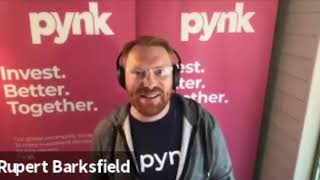
Rupert pitches Pynk, a zero-fee investing app that weights thousands of user predictions through AI to identify consistently accurate investors. The proof-of-concept portfolio returned 15% by early 2020 and 48% year-to-date during COVID, with 33,000 users growing 9.7% weekly. Revenue comes from selling anonymized prediction data to institutions.
Chapters
Thank you very much, everybody, for having me here today. We really appreciate it. As Jonathan has already alluded, I'm Reaper, and I'd love to talk to you about the multi-award-winning company that is Pink. We're a zero-fee wealth management app. And before I go into too much detail about what Pink is, I want to dispel any thoughts you might have about what an investment app actually actually is and does. Because with our unique technology and our unique business model, we've created an entirely new category of social investing, enabling people to work, learn, and earn together. So the problem that we're trying to solve is really very simple. On the whole, retail investors are pretty much usually getting screwed. Meanwhile, professional fund managers only really perform 3, maybe 5 years, and then implode. When we were putting together Pink, we thought that there must be a better idea. Well, that's, of course, where we come in. Our portfolio is controlled by tens of thousands of fund managers, our users, who all contribute to our proprietary AI. That then seeks out the experts with inside our community on a specified time on a specified asset. And we do all of that whilst providing access to this global portfolio for free to anyone, anywhere. Now, you might have heard about the wisdom of crowds, and John actually alluded to it at the beginning there, but our technology is kind of inspired by this, and it builds on its bias reduction techniques and proven forecasting methodologies. Our AI then dives into this to continually seek out either individuals or small groups within that global community that are consistently accurate. That's really important to remember. Now, we then use that data to decide who we listen to and who not to, and then we rebalance our portfolio for best performance based on that data. Now, we've been running our proof of concept portfolio since February 2019, and we returned 15% by February this year. And throughout COVID, we've already done an 11% return year to date, so we're pretty stoked about how well it's going to perform perform for the rest of this year. Our unique business model means that we can be free for anyone, any everyday investor that participates with inside our community. We use that data to drive and produce reports for tier 1 institutions as well as managing capital for family offices, generating significant recurring scalable income. And on the note of everyday people, that's where PINQ shines. We're growing at about 9.7% a week at the moment. We've grown to over 33,000 users on zero marketing budget, and that's because people buy into PINK— Invest Better Together. That is what they like. They want to work together to make one portfolio work the best for the whole world. So we're neither a place where you can go and trade your money into oblivion, nor are we a place where you could just stick your money and forget about it. We're right in the middle. We give you an alternative where you can participate without the overbearing responsibility of being correct on every trade. Now, this wouldn't have been possible without the amazing team behind PYNK. There you've got myself. I've been in startups for some time, and I've exited out of paper and ad tech in 2016. And then I've been supported by Seth, who's created a crowd wisdom product before and sold that in 2017, and our amazing Mark Borwick and Louis Stephan, who come from major financial institutions. Right now we're raising about £2 million on the convertible notes. And as John already said, we've raised a big chunk of that on our massively overfunded Seedrs crowdfunding campaign. And in August, we're opening up on Crowdcube, which allows US accredited investors to invest directly into the product. But obviously we'd be happy to talk to you. If you'd like to know a little bit more right now, head over to deck.pink.io and have a look at our deck. On there. But in the meantime, I'd love to take any questions you've got.
That was great, that was great, uh, Rupert. So, uh, a lot of questions coming in here in the chat. Keep them coming. So, uh, really quick, Rupert, and one of the first questions here is, is from David, uh, you know, a simple sort of— it's why does this product have a 0% fee, right? I think I know what the answer to the question is, but do you want to talk about why you guys designed the business with that model.
All right, so it's, yeah, super simple. We require data to outperform, and we get our data from people. So how do we give back to them? We give them a zero-fee product, and we use that same product for people who want to pay a fee, who don't want to give data, and that's typically institutional or family offices or that sort of stuff.
Yep, makes sense. And how are you guys— and this is a question for me, and keep the questions coming in the chat— How are you guys reaching these family offices and some of those organizations to get them onto the platform? I mean, you guys are obviously showing really good returns, but how are you acquiring those customers?
So that's actually the second part of our business model. So we start by delivering data. So we give them feeds of either our AI or our raw predictions. It's all anonymized. We never give any actual user data out. But we give them feeds about what the market might be doing. So, for example, we know that predictors in Sweden are very good at predicting the price of gold. So we sell that as a, as a feed. What that allows us to do is to create a stronger bond and relationship, especially with the tier 1 institutional banks, so that they can see our performance and how good our data is and how well we're performing over time. And so once we've got that track record, which we're really expecting kind of year 2, year 3 to be able to have a long enough track record that they are comfortable putting larger checks. And those, those checks in our world look like about $100 to $200 million.
Nice. And did I get this right, that you guys, uh, year to date this year are at 11% on the return?
Correct. Yeah. So that's in our main thesis product. So that's the one that everybody can invest into as a retail investor, but also as an institutional. And then we've got some other individual products. And I think, Jonathan, I was talking to Adair a few weeks back. One of our products at the beginning of this year is actually currently running at a 48% year-to-date return. That's based off the crash of COVID and we were able to forecast that, and we got on the right side of those trades.
Interesting. All right. So, and this was sort of a follow-up to this. So Mike is asking, you know, results in down markets versus performance in up markets. So if I could rephrase that question, I guess maybe it's like, you know, but by using your methodology, right? And I think we can all agree that the markets are going to be a little crazy for the foreseeable future.
Yeah.
Um, your unique methodology sort of, uh, can, can handle that, forecast that, uh, you know, why would you, like, why, right? How could you guys do that?
So, you know, being absolutely totally open and honest about it, we're better at predicting bigger swings than we are smaller ones. So if the market's moving sideways at a 1% or 2%, we tend to take an out-of-market position on trades. And this refers to some of our individual products that we sell to institutionals as opposed to our global thesis product. That's done the 11%. We tend to take an out-of-market position until we know for certain that something's coming up that we should get into a position for. That benefits us because it means that we're trading less. It means that we're losing less fees, which is a big problem in trading in general. It means that we're in the right position as and when those big opportunities come up. So a tumultuous time like now is actually great for us. But we've been through the quiet period as well. So the quiet period for us was 2019. So in 2019, we were only able to achieve only a 15% return. But if we hit that on a quiet period, then we are super, super happy, of course.
Yeah. And Hugh here is asking a question, kind of diving a little bit into the algorithms and the methodologies here. Like, do you guys wait different users or opinions, you know, as you're getting in, and how do you do that and sort of what's the thinking behind how you guys do that?
Sure. So best way to explain this is with like a user example. So John, you would come onto the product and you would forecast the price of gold. And every Tuesday, your price of gold predictions are particularly accurate when the gold is in a bear market. And it happens to be the summertime and some other factors that we'll look at that correlate. So when those factors all correlate, we know that your prediction is much more accurate than other users, and we're going to weight your prediction much higher. Now, that also works in the inverse. So we might find out that every Tuesday you are the worst predictor, but you're the—
That's probably closer to the reality.
But you're the worst in the right proportion that we need. So we will invert your answer in that— those those days. So what's not good for us is people that are middle and we kind of discount all those people generally, but there's always a correlation where someone is better on a specific asset in a specific time set in a specific market condition.
Makes sense. Okay. So I'm going to, I'm going to wrap up here with the final question for Rupert, but, but once again, Rupert's contact information is in here. As well. You're going to receive a video. Reach out to Rupert. They're doing some really cool stuff. His campaign was just funded almost 400%, got some new campaigns coming up as well. But, uh, but yeah, I guess, I guess what I would say, Rupert, is, is, you know, and I think this is a lot of, uh, this is a question that at least on the consumer side a lot of people are going to have, right? Like, the markets are getting a little crazy.
Yeah.
Um, over these next couple years, you know, what do you think is gonna give you guys a competitive advantage over, you know, a lot of these other fintech products, a lot of these other places that are trying to say, hey, put your money here, we're safer, like that kind of stuff?
Yeah, I mean, what we've always been focused on, and we've been focused on this from the start, John, is that the end of crazy valuations for fintechs and that the being able to just raise money on no product is over. We have the best product in the industry. We have the knowledge and the team behind it. But moreover, we have a sustainable business model whereby we're not reliant on just AUM figures. Our data is driving the value of part of our business. And then the other part of our value is our very, very sticky application. Where users don't only just come in and dump money, they come in and they are there every single day checking, being part of the community, being connected. And that's what's driving part of our valuation, backed up with our strong business model. And so that's what's going to drive us forward. And being a global platform, we'll easily hit unicorn status in the next 5 years.
All right. It's great optimism. I love it.
Not optimism, plan.
There you go.
¡Gracias!










