Quin AI Founder Interview: Gulsah Gulser on Optimizing eCommerce Revenue & Engagement
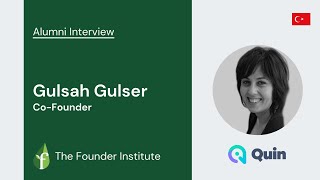
Gulsah Gulser left KPMG to co-found Quin AI, which uses first-party clickstream data to predict what online shoppers will do next. A Turkish music store got a 30% lift in call-center traffic. Retailers like Decathlon saw 20-30% incremental revenue gains.
Chapters
Welcome to this Founder Institute livestream. My name is Dustin Betts. I'm a community manager at FI, and I'm joined here today by Gussa Golfer. She's the co-founder and business development officer of Quin AI. This is an FI Turkey portfolio company that's helping online businesses to optimize their revenue and engagement. Gussa, thanks so much for joining us today.
Thank you very much, Dustin, for hosting.
Yeah, so before we, um, you know, dive into your company Quin AI, uh, the first question is, could you please, you know, tell us a little bit, uh, about yourself and your startup journey? What were the experiences of yours, professional or personal, that led you to founding this AI startup, uh, helping e-commerce businesses?
Yeah, sure. Um, so, uh, before Quin AI, I had a very predictable and structured life as a consultant in KPMG. Then, uh, we came up with this idea together with my Sister. And as we see the importance of predicting user behavior in real time, we have the ambition and the bold vision is to make, you know, easy and accessible machine learning to predict user behavior. And we always have that because, you know, all the AI technologies and streaming are improving in that direction. And we need to position the company there at the heart. And we started our journey in e-commerce as there are billions of available clickstream data and there is relatively less access to the real-time decisioning.
Awesome. I know a little bit about your company as an FI portfolio company that, you know, Quin AI, you're harnessing the power, as you kind of talked about, of individual or buyers' intentions from their their digital footprints, but please give us, um, you know, your short pitch for those who have never heard of it before. What is Kwinn AI?
Yeah, Kwinn AI is AI as a service to help e-commerce companies to automatically generate incremental revenue as far as 30% by understanding the real-time intention of visitors and taking, uh, action upon it.
Perfect. Uh, and so yeah, you're really helping other digital entrepreneurs who are in, you know, the online small business or small business owners with your solution. And I think the landscape for e-commerce and online sales, it's always shifting, it's very competitive. There were aggregator sites like Amazon, and now it feels like there's more competition or ability for solopreneurs and small sellers to build on top of platforms like Shopify. And then now, I mean, this has already been happening in Asia for much longer, but there's more shift towards like this socially native selling on social platforms. But with an e-commerce space that's always changing so rapidly, can you share with us just about some of the biggest challenges that your target users are facing in their own e-commerce businesses today?
Yeah, as you highlight, there's really a big, big challenge in that one, and it's getting harder day by day, not only because of this competition, but also changing, disruptive, but also due to disruptive changes like COVID also proved. And you know, these privacy issues around data and GDPR, third-party cookie laws. So there are a lot of things to consider while devising the future for the industry. And as you mentioned, the biggest challenge is mostly around, you know, the competition with giants, also with other channels that and relatively small players. So, in that sense, the key idea of Kwino is to understand the real-time intention in the session. So, what we claim is you don't have room to lose your customer when they come to your websites because once you lose, then it's getting really, really difficult to get them back or to inspire them again. So, that's why the real-time decisioning is really important in that sense. And you need to understand your visitor's intention in the context. And on top of this part of competition, like as COVID proves, past behaviors are not that important or relevant. So that's why we focus on the intention at the very moment. And as there are concerns around privacy and GDPR, We are claiming that focus on your first-party data and have control over it instead of relying on third-party data or, you know, other data sources. And there is a lot of room to do these improvements in the companies as we see, and especially for the relatively small ones, that is also easy because you have your clickstream data So you don't need to play with very big data, you know, issues or data lakes. So by benefiting your clickstream data, you could increase your value significantly.
Yeah, I want to kind of dive into some of those details of your solution that you sort of mentioned. So yeah, can you just explain a little bit more about why, you know, this particular solution with Quin AI? So this real-time predictive behavior to target. Can you just tease that out like a little bit more? Why that's unique or a good solution for these challenges?
So in martech, there are a lot of buzzwords, of course. And when you say real-time, the definition of real-time is really critical because everyone says real-time, real-time. But for us, the definition is understanding the real-time of the visitor in the context and act upon in less than 70 milliseconds. So it's really happening in real time. So what we tested with our clients is it brings a sizable incremental revenue effect and effective engagement. And so these kinds of models are becoming kind of affordable due to technology changes, both in AI and real-time streaming, because real-time streaming is also a very critical part of it. Because you have your own structured clickstream data and you need to make sense out of it. And with the algorithm, you need to work on it. And so, the accessibility part comes from here in this zone. And making it accessible is the critical way because industry is heading to this way. And then, you know, there are, of course, solutions, but they are heavy, not light, not productized. And not affordable. So making it accessible to the mass is really critical in that sense because all the data trends and analytics trends are heading to this direction.
Yeah, yeah. And I want to kind of talk about, you know, some of those, like the case studies, or you have some case studies published on your website about your customers. But I mean, when you're, as you mentioned, you're making it accessible for small businesses that are selling online, adopting these solutions can make a really big difference, right? So talk to us about some of the impressive metrics and numbers that some of your users have experienced through implementing Klin AI?
Yeah, sure. So as customer base, we could support relatively small ones, meaning that, you know, they have traffic around like 500K monthly traffic. And of course we can support the big ones also, but for small ones, as I mentioned before, they could immediately benefit from the first-party data and then they and act upon it, which we tested with number one music store in Turkey. And so with the COVID they have, you know, they had a relatively traditional model selling the music instruments through their concept stores. But of course with the COVID the online sales is becoming really important for them. And then there was a switch to that and they need to immediately act upon it. And that's how we started with them to test and to work on Queen. And we directed the, you know, the real buyers to the call center, and there is a big conversion rate, like 50% of them converted. We directed 30% more customers to the call center, and then out of them, 50% turned into sales. And with big accounts and relatively big accounts, I could say, like with traffic more than 6 million, 10 million, what we see as a big jump is as we can immediately understand the buyers and abandoners in real time and as the companies can act upon it, they can lead up to 20%, 30% incremental revenues. That's what we tested with Kingfisher's sister company, in Turkey, which is number one do-it-yourself online business, Koçtaş, and also Decathlon recently.
Yeah, those are some really impressive numbers. As somebody who used to have an e-commerce, well, I called it a startup and then it was a side hustle. I mean, yeah, those kinds of figures like increasing lead gen by, you know, 30 to 50%, and then that translating into, you know, 10% or more in increased revenue. Those are the kind of things that could have maybe convinced me to stick with my e-commerce side hustle for longer because they make a big difference for these online businesses. I understand that visitors to your site can currently fill out a short form to book a demo with your team at Clin AI. Are there other key features we haven't talked about yet or that you want to highlight here?
So the process is like really simple, like it's like very simple tech management, and then we collect data from the data layers, and then we immediately model it and then enable companies to act. And the whole process is happening in a very short period of time, like in a month you can deploy the product, and then, you know, see the results and then see it and experience it. And in terms of features, of course, we don't— as we predict user behavior, our behaviors are not just focusing on buyer or abundance, but there is very rich behaviors that we could say who is price hesitant, who is payment hesitant, who are good audiences for click and collect, and who could be the best audience for subscription because companies have different targets. Of course, the hard numbers conversion is number one mostly, but also increasing subscriptions and, you know, directing people to other websites and directing them to click and collect. So there is a lot of things that companies can do with Kwinn. And the most important, another most important thing is you can feed most of your communication tools, even your your, you know, web push tools or your recommendation tools or any of the, you know, uh, communication tools like a chatbot or call center. Uh, so Queen positions as, as the, you know, the smart algorithm of them all, uh, in that sense.
Yeah, yeah, definitely all kinds of opportunities, I guess, once you can understand your audience better to, uh, yeah, so as you said, like to direct them in different places or figure out who's the best fit for what product. Um, yeah, all of those insights can all fit into it as well. Really cool. I want to ask you to make a prediction here, which is just sort of about an extrapolation of the technology that you're currently developing and in your industry. So how do you think artificial intelligence tools and applications are ultimately going to change e-commerce over the next, say, 10 years from now?
Yeah, definitely. I believe that AI is going to make the things smartish in a way. It will help companies to market their website in a smarter way. And the number one step is real-time decisioning muscle that needs to be incorporated. And in data trends, we all see that like there is a tendency to operate with less data, smaller data with adaptive machine learning instead of, you know, relatively traditional models which are based on, you know, working on historical data and other things. So also the COVID proved this one, and also due to privacy issues, the another part of it is responsible AI, of course. And while you are doing all of them, you need to be careful with all of the GDPR, you know, and privacy issues. Plus you need to give the reasoning, which we, we see it in the explainable AI, because, you know, some people think it's the black box. So, um, trying to convert it to a glass box is, is a critical step, and going forward it's going to be a bold step for, for AI. And I think to maintain the trust, um, it will help every company.
Yeah, yeah. And it feels like, you know, tools like yours that are AI solutions that can plug into, you know, other, uh, you know, platforms that are using for their businesses. I feel like that is going in that direction, like in making it more accessible and less of a black box for people who are less technical. So yeah, you're part of making that prediction come true as well. So yeah, really good, really good prediction. What advice would you offer to an early stage or maybe even just an aspiring entrepreneur who's just getting started or even just thinking about getting started? Something you wish you knew before you'd left the big consulting, like when you were just kind of going into your journey, that you would impart on other entrepreneurs?
Yeah, sure. The most important thing is, I think, being resilient is very critical because it's really a tough journey. It's not an easy bit. And I have been a consultant and I was thinking the consultant's life is a challenge, but after this start of life, I'm like, oh my God, it was so easy. So yeah, that part is a big challenge. So, uh, but, but you need to be really resilient, and also you need to believe in what you do, and then you need to set your bold vision. And then the, the most important thing is your team and the, your co-founders next to you, because this journey cannot be done alone, I believe. Of course, I have a big, big, big, uh, you know, um, kind of admire to the solo co-founders, maybe respect, sorry, to the solo co-founders. But for me, it's really difficult. So you need to have a very good team and co-founders next to us. And then keeping the team momentum is very critical. And at the beginning, it's really difficult because you have limited resource and then you don't have money, but people need to believe in something, the vision, and then follow you. So it's, it's really important and keep that momentum. Is so critical. Getting feedback is very important from mentors, investors, customers, but also you should be really careful to filter them in a way because sometimes it's very confusing. And so, and focusing on the story and the vision, keeping it in mind, and then, you know, having a dedication around this really really, I see, critical at early stages. And for us, we, we were both first-time founders, so, uh, and I, I always like, uh, feel good having Efi next to me as a precedex later because, um, it makes the things faster in that way, uh, because it's, it's an, uh, it was an unknown world for me, a new world, and You both need to focus on your business, learn how the ecosystem works, you know, and everything. So it's so overwhelming, but at least if you have people around supporting you, that, that really helped us.
Yeah. A lot of themes in there about resiliency and building your resiliency through your team, like being able to like lean on one another. Um, it feels to me like it's in your case, how you're describing, uh, with your co-founder, like That resiliency element is very much tied to the team element and being able to lean on each other as you go through that journey together. Yeah, really good advice for I think any early-stage founder there. Final question I really have here is just where is Quin AI headed next? Are there any news you want to share with the Founder Institute community or ask for the audience who might be watching today?
Yeah, sure. So we are moving to the next step in a way, like we establish our company in the UK, and then we— UK is going to be our headquarter, uh, is our headquarter. And, uh, so, and the things are moving in terms of, in the, uh, from fundraising, uh, part, because that's very critical for us to make a step in the Europe. And, uh, there the momentum is, is good, I could say. And then of course the news will come soon. And, um, but then really is, uh, like every day you have some surprises, both negative and positive, but yeah, keeping the momentum up is really critical. And I could say we are with high motivation, keep going, and we'll come with nice news shortly.
Awesome. Yeah, congratulations on the new headquarters. Yeah, and making the move to the UK. So that's, yeah, very exciting. This has been really interesting learning about how AI tools are helping online businesses understand their customers better, and we're all really Looking forward to keeping up with Quin AI and where you're headed next. So, Gustavo, thank you so much again for joining us today.
Thank you for hosting. It was really good.










