SpaceTech Online Demo Day (4/23/2020)
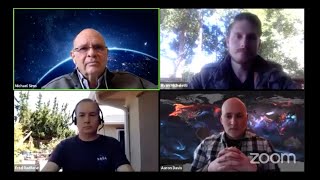
Three space startups pitched at the Founder Institute demo day. Ceres Robotics targets NASA's lunar program and wants $5M to build moon rovers. Beyond Earth offers small-satellite launches for under $1M with 24-hour turnaround. Mountain Aerospace is developing an air-breathing rocket engine that uses ambient air as fuel.
Chapters
We're good to go, Ryan. All right. Hello everyone. Welcome to the Founder Institute Online Demo Day. Today we've got really 3 great space tech companies that will give you a short 3-minute presentation about their companies. And we're going to do Q&A with the audience. So this is live. If you do have questions from the audience, please make sure you put it in the chat. Um, just really quickly, my name is Ryan Micheletti. I'm head of global operations for the Founder Institute. Um, currently we're enrolling a record number of founders in our programs across 180 cities around the world. Uh, you can see cities that we're enrolling in the program if you go to fi.co/enrolling. So, uh, if you're a founder who's interested in space, or even if you're a founder that's just working on a startup and you're looking for expert expert guidance and connections to our team here in Silicon Valley. We'd love to help you launch your company. Founder Institute is the world's largest pre-seed startup accelerator. Since 2009, we've created over 4,000 startup companies across 180 cities, and we have the largest mentor network in the world of almost 15,000 mentors. If you are an experienced entrepreneur or investor and you're interested in helping launch companies in your local ecosystem, You can go to fi.co/lead. So let me just quickly go over the agenda for today. So as I mentioned, we've got 3 really great space tech founders. And the context is that all of them are graduates and alumni of the Founder Institute Silicon Valley Advanced Tech Accelerator. And so we run a program, 14 weeks, where we help them build their companies. And so what you're seeing is really the culmination of several years' worth of work. And so we're going to start off today with, with Michael Sims. For those of you who are interested in launching your space company, please feel free to respond to any of the follow-up emails. We're going to be sending out the pitches and the recording of this, as well as our contact info afterwards. So if you're an investor who's interested in connecting with the founders, you'll have their contact info, or we can put you in touch with them. And if you're a founder that's just interested in connecting, or maybe you're a partner, then we're happy to connect you as well. So first up today is Michael Sims. So Michael is the CEO of Series Robotics. He's also a good friend. He has a very interesting background. I'll let him kind of dive in a little bit more, but he was a senior research scientist at Mars Institute, and he helped lead the Pathfinder and MER missions at the Jet Propulsion Laboratory. So Michael, why don't you fire up your screen and get ready for the pitch?
Okay.
So as Ryan said, my name is Michael Sims, and I'm CEO and founder of Ceres Robotics. Ceres went through the Founder Institute in 2017, and I just want to bring you up to speed on where we're at and what's going on. Ceres builds landers and robots for planetary surface. In other words, for the moon, Mars, and asteroids. And we have two primary products that we sell, one of which is landers, one of which is robots. And on the left-hand side of this picture, you can see a small lander, which is one of our early designs of a lander. And on the right-hand side, you'll see a rover. We sell those in the context of a contract for particular things. Those contracts in general run from $100 to $200 million for a lander. And for a rover, there's some reasonable fraction of that amount. So let's see, I'm not to get to that slide. In 2019, we were selected to build and fly the first commercial rover to the Moon. Unfortunately, the prime contractor canceled that mission, no fault of ours. And in 2019, we were also selected by NASA with a pretty impressive set of other companies, SpaceX, Blue Origin, Sierra Nevada, to bid to build the next generation of lunar landers. I want to take a moment and just look at a single slice of the market that we look at, and that slice is NASA's CLPS program, C-L-P-S program. CLPS is a $2.6 billion, 10-year program, and during 2020, CLPS will have 4 landers. That will be begun, started to go to the moon. And in every subsequent year after that, there will be 2 lander contracts begun for going to the moon. We will argue there's a high probability we're going to win one of those next 6 contracts. We— if you simply look at the numbers and look at the probabilities, you'll find that our probabilistic chance is 45% of winning one of those. We think we can bring that close to 1 with our effort. So for us, CLPS is a gateway program to other NASA programs, Department of Defense, international contracts to do similar work. I just want to take a moment and throw this slide up. I'm not going to— it's too small and too hard to read, but the only point I want to make about this is a NASA slide where they've laid out a future, and all those little dotty things on the bottom are rovers and landers, the kind of things we propose to do. Taking one element of what we do, a rover, we build that, we design that rover, we build that rover, we operate that rover. And a rover on a planetary surface is basically a spacecraft. And so it looks a lot more like a spacecraft in many ways than robots on Earth. We have to build the autonomous systems, the system that's controlling what's going on in that, and lots of that's autonomy. We also have a ground station at which we build which we control those robots and landers, and that has a great deal of autonomy in that as well. In the picture on the right, you see me participating in the control of Mars Rover in front of a hyperwall. So we were able to get where we are so quickly, really on the strength of our team. And I don't want to point them all out, but let me just take one. So I'll describe Jack Fox. Jack was Chief System Engineer the shuttle program at Kennedy Space Center and was the co-founder of Skunk Works at Kennedy. From an investment point of view, we're looking for $5 million to cover 18 months. That is going to build on our team, it's going to allow us to build the rover spacecraft, and it's going to build software all around that. That altogether is going to end up as being a a robot that we can sell either directly for landing on, on the planetary surface or as part of a package with our lander. We anticipate that leading to $30 to $200 million in sales over the next 2 years. So I just wanted to end with a little picture of where we're coming from. We are all about humans becoming multi-planetary, and what can we do to make that happen? In this case, you see my favorite Martian with some serious robots. On Mars in an artist's rendition, just showing where we're headed and the kind of image we have of it. Thank you.
Amazing. So Michael, you've assembled a really strong team, which is, you know, probably one of the most important things when you're working on these large government contracts. So we have some space entrepreneurs here on the webinar today. So given your vast experience working with NASA, securing these lunar contracts, do you have any advice for early entrepreneurs in the space industry on how to work with NASA? Have you had any lessons learned over the years on best practices?
Yes, and we are an unusual company, so I wouldn't necessarily use us as a particular model. We're unusual in that we focused exactly on space missions. As opposed to having a great deal of effort on Earth-based proof of those, Earth-based verification. We did that because we had a huge amount of experience on the team on Earth-based activities and on space missions. But for most startups, it's probably best to look at things like SBIRs is beginning, look at all the NASA releases of contract programs. And it is definitely an easier game if you know the people to be in contact with, or if you know someone that knows someone to be in contact with.
An even greater argument for having a very strong team with the right connections. So Tim asks, what are the requirements to bid on government contracts, and specifically how much general liability? I think he's referring to the insurance policy.
Yeah, insurance policies aren't a particular big deal of it. Certainly there are many classes of government contracts. So if we just take NASA for a moment, The primary entry program for many people would be an SBIR program. Those, yeah, so I would say those are relatively small in the beginning, may not seem so, but they can get quite large over time. But there are many other classes of programs. You just have to find the right references, and you can go to nasa.com and probably find all the pointers to the right places. But I would say, yes, you need insurance for your own benefits, but for the most part, when you're working with a NASA program, NASA self-insures.
Yeah, that's great. And, you know, referencing SBIRs and STTRs, that's something that the Founder Institute Advanced Tech Accelerator can help you with. So if you're interested in, you know, getting some government grants, you know, we can help you with that through the program. Eric, you have a question and a comment. You say that a lander is more than a $60 million SpaceX rocket. What is being done to reduce costs?
Yeah, it's a great question. And it's— the reason the CLPS program exists is for the government belief that if they allow the commercial companies more latitude in what they do, that they can bring costs down. And there was a long-term lunar program called GLXP, Google Lunar X Prize, which was totally designed to bring costs down. But the $60 million or so that a launch vehicle costs you is sort of the starting price for any large mission. So you begin above that, and then the question is, how do you bring down prices? Our approach has been, and it's one I recommend, is we know incredibly well what all the steps that are done are, and we proceed from there to reduce the cost across the way. That's not always the best approach. Sometimes other ways work. But for example, if you look at orbital LEO, effort, the launch cost has gone really cheaply and people have found very innovative ways to decrease costs there. That will eventually move to GEO, so for geosynchronous orbits, that sort of strategy will move, and eventually to outer planets. But that's not where— we are part of the program trying to bring those costs down.
Ricardo asks, is it better to start thinking about a particular mission or just start developing tech for rovers if you're getting started as a founder?
It's— from my perspective, it's most critical to have a vision of where you're going, right, as opposed to it being a specific mission. But for our case, it is we want to do whatever we can do to enable humans to become multi-planetary.
And we believe—
we do robots because robots, we believe, are the fundamental lever in making humans capable of doing that. Another lever is launch cost, but other people are working on launch costs, so that's not one of the things we're decreasing. We got into landers because— partially because the program we were in before was canceled, so we decided we could take our own destiny in our hands and build our own landers, and we had the engineering where withal to do that. So we've gone in that direction. But I think, I think if you have a technology, which is important, it's often the first step that one needs in order to get going and get started.
Yeah, very true. So Alex asks, how does Ceres Robotics compare to Europe and Asia-based projects? Such as iSpace and Spacebit?
Yes. So I can give a reasonable comparison to iSpace. iSpace was a Google Lunar X Prize company that was— is a Japanese— initially a Japanese company who got substantial investment backing. And iSpace also has a European office in Luxembourg. Our approach is different for sort of— in many ways, we're trying to do the same things, build robots and build landers. We have— are now part of the NASA CLPS program, which unfortunately implies— it requires you to be a US-supplied company, US company. iSpace, I don't know if they have a US subsidiary, but they didn't initially. They partnered with other companies. They partnered with Draper Labs, and Draper being the prime on there. And so they are still part of the CLPS program as part of Draper Labs' CLPS effort. Draper also works with us on other things.
Great. And I see a lot of people are using the raise a hand feature in the webinar, so just make sure you're putting your questions in the chat and we'll sort them and ask the panelists. So another couple questions here. So, Aaliyah, you say, at the beginning of the project, how could you pay the expertise to join the team? Were they full-time? So how did you recruit this all-star team that's helping with Ceres?
So we began first, myself nor our president of our company yet received any compensation. So that sort of is part of that. It helps a lot when you're not getting paid, right? So that allows you a lot of lever. To work with. But in addition to that, initially people were brought on, specifically chosen for their expertise, but brought on to participate for equity as a function of time. So they were— there was a vesting process for their equity, and they worked, some of them, extremely hard. We now have investor capital that is paying some salaries. But that's— yeah, it's— you really have to— you have to sell the dream to everyone you're talking to.
So, all right, another question from Nestor is, you mentioned that you're focused on space missions, not ground verification. What exactly does this mean? Because it sounds like you won't be testing much on the ground, but you must test the robot somehow. So are you depending solely on verification by simulation?
No, it's a great question. So it's a— there is a lot. I used to be part of the NASA committee at NASA that funded research, both internal and external, in robotics. Autonomous systems in NASA and all of our contractors. And I can tell you that there's a huge amount of work to do out there that is very specific, but it— and it can lead to careers, it can lead to labs being quite substantial and going on for long periods of time. We chose to very laser focus on going to flight. And the reason for that is twofold. One is we've been in this game. We'd known this was the right game to play for probably 30 years, right? And the time wasn't right to do it. So in that time, we spent our time investing and working, myself and other team members, on ground missions and also small parts in other missions. But now the wave is changing. We think the time for surface robots is right now. And that time, depending on the domain you're working in, that time may be present or it may be past or it may be in the future. For surface robots, I'd say it's right now. And most of the technology we're building on is well-understood technology. We have to tailor those to the problems we're addressing, but in general, the robotic technology we demonstrate on Earth is from, say, a software mechanical point of view, is often very advanced relative to what we can fly in space.
Great. And then one final question, and we'll move on to the next person. So how do you approach investing when thinking about aerospace companies? Are you seeing more space tech startups coming out of the emerging markets?
Yes, yes, there's a number. In fact, there's a number of programs, including FI programs, where they're— which are intended to accelerate space-focused programs. And yes, there's quite a few that are coming out. Investment is opening up, although I wouldn't say it's flowing, but it's, it's there. And it's hard to know how the current pandemic is going to affect all of that, at least hard for me to know. Um, and, but yeah, I see a number of companies coming out. I think it, I think it's, it's the right time. I think humans are going to become multi-planetary. This is an event on the scale of tens of thousands of years. The last time we did anything of this scale, last time we did anything at a scale was the humans moving into North America. So we We are at an epic point in the history of humanity, and I think it's a good time. But if you're in your particular technology, like robots on the surface, if you were 20 years off commercially, it would have been hard to make it. So one has to be sensitive to the timing fitting the demand.
Yeah, what a beautiful vision. So Thank you, Michael. If you do have further questions, use the Q&A feature where it can be sent directly to us. Unfortunately, there's some trolls in the chat, so we turned that off. But let's move on to the second pitch. I'd like to introduce Fred Radford, the founder of Beyond Earth. He is also a Silicon Valley Founder Institute alumni. And Beyond Earth is a mobile launch system for the small satellite industry. So Fred. Why don't you take it away? Oh, you're on mute, Fred. Looks like we're not able to unmute you. Maybe you need to unshare your screen really quickly. Can you hear us?
Yeah, that doesn't seem to be working.
There we go.
All right, let's try this again. Okay, okay, you ready?
Ready to go. Yes, I'm Fred Radford and I'm the founder and entrepreneur Sorry, you got to share your screen again. It's not showing. I'll let you know when it pops up.
Okay, thank you.
Here we go. All right.
Okay. Can you hear me? And can you see the screen?
Ready to rock and roll. Take it away.
Okay. Finally. Okay, great. So yes, I'm Fred Radford, entrepreneur and founder of Beyond Earth. And what we do is we build rockets that allow you to launch your satellite into orbit effectively for zero cost. Our customer profile is around NASA and SRI, Hawkeye 360, and of course CubeSat companies. And we already have 7 letters of interest for our rocket launch system. The team is built up kind of like what we just heard about from Michael around aerospace entrepreneurs that are really focused on the timing and when is it the right time to be able to produce these kinds of features. And so, for example, I've been launching rockets for 20 years, and Gary owns a solid rocket manufacturing company. The problem that we're addressing is that there's a huge amount of lost time-to-market revenue, because after a satellite is completed, it can take 12 to 18 months before it's actually launched and you start producing revenue from it. And for research missions, this isn't such a big deal, but now that we're seeing all these entrepreneurs creating commercial or commercial satellite companies, getting a return on your investment is much more important. And you see the cost per kilogram coming down for the large missions, but it hasn't started to come down quite as much for the microsatellites yet. In fact, most rideshare missions are still costing around $30,000 a kilogram. So what we need to do is work on getting that down as well. And our solution is a customer-focused, dedicated, on-demand launch-as-a-service for microsatellites. Basically, the launch can be free. By launching 4 to 12 months earlier than a rideshare mission, it can pay for itself in time-to-market revenue. It also has the advantage of having custom orbits, no coordination with other payloads, and a total cost of under $1 million. We do this with an on-demand solution with ready-to-fly rockets, little notice, as low as 24 hours, and you can change the launch window whenever you want. Our secret sauce is the intersection between this low cost, the on-demand nature, and being able to focus on dedicated missions. Our business model is similar to NetJets, where we have a reservation of 10% to get the nose cone and start the integration, which can happen months and months before the launch, and then you pay the balance, 90%, when you're ready to do the launch. Because of this, we actually are projecting revenue prior to orbital launch of 2022 revenue of just over $1 million by selling the payload modules. We were formed in 2018. We have 7 letters of interest. We just finished the preliminary design on our first vehicle, which is designed to send 30 kilograms to 400-kilometer sun-synchronous orbit, and we're ready to start manufacturing. When we analyze the market, everyone knows it's very large. We did a bottoms-up estimate for the 30-kilogram market by 2028, found that 75% of satellites by quantity will be in that range. And we estimate about $1.4 billion in serviceable, attainable market for 2028. Obviously, there's competition. This chart is showing that we're on the— from left to right on the dedicated side and from bottom to top on the fast response, 24-hour turnaround time. So SpaceX is great if you need to send a school bus up, but not so great if you need to do something quickly. We're raising a $2 million seed round for the next 12 months. The proceeds will be used for creating the first vehicle prototype, doing regulatory approval, and getting our launch and ground systems operational. Thank you.
All right. Thank you, Fred. First question comes from Tori. Hey, Tori. Fred, I would love to launch a small enclosure with one of our pill robots to test the propulsion system in a weightless environment. What would that process and timeframe look like if he were to use your company?
Right. So we are at the beginning of the development phase. We will not have an orbital launch until 2023, 2024, which from a hardware standpoint or software standpoint sounds like it's a long time, but from a rocket company, it's about one quarter the amount of time it normally takes because we are using existing technologies and building on getting to orbit and not necessarily reinventing things or creating new engines and things like that. For your pill robot specifically, we do have space validation as a new market that we're exploring and like ramping up. So if there's a value in being able to do something this week for $1 million, then we're the best solution for that. Again, it would be 2023 timeframe. Other thing is that if you have other organizations that want to do space validation, you can get together and build the payload module out any way you want and put it together. But for some of these really larger missions, they're in the hundreds of millions or billions of dollars, being able to do a space validation in a week for only $1 million is a really good value proposition. I'm not sure how it fits in with your robot validation.
Yeah, and Tory, in addition to that, you know, through the Advanced Tech Accelerator, we can connect you with the International Space Station where they do these types of experiments on the International Space Station all the time, and they can help do it for free. So let's connect offline on that because I know that's, it's an area of interest for you.
Especially if you have the time, they can do it almost for free. Yeah, it's very, very cost-effective.
Yeah. So David asks, is there money to be made from the pre and in-mission datasets produced from the launch?
For the launch vehicle itself, not so much. I mean, there's a little bit that can be used primarily for defense from analysis of the launch profiles and the trajectories and things like that. Really, most of the data, most of the value is really coming from the satellites that are in orbit. What we're trying to do is make innovation happen in orbit a lot quicker, on the order of months instead of years. So we're kind of selling the shovels, not necessarily saying that we're going to be selling the data. In fact, if you look at the If you look at the FAA's market for the space economy, last year it was $355 billion. Launch was only $6 billion of that. And that's because if you can launch something for a billion dollars, you'll actually get $15 billion back in revenue from cell phones and television and all the geospatial data. So really that's where the return on investment for the satellite companies is from a data standpoint, not necessarily on the launch vehicle, but much more on the communications and the imaging the satellites are providing.
That's great. Andres asked, can you clarify how the launch is free? So in the very beginning you had the launch for free.
Yeah, so here's the current problem is that you build a satellite and it takes you X number of months, let's say 9 months to build a satellite. And oftentimes the first thing you do when you start building the satellite is contact a launch provider and say, How many amps do I need at 28 volts? What kind of payload adapter? What FAA or FCC frequencies am I allowed to use? Because you have to start doing all this negotiation way, way in advance. But even after you get all that done and you're spending all that extra time that's not on your product, you get your satellite finished and it has to go for integration after it's all been tested. It has to go for integration and waiting, and the prime payload might get delayed. And so all of this is putting a timeframe in where there is the schedule that is between 12 and 18 months on average. Bryce just released a study, I think it's 2 days ago, 3 days ago, that the average delay for the small satellites— this is delay, this is not even the scheduled— is 128 days. So if you take the schedule of having a delay of 4 to 6 months and an average delay of another 128 days, you see that What's happening is that there's this hidden cost that no one is tracking. Because in a research project, if it goes up this year, next year, or the year after, it really doesn't matter. When you're trying to make revenue off of your small satellite and you're gonna expect $100,000 a month or $250,000 a month, every month that you're not in space and generating revenue, you're losing money. So if you're making $250,000 a month and you get up only 4 months sooner, you've just paid for the launch. It's effectively free. And if we get you up 8 months sooner, we actually made you $1 million. And if we get you up 12 months sooner, now you're $2 million ahead of the game. And in this environment where you have, uh, trying to reduce the risk of startups, being able to get time to revenue is very important. I hope that answers the question.
Great. Um, Alex asks, where are you planning on launching from and how does this reflect your margin?
Right. So we're a mobile launch vehicle that can be launched with a team of 5 people. So the pandemic of people having 10 or more groups doesn't affect us. We can actually still keep launching. The entire system fits in a 40-foot shipping container and can be taken anywhere in the world and launched from any place that we have permission from. Being a US company, we need FAA permission, and there's 38 spaceports that we qualify for. For this. Initially, our launch location will be Wallops. They're very well known for knowing how to launch a large quantity. They launch 16,000 sounding rockets. And we're very small. We're doing 30 kilograms. So we're just about twice as big as a sounding rocket. But also Alaska and in Southern California at St. Nicholas Island will be the initial launch locations. But we can launch in New Zealand, the new Brazilian site, all these places because we don't really need any infrastructure. We can show up and within a matter of days be ready to launch.
Great.
One final question here and then we'll move on to Aaron. If it's launch on demand as a service, how long does one rocket take to build or do you have a stock of rockets ready to launch?
Right. And that's part of what I was talking about with the secret sauce of being on demand. Most of the time when you build When you buy aerospace equipment, whether it's a jet or a rocket, you sign a contract and then the company starts building it. Because we have founders that understand how to build commercial solid rockets and vehicles in advance, we're really taking it and flipping it on its head. So it's much more of a going to a Toyota dealership and picking out a car that's already assembled. By doing this, you won't be paying for something that's built far in advance. The reason we can build these in, in advance and have them staged and standby is that they are small and they're much less expensive than having to build this huge infrastructure out there. The idea is that by having 10, 15, 20 at each of the launch sites, whoever needs to launch can launch on very short notice and pick whichever one's available. It doesn't have to be a named vehicle anymore. It can just be whichever vehicle is available to you. And that's kind of how we're kind of changing the game by being able to pre-build these rockets in advance.
All right. Thank you, Fred. Great pitch. Next up on our final pitch for today, I'd like to introduce Aaron Davis, CEO of Mountain Aerospace Research Solutions. They're developing the world's first air-breathing Fenris rocket. Aaron is a Marine and previously a security consultant. So Aaron, why don't you take it from here?
All right, everybody see my screen?
Yep, ready to go. All right, maybe share your camera as well.
Um, let's see, one thing at a time. Hello, my name is Aaron Davis. I'm the CEO of Mountain Aerospace Research Solutions, and you can find us online at marsengines.com. I'm going to talk about the ultimate tool for social distancing. Air-breathing rockets. A little bit about us. Uh, much like the Wright brothers, our team may be small, but our impact will be felt forever. Scott is a master at his craft. He has worked for major aerospace companies. He has started companies and worked for startups. He also was most recently the technical director for the MEV probe. Uh, we spoke with 5 experts at NASA's Marshall Space Flight Center. They reviewed the data from our test, and off the strength of that call, Scott works for the company full-time now. Um, I know how to win against all odds. I worked in aviation in the Marine Corps. I served 10 years in combat zones as a contractor. I have a degree in intelligence with an emphasis in special operations, low-intensity conflict. I retired for the first time at 32 after leading over 1,000 successful covert operations with zero loss of life. I see space as the greatest opportunity for capital return in the history of investing. Um, the real problem is that our entire species is basically trapped on this planet. Current engines are 99% efficient, and with those engines and the best engineering, only 4% of your rocket is payload, and payload is the point of going. Our company has invented a new type of engine that will get payloads to orbit with a more reasonable payload-to-propellant ratio. This engine has minimal complexity with no internal moving parts to break or wear down. This is our actual prototype after the— our first test. Uh, here's a picture from test day, and even though this was a low-power proof-of-concept test, we still generated positive thrust numbers. This is how our engine works. Our toroidal combustion chamber pinches hot gases into a cone, which creates a directional bias. This draws in the surrounding atmosphere, using it as free reaction mass and propellant. Um, this engine has been designed and static tested. It is not just theoretical. We have achieved a breakthrough in propulsion technology. Our engine demonstrated the ability to pull ambient air in through the intake while fixtured to a test stand. All previous attempts at doing this require considerable forward airspeed, like ramjets, scramjets. You're talking Mach 3, Mach 5 just to even get them running. We have one patent pending, and we've already been issued one patent. And by using our intellectual property to acquire licensing deals, we can bootstrap into a dominant market position in just a few years. And if the current trend holds, the rocket engine market will grow from $3.8 to $7.7 billion in 7 years. This was before our engine, and we expect our engine to capture a good deal of this market in the near term. Um, this year we will begin testing our full-scale cryogenic version. This will proceed to flight test through the air column to gather data and measure overall efficiencies We will license our various engine configurations and produce engines for direct sales. This matrix shows our competitive advantage. We can get more payload to orbit for less than any other engine. Since our company is small, we have low overhead and a laser focus on our objective. This timeline shows how we got here today, from just an idea to a world-changing engine. We've been on the COVID of 3 newspapers, had 1 TV news spot on CBS, and an interview with Aviation Week. We're raising $2 million to eliminate bottlenecks and license the technology. This is a pure play on a fundamental new technology. Don't miss your chance to invest in the engine that can bring humanity to the stars. Thank you for your time.
All right, thank you, Aaron. Um, so just a quick question for you is, um, why is now the right time to, to build a space startup? Like in your opinion?
Well, for the first time, um, the tools exist that you can actually do it as a startup company and not as a major nation-state. Um, 3D printing— like, our engine's 3D printed. We're able to do this with just 2 people. I mean, building a liquid-fueled rocket engine with just 2 people, uh, that required the entire, you know, the entire— that required an entire government or entire nation-state behind you back, back in the day. So It's fairly considerable that things have changed to the point where the technology is really readily available.
So obviously, you know, you've proven this concept, you've done, you know, a test and had very positive results. And you've also had a lot of people review the test and the results and give you feedback on it. So maybe talk a little bit about sort of the third-party verification of of the science behind this? Because it's obviously a huge breakthrough.
Yeah, um, like I said, we, we got a test report together and we did a cold flow test, which is nitrogen, and then we did the hot fire test, which I showed some pictures of. We sent that test report off to 7 different experts. 2 of them are civilian and 5 of them are at the actual Marshall NASA Space Flight Center. Um, you know, great claims require great proof. We generated positive thrust numbers, we pulled in air through the intake, but we didn't generate the kind of performance numbers that are going to get us sales. That's why we're pressing ahead with a high-power version. And the only reason we didn't go high-power out the gate is we don't want to blow ourselves up with a brand new engine. But, um, we haven't received any type of feedback from independent experts that would disabuse us of the notion that this is a fool's errand. This is actually the future. Of space travel.
So going back to, you know, the fact that today, like, when you, when you send a rocket up, 96% of that weight is just propellant, it's fuel, right? And only 4% is payload. Um, what, what's your vision for the future? How can your rocket change that?
Well, I mean, in order to get to space, you need a lot of fuel and propellant, and you need the fuel and propellant to lift that. So the more of that we don't have to carry with us will translate directly into payload Uh, which reduces the overall cost. It makes your— makes your spacecraft more robust. You don't have to pinch as many pennies in an engineering standpoint. You don't have to make things as, you know, microscopically, uh, you know, you can increase your safety factors. What I want to say, I mean, it just— it just spreads the ability around for people to get to space a lot easier and with a lot lower cost.
So there's a lot of space people on, on the webinar today. Are you looking to expand your team?
Absolutely.
We're always looking for dedicated people. You got to have a passion for this though, because I'm already 2 years into this and it's a lot of hard work. It's rocket science.
Great. And Jerome had a question. He just wanted to clarify whether or not you're going to plan to license the tech and have someone else build it, or if you're going to build the engines yourself and sell them?
Um, initially we want to license, uh, and then do systems integration with our customers. Um, when we start generating some good licensing fees and whatnot, we're going to bring some of that technology that we upstream from our licensing deals in-house and start manufacturing our own engines for those who lack the capability but have monetary ability to purchase them.
Got it. Aditya asks, "Given that this is completely new technology, how long do you think it will take for you to make a high-power engine and get certification to launch? Will that $2 million be enough to get you to that next stage?" Well, we're also going through SBIR, so we're tapping external funding resources.
We're also looking for investment. We will have a full-power cryogenic engine full size to test this fall. We're hammered down on this. We will get there. Um, flight, that's a different matter altogether. We have to integrate into a launch vehicle that is designed specifically for an air-breathing rocket, which does not exist right now. So that's going to take another couple months to come up with that, just for a small test vehicle. Um, and, you know, $2 million would get us most of the way there, but it's not going to get us all the with her.
Great. Another question, Tori asks, Aaron, with $2 million, are we going to see a flight article?
Like I said, we could get to flight with $2 million, especially with some assistance from SBIR. But, you know, aerospace is spending, you know, we're not sure how far we can pinch our pennies and how far we can make it on what we've got right now. But we're pretty, I'm, I'm confident that we can get to a full power test, and, and a static full power test is, is pretty, pretty important at this point because we need to fully, um, fully understand what we're dealing with here because it is new, you know what I mean? We have to get some test hand time before we start putting something in the air.
Okay, Jerome asks, can this technology work in the aviation industry? So not just for rockets in, in space, um, such as like the new Concorde?
Yeah, I really see this replacing long-term commercial, uh, flying applications because, uh, suborbital hops are much faster, a little bit tougher on the human body, but you can get anywhere in the world in just over 45 minutes to an hour basically. And I really see this as the way forward. It's more efficient than flying a giant tube of people for 20 hours. It just, it's just better.
Um, so Eric from Facebook, because this is on, uh, Facebook Live, um, he asks, what's your solution for a lack of atmosphere?
All right, so once we get high enough where there's not enough air pressure to be beneficial, we just close the intake and run it like a normal liquid fuel rocket for the rest of the way.
Okay, and, uh, one last question here. Um, Ivan asks, Aaron, what is the specific impulse of your prototype?
All right, we have a specific thrust of like 539 seconds. Uh, specific impulse was something like 10. It's not very much because, I mean, because you're also dealing with an air breather. We weren't able to get good data on our, um, pressure transducer. It failed during the test. So we were able to do specific thrust, not specific impulse. And it's not really an apples-to-apples comparison either when you're going like Oh my gosh, there's like 300 ISP on the Dragon or the Raptor engine or something like that. You're like, oh my gosh, it's not apples to apples because we get to use the atmosphere.
Okay, great. Thank you. So if you could stop sharing your screen, I think we'll prepare to wrap up. For those of you who are participating in viewing the webinar, you can learn more about the Founder Institute by going to fi.co. As I mentioned, we have a great partnership with NASA Ames and the International Space Station where we are helping develop new companies that are in the space industry. We're going to be launching a Silicon Valley virtual program, so no matter where you are in the world, we can help you build a space company. So go to fi.co/enrolling, or you could simply reply back to any of the emails that we're sending, and we can, we can connect and set up office hours. So myself, other team members from our HQ team will be able to set up office hours and discuss your companies. I would like to also say that this recording and also the contact information for the panelists today will be sent to you in a follow-up email. So if you do want to get connected again, you can just reply to any of our emails, say, hey, who is the Fenris Rocket guy? I'm interested in learning more, and we'll make sure we connect you. So I want to give a big thank you to the speakers today. We're super proud of the work you're doing. Very big visions and really great teams here. So I want to thank everyone. And we also have multiple webinars. If you're a founder not in the space industry, you can join any future webinar by going to onlinestartupevents.com. And you'll see a variety of different topics that we cover from weekly pitch sessions to more demo days like this. And I'm just really happy and honored to be here with everyone, and, and thank you for your time. Have a great rest of your day and good luck.










