In this presentation Clare McTaggart, founder of SquarePeg, outlines the company’s vision for an intelligent, personalized job‑matching platform. She begins by highlighting the shortcomings of current hiring systems—high turnover, candidate dissatisfaction, and a growing emphasis on diversity and fit over salary. SquarePeg addresses these issues by collecting rich data through custom, psychology‑backed assessments that capture hundreds of attributes (skills, preferences, personality) for both employers and job seekers before any search begins. This data fuels a matching engine that uses natural language processing, machine learning, and deep industrial‑organizational psychology to generate curated candidate batches (5‑10 per role) and job recommendations, accompanied by transparent analytics explaining each match. The platform parses resumes and job descriptions in under 30 minutes, integrates with applicant tracking systems, and delivers all communications through its interface. McTaggart differentiates SquarePeg from crowded job‑board and assessment‑only solutions by emphasizing behavioral matching and adaptive assessments rather than simple filtering. The business model is a monthly subscription for employers, targeting business‑generalist roles (marketing, sales, communications) where soft skills dominate. The company has a beta user base of 6,000 job seekers and 40 corporate clients (including BBC, Lord Abbett, Audible). The team combines management consulting, recruitment, leading US personnel‑assessment psychologist Dr. Highhouse, and data‑science expertise. SquarePeg is preparing a seed funding round to scale the platform.
Chapters
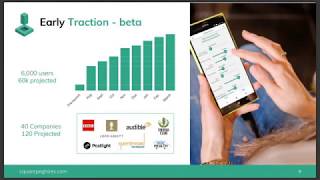
Hi, I'm Clare McTaggart. I'm the founder of Squarepeg. We are a platform for intelligent job matching. So I'm just going to pull up my slides. Okay. So the future of hiring will be intelligent and personalized. Online platforms are going from the initial model of searching and filtering through long lists of results based on keywords to smart matching and recommendation systems that learn as they are used. Square Peg is curating the job matching experience for both employers and talent based on fit. So why does this matter now? The current systems really aren't working for either side, so the problem is acute. For employers, nearly half of new hires are considered a mistake 6 months into the job, and 80% of job seekers think that job boards are painful. Also, our priorities and values are shifting, with employers caring much more about diversity and job seekers actually ranking fit as a higher priority than salary for the first time. We also see big data, machine learning, and AI entering HR for the first time, and job seekers wanting a more personalized experience. So how are we different? Square Peg's approach starts with the type of data that we collect through our unique assessments, which go well beyond the resume or the job description. Our custom assessments measure hundreds of attributes from skills to preferences to personality, and we measure that for both companies and job seekers. We also do this before the job search or candidate search begins. So essentially you take an assessment, we learn a lot about you, and then we send matches directly to you that are highly curated for the role or for you as a job seeker. We also include insights with everything that we do, so that means unique analytics. We provide free reporting once you take our assessments. We also provide a lot of match analytics to understand why you might be a good match for a particular company, or this candidate might be a good match for the role, and we provide transparency analytics throughout the process, which most other companies don't do. So here are some screenshots of our platform, but in terms of our assessments, we are working with the leading psychologists and data scientists scientists to make smart and adaptive assessments that look at all different attributes. Also, our personalized matching uses NLP and machine learning, so our recommendation algorithms get smarter with more use and the more data that we get. In terms of our insights and our communications, everything is done through our platform, and we also integrate with applicant tracking systems. So in under 30 minutes, we can actually parse resumes, parse job descriptions, and assess both the job seeker or a hiring manager and their existing team. We'll look at these hundreds of indicators which will inform our matching algorithm so we can do highly personalized matches, giving somebody a batch of 5 to 10 candidates versus a long list of job applicants. So how are we different? Essentially, the most crowded part of the HR tech landscape is in job boards, which are using resume data to basically do high-volume matching. There are also lots of assessment tools. They act more like a filter, so they don't actually source candidates and employers, but once they're sourced, they just act as a filter. This has impacts on the type of data that they get and their ability to connect. Some of the smart tools are similar to Square Peg in that they're leveraging natural language processing, AI, and machine learning, but what they don't include is the deep IO psychology and behavioral matching. Our business model is essentially a subscription for employers on a monthly basis. And in terms of our job seekers and our target candidates, we focus on business generalists. So not technical hires where a skill or coding requirement might be better, but actually where soft skills are really important. This is like marketing, sales, communications. We launched our beta this fall and we have currently 6,000 users who are actively looking for jobs on our platform. They're getting their jobs sent to them based on their assessment results. And we have 40 companies that are working with us, including the BBC, Lord Abbott, and Audible. Our team is made up of people from business, science, and technology. I come from a management consulting background, but also spent 4 years running a recruitment team. Dr. Highhouse is our chief psychologist, who's one of the leading US experts on personnel assessment. We have a team of psychologists working under him. On the technology side, we leverage a lot in data science, where we are focusing on machine learning and natural language processing. So that's a quick overview of us. In terms of where we are, we're moving soon to our seed round of funding, and that's it. So I think my contact details will be shared. So thank you.