Start 2026 Fundable: Pre-Seed Funding AMA with Founder Institute
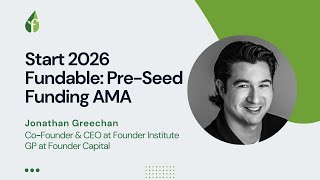
In this live AMA, Founder Institute CEO and Founder Capital GP Jonathan Grecian walks attendees through 2025‑2026 fundraising trends, investor sentiment, and practical strategies for raising pre‑seed and seed capital in 2026. He explains how the post‑pandemic market shifted from startup‑friendly to investor‑friendly terms, highlights the rise of micro‑VCs, smaller early‑stage checks, and the growing importance of AI‑driven efficiency and bootstrapping. Grecian presents the FI Startup Fundraising Benchmarks (global averages for pre‑seed, accelerator, seed, and Series A metrics) and stresses that traction—revenue, users, LOIs, or strong team—is the primary driver of investment. He offers concrete fundraising advice: raise only what you need (+20% buffer), de‑risk the next round, expect many rejections, and craft narratives that match investor focus (problem‑solution, vision‑opportunity, team). The session also details Founder Institute’s program tracks (Validate, Launch, Traction), the post‑core advanced accelerators, the FI Venture Network, and the Equity Collective warrant (2.5% future equity). Throughout, Grecian answers audience questions on metrics, deep‑tech validation, SAFE usage, VC‑investable characteristics, and founder‑led marketing, reinforcing the message that AI‑native operations and disciplined storytelling are essential for success in 2026.
Chapters
Hey everybody, happy holidays. My name is Jonathan Grecian, co-founder and CEO of the Founder Institute, and also a general partner of the Founder Institute's new venture capital fund called Founder Capital. Maybe not the most creative name, but we thought it was fitting for what we do at FI. Thank you all for joining, taking your time during this holiday season to join. I know that there's probably a lot of different things you could be doing at this time, so do appreciate that you took the time to join me today on this event. So this is a live event, and with any of these live events, we love to create as much interaction as possible. So I already see, well, a lot of the stuff that I'm seeing in here are the AI recording things saying hello, hello. I guess that's the world that we live in now. But I'm seeing here Yeah, you joining from New York City. Welcome. Yeah, you. I grew up in White Plains, New York. So just north of New York City. I'm a New Yorker originally. Now I'm based in Colorado. Seeing some other people here from Bulgaria, from Istanbul. Hello from Connecticut. My mother, Narayan, works in Stamford, Connecticut, actually. Calgary. Hey, Lauren from Calgary. Okay, so we got a very international group here too, which is awesome. A couple of things today, guys. What we're going to do is, and I don't think we actually have— oh no, we do have the Q&A enabled. Okay, so a couple of quick housekeeping items. So yes, and I already see some stuff coming in here on the Q&A. But this recording or this event will be recorded. Okay, and the event's gonna go like this. I'm gonna spend a little bit of time talking about the 2025 to 2026 fundraising trends, talk about some tips on how you can raise funding in 2026, and then honestly go just very quickly into how FI can help you do that if you do choose to go that route, and then open it up to an AMA on anything related to fundraising, Founder Institute, entrepreneurship, my dog, whatever you guys want to talk about, I'm game. Okay, now, and I see here too, JR from Westchester, awesome fellow Westchester native. So lots of people in here. So here's the deal, guys, if at any time you have questions, okay, and please don't be shy, you can put them into the chat. Or probably the more efficient thing would be to put them into the Q&A, but you can also put them into the chat as well. And then we have a member of the DFI team, Casio, who's also in here, and he is going to be kind of feeding those questions to me on a Google Doc. We're super, super high tech here. So, and I will get to all of those questions after the short presentation, but hopefully I can share some some knowledge with you guys before that, and then we'll get to all of your questions. I'm going to try to wrap up this presentation in about 20 minutes because I do want the majority of this event to be just more of an AMA format and talking about, yeah, just all of the challenges that you guys are seeing specifically and how we might be able to help you raise funding in 2026. Okay, so to get started, I like to show this chart, right? So this was a chart by PitchBook, and this was using a lot of different metrics, right? PitchBook tracks a lot of these deals, and they would track the different metrics, clauses that were in fundraising agreements, things like ratchet clauses, which means that it's becoming much more investor-friendly, you know, and then other clauses that means becoming a lot more startup-friendly. And as you could see here over the last couple of years during this pandemic boom over here, it became extremely startup-friendly, right? Then we sort of hit this post-pandemic boom bubble, where then it kind of totally flipped as quickly as possible to investor-friendly, right? And that's the sort of graveyard that we've had the last couple of years, a little bit on the startup fronting fund. Now, you could see here, they haven't released this yet for 2025. But you could see where the, where it was going. And I'm pretty sure that when they do release it, we're going to be somewhere around here. Okay, and I like to show this chart because I think it just describes the general sentiment in the startup investor community right now. I'd probably classify as being cautiously optimistic. Right. There was a decent amount of money that was returned to funds this year. Right. It wasn't as many IPOs as people had hoped. It was much more the M&A market. There were a lot of acquisitions and we still— that's going to continue, right? Because it was part of these AI wars. There's going to be a lot of consolidation. And when there are acquisitions, that means that investors get money returned and that means that that then spurns more investment into the community. So I think it's— everybody's going into 2026 as sort of with this cautious, optimistic feeling. We do think that there's— there will be a lot of IPOs, hopefully, right, is more than we saw this year. But I think more importantly, the M&A market and the secondaries market is going to improve those things as well. Now, we just released, and this is a resource that we release every couple of months, called the Startup Fundraising Benchmarks, and you can see this at fi.co/benchmarks. And basically, from working with thousands of founders around the world at Founder Institute, our portfolio support team is seeing dozens of term sheets a month. We also have a venture capital fund, Founder Capital, so we're also looking at deals from that perspective, and we have a huge network of angels as well that we consult on these types of things. And we try to release the data that we're seeing across the different stages. Now, this was the first time that we actually broke the data out. We used to just have it as pre-seed. Now we broke it out into what we call accelerator stage. You know, you could also maybe call that like angel stage, but we thought calling it the angel stage might be a little confusing because angels also invest at the seed stage and later. Right? But basically, if you look at it like this, these are the metrics that we see are required to get funding at these various stages. Right now, again, guys, these are averages. These are, you know, basically just— and it's global averages as well, right? A lot of the data that you see around the world typically tends to be concentrated in markets like Silicon Valley, New York, et cetera. These are the averages that we're seeing on the deals that we work with, with all the founders that we, that we advise across the world. And a couple of different things here, and please guys, just go to this link because there's a lot of other interesting data on that page as well, and just analysis on what we're seeing in the funding market. But a couple of big things that I'd like to point out here is that number one, With all these AI tools, guys, it's like you're expected to generate some kind of revenue or at least show some kind of traction before funding. Okay. And that's been the case for a couple of years now. And as these AI tools become more and more powerful— sorry, I just spilled my coffee down here— as these AI tools become more and more powerful, it's going to become more and more of a requirement. So, you know, the concept of like a pre-revenue startup raising funding, does it happen? Yes, it certainly happens, right? But I would say that I wouldn't go into that with your strategy, especially if you're a first-time founder. Okay, a lot of the stories that you'll see out there, and yes, if a founder has been successful before, they have investors that'll just write them a blank doesn't even matter what they're working on, right? Because they believe in the founder. But if you are a new founder, first-time fundraiser, right, these are the metrics that you are going to want to push towards in order to raise funding. Because above all else, investors invest in traction, right? Not ideas, they invest in traction. And the traction is what I show here, right? And that's because a lot of times you're like, okay, well, what does traction mean? Obviously, it means a lot a lot of different things. If you're building an e-commerce site versus like some piece of hardware, right, obviously your hardware is not going to be something that you can, you know, release right away without funding, right? So when we look at things like hardware, you know, which I would have here under like deep tech, then it becomes more things like strong leadership, letters of intent, proofs of concept, things like this, right? But these are, generally speaking, the types of traction metrics that we're seeing are required to raise funding at all of these various rounds. And I'll circle back to these metrics again in a little bit when we talk about fundraising strategy for 2026. But definitely, you know, this is some of the most popular stuff that we release across our network for free, just because we're seeing all this data. So we're trying to help create some standards in the, in the stuff that we are in, and all the deals and the term sheets that we are, that we're seeing from all around the world. Now, when you look at what we've seen this year, and I have, you can see here on the right, right, that same kind of cadence of, okay, accelerator round of funding, pre-seed, seed, and then Series A and later, right? Founder Institute typically works with people at the earliest stages. So I'm going to spend a lot more time on the accelerator kind of first check, you know, side of the equation here, just because that's our market. And what we did see in 2025, which was super, super encouraging, okay, super encouraging. And you could see this was a reversal of a trend that we had been seeing across the last couple of years, is that we're going to have the most first-time financings in 2025 than we've seen in a very, very long time. And, you know, hopefully that this is projected right now, the pace. So, you know, 2021 is always going to be seen as an outlier year, but there's a chance that it may break that one. But this is encouraging. Okay, this means that there's being a lot more bets being placed into new companies. Right. And the tricky thing, though, is that when you look at this, right, contrast this chart with now this chart, because— and one thing I want to say here is 2025 looks really low, right? But this chart's only up to October 31st. So really, by the end of the year 2025, this number is ultimately going to be— I don't know if it's going to be less than 2024, but probably a little bit less, right? And going into this year, By the way, guys, not to like pat myself on the back or anything, but we were telling everybody that 2025 was going to look exactly like 2019. And that's kind of what we're on track for right now. Right. I like to look at 2019 as like the last time the venture market was somewhat rational before we, before we got into this whole post-pandemic craze. But now Yeah, so we are— it's funny because we have so many more first-time financings happening, right? But the number of deals is not necessarily going up alongside that. All right. And so we've essentially seen in the venture market is sort of like this barbell, right? On the beginning side of things, we're just seeing like more smaller checks, a lot more micro VCs and angels. Our sister company VC Lab also launches venture funds. They've launched over 850 new kind of micro VC venture funds over the last 3 years. So the growth of these venture funds is still continuing and we're continuing to see that happening more and more. You're seeing a lot of new models where angels and accelerators and micro C investments will go as low as $10,000, right? So again, it's more smaller checks. It's kind of, you know, instead of the strategy has been, it's like instead of getting to people and waiting for them necessarily to have a ton of traction, you give them a really little bit of money in the beginning, see what they do with it. If they prove themselves, then you sort of double down and double down and double down, right? And this is a trend. It's a strategy that we also use at Founder Capital where our initial check into companies is typically $25,000. And then we could do a follow-on of $150 million after that, you know, if some of the metrics are met, you know, from the plan of that initial financing. So this is something that you're seeing a lot as well. And really, these more, the smaller checks too, on this side of the game is being driven by AI and then just this whole capital efficiency movement. That has just really been the name of the game since the kind of the frothiness of the bubble that we've been coming out of the last couple of years. Now, when you look at the seed rounds, right, this is where it sort of flips in the accelerator and pre-seed. You know, you're seeing a lot more volume, right? A lot more fragmentation, sort of a lot more bets being placed around smaller bets. But then when you get to the seed rounds, right, then you're seeing a lot more concentration, right? So it's going from sort of fragmentation concentration. A lot more money is going into a smaller number of companies. All right. And this is largely driven by the AI industry right now. I mean, you see some of these numbers, a $20 million pre-seed round is just ludicrous, guys. I've never seen anything like it. Never seen a $2 billion seed round either. Right. But these aren't your typical kinds of companies. So a lot of these metrics, or a lot of these deals are sort of throwing a lot of these stats out of whack. But the fact does still remain that we're seeing, you know, kind of in the beginning, the earliest stages, a lot more companies are getting funded for smaller amounts, right? That they are then expected to prove themselves and be efficient. And then The ones that do are able to prove themselves are then getting, raising very large amounts of money, right? But it's a smaller amount of those companies raising money, right? It's really seed constant seed. And it's after the seed stage, there's just a lot of concentration that is happening in the market. And you can see this here. This is from PitchBook. And I thought this is a really interesting statistic, right? When you look at the top 10 deals as a proportion of total deal value, it's essentially going to more than double 2024. And I don't know if 2024 was the highest on record, but it's at least for the last decade, right? It is. So and this just shows you that, you know, it's a lot of these bets, right, that are, that are driving this. So I guess my, my advice is, is that if— and I know most of the people on the line today too are probably going to be on the earlier side, right? And that's our market. There's a lot more opportunity to get these smaller checks at the earlier stages, but capital efficiency is the name of the game. They're going to be looking to give you less money, and they're going to expect you to make more progress. And the ones that do make more progress are then going to be raising more capital at the seed rounds and at the Series A rounds. So with that said, now let me talk about like, what does that mean for you as somebody who's trying to raise money in 2026? And the funny thing is, is that I give some variation of this talk every year. So some of you may have seen this talk from last year, and you're going to notice that a lot of these tips really haven't changed very much. And I think because a lot of them are just sort of foundational And it just was kind of a little bit of a getting back to the basics approach where during COVID it was all about hype and, you know, just, just driving like fear of missing out amongst investors. And there are all these different strategies that are working. Everybody was raising money. And now we've really just gotten back to a back to business or back to basics approach. So let me get started here and I'll show you what that means. You need to do more with less, right? And this is exactly the same slide that I had for this talk for last year, one year ago. This just movement of, okay, we threw so much money into these companies during the COVID era, during that bubble. Now with AI, that is creating so much more competition, right? Because anybody can kind of start these companies really, really cheaply, that the cost of starting a company, the cost of building a product, the cost of coding out an MVP, all of these things are literally dropping by the day, right? That is creating a new normal of expectation of efficiency amongst investors, right? And what we're telling companies that are coming through Founder Institute now is that AI is not optional. Now, that doesn't mean— just bear with me here for a second, right? Because I'm just as annoyed as anyone on the investor side when you know, you're getting all these companies that are pitching you, oh, we're an AI company, we're an AI company. And it's like, no, you're not really an AI company, you just have like an algorithm or whatever, right? So I'm not saying that you should pitch yourself as an AI company if you're not. What I am saying is that every company needs to be AI native. Okay, and that means that, okay, yes, maybe you are an AI company, meaning that the AI is really is a core part of your product. But even if AI is not a core part of your product at all, it sure as hell needs to be a core part of your productivity. Right. And that gets back to the efficiency. People that are starting companies now are at a massive advantage. Okay, trust me, I'm kind of the steward of the Founder Institute platform now, which is going on 17 years old. And now we're integrating AI features and an AI mindset and all these things, infrastructure into an existing platform, that's a hell of a lot harder than if we were able to just do it from scratch in the beginning, right? So investors are going to expect you— again, it doesn't mean you're an AI company, right? You can be a dog food company. It doesn't matter what kind of company you are. But if you're not using AI as a means of productivity, you know, then you're gonna be left behind. You're expected to do more with less. That's what entrepreneurs do, right? And in this age of AI, there's no excuse not to do more with less. I like to say that bootstrapping is mandatory. Now I'd leave an extra 0.5% there, right? It's 99.9 or 99.5% mandatory. Because there is, you know, that other point 5%, I don't know, somebody that, you know, multi-time founder, who again, just maybe people will just write them a blank check, you know, maybe you have a rich uncle or whatever, maybe you just tell like a really, really amazing story, right. But for the vast majority of the rest of us, bootstrapping is mandatory in the beginning, because you have to prove that there's market demand. And you have to sort of create the kindle to this fire so that to raise this money from investors was essentially the gasoline to pour on the kindle of your fire to create growth, right? Generally speaking, investors don't invest in ideas, they invest in traction. And the only way to start showing that traction is bootstrapping, And the good news is, is that bootstrapping is becoming again, every day, easier and easier than it ever has been before because of all of these new AI tools. One thing that I also love to put in here too, right, is that some of you just might not be venture investible businesses. And I think there are a lot of people that don't understand that. And look, there's nothing wrong with that. We have plenty of companies that come through Founder Institute that ultimately don't raise venture capital, and they just build the company based off profit. They bootstrap and they build it off profit, right? Absolutely nothing wrong with that. You know, it's for your business to be venture investible. That basically means that the company has the potential to be a $1+ billion company within a couple of years' time. All right. That's it. And this is something known as the power law when it comes to startup investment. This chart here shows a typical venture fund. Let's say it's going to invest in 20 companies, right? This is how the partners look at that venture fund. They're not trying to hit 20 singles, right? They're trying to hit one grand slam over here. Right? And then what is this? I don't know, maybe this is like a double. This is a single. And this is like, I don't know, an infield single. I'm using baseball analogies here. So hopefully people know, understand some of what I'm saying. But it's like they're not trying to look at this as, oh, we're going to take 20 medium-sized bets. They're going to take sort of 20 moonshot-style bets. Because they know that the vast majority of them will probably fail, and maybe not even fail as a business, but this just means like they won't generate a return for them. Right. But they're generally looking for the ones that can be fund returners. Right. And it's usually— it's called the power law because it's sort of like, you know, this 20% of, or 80% of the value is going to come from about 20% of the portfolio, right? It's usually 1 or 2 companies out of a 20-company portfolio that basically returns the whole fund, and everything else on top of that is gravy and profit. So be realistic with the business that you're building. It's okay, you don't have to, you know, to not be a venture investible business. I would love, trust me, I would love, and I know there's a lot of smart people working on new models, for venture investment right now that are a little bit more sustainable, that aren't just driven by, hey, kind of, this is, this is basically like all or nothing kind of mentality. But this is what is driving the venture market right now. So if you don't think that your business can become a billion-dollar company within a couple of years' time, then you may not be a venture-scale business. Right. But again, bootstrapping, is if you just bootstrap, right, you'll figure this stuff out. So that's why we just say you need to start by bootstrapping, right? And you can then start to discover if you're a venture-scale business or not. And look, if you can bootstrap and just not even need to raise money, that's the best case scenario for everybody, guys, trust me. Alright, the second thing here is you want to de-risk your next round. So for anyone that was on this meeting last year, this is going to sound pretty familiar as well, right? Because we saw, and this was something that was pretty standard, like pre-COVID years that we saw in pitch decks from founders, but definitely during the COVID years when kind of hype and FOMO, fear of missing out, took over, we saw a lot of people get kind of get away from these basics. All right. But if you think like an investor, their biggest fear is your ability to raise your next round at a markup. All right. You're coming to them and telling them, hey, I'm trying to raise some money. They know that you're going to need to raise multiple rounds of funding. Okay. So if they, if they're not convinced that with the money that they give you, that you will be able to accomplish what you need to get to that next round of funding and not only get to that next round of funding, but get to that next round of funding at a higher valuation than you are right now, i.e., that's what we call a markup for investors, then they're going to walk away from the deal. And this is how— where you can reverse engineer the metrics, right? So literally, I copied and pasted the screenshot from that original chart that I showed showing the traction metrics from the fi.co/benchmarks page. So let's say that you're raising a pre-seed round right now, right? Okay, you're raising a pre-seed now, you need something like this kind of traction right now to raise a pre-seed round, and your entire funding plan, the amount of funding that you plan to raise, the pitch, the narrative, the story, the plan, everything has to be around how you are going to get to these metrics. And you see here, the timelines used to be about 12 to 18 months, right? That's what the runways is what we used to call it on just how much, you know, how much time you would have based off of the capital that you raise. But you need to have that plan to show the investors that you'll be able to get to these metrics within 9 to 12 months, right? And this has increased. Right? That's why I crossed that out just to show you that because of AI, because of the amount of competition out there, the, the capital efficiency requirements are increasing. So you want to raise a pre-seed round again, investors want to know, okay, well, number one, like, are you somewhere? Do you have pre-seed traction? You do? Okay, convince me how the money that I give you, right, and everything about it, you don't just, don't just pick some random number, I'm raising $1 million because it's nice round number. No, they want to be able to see you're raising $1 million because that's going to help you do X, Y, and Z. Which ultimately is going to help you reach these metrics or higher, right, in a very short period of time so that they can immediately say, okay, great, then my investment will be at a markup in a short period of time. All right. And this brings me to a couple of other points, right, is that raise only what you need. Again, efficiency is the name of the game now. So what I would do is when you're trying to plan out these metrics that you're trying to reach, right, create a realistic plan, right? Really get into it and then add 20% just for a little bit of overage. Okay. But, you know, in the past, I know a lot of people would say, you know, raise as much as you can and do things like that. And I generally don't think that's a good strategy. When you raise more than you need, that can create a lot more problems. It can, number one, create a lot more dilution. You lose more of your company. But the expectations and the timeframes the pressure also goes up as well, right? Raise only what you need and then add about 20%. And just know that as you're going through this process with investors, right, and I put on here no donut charts, because every time I look at a pitch deck and it's like, okay, what is our ask? Oh, we're asking for $500,000. For what? And it's like, oh, 40% marketing, 50%, uh, you know, tech and 10% sales or something. I'm like, that really— that's your plan? Like, that tells me nothing about how you are actually going to take this money to get to these next milestones that you will need to keep kind of your fundraising train going, right, in order for you to potentially become a billion-dollar company. So, um, you know, again, it's, it's— they're much less interested in how much gas you need. Right? Don't tell me, you know, you need $500,000 because that's 18 months of runway, right? Okay, so you're just gonna— what are you going to do for 18 months, right? They're much less interested in that. They're interested in where you are trying to go and your thought process in figuring that out. And the third thing here, guys, before I get to the next part of this presentation and I see a lot of awesome questions coming in, guys, so please, please keep them coming there and we're going to get to those in just a few minutes. The third thing, and this is also a repeat from last year too, is you just got to be ready to embrace the suck. Okay. To close a funding round, you need to be prepared to get 100 nos and you need to prepare to tweak your pitch, right, about 50 times before you start to get to a yes. 20 hours a week for 8 weeks, I'd say at a minimum. And does this sound like a lot? Yes. But there's a reason why entrepreneurship is hard, right? It requires persistence. So literally just this process above filters out the majority of founders. All right. Most investors will tell you that persistence is one of the key things that they look for in founders. Well, that's why the fundraising process itself, because it does suck so much, is actually a pretty effective filtering tool from filtering out the founders that have that persistence. Now, when I say this, it's not just persistence, okay? It's not just like, okay, I'm just going to go in there and I give this pitch and shove it down people's throats. Right. And by the way, guys, even Jeff Bezos said in a speech last year that fundraising sucks for everybody. Okay. It was the hardest thing that he's ever done. We have a mentor, Scott Painter is his name. He's raised, I think, almost $2 billion in venture capital at this point. Right. Anybody in the world would call him a venture capital expert. He equated raising venture capital with that movie with Tom Cruise. What is it? Edge of Tomorrow. If anyone's seen the movie, right, it's like with aliens, it's an alien invasion. And every day he tries to get as far as he can and then he dies. And then the next day he wakes up, he tries to take everything he learned from the last day and he tries to just survive a little bit longer and not die the next time. Right. That was the analogy that he used for fundraising. Was that you start off, you go into meetings, right? You're going to get nos, expect to get the nos, right? But then again, you die, essentially, you get the no, you take that knowledge from that, and then you apply it to the next meeting and you slowly improve, you slowly get a little bit farther every single time. But it is hard. But that process, right, the process of going through and giving those pitches and getting that feedback is what actually enables you to raise the money, right? That's how, just like using that analogy in that movie, that's how you learn, oh, okay, this worked, this didn't, this worked, this didn't, right? It's how you start to identify, okay, what are the biggest problems in my pitch? What are the narratives? What are the lines that I'm using that people are most attracted to? Right? What are the holes in my pitch that people are picking apart the most? Right? It's literally only through the process of pitching that many people are you actually able to figure out those key components of your pitch and be successful. Okay, so just understand when I say persistence, yes, it's persistence, but it's also tweaking the pitch, right? The process is a learning process. Throughout, right? And you'll start to see as you start to pitch that many people, you're probably going to have a couple different variations of the deck, right? Maybe you'll have some investors that are a little bit more impact-focused or something, so that would have a slight variation. Others are more interested in this side of the equation, right? Some variations. But you're just never really going to understand what are the messages that click, with investors until you start doing a lot of pitching. And that's why we're saying it takes about 100 pitches. And, you know, a big part of this is just that you need to figure out how to tell the right story. As a founder, you are the chief storytelling officer, right? And something that we always like to tell founders is that these ideas, right, we all have ideas, we all plans about a great business, whatever, they all just sort of float in the wind until you're able to attach them to a story that makes them stick. And the only way to really start to figure out what that story is, is to start pitching investors and getting that feedback. And we have identified, and if we could put this link into the chat here too, Casio, we have identified a few narratives that are typically the narratives that you'll see in most start-up pitch decks, right? What you shouldn't do is just go download like the Airbnb pitch deck and then insert your information. Okay? Because the Airbnb pitch deck, which is a common one, which I see variations of all the time, it's a great pitch deck, right? It's nothing against that. It's just that's a great pitch deck for that business, right? For what they had. You need to play to your strengths, right? And that's what narratives is all about. So we've broken it down into 4 main narratives, right? And in some cases, it's like a problem-solution framework. And this is something for like obvious customer solutions, right? A vision-opportunity framework is something really more for like moonshots, right? For an opportunity that is just sort of on the cusp of the horizon, but it's not here yet. A team framework, right? If you just have an amazing team, then why is your team slide last, right? I, like, that kills me when I see that all the time with founders. I'm like, dude, lead with the team, right? I would have been so much more impressed right off the bat if you led with the team rather than hiding it all the way at the end. And it's the same thing with traction, right? If you, if you already have a lot of traction, you got to lead with the traction, right? And then the narrative and the whole story should flow from there. But there's a great resource, so I recommend You guys check it out. And then a final word before I take just 3 or 4 minutes here to talk about how Founder Institute can help you raise funding is to understand that, you know, every investor has their own process, right? But trust me, every single one of it, every single one of these processes and methodologies, it's some variation of evaluating market, founder, and traction, right? They want to make sure that the market is large enough, that it's growing, that it doesn't— it's not, you know, encumbered by restrictions or whatever, already owned by somebody else, whatever it is, right? They want to make sure that that market is big enough and receptive enough to create a billion-dollar company, right? And a big saying is that great markets can kind of pull up mediocre companies while bad markets will kill even great companies. The second thing is the founder, right? They want to see your persistence. They want to sort of see the founder market fit. They want to see somebody that they could see other people inspired by and that will follow, you know, on the vision and the mission that you set. And then finally, they want to see some traction, some kind of validation, right, to show that everything that you're doing here is not just great storytelling, but actually it's being proven in the real world. And, you know, again, that's why we always push bootstrapping, because bootstrapping is a way to help you build the case for all of these, right? You can show them the market through bootstrapping, you can show them how persistent you are and the things that you've done as a founder, how efficient you are, and then finally, you can, you know, start to build at least some small signs of traction, you know, based on that chart that I showed before through the bootstrapping case. Okay, so Founder Institute's here to help you raise funding. I'll go through this really quick and then I'm going to get to your questions. We are the world's largest network of startup accelerators, investors, and advisors. We've helped over— we're going to cross 9,000 companies really soon. In Q1 next year, I believe, right? They've raised over $2 billion. We have over 15,000 investors in our network, including ourselves, Founder Capital, which is FI's venture fund. If you look at where FI is on the traditional timeframe of our— or the roadmap of how founders usually build companies, right? We would be right in that section before you get to your first funding. A common question that we get is like, oh, well, why should I do Founder Institute over a Techstars or a Y Combinator? And my answer to that is that you shouldn't. If you get into Techstars or Y Combinator, you're further along than Founder Institute, right? We work with people that are, you know, just getting that initial traction, validating the ideas and getting them ready and getting the money to build a fundable business, right? So that they can raise capital afterwards. And it all starts with our renowned FI Core program, right? This is for these pre-seed stages and the FI Core program, because people come in at sort of different points, we've broken it into 3 different tracks, right? There's a validate track for people that still have ideas that are sort of still working and iterating and validating and not fully all in on the idea yet, right? We have the Launch Track for people that are a little bit further along to help them focus on team building, starting to generate that first traction and start to, you know, start to build out the product. And then finally, we have the Traction Track for the people that already have, you know, a working product out there, maybe even a little bit of revenue, but then to get them, help them get to the metrics needed to raise funding and then to help them raise that funding. And if you look at our roadmap, it doesn't just end at the FI Core program. It really is the beginning of a lifelong relationship. We have FI Core graduates of FI Core then get access to our advanced accelerators afterwards. There's no additional cost or equity or anything like that, right? These are advanced versions of our core programs to just help you help continue you know, you growing in your entrepreneurial journey, whether it's raising funding, growing your leadership skills, things like that. And then finally, obviously, there's access to funding. We have a venture capital fund, Founder Capital, where we invest up to $175,000 in Founder Institute graduates. And we've also built something called the FI Venture Network, which is, I believe it's over 10,000 investors strong at this point. And that network is specifically focused on active investors that put first and second checks into companies. Okay, you can go out there and you can find all these VC lists and things like that. The problem is, is that the most unorganized part of the startup investor market are those earliest investors, right? The angels, the angel groups, the micro VCs, right? The ones that actually write first and second checks. And at the same time, those are the ones that are most relevant probably to most of the people on this call. And the result of all this work that we've done since 2009 is our companies have raised over $2 billion in funding. And this is not just in markets like Silicon Valley, New York, London, etc., right? We're doing this on all corners of the planet. We have chapters in over 100 countries and 200 cities around the world. The way that we do this is through what we call our Founding Framework, right? We find great companies, we activate their potential through focus, we accelerate their growth through systematic feedback, and then we scale their growth through a devoted and global network. So if some of you have actually taken the Entrepreneur DNA assessment, this is what we use as our main admissions criteria to get into Founder Institute because we work with founders at such an early stage, in some cases at just the idea stage, Right? We're here to evaluate who has, who are the strongest founders, who have the raw materials to actually see a project through. At the stage that we work with founders, trying to evaluate the ideas is a little bit of a fool's errand because those ideas are going to change. All of the value of a startup idea is created in the evolution and execution of that idea over time in response to market and customer feedback. And the person who does that is the founder or the founders, right? So we've developed social science assessment to try to find the best founders. You can learn more about that at fi.co/dna. But anybody who has applied to the Founder Institute, you will see that that is our main criteria for acceptance into the program. Once we find high potential founders, we then get them super super focused. Okay, we believe that most new startups fail because of a lack of focus. It's a blank canvas. There's so many different things to work on at once, you don't know which thing to work on. And at the same time, every minute that you're not working on the right thing is one minute you are closer to running out of money and the company dying. So we try to wake— take away all of that analysis paralysis. We've developed a methodology called the Rule of One, that focuses you on solving one problem for one customer with one product, one killer feature, and one revenue stream. And we deliver that through a curriculum that has been refined now since 2009 to push you to accomplish each of those things as quickly as possible. This is all also all powered by our FounderGen tech platform. It's basically our learning management system, right? We have dashboards to just keep you super, super focused step by step, right? Okay, this week, focus on this, this, this, this, and this. Is this— is this other thing a problem? Yes, that is a problem. Don't worry about it now. We'll worry about that in week 8, right? Right now you need to do X, Y, and Z. We try to keep you laser focused so that you can move quickly. And we have a ton of AI tools that are built right into the platform as well to help you accomplish these tasks. The third thing is that we don't only want to help you move quickly, we want to help you move smartly. So we've built in systems here where you are getting feedback every single week from experienced entrepreneurs and investors to make sure that you're making the right decisions as you go through the business building process, right? It's typically about a 2-to-1 mentor-to-founder ratio in any of our programs. Every single week they're rating and reviewing you on both a quantitative and qualitative basis, right? We have office hours, we have review sessions, live sessions, and they're also rating you number scores as well. And all of those ratings are then collected into a founder dashboard that you could see, which again, is helping you, you know, as you are moving fast through the program using all of our growth sprints, you're also seeing that feedback from experienced entrepreneurs to help you make the right decisions as you move quickly. And then finally, we help Founder Institute companies graduate scale through our global network, which has over 35,000 mentors and investors from around the world, and through these post programs. As I had mentioned before, right, the core program is just the beginning. We have advanced accelerators for people that graduate FI Core. Once again, totally free. It's just our way to help you continue building your business after the core program. And then we provide access to investors to the founders who are ready, not only through our own internal venture fund, Founder Capital, but also through the FI Venture Network. And one last thing that I want to note here too is that our goal is to give you, right? And we know that these companies aren't built in a weekend or a month or even in a 4-month program, right? We specifically designed the business model of the Founder Institute to ensure lifetime support for the lifetime of your company through going through the Founder Institute. And what is the best way to align incentives and kind of incentivize people to continue to help you in the long term, right? And for us, we thought that financial incentives would be the best incentive to do that. So we actually have something called the Equity Collective, right? And what the Equity Collective is, is that about two-thirds of the way through the program— so this isn't something that you sign on right when you start FI, okay? Because a lot of people come in FI, they don't even have a company, right? So there'd be nothing to sign. But about two-thirds of the way through the FI program, you're asked to sign a warrant to join the equity collective. And this is for 2.5% in the company in this 15-year equity collective. Now, a warrant is not real equity in the company. It's essentially an option for future equity. All right. And the reason why we do that is kind of similar to this concept of a SAFE agreement, where with the SAFE agreement, you know, you don't put a valuation on the business yet. You let that valuation be set Whenever you raise funding from a professional investor, right, then you and that investor negotiate whatever the valuation is. All right. So that's what the warrant is in the beginning. Now we do that for every single cohort and any financial returns that we receive from those warrants in each cohort, right? So let's say New York Fall 2016 cohort, right? Let's say there were 10 companies that went through that cohort. And let's say that a couple of those companies exited, Founder Institute received money, you know, as a result of these warrants, we then distribute that money right back out. Okay, of that 2.5%, 1% of it goes to the local leaders. These are the people that run the local programs, the local program directors, right, who shepherd you through the process and essentially act as advisors in your business. A half percent goes to all of the mentors that we bring in to help you. And their percentage, by the way, is not just split evenly. If it's 40 mentors, they don't each get 1/40th of that half percent. Their ratings are based on the anonymous ratings that they receive from you, the founders. So the more they mentor, the more helpful they are, the better piece, the bigger piece of that half percent they receive. And then finally, the last 1% comes to us at Founders Institute headquarters. And honestly, that's our main model for growth, right, is to own 1% in these companies. And that also incentivizes us to, you know, continue providing these, these resources and this assistance long after the core program ends. Alright, so the whole design of this is for you to have an army of people behind you not just during the FI Corps program, which is 4 months, right, but for the duration of your business. What is the best way to do that? It's to create these financial incentives. Last thing I'll say here is that we're here to help, but graduating from the Founders Institute is hard. Okay. And the reason why the Founders Institute is hard is because building a fundable startup is harder. We push for really, really brutally honest feedback in the program. We have a policy called no 3s allowed on a scale of 1 to 5, no 3s are allowed. And we had to do that because a lot of mentors try to be nice. And, you know, just, they just try to be nice to entrepreneurs. And I'm not saying that we're mean entrepreneurs, but I'm saying that we try to force feedback that will actually be actionable to you, right? So You know, we call it brutally honest feedback, and that's something that we really do push in Founder Institute. I'll also mention that the program itself is a filter, right? Because we work with founders at an earlier stage, getting into Founder Institute is like the step one filter, then making it through step two filter, right? To remain in the program, you have to complete all of the deliverables every single week. And you have to maintain these high mentor ratings with the mentors are, you know, rating you every week. So essentially, you need to show us that you have the ability to move quickly, right through that curriculum that's just got you all on the focus, and that you're able to move smartly, because the investors or the mentors, some of whom are investors, are rating you every single week. And they're saying that, okay, yes, they're making smart decisions. All right. Now, the good news is, is that a lot of people do drop out of the program. But number one, if you drop out, you can enroll in the next cohort for free, right? This happens a lot. People will drop out and say, hey, I just need a little bit more time to go back. I learned a lot, need some more time to go back to the drawing board. I'll be back next time stronger, right? That happens a lot. But also people drop out because they realize that the business that they were trying to build is not sustainable, or that just it's not the right time for them to build a business right now. And I know it's a shame because in our system they're marked as dropouts. But I know a lot of people have thanked us, guys, right? If we can save you a lot of money and a lot of time pursuing a business that doesn't make sense or is just not in line with, you know, your, your current life situation, then I see that as a success. And then finally, there is a low entrance fee. To come into the FI program, it varies by location because it's based on the cost of running the program. This is a one-time fee, right? So there's no like subscription or anything like that. This covers our basic operating costs. You can get a full refund if you drop out before the revenue and business model session, right? We want founders to be able to come into the program, make an informed decision for themselves, CFFI is right for them. And then after that, right, again, like I said, you don't, you don't join the Equity Collective until about two-thirds of the way through the program. So that point in the program comes later as well, right? We've staggered it in this way to make entrepreneurs more comfortable, right? To give you optionality. We are entrepreneurs, right? We believe in providing as many options as possible. Right, and for you to make an informed decision if our process is right for you. Okay, so let me start to get to some of the questions here, guys. Lots of questions. Sometimes when we've done these events kind of over the holidays, it's been it's been a bit quiet and I've had to improvise a little bit and freestyle because we didn't get a lot of questions. But here we definitely do have a lot of questions. I'll start with some questions on metrics. Valerie here had a bunch of questions on metrics. Valerie is asking, what What do you, what do you use to determine if you want to take a company to the second level? I'm assuming the first level is based on the criteria specified on your website. And then other questions were, what metrics do you use to determine and track the companies invest in? How often do you review metrics and which ones at which time? Well, for all of those, I would look at the fi.co/benchmarks page. Okay, generally speaking, those those are some of the metrics that, you know, depending on industry, are the metrics that people will look at. And I remember I saw there in the chat before, you know, somebody was like, oh, if I'm building an aerospace company, right, do I need like similar metrics and things like that? Obviously, you know, traction and the types of metrics that actually are meaningful change depending on the type of business that you're building. Right? If you're just building a dating app or something, right, you can count users, right? But you can't count users for an aerospace company, and it's going to be a long period of time. And that's where aerospace company traction, right, doesn't mean that, oh, we've built this rocket already, it's ready to go, right? It would mean like, okay, your ability to recruit amazing people onto your team, right? That's social validation. Right. Your ability to get like letters of intent with, with some big companies, right. Showing, oh, there's market demand. Right. So it's not necessarily revenue and users. Right. It's just, again, you have to look at it in the eyes of the investor. Right. Has this idea been validated? Oh, you got one of the top people from this company who's done this before to join your startup instead of that cushy job that they just had. Okay, you're probably on to something, right? You got this company to sign a letter of intent saying that, you know, that they want this product. Okay, that shows me some demand, right? Put yourself in the, in the shoes of the investor. That's the way that they're looking at it. So the metrics obviously change depending on the type of business and the type of stage that you're at. And that's why we have it on that on that benchmarks table. So Luvo is asking, we're a vertical B2B SaaS platform for surveying and construction. You know, what metrics work for us? Yes. So SaaS is— a lot of investors like SaaS because SaaS is sort of simple. Right. It's simple because people like the metrics are a lot more standardized because there's so many SaaS companies out there. So generally speaking, what they want to see with SaaS is, you know, monthly recurring revenue and retention rate. Right. So essentially, how, how fast are you growing these monthly subscriptions? To the platform, right? And how many of those people that sign up actually find it useful enough to not cancel and stay on for a certain period of time, right? And then the final metric that I would put here too, guys, which is related to growth, and this would be applicable to almost any kind of company except maybe the deep tech ones that aren't going to have a finished product, but it's going to be your unit economics. Right? It's basically how much does it cost for you to acquire a customer? And then how much value does that customer provide you throughout the lifetime of your relationship with that customer? Right? So Google unit economics, it's a very simple formula. But that essentially shows them, okay, yes, you're growing the business, right? People seem to like the product, Right, and so that you're not just spamming them with Facebook ads and stuff, and they sign up and oh, you have a lot of signups, right? That doesn't tell me much. Right? Are they continuing to use the product? That means that, that it's valuable, right? You're solving a problem. And getting back to those Facebook ads or something, right, is your cost of customer acquisition, right? Compared to your LTV, it's called lifetime value, right? Is there a good margin there on the amount of money that you can make by acquiring each customer? So generally speaking, those are, those are the ones that you should, you should look for. Ben, just a couple questions on the fundraising side, like Ben's asking, how do you, how do you grab an investor's attention? Well, it's a good question, Ben. It's a very general question, right? You know, I listed those 3 things before. It's— sorry, I'm just slowly trying to clean up this coffee that I spilled all over my desk at the beginning of the webinar. Every investor is going to look at some combination of founder, traction, right, or market. So could you fulfill all 3? Sure. It's likely that you can't, right? So if I were you or if I were anybody, I would kind of pick one of those and then just go like all in on one of those, right? Depending on the situation that you have, right? Are— do you have the ability to drive some traction metrics? Then I would just focus on that, right? Is your background and everything and your connections and your life story and all of this stuff— is the founder market fit? You know, so perfect that you think that you can drive that home, like, I'm the right founder for this, then, then tackle that, right? I think most investors, most founders go into investor meetings thinking that investors are like, you know, a typical kind of like real estate investor where it's all about like managing risk or something like that. And it's not with venture investment, right? And I showed before that power law They're not trying to manage risk. They're trying to optimize for upside, right? They're not trying to launch one rocket to the moon. They're trying to launch like 20 to Mars with the hopes that 1.5 get there, right? Is the analogy that I would give. So, you know, you need to sort of just position yourself as one of those that can get to that point. So yeah, just as to the answer of a general question of that, that's how you can grab their attention. Alex is asking, Alex Luca, what's the best way for a late, say, late seed fintech startup, late seed fintech startup, okay, with a couple of clients on MVP that is bootstrapped to raise their first external funds? Ideally via SAFE up to $2 million is the question. So Alex, if you're late seed, then you shouldn't be raising SAFEs anymore would be the first thing that I would say, right? So for anybody who's, who's not familiar with the SAFE, it's a simple agreement for future equity. This is something, if we're telling the truth here, Founder Institute released something called convertible equity that set the stage for this. 9 months later, Y Combinator released something called the simple agreement for future equity, which was an improved version of what we had built, and it has become the industry standard. With the SAFE agreement, if you're telling me that you're late seed, then that means that you should have a valuation, right? Most companies, guys, you will raise a SAFE, simple agreement for future equity, because like I mentioned before with a warrant, you don't want, you want to basically punt on putting a valuation on your company. Okay. And the reason why you want to do that is because there's just not enough data. It's going to be kind of a waste of time. Like, you know, you're going to say, oh, we're worth this, investors are going to say we're worth that. There's just not enough data or really benchmarks to say, okay, no, the company's actually worth this much. So instead, these early investors say, you know what, it's fine, we'll figure out the valuation later. You'll figure it out with your first professional investor, right? But we want to invest now. And that's when they'll invest in something called a SAFE, a Simple Agreement for Future Equity. And then once a valuation is set on your business, right, this can happen at two times. Number one, if you just get acquired right after that, which is less common. Number two, the much more common thing is then you'll raise a seed round, right? At your seed round, that's a really, really key trigger point in any investment process because that's where the first valuation is actually put onto your businesses and then all of those SAFEs essentially convert into equity. Right. So, yeah. So when you say a late, late seed on that, you know, that, that concerns me that you're trying to raise a SAFE up to $2 million because at that late seed, you know, you probably don't want to be loading yourself up with a lot of more saves. So Jonathan's asking, what's the best way for a startup mixing entertainment and AI with strong traction and products ready to launch to raise $1.3 million at the seed stage? Yeah, so a lot of these questions are hard to answer, guys, with without a ton of context. But you have a startup mixing entertainment and AI with strong traction. Okay. You know, again, I would say, guys, it's, it's back to the basics. It's all right, you have strong traction, look at those charts. So let me, let me bring up the deck again, just so I can kind of reference it. Okay, if you look up those charts, on fi.co/benchmarks, right? Here, in possession. We, we created this because we want it to be a resource that you guys can use to kind of do some of this planning. So let's see, where are the benchmarks? Okay. So, you know, what kind— where do you fall in when it comes to these general numbers, right? Would be the first question I ask. Then number 2 would be, okay, then the best way to raise funding would be to— number 1, if you're not already— when you say traction, if you're not already at these numbers, then you need to grow more. Okay. And then number 2, if you are, great. Now build a plan that shows how you're going to get to these numbers, right? Determine the amount of money it will take for you to get to these numbers. That will then be your funding round size. And I believe I mentioned, you know, add 20% on top of that. Right? Reach out to investors specifically with background in the entertainment community. All right. That's another big thing, guys, is I see way too many founders— again, time is your biggest asset right now, you know, reaching out to non-relevant investors where their thesis is just not related to what you do is a waste of your time. So reaching out to people, you know, in the entertainment space, would be the way to do it. And again, just, you know, giving them the plan on how you plan to achieve those next metrics and to get them a markup on your next round of funding, which you will be able to raise within 9 to 12 months' time. That would be my recommendation there. And let me look, sorry, I have Anyone else just plagued with too many windows open? Okay, let me find— I gotta find the document again, but hopefully, hopefully that's, hopefully that's helpful. Gracias. I lost the, I lost the agenda here somewhere on my desktop. Oh, there it is. Got it. Okay. So let me go through a couple More questions here. Okay, a lot of deep tech related questions here, which is interesting. Okay, so I see JK, Ma Buber, hopefully I said that correctly, apologies if I didn't, Ozer, JK again. Yeah, a lot of questions on deep tech. Okay, so yeah, deep tech is always, is always an interesting one, guys. And, you know, again, when you look at deep tech, traction means something different, right? It's because you obviously can't show this is how many people who bought my product or whatever, right? Depending on what you have, maybe there's some clinical things that you could show and other types of proof, right? Scientific proof of what are— whatever technology it is that you're building. Right? And you should have that for sure. But really, the external validation is some of the best things that you can do to get traction for deep tech companies. And that's where, like, strong leadership, okay? If you are able to recruit even maybe some advisors, but more definitely much more preferably people you know, full-time on your team or even co-founders that have a proven track record in the space, that understand the space, maybe have key contacts to selling in the space, etc., you know, that would be a huge thing. I would also say too that one of the biggest red flags that an investor will see in any kind of deep tech company is if there is the absence of sales. Okay, we see this a lot where, you know, we'll have researchers coming out of universities and things like that, and they have a lot of great innovations, right? But they don't have the ability to sell them, to scale them, etc. So, you know, make sure that you have that sales side represented as well. And really, some of the biggest things that you can do on the deep tech side is to recruit great people, sign letters of intent or even like collaborations and things like that with prestigious organizations in the space, right? These are all things that really just start to build up the case that, hey, all these smart people who really, really know what they're doing are devoting their time and effort, right? Maybe even joining my team, right? Because they believe in what I'm doing. So that is You know, that's a great way to do it on the, on that side. And I believe, I believe Founder Institute does have an LOI template, Lauren is asking, but if we don't, there, there should be a lot out there. I would just probably Google something like LOI template for startup validation, right? Just, just so that you get more of like a startup-focused one. I believe Founder Institute does have one. I just don't have the link on me. At the moment. So Toshina was asking, could you be clearer of what companies are VC investible? Like what other areas or characteristics that have been seen? You know, the core component of being an investible company is that is the company that has the ability to scale, right, and generate a massive return. I mean, I think that's pretty much the clearest way to say it, right? It doesn't mean that it has to be software, right? I mean, it could be a dog food company that was like Farmer's Dog Company, absolutely crushed it, right? During the pandemic, and this is worth a ton of money now, right? So it doesn't necessarily have to be software. It just has to be a company that has the ability to scale. Right. And that's where, like, if it's a consultancy, if it's brick and mortar, if it's, you know, something that just requires a lot of people to service one client. Right. These are all the types of things that investors are going to look at and be like, you know what, I'm not sure this is a VC investable business. The other side of it too, that could make it not a VC investable business is, you know, this business can scale, but the market that it's in is so small or the margins are so small that, you know, it's not going to have that ability to get to that billion-dollar business. Right. And look, this is just as much of a choice for you as it is for the investor. Okay. When you decide to take venture capital, right, you are essentially signing up to go all or nothing, right? You're putting all your chips on the table to use poker reference, right? You're not putting a little bit of chips on the table, you're putting all your chips on the table, you're going all in. Right? It doesn't mean you're trying to build some nice little $100 million business. No, you're going all in, you're trying to build a billion-dollar business. Right? They're going to be pushing you to spend their money. They're like, hey, you have this money in the bank, why aren't you spending it, you know, trying to drive more growth, trying to triple your growth rate, right? Like you're on this track to basically launching a ship to Mars. All right. That's the venture track. It's all based on that venture law. They want you to grow fast, fast, fast. That's the model. So in a lot of cases, is this venture investible can be a question on your side as well. Is that really the type of business that you want to run or are you just trying to build a nice business that, yeah, is valuable, Hey, you know, I just want to have like 10 employees, I want to build great products, and, you know, just live a comfortable life or something like that. A lot of those scenarios are not going to be venture investable businesses. And it's, again, those would be just as much of a question for you as it is for the investor. Diane's asking, is it mandatory that you first attracted friends and family money? Definitely not. I don't see friends and family money, you know, raising money from friends and family as either being a positive nor a negative at all, honestly. Like, it's just, it's either there or it's not. You know, we do, a lot of people that come through Founder Institute do raise friends. I mean, a lot of people that bootstrap end up raising a little bit of friends and family money. Right, not large amounts. But I wouldn't necessarily say that it's like a red flag or a green flag or anything like that to investors in the long term. You see, when I say billion-dollar company, is that revenue or valuation? It's valuation, right? Investors care about valuation. I don't know if anyone's watched the show here, Silicon Valley. They actually came to our office in Palo Alto and kind of picked our brains after season 1. The show is funny and also scarily accurate, to be honest, and in a parody kind of way, obviously. But, you know, there's a scene in that show where, look, it's not about how much money you make to a lot of these investors, right? When you look at that venture math, right, the power law, right, it's how much you're worth. So, you know, when I say it's a billion-dollar company, does making a lot of money hurt? Certainly not, right? Obviously, the fastest way to become a billion-dollar company is to make a lot of money, but it doesn't necessarily mean making a billion dollars in revenue, right? It could mean, okay, wow, you're making $50 million a year, you have this IP, right? This company wants to buy you, you have this moat that's, you know, protecting you from incumbents, right? All these factors, the market's really frothy. And now all of a sudden, you're worth a billion dollars. Right? So it could mean, it could mean a lot of, it can mean a lot of things. Yeah. And I'm seeing here radio on internet ROI. A lot of funny quotes from that show. That is, yeah, I had to stop watching that show at one point because even though it was entertaining, it was hitting a little too close to home for me. So, okay, so Salim was asking a question about the Equity Collective at Founder Institute. So what is the extent of FI's 2.5% dividend agreement. So let me just be clear, it's not dividends. Okay. The 2.5% equity collective that you don't owe us 2.5% of your profits, you know, it's not any kind of dividends or profit sharing or anything like that. Okay. It's a 2.5% warrant. So that means that when you actually get a valuation on your company, right, which is typically at the seed round or again, less, less typically if you get acquired before the seed round, right, then that converts and Founder Institute has 2.5% of your company. All right, it's just equity at that point. And then it dilutes over time over all your other funding rounds. And then if we ever get a check back, right, so if you IPO, if you sell the company, or there's some kind of secondary stock offering or anything, right, if money comes back to Founder Institute, as a result of that 2.5% warrant, then we distribute that out, you know, to the ecosystem, right? And on that 2.5% model, 1.5% goes right back to the local program, the local mentors, and the local leaders. So yeah, just to be clear on that, it's not dividends, there's no revenue sharing or anything. It's just future equity, essentially. And what is the potential effects on third-party partners And investors, you know, we haven't seen much impact, guys. We've had the world's largest investors have invested in Founders Institute companies. We have countless companies that have gone into Y Combinator, Techstars, raised money from Benchmark, SoftBank. I mean, you know, you name it, the biggest investors in the world have invested in Founders Institute companies. So, you know, we've been doing this for a long time. It doesn't, it doesn't cause issues. So, okay, Jerry, James Richardson is asking on traction. I think this is a good question. And, and Rebda Reed is asking, just quickly on the 2.5%, does it get diluted somehow in the future? Yes. So all equity essentially gets diluted in the future, guys, right? So when you Every time you raise money after the first seed round, you, in order to raise money, right, you're selling shares in your business. In order to sell shares in your business, you're essentially issuing new shares, right? So when you issue new shares, that creates what's called dilution. Because before, let's say I had 10 shares out of 1,000. Right? That's worth what, 1%? All right. But now we, let's say we added another 1,000 shares to raise this next round of funding. All right, guess what? Now I have 10 shares out of 2,000. Right? So now I'm down to half a percent. Right? And that's the concept of dilution. And that's going to happen to founders, Right. It happens to everybody on the cap table typically. But yeah, as you raise more and more money, there's more and more dilution that happens on your cap table. And yes, after the Founder Institute's 2.5% warrant kicks in, after that, you know, we get diluted just like anybody else would, you know, depending on the depending on, you know, the terms and however many funding rounds that you do after that. So, okay, let me see. So many questions, guys. Thank you. James, yes. So back to the question that James has. We don't yet have customers. We have what we believe to be reasonable market validation. Reddit posts asking for what we've built. That's not reasonable market validation, James. It's a start. But, but that's validation that there's a market, right? But you need validation that you can capture that market. Okay, so I think that's the difference here. You say we also have a working prototype ready to release. Is this sufficient traction to raising funding? No, typically no. Now look, you know, again, guys, if you're super charismatic, you know, most of the people, most investors, right, they're looking at market, founder, traction, right? So if you just nail that founder part and they believe in you and you have the background and you just like are magnetic and people want to follow you and all that kind of stuff, right? You can overcome all those other things. But generally speaking, James, you know, just having a prototype saying, hey, there's a market for this to raise funding. No, it's like, okay, you have a prototype, prove that you can act on this market, right? Get some users, get some validation, get some revenue even if you can. Right. I mean, that's what they're looking for. It's not just that the market exists. That you have the ability to, to capture the market. Here's a good one. So Anonymous said, you know, you said traction can be different things. I'm building a healthcare platform that organizes fragmented health data. Can we count the volume of data we have as traction rather than revenue, which is not enough right now. No, volume of data would definitely fall under a vanity metric label. Okay, we see this a lot where in pitch decks, you know, it'll be like, oh, we had this many like API calls this month or something like that, right? Those are, yeah, those are not going to be seen as traction metrics. Now, you know, you said rather than revenue, which isn't enough right now, you know, I'll just also say that, you know, the metric doesn't have to be revenue. Okay? It could be growth, it could be the retention rate, it could be the— why is the name escaping me? It's the— it's the— it's that rating score that you give on how much people really love your product and It's just somebody will probably put it in the chat. It's just escaping me at the moment. It's been a long holiday season. Net Promoter Score. There you go. NPS. Yes, thank you guys, right? It could be something like that. How much they love your product, right? Or it could be the virality, how much they're sharing the product with your friends, right? It could be a lot of different things. It doesn't necessarily have to be traction. But something like how much data you've been able to like suck up with technology, like that's, that's going to be seen as a vanity metric. Those are just essentially table stakes, right? Like, yeah, you need to have the ability to bring in a lot of data. It's what are you doing with that data that's actually, that's actually valuable. And I'll use this too to just go on a quick tangent, guys, because I know a lot of people are building AI startups out there. We've seen something very specifically in the AI space where, you know, you have The first wave of AI funding was obviously kind of more foundational, right? It was more focused on the models, the things that are going to be the infrastructure for this whole AI economy that's coming. And obviously, that's continuing now. Now it's going into like data centers and things like that, right? But the first wave was the models, the Anthropic, the ChatGPTs, et cetera. The second wave, which has basically been about the last year and a half or so, were on the verticals, right? So then it was like, okay, well, we have these models, now we have all these use cases, right? So now everybody just starts slicing up the market. Okay, well, we can use generative AI for healthcare professionals to do X, Y, and Z. We can do it here, we can do it here, we can do it here, right? And that was driving a ton of funding. And honestly, I think that played a large part in the reason why there were so many new first-time financings in the last year was because it was essentially a new technology and it was like, okay, well, how do we apply it to all these different markets? Right. So I would say that it went from like foundations of investing in AI to verticals. And then now what we're seeing, the next phase is really like defensibility and moats. right? Because yes, there are a ton of verticals that can use AI, and honestly, they're probably all going to use AI at some point, but there's going to be different dynamics. Some people are going to be too early, etc., right? Now investors are much more looking not just at, oh look, we can do this really cool stuff in, you know, with this specific use case in this industry using AI, but, you know, in doing so, we also have defensibility. Right? We have this moat, we can build a sustainable business out of that. And this is super important because, you know, you see it a lot. Basically, every big company, right, just started having mandates. Managers are like, hey guys, we got to get on this AI thing, right? So they're just telling all their managers under them like, hey, like, start using AI, right? So obviously there was a rush in signups on all different types of services. Right? The key thing is how sustainable are they, right? How many people are actually using them within those companies? How many people are re-upping, right? What's the churn rate on the subscriptions and things like that, right? Those are all the things that are coming much more into play now as the market matures. And that's where we see, yeah, it may be too late on sort of like the vertical side of the AI game unless you know, without being able to show that you have some kind of structural advantage, such as the data or distribution access, right, the ability to reach the customer at scale, or some other kind of, you know, just inside, you know, inside advantage that you have that, or IP that, that other people don't have. Let me see here. Okay, so I— we got about 15 minutes here, guys, and thank you so much for getting all these questions. Wow, I'm blown away. This is the most active we've had the chat be when I do one of these events during the holiday season. So thank you, guys. You're making my job easier. I don't have to sit here and try to entertain. I can just answer questions. So Yeah, and I'm trying to pick out questions that are somewhat applicable to not just the person that asks, but that can be valuable to other people as well. So, okay, just a quick question. So, Yagyu Shim, this is on FI specifically, like with FI programs, if I have a co-founder, should both of us join the program together? So, Yagyu, we have a flexible policy on that. What we ask is that you should probably both Just apply, okay? There's no, there's no sense in not both applying. In some cases, one co-founder gets in and the other doesn't, by the way. But if that happens, that doesn't mean that you're both rejected, right? We're the founders too. We work with founders. So we have many scenarios where the single founder or a co-founder, like only one, only one founder will participate in the program. The other one just just, you know, won't, and that's fine, right? They'll still be working together. That other founder just like won't be on the sessions and things like that. That's totally fine. There's some cases where we've had 4 co-founders and they all got accepted and they all enroll, and that's fine too, right? It's totally up to you. But the first thing is just to see, okay, does everybody get accepted? And if multiple people do want to enroll, and if you— if multiple people get accepted, we do encourage you to enroll, right? There then is bulk pricing, right? So you don't— because you're enrolling with more people, it's not the same rate for each person, okay? And you can work that out with the policies for that are listed on our FAQ, but our admissions team, you know, will make those very clear in the conversations. For anybody that has applied, you'd probably converse a little bit with Megan on our FI team, right? Like, these aren't bots that are responding on the emails to you guys. We have a great admissions and support team. So if you have any questions, you know, specific questions about your situation, they're always there to handle those as well. Okay, let me see. "Will a pitch be needed when the company is already initially starting its operation?" That's from Richie Alveola. Yes, Richie, The pitch, the pitch always needs to be strong. Okay. Your stories are literally, and somebody was explaining this to me recently, and the way that they phrased it really stuck with me, is that storytelling is literally a linguistic technology. Okay, it's a linguistic technology that has been passed down through generations and generations of humans, you know, probably back to when we were like cavemen, right? It's just information is absorbed, retained, understood, and passed to others significantly more effectively when it is in the shape of a story, right, versus just throwing it at people, right? It's literally like a linguistic technology, like a hack on how our brains work, right? It just, it makes things stick. So yeah, even if you have a business that's already operating, you have all the metrics, you have all that stuff, yeah, you still got to create the pitch, you still have to wrap it all together to, to tell the story. Amir was asking another thing on the storytelling side was, when telling stories, how important are numbers or statistics? Is it better not to dwell on them? No, I, I love using numbers and statistics in stories. I think using the numbers and the statistics and stories are a really effective way to drive things home. And to put some credence into what you're actually saying. Right. So, yeah, I think, I think the phrasing of storytelling, you know, it kind of makes people think like, oh, back like kindergarten or something reading like a children's book. But really what it is, guys, is just taking what you have. And some of that is data. Some of that is insights you've gotten from a market, and explaining to investors that, look, this is what we have. There's this cresting wave coming. We're building something that's going to be riding this cresting wave, right? We can prove that through X, Y, and Z. We've already done X, Y, and Z or A, B, and C, right? All these numbers. All right. So, yes, like metrics. I feel like the question was like, oh, is data the opposite of storytelling? No, data is a very key part of storytelling because it actually brings some credence and some validation to the story that you are telling. Right? So trust me, they definitely want to see numbers, they just don't want to see them just thrown at them in some illogical fashion. Right, the numbers should be thrown at them within a clear narrative. And, you know, if you go to that, that link that we shared before, that quick deck guide, hopefully that can help you sort through some of that. Okay, so I have, I have 7 minutes here left, or 6 minutes now, it just changed. Before, before I get— before I need to jump to another call. So let me see here. Shivam was asking, Jonathan, you said today during the bootstrapping part, how important it is to have AI included in your business, even if it's not related to your business. Yes. What is your report? What is your opinion on having an authoritative presence on social media to attract connections and traction for a business? It's a great question. You know, a lot of people are still figuring out, I certainly don't know how to do it. But a lot of people are still figuring out like how to break through the noise in this new like AI age, right? It used to be before AI like, hey, thought leadership, SEO, that kind of stuff, right? And now it's like, you know, trying to engineer how you can show up in the results of some of these chatbots. But one trend that is huge, and this is something, you know, we ran this event called the Founder Showcase a couple weeks ago where Jenny Fielding, who's one of the most active first check investors in the world at Everywhere Ventures, you know, we were talking about how important it is for really like founder-led marketing, right? There's a whole movement now that you guys are probably noticed, it's called building in public, right? And in a lot of cases, like literally the founder of a company's LinkedIn feed, their social feeds, wherever they are, right? And this, this could be whether you're a fashion company, and it's really like brand related, or, you know, you're a software company, you know, selling into enterprises, right? Your social presence, your ability to get your message out out there is incredibly important, becomes a distribution engine for your business. Right. And there's really great tools. We use a tool called Waalaxy, or Waalaxy, I believe it's with two A's. Right. And that's a tool that helps you set up sort of like automated outreach campaigns to people on LinkedIn specifically for B2B sales. Right. But for sure, if you are able to have a following yourself and just share all of the things that you're learning about your business and, you know, really it doesn't even have to be like a huge following, but if it's a following very, very specifically within the niche that you're serving, that's going to be seen as a huge advantage to investors because number one, they're going to see that, okay, you understand the pulse of this market, right? You're speaking their language. You've done your research like you understand their problems really well. And number 2, they're going to see it as a distribution engine, right? They're going to see that, oh wow, okay, if every time this, this person posts something, they're getting all this engagement. Okay, well, then that means that they probably have some reach and they have a little bit of a distribution engine themselves, right? Specifically, if you're in the B2B space, you need to sort of be looking as your business as a media channel, not just as a business channel, because everything is so fragmented now, right, that your ability to reach your customer directly is becoming more and more important. Okay, let's see here. And sorry, guys, there's just so many questions. So it's hard to It's hard to sort through them quickly while I'm also on the screen here. So Lauren was asking, how are FI's Funding Lab and the Venture Network connected? I'm an FI grad, how do I know which program to apply to now? Yeah, so Lauren, Funding Lab is the program, right? So for everybody, like, we took the Essentially the Founder Institute methodology, right? It's the same thing. It's like, okay, every single week we're going to have you very, very focused on doing the things that you need to do to raise funding. And then after that, you are getting feedback from mentors and investors to help you, you know, make sure that you're moving smartly, not just quickly, in order to raise your round of funding, right? So that's what Funding Lab is. You know, it's a program that's just for FI grads. And, you know, again, it's totally free, right? So that's the program that you should be applying to. It's the people that then go through that program, and you don't have to go through that program to get access to the FI Venture Network or be considered for investment by Founder Capital, right? But, but it is a strong way to do that because, you know, it shows that you're, you're in the process of actually raising around, right? And, and You know, we give you a ton of resources to do that. And yeah, and it just gets us a lot more familiar with you too as you start to build out the business. Okay. So I do have to jump now, everybody. I know there were a lot of questions here that were missed, but hopefully I got to a good amount of them so that that was, that was helpful to everybody on board. We will be sending out a video recording of this session. That will be— give us a minute of time on that. All right, most of the Founders Institute team is off this week. We're taking some well-deserved time off. So the video probably won't come, you know, until like Monday of next week. So thank you for your patience on that. But I really do appreciate and I'm humbled that so many people were, you know, taking out some time during this holiday season to come hear me talk. So I appreciate you all coming in. Feel free to connect with me on LinkedIn if you guys would like. Definitely, if there's one thing that you should learn from today is check out the fi.co/benchmarks page. Okay, that page is super, super helpful. And also we just put some links in there to check out some of the other events that we have coming up. We're starting off 2026 with a bang. We got a co-founder event coming up. So if you're looking for a co-founder, join that event. You could see all of these events at fi.co/events. And for everybody here, I hope you have a safe and happy New Year's and let's go into 2026 with some positive energy and Let's raise some money and build some amazing businesses. Okay, thank you, everybody. I hope you have a great rest of the day. Once again, Happy New Year's, happy holidays. Appreciate all the questions. You made my job pretty easy today. So take care, everybody. Bye.










