Startup Crowdfunding: Best Practices + Q&A with the founders of Bandwagon, Utobo, & Xiggit
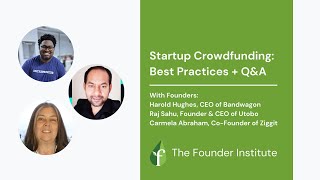
Harold Hughes, Carmela Abraham, and Raj Sahu discuss raising equity crowdfunding on platforms like Republic and WeFunder. They explain why founders use it as a customer-acquisition tool, how to pick a platform, and what you need: solid financials, legal counsel, and a real community. Only crowdfund if you have strong numbers and treat it as a growth lever, not a last resort.
Chapters
All right, welcome everyone to the Founder Institute event on startup crowdfunding best practices and Q&A. My name is Ryan Micheletti and I am your host today. We have a fantastic panel of founders from the FI Network and I'm excited to kick things off. So my role at Founder Institute is Head of Global Operations. For those of you who do not know, the Founder Institute is the world's largest a pre-seed startup accelerator. Since 2009, it's grown into an international sensation, launching over 6,000 startups across 200 cities with a mentor network of over 25,000 mentors. So I've had the pleasure of leading the Founder Institute's operations team here in Silicon Valley over the last 8 years, and I've directly launched over 600 startups through the accelerator programs that I've run. I've worked with thousands of founders around the world. So I'm really excited to talk about crowdfunding today. It's a big topic. And so before we jump into introductions, I'd like to just set an agenda. So in a moment, I'll introduce the founders who are on the panel today, and then we'll have a panel discussion. So this is a live event. We wanna make this as interactive as possible. So please, if you have questions at any time, go ahead and put them in the chat so we can ask the panel. And then finally, at the end of the event, we're gonna do an optional networking session for those of you who've joined us today. You know, when you run virtual events and in this sort of like remote world, you wanna meet as many people as possible. So we wanna give everyone here the, an opportunity to network with each other afterward using Airmeet. So stick around and we'll put that Airmeet link in the chat at the very end of the session. So without further ado, it's my pleasure to introduce the founders on the call today. So in, in addition to introducing yourself, maybe you could share some details about your startup and, and what you're working on. Harold, great to see you. Let's start with you. Do you want to do a quick intro?
Sure, absolutely. Thanks for having me, Ryan and team. So my name is Harold Hughes. I am a startup founder. My company Bandwagon actually went through Founder Institute in Greenville, South Carolina in 2015. We were the first chapter in South Carolina and first chapter in all of the Carolinas. I was doing the program while working full-time and then had the opportunity to go full-time with the company, with my startup. In January of 2016, so the timing was really great. My company is Bandwagon. We are an experience technology company. We connect brands and entertainers with their fans and audience members using user-generated content. So the pictures and videos that we all capture when we go to events, we tend to believe as a group that data is king. We also believe content is kingdom, and like most kingdoms, being able to expand and acquire more makes you better. And so it's the same thing we see about user-generated content as part of your marketing strategy. Strategy and your engagement strategy. So we help fans and consumers connect with their favorite brands and entertainers by minting, basically putting their content on the blockchain and allowing those organizations to monetize it, use it in sponsorship, licensing, any of that stuff. So creating really unique fan engagement opportunities. I am a remote CEO, so my company's headquartered in Greenville, South Carolina, but I'm based in Austin, Texas. We've done an equity crowdfunding campaign with Republic. I'm a Republic senior venture partner and also an I'm an angel investor and I've done about 3 dozen deals in the last few years.
Amazing. And Harold, I've got some good news for you. We're relaunching Founder Institute in South Carolina.
How about that?
Not based in Greenville, but based in Columbia. And so we've got a really killer team there that I'd love to introduce you to a little bit later.
Awesome. I love it.
Yeah. Thanks for joining us today and always a fan to have you on these. Next up, we'll go to Carmela Abraham. Carmela, you're a Founder Institute Silicon Valley alumni. Why don't you do a quick introduction on yourself and your company.
Thanks, Ryan, and thanks for adding me to the panel. Ziggit is my company, and we are benefits for the 82 million people that do not have benefits today. We sell both to individuals and to employers, especially small employers. 65% of the U.S. market is small businesses, and 50% of those do not have benefits. For their employees, especially hourly workers. We look primarily right now at these, what we call the safety net benefits, which are retirement, savings, healthcare. With those three, most people can get financially stable, and whether they're seasonal, their income fluctuates, there's a way for them to be able to get off credit cards and support themselves. Thanks.
Awesome. Thanks, Carmela. And last but not least, Raj, good to see you. Thanks for joining us. I know it's getting late, so why don't you do a quick intro?
Yeah, for sure.
Thanks so much, Ryan, and thanks for having me here. It's always nice chatting with you and Founder Institute group. So Utobo, I'm founder and CEO of Utobo. My name is Raj Sahu. We did an accelerator program like Founder Institute Toronto accelerator program. So Utobo is basically the simplest platform for creators to create online courses and digital products and sell it. So the time when you walk into our website, if you're a content creator, say you're teaching yoga or you're teaching music or you're teaching anything, just go to utobo.com, takes, you know, say 14 days free trial subscribe it till the time, like, you know, like in just like 15-20 minutes you would have your first online school open. You can integrate Zoom immediately, like just, you know, go there, click integrate Zoom, and once you log in, you're integrated with Zoom. If you want to receive payment directly in your bank account, we just recently cracked partnership with PayPal. So all you need to do is log in with PayPal or Stripe and you would be able to accept the payment. So you literally don't have to waste a single minute. Figuring out what is where, and what that I have to do with the platform. You can just simply go upload your videos. You will get a beautifully designed e-commerce website and you can start selling. 15-20 minutes max. So we are removing all the friction for creators to create and sell online courses on a platform. So we are pretty new company. We incorporated in Delaware as C-Corp in January 2021. We have raised $260,000 so far from 6 angel investors. We launched our product in October 2021. So far in just like 6 months of time, we have 1,700+ creators using our platform, right? So we have done remarkable, like we didn't even like invest a lot of money into marketing, but it's all mostly like organic and partnership growth. So the platform simplicity is like quite attractive. So people are kind of like referring each other saying that, hey, just give this particular platform a shot. And we have been lucky, you know, choosing the right partner. We launched on AppSumo, we recently launched on Republic. So the reason we chose Republic, because I think they have like 1.5 million retail investors and it's a great marketing opportunity for us to just go and showcase our product and, you know, create evangelists for our product. So we are just trying to find, you know, great partners where, who already have like a lot of their own kind of like network and we can just kind of, you know, showcase our beautiful products to them. So this is where we are at. We recently launched our campaign on Republic. I think 86 investors have invested $50,000 so far. The campaign will be live for more than I think 260 days. You know, from now. So there is enough opportunity for a lot of people to kind of like look at our solution and, you know, be a part of Utopo. So thanks so much, Ryan.
Awesome. Thanks, Raj. And, you know, just kind of looking in the chat here, I mean, we've got people from Miami and Lagos and Canada, Belgium, Bolivia. So I love seeing this international audience. And, you know, feel free to share with us what you're working on. We have a lot of startup founders in here as well, and we also have some investors and mentors. So let me go ahead and ask the first question here. And, you know, we're seeing the venture landscape change. Part of that is due to, like, the economic situation. Investors are anticipating a potential recession, so they're tightening their belts a little bit. Valuations are starting to come down to, like, a more realistic level where they were maybe a few years ago. But, you know, crowdfunding is this— it's sort of a separate beast, right? And there's particular companies that are well suited to raise crowdfunding. Versus others. And so let me just ask this, and we'll start with Harold, then go to Carmella, and then Raj. Like, when you originally made the decision to raise crowdfunding, like, what was, what was the trigger for that? Like, why did you decide to do that versus going like a more traditional fundraising route?
Um, so we actually did it at the time we were a B2C company, um, and so the idea there was that customers as owners and running a campaign, we saw being able to turn our existing customers into owners. So if you're a fan of what we were building, you could now be an owner in it. But then also as owners, you may be more inclined to use a product that you've invested in. And so we would use it as part of the customer acquisition cycle. So that's really the way that we went about it. We were actually on season 2 of Meet the Drapers, and so we ended up working with Republic as well. Big fan of them now, but at the time it was an awful experience. Because they didn't have a lot of the infrastructure they have in place. They didn't really think about what it looked like to run these campaigns. And so for us in the beginning, it was like, oh, very clear, we're gonna do this and it's gonna be a cycle, like a cycle, little flywheel. And so that was what really was the impetus to us making the decision to run a campaign.
So Harold, you know, you mentioned like at the time, like Republic's like system was still being built and infrastructure. Was there a reason you chose Republic over other options like WeFunder?
Republic was the partner of Meet the Drapers. So for us, we didn't really like evaluate them equally. It was if you got selected for the season, Meet the Drapers, for people who don't know, was basically trying to create a web-based TV version of Shark Tank where companies would go on, they pitch their company, talk about what they're building, and then viewers would be able to watch at home. And if they like the idea, you know, screw whoever's on the stage, they could put their own investments in of starting at $100. And so that's, that's why we ended up using Republic in the first place. But since then, I've definitely used platforms like WeFunder, I've used StartEngine, I've used a couple of smaller ones, Fund Black Founders. And so definitely some unique— there's lots of them around now, but I do think the Republic's probably best equipped to handle some of the scale of this. And in disclosure, I am a Republic investor now, so I can share a little bit more about that separately.
Awesome. Thanks, Harold. And, you know, it sounds like a big piece of your decision was like you could potentially use it as a customer acquisition channel. I've seen that happen a lot with startup founders looking to raise crowdfunding. Carmela, let's, let's go to you. Like, what was sort of your decision for raising crowdfunding initially?
Yeah, we were actually getting asked by our employers if they could invest in us, which was kind of a surprising thing for us. We weren't, we weren't expecting that. And so we decided similar to Harold, to use it as potentially a customer acquisition, as well as we were looking for a bridge to get a little more momentum behind us and some, a bridge of money to get us to the point. And then we got a year runway out of it, which the timing was excellent, given the economy right now. So And we are now starting to get that traction, so that's really exciting. But yeah, we also had some charities we were working with that we wanted to give back to. Resist— uh, Resilience Education, which supports formerly incarcerated people trying to break into the job market, a lot of time doing manual labor, and this was a way of helping them, as well as your Your Vet Crew, Ryan, is another nonprofit that we were looking to donate subscriptions to, and our Republic investors have been amazingly generous. We were getting like 80% donation of the subscriptions that we offered as part of their donations. So it's proved to be very helpful. And it's been wonderful meeting the people that invested in us. They've been great and very supportive.
Yeah, that's really, you know, it's interesting you say that. And, you know, I think like for someone like you where like your customers are almost like your biggest fans, right? They're like, they see the value, like how, you know, we think this is going to be big. How do we get involved? I think that makes a lot of sense. Raj, let's go to you. Like what was sort of your decision? And you're still actually in the crowdfunding mode right now. So like what was the trigger for you to decide to do crowdfunding versus more traditional raise?
Right. So honestly speaking, like I saw the couple of like Republic raised, what was super awesome, like couple of companies literally had 4,000 people investing in their startup. And with that particular perk, you can onboard them as your customers, you know, and just imagine that if you're like B2C company or B2B, you know, company which is like targeting both the segment. If you are onboarding 4,000 customers who have invested in your platform, the kind of ripple effect it would create is enormous. Like, it's just like unbelievable, you know, in a year of time, like probably if you want to, if you want to get to 5,000 customers, like literally even you know, asking them to just try out your platform, like free of cost, just to do sign up, you would end up investing somewhere around $250,000 to $300,000 on marketing to get to that particular number for a SaaS platform. And with Republic, you would be actually raising $1 million and getting 4,000 customers who would be actually speaking good about you because they have invested in your company. If they're like, of course, like happy about your PayPal. So that was the first, you know, amazing point which I saw, the first benefit. Second benefit is, you know, I think like now you'll be seeing a lot of pressure in startup companies who has taken a lot of money from VC funds only, right? So even if like a seed-level startup and if you raise a bunch of money from, you know, VC funds, you would have like a different sort of pressure on your head to perform, to grow sales. And, you know, probably you'd be killing your vision sometimes. You'd be pivoting and you end up hating what you're doing. The reason why you want to become a founder or start a company because you're really passionate about that particular field and you want to do it in your terms. That's why you are a founder, right? And what happens when you have additional pressure? You know, early on, you just deviate from your vision and that passion of building the company, you know, it just goes somewhere else. So that was like the second reason. We want people who believes in our mission. Who knows what we are doing, who have tested our platform and invested in the company. So they would be like kind of, you know, partner for a long, long term till the time probably would be, you know, going IPO or raising a big round or something. Right. So that, that was like two major reasons I would say we launched our company Republic.
Yeah, that's interesting. It sounds like everyone here actually used Republic. Harold, you have experience with like multiple platforms. I mean, how would you describe it or would you recommend one over the other, or is there like some sort of like, um, you know, differentiation that you would, you would advise companies on?
I think the biggest thing is, uh, you being able to manage your community. All the platforms are pretty much the same. They allow you to have a website that you can upload a video. You can have a deck. Um, people can see the deal terms. It's all pretty straightforward. Um, so as far as deciding which ones to use, you definitely want to think through you definitely want to think through how you would manage your community regardless of which platform you choose. Now, that being said, I believe that WeFunder may have the largest mailing list. Someone could check on that. I think WeFunder may have the bigger mailing list, and StartEngine does a lot of investing into marketing on traditional avenues like TV. Like, I can't tell you how many, like, StartEngine campaigns I've seen on, like, ESPN randomly, and I'm just like, oh shit, like, people are running commercials for this. I haven't seen Republic do that. And so it really just depends on what it is that you need. I think that one of the best things you can do is really just evaluate all 3. Some of the things that you can do when you negotiate them is get them to lower the percentage that they take. So for example, I think some of them take like 6%. And if you, you know, say, hey, look, I'm actually going to bring you 1,000 people from my community that aren't already on your platform, they may be interested in negotiating that fee. So I think that they're all largely the same. And at the end of the day, you've to run your campaign, but at the same time, definitely don't be afraid to talk to all of them and evaluate each of them equally.
You know, that's a super good hack, Harold. So thank you for sharing that. You probably saved some founders here thousands of dollars. I see Stephanie, you're raising your hand. Go ahead and put your question here in the chat. There's a question from Constance, which is like, you know, what are the basics to crowdfunding? And so would anyone on the panel like to describe like, crowdfunding versus like regular startup funding?
Since we've had some angel funding as well, I can talk a little bit to that. So we've had some angel funding, we have many relationships with VCs, and we've done crowdfunding. For us, each of them has been a distinct process. For angel funding, we reached out to a bunch of angel company, or groups, I should say, and we also, reached out to some people on Crunchbase that had funded similar— not exactly the same, but in the same general vein of what we had done. And we were able to raise $100,000 that way. And it worked really well. It was relatively— there was no marketing involved. It was relatively straightforward. And it was just setting up the meetings and talking. For the VCs, we have not started fundraising with them yet, but we have been building relationships probably for about 6 months to a year. And so we have a VC list that we regularly email, give them updates. That's a little more time-intensive than when we looked after the angels, but we're looking for more money eventually when we go to them. And we're hoping to do the October the next funding labs with FI, now that we're starting to show the kind of traction we were looking for. And with the crowdfunding, the— was way more market intensive. If you don't— if you don't— we actually hired a marketing company for— we spent about $7,000 on it, and they were fabulous. They helped with videos, they helped with outreach. They did all of our marketing online to various sources. So that was really super helpful. And then Republic itself, when we hit our numbers, and both with number of investors and number of dollars invested, their marketing definitely was a boost for us as well.
You know, I think it was Simon here that just mentioned that, you know, he asked like, where do you find a good marketing company to help with with the crowdfunding campaigns?
So we interviewed 7. We asked around and really happy with the company we ended up with. They ran ads on Twitter, LinkedIn, We all had to upgrade, however, to LinkedIn Pro so that we could run, they could run against all of our contacts. We started only with 2 of our contacts lists and went on to 3. So that was, that was because it was so, LinkedIn turned out to be extremely helpful because You never know who your peeps are linked into and how far that message can go.
Yeah.
And there's—
oh, sorry, go ahead.
No, I was gonna chime in real quick. So I am opposed to the campaign hiring outsized marketing primarily because how expensive it is. So Carmela just talked about $7,000. Like, that is a bunch of money in my opinion. And so really the thing is, is to think through your content calendar. I've got a case study that I'm gonna upload here in a second that folks will be able to download. But really, One of the things we've learned across, you know, the JOBS Act was re, you know, re-put in place, you know, a decade ago is that it takes about 7 touches to get someone to invest. And so you've got to continue to hit them over and over and over. One of the biggest mistakes I think that founders make when it comes to crowdfunding is thinking like, all right, put the website up, I emailed my customers, and it's just like, no, you can't do that. And so literally, you know, I advise these different companies on this and it's like, okay, What new customers have you signed? Like, oh, we just signed this customer. Okay, don't announce it for 4 weeks. Announce it later. Okay, we're rolling out this new product. Okay, are we rolling these new products? Okay, can you announce one of those products in 2 weeks and one of those products in 8 weeks? And you have to almost like plan out your presence, plan out your online presence, plan out your engagement. And the other thing, and I'm sure Carmella can speak to this, is like how you-centered it is. Like a lot of my investors, I ended up doing a bunch of data and polling around it. A lot of my investors were Black. A lot of my investors, it was their first time doing it. So I spent time creating content, educating them on saying, this is the difference between this and an IPO. This is the difference. I mean, and, uh, and buying on, on Robinhood. This is the difference between this and Kickstarter. And then being able to help educate them. And you'd be surprised, um, how important that brand equity is and transfer from I'm buying your stuff as a customer to moving over to being an investor. You have to help educate me so I know what I'm doing. Like, that stuff is really important. And so I personally, whether you can definitely hire someone to like help you tactically, uh, like post and stuff, but I think that from a strategy standpoint, as much of that as you can own as the entrepreneur, the founder, the better, because it's, it, that, that's who it's gonna fall on.
Yeah. For us, we were, we were a team of 3. And so to the logistics of timing the posts and hitting all the platforms, that's where for us they were invaluable. Every piece of content we approved, we contributed to. Every email was run by us and we were part of creating. And then also like which type of information when. We were part of the building of that calendar. But logistically, it was really super helpful to have somebody else actually doing that work. Because we would have had to hire a— sorry, someone to do the ads. In the various pieces if it hadn't been, it was much easier working with one company.
But yeah, Raj, do you have any feedback?
Right. I'd go with Harold on this. I think he's absolutely right when it, when it comes to kind of like pitching it to your community, you, you got to educate, but I would start with, because whatever the investment which we have received so far is all organic. The reason why we were able to pull it off is We kind of, we kind of tracked a couple of companies early on who has been super successful on Vfunder and Republic. So we saw them raising over $4 million. So I kind of like was tracking their posts on LinkedIn, Facebook, what kind of posts these guys are doing, what kind of emails which I'm receiving. I subscribe to their email base. One thing I've learned that if you want to launch your crowdfunding campaign, you got to have your own database. Probably of your customers, prospects, the community member, whoever you have interacted with. And you gotta filter all this particular database based on multiple parameters that these are the customers, these are the prospects, and these are your, you know, like say prospective angel investors, right? When once you do that, you gotta drive separate email campaign to each of them saying that, hey, you gotta introduce yourself first and tell them that your product is super cool. And then you gotta like give them a couple of updates saying that we cracked this partnership. Hey, this is the free ebook for you and sort of, you know, all these pretty good things. And then boom, like we launched on Republic, you know, and here is an opportunity for you to kind of own a part of like Youtobo or your company. And then they're like, you know, go to check out your page, the campaign page. And once they land in your Republic campaign page or you know, your crowdfunding campaign page. That's where you know that, you know, people are taking interest. What's your open rate? What's your click rate? And then you can, you know, figure it out that these are, say, 5,000 people I need to target to convert, you know, say $40,000 in one month of time. So you've got to plan it chunk by chunk in order to kind of like make it successful. Even if you're using two channels, LinkedIn and email marketing, you, I think it's pretty good. You'll be able to raise significant amount of money, but I would still say Carmela's point is also valid in a case. I saw one particular campaign which raised over $4 million. I interacted with the founder and they told us to hire an agency, not because of, you know, you won't be able to do it alone. It's just like speed of things for you. It means that they have been doing it for like, say, last 10 years. They have their own set of databases. They have their own Facebook group. They have their own blogs, which has like, say, thousands of users walking in. So if they are kind of going to hit you, hit your company up on that Facebook group or a blog, you would definitely end up getting some sort of traction. And they have built that community over you know, 10, 12 years of time, which is impossible for you to build. And all you gotta do is save time, you know, when you're launching. So I think, you know, you gotta have your own databases as well as if you are getting a great agency, talk to a couple of founders who have successfully raised it, select one, and I think go with it.
It also helps, Ryan.
Oh, sorry.
It also helps when we, when we talk to the marketing, we ask for examples. Of fintechs, insurtechs that they had marketed for before us. Because I think it's really important that when you're dealing with both a crowdfunding company and with a marketing company that they understand your market and your industries that you are in. Because the language is different and the, the The audiences are different for those, even on the investor side.
I think there's a lot of questions here in the chat. There's some around like nonprofits raising crowdfunding. There's equity crowdfunding versus like raising crowdfunding on like Kickstarter. I think just to kind of narrow the conversation. So today we're talking about equity crowdfunding, which is you're essentially like giving up ownership of your company in exchange for the investment from people from the crowd. Versus like a Kickstarter is like you could invest in a Kickstarter project and like they would give you some kind of prize or some kind of benefit or perk for doing that, but not necessarily equity or stock in that company. Just curious, has anyone here raised on Kickstarter or worked with any Kickstarter projects? Harold, I mean, like how would you define the difference between equity crowdfunding and doing something on Kickstarter?
I think the biggest thing is just, so we did an Indiegogo campaign, which is a equity crowdfunding, excuse me, it's a rewards-based crowdfunding similar to Kickstarter. And we did that in like 2014 when this was just an idea. The threshold is different, right? You don't have to deliver anything, right? Everyone understands that this is a huge risk, different from startups in that you may never deliver anything. You offer rewards normally based on, hey, You know, I'm going to give you like a crappy version of our product that anyone can, you know, normally my product would be available at this price, but I'm going to give it to you at this price if you're a contributor. When it comes to equity crowdfunding, you are committing to reporting with the Securities and Exchange Commission. You are committing to distributing or should be displaying your financials for the next 2 years. You're talking about the equity the officers have. And legal information, legal and litigation issues that you and the company may be embattled in. Like, so the level of transparency is just so much higher. So I would definitely consider those to be like very different stages of conversation. If you're considering equity crowdfunding, you should have a business that is return, like already generating revenue, is very clear on how adding 1,000 people or 500 people as investors makes sense for them. Um, not just for you getting cash from dumb investors because you don't feel like you have to go through VC meetings. I think that's one of the bigger challenges I'm seeing is that, um, a lot of founders are essentially preying on these, uh, retail investors, um, with these really ridiculous valuations and not really great financials. Um, and I think that that's probably one of the biggest challenges I'm seeing in the space.
Yeah, that's super helpful and, and really good insights here. No, there's a question here around like, what is like, you know, what are some of the things that you should do and what are the requirements before doing equity crowdfunding? And I think like it could be helpful to talk a little bit about like, you know, some of the things that we look for, for, you know, criteria for someone actually going and raising like a traditional, like, you know, equity funding round, not crowdfunding. So for those in the audience, we run a program that Carmela mentioned called Funding Lab. which is essentially a fundraising program where we help our alumni raise capital through the structured process. And so, you know, for 99% of the founders there, that's going to be going to angel investors or VCs and raising like a pre-seed or a seed round. And the criteria that we look for in order to even apply and like join that program, one, the founder needs to be a Founder Institute alumni. Two, they have to be full-time on their startup. 3, they have to have some kind of MVP built. And then 4, they have to have that MVP demonstrate some level of traction or have like some strong level of customer validation. Without any of those things, it's going to be really hard for you to go and raise funding when it comes to like talking to investors, because you got to remember, like you're competing against every other founder that's talking to that investor for that same investment dollar.
That you're trying to raise.
And so that's sort of the baseline that we see for being able to raise like a traditional angel, pre-seed, or seed round. But let's talk about like what are the things that, you know, you've experienced in terms of the panel for being ready for raising crowdfunding. Would anyone like to start on like the criteria that they've seen for successful companies who raised?
I can talk a little bit about it just as a venture partner, the things that we look for when we're submitting companies to be considered. Number one, we expect you to have cash in the bank, no less than 6 months runway, primarily because creating the campaign in and of itself is a longer drawn-out process. And so they don't want you trying to say, hey, we're going out of business, let's try and get some money from these, you know, non-VCs real quick. So you want to have at least 6 to 12 months of runway in the bank. You also want to try and have a way to demonstrate your GAAP financials. And so most of the time you'll see businesses say like, hey, here, our financials, but they may not have been GAAP compliant. And so you'd normally have to work with a certain kind of accountant to get your documents in order. Um, and then the third thing I will say is, um, really a commitment to what the strategy is. Um, this isn't one of those things, as I said, where you just say, hey, this is my product, we do $100,000 a month in revenue. It's understanding like, so why would raising from the crowd be very beneficial to you? And being able to communicate that to the various platforms. Because at the end of the day, the platforms decide who gets on. And that's something that they, you know, there's constantly people applying. And so you want to be able to make sure that you're able to say, yes, there are thousands of beauty companies that you could let on, but you should let us on because of X, Y, and Z. And so those are 3 things I would look for, for sure. Cash in the bank, making sure that you've got your financials in order, and then why you in a very crowded space that could potentially be raising.
Yeah, that makes sense because, you know, especially in a situation like this when you're raising money from essentially strangers, right, there's transparency issues, there's some potential fraud issues. So at the onset, like the, the people at Republic or WeFunder, they're going to be pretty stringent on some of these requirements. So there are some like questions earlier in the chat of like, do I need to be incorporated? Like, do I need revenue? Like all of those kind of basic things. Like you actually need to have like more of that compliance in place probably than if you're to just go and raise like a $25K check or something from an angel investor. Any other feedback from Carmela or Raj, or should I move on to the next question?
I want to jump in. I would also—
Go ahead.
Yeah, please go ahead. Like, if you want to go first, no problem.
I was just simply going to say that you will need to be answering questions on the platform And so you need to think ahead of time what people might be asking and make sure that you know your numbers, you know, you know, how to define your sale, be ready to provide a one-pager to investors once the campaign's over so that if they want to help you get more people using your platform, you're ready for that. It is time-consuming and running the company is time-consuming, and so you just need to be prepared.
Raj?
Right. Yeah, so I basically did Funding Lab as well. You know, Brad, you definitely know it was like a really, really, really difficult course to be in. A lot of work is involved, but, you know, because of the Funding Lab, we did— we raised $225,000 from angel investors on equity round. So it's like a very structured program and I can definitely vouch for it. In terms of like crowdfunding, I'd say you gotta take a lot of time from your daily routine work in order to be able to raise. It's not easy. It's lit. It's gonna like literally challenge you in every single way because you are putting your startup, you know, in front of like thousands of people. Okay. They would be, they would be asking different questions, but in order to even get through the Republic process or any compliance process, you have to hire a CPA to do this GAAP compliance thing. You have to hire a lawyer in order to do your C-form filing. You got to work with team members to define your story, to build an amazing campaign page. You have to provide facts and figures for everything which you're claiming. You can't just say and go ahead and say that, hey, we are the best platform in the world for this thing. You can't say that. Where is the proof? Like, there's like, Forbes magazine has literally given you award for that. So you have to maintain every single facts and figures with you with third-party certification. You can't claim anything unless it's verified by third party. You have to have 6 months runway, as Harold said, and you gotta have like at least a capacity of investing somewhere around $10,000 to $12,000 even to begin the fundraising process. So if you're not like really a good company, I've seen like a lot of companies end up losing money in crowdfunding. This also happens, you know, if you're— if you have invested, say, $7,000, $8,000, you know, given money to CPA and lawyers, and you have invested a lot of your time as a founder, and if— what if the crowdfunding fails? You know, you, you are going to lose 3 months of time, and this, this, these you know, like say $10,000 of your money. I have seen the startups like who has raised significant amount of money mostly raised because they already had significant revenue. A couple of startups had like $5 million in annual revenues, right? Very strong founders. They have exited 2 to 3 companies. They have vast network of their own. Or other founders which I have seen are the founders like who has their own community base. Of like say 50,000 followers on LinkedIn, you know, a million followers on Instagram, these guys raise money pretty quickly. Or you have to kind of like, if you are a trendsetter company, if NFT trend is happening or any other trend is happening, and if you're part of that trend, then you can definitely go and raise significant amount of money. But you gotta be really, really careful when you are raising money through any crowdfunding, I would say.
So there's some questions here, like I wanna talk about like determining like, Um, the deal terms, valuation, but, but, you know, before we get into that, um, there's a question here of like, okay, well, if you need revenue and you need a product, you need some traction, like, what do you do if you're pre-revenue and you need funding to build your platform? And this is like one of the most common things that I see with startup founders. It's like, hey, I just need $1 million and then I can go and build this thing. And then, you know, we can start making money. You know, I'm sure you guys are laughing because you've seen it a bunch as well. I mean, what advice do you have for founders that like feel they need to go and raise money before they build the product?
I think we all have thoughts. Carmela, go ahead. Carmela wants to go first, though. I'll go after her.
It is better to go find the people first. Go find that audience. Go find the buyers of your product first. You don't have to actually have a product to do that. You can ask people, you know, "How does this solution fit on your priorities of 1 to 10? Would you buy it? Like, is it in the top 3?" That finding, and even if it's just drawings on a piece of paper, People will take the time to talk to you, especially if you're talking about something that's in their top 3. You'll know instantly. They'll be like, oh my gosh, yes, where can I— like, when will you have it? How can I sign up? That's what you're looking for. Money will not get you that. You could build the most amazing product in the world, hits all the bells and whistles, but if nobody wants it, You're done.
And in addition, if you don't have a team to help support you through that, investors are more wary. Harold, let's go to get your thoughts and then Raj.
Yeah, I mean, Carmella covered a lot of it. I think that ultimately people do believe that money solves it, and so you want to have more of it than others. And I mean, it's so funny now because it's 2022 and technology is cheaper than it was in 2012. Um, yet the amount that people say they need to start has only gone up. Um, I remember 2015, our first round of funding was $310,000. Um, now every startup I talk to, they need a million dollars to get started pre-product. Um, despite there being so many open source tools and so many, um, services that you could build, bubble.io, um, is one of those things. And so, um, I would question a founder who believes they need that much money to start something, to remember that you don't necessarily have to build the entire thing. It's okay to build an MVP, and it's also okay to build a maximum viable non-product, which is a new phrase that's been talked about more the last couple of years. But the idea is, is what is the most I can build that isn't what I want to build, but this demonstrates the market need, that demonstrates the deliverable, The maximum viable non-product can actually help create the vision that you have into like a tangible reality so that people can understand it. And then lastly, I will say, if you need that much money, go to people who can write this off as a loss, like VC firms. Do not go to teachers and people who work at restaurants and people who are trying to figure out how to make their $50,000 salary stretch for a family of 5. Do not try and ask them to invest $100 into your company. Go to VC firms, go to high net worth individuals and angels to help you get that money to go from idea to early concept to market. But those are, those are my thoughts.
And anything to add, Raj?
Yeah, definitely. It completely depends on what kind of personality you have. Literally, if you have exited companies previously, you can, you can go ahead and raise $100 million. In India, there is one founder right now who is raising $300 million and starting a company. So you, if you're a superstar, you can do that, right? If Elon Musk is starting a company, he would be able to do it. For you, you don't have any sort of like background yet, right? So the first step which you're going to do is form a team, you know, go and form a co-founder, like found a co-founder who believes in your idea. So that's like the very first step I would say. Second step is go and see what problem you're solving and whether you'd be able to kind of like get a few customers who are really willing to take your product, as Carmela mentioned. And the third step is, I think the way we raised angel round of investment was you don't have to pitch everyone. You just got to find someone who believes in your vision. What it means is that if you're passionate about food industry, go and find, you know, people who are passionate about food industries and pitch the idea to them. If you're passionate about education, go and find people who are passionate about education and pitch the idea to them. All you need is initial few, you know, say $20,000, $25,000, and you can use Bubble and multiple other products to kind of like launch your first MVP. Once you have MVP, then you can go to VC. But if you, if you have really done some remarkable, you know, stuff like you are Stanford graduate, you know, like, or, you know, there is a company called Zepto in India. They have raised— they're now like, I think, over $900 million company, and they're literally kids right now. Like, I think they are below 20 years old when they started the company, Stanford dropout, and still they were able to, you know, raise over $100 million. So it literally comes down to you as a person. If you believe in yourself and if you think that's a valid idea and you can do it, Try it, like there is no harm in trying. But if you, you think you don't have like that kind of badge of Stanford University and a couple of other badges, I think the wise thing to do is find the team, build, you know, a small MVP version of the product, find 2 to 3 people who can purchase it, raise angel round, and then go to VC.
Really, really good feedback here. In the last 10 minutes or so, let's talk a little bit about deal terms, valuation. So when you go to these crowdfunding sites, one, how do you think about how much money you should raise, first of all? And then two, how do you then structure the deal so that it makes sense for crowdfunding? And then how does like Republic or WeFunder come back and try to restructure those terms?
Let's start with—
I want to go Go ahead, Raj.
Yeah, I can go, go with that. So it's fairly easy for, for you to kind of like come up with your own valuation. Honestly, the easiest thing is to see other startups with similar products and what kind of valuation they have and what kind of money they have raised and from who, you know. So that's the easiest way to evaluate your company and then pitch it to say WeFunder and Republic saying that this is what my company worth and this is how. So I looked at like 10 different companies who have raised significant amount of money from our category. And, you know, this is their, say, kind of like, you know, valuation right now. So if you are able to kind of like prove it in this simplistic way, you can define— you can come to a value. The second easy thing is if you have existing investors and if they're ready to write you a check, on higher valuation which you are putting into Republic or, you know, StartEngine, then Republic or StartEngine will definitely approve it. But you gotta have like some sort of existing investor who is writing you check, you know, on a higher valuation. So that's the two way I would say.
Harold or Carmela, like when you went to go and do your crowdfunding, like one, how do you determine how much money to raise? And then two, like how did you come up with like the valuation?
I was trying to— mine was really straightforward. I wanted to make sure we were being fair with the folks who may not understand how the business, how that whole industry works. And so we raised on the exact same terms that we had raised our price, like our round from investors from. So it was a $10 million valuation that we were raising from strategics, and then we had $10 million we were raising from the non-accredited investors who could put in those little $100.
Yeah, we were in a similar situation. We had just raised our angel money and we used the same valuation.
And did Republic, or I guess for you guys, you used Republic, but did they have any pushback on like the terms or valuation, or was it just because you had professional investors come in and set that price? Already that it was approved?
We didn't get any pushback.
Yeah, I didn't get any either.
The same thing with us, you know, I think our existing investor invested in this round as well in the similar kind of like same valuation which you are putting into on Republic. So it's like very easy if your existing investor is trusting you again. I think that's the best kind of like proof which you can give to Republic or any, any crowd So it's funding paid for.
So, um, let's talk about some of like the— we talked about the benefits of crowdfunding, right? It's a good customer acquisition strategy, um, you know, it's sort of a different, um, process than raising like an equity round of funding. But where are the risks, right? Like, you know, Raj, you mentioned you could waste $10,000 and 3 months of your time. I mean, what, what are some of the other risks here, even if you've successfully raised money from the crowd? Like Are there things that could come back to bite you, like terms that these investors get that maybe are different than like a normal equity raise?
Yes, definitely. I think, you know, the most important thing is that you have to remember that you have now community members of say 5,000 people, okay? And they're watching you throughout what you are— throughout like throughout, like, say, the lifespan of your company. They would be definitely seeing your growth, you know, what kind of post you are doing, what kind of update you are doing, whether you are doing good, you know, product-wise or not. So you have to be responsible to those 5,000 investors, you know. So that's one of the biggest things which you got to remember. So if you're screwing up somewhere, you would be getting a lot of, like, you know, lashback from, from your community. They would be family, they would try to support you, right? But you have to be really, really careful in terms of how you are, you know, kind of like operating your company because you have to be responsible for more people. And in terms of like VC money, like say they get their money from LPs, right? They have a lot of money to invest, and even if they're losing money, it won't be a very huge setback from them. But imagine that a, say, teacher or, you know, say someone who is like working in a restaurant has invested $5,000 in your company, trusting you as a founder. Right. So that like if you are not able to perform or if you're not able to give them returns, at the end of the day, you would feel really, really bad for yourself and for them saying that, you know, they trusted you with $5,000 of hard-earned money and you kind of like could not fulfill their commitment, whichever you made. So you have to be really, really kind of like watchful for the whole community, I would say. So it's a big responsibility.
So I do have one other question here I'd like to ask before we wrap, but just as a reminder to the founders who are on the webinar today, we are going to do a networking session right after this. So once we're done towards the end of this, I'm going to paste a link to Airmeet, which is the platform we use to do networking where you can meet other people here in the audience today. So before we wrap up though, I have one question I wanna ask. We'll just start with Harold, go to Carmela and Raj, which is, you know, what— now we've talked a lot about crowdfunding today. What is one piece of advice or best practice that you would like to share that you learned through this crowdfunding process, you know, for a founder who's either contemplating raising an equity round or raising a crowdfunding round?
I would definitely say to not need the money. I think those are the best companies in crowdfunding. When you're a company that's down to your last 4 months of runway or less, or you're trying to think about how your message isn't being landed or received well from VCs, I think it puts you in a tough spot because the message that you're selling to, like I said, teachers and working families and all these folks who could invest is this vision of what you as a founder believe it can be, right? Like, that's one of the things that we have to have as founders is this like unrealistic belief that this thing will work. But at the same time, it could go left. As we know, many startups fail. And I personally wouldn't want to have money lost from that many people, hundreds and thousands of people who gave it to me. And so I encourage folks to say, look, we just raised $4 million, we're opening up a quarter million dollars for our customers, or we wanna diversify our cap table, but we took a bunch of money from white guys and we wanna see more women and people of color invested. And so we're opening up this to make sure we create better opportunities for folks to get involved and seats at the table. Those are the types of things I would encourage companies to do. But if you're early stage, pre-seed trying to raise equity crowdfunding, I think it, can put you in a tough spot on the amount of pressure you've got to have to succeed relative to the community that you're connecting with. So that's my biggest piece of advice.
Yeah, really great feedback, Harold. Carmela, what about you? What's the one piece of feedback you'd give someone contemplating crowdfunding?
Beyond what Harold said, which is know your reasons are the right reasons. For us, for us, it was the opportunity to expand our connection to our employers and to our individuals. And that was really an opportunity that has paid off for us. And as I said, for those that don't need— we had investors that, you know, they have 401(k)s, they have have their retirement already, they didn't need the IRA piece that we had offered as a perk. And it's given us the opportunity to then turn around and give that away. So thinking about how you can turn what you do into an opportunity to make, make your product a better place for— in our case, we are specifically targeting low-income workers, hourly workers, with our products. So for us, it was really an opportunity to give our product to people who don't have access, and that really was a big part of what we did. But also, know your finances, like really honestly know your numbers. I can't emphasize that enough, how important that is to really understand exactly what your burn rate is, what your income is, what your, you know, cogs are. I find a lot of people, even when they're making money, don't know that answer. And don't assume just because it's crowdfunding, not a VC you're talking to, that you don't need to know those numbers.
Yeah, that's good advice just across the board too, even for founders that aren't fundraising. So thank you, Carmela. And Raj, what about you? What's one piece of advice you give the founders on the call today?
Build your community. I think that's the most important thing. You're raising from the community, like you have to search, you know, for people who believes in you and believes in your vision, believes in, you know, your team. That's the most important thing. So unless you have a great community supporting you, I think it's not a good idea to do a crowdfunding round. I'd say that.
Awesome. Well, we're just about out of time here, so I want to thank the panelists for joining us today. We're going to move over to Airmeet, which is where the networking session is going to take place, so I just put the link in the chat. I'm going to keep this line open for a few minutes so people have a chance to click the link. Thank you so much, panelists, for joining, Harold, Carmela, Raj. A real pleasure seeing all of you today. I mean, for people in the audience, if you're looking to learn more about startups or crowdfunding or raising capital, um, go ahead and apply to Founder Institute. We go over a lot of this content there and we'll help you build your startup. So thank you so much to everyone on the call today.
Thanks, Ryan. I'm sending you the PDF if you want to send it to the registrants on the case studies on understanding crowdfunding.
Perfect. Thanks, Harold. Appreciate it. I'll see you out in Austin. Take care, everyone.
Thanks, Ryan.
Thanks, Ryan.










