Startup Fundraising Q&A with Veteran VCs: Mike Sherbakov, Ryan Micheletti, Tim Hsia, & Dave Tompkins
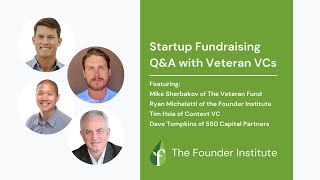
The Founder Institute hosted a live panel and Q&A on July 22, 2022 featuring veteran-focused venture capitalists Mike Sherbakov (Veteran Fund), Tim Shah (Context Ventures), Dave Tompkins (550 Capital Partners) and moderator Ryan Micheletti (Founder Institute/Global Operations and GP at the Veteran Fund). The session opened with introductions and announcements about the Veteran and Military Family Accelerator, a $100,000 veteran pitch competition, and resources for founders. The discussion covered the current macro‑economic environment and its impact on venture capital, with panelists emphasizing that downturns create opportunities for resilient founders, especially veterans. They detailed their investment criteria – focusing on late pre‑seed to seed stages, founder experience (often military), product‑market fit, traction metrics (revenue, users, LOIs), and valuation ranges ($4‑12 M). Non‑dilutive funding options such as SBIR/TurboSBIR were highlighted as a competitive advantage for veteran entrepreneurs, with advice to prioritize commercial customers before government contracts. Practical fundraising tools were recommended, including Foundersuite, HubSpot, Signal, and paperstreet.vc for investor outreach, and the importance of building a large top‑of‑funnel of investor contacts. Panelists shared personal advice: leverage technical co‑founders or low‑code MVP approaches, be scrappy, focus on revenue, maintain mindfulness and health, and use trend‑line analysis to gauge progress. Community resources – the Veteran Fund, Context Ventures’ office hours, 550 Capital’s network, and Founder Institute’s accelerator – were offered for ongoing support. The session concluded with final advice for veteran founders and a networking invitation via Airmeet.
Chapters
Welcome everyone to our Founder Institute event on startup fundraising and Q&A with our panel of veteran venture capitalists. So we've got a really great panel of investors for you today, and I'm excited to kick things off as your host. A quick intro on me. My name is Ryan Michaeletti. I'm head of global operations for the Founder Institute and a general partner at the Veteran Fund. And so for those of you who don't know, Founder Institute is the world's largest pre-seed startup accelerator. Since 2009, it's grown into an international sensation, launching over 6,000 startups across 200 cities with a mentor network of over 25,000 mentors. And we're just getting started. So I've had the pleasure of leading the Founder Institute's operations team over the last 8 years. I've directly launched over 600 startups through my own accelerator programs, including VetTech, which was the very first veteran startup accelerator here in Silicon Valley. And indirectly thousands of other startups through the programs that I oversee at Founder Institute. And so in addition, I also co-founded the Veteran Fund, which is an early-stage venture capital firm that invests in exceptional leaders from the military community, which my partner here, Mike Shcherbakov, will share a little bit more about. And so our mission is to really unite the national veteran startup ecosystem to help build startups that will positively impact the world. And as part of this mission, we recently launched a special program for veterans and military families called the Veteran and Military Family Accelerator at Founder Institute, which will allow veterans and military spouses to join our pre-seed accelerator program for free alongside our FI San Diego program. And one other special announcement for the veteran community here, we're excited to share that we have officially got the dates for the second annual $100,000 veteran pitch competition. It's scheduled for September and October of this year. We're going to do things a little bit different if you participated last year. We're going to, we're going to have the semi-finals finals online where 12 founders are gonna pitch, and then we're gonna select the top 5, and those 5 are gonna pitch live in Las Vegas in October at the Military Influencer Conference. So I'll share some more details here in the chat. So the call to action here is whether you're an established founder looking for startup funding, you can go to the Veteran Fund. It's www.veteran.fund, or some of the other panels will share their information here. Or you can apply to the $100,000 Veteran Pitch Competition and compete for an investment from the fund. And if you're, you know, just starting off as a founder, if you're looking to join an accelerator program to help you increase your traction and funding, you can go to fi.co/veteran and apply today. So let's go ahead and jump into the agenda. So in a moment, I will introduce the veteran VCs on the panel today, and then we'll kick off the panel discussion. So, so all of you know, this is a live event and we want to make this as interactive as possible and get your questions answered. So if you have questions, please put them in the chat. And the other thing too, if you're here in the audience, tell us where you're from. We want to see where people are joining us from today. And finally, at the end of this event, we'll do an additional networking session on Airmeet, which is a platform we use to connect the founders and the people here on the call. So stick around towards the end of this presentation and event, and we'll send the link in the chat at the very end. So without further ado, it is my pleasure to introduce the veteran VCs on the call today. In addition to introducing yourself, share some details about your fund and maybe even a little bit of your background and why you launched the fund. So I'd like to first introduce Dave Tompkins. He is a founder at 550 Capital Partners. David, welcome.
Thanks so much, Ryan. Hi, I'm Dave Tompkins, 550 Capital Partners. We recently launched our first fund. I spent a lot of my career— I'm the old guy on the call today. I spent a lot of my career in Silicon Valley in startups. I graduated from West Point a long time ago. And served and then got my MBA from Stanford and was in Silicon Valley for about nearly 20 years after that. I am now relocated back to the southeastern United States, Beaufort, South Carolina, closer to home. And our fund, we focus on military veteran entrepreneurs in health and wellness, medtech, and human performance. But leveraging the learnings from Ryan and Mike and Tim, we're also very cooperative and helpful to the ecosystem at large. And so we like to help not only with our checks in our fund, but also with veteran entrepreneurs who would otherwise be outside our fund. We're here to help. This is a labor of love for me and something I love doing, and I'm just thrilled to be here and very grateful for Ryan for having me on the panel today.
Yeah, you're welcome. And we love collaborating with 550, so thank you for that. Next up is our friend over at Context Ventures, Tim Shah. Tim, first of all, you've been doing a lot of really great things for the startup ecosystem. Would love for you to just do a quick intro and talk a little bit about your work.
Great. Thanks for having me, Ryan and Mike, and this is really fun to do. And Dave, great seeing you again. So my quick background— actually, before my background, I wanna talk about the $100,000 Veteran Pitch Competition. Last year's winner is Clark from CandleLytics, and he's doing great. Kudos to Mike and Ryan for this, and kudos to Clark with Canalitics. If you're a veteran entrepreneur, highly recommend you all participate in that. And the accelerator for veterans sounds really fantastic, and so also encourage you all to check that out. My background real quickly is West Point '04, spent 6 years as a Active duty infantry officer, then went to grad school, and then after grad school went to startup route. And so first was an operator at a company called Pocket, early employee, and then started my own company, Media Mobilize, a bootstrap company. So I know the pros and cons of venture versus non-venture, and then have been investing for the past 6 years, primarily personal investing. And so invested in a few companies, Workflow acquired by Apple, ThredUp IPO, Morning Brew acquired by Business Insider, Hustle acquired by HubSpot, Portera SPAC, and a number of other companies. And just like Ryan and Dave and Mike, started a fund. It's a really young fund, fun one, focused on two areas. One area is military veteran entrepreneurs. The second area is consumer startups. For what it's worth, out of the funds so far, 80% of the investments have been actually in veteran entrepreneurs, which is actually not what I was anticipating when I started the fund. I actually thought it was going to be more consumer startups because that's what I've been doing historically. And we like to invest in pre-seed, seed, like to invest in valuations, post-valuation of $10 million or lower. That said, if it's a company that like we missed and we want to catch them, we will occasionally like go beyond that. And currently actually in Bellevue, but very likely actually moving back to the Bay Area where I was for about a decade prior to COVID-19. I'll stop. Last thing I'll say is married, 2 kids, and really appreciate Ryan and Mike for hosting us over.
Thanks, Tim. Always a pleasure to have you here, and thanks for all you're doing for the vets in the ecosystem. Last but certainly not least, Mike Shcherbakov, my partner at the Veteran Fund. Mike, I've seen you like 4 times on Zoom today, but why don't you do a quick intro?
Thanks, Ryan. And Dave and Tim, such a pleasure and really always appreciate and grateful for the work you're doing in the veteran ecosystem. My name is Mike Shcherbakov. I spent 5 years active duty as a Marine and ended up in San Diego where I went to undergrad, started my first business, and have kind of been in the startup ecosystem for the last 10 years. Did a little bit of angel investing, had a couple small wins early on, and I ended up launching the Founder Institute program in San Diego, which I currently still run. I also, in addition to being the managing director of that program, co-lead the veteran vertical alongside Ryan that he mentioned earlier. We launched the Veteran Fund at the end of last year, and as of last week, we made our fourth investment. So the Veteran Fund is a $20 million fund that backs veteran-led, military spouse-led technology startups. The exception to that rule is dual-use technology, so if there's a government and commercial application, and our sweet spot is we like to lead rounds. We write $250K checks into pre-seed rounds. We're targeting at a $4 to $6 million valuation. Of course, as Tim mentioned, we're kind of flexible depending on what the company is doing and the industry they're in. We write $500K seed checks. We target $8 to $12 million valuations there. And at the end of the day, as Tim and Dave are doing so well, and Ryan with everything you've been doing in that ecosystem for the last 10 years, our goal is to add value. If there's a founder on this call that's had a call with me, you know that because I point them in the direction of 550. I point them to the great work Tim's doing with the Veteran VC Coalition and the office hours he hosts. So at the end of the day, I hope you find today helpful. We're going to share as many resources as we can. We're going to share what we've seen in the venture ecosystem. And if we can point you in the right direction, I believe a rising tide raises all ships. So I hope you find this meaningful, helpful, and get the resources you need, and you're a better founder at the end of this hour we spend together.
Yeah, I love it. And Mike, thanks for that. We did get some people to write in saying that they weren't able to add their welcome to the chat. Go ahead and try it now. We just turned it on. And if you're a founder working on a startup, put a link to what you're working on. You know, we're interested in seeing that, and we also want to answer questions that you have. We had a question earlier around like, is this event just for veteran startup founders? It's not. It's for everyone. We're going to be talking about startup funding in general, but because we have a panel of veteran VCs, there is a slight bend to it. And so let me kick this off by asking the very first question. And again, you know, this is live open Q&A. If you have something pressing whether you want to talk terms or you want to talk about like how to go and raise capital, put those questions in the chat because we really want to dive into the questions that you have. But let's talk about the current venture landscape and how it's changing due to the economic situation. So I've talked to many founders, they're worried about, you know, the looming recession, and they see that VCs are tightening their investment criteria. Some valuations are coming down. Founders are starting to look at like extending their runway. So overall, you know, and this is, you know, maybe, um, Mike, we could start with you first. Um, do you have any advice for founders on how to succeed in the coming months given the potential of a recession? And how has the recent economic turmoil affected the Veteran Fund's investment strategy?
Yeah, thanks, Ryan. I'm happy to kick this off and just say that, um, I kind of want to put everyone's worries at ease and say that if you're a founder that's building a meaningful company, there's never been a better time. And if you're an early-stage investor, there's never been a better time. In fact, fortunes are created in down markets and collected in up markets. And what we've seen in the last several years is an overvaluation. There was a lack of diligence, there was a lack of discipline, there's a lack of just good etiquette across the board on both the founder and startup side because, in my opinion, and I'm happy to be proven wrong here, it was kind of splashy cashy all the way around. Due diligence processes were done in 24 to 48 hours, and now we've just kind of come back down to reality. So valuations have kind of repriced and reset. Investors are taking their time, founders are taking their time. I'd say from the founder perspective, it's certainly, if you generally wanted to keep 12 to 18 months of runway in the bank, it's a good idea to have 18 to 24 months, kind of stock up a little bit. But in general, I'll say if you're building something meaningful, it's a really great time. And the last thing I'll say is, This is why we bet on veteran entrepreneurs. We, as veterans, and other founders will relate to this because it self-selects for a type of personality that loves challenges, that is much more risk tolerant than the general population. So I'll say, I know it can seem very daunting, it can seem like a very challenging time, but in my opinion, this is a perfect time to separate who the great founders are because of the characteristics of leadership, resilience, and purpose.
Can I build on that, Ryan, real quick? Yeah. Being the old guy, as an entrepreneur in startups, I lived through 9/11, I lived through the Great Recession, and I could not agree with Mike more. While the times look very bleak now in terms of lower valuations, limited capital, the need for more runway, It really, it identifies the best entrepreneurs and the most resilient entrepreneurs. And I think it speaks right to the veteran entrepreneurs. And it really gives you a competitive advantage. I mean, because this is a very tough period. We don't know how long it's gonna last. None of us really do. But it really plays right into your hands and what you've, you know, your DNA. From your time in service and beyond. And gosh, I look back to, you know, '02, '03, and then '08, '09, '10, and, you know, good decisions I made, bad decisions I made, and had I, you know, made good decisions versus the bad decisions, what would've been available to me on the other side of it? And I'm just, I can speak from experience that this is absolutely a golden time if you take advantage of it.
And what about you? What are you seeing?
I want to really reiterate what Mike said. I think it's a great opener. And I think what we're seeing in 2022 is a reversion to kind of the mean, right? So 2021 and 2020 were very, as Mike said, frothy. I think he used the word splashy, catchy, and that's like exactly how I would describe it. So it's almost less like we're in a different environment and more that we're in an environment that was the environment outside of 2020 and 2021. So this feels like 2018, 2019. And of course now everyone's talking about a recession and I would just note, this is maybe one of the most predicted recessions in my lifetime. I feel like everyone's now a macroeconomist and everyone's like, this is a recession. So for that reason, I'm actually feeling a little bit less worried. If everyone's like, this is going to be really bad, It of course could be really bad. I'm still worried about that, but it just feels like we're really worried about the downside. And so in some ways the downside will be less terrible, knock on wood. I would also add around getting to know your investors. Fundraising takes time and no, there's very little, very few meetings where it's like the first meeting, it's like, hey, like that meme of take my money, right? Occasionally that meme happens, but that meme is so far and few between. And so if you are fundraising, I would start as soon as possible to get to know the people that you want to raise capital from. And I would also try to have your top of funnel as large as possible. And it's almost just like trying to catch customers, like, hey, you're trying to go customers and you know, you have to have about 50 customer meetings before you have a few that convert, like think about that math also for investors. And then one more note I would say is venture is not necessarily a first choice. There are excellent companies that are bootstrapped. I respect that a lot. Companies like Atlassian and Mailchimp that grow to be billion-dollar companies and more. And so I think a lot of entrepreneurs are oftentimes enamored with this mindset that I need venture capital to succeed. That's not always the case.
Over.
Yeah, I love that. You bring up— Everyone had so many good points here that I'd love to just kind of like reemphasize. You know, there's a lot of, you know, talk about the upcoming recession, but recessions aren't necessarily a bad thing. It's just a correction. And I do think that like, you know, even though the tech ecosystem right now is seeing some layoffs, like this is a really good time if you're a pre-seed entrepreneur, which it seems like a lot of these people are. And to your point, Tim, I mean, bootstrapping, I'm a huge fan of bootstrapping. You know, there's some questions in here that we'll get to around like, when is the right time to fundraise and how can I raise money for my, you know, pre-revenue product? Um, you know, at the end of the day, right, you don't necessarily need to raise venture capital. It's for a very specific type of company. And it's, you know, with the investors tightening their belts like they are, it's going to get more competitive. So, um, you know, why don't we talk a little bit about like what you look for in terms of traction? So like putting your VC hat on, if you're looking at a company and they're trying to raise money, What's sort of like the benchmarks that you're looking for? What's that investment criteria that they really need to check in order to get a term sheet from you? Mike, do you want to start this time as well?
Sure. So our investment criteria and our fund mandate is a little unique at the Veteran Fund because although we say pre-seed, we're really as late pre-seed as possible because we feel like that kind of de-risks our investment. I'll share something that Jason Kalkanis, if you're not already connected with him, I would say from a content standpoint, puts out really great content with This Week in Startups and the All In podcast. I think if you're interested in macro markets and what's happening, the four of them are incredible, Chamath, Jason, Jason Friedberg, and David Sacks. But Jason says it well. He says 9 out of 10 startups fail across the board. This is just kind of what we know. If they go through some kind of accelerator program, 7 to 8 of them will fail. And then if they go through some kind of accelerator program and reach some kind of demonstrable traction, an early MVP, early customers, it can be in the form of, you know, customers, revenue, something, then 6 of them will fail. And that's kind of the spot where we come in. We want to see some type of product in the market. We want to see a founder that has years of experience in that industry. We want to see a team that can execute. And so we're not looking at kind of the napkin ideas. We want to be able to talk to customers. Of course, like a demo is like and playing with the product is the best thing we can have. But if you're short of that, you know, LOIs, having a good pipeline, having— again, we look for great founders, number one, these resilient founders, and this is why we bet on veterans, because they've already passed this kind of virtue test, they've passed the resilience test, we know they're so mission-focused that even when things get hard, which is a challenging environment, they can push through and accomplish it. So we bet on them first. But then we are looking, do they have this some type of traction in the market? And it does depend on the industry. And I'm certainly interested in hearing how Dave and Tim approach this as well.
Let's go, Tim. Why don't you answer and then we'll go to Dave after?
Cool. Well, I think many of the criteria that Ryan and Mike looked at are quite similar to mine, and I'll just peel the onion a bit more. So I would say It is probably 3. It's founder, revenue, and product. So for founder, we like kind of serial entrepreneurs just because we think that like your second deployment, you're better than you were on your first deployment and you just like know these things. It's just like there's so many questions you have with your first deployment that makes it like miserable and hard. And the second one is just as hard, but like you just kind of understand certain— you just understand the terrain a bit better. The other thing I really care about is network, primarily because I'm such a small fund that I can't back you for the life of your journey. So can you raise from Ryan, Mike, Dave? Do I think that your network and your pitch and just your personality is compelling enough that other people are going to support you along the way? The other last point is Founder's industry background. So sure, I'm an Army guy, I like Army people, but that's not enough. Like if you're doing fintech, I need to believe that you have enough fintech background for you to execute against that. And so how much experience do you have in that? And then revenue, ability to show traction, that doesn't have to be much. We have and will invest in pre-revenue, pre-product. There's a lot of risk there, but ability to even show some traction will be helpful. And then product is just how sticky is it and can you build the product? Over.
Dave, what about you? What's your investment criteria?
Yeah, really not much more to add to what Mike and Tim said. I think that's all great stuff, and I hope the founders on the call today are taking good note. I know it's recorded so they can listen to it afterwards. So nothing too much to add to that other than to say, What's big for me is trendline. And, you know, I always start with the first time I'm introduced to the founder and first meeting. And then when it comes time for them asking for, you know, a check or, you know, are you interested in investing or not, or, you know, whenever I have to give some sort of indication as to my interest in investing, I look at the trendline that, you know, starts at time zero and then is time one at that point. And I look at sort of two lines, two trendlines. One is what they said they were going to be able to do between time zero and then, and second, as to what's happened. My experience and advice from people far more experienced than me in venture investing have told me that first off, that gap between what they said they were going to do and what they actually did, that whatever those slope differences are, rarely changes over time. Then I think even more importantly, the actual trend line rarely changes over time going out into the next number of years. Something dramatic and often traumatic has to happen for that trend line to change. So, when I draw the line between those two points, that really helps me kind of make sort of the deciding vote with all the buildup being everything that Mike and Tim talked about.
Ryan, I'd love to just jump in for a second and add on top of that some helpful resources. I couldn't agree with Dave more, and actually what Tim shared in his opening with start networking and developing those relationships early, there's that kind of common phrase, which is when you ask for money, you get advice, but when you ask for advice, you get money. And I think it's a great idea to start establishing relationships with investors and just supporters of what you're building early on, And I talk to every single founder. So every single founder that applies to the Veteran Fund, I get on a call with and point them in the right direction. 70% of them, 70 to 80% are too early, 10 to 15% are too late, and then maybe 5% of them will be in our sweet spot. And when they're too early, I tell them, make sure you have a distro list. Use things like paperstreet.vc, there's a free version of it, and just add the contact, ask the investors you're talking to, their permission, of course, But to Dave's point, you won't be able to get on calls with them every month or every 3 months, but if they're on your investor update list, they'll be able to see the traction you're making. And so for me, I talk to someone that has a back-of-the-napkin idea, they add me to their list, and then every month I see an update. I don't reply to all of them, but I see it. And then all of a sudden, in month 3, month 6, they're actually hitting those milestones that they've mentioned that they said that they would, and now they're in a point where we think we can fund them. So maintain those relationships, and it kind of keeps you accountable. So use resources like that to continue to build the network and share milestones.
Enrique here in the chat, you know, asked a really good question that kind of dovetails in that, which is, you know, one, like, what are the key aspects before launching a fundraising campaign? And then his follow-on is, would you recommend any CRM investor software? You know, for me to just kind of jump in and answer, you know, the second piece here, a lot of our founders use something called Foundersuite, which is sort of like a CRM software. A lot of different— we use that in our our funding lab program at Founder Institute. And there's a lot of others, like Signal's really good for finding investor contacts. But, you know, as Mike mentioned, and actually, Tim, you said this first, you need to have a really big top of funnel of investor contacts before you go out and fundraise. And, you know, here's some of the things that we teach founders to do in Founder Institute when they go out and raise capital. So the very first thing is like, you have to have a team. right? And you have to be full-time on your startup. If you're not full-time on your startup, you're shifting the risk onto the investor. And most investors will not fund a company where the CEO or the founder is not full-time. So like the, the notion that you're gonna go and raise like $5 million and then quit your day job, it's a fantasy. You have to do it beforehand, but you wanna also make sure before you do that, that you're actually at a point where you can. So do you have a product? Do you have a little bit of demonstrable traction? All these things are important because when you go out to fundraise, not only do you have to spend somewhere between 20 to 30 hours a week just on the fundraising piece, but your company also has to make progress over time because the investors aren't just going to talk to you and say, "Great, we're in. Here's a check." They're going to ask some questions, maybe set up another call a month down the line, keep in touch with you. So it's really kind of a 3-month-long process. And if you don't have a team that can help you continue to get traction, continue to grow the business, then it's going to be really challenging for you to spend that time fundraising while also building the business. Because every touchpoint you have with the investor, you want another update or you want to show progress over time. Maybe you closed another customer or increased your revenue. Those are the things that sort of traction and momentum is exactly what investors want to see. But I'd be curious to get the thoughts from, from maybe Tim, we'll start with you. Like, are there other things that you would recommend before launching a fundraising campaign? And do you have any CRM investor software you would recommend as well?
The first on the CRM software, I think HubSpot is very simple, easy to set up and just to get ready to rock and roll. So I'd highly recommend that. And it doesn't cost much. And if you're using Google Chrome, it just integrates really well. And so Highly recommend that. In terms of other things, I would just be prepared for the first 2 years to be brutal. Like, I hate to say it, it's just really, really hard. Think of it as your first 2 years in the military. There's just so much, like, you go through boot camp, then you've got training on top of that, then you go to your first unit, and it's just you're constantly being challenged, and it's really hard. And so I sometimes find that veterans underestimate surprisingly just how hard starting a business can be. And I've heard veterans say, it is the hardest thing I've done. And they've done really hard things. Like, I mean, I've heard SEALs say this. I've heard like veterans who have like incredible spec ops background talk about how growing the business was the hardest thing they've done. And so that, I think, really resonates with just like, I think a lot of VCs who, all of us, I would actually say are founders too. And I don't think enough people realize that like veteran, first-time fund managers, like we have to be just as scrappy as you all. And all these points that like we're sharing, we're kind of living it ourselves. And I think those are the main points. Over.
Dave, what about you?
Yeah, Tim makes great points. We're founders too, and we're first-time fund managers, I think everyone on this call, and so we're living and learning as we go. I would also add that, and I think one of the greatest things about the veteran entrepreneur ecosystem is how sharing we are and how open we are, just forums like this, and any of the four of us and hundreds of others in the ecosystem, are happy to introduce you to other veteran-led startups. And I think it's really important to talk to them, you know, talk to a representative sample of them, 8 of them, 10 of them, 12 of them, 15 of them, and talk to those who have been funded and have been successful, those who have been funded who are struggling, those who have not been funded and somehow bootstrapped their way to success, and those who have not been funded and are still struggling. And just learn from all that, because it is nothing to— there's no, you know, judgment on any of these people as entrepreneurs. It's just how the cards fell, but you learn so much from talking to them and learning from them. And what you'll probably find is, maybe there's a set of repeatable things that, whether it's mistakes or shortcuts or whatever, that you can avoid and do better than they did. Data is so important right now because I mean, whether you're a first-time fund manager or an entrepreneur, I mean, all the upside and all the stuff you read about in terms of all this world-changing and compensation and wealth and all this stuff, it's all on the back end. The front is just a lot of sweat. And to talk to folks who are 2 years ahead of you in the journey of sweat, I think, can be very, very valuable. And we're happy to introduce you to folks like that.
Yeah, I'd love to jump in and say that those aren't just words. We're living this. And what I mean by that is I do believe that community is the answer to many of the challenges that we as either founders or fund managers have. And so this is something that's unique in the venture ecosystem. I certainly haven't seen it this collaborative in any other vertical. I mean, you'll see if you go on our team page at the bottom, we have 550 contact ventures listed there because I want every founder to go there. In fact, I don't think I have access to the chat, but Ryan, if you can put Tim's office hours at veteranvcs.org. Tim hosts monthly office hours where he brings 10, 15, 20 VCs together just to help founders, not to poke holes or make any fun of— if founders will say, this is what I'm being challenged with, and a bunch of VCs are telling you, okay, yeah, we've seen this before, here's how we can help. And so I want you to know that if you're listening to this live or if you're listening to the recording later, you're in good hands. Like, we've got you from an ecosystem standpoint. So, you know, come to the event. Again, Tim just put on another great event. Tim and I connected for the first time at the Military Veteran Startup Conference that he hosted in San Francisco. So this community will welcome you with open arms. We're all here to do really hard work. Trust me, it's not like no one's going to do the work for you. But we respect each other because we know that we're kind of— we're in the mud together.
Yeah, I love it. That makes a lot of sense. You know, there's some questions in here around like, at what point, you know, should we look at seeking funding? And, you know, can we talk a little bit about our pre-seed round? I just want to share a resource for everyone. You know, we came up with these benchmarks for our mandate, and these are by no means like a hard and fast rule here. But like some first-time founders are usually pretty shocked at like the amount of traction that they need to have before they raise money. And I was guilty of this myself. When I first started as a founder in like 2011, I was like, oh yeah, we're just gonna be like, raise $2 million without a product and like a part-time team. And like, you know, then we're gonna build a billion-dollar company, 'cause that's how you do it in Silicon Valley. But the truth of it is, and I've learned everything the hard way, is that you really need to build that team product traction to get to that point. You know, funding is more of a lagging indicator. You, you build a successful company, then you can raise funding, versus needing funding to build a successful company. So I just want to share this with you. Uh, I think you all can see this.
It might—
let me know if I should zoom in. But here are the different investment stages. You have pre-seed, you have seed, and you have Series A, right? And feel free to take a screenshot, uh, if you want. This will be in the recording afterwards. But These are typically what we see in terms of growth rate. Most people on this call are squarely in this pre-seed stage. But now if you look at like, what are the— what's the traction you need to raise money at these various stages? You know, if you want to go and raise a seed round, which is, you know, by definition anywhere between like $2 to $5 million, then you want— you need to go and be able to, you know, demonstrate that if you're, you know, a SaaS company, that you have $20,000 a month in recurring revenue. right? Up to $100,000 a month, like $20,000 minimum. And a really, really important takeaway I want to emphasize here is like, you are competing with other founders that you don't know. You know, the best VCs are looking at 100 deals a week easily. Um, and so, you know, how do you become the top 5% of that to then go and get a meeting? Well, you should probably be on the higher end of the spectrum, right? And, you know, everything is like, you want to look at fundraising as like effort per unit of time. So if I had, you know, $100,000 in monthly recurring revenue and I was raising a couple million bucks, it'd be pretty easy for me to raise, right? I could probably have a couple meetings with some VCs and do it. If I have $0 in monthly recurring revenue, I probably need to talk to 500 investors to find people to believe in me to invest in that realm. So I shared this with you that like you have to get these things in place before you go out and raise money. Even at this pre-seed level, you need some, you know, if it's consumer, you need some daily active users. If it's SaaS, you need paid pilots. The exception here might be in deep tech. And I think a lot of veterans might check this box with like some of their dual-use technology. But if you're building like quantum computers, it's going to cost millions of dollars to build an MVP, so to speak. So that might be an exception at this pre-seed round. So hopefully this kind of gives everyone an idea and some context around like what are the benchmarks that you need to be successful here. I'd love to get, you know, others' thoughts here, or we can move on to the next question. All right, sounds good. Well, let's, let's keep rolling. So there is a question here. From, it looks like, Orr Systems. I think this might be Sean. So you have an MVP, you've bootstrapped it to date with several different product lines and possibly dual-use military and commercial applications. Your CEO and you are retired special forces, and you've built a small flexible team that can accomplish any mission. What is your advice for a company like ours? So I guess like the first question I would always ask someone is like, why are you building what you're building? And why are you the exceptional person to go out and solve that problem? You know, there's, there's a variety of different things you could be spending your time on. And so that personal motivation, that personal why is probably the single most important thing that any person, even outside of entrepreneurship can answer. You know, Dave, Mike, Tim, I don't know if you have any additional thoughts for our system here.
All I'll say is, and this is just a little bit of kind of a chip shot of an answer, but one, I think, unique advantage that I'm seeing in the ecosystem that we have is that we are getting DOD government non-dilutive funding opportunities faster and bigger than people outside the ecosystem. So if you have some really incredible technology, and you have ties back to your, you know, former, you know, brethren in the military, and you can get, you know, STR grants or CIBER grants, you know, through some sort of, you know, faster means, then by all means pursue that. Because, you know, a government contract to help build out what you're building, it brings in revenue, it lessens the burden on outside fundraising, And it is, I think, a unique competitive advantage that we have in the veteran entrepreneur ecosystem. So please, you know, and if all that's new stuff to you in terms of who asked the question, then talk to us and we can help you because we, you know, much of our portfolio of the 4 of us are pursuing these non-dilutive grants and opportunities within the DOD and government.
There's— Yeah, go ahead, Mike.
I'll just say I'd be interested to know, Dave and Tim, when you talk to founders, it sounds like most of the founders that are on this are fairly early stage, maybe idea, early MVP. You know, what are the resources that you send them to? Because a lot of them actually are not familiar with non-dilutive funding. And I'll just, you know, high level, essentially what it means is if you have a dual-use company where there's government and commercial application, you can use this free government funding to help with the R&D, the product development. And for us, we actually, we like that as long as we see a path to commercialization. I think if you pigeonhole yourself just in the government, it's not a terrible idea, but it's always nice to have kind of both options. You know, a lot of times if a company is leaning on one contract from the government and that contract falls through, then the business is, you know, it's very challenging at that point. So I know we use a resource like Turbo SBIR which is kind of a— it's like a TurboTax, very easy. They have a free search tool where you can look at the different non-dilutive funding options available. Tim or Dave, do you have resources that you send founders to to learn more about non-dilutive funding?
Yes, I have an Air Force flight surgeon that I work with out of Beaverton, Oregon, and, you know, he's just one of many resources, but he's kind of a captive resource to 550. He's helped a number of our startups. So, and he's actually, he has a pretty cool cohort of like now over 70 veterans that he's helping sort of do what he does in terms of get on scientific and medical advisory boards of these startups and to help them get non-dilutive funding. So I can always make the introduction to Eric in Beaverton, Oregon.
A few notes. One is the— I would think of SBIRs as, and non-dilutive funding, as actually long sales cycles too. And so it's— if you feel that your product is ready to go sell, go sell it. And I—
this—
let me first start with something that Ryan said, which is that we care about product-market fit and then founder, right? So it's found— it's really founder-product-market fit. Ryan said like, why, what makes you so special? Like, why can you succeed where others haven't succeeded? And so there has to be something in your background or your vision or your execution that differentiates, differentiates you. So that's the vision side. The transaction side, and this is something that I've gradually become more comfortable saying, and it's somewhat I think maybe too blunt, but our titles are venture capitalists. And so by nature, we're capitalists. And so by nature, we have to care about dollars, right? It's dollars in and dollars out. And that's the same for entrepreneurs though too, right? In order for you to succeed, like generally you need to be generating a lot of revenue. And so why am I saying all that? Because if you're having all that great traction, the revenue should show it. And then if the revenue shows it, that's gonna make VCs actually wanna chase you. Typically the best deals are actually the— for VCs are the ones that we're chasing after. And we chase after deals because they just have the revenue. So I'm not sure if I really answered the question, but I tried to. Over.
That's great, Tim. I'd love to add one more resource too. Again, my commitment was, I hope at the end of this hour, you have— you're a better founder and have good resources. I love what Tim shared because I think this is an important thing that I often share with founders in the accelerator or just founders I talk to in general. Think when you're talking to investors, put yourself in their shoes for when— do a little bit of role reversal. And so if you're not familiar with how venture capital works, we are general partners in a fund, so we run the fund. We have limited partners, LPs, in the fund, and these Limited partners are investors. So it's different than angel investing. Angel investing is your own money. Once you're a VC, you're investing OPM, other people's money. So we are fiduciaries. We have the responsibility to make more money for our investors that believe in us. So with that said, I mean, at The Veteran Fund, we look for 100x potential. And it sounds crazy, but we invest early stage. If we don't think the company has the potential to 100x, it just doesn't make sense for us. So we're not only betting on home runs, we're betting on grand slams. And so again, if you're coming with just an idea, that may not be— for some VCs, it may be a fit, but in general, the more traction you have, as Tim said, we're often chasing the company, or they're on the higher end of the metrics that Ryan touched on. And a really great book that I recommend everyone read, I recommend this to all founders, is called Secrets of Sand Hill Road by Scott Kupor. He was first over at Andreessen, a16z. So it really is advice for founders through the lens of a VC, and then you'll kind of understand. You go, oh, I get it. This is what investors are looking for.
[Speaker:BRAD_STONE] And what I love about that book is his initial premise is that all the startups don't have to be funded out of Silicon Valley. It doesn't have to be just a Silicon Valley world. He wants to democratize the whole venture industry, but he said, "Okay, you, Mr. and Mrs. Founder in Indianapolis, we need for you to understand how the venture capital model works." You need to—
there it is.
It's a great book. I've got it right back there. You need to understand how we work because you need to empathize with kind of where we're coming from, and that helps you sort of structure your pitch for us. And it also gives so many rules of the road, and it walks you through a term sheet and what to look out for and stuff. It just really, it removes a lot of the fear of the unknown. And to Mike's point and Tim's, visual demonstration. It's probably as good a book out there right now for you to read on venture capital.
So those are all really good suggestions. I want to touch base a little bit on non-dilutive funding. And also, like, you know, Mark had a question in here around, you know, what to do if you have a product that where you're building an MVP and you have no revenue, but you want— you need to go out and raise money. So let's kind of take this one step at a time. So first, let's talk about dual use, right? And let me add some context here. You know, we talked with some leaders in one of the DoD's innovation arms, and their best advice, not only to us but to founders, was that if you're going to go the dual-use route, which again means you're going to sell to government and the private sector, is make sure that you first sell to the private sector. So don't build an application just for the government, because you're basically taking a huge risk relying on that one customer base. It could pay off handsomely, and that's great, but it's slow, and you're taking a big risk not diversifying. Instead, what the best advice is that you should go and build a product for a commercial customer that also has a government application, so you can start selling to your customer base, generate money and traction, and then you leverage all of this non-dilutive funding to then expand that product, build out the team, do R&D, and there's a lot of non-dilutive funding available, but you want to make sure that you're not tying yourself directly to the government per se. Now there's some applications that are government-specific, and unfortunately we've seen some of them fail because they're hoping for a contract to come through and it didn't pan out the way they wanted it to. Is there any other kind of final points on non-dilutive funding that any of the panelists would like to share?
I would just double-click on what Ryan said, which is oftentimes dual-use entrepreneurs are actually single-use entrepreneurs in that they're just like targeting the government, right? And it's just like sometimes they'll be like, I'm a dual-use defense tech company. I'm like, no, you are just a gov tech company. Company, um, and govtech companies have a really hard time because it's a really long sales cycle. The thing with long sales cycles is, yes, the inverse is true. Like, once you're in it, then you have a moat because it took you so long to kind of travel that path that, like, the government's probably just going to utilize you. Um, but it's just such a long path that very few will necessarily survive it just on that path. The other note is veterans typically go down, like, a govtech or government service or software pack, primarily because they can also leverage, which is— I would highly recommend it— their veteran status. So like whether it's SDVOSB or other things, like that will help you land government contracts, but it's not going to be the determining factor.
Exactly. To Tim's point and Ryan's point, modify what I said about and what I believe about non-dilutive funding and how I think opportunities across the board are more prevalent for veteran entrepreneurs than they are for non-veteran entrepreneurs. Modifiable, what they said is that like, that can't be your— that more often than not, almost always more often than not, that can't be your bet the company strategy. You've gotta establish viability commercial, you know, first, or at least in parallel.
So let's jump over to product really quickly, 'cause this is an important topic. A lot of founders, think that they can just go and like pay a product development company like $100K to build an app or whatever, you know, they charge. And that's not necessarily the path to seeking funding or even building a great company. And so what if you're in a situation where maybe you don't have the tech skills to build the product, but you've got a great idea, you validated it, but you really need to build like your tech team? Like, what would your suggestion be for those founders that are like still building the MVP, but they feel like they need to go out and raise capital to build the product?
I'll just jump in and share, because I think this is a common— I don't want to call this the valley of death, but this is a very common issue, right? Founders say, "Well, I've got this big idea." Usually the CEO, founder has this big vision and they're not technical. And so I'd say the two resources that I find most helpful is one, find a technical co-founder that shares your same vision, mission, values. And Founder Institute does a great job at putting these networking, meet your co-founder, meet a technical co-founder. By the way, they're also in ridiculously high demand. Everyone wants a technical co-founder. That said, I started this call by saying there's never been a better time to be an early-stage investor or early-stage founder. The fact that these huge tech companies are laying off 20%, 30%, 40% means that there's a great opportunity for you to hire or bring on technical co-founders. If they've been at a Facebook, Google, Apple, or some of these companies that have been doing layoffs, and they've made their $200,000, $300,000, $400,000 a year salary for the last several years, and they say, "I want to do something meaningful," you'll actually see this quite often. Once someone's comfortable in that space, they like to move into the early-stage space. They like to be at this ideation, creative, early-stage time. So it's actually a good time to find a technical co-founder, and there, again, Founder Institute's a great resource for that. The second is, If you do kind of outsource and go with some kind of, you know, development shop, I would say make sure that you're doing things in iterations and in sprints, right? Don't commit to these, you know, long year-long contracts, kind of everything. I'm a fan of performance-based and milestone-based outcomes. And so make sure that you just do some diligence when you're talking to potential development firms. Make sure that, you know, you've talked to their customers and who they've worked with in the past. And generally you can do things in, you know, 2, 4, 8-week kind of sprint cycles and build out. And the last thing I'll say is like, a lot of times there is an MVP, a very low-code, no-code way you can create something on the cheap without, you know, everyone says, I need $750K for development. I'm like, but you can use this platform that exists, validate it. We have a founder we're looking at right now that's using Thinkific to run courses and subscriptions. And you don't want to say any details, but proving a model using already existing technology that cost them a fraction of what it would cost to bring on a co-founder or development team.
Yeah, great points. Dave or Tim, any additional thoughts?
Well, that was golden, what Mike just said. I can't add anything to that. That was fantastic.
Likewise, I would just add just a— I'm not even going to add it. I peel the onion on this, which is I like alliteration. So I would just say scrappy, service, and then software. What does that mean? That means like be super scrappy when you're starting off. Um, and that might mean you don't start with software, but you start with a service. And there are massive service companies, right? Like McKinsey, Deloitte, Accenture, like these consulting businesses, they provide services. They don't provide technology. They don't even provide a product. They provide a service. So like maybe there is a service equivalent to your product that you can just get revenue and get product-market fit, and then get the revenue to then fuel the software, which can then fuel the scale. And too many folks oftentimes, especially first-time founders, will just go moonshot and say, I'm just gonna build the software and I need, you know, $100K, $500K, $1 million to fund my technology. Like, is there a way that you can first prove product-market fit through the service? Much of what Mike said over Yeah, that was great.
In the last 5 minutes here, let me just ask one final question because I don't really see any here in the chat. What is like the one piece of advice that you would want to give a veteran founder who's listening to you today? And it could be about anything. Dave, let's start with you.
I go back to that point on trendline. That, you know, I— Tim mentioned Accenture. After my time in service and getting my MBA, I worked at Accenture for 6 years in Silicon Valley. So I consulted to high-tech start— high-tech, mostly, you know, public companies, but then was in startups there for 15 years. And I kind of learned traction the hard way and then, you know, sort of reflected on it all these years later, looking back. And that trendline point is just so important. It's a way to measure yourself. Don't leave it to your prospective investor to measure you on it. And look at where you are now, and then 3 months from now, look at where you've gotten to. See that trend line. If you're satisfied with the trend line, keep going. It's a good chance you're gonna get funded and be successful. But whatever you don't like about it, endeavor to change it early on and change the slope of that line more positively. So you can get to where you're going. Because regardless of who you are, you're going to be working on your startup probably for weeks, months, maybe a year or two before you ever go out to market looking for outside capital. So really be focused on those early months of trendline and valuation building.
Yeah, great feedback. Tim, what about you? What's one piece of advice you'd like to share?
This is going to, again, sound so blunt, But revenue solves a lot of things, not everything, but revenue solves so much. And I would just say, as a veteran, when I transitioned, I didn't know how to make money. I didn't. Like, you're like, oh, well, like these companies, Nike and IBM, they make so much money and it's like, you just take it for granted. But like, one doesn't understand like how to get the money or even how to create the value and then capture that value. So So what I guess another takeaway to that is it is not terrible to not be an entrepreneur, meaning like if you want to go to a corporate job to learn how the civilian world works and learn how to do sales and learn how to do marketing, like that's fantastic to go learn on someone else's expense and get paid for it. And so entrepreneurship is not glamorous. It is hard work. Over.
Yeah, love it. Really great advice, Tim.
Mike.
I'm going to take a slight turn here because Dave and Tim have shared such great advice on the business side. I'm going to actually address the personal side in terms of advice, and that is, I've got to give a shout out to, I think he may still be in the room, Chris Gosselin, who arguably no one better, mindfulness. Coming back to why you're doing this in the first place, having some kind of consistent whether you call it meditation, mindfulness, reading, taking time to go outside and walk, like these things are so important because as we talked about, it's not easy. What you're going through is not easy. What we're doing is not easy, but we signed up for this. We're like the crazy ones that gave up something easy 40 hours a week for something extremely difficult with no certain outcome and spending 80 to 100 hours a week. And so make sure that you're present, make sure that you're present with yourself, that you're taking care of your health. They say a healthy person wants a million things, but a sick person only wants one thing. And so make sure that you're taking care of yourself because you got to remember why you do what you do. So I would say have some consistent mindfulness practice in your life.
Yeah, love it. And that's something that we're seeing at scale with a lot of the veteran founders. There's a really big mindfulness movement that's happening and it's really That's really great to see. Well, I want to thank the panelists before we wrap up here and just say this was awesome. Always appreciate you guys jumping in. And, you know, I'm really excited to see the collaboration that's happening within the veteran community. I think it really sets us apart from, from others. And just watch over the next 10 years, there's going to be some big things that happen. I want to make sure that everyone here also gets the link for our optional networking session. So I'm going to put a link here in the chat to a platform called Airmeet. Airmeet is what we use to do some networking. I recommend using the— there's like a way to do like the one-on-one, like 5-minute networking. So whenever you're ready, you can go ahead and click this link to join. I'm going to leave this line open for a few minutes just so everyone can get the link and move over there. Once again, thank you to the panelists. And for the founders here on the call, if you're looking for some extra startup resources and support, you've got the Veteran and Military Family Accelerator, a part of Founder Institute. You've got the office hours that Tim is doing, and you just have people in the community that genuinely want to help. So feel free to contact any of us on LinkedIn, and we look forward to seeing you guys grow and succeed. Thanks, everyone. Oh, and Dave has an event on August 12th. So Dave, send us the details and we'll share it with everyone.
Yeah, I'll— they'll be coming out in a week or so and look forward to have everyone on. So it's just so cool what the ecosystem is doing in terms of just share and care. And, and, uh, like Ryan said, 10 years from now, oh my goodness, it's gonna be amazing to see.
Awesome. Thanks everyone. Take care.










