Startup Insights with Founder Institute Alumni: Maria Sucgang, Florin Irimescu, & Abdulkadir Lapai
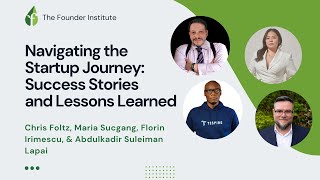
In a virtual panel hosted by Founder Institute Global Entrepreneur in Residence Chris Foose, three alumni—Maria Sucgang (Remotify), Florin Irimescu (BluAna Foods), and Abdulkadir Lapai (Taspire)—share their startup stories, challenges, and lessons learned. Maria discusses building an employer‑of‑record service that enables remote teams in the Philippines, emphasizing bootstrapping, co‑founder complementarity, and a value‑first go‑to‑market approach that landed the first client in two weeks. Florin explains his transition from forestry and traditional fish processing to plant‑based seafood, describing multiple pivots, technology development, and the importance of market feedback in shaping product SKUs. Abdulkadir outlines his ed‑tech payment and school‑management platform for Nigerian schools, highlighting trust barriers, the need to target government institutions first, and the iterative validation required for African markets. Throughout, the panel reflects on the intense, boot‑camp‑like experience of the Founder Institute, the necessity of loving the problem over the solution, strategic hiring for well‑rounded teams, and the personal resilience required to leave stable jobs and scale with limited resources. The conversation also touches on co‑founder dynamics, market‑specific regulatory hurdles, and future growth strategies such as deepening presence in the Philippines and expanding plant‑based food lines.
Chapters
First challenge, when to let go of your day job. Took me a year. My day job knew that I had this on the side. And after a year and after 12 long years of loving that company, decided to take the leap, right. And of course, that's never easy when you have responsibilities, when you have mouths to feed, bills to pay, right. So that's a challenge.
And welcome everyone, and thanks for waiting, uh, on the stage for all of us. My name is Chris Foose, one of the Global Entrepreneurs in Residence at Founder Institute. So excited to be here with everyone in the morning, afternoon, or evening depending on where you're coming from. We have a wonderful set of alumni that we're going to be interviewing tonight, some of our portfolio companies that have successfully graduated our Founder Institute core program. Some of them have gone on to some of our other programs as well. Now, Founder Institute has been around Since I would say before the dawn of all of the accelerators in the ecosystem, now we have over 7,800 graduates from our program in over 100 countries that have got nearly $2 billion investment with a portfolio value of north of $20 billion. And we're gonna hear from some of these wonderful alumni tonight. So first, first, let me just make a couple introductions to some of these great leaders that we have. I'm gonna start out with Florin, you know, I never quite knew that there was layers to healthiness when it comes down to food. And then when it comes down to BluAna Foods, uh, Florian is actually making plant-based sushi. And we're going to hear about all this tonight and some of the trials, tribulations, and some of the steps he had to take to get the successful company going. I think a lot of us think we're super conscious as it is when we're eating things like fish versus cattle or something, Well, Florian and his company have taken it to the next level. So let's invite Florian to this stage, and then I'm going to introduce everyone, and then we'll start with explanations and, uh, we'll get into the questions. Next person I want to bring to stage is Abdul. Now it's Abdul Kader. I probably messed that up. We talked about this backstage. Mad respect for this person, but I want to respect his name, so I'm just going to call him Abdul for tonight. Now I worked a lot in Africa over the last several years, and I've noticed there are these gaps that most people in America you know, take for granted, um, that were not necessarily solved. And if it wasn't for people like Abdul solving this problem— and when it comes down to schools, and you're going to be interested to see what this problem is tonight because you're wondering, is it school funding?
Is—
of course. But he's solving some particular problems that most of us take for granted. I'm going to bring Abdul to the stage tonight, Abdul Suleiman, and, uh, Taspire, his company, which is doing amazing things. And he's got a track record of doing amazing things in the startup space. And the last person I'm here to talk about is Maria and Remotify. Now, the, the constant change in the global HR environment has been vast. And when I say that with the introduction of HR, using AI now, with the introduction of the way that the automatic tracking systems and everything handle resume, resumes, it's harder than ever for companies to find qualified talent. More importantly, talent that they can afford they get the job done and actually serve all the stakeholders, not just their customers. Well, Maria has an interesting way to solve this with her Modifi out of the Philippines, doing great things to revolutionize. And there's this concept she talks about, employer of record, that now makes complete sense to me. And we're going to have her talk about this tonight and her journey to create this interesting, impactful company. Let's welcome Maria to the stage. I think she's having some camera problems, but that's okay. She's here. As spiritous and as voluminous audio-wise as ever. So, so excited to have everyone here. First, I'm going to go around and I'm going to ask all of you to just tell me a little bit about your startups, right? You know, I mean, we're coming from such diverse backgrounds here. I'm going to start with Florin. As you know, I was saying earlier, we were talking backstage, I had no idea that there was plant-based sushi out there. There's plant-based a lot of things, but I didn't really take that into consideration. I eat imitation crab, but that's also made from fish, so I'm not really solving any problems and I'm probably killing myself, right? So that being the case, I checked out Bluana and what you are doing over there, but I also looked into your background, Florin. I mean, you have this interesting background coming from the world of forestry and all this, and I have some questions about that. But first, tell us a little bit about Bluana, what you're doing, and, and how this even came to be.
Yeah, thank you, thank you, Chris, for having me here. And yeah, it's a story of making fish from the trees, from the fields, and actually helping the real fish to thrive and to be there for the future generations. My previous company was also a startup which I started in real fish. I sold it. And then I realized maybe this is not the healthiest system on the planet. I mean, in all the planets, because this planet, it's what we have. In this rhythm, in 10 years, we will need 2.4 planets just to satisfy the demand for the fish, because we like sushi. We are taking 38 creatures from the sea just to have one fish on the plate. And we are throwing after that 50% of it. So we are very bad at managing this resource. And in this space, I saw an opportunity to do something better. So this was the idea of Blueana, making fish from plants. And our story, it's actually a story of pivoting, pivoting a lot. We started with an idea, with a product, Then we become actually a technology company because we develop a technology. We patented in the PCT route, and now we also have a grant for making more innovation, develop and development in the machinery that we are using to implement the technology. So This was the journey and idea, and I'm looking forward to listen to my peers here. Maybe Abdul?
Yeah, you know, it's like this, buddy. Just hearing you explain this, you just added about 10 more questions to my archives. I'm gonna have to do several sessions with you. I think it's fascinating. I'll come back to you in a minute. Let's jump over to Abdul. You know, one of the things I was looking at, I checked out your website for Testfire, Abdul, and I saw 7,000 schools, and then I was diving in deep to kind of really understand what you're doing. And I already loved it from the first moment I saw it. But there are challenges that schools in Africa face, and I know you started your company in Nigeria, that are fairly rampant. Why don't you tell us a little bit about Taspire and some of the things that you are actually solving that most people here in the West take for granted regularly and why it matters so much?
Hi, hi. So excited to be here. And I think, you know, the energy that we Africans bring on stage, considering from the fact that the sheer amount of problems actually we do wake up to see every day and how we're so passionate about, you know, solving them. So I think it's such an exciting time to be an African now, you know, and how we're thinking it's through the founder's heart. To want to solve all of these problems. So my story hasn't really been like a conventional path to building the tech. I just grew up wanting to solve problems. I grew up wanting to build things that people would use, and I was in investing, right? And I saw a lot of queues where people would have wanted to pay school fee already registration fee, as you call it. And, you know, to even pay fee, you have to go through a queue, thousands of students queuing to just resolve or where to just register for a similar, and as well, you know, um, so, and I began to think about how to, you know, uh, provide solutions to this problem. Because when people see problem, I see opportunity. So that was how we started our first company called, you know, JD Lab. And fast forward, come to Test Square, it was, uh, Test Square was as a result of, oh, we had a lot of products in the edtech space and we needed the one that could scale fast, that could respect the startup laws and all of that. And then that was how we came to choose, uh, you know, Test Square. And going through the FI program with Test Square was like an opportunity for us to validates our idea, right? And look at it from a point where, is this a problem that we're supposed to be able to solve, or is this not a problem we're supposed to solve? And that was how we saw that hospitals were losing, um, uh, like, a lot of money.
I think your signal's breaking up a bit. Oh, you're back now. Your signal was breaking up, but you're back now. Didn't mean to interrupt you. By all means, go ahead.
Looking revenues.
All right, well, that's fascinating. So from what I'm understanding, what you're saying here is for parents to register their kids for some sort of school program or something, they would line up, they literally get in lines and wait forever to manually pay. And that's what you originally came to solve, this payment processing aspect. And I gotta tell you, here in America, oftentimes we'll complain about having to go online and make a payment for something like this is some big time-consuming things. Well, let me tell you, with Nigeria, you're, you're constantly waiting in line, and then when you get there, you have to pay in naira, um, not necessarily been able to process it online. And if it wasn't for people like Abdul solving this problem, nobody would. So I look forward to asking some questions about this, how this came to be as we go through this evening. I'm gonna jump over to Maria real quick with Remotify. Now listen, Maria, I checked out your company. I think it's super interesting, but I, I've worked in the employer space and all this before. I have not heard any startups using the phrase becoming your employer of record. I also checked out your background, super interesting. And, you know, I would love to know how Remotify came to be and tell us a little bit about what it means to be the employer of record for somebody so people have a general understanding. Let's, uh, welcome Maria to the stage.
Hi guys, um, good morning. Sorry I couldn't join with the video, tried with different browsers but unfortunately not today. So a little bit about— yeah, we'll do, we'll do. So while my peers are answering, um, I'll restart and see if I could join you with a camera. So a little bit about Remotify. So as you mentioned, Remotify is an employer record solution but we always say we're employer of record, but better. And what we do is we help startups and mid-market companies, international businesses, to extend their runway by building remote teams in the Philippines. Right. So we founded Remotify in 2021, mostly bootstrapped throughout the journey, and now we're raising the round. We started getting investments, but we've grown it to about $1.4 million GMV in 2024, and with the current run rate of $1.8 million in 2025. But the— I think the biggest accomplishment is that even though we've not met most of our employees because it's remote, we are certified Great Place to Work. That only means that in the future of work where it is remote, culture is still everything, right? So we have employees now spanning the Philippines from north to south. There are 7,000 islands, in the Philippines, 66% of whom are women, all are knowledge workers, think software developers, accountants, etc. And our goal is to really go deep in the Philippines, prepare for market consolidation and to replicate that success in other emerging markets. So basically go deep, then go wide. So what it means to be an employer of record is that you can have a team in countries where you don't have an entity. And basically, we're your HR partner on the ground. We take care of the payroll, we take care of your team, we take care of all of the things that you don't want to worry about simply because you don't have an entity, you don't have the capital or the capacity to set up your entity, but you still want stable talents, right. And so now we have clients that have been with us for the past 4 years with the same employee for the past 4 years. And that to me is success, right? Creating a much longer lifetime value for both and redefining what it means to be remote working. So now we're building the operating system for, you know, the new world of work, workforce and workplace.
I gotta tell you, Maria, those are some impressive numbers. You know, one of my colleagues, Dan, he often has told me about the amazing workforce in the Philippines. And of course, everyone's always pitching their market. And Then I started working with some of the amazing talents in Philippines, whether it be from creative, as you mentioned, knowledge work, and I was blown away. Some of the best creative designs I've seen in my career in marketing. You know, this isn't about going and getting some lesser standard here. I've seen the Philippines raise the bar when it comes down to this space around the world. I'm so thankful to have you with us here today, Maria, and I certainly have some more questions. I'm going to jump back over to Florin for a minute. You know, Florin, I looked, like I mentioned before, I looked into your background and, you know, you spent many, many years working in the, I guess, the nation's Department of Forestry, and there was also kind of fish, it appears to be in that department. And then you left that and you went into, as you described them, as real fish. And then now you're into this emerging market of an alternative to traditional fish. That's quite a jump in those steps, right? So there had to have been some roadblocks that you hit along the way here, you know, coming from traditional industry of forestry and, uh, and, and fish, and then going in. What were some of these challenges that perhaps you didn't expect? And first, what caused you to make that jump from the stable life that you had into this venture of entrepreneurship?
Yeah, it's, um, it's a question with many angles, and actually many questions inside the questions. Um, I think the thread that united these stages of my life was the inner passion, um, that wolf that, uh, it's pro-entrepreneurship, um, meaning I'm a builder. I have to start something, go to maximum, then build something else. So this is the explanation from going from a career to another. Actually, the jump wasn't so big in between. Because always they were a little bit interconnected, overlap. Since I've been in the forestry, I started to advance in the career. At some point I realized the next level, it's not possible to have it. I mean, I had to wait too much time, so I started in parallel a personal business. I had the opportunity to access some grants, I built something, then I switched it When the time was right to that new venture, I started to grow it, learn a new sector. I worked with fish before in a trout farm, then I started to work in the processing and I won all the gourmet prizes in Europe, in London, Brussels, Valencia, and so on. Then I sold that company, but in the meantime I had the idea of making an alternative from plants that should be, um, something to, to fit the, the sushi in the first step. And then we realized, um, yeah, as because I didn't have a very technical co-founder in the beginning, that I need someone which has a little bit of knowledge in the technology So, my co-founder came from Nestlé. He worked on developing technologies. It's an entire process. And we switch and we pivot the entire approach to making a technology. So, it's a continuous learning process. When you started to build, you start in some point You don't know quite well where you'll finish, but you have to be flexible. I think this is also very important, like a twig of a tree. And now I'm having another idea to close the circle. I've learned something in the food industry, in the making, actually, real meat from cells, and maybe I will apply it to the wood again. So you never know, you never know.
I mean, I don't think anyone that's listening today doubts one bit that you'll most likely be successful in that as well. Now I gotta ask, you know, I saw online there's like a salmon and there's a tuna that you have right now. Um, are those the two fish? Is this considered fish substitute? How is this classified market?
Well, substitute, it's something that it's very hard to claim because the real deal was made by God in several millions of years and we have such a little time to make a real substitute. It's an alternative. We score the best boxes, we tick the best boxes, meaning the nutritional content, the benefits, the taste, the color, and so on. But it's not, of course, the real thing. It's an alternative, so it can grow like his own space, taking a bigger piece of the market in time. I believe that at some point, um, the alternative market will be big enough and affordable enough to be part of our diet. So maybe not a replacement, but an alternative that has the potential to have his own life. Yes, in this moment we started with two SKUs, meaning an alternative for tuna, one for salmon, and for the smoked salmon as well. And we are having some others in the pipeline, but these are the main sushi species. So that's the— that's the go-to the markets right now.
Well, I'm impressed. I love your way of answering questions as well. You even handled my 15-part questions like I was questioning the President of the United States from a press conference. So I appreciate that tremendously, my friend. I'm going to jump over to you, Abdul, and talk a little bit more about your amazing innovations that you've had from the lab to Tyspire. Now, you know, I looked online and I saw, I believe that you're in 7,000 schools or something of this nature. You know, it's a challenge oftentimes for startups to get their first customer, right? Tell me a little bit about your journey to getting your first customers and for your payment systems and the systems you have in school. I know that's one of the challenges a lot of startup founders face. Is getting their first customers. How'd you do it, my friend?
Yeah, I mean, uh, we have had to, uh, come creative in that aspect, especially when it has to do with taking a product out into the market in Africa. You know, uh, there's always that, uh, challenge in terms of trust and slow adoption process in terms of, uh, they're not really used to some sort of technological solutions and the likes, right? So we saw that while we're in terms of customers and those that we're building for, you know, there was that part where we have to be on, you know, so at least we get to do the products. When, when the time is right to come onto the platform, it's not like we're gonna go and for people to use the platform anymore, but rather they are So that was that part, right? And then there was a part where we have to like, uh, generate revenue on the go because we've been an existing company from the past, right? And we don't have that so much time to experiment on what we're doing. So we have to look at, uh, you know, like creatively look at a part where there are governments who are interested in these solutions, right? So what we are trying to do is understanding the fact that there are this X amount of number of schools in Nigeria, right? And with that X amount of number of schools, how many of those schools are approachable in terms of the solution that we have, you know, currently at the moment? And how many of those schools are available through the public sector, which are managed by the government institution? So we had seemingly just prioritized the government institutions because we felt, oh, that was going to bring cash, you know, quicker. So in as much as we are trying to innovate, in as much as we're trying to bring the solution to the table, we had actually looked at the government institutions to give them a profitable solution, then looking at the private institutions that are on their own, which we would go on and on to pitch the solution to them one at a time. So, um, this earlier this year, right, if we've done, uh, over 7,000 schools because we had actually worked with government, but like right now what we're trying to do is looking at the parts where we could bring in the private school aspect where schools are privately owned. And this is what we're looking to scale with because this is the long-term sustainable approach. Because, you know, government could come and go, right? But our solution has to stay.
I think that's a wonderful thing. And one of the things I've noticed in Nigeria, you know, I'm deeply involved in Abuja and the region, Ugomba Center for Leadership, shout out to them. And I noticed that the private schools, seem to be something— it's different than it is here in the United States in terms of how many parents send their kids to private schools, the pathway to schools, the tests that you can take when you're 16 to basically, you know, test out of school. I think a lot of people don't understand the differences in the education system. But of all the things that you touch, what, you know, in your industry, what got you focused on this channel in the education world and solving this problem? I mean, we knew it was a problem, But you could probably solve a dozen others. Why did you focus on these problems?
I mean, like I said, focusing on, like, this particular problem was something that we've been doing for a long while because we've been working with tertiary schools for, like, over a decade, right? And there comes a time that we wanted to build more impactful solutions. And we felt the solution that we had actually provided for tertiary schools isn't something that is scalable. And we were like, okay, can we look the other way around, which is the basic school? And we saw a bunch of enormous problems that we felt the, the part of the store would have actually resolved or have gone above that. Particular problems or those problems. And, um, I mean, was something to see those amount of problem, but as a startup we have to just one problem that we, you know, solve to a large extent. So trying to assess—
might have lost him. All right, we'll come back to Abdul on this. I think he might have some internet challenges right there, which is probably the next industry he's going to solve the problem. So I'm gonna jump over to Maria. We'll come back to you, Abdul. I think you were having some internet problems. If the camera gets shaky, feel free to turn it off. But I'm happy to announce that Maria got her camera on. So for all of you that have been anticipating Maria joining the stage, here she is. Now, Maria, in the last question, you were talking about some real numbers here, right? So as you're growing business in the startup world, you know, I think a lot of people just assume you're going to you know, start your company, you're gonna launch it, you're immediately gonna have customers, investors are gonna be knocking on your door, you know, there's not gonna be— but you need to have real numbers to get somewhere. How did you actually start getting people to, to on platform? Like, what was the deciding factor? I mean, there's tons of companies that are propped up to help people hire. So what did you focus in on to get those first customers?
So that's a great question. I think we started not thinking about fundraising to begin with. We started thinking about what value we can create, right? Not valuation. We focus on value, not valuation, and to really solve a pain point for, for people. So a little bit of a background, right? Before starting Remotify, I used to work for a UK-based telco tech startup for 12 years. And making a decision to jump off of a cushy, like, 12-year role was a difficult decision. But seeing the problem that we wanted to solve made it very easy for us to design the process, right? So what we focused on when we started off was to actually create a service blueprint, right? So understanding what it means for all stakeholders, what it means for the international business, what it means for the employees that we're going to hire under our record. Because one of the things that gave life to Remotify is, is the, is the pandemic, right? Like, during the pandemic, I realized just how abnormal my life was, right? So I mentioned that I worked for a UK-based startup, super innovative, but then during the pandemic, I realized just how abnormal my life was. I realized that actually, I didn't get to see the kids only over the weekends. I saw them because I typically would choose to work with my teams. I had a team in Portugal and in the Philippines, also before in Hong Kong and in the UK at some point. But because of the normalcy of just you know, working day in, day out and not even thinking if you, if you have enough time for all the rest of the pieces of life that gave life to Remotify. During the pandemic, I realized we eat breakfast, lunch, and dinner with the kids. And that before, if I was unlucky, I'd be with my team in Portugal for a month or be with my team in Hong Kong for 6 months and absolutely miss all the milestones. And then I realized during the pandemic, Hey, if I would want to do this more often, there— then there would be a lot more people from the Philippines especially that could actually do this because there are 7,000 islands. Jobs are concentrated in the 3 metros, right? Metro Manila, Metro Davao, Metro Cebu. And then looking around, we realized that a lot of Filipinos working remotely, working directly for foreign clients, are usually unregistered employees without employers on record. And what that means in the context of the Philippines is that they have no Social Security, no health insurance, they don't even pay their taxes. It means they can't buy a home, get a car, be approved of a loan, or even travel outside the country, right? And that makes it very difficult for clients to retain them. Cut to the other side of the problem where, you know, international businesses grapple with finding the right talents, keeping the right talents, and complying with regulations when hiring directly. So really, the focus is to design that experience we had an end-to-end service blueprint, we went to market with third-party tech stack, because, you know, people don't really care about your tech if you're not delivering value. I've seen a lot of clients that are falling off of bigger brands because they have the tech, but they didn't really solve the problem, right? If you get payroll wrong for 100 employees of your clients, people are gonna walk, right? Like, if you don't get the basics right, right? So So that's what we've done. And when we started, we debated every single word on our website. And we've designed the service that when we launched, we closed our first organic client within the first 2 weeks without running any ads, because they— the message just resonated on the website and the service that we've designed just resonated. So yeah, I think that's the early start of Remoteify.
I think you're my spirit animal, Maria. I mean, I gotta tell you, I'm very impressed by every I think a word you said right there, and I can, I can see why the website language matters so much. Now in this, this situation, I guess I didn't think about the employer of record from that perspective. So before you, in the common circumstance, are the workers from the Philippines, they're independent or going through Fiverr? They didn't really have kind of like an ecosystem where here in America we have like job agencies, employment agencies, temp agencies. Is it something that you were solving a problem like that for them, giving them a home base to protect them? Is that what's happening here?
Yeah, that's, that's correct. Right. So much like Dell or Rippling, the bigger ones, right, we focus in the Philippines to make sure that we are the employer of record, but going deep in the problems of the Philippines. Because as you mentioned, right, when, when, like a country like the Philippines that have none of the maybe basics for other countries, right? Like basics of healthcare or whatever, right? Like all of these stuff are so important under unemployment. And so we're solving that for Filipinos. But at the same time, we're solving that for, for example, we have a client from the States, and he struggled with this. He struggled with attrition, with rehiring, and with payroll headaches each month before onboarding with Remotify because he had freelancers, but actually they're working as employees, right? So when, when we— he onboarded with us, we grew his team from 3 to 30 employees. And now 4 years in, we're still happily together. And he's a champion client. We're— we absolutely love this company, right? So they're a really cool company in the US solving big problems for neurodiverse individuals in the state. So we, we help children that are falling off of the government support at 21. Before they fall off, we help them land jobs in AI or cybersecurity or just make a sandwich and all of their special education teachers are in the Philippines being cared for by Remotify. And yeah, so we're able to—
I'm so proud of the work that you're doing. You should be proud of it as well. Thank you so much for that. You know, you're making an impact. All right. We'll come back to you in a moment, Rhea. Thank you. I'm going to jump back over to Florin. You know, you said, Florin, a couple of times, and thank you for answering questions in the Q&A. For those of you that haven't yet, if you have any questions, get them in the Q&A panel and then we'll bring them up and make sure they get answered. But Florin, you know, you've mentioned that you kind of had a lot of pivots along the way. And I think that pivoting is one of those things that a lot of people are scared of, right? Like when you pivot, you're failing. When in fact, I think ultimately if you don't pivot is when you often fail. How did you know that you needed to pivot?
Well, I don't think people think it's like something very sudden. It's been built like step by step. And at some point, you realize you're in a different reality. So this was at least my case. So it was a step-by-step process, um, having inputs from the market, listening always, realizing what works, what doesn't, seeing how the particular startup field I'm in is changing and what it's non-negotiable and stays, but what are the fads, um, how the, the investors are seeing the, the sector. So you realize that maybe it's a better place in that spot, um, to solve also this problem and attack the problem from a different angle. So I think the pivoting, it's not like overnight, from tomorrow, I will pivot, or from this morning, I will go to the left instead of right. No, it's a step-by-step process. It's gradual. But in some point, you're in a different world. So something like this.
I think that's amazing. And that's a great way to answer it. You know, you had also mentioned that Along the way, you brought on, I think it was a partner, perhaps co-founder, the technology lead. And I think oftentimes, you know, people are to the point where, you know, you have some class of founders that are like, listen, I can do it all. I've got all this experience. And they kind of stay in the one lane that they know a lot about and leave a lot of innovation on the table because of that. You brought in a tech person. How did you know that was the right person to bring in? And complement the company, your values, the needs, and the goals that you have?
Actually, we have almost 3 years together, and I'm not sure that he is the right person. You never know. So yeah, you never know. You never know. I mean, it's like in a marriage, it's like in every relationship. Time will tell. Time will tell. Yeah, but if we have 3 years together, maybe maybe we have a little bit of chemistry or we can deal with each other. So this is also a very important point.
Well, I have mad faith in the success that will continue to lie in front of you. Your candor and authenticity on things is just remarkable, and I appreciate that. Authenticity is the new disruptive. So Abdul, I'm going to jump over to you, my friend. You know, Africa is an interesting landscape, right? And I know that you You're doing everything you can to make an impact there. But I think to a lot of people in the West, there's a lot of misconceptions. And you had drawn attention to, in your last answer, this idea that when you start venturing outside and working with people outside, there's some trust issues, there's some security issues, so on and so forth. Abdul, what was the biggest challenge that you faced when you were launching your most recent venture that was bigger than the rest that you have faced? I think your audio is breaking up, Abdul. I don't know if you want to perhaps switch Wi-Fi or something.
I have had— I have had to turn, uh, the off. Can, can you hear me?
Well, I can hear every 9th word that you're saying. So to answer your question honestly, yes, but I don't think it's, uh, what you're trying to say.
Yeah, something, you know, we don't even have to overstate. So one of the biggest things that I know we've been able to Yeah, it's still breaking up, buddy.
I'm just going to come back to you in a moment. Um, I, I just want to make sure that what you said is heard, so I'll come back to you, um, in a moment if you don't mind that. Um, I'm gonna jump over back to Maria here for a second. There you are. All right, we'll go back to you. Sorry, brother, I just want to make sure that you get heard. You were broken up. I'll come back to you with the same question. I'm going to jump over to Maria with the same question. You know, um, after hearing all of your, your answers, Maria, I'm just like, all right, this, you know, we got all the copy on the website dialed in, 2 weeks we got our first customer. You know, this has just been the gold line pathway to success. My guess is you face some challenges along the way. You know, what would you say the biggest challenge is? I mean, I'm listening to you. I'm like, man, I don't think there's any challenges she couldn't overcome. But I'm sure you faced some big ones, Maria. What's the biggest that you faced?
The early challenges, biggest difficulty decisions is that, you know, how do you scale? How do you grow it with, with not a lot of resources, right? You always have to balance it out, right? We We— I mentioned earlier that we started a business mostly bootstrapped, took a sale of a house to bootstrap the business. First challenge, when to let go of your day job. Took me a year. My day job knew that I had this on the side. And after a year and after 12 long years of loving that company, decided to take the leap, right. And of course, that's never easy when you have responsibility responsibilities, when you have mouths to feed, bills to pay, right. So that's a challenge, but also a challenge to make sure that we're able to keep on being true to, to the, to the vision we fell in love with, with not the solution, but with a problem that we're trying to solve, right. And so as we grew Remotify, we kept on innovating. I think what served me well is that I had a is that I have a good co-founder, right? And Erwin and I both worked together, um, at the telco tech startup, so we already knew we worked well together. What we didn't know is we worked that well together. When we started the business, like, on the first day, we didn't talk about what he would need to do and what I would need to do. I just worked on the things that I felt were important for the business, and he did that did the same. At the end of the day, we were so mind-blown with how much we've done. And simply because when I also ran our strengths through CliftonStrengthsFinder, we're absolutely the opposite. My top strengths are his bottom, and the other way around. And so we make sure that we hire for the gaps within the team, because there's never a well-rounded person, only well-rounded teams, right? And so having a co-founder that you can complement with, but at the same time, really being deliberate on your hires, right? So because we're working with super little resources, you gotta understand, and the reason why we were able to distinguish what hires we would need first, with little resource, is because we've thoughtfully mapped out the experience. So what are the things we can deliver ourselves? And then what are the things that we need a third person on? So those are some of the early challenges, right? And then setting up, I think, basics of a business, right? Trying to get your vision clear, trying to get the right people in the right seats, knowing your data, right? Not going on gut reaction when you make decisions, of course. Fixing your processes. It's an ever-evolving thing, right? We've grown Remotify to this stage with only 5 full-time employees, founders included, and a lot of automations, right? And so just being very deliberate on that. And just last Monday, we started adding more people in, right? Because we can reinvest in that. But investing in toolsets that could, you know, make that the experiences are never a compromise, and being able to solve issues quickly and being able to really be humble to say, hey, there's a problem, and then go for it with the solution and just dig very deep. And yeah, and monitor your, your progress, I, I suppose. So those, those in and of itself, building all those flywheels are the early challenges that we, that we face. But I'm so happy that every day we wake up and we're excited to do what we're doing. And I guess the first challenge is to find a problem and to find something that you would want to do that it's like productizing who you truly are, right? Like you play to your strengths. And then that's where you, you'd come alive. And that's where your, the, the best ideas could come. And I think the, you will be more of service to the, to the world when you're when you're in your flow state, when you're doing something that actually you use the best of you for.
I mean, I think that's— I feel like I'm at your TED Talk right now, Maria. I'm just going to give it to you straight. You know, and I mean, there's some powerful bits of advice that's come from everyone tonight. But, you know, the idea of falling in love with the problem, not the solution, is probably one of the most gold standard things I've heard. In quite a while, because the moment you fall in love with the solution, you fail to listen to your customers always. You fail to pivot when necessary and everything like that. You got to be falling in love with solving something. There's a difference between a solution and solving a problem. And I love to hear, Maria, so much that you are focused on solving the problem. And also the idea of, of, you know, you can't necessarily hire a well-rounded person, but it's well-rounded teams that matter. These are prolific things that I think all people to take note of. And, and, you know, I also think it's important Maria, your attention to the idea of, of understanding your co-founder is key. My business partner, Russell, oh my goodness, we are the exact opposite of each other, right? And I mean, I like to say he's like a super nerd, but then it would be saying I'm not a nerd. I'm a nerd too, don't get me wrong, but we're opposite. And my colleague Bethany just came up with this very interesting co-founder alignment assessment, which is very, very interesting. And it sounds like you did all that stuff on your own, Maria. I think that's fantastic. Let me jump over to you, Flor. You know, I saw you answering some questions in the chat. And, you know, you drew attention to how FI is like a Navy SEALs boot camp, more or less. And I know you're right about that. You know, even Jason Kalkanis basically said it is the most street version of a program ever in terms of how hard it is. If you could go back in time, you know, before you were starting this company, before you were in FI, and give yourself some advice, right? And say, hey, listen, Florian, myself, a younger Florian, this is what you should do that's different than what you're about to do. What would that be?
Another hard question. So before answering this, I just have to tell to the people that are still here, and they're still 45 like in the beginning, um, that We people on the stage have 1, 2, 3, 4 chats here on the desktop. So I thought that that was a direct message. Actually, it's a Q&A. Yeah, what I would have done different. It's a very, very hard question because so many things Actually, you don't know how they will work, but the decision, you still have to make it and go forward. Maybe not too many things I would have changed.
That's fair. I think you drew attention to something there. I'm sorry to interrupt. Go ahead, Florin. I didn't mean to cut you off.
Yeah, building a startup, it's like jumping into the river with cutting some wood and building a raft along the way. And that's, that's the way it is. So yeah, you know, you have to, to find yourself a little bit comfortable in this uncertain environment and move forward.
What was the biggest thing you've learned from Founder Institute through your process?
Oh, I have to say that I passed through other programs that are so soft compared to Founder Institute Yeah, I could say that it was like a boot camp, Navy SEALs boot camp. There were so many times where when I felt the bullet like through my ear, I will go out. And yeah, every single time you are still in the game, you feel like you achieve something, you're still moving. Don't you also feel that actually I'm not good enough or something. I'm just modeling here. But you learn. That's the only way you learn. There is a book called The Power of No. And actually, the idea is you learn better in negative circumstances. Also, Jason Huang recently told about this. So yeah, I think that's the value of Founder Institute.
Oh, Florian, I mean, I gotta tell you, you're a wealth of knowledge. You have a very, very interesting story, and I love everything about it. I want to try your product. I love your website. It's pretty. Hopefully you can stay after and go to the tables for a few minutes. I'm sure some of the attendees would love to ask you some direct questions tonight. I really, really appreciate you taking the time to spend it with us. Let me jump over to you, Abdul. I'm going to ask a similar question, right? If you could go back in time and give advice to yourself about something that you didn't know back then and you know now, what would that be, Abdul?
Yeah, I mean, sorry, I've had to deal with the network challenge. Oh, you sound perfect now.
I mean, this is great. It's like we're in a studio. Yeah, wonderful.
I have had to turn the video off right, to be able to put this out, you know. So I mean, uh, it's difficult, right? It's just been a roller coaster journey. And every day now I'm here, I had, uh, Florian was saying that it's a, it's a learning curve, right? So for me, I think some of the mistakes I made earlier on were to stick to an environment that, uh, I felt talent was going to come to us instead of us going to the talent, you know. So if there's something I know that would have done then, and if we are able to do it faster now in terms of execution, is taking the idea to where talent is, you know, and then, then you now go after the market, right? Uh, that's one. Then two, um, there is a part where, uh, it— like, building in Africa is not just something that you just wake up one day and be like, oh, I want to have a business, you know. So you have to have have, uh, that amount of resilience in terms of every day you're just gonna wake up to a different problem, right? And then it's always going to be that, um, you, you start asking yourself whether you, you want to keep solving this problem or you want to jump on, you know, the next, you know, problem. Because the sheer amount of problems that you see on daily basis is just so, uh, enormous that might want to deter you here and there, you know. So you, you have to— I think what one thing I, I know I have now is, uh, like, you know how you're built tough now? You're prepared for it, right? Back then it wasn't like that. It was always, oh, we're gonna find our way around it, and it's just gonna find, uh, like, sorry, we're gonna find our way around there, and maybe the problem would find a way to fix itself or something. And also, finally, is the part where I think, you know, why, why it has taken so much time for us to have come to this level is the fact that, I mean, we just started. You know how, uh, you're so pumped up after investing, you just want to build something. You, you don't know how, uh, venture building works. You don't know how to validate an idea. You don't know how to go after a market and all of that. So you can imagine what it's like to understand what market validation is now, you know, understanding it from top tier to the level which you are operating from, to understand where you're going to pick things from. So it's different now, right? So I, I feel if there's anything I will tell anyone, or if there's something I'm going to do better, or any idea I've gone to, gone into the past 5, 6 years, I've always found a way to validate the markets so I can understand the kind of product that suits that market. Also understand how much I'm, you know, supposed to be able to get from, you know, the market I'm building for, considering the fact that this is Africa. And there are so many peculiarities that apply to building or solving a problem when you're building a product.
Thank you so much. I think that's a phenomenal way to answer it. Phenomenal answer in general. And hopefully you can stay a little bit afterwards and talk to some of the attendees tonight. I'm sure a lot of people, especially those that have faced some challenges coming from a market that's constantly shifting so much and so many dynamics like Africa, is at the current moment. So hopefully you can stay a little bit after. I appreciate you so much, Abdul, and thank you for joining us tonight. And for our last question, I'm going to go back to Maria here. And there's a question in the chat for him, if you can bring that up, from Peter. And it's in reference to the last question that was asked. And we're basically talking about co-founder synergy here. And, you know, how I am basically at a zero similarity and whatnot to my business partner. And And in Maria's case, 100%. And when you know these statistics, how can you ensure that the key skill arenas are covered? I think that's a phenomenal question, Peter. Maria, what are your thoughts on Peter's questions here?
Yeah, I think it depends on really the industry, the problem that you're solving, especially when you're starting off and you don't have a lot of resources. So you got to be practical, right? What are the things that are on the table that needs to be done. So as an example, for me, my default would be design the experience, build brand value, right? So all the branding stuff, all the compliance governance stuff, I'm just a geek in this, like, I want to make sure the accounting is like just unquestionable and all of these stuff, right? Designing the team, hiring the team, That's me. But my co-founder, then of course there's payroll to be done, right? I don't want to be bothered with checking payrolls or billing the client, or like I sell, but he sells, but he does all of the client selling also because my co-founder is Dutch and we typically sell to countries outside of the Philippines. So that also brings trust, right? So making sure that you're able to assess your strengths, assess first your chemistry, right? Like, life is so short to be working with people you don't want to drink with. Like, no, kidding aside, like, just honestly, it should be, you know, hard work, but a lot of fun, right? And that's what if you, if you imagine yourself building something, for 10 years, you don't want to be miserable building it with somebody you don't like, right? So first, do you like the person? Second, do you have strengths and skill stack? Have you, have you, you know, do you have enough of the basics to get the business going and then keep learning together, right? Like, I mean, especially with an ever-evolving market and with AI coming into play, right? Like, you got to make sure you have a partner that both of you can challenge each other to learn more. Because if you feel like you're the smartest person in the room, then you're probably in the wrong room. And if you sometimes don't feel dumb in the company of your, of your co-founder or your colleagues, then it means that maybe you need to uplevel, uplevel your, the peers that you surround yourself with, right? You gotta be able to embrace that, that challenge of And like, like I said earlier, right, there's never a well-rounded individual, only well-rounded teams. And if you're humble enough to kind of know the gaps, then you can hire for those gaps. And then you can allow for those hires to use their whole brains into the organization. Because if they feel like, okay, I can't use it because she should be right all the time, or he should be right all the time, then it's a disservice to you and your money for not using the whole resource properly.
Well, I mean, I gotta tell you, you know, you're a fantastic, you know, I do believe there are well-rounded humans. It may be you, Maria, in this situation, but you kind of function as a team as it is. I really appreciate you joining us today, and hopefully you can stay after a little bit to answer some questions for some of the attendees. I guess my answer to that question is, you know, I come from the world of politics. I spent my entire life telling the world how my clients were different than the other candidates we're running against. And generally, that would have been what prohibited me from being partners with Russell. And what I realized through all these years, in addition to what Maria said, surrounding yourself with people that are smarter than you, is that if we all just take a moment, instead of just focusing on what makes us different than people, and take time to find, like truly search and find what makes us the same, then you're gonna find out that you may have a business partner like Russell too, right? We have the same goals. We care about the same mission. We have a different approach to getting there, but we can find uniformity on our pathway. And that's how we're able to move the needle every single day. So I thank you, Peter, for the question. And I thank all of you for joining us tonight. I especially wanna thank Maria, Abdul, and Floren for taking the time to share some, share some of their founder journey, you know, through our program at Founder Institute and beyond. And I look forward to all of them and all you joining us afterwards for just a little bit where we can take some time to do some questions with the actual speakers from this evening. Again, this is Chris Foltz, Global Entrepreneur-in-Residence at Founder Institute. And if you haven't signed up for Founder Institute yet, just please go to our website, take the entrepreneurial DNA. The entrepreneur DNA changed my life. It's a test everyone takes when they come into it. I promise you, in our next session, I'll explain my results to all of you. But join us in the tables afterward. We look forward to all of you Again, Founder Institute, thanks you for your time. Take care.










