Startup Lessons from Europe’s Leading Founders: Yavuz Cingitas and Daan Weddepohl
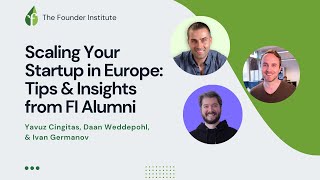
The session is a Founder Institute alumni panel hosted by Ivan Germanov, featuring Dan Berepoul, founder and CEO of Peerby – a hyper‑local sharing marketplace – and Yavuz Çingitaş, co‑founder of InnoDash – an AI‑powered business‑idea validation workspace. The conversation begins with brief introductions, then moves into each founder’s personal journey from corporate roles to entrepreneurship, the specific challenges of building a hyper‑local marketplace (low‑frequency, low‑value items, two‑sided network effects, sustainability positioning) and an AI‑driven B2B product. A large portion of the dialogue focuses on fundraising: the trade‑offs of VC money versus bootstrapping, differences between European and US investors, the importance of choosing supportive investors, and the impact of capital on founder timelines. The panel repeatedly stresses early‑stage priorities – rigorous customer and problem validation, building momentum, staying lean, and leveraging networks (especially the Founder Institute’s mentor ecosystem). Practical advice is given on how to validate ideas beyond one’s personal network (MVPs, landing‑page tests, low‑budget ads, AI‑assisted prototyping) and on what type of startup stage is appropriate for joining the Founder Institute. The founders close by sharing one thing they would do differently if they could start over, highlighting the value of realistic timelines and focusing on product traction before seeking investment. The session ends with logistical notes about post‑panel networking and contact information for Peerby and InnoDash.
Chapters
If I could do it all over again, I would try to do it without VCs, although it's extremely hard as well. You know, it's so nice that the money buys you time to really focus on it and to buy, you know, to get people involved. On the other hand, it also means that you have basically the clock starts ticking the moment you get the VC on board because now they're looking for some kind of return on that investment.
Hello. Hi everyone. Welcome to our Founder Institute alumni panel. Good evening, good morning, good day. I don't know where you are. It's night, it's evening here. It's 8 PM my place. And I hope you're all like, well, you slept well or you're well caffeinated and ready for this panel. My name is Ivan Germanov. I'm part of Founder Institute HQ team. And today I will be your host for this incredible event. In this event, we put you in one room with some of the brightest companies who graduated from Founder Institute core program. So you can learn all the, all the dos and don'ts of the startup life, uh, directly from them, directly from the source. We have two incredible panelists today, uh, and I'm sure you're looking forward to asking them all your questions. Uh, but first, for all of those who are just dropping in and are not too familiar with the Founder Institute program, I just wanted to give you a brief who we are. And we are a global network of startup incubators, accelerators, and investors on a mission to empower early-stage founders. Probably many of you here in this session, in this call, are exactly this. So guys, I know you have a lot of questions to our panelists, and I'm looking forward to give you the stage as soon as we start this session officially. Make sure that you have all your questions sent into the chat. Don't be shy. That's your chance to actually get a first glance of what it is to be an entrepreneur. And yeah, we know about this just because we've been helping entrepreneurs start their journey for 15 years already. More than 8,000 companies have been graduating Founder Institute for that time. And we have a lot of people who made a lot of incredible things. Maybe you've heard of Udemy. There are, of course, other people like the ones that we are going to present to you today. So without further ado, I would like to introduce our panelists today. And I would like to invite, of course, Dan Berepoul from Peerbuy. Welcome, Dan, right here. Hey, good evening.
Good morning or good afternoon, wherever you are in the world.
Indeed.
Good to be here.
So Dan, he's a founder and CEO of Peerbuy. It's a neighborhood sharing platform that helps people borrow and lend everyday items to cut waste. And he advises the Dutch transition agenda for consumer goods and serves on the SIDN Foods Advisory Board. And also he's an author. He might tell us about his book that he wrote. But Dan, you can introduce yourself and give the people a little bit of background check on yourself and who you are.
Yeah, my name is Dan Vittapul. I'm the founder of Peerbee, and Peerbee is a website that lets you borrow and lend household items from others nearby. We were part of Founder Institute in 2011. Quite a while ago already. And yeah, we are one of the very, very few marketplaces of this type that's actually viable, that has critical mass, profitable unit economics, and is financially healthy. And that is, yeah, that's something I'm quite proud of because Doing a startup is hard. Building a marketplace is even harder. And if you have hyper-local constraints in that marketplace, it's near impossible. But we, yeah, managed to do it. And I'm excited to share my learnings. It's been quite a journey. It's been such a journey that I, indeed, I did write a book about it, which is called 99 Reasons to Quit, but Persevering Anyways, the rough translation.
Amazing, amazing title. I definitely would love to read that book or listen to it if there is an audiobook.
I'm afraid it's in Dutch though, but there is an audio. That's the only downside.
Okay, thanks so much for the introduction. And next on the stage, I would like to invite the Yavuz Çingitaş. Yavuz, waiting for you.
Hi everyone.
Hi. Great having you on stage. So he's a co-founder of InnoDash, an AI-powered workspace, sorry, that helps teams design and validate business ideas. So Yavuz, you can take it from here and tell me what your company does, who you are, and give us again a little bit of background on what your entrepreneurial journey has been so far. Sure, sure.
First, I was an employee in first BMW and then Bridgestone for nearly 10 years. I worked for corporates actually. For the last 2 years of 10 years, I was like and worked as an entrepreneur. So it's like, you know, building innovations in a corporate So I have learned lots of, you know, fails, lots of products and so on. And then I first built my first company in 2015. It was innovation consultancy company. And then InnoDash is my 6th startup in 10 years. So I have 2 fails, 4 is still going, and I think For now, it's, it's Yavuz for now.
Yeah, that's great. So serial entrepreneur, 2 fails, 4 successes. That's, that's remarkable. It's like almost a boxing, uh, you know, uh, track record. So yeah, I'm gonna just briefly introduce myself here, guys, so, um, not to stay behind. Uh, I've been also— I'm actually, I'm the third alumni of this program tonight, although I'm hosting. Right now I'm working with Founder Institute. I'm working for the HQ team. I am also co-director for the Central Eastern European program and working with founders on their startups, helping them meet the right people who can actually leverage their journey and their endeavors. I've also been an entrepreneur my whole life. And the last project, unfortunately, that I went through, uh, in Founder Institute with didn't succeed. But that's okay because, uh, I'm the guy who's gonna be the don'ts— don't do that. I can tell you what not to do. And the other two guys, Dan and Yavuz, they're gonna be helping you, um, know what actually to do right and what to, um, to expect in your journey. Because even if you do the right things, sometimes, sometimes the timing is not right. Sometimes the luck is not on your, uh, on your end. Uh, so you don't have— you, you have to stay focused and not quit. And I'm sure Dan is going to be able to, to tell you more about how to do that. Uh, it's okay, guys. Uh, once again, I'm gonna ask you, please don't be shy. Give us your, uh, your questions in our chat so we can forward them to Dan and Yavuz. But first, I would like to start, uh, with a, you know, icebreaker question. I would like to ask Dan, uh, how and what brought you to that, to your entrepreneurial journey? How did it look like in the beginning? And I mean, how did it shape your life? When did you start and how did you start?
Yeah, shall I start with before Peerby then and talk about other companies that I also ran? Because I guess I didn't go into that yet. My background was in ICT, I guess it was called back then. I don't know if it's still a term that's used, information and communication technology. And I started my work as a network engineer. And consultant on— and basically I worked for big corporates, banks and Philips, and I got quite bored with that for a while, after a while, and I wanted to do something more adventurous, so I decided to become a snowboard teacher. And I did the training, but on one of the last days of the training, when I was actually getting ready to to change careers, I broke my leg, and, uh, that was, uh, the end of that snowboarding, uh, instructor, uh, career. Um, and but I had already quit my job, so, uh, I needed to do something else. And, uh, I figured I could go back to the consultancy, uh, job. My, my boss even said, you know, you can, you can always come back. But I, uh, I didn't want to, want to work for a boss anymore. I want to work for myself. So that's where I started. And I, I built my— I started a software development company. And because I was good at building software, one thing I had never really realized up until that point was that you need more than just skills to build in one area to build a company. You also need to be able to sell those products. So I was basically waiting for customers for the first half year and very few turned up. I got some business, but it was quite, quite hard. And then at some point I found a co-founder who actually had a lot of experience in sales and he joined the company. And now we, uh, it was— we had technical skills and sales skills, and that's when things start to take off. And we, yeah, we built this custom software development company and built software for bigger brands like the technical solution behind a lot of kind of marketing-oriented stuff. We invented the first website translation tool for the microsites for Philips. We did a bunch of work for Mitsubishi to connect their connect their, what do you call it, like their auto show information terminals to their central data system and make that work with highly unreliable connections. And that was my first company. So I jumped in quite, in a quite naive way. I didn't realize what it would take, but I found out quite soon that it would take more than just one set of skills to to make that work. And then, well, fast forward to Peerbee, my current company. This idea actually started during quite a dramatic moment in my life. There was a house fire and I went for— at that point, I was a CTO for a software company and I went from leading a completely independent life where I had all my own stuff, my own car, my own house, to kind of losing all of that in one go and having to rely on others. And at first I started asking questions when I noticed how in a way it was a very sort of beautiful experience to be forced to connect with others because you realize how big the willingness of people to support each other is. I thought, well, this is actually why we as humans, why we thrive as a species, not because we're isolated individuals, not because we're lone wolves, but because we are an ecosystem. We support each other and that's why we build societies. That's how we built all of this. That changed my perspective on what I wanted to do. Then I started to think about how can I create more interdependence We've, you know, modern society is sort of isolating us in these little consumer boxes. What would happen if we would be more connected? And then, yeah, they started to ask questions like, if there's a street with 100 lawns, do you really need 100 lawn mowers, one for every house? Or, you know, is there a smarter way to do it? And I think, yeah, there is a smarter way. So that's how we got started. And we started building this idea of people sharing goods so that we don't have to buy things that we only need once or once in a while. We don't have to waste resources and we're able to connect neighbors. And I, again, I think I started in a quite naively. I had no real understanding of how hard it would be to build a hyperlocal marketplace. Place because it's, it's a Venn diagram of challenges. Like, I think the ideal business model is one-sided, has high frequency and high transaction value, right? So like the best, uh, the best business model is probably one where you, where you sell $1 million items, uh, uh, every, uh, every minute, right? Uh, it's gonna It's gonna be good revenue. But if, so if the frequency goes down, you know, if it's not a toothbrush, I think Google likes to say that, you know, that we wanna make products that are toothbrush, something that you use every day. The frequency of use goes down, it's harder. Well, what's the definition of something that you borrow? It's an infrequently used item, 'cause if you need it every day, you're gonna be buying it. So it's low frequency. Then it's not one-sided. It's two-sided, it's a marketplace. So you're not serving one customer, but you're serving two customers. So that's basically two startups and then a third startup, 'cause you have to figure out what the overlapping value proposition is that will make those two groups match and do something together, form a transaction. And then to add to that difficulty, these items are usually quite low, transaction value. So a lot of our members are actually transacting for free. They're not even charging money for— because they're just helping a neighbor. About a third of our transactions are free, and then another third is like, you know, a really friendly price. So it took a lot of, um, uh, puzzle solving to figure out how to take basically the, the, uh, a business model that's impossible on paper and then figure out solutions for each part of that.
Yeah, that's amazing. And actually, not every time that somebody tells you, and that's very important to know, guys, because a lot of times in our program, we see that founders get negative feedback and mentors just don't, sometimes can't get the business model or don't believe it's gonna work. And here you are done like 11, from 2011, up until now, you made it work somehow, just believing that there is a need there and working toward it. So keep in mind that everything that you hear as feedback needs to be taken with a grain of salt. And if you really believe in your idea, you need to push if the market actually allows it, because at some point, if the market does not take it and does not allow it, I mean, you have to face the reality. But You need to test, test, test, test, and iterate. Thanks so much for that sharing, and we'll be coming back to this because it is really interesting. I really want to know about the business model more, but I want to give the stage to Ihabuz now and actually ask him the same question. How did everything start for you with that 6th company? Or maybe you can take us from the start from the first one and then go down the road.
I never recommend that. So first of all, never do that. So I started innovating while I was working as an employee in Bridgestone. So I was responsible for, you know, the innovation department and the customer journey. So we have developed nearly 10 different products in 3 years. So one of them was like, you just order your tires, you know, Bridgestone is a tire manufacturer. So you just order your tire from your computer, it's an e-commerce site, and we just came to your door and mounted at your door. So it was 2012. Yeah, yeah, 2011 or something like that. So it was really a great service that, you know, we just saw that our users don't want to spend time for mounting their tires. You know, tire is not a product like, like, like a car. So you never wanted to go to a tire shop and buy a new tire, you know. So it's not a magical experience. So it's not like buying a car, you know. So, uh, yeah, as I said, we developed lots of different products in there. And then, so I, I saw that our company is not going to spend time and money for innovation. And in 2015, I just resigned and built my first company, which is Goin. Goin is an innovation consultancy company and a venture builder at the same time, because we believe that if you can't do— I mean, if you can't build startups, you can't consult companies to do that. So Goin is basically consulting multinational companies to build new startups, new ventures, and so on. So we, we manage accelerators, internal or external accelerators, and so on. So that's why we learned lots of things in there. We worked with lots of companies, startups, internal startups, I mean entrepreneurs, and so on. That's why we are a venture builder, because, you know, we had lots of problems and needs, problems and needs. And that's the, I think, the magical part of building new products, because if you don't know the problem and you, you couldn't be able to build a great product. So, um, and then we built, before InnoDash actually, we built two different products as well. The first one was an innovation platform which gathers ideas from employees. I still can't believe that corporates are paying for this value proposition. Still, they are paying for this value proposition, gathering ideas from their employees. And we did the same in 2016, '17. So, um, yeah. Lots of banks and conglomerates use our platform, but that's not the thing, you know, it's not going to scale. So then we built another product which was basically— we, we thought that it's going to be a B2C platform, and it's like we have— we had videos and digital canvases in there. So video explain how to do a business model, for example, and it stops somewhere and let you to just fill the business model's problem part, for example. So you just fill that and go up to the video and continue. So it makes you to build that business model step by step. So we thought that it's a B2C platform, but then we saw that companies are very, uh, you know, eager to use that to make their employees more innovative and, you know, entrepreneurial mindset and so on. So 10,000 people use that platform so far, and then we just close that platform and build InnoDash on top of these all the, you know, the problems, needs, fails, and everything. And InnoDash is an AI-based business workspace that helps, you know, product teams, UX teams, service design teams to validate problem, idea, building business models, mind maps, and so on. So now we are here actually, but I had several startups, which was one of them is, was an actually a pregnancy tracking app. So we had 110,000 users in there. So we had 10 million page views. And we failed, really, we failed. So we earned, we earned not bad, but not enough. So at some point, actually, we need to stop spending money on that app. And we stopped, unfortunately. We were 3 co-founders and, you know, one of them didn't want to go further. That's why we just stopped. And the other one was in Australia, another continent. So it, it was a travel app that helps you to build videos on top of your pictures. Actually, you know, pictures have some location information in there and timestamps. So we get these information and we put the pictures on the map and build a video by using these informations. It was 2019, but we failed again because the product is too big actually, because it is at the same time we have the social part and also the video building, video building part. So both are very, you know, very very complicated things. So that's the, that's the, I think, problem we shouldn't go for too. And Bubbleworks Media. Bubbleworks Media is a startup that comes from the GoInVenture, GoInVenture Builder, I mean. So it's a podcast production company. We built that company in Estonia. Uh, it's still operating, by the way, but I'm not managing that startup. I'm just co-founder and kind of investor, I can say that. So Goin, Bubbleworks, and InnoDash is still operating, but I'm 100% working on InnoDash. Maybe we can just talk about it, don't manage two companies at the same time. So it's a subject.
Yeah, watermelons under one pit, it's always a challenge.
Yeah.
So I mean, I definitely see the need for that solution also. I mean, there's a quote I really love from one of our mentors, is like, 70% of the startups fail in the first 6 months of their launch, and the other like 25% fail because of something they did in the first 6 months. So it's very important when you start to actually test your ideas, and the faster you can test, fail, test, fail, test, fail, the faster you're gonna jump over that chasm and get to the right point where you actually find a market fit, which is like the holy grail of entrepreneurship. Market fit is the hardest thing. And hopefully everyone here that is building something will find that. So I'm jumping right in with some of the questions that we already got in the chat. I want to actually say hi to Rafael, to Ines, to Dimitri, to Erdinc, to Osman, John, Pardeep, Fritz. Guys, it's great that you are active in the chat. Please, everyone who has any questions, just shoot them there. So I'm starting with the first questions from Dimitri, who is asking, can you share your experiences working with PCs? The US VCs are famous and loud. EU VCs, the European Union VCs, not so much. And yeah, definitely I would say they're a little bit more conservative. So what is your experience with them? That's a question that you can both answer. It's not directed to anyone particularly.
It's a very broad question. Maybe if you get the chance, uh, uh, add some, uh, some, some angles maybe that you're interested in. But I can try and start off very, very broad. Um, there is, uh, I think European investors are more conservative than American investors, have a smaller appetite for risk. Um, but I do think they are more likely to invest in impact than American investors purely for the sake of impact. So I think American investors are very ROI-driven, very much out there for the commercial gains. I think there are more European investors that will invest in something that they really want to support as a cause, but maybe has, uh, has a smaller likelihood of becoming huge. Um, the— I'm not saying it's easy to convince any investor. Um, I think VCs are— in that sense, you still need to have some sort of, uh, path to, uh, to potentially building a very big business. And, um, I— my personal recommendation would be like, we raised, uh, I think about €6 million in total. If I could do it all over again, I would try to do it without VCs, although it's extremely hard as well. You know, it's so nice that the money buys you time to really focus on it and to buy, you know, to get people involved. On the other hand, it also means that you have You're basically— the clock starts ticking the moment you get the VC on board because now they're looking for some kind of return on that investment. Meaning that if you want to build a long-lasting business, whether it's going to be very big or whether it's just a medium-sized business, there's going to be an expectation there for you to go fast and build it and maybe even shut it down if it's not. Successful fast enough. So I think you have to think very carefully about what you want out of your business. Do you want to build something that is long-lasting? Then taking VC money might, might, might actually be detrimental to that mission. Um, do you want to move fast? Do you enjoy sort of having external incentives push you forward, then maybe it's actually going to be helpful to have that VC money and have people on board that want you to move fast. I'm going to help you do that.
Yeah, I totally agree with that. So, do you really need VCs? So I believe bootstrapping. So, and VCs always ask for ask for more. Actually, if you have 10,000 MRR— I mean monthly recurring revenue— they ask for 50. If you have 50, then they ask for 100,000. So they always ask for more. So if you can do bootstrapping, is the best way, because everybody thinks that the success is, you know, getting investment. But in— I think in reality, success starts with the validation. I mean, if customer pays for your product and if it's scaling, if it's growing, that's the success actually. And then, yeah, and then investors will invest on you for sure because you are scaling, you are growing, and you have a validated business. So it means that they are going to invest you. But if you chase them before validating your product, they are not going to invest.
Or you wouldn't like them to invest because these are going to be very expensive money. The money you get in the beginning are totally capable of breaking your cap table and, you know, just injuring your startup, uh, right before the start. So basically, be very smart about who you pick. And, you know, something I'm adding here is like, you guys have something they want. It's not something they have that you want. I mean, founders need to know that they're equal part of the deal and they're not like just asking, begging for money. These guys are gonna make a lot of money out of you when you're successful. And that's why the next thing that I would say is just pick the right, the right VCs, because not all VCs are equal. Some are like— that might not be very fair on my end, but I call them like deadweight people who are not contributing for your startup. They're just giving you money and waiting for you to deliver. This is not people who you want. You want people who are going to be supporting you, who are going to be making intros, who are going to be helping you with your business. You need those guys that are invested not only with their bills, but with their time and with their contacts. That's great.
To add to that, the spectrum that you're describing to me still sounds ideal because it goes from not doing anything to doing positive stuff. But you also have to think about the spectrum of investors who can actually be detrimental, who can have no idea how startups work and start to ask you to, uh, to do types of reporting that will cost you hours every week that are useless, or that have no idea about strategy and will start pushing you to do the wrong things. Or investors that are unreliable and don't keep their promises, promise to keep a certain amount of money, put a certain amount of money in and don't deliver. Or yeah, you can have some really bad investors as well. So I'm already quite happy with the spectrum of investors that just don't do that much, but are other than that are good folks.
Yeah, that works too. That works too. I mean, if they can help, they should not— at least they should not be standing in the way. I mean, that's in sports, that's in startups, that's in everything that we actually do. So I think there's another question. I think we answered the second part of the question of Fritz, but I would like to address the first part. Fritz is asking particularly for Dan. What are some challenges you faced as a founder of a sustainability marketplace and how did you solve them? Like you started answering that question and that's a very good question. I want to go back to it and elaborate a bit on it.
Yes, challenges, many, 99 as my book is titled. Gosh. You know, the first thing I'll say, and it's a bit cynical, I'm afraid, most people do not put their money where their mouth is. So there's a lot of talk about sustainability. People are, you know, if you ask them, do you want sustainability, they'll say yes. So will investors write entire theses about you know, what, how they support sustainability and sharing and all this stuff. But when, uh, it comes to actually then building that company, I think there's very few, few that don't just look at return on investment and are, are really following that, um, that, that, that, like, that, that mission that they, that they put on their website. And, um, in a way, the same is true for consumers. I think there's a small group of consumers that will actually have their, uh, let their guide their, their buying decisions based on sustainability. I think most consumers do not. Um, so I think that means that if you, if you're building a sustainable company, you need to build a product that competes with what's out there, is better than what's out there, and in addition be sustainable, but it's almost like it's a bonus. So you still— it's— I care very much about having purpose as a founder. Like, I want to work on something that I think has meaning in the world and is a net positive for the world. But do— yeah, expect that things will be harder because you're adding an extra hoop for yourself to, to jump through that is not going to convince that many investors and consumers to actually buy your product. So in a way, you're almost doing it— you're doing it for yourself and for the world, but the market is not. I think, I think the market is not the, uh, um, the same as we— as we are human beings, right? And the buying decisions that we make, we make as consumers. But we are more than just consumers. We have desires, we have wishes and dreams that are not translated into actual market behavior. And I think we often sort of put that all into one, like what the consumer decides to do with their money is what we want for the world. But I think it's It's more complicated than that, you know. If everything we did was a market decision, then I don't think we would be having kids or starting relationships or thinking about the long term, you know. It's all— yeah, there's more than that. But yeah, in the market, sustainability means very little, I'm afraid. That's my negative, slightly cynical view on it.
Yeah, definitely. I can attest to that. Like, kids are not the most economical decision of them all, but yet again, I mean, boy, is that worth it. For sure, for sure. So let's continue. I hope you got the answer to your question, uh, Fritz. I'm going to the next questions. So, uh, Ahad Khan is asking— Ahad Khan, I hope you're— I am not butchering the name, sorry, sorry, man, if I'm doing that. But what are the most important things to focus on early startup days? That's a very broad question again, but it's important one. If you can distill that, I'm gonna definitely steal it, publish it everywhere I can, because that's a $1 million question.
You want to take it first?
Yeah, sure, sure, sure. I think Um, I'll go with the validation again. So, um, the early stage is all about validation. So validating the problem, the customer, and building the idea on top of these. So I think that's the only thing you can— you need to just focus on.
Yeah, customer and validation.
Yeah, exactly.
Customer development.
Done.
What's your take on this?
Yeah, I, I, I agree with that one. I'm, uh, I'm reevaluating this question, and I— if I can make that broader, I would say momentum. And so what, what are things that can get you or keep you moving? And what, um, I think customer validation is a huge one. That is such a great signal that you're on the right track. So gather signals and information and things that can get you moving and keep you moving. Um, the— and everything, everything compared to, like, is there a customer in the— out there in the world that wants your product? Everything else is sort of less important. But of course, you're more than just an Excel spreadsheet that needs to tick the boxes. There's also the how do you keep moving as a founder, right?
How do you—
what motivates you? And I— there's— so sometimes there can be more than just that validation, but I'm thinking there's so other kinds of momentum, like finding, working on exciting problems, right? Finding the type of work inside of your company that excites you. Yeah, the question was about prioritization, right?
What's the most important things to focus on in early startup days?
I think, I think the, uh, oftentimes as a founder, maybe the, um, we try to do, to build too many things on an assumption, right? And that can be, uh, uh, anything that you're building without validation. And maybe it's not just a product, it's also the, the company. Like, I think he sort of try to keep it lean and mean so that you can keep moving. Sometimes people will kind of stop moving because they feel like, I need investment first because I'm going to need to build an app. And then when I have an app, I can validate. Those are often sort of fake hurdles. Like, that is probably not the right order of things. Probably you want to somehow validate that there is a customer and, and build some sort of very simple product with AI and then raise money off of the, the traction that you build with that. And that's— so it's, it's a— I think it's all about how do you keep moving. And if you think there's a big obstacle right now that is stopping you from going ahead and, and you think it's outside of you, come try to come up with, with ways where where this obstacle is something that you can achieve because there's almost always a way that you can do it, that you can validate it. Any company can basically run with a phone and a pen and a piece of paper and you're ready to go. That's your first marketplace. That's the platform. That's true.
That's true. So true. And I would take the liberty of adding on top of this, I think that one of the most important things is get next to the right people and get surrounded by the right people. Be very proactive into searching those connections and those people. That's, that's where actually Founder Institute shines, that we have like vast network of mentors and people. But what I'm seeing with some of the companies graduating is they are not proactive, even though they know we have the resources to help them. They just don't reach out, which is something that I actively encourage all the companies going through our program. Like, guys, if you don't ask for help, nobody's going to be able to do it for you. Nobody's going to come and take your hand. So reaching for the right people. And, you know, in our ecosystems, it's like everyone is like 2, 3 phone calls away. So you can get to a lot of important decision makers if you are proactive enough. So I think when you are still green, when you're still early in your journey, that's what you have to do. Try to be everywhere, know everyone, and at some point you're going to be acquainted with the right person. So thanks so much, guys, for the answers. There's another question here that I would like to— it's a more specific question from John Gibbons, uh, he's asking, we have an operational software as a service MVP model at the moment and needs to fully develop this product for the market in like a year and a half. What is your advice regards investors, but non-VCs, probably angel investors, and getting them on board right now? How to get on board investors when you are in that stage, uh, before the market actually is being approached?
Um, maybe I can start. I don't know if it is possible, so I couldn't do that. So even if I have 10,000 MRR operating, uh, SaaS platform and we have our own rack and we are fine-tuning our own model, but still struggling to get VCs or non-VCs or angels and so on. So I don't know if it is possible. I think some can do by using their network. So the reason I joined FI is try to find more network in Europe actually. Because I born in Turkey and lived for 38 years there, and then I moved to London and I've been living there for last 6, 7 years. So, um, I have no background in Europe, so that's why FI is a very good point for me. But reaching VCs without, uh, revenue, I don't know if it's possible. So maybe Dan can, because he raised a lot.
So yeah, there's different, uh, there have been different times in the history of fundraising, and we have raised quite a bit of money pre-revenue, uh, but a long time ago, and I don't know if the markets for that still exists. So, um, maybe You say you have an MVP, um, so I'm— that makes me very curious. Like, are you able to find customers? Are you able to prove traction? Are people using it? Is that something that you can already show to VCs that is some— that, that the promise that you're making is actually true? I think if you're in a stage, in a phase right now, let's say that you have an MVP in the market, but it's not actually working yet for customers, and you're saying like, I need 12 to 15 months before customers will actually start to like it, I think that as a VC, I would not invest in that, probably. That because that, that then the— I think the only money you're going to be able to raise if you're, if if you're— if you have a product that is pre-traction, pre-revenue, um, like that, is maybe if you have a reputation as a successful founder, maybe you've already done it. I think then you, you might be able to raise some money. But yeah, you need to collect signals. And so it's hard to gauge from your description exactly like what, what, what you have in place. But yeah, find signals, early customers, customers use? How— what's the usage? Is there stickiness? Are people using it often? Is there some kind of signal that you can, can get out of the, the— that your MVP that you can use to show this has huge potential, uh, you should be investing? That, that would be— yeah, I think if, if there's a chance to get VC funding at this stage, then that's it. But it depends on what your platform is. It's hard for me to say exactly what you are, what's there. I do say, I think oftentimes when you look very closely, there are, sometimes you need to dig to find that metric. Sometimes there is, maybe it's not the revenue, but maybe it's the engagement, or maybe it's not the engagement, but it's the abnormal high conversion to, to sign up for people that land on your page. So find that one thing that really sticks out as an indicator of success and try to build more and more of those indicators. So if your theory right now is like, I'm just gonna continue building and in 15 months then I will have something that my customers want, that to me sounds like a very risky approach, but maybe that's not what you're, what you're doing. But I would say collect as many signals, try to collect signals of success every week if you can, because you have a platform out there now. You can start working with customers, get testimonials, you know, get 6 customers that say, wow, if they manage to do this thing that they're promising in the next 15 months, I'll be paying because I need it. That could also be signal.
Yeah, they need to stay shut up and take my money, right? Yeah, yeah.
So yeah, guys, I just want to let you know that we need— within 10 minutes we're going to be closing the session, but afterwards there's going to be a networking, uh, in the main— in the main stage. So you can guys stay, mingle together, continue the conversation, and, uh, I hope that you— and Don are I'm not going to be able to stay and answer all the questions because there, as I see now, there are a lot of questions that haven't been answered yet. I got one that's, that's very, uh, it was very interesting here, and it's like, uh, as a successful alumni of FI, what is your recommendation for someone, uh, to join the new cohort? Should they already have a working business model or just an idea or already having early revenue, what's your recommendation there? That's from Rania, I think. Rania and Ginka.
Yeah, so it's a long time ago that we participated in the program and times have changed. So I think it was years until before we actually started applying our first business model. We were just— the back when we were, uh, where I started, there were still some VCs who said, you know, just, just grow and, and get as many people on board as you can, and then we'll figure out the model. Uh, I think that is, uh, no longer, uh, the case. Um, but do you have to have a working business model to join the program? No, I, I don't think so. I think that's something you can figure out during the And just an idea to me sounds great. In fact, I think the strongest way maybe to start a startup is not to fall in love with an idea, but to fall in love with the idea of starting a company and then doing rigorous work to figure out how you're going to apply that desire to build a company. Because most companies take a lot of pivoting and changing your idea, and you're gonna have to throw out a lot of work and a lot of ideas. So it might be ideal to just start with nothing but the desire just to start a company.
Yeah, if you have like 10,000 MRR, maybe FI is not suitable for you. But if you are in an early stage, it would be better, I think, because they make you to build everything starting from the problem persona and everything. And maybe you need to ask your reason to join FI. So my reason was building a network. So I think it was the right decision at that time. So it was 2020, by the way, and my alumni. So I think you need to ask yourself what is the reason to join FI, and yeah, you need to decide.
Yeah, thanks so much for, for the answers, guys. Uh, there's another question here, and I think it's, it's a very interesting one. That's from Alberto. Uh, when you have some ideas, how do you validate them beyond your private network? When you have an idea, how do you validate it beyond your private network? How do you convince others to get involved in the validation process and provide useful feedback? I find that cold emails simply don't work. So what is your suggestions? What are your suggestions?
If cold emails don't work, that could also be a signal, right? That means that potentially a a stranger that is not your friend is not so eager to engage with the solution that you're presenting. I would, but yeah, if you're convinced that this is something that people are going to enjoy, but you just need to get to the right connections and try to see if your own network can connect you to that next step. Or join Founder Institute because you'll be exposed to a lot of people, a lot of mentors out there that can make amazing introductions if you have something that they think could be of value to the network that they have. Yeah, I don't know if that's an answer.
Yeah, cold emails are not a good way to validate an idea. So it's the best way, you know, building an MVP. So, but nowadays you don't need to build an MVP. You can build the, the, you know, the initial version of your product actually by using like Bolt or Lovable, that kind of, you know, AI-based development, uh, AIs. So, um, I really recommend you to build a first version of your product and try to get some users, or even try to get some emails from them to being a first user of your product. So that's the initial validation of your idea, uh, and then you need to maybe get insights from them. So we always do that. So we first build the first MVP, like just, just the landing page, get emails and send them the beta test and get feedback from them to understand what they need, what's their problem, and is the solution fit for their problem. And then build the version 0.1, for example. So that's the way to understand if your idea is going to work or not. That's my experience.
Yeah, and you can go even more lean depending on how big your product is and just create that landing page where you explain what the product is plus the signup page and when people sign up. And the signup is just to join the waiting list. That can be your validation. The challenge here obviously is still how do you get those people on the site? Sometimes something simple that we would do is reserve a little bit of Google search budget and advertise your value proposition. So have that landing page where you explain what it does and have put a little bit of budget into trying to convert people. You can even test different value propositions. On Google Ads and see what drives the most traffic to your website. You have the statistics in Google Ads to see what is the cheapest cost per click and is driving most people to my site. So that's the initial message or signal that you can already get on that. But yeah, AI is changing a lot. You can build a lot very quickly. In the olden days, the advice was don't build, first validate. But now with AI, you can do so much so quickly. So yeah.
True. For so much, for so less money. Sorry for interrupting. It's like you can sell your TV and be an entrepreneur. It's not like selling your car or apartment. Yeah. Yeah. Thanks so much, guys. So we're going toward the end of this panel. There's just one question I would like to ask you both and I would really love if you can keep it short. And I know that that's a hard constraint because there's so much to say, but what's the one thing that you would do differently if you were able to start over right now?
Mine is short. Maybe I can just start. Just don't focus on the investment part. Just focus your product, traction and lead.
That's great, great answer. Thanks so much.
Thank you. If I could do it all over again— oh, such a hard question because I made a million mistakes, but, uh, here I am. So, so the mistakes also taught me a lot, um, and maybe The first thing that came to mind for me is expect it to take a lot longer than you think it's going to take. But then I don't know if I want to start with that idea because then maybe you don't start at all. I remember that when I joined an accelerator, they said, do you realize that you'll be spending the next 3 years of your life on this? I was like, oh my God, the next 3 years? And now I'm 14 years in and I'm like, that 3 years was a clear understatement. But don't scare yourself. Maybe it's good to be naive sometimes and just do and learn. Do and learn. That's the only thing you need to become. You're an entrepreneur the day you start doing that.
Yeah, a 10-year overnight success. Exactly, yeah, sure, but it's worth it, always worth it. It's okay, guys, thank you so much for being with us in this session. Thanks everyone who asks the questions. I'm really sorry that we didn't have the time to answer all the questions. Hey, stay with us for the networking after this panel is over. I hope that Dan and Yavuz are going to be able to join briefly so they can answer question, uh, personally. Thank you so much. If you want to learn more about Founder Institute, about our program, about entrepreneurship, just visit fi.co and learn more about how you can join on or how you can actually leverage your entrepreneurial journey even with our free resources. Dan, where can people find you and eventually your business and maybe, I don't know if they're in your area, share some tools like for maybe someone is renovating their home and they're in desperate need of a drill or I don't know.
Sure. Then they should definitely go to peerby.com, P-E-E-R-B-Y.com for borrowing and lending items. And yeah, they can find me on LinkedIn if there's anything else.
Yeah, thanks so much. Yavuz?
Yeah, and also we are perk for FI Founders alumni, so you can just search for InnoDash in the platform, inno-dash.com. Yeah, you can validate your product idea, problem, everything. So please be my guest. Yeah.
As soon as you guys graduate from Founder Institute, just find, you know, Dash in the alumni dashboard and voilà, you got it. Yeah. Okay, thank you so much for joining us. Have a great evening and I hope you have a great networking afterwards. Good night, or I don't know, good day depending on where you are, and I hope to see you next time in our panels. Bye-bye everyone.
Bye.
Bye-bye.










