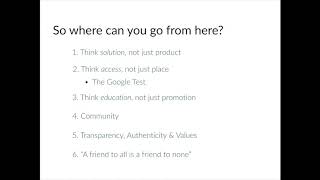
When you try to appeal to everyone, you appeal to no one. Pick your early adopters, understand what they need, and build your message for them first. You can expand later, but starting narrow is how you build something that actually resonates.
Chapters
The last one is one that I love to talk about, love to teach. And this is a saying, I'm sure you've heard this saying, a friend to all is a friend to none. We have a marketing saying that's very similar, and that is, if you market to all, you market to none. So if you're kind of sitting here in this session, you're like, okay, yes, I got it. I can educate my people, I understand my customers, I can be clear and transparent about my values, but I don't know who exactly to market to. and how do I actually hone in on my target audience, my ideal customer? Um, this saying I love to teach because in marketing and branding, and like, I've even seen this at global organizations that I've worked with and big brands, you cannot effectively market to everyone equally at the same time, right? Of all the brands, projects, and founders I've had, I've had the opportunity to work with over the past years, I would say this is the biggest mistake that I see. That's being made. And basically what I mean by that is even though your product or service could be relevant to everyone doesn't mean it should be relevant to everyone. And this is usually the million-dollar question when building a brand is who does the brand serve? So, and if the brand serves multiple, multiple customer groups, how do those groups relate to each other and what is unique and different about them, right? So in general, you want to know who your early adopters are, right? Because if you market to all, you end up marketing to none, right? A friend to all is a friend to none. And it feels very natural for founders to cast a super wide net and try to get as many customers as possible, when in fact, if you can narrow, narrow, narrow, narrow focus your customer bases and really kind of hone in on that ideal customer group, to get you started, that's the best thing that you can do, definitely during COVID because everyone wants to know kind of where you stand on these issues, sociopolitical issues right now, and definitely here in the US. I'm certain that's not the case globally, but in the US that is the case right now. Right, customers want to feel like they belong in general, and that's relevant cross-borders, right? So it feels very like, ah, it feels very scary to be able to super hyperfocus your brand into one area or one customer segment. But by doing, if you don't do that and you end up trying to market to everybody at the same time, you end up diluting your messaging because you're trying to communicate too many, too many different types of values to too many different types of customers. Right? So the more, the more you narrow your focus, the better you'll be in positioning your brand. And again, we can do a whole class just on this, but in general, Try to narrow focus as much as possible. It really goes back to those core foundations I talked about earlier, which is value and understanding your customer's needs. So in order for you to build a brand that's really going to resonate and be ready to scale and really provide the maximum output possible for your business, you really have to get that core customer piece nailed. And that doesn't mean that you can't start to serve a broader customer base moving forward. That's not that at all, right? But figuring out who those early adopters are in your business is going to be really important moving forward.